
 By
Contents
- RAG uses your own documents, not training examples, so try it before fine-tuning a model.
- Fine-tuning changes style, tone, or format, and needs hundreds to a few thousand curated input-output examples.
- Hold back a portion of your labeled data as a test set before training anything.
- Clean, deduplicate, and remove personal data before any document enters your AI app’s knowledge base.
Key Takeaways
A custom AI app needs different data depending on how you build it. Your data needs depend on the approach you choose. Retrieval-Augmented Generation (RAG) needs documents, fine-tuning needs labeled examples, and API-only apps need none.
Teams often pick a model first and look at their data second. That order wastes budget, because your approach decides which data you must prepare. Data preparation can take 25% to 40% of budget, per our AI development cost guide.
This guide covers the data each approach needs and how much of it. It also explains how to prepare that data. Our AI consulting services team has scoped such builds since 2010.
1. What Data You Need to Build a Custom AI App, by Type
A custom AI app draws on four types of data, and your approach determines which ones you need to provide. Most apps mix structured data, like tables and transactions, with unstructured data, like documents, images, and chat logs. Knowing which type carries your use case tells you where preparation effort will go.
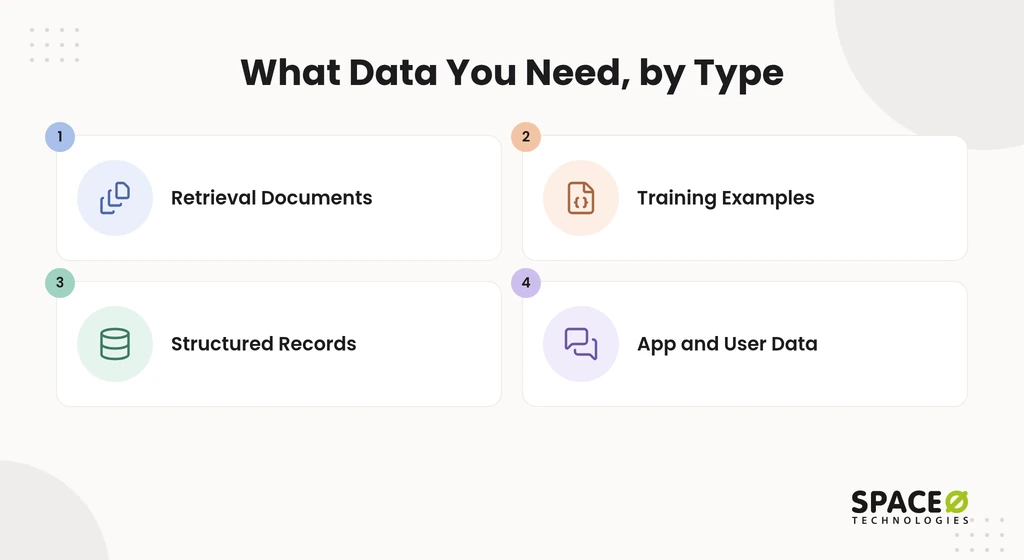
- Retrieval documents: PDFs, wikis, FAQs, support tickets, and database records that a RAG system searches when a user asks a question.
- Training examples: Labeled input-output pairs, usually in JSON or JSONL, that fine-tuning uses to change how a model responds.
- Structured records: Historical tables, transactions, and time series that traditional machine learning models learn patterns from.
- App and user data: Form inputs, API feeds, chat history, and system prompts that the app handles while it runs.
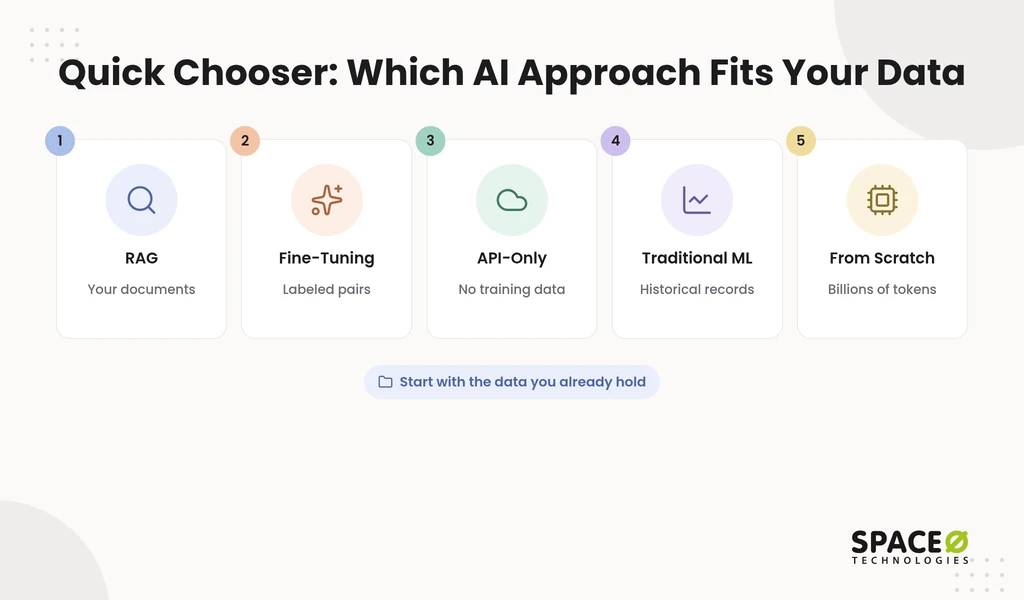
The data you already have usually points to the right approach, and sound data management keeps it usable for AI app development. The chooser below compares the approaches side by side.
2. Quick Chooser: Which AI Approach Fits Your Data
The fastest way to scope your data needs is to match your goal to one of five approaches. Each approach differs in the data you supply, how much you need, and how much preparation and upkeep it takes.
| Approach | Data you supply | How much | Prep effort | Privacy exposure | Ongoing upkeep | Best for |
|---|---|---|---|---|---|---|
| RAG | Your documents, records, and metadata | No training examples | Medium: cleaning, chunking, metadata | Retrieved passages reach the model at query time | Refresh documents as they change | Answers grounded in company knowledge |
| Fine-tuning | Labeled input-output pairs (JSON/JSONL) | Hundreds to a few thousand pairs | High: curation and labeling | Examples are uploaded for tuning | Rebuild the dataset when behavior must change | Consistent style, tone, or format |
| API-only | System prompts and live user input | None | Low | User inputs reach the API provider | Update prompts as models change | General drafting and summarizing |
| Traditional machine learning | Labeled historical records and time series | Scales with features and seasonality | High: cleaning and feature work | Records stay in your own pipeline | Retrain as data shifts | Forecasting and fraud detection |
| Training from scratch | Large text corpora | Billions of tokens | Very high | Depends on corpus sources | Continuous retraining | Companies whose product is the model |
For most business apps, the decision comes down to the first three rows. The next sections cover each approach in the same order.
3. Data for Retrieval-Augmented Generation (RAG)
RAG needs your own documents as a knowledge base, not training examples. It points a pre-trained model at your content instead of retraining it. A base model knows nothing about your internal policies, products, or customers. RAG supplies that knowledge at runtime.
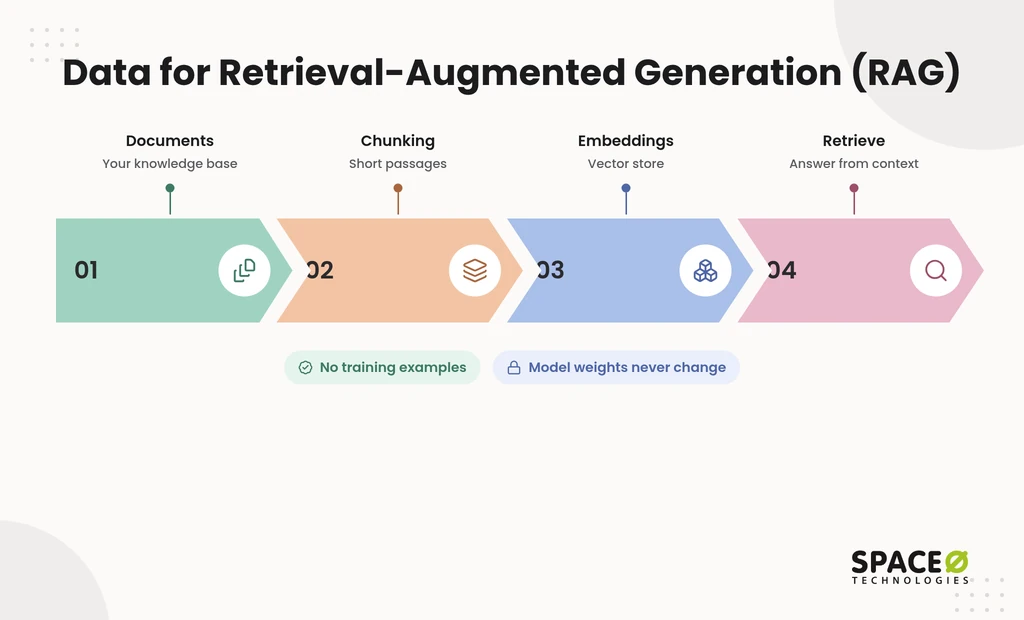
- Data needed: Zero training examples. You supply the internal documents, wikis, PDFs, FAQs, tickets, and database records the app must answer from. You also add metadata such as date, owner, and access level so retrieval can filter results.
- How it works: Documents are split into short passages, a step called chunking. Each chunk becomes an embedding, a numeric representation of meaning. Embeddings are stored in a vector database such as Pinecone, Milvus, or Chroma. At query time, the app retrieves the best chunks. It then passes them to a model such as GPT, Claude, Gemini, or Llama. The model’s weights never change.
- Best for: Internal assistants, help-center bots, and policy lookup tools. Any AI chatbot that must answer from company knowledge fits here.
Training is a poor way to add facts to a model. RAG puts the right context in front of it instead. When your problem is about facts, start here. When it is about behavior, fine-tuning is the next option.
4. Data for Fine-Tuning
Fine-tuning needs cleaned, labeled input-output pairs, typically hundreds to a few thousand. It changes how a model behaves, not what it knows. Fine-tuning steers style, tone, or format. It is not a reliable way to teach the model new facts.
- Data needed: Curated examples, each pairing a real input with the exact output you want. These are formatted as JSON or JSONL, and a separate validation set is held back.
- How it works: The examples adjust a pre-trained model’s responses. Methods such as LoRA train a small adapter file instead of the full model, keeping compute and storage lower.
- Best for: Fixed output formats, a consistent brand voice, and classification or routing tasks that prompts alone cannot hold steady.
Try prompt engineering and RAG before you fine-tune, because both need far less data. If you need a specialized voice or format, our generative AI consulting team can judge whether fine-tuning pays off. Some apps need neither approach.
5. API-Only Apps: When You Need No Training Data
An API-only AI app needs no training data, because it calls a foundation model directly and shapes output with prompts. This is the lightest path when general model knowledge is enough for the task.
- Data needed: None for training. You supply system prompts, guardrails, and the user’s live input at runtime.
- How it works: The app sends each request to a model API, and prompts control the reply’s tone, structure, and limits. Enterprise and business tiers of major model APIs generally do not train on customer data by default. Confirm this in each provider’s data terms before launch.
- Best for: Drafting, summarizing, and extraction tasks that do not depend on private company knowledge.
API-only apps are quick to launch, but they cannot answer from your internal records. Our comparison of custom AI vs. off-the-shelf tools explains when that limit justifies a custom build.
6. Traditional Machine Learning, Forecasting, and Computer Vision
Traditional machine learning, forecasting, and computer vision models need your own labeled historical data. You train each one on your records. These approaches suit prediction and detection tasks that language models do not handle well.
- Data needed: Labeled records with enough rows per feature, time series spanning a full seasonal cycle, or labeled images for each class. Section 8 gives the volumes.
- How it works: The model learns patterns, is validated on held-out records, and is retrained as conditions change.
- Best for: Demand forecasting, fraud detection, and visual defect detection in operations.
These models depend most on data quality, because no pre-trained knowledge backs them up. Experienced machine learning engineers can judge whether your records are ready. The most data-hungry option of all comes next.
7. Training a Model From Scratch
Training a model from scratch needs billions of tokens of text, and almost no business needs to do it. Building on an existing foundation model is cheaper, faster, and usually more accurate for business tasks.
- Data needed: Very large text corpora, plus the compute and engineering to process them.
- How it works: Every model weight is learned from your corpus, with no pre-trained starting point.
- Best for: Organizations whose core product is the model itself.
For nearly every custom AI app, RAG, fine-tuning, or an API covers the need. Compare an open-source LLM vs. a proprietary API before you consider anything heavier. Your next question is volume.
Find Out Which Approach Fits Your Data
Share your use case and the documents, records, or examples you already hold. Our AI consultants recommend RAG, fine-tuning, or API-only and outline the preparation work.

How Much Training Data Is Needed for a Business AI App?
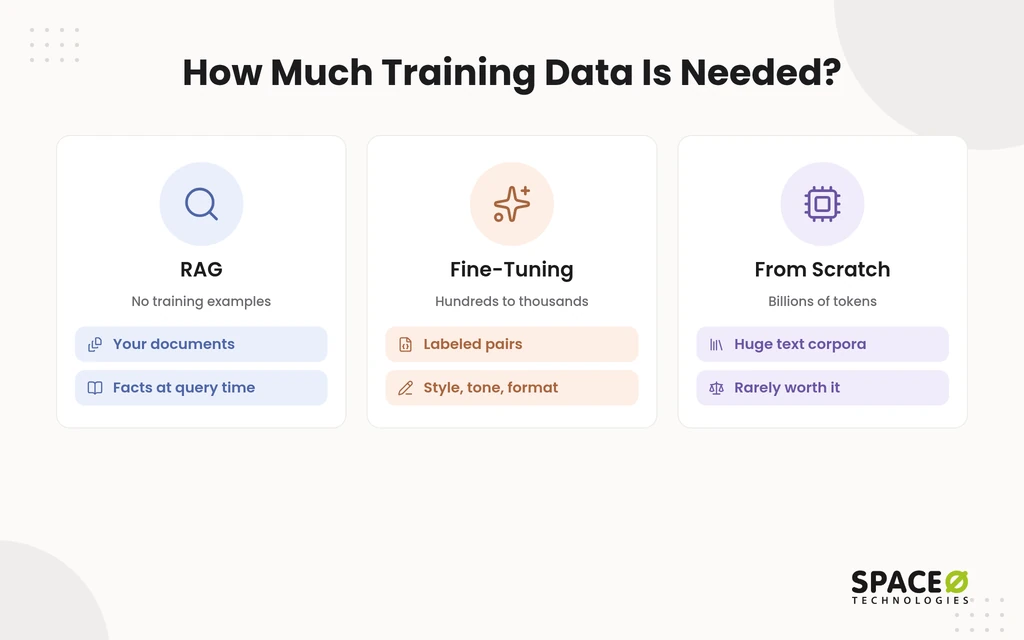
How much training data a business AI app needs depends on the approach. RAG needs no training examples, fine-tuning needs hundreds to a few thousand, and custom models need far more. The table below gives each approach’s volume and the evidence behind it.
| Approach | How much data | Evidence or rule of thumb |
|---|---|---|
| RAG | No training examples, only the documents the app must answer from. | Your document set sets the volume, not a training count. |
| Fine-tuning | Hundreds to a few thousand curated input-output pairs. | The LIMA study fine-tuned a model on 1,000 carefully curated examples. |
| Traditional machine learning (tabular) | Many more data points than features, so each feature has plenty of rows to learn from. | Rule of thumb, not a fixed standard. |
| Time series | Data covering at least one full seasonal cycle, plus extra observations held back as a test set. | Rule of thumb, not a fixed standard. |
| Computer vision | No reliable single figure. Published sizes vary widely by task and conflict with each other. | Size from your task and test results. |
| Training from scratch | Billions of tokens, far more than any other approach. | Rarely worth it for a business app. |
Clean, accurately labeled data beats a larger noisy dataset, because a model is only as good as its inputs. Engineers call this “garbage in, garbage out.” A smaller dataset with accurate labels can outperform a larger one full of errors.
The Rule of 10 counts features, not model parameters, so plan on roughly ten examples per feature. Synthetic data can fill gaps where real examples are scarce, but test the model on real inputs. Volume covers training data; the app also handles a second category of data while it runs.
App and User Data Your AI App Runs On
Every AI app also handles operational data at runtime, separate from anything used to train or ground the model. Plan for this data early, because it affects storage, security, and cost.
- User inputs: Form entries, uploaded files, and questions that users submit through the app.
- External data: Live feeds from APIs, such as order status, inventory, or account records.
- Chat history: Prior turns of a conversation, trimmed to fit the model’s token limits.
- System prompts and guardrails: Instructions that set the app’s role, boundaries, and refusal rules.
- Interaction logs: Records of requests and responses, used for monitoring and future improvement.
Runtime data often holds the most sensitive information in the system. That makes preparation and privacy controls part of the build, not an afterthought. Live feeds from your systems also depend on solid API and third-party integration.
Data Preparation and Quality Checklist
Data readiness means your data is collected, cleaned, labeled, and split before any model sees it. Skipping a step usually shows up later as poor answers or failed tests. Treat these steps as the first stage when you build an AI app.
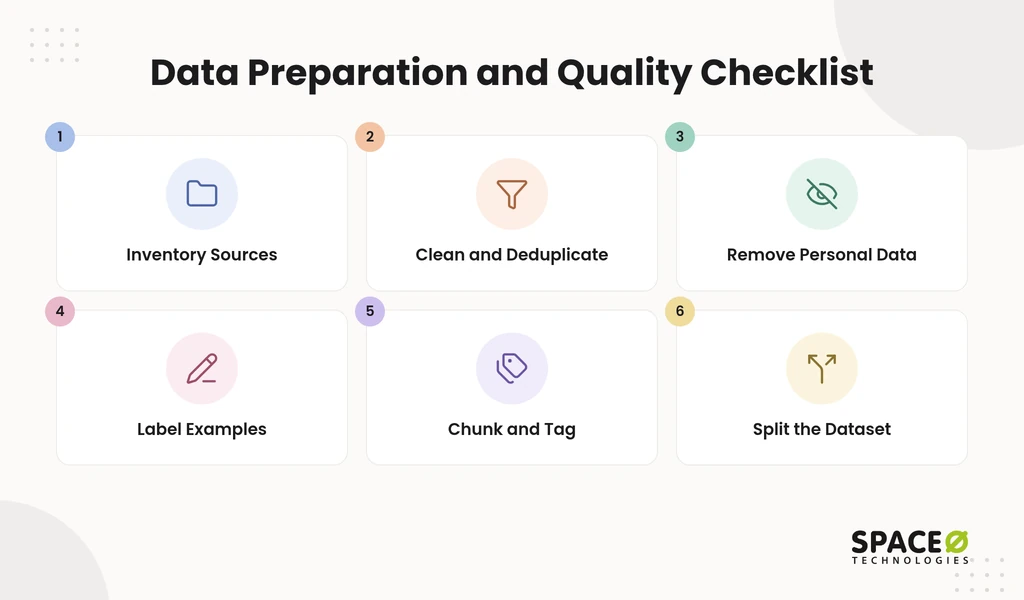
- Inventory sources: List every system that holds relevant documents, records, or examples.
- Clean and deduplicate: Remove outdated, duplicate, and conflicting records.
- Remove personal data: Mask or strip personally identifiable information (PII) the app does not need.
- Label examples: Pair inputs with correct outputs for fine-tuning or supervised machine learning.
- Chunk and tag: Split documents into passages and add metadata for retrieval filtering.
- Split the dataset: Separate training, validation, and test sets, and hold back a portion of the data for testing.
A finished checklist gives you a dataset you can measure against. The next step is deciding how to measure it.
Building an Evaluation Set Before Launch
An evaluation set is a fixed collection of real inputs with known good answers, used to test every release. Without one, teams cannot tell whether a prompt change, new document, or model upgrade helped or hurt.
Build the set from real user questions, including common requests and known edge cases. Grade each expected answer with your domain experts. Rerun the full set on every change, and add new cases whenever production reveals a failure.
An evaluation set turns quality into a number you can track. Regulated data adds a second layer of checks.
Privacy and Compliance for US Business Data
Any custom AI app that touches personal data must meet the privacy laws that govern it. Check this before the data reaches a model. The rules depend on whose data you hold and where they live.
- HIPAA: Protected health information falls under the HIPAA Privacy Rule, which requires safeguards on its use and sharing.
- CCPA: Personal information about California consumers falls under the California Consumer Privacy Act, which gives users rights over its use.
- GDPR: GDPR covers personal data about people in the European Union, even if your business is US-based.
In healthcare, fintech, and insurance, two concerns often decide between RAG and fine-tuning. The first is keeping client data out of model training. The second is keeping a person in the loop on high-stakes outputs. RAG keeps sensitive records in your own store, where access controls apply, while fine-tuning bakes patterns into model weights. A HIPAA-compliant build also needs encryption, access logging, and human review for consequential decisions.
Compliance work is a real cost line, and it sits inside the larger data preparation budget.
What Data Preparation Costs and What the Spend Covers
Data preparation is the highest cost in most AI builds because it combines six separate jobs. That share, 25% to 40% of the total project budget, covers the following work:
- Cleaning: Fixing errors, standardizing formats, and removing duplicates across source systems.
- Labeling: Writing or reviewing correct outputs for each training example.
- Chunking: Splitting documents into retrievable passages that keep their meaning.
- Metadata: Tagging content with dates, owners, and permissions for filtered retrieval.
- PII removal: Masking personal data to meet the privacy obligations covered in section 12.
- Evaluation-set building: Collecting real inputs and grading their expected answers.
The effort shifts by approach. RAG projects concentrate on cleaning, chunking, and metadata, while fine-tuning and traditional machine learning concentrate on labeling. Infrastructure and API usage add to the total as well.
After launch, maintenance typically costs 15% to 25% of the original development cost every year.
Knowing where the money goes lets you budget for data before you commit to a model.
How Space-O Technologies Helps You Prepare Data for AI
Space-O Technologies scopes your data before your build, so the approach you choose matches the data you actually hold. Since 2010, we have served 1,200+ clients and delivered 300+ software solutions, with 97% client retention and 140+ in-house developers.
We sign an NDA before every project starts. All source code, data, and IP built during the project transfer to you at completion. Every production model gets an evaluation suite covering accuracy, hallucination rate, bias, latency, and cost, plus continuous monitoring. Outputs that fall below an acceptable confidence threshold go to human-review checkpoints.
You can work with us as a Dedicated Team, on Time & Material, at Fixed Cost, or through Staff Augmentation. Our teams work from Mesa (Arizona), Brampton (Ontario), and Ahmedabad (India). Tell us your use case and the data you hold, and we will map the right approach with you.
Frequently Asked Questions
Do I need training data to build a chatbot on my company documents?
No. A chatbot answering from company documents usually uses RAG, which retrieves passages at query time instead of training the model. You supply clean, current documents with metadata. Training examples become necessary only if the chatbot must also hold a strict format or voice that prompts cannot enforce.
How many examples should I start with when fine-tuning?
Start with a few hundred high-quality pairs and measure results against your evaluation set before adding more. Add examples only where the model still fails. Invest in label quality before you invest in volume.
Does an AI API provider train on my business data?
It depends on the plan you are on. Business tiers usually exclude your data from training, but consumer plans can follow different terms. Confirm the provider’s data policy first. Keep regulated data, such as protected health information, out of prompts until you do.
Can synthetic data replace real data for a custom AI app?
No. Synthetic data can supplement real data, but it should not replace it. Use synthetic examples to cover rare cases or balance underrepresented classes. Always test on real inputs, because a model trained only on synthetic data can fail on real production traffic.
Is structured or unstructured data better for a custom AI app?
Neither is better; the use case decides. Forecasting and fraud detection depend on structured records such as transactions. Document assistants depend on unstructured text such as PDFs and tickets. Most business AI apps combine both, using structured fields to filter or enrich what retrieval returns.
What if my business data is incomplete or inconsistent?
Run a data readiness review before you choose an approach. Inconsistent records need cleaning, deduplication, and standard formats first. RAG can launch on a smaller, well-maintained document set, while custom models need consistent labeled history. Gaps found early are easier to plan around than gaps found after launch.
Does data preparation cost more than the AI model itself?
It can, and the two costs behave differently. API model access is usually a usage-based line item that scales with traffic. Cleaning, labeling, chunking, and evaluation are engineering work that recurs whenever your data changes. As a planning rule, reserve 25% to 40% of the budget for data preparation. Budget yearly maintenance on top.
What can RAG do that fine-tuning cannot?
RAG answers from your current documents, and you update it by refreshing those documents. Fine-tuning changes style or format, but it is not a reliable way to add new facts.



 All our projects are secured by NDA




 4.8


