
 By
Contents
- Choose a custom engineering partner when you need the product built around your model, not only the model.
- H2O.ai, Databricks, and other platforms still need your own engineers to build products on them.
- Choose Fixed Cost for a defined minimum viable product (MVP) and Time & Material when data reshapes scope.
- Budget yearly upkeep of 15% to 25% of the original build cost after launch.
Key Takeaways
An AI software company with machine learning (ML) engineers builds your model and product. Many founders hire one vendor for models and another for apps. That hand-off is where many ML projects stall.
Space-O Technologies is a custom engineering partner, so one team builds both. Our machine learning development services come from the team that ships your software. Since 2010, we have served 1,200+ clients and delivered 300+ software solutions.
This page compares three provider types, the ML roles you can add, and build costs. Our wider AI development services cover generative AI and agent features besides ML. Share your scope through the form on this page for a free, expert-reviewed estimate.
Three Kinds of Companies Employ Machine Learning Engineers
Each provider type employs ML engineers, but each asks something different of your team. If you pick the wrong type, you can end up with a working model and no product around it. McKinsey’s State of AI survey finds most organizations use AI, yet only about one-third have scaled it.
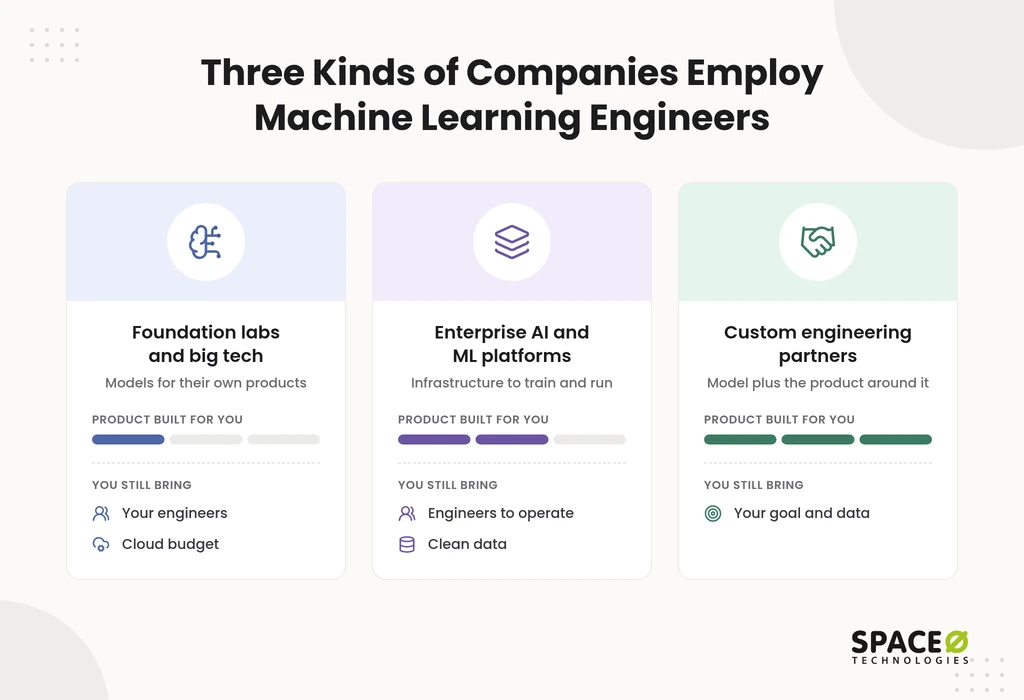
Foundation model labs and big tech
Foundation model labs and big tech companies employ ML engineers to build models for their own products. Many also sell parts of that work as cloud tools.
- OpenAI: A foundation model lab whose ML engineers train, optimize, and deploy frontier language models.
- Anthropic: A foundation model lab that hires ML systems engineers to train and serve large models.
- Google: Runs machine learning across Search, YouTube, and Google Assistant, with Google DeepMind, Google Cloud, Vertex AI, and TensorFlow.
- Microsoft: Offers ML through Azure Machine Learning and Copilot, backed by its OpenAI partnership.
- Amazon/AWS: Provides ML through Amazon SageMaker and Amazon Bedrock on Amazon Web Services (AWS), and powers Alexa.
- Meta: Develops the PyTorch framework and the Llama model family.
- Apple: Focuses on privacy-centered, on-device ML, including Siri.
- IBM: Supports enterprise ML and governance through its Watson platform, including Watson Machine Learning.
- Salesforce: Brings ML into customer relationship management (CRM) through Einstein.
To adopt one of these tools, you need your own engineers to build on it. You also need a cloud account and a budget for usage costs that grow with traffic.
Enterprise AI and ML platforms
AI and ML platforms give your team the infrastructure to prepare data, train models, and run them.
- H2O.ai: An open-source machine learning platform, with automated machine learning (AutoML) through Driverless AI.
- Databricks: Runs a lakehouse platform and MLflow for managing the ML lifecycle, including generative AI work.
- DataRobot: Delivers AutoML and machine learning operations (MLOps) for enterprise predictive modeling.
- Dataiku: Offers a unified, end-to-end platform for data preparation, visualization, and model deployment.
- Scale AI: Provides AI training data, including labeling, annotation, and model evaluation.
To adopt a platform, you need engineers who can operate it. You also need clean data and a budget for licensing or usage fees. Our guide to machine learning platforms compares these tools in more depth.
Custom software and ML engineering partners
Custom engineering partners supply ML engineers who build the model and connect it to your business. They differ in how much of the product they own.
- Staff augmentation vendors: Add vetted ML engineers to your team, while you own the roadmap and architecture.
- Enterprise integration firms: Connect ML to large existing systems, with internal owners needed for each system.
- Data-first consultancies: Build data pipelines and modernize legacy data before modeling starts.
- Product-to-production partners: Build the ML features and the full product around them with one team.
A platform fits when you already employ ML engineers. A custom team fits when you need the product built too. Our guide to custom AI development weighs that choice against a platform. Space-O Technologies works as a product-to-production partner, and the next section shows what that covers.
We Build Your ML Features and the Software They Run In
We build your ML features and the software they run in, from MVP to scale. Founders, SME owners, and enterprise teams get one team for the model and the product. Here is what that team delivers.
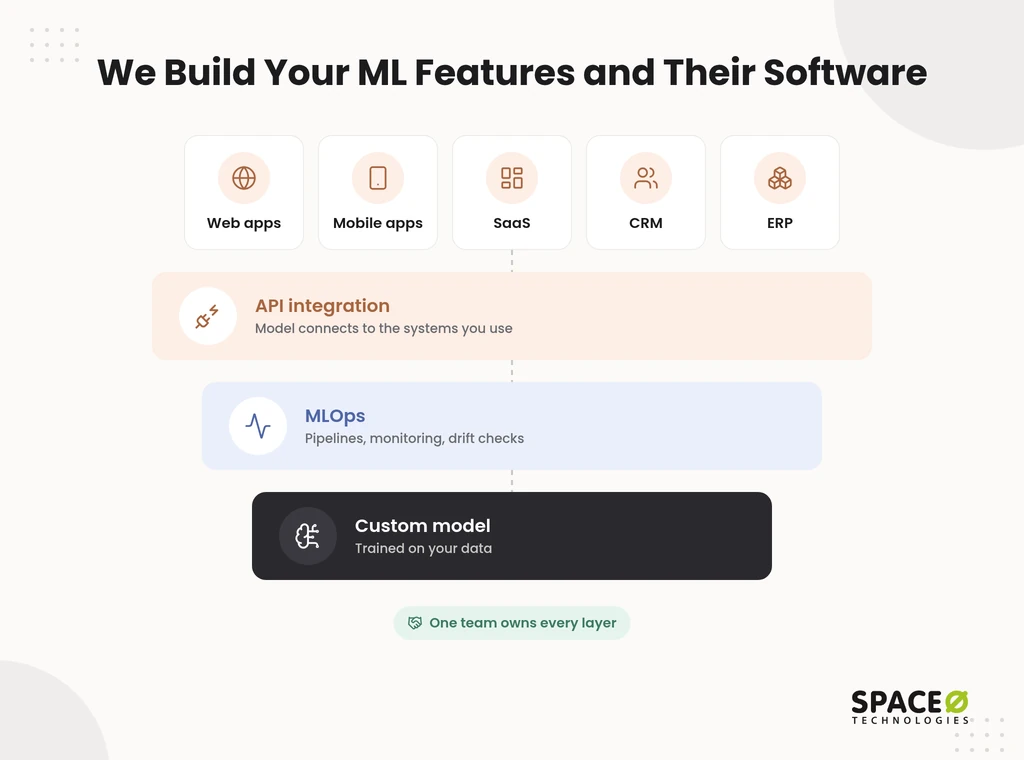
Custom models trained on your data
Our ML engineers turn your data into models that solve one defined business problem. They prepare data, engineer features, and then train and fine-tune models in TensorFlow or PyTorch. Typical uses include forecasting, fraud detection, recommendations, and computer vision for defect detection.
MLOps that keeps models reliable after launch
A model only earns money when it serves users every day, so we run it like production software. Our MLOps work covers deployment pipelines, experiment tracking in MLflow, monitoring, and checks for model drift. If you already use Amazon SageMaker, Vertex AI, Azure Machine Learning, or Databricks, we build on it.
ML features wired into web, mobile, SaaS, CRM, and ERP software
Your model connects to the apps and systems your team already uses. We integrate models into your systems through application programming interfaces (APIs). That covers web apps, mobile apps, SaaS platforms, CRM, and enterprise resource planning (ERP) systems. One team owns both sides of every integration.
ML engineers and AI engineers cover different work
ML engineers train, optimize, and deploy models, while AI engineers build products on existing large language models (LLMs). AI engineers work with retrieval-augmented generation (RAG) and AI agents. Many products need both: an ML model scores the data, and an LLM feature explains the result.
An in-house ML team you can extend
The engineers on your build come from Space-O Technologies’ 140+ in-house developers, never a freelance pool. You can take a full team or add specialists to your own sprints. The roles we staff on ML builds are:
- Machine learning engineers, who own data preparation, training, and model tuning.
- Data engineers, who build the pipelines that feed training and production.
- MLOps engineers, who run deployment, monitoring, and retraining schedules.
- AI engineers, who build LLM, RAG, and agent features.
To add specialists to your sprints, you can hire ML developers through our Staff Augmentation model. With the team in place, every build follows the same five steps.
How We Take Your ML Feature from Scope to Production
Every ML build moves from a signed NDA to a monitored model in production in five steps. ML projects slip when data surprises arrive late, so we front-load the data work in every custom AI solution.
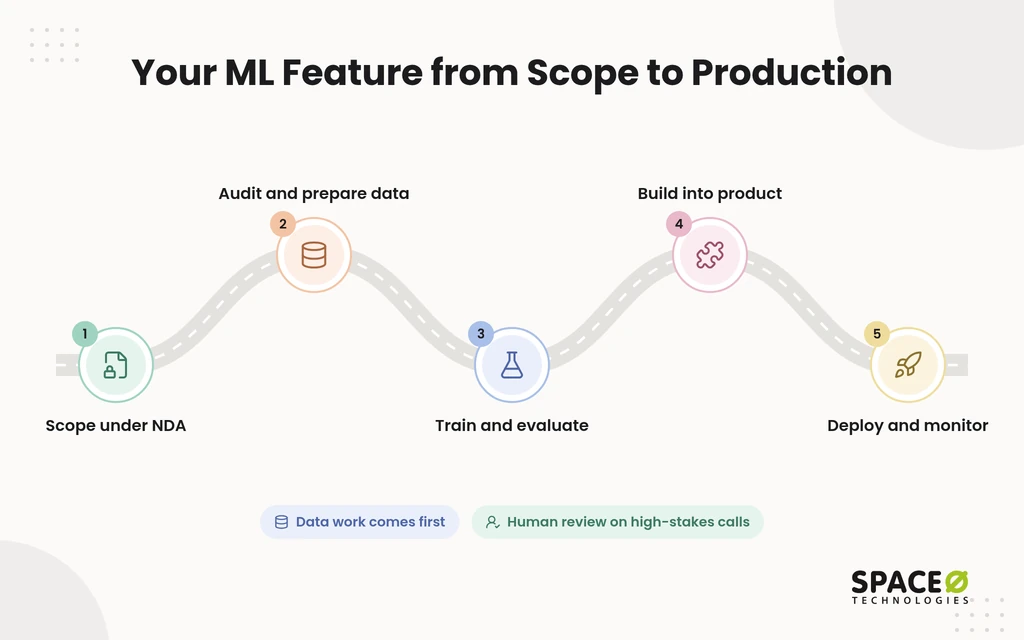
- Scope the goal under NDA: We sign a non-disclosure agreement (NDA), then define the decision the model must improve.
- Audit and prepare your data: Data engineers clean, label, and pipeline the data before any modeling starts.
- Train and evaluate the model: Every model we put into production gets an evaluation suite. It covers accuracy, hallucination rate, bias checks, latency, and cost.
- Build it into your product: Outputs are grounded in your company data, with review checkpoints for high-stakes decisions.
- Deploy and monitor: Continuous monitoring runs in production, and you receive everything we built at completion.
Shipped Products and Returning Clients Back Our Delivery
Judge an ML partner on what it has shipped, not on its pitch. Here is the record behind ours.
97% client retention and public reviews
Space-O Technologies reports 97% client retention. Most clients who launch with an AI development company they trust return for the next build. You can read client reviews on Clutch.
Glovo as proof of consumer scale
Glovo, the on-demand delivery app we built, secured $1.2 billion in funding. Apple chose it for Best of 2016. We cite it as proof of scale, not as an AI build.
Security and compliance for regulated builds
Our compliance posture covers HIPAA-ready frameworks for healthcare AI engagements. For a medical devices company, we delivered a custom software system for data protection and compliance.
Proof shows what we have already done. The next section shows what we commit to on your build.
What Space-O Technologies Commits to on Every ML Build
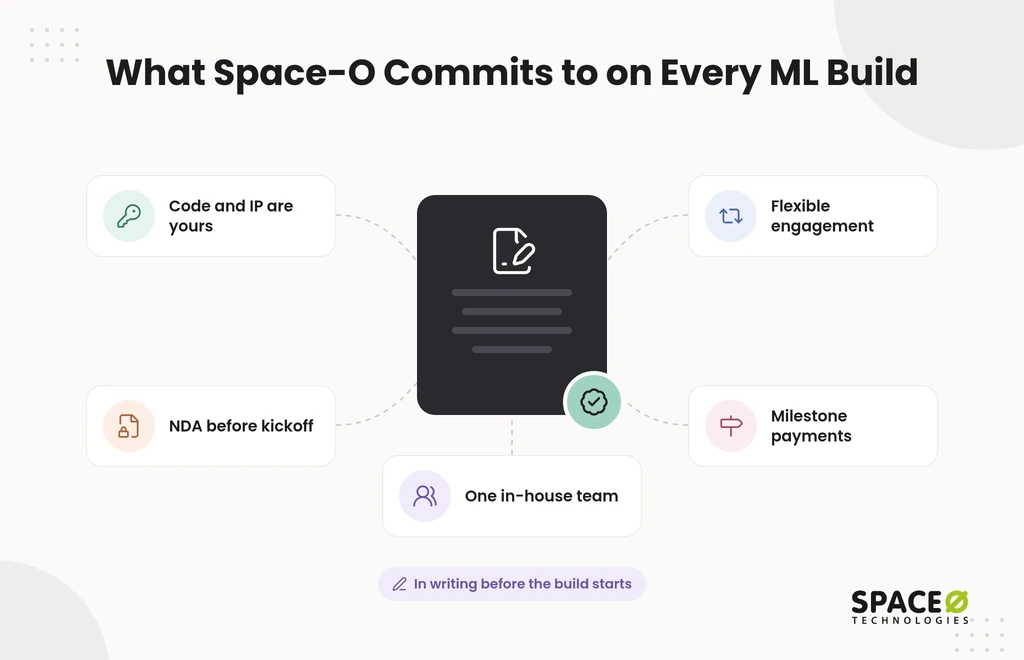
We put ownership, confidentiality, and flexibility in writing before your build starts. Buyers often learn these terms too late, after the code is written. The table answers the questions buyers ask most.
| Your question | What Space-O Technologies commits to |
|---|---|
| Who owns the code and IP? | All source code, data, and intellectual property (IP) built during the project transfer to you at completion. |
| When is the NDA signed? | Before every project starts. |
| Can the engagement change as scope changes? | Yes. Four engagement models let you move from a fixed-cost AI MVP to a longer-term team. |
| How are MVP payments made? | Milestone-based payments, each tied to a deliverable. |
| Who builds the model and the product? | One in-house team across web, mobile, SaaS, CRM, ERP, and AI. |
What an ML Build Costs and How You Can Engage Us
Budget for the build and for yearly upkeep, because ML systems keep costing after launch. Few buyers see these figures before a first call, so we publish them here.
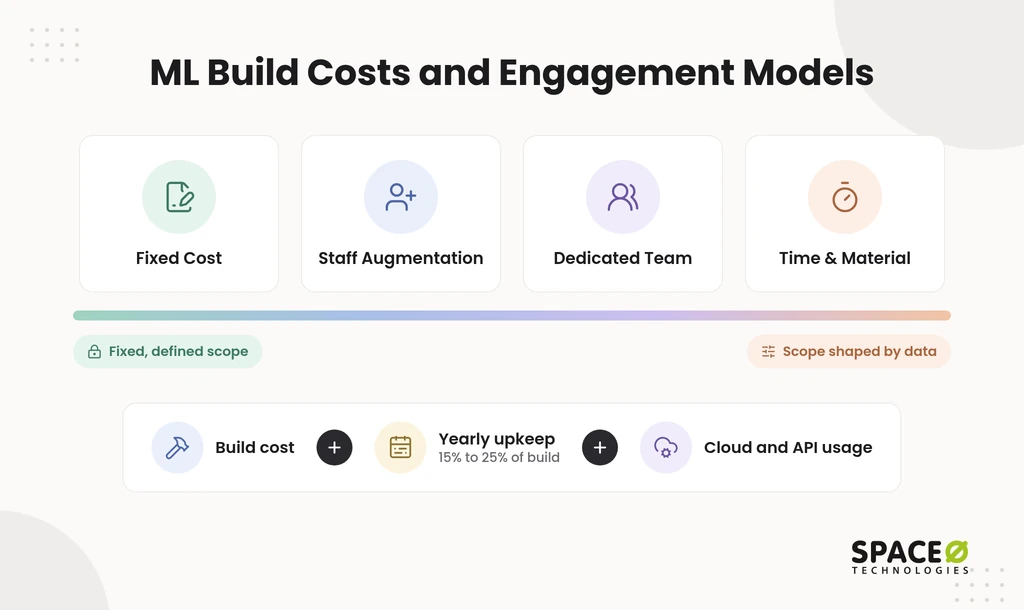
Engagement models matched to how fixed your scope is
Because real data often reshapes ML scope, choose the engagement model based on how fixed your requirements are.
| Engagement model | Scope it fits | Cost range |
|---|---|---|
| Dedicated Team | Long-term ML product build with a stable team | Billed monthly: 160 hours full-time or 80 part-time; one-month minimum |
| Time & Material | ML work where scope changes as data reveals results | Billed on actual effort, with a scoped estimate first |
| Fixed Cost | A defined MVP with clear features | Basic MVP from $15,000; feature-rich MVP up to $50,000+ |
| Staff Augmentation | Vetted ML engineers added to your existing team | Engineers matched within 48-72 hours; scoped by role and duration |
The fixed-cost range comes from our MVP development services page.
Build cost by project size
AI development costs range from $25,000 to $500,000+ in 2026, according to our AI development cost guide. Custom models, multiple integrations, and compliance controls push a project toward the top of that range.
| Project size | Typical build cost |
|---|---|
| Proof of concept | $15,000-$40,000 |
| Basic AI feature | $40,000-$100,000 |
| Recommendation engine | $50,000-$150,000 |
| Mid-level AI application | $80,000-$200,000 |
| Enterprise AI platform with custom models, deep integrations, and compliance controls | Can go well past $500,000 |
Our AI development cost guide puts data preparation at 25% to 40% of the total project budget. That makes data preparation a major cost driver in an AI build.
Costs that continue after launch
Annual maintenance for an AI build typically costs 15% to 25% of the original development cost. Our AI development cost guide gives this range. At that rate, a $100,000 system carries roughly $15,000-$25,000 a year, before infrastructure and API usage.
These ranges give you a planning baseline, and your own scope sets the final number.
Build Your ML Model and Product with One Team
One team for the model and the product removes the hand-off between a model vendor and an app vendor. Tell us the decision you want the model to improve and the product it should live in. Our engineers will scope both in one plan.
Get a Free Estimate for Your ML Build
Our engineers review your model and product scope. You receive a clear, expert-reviewed estimate with scoped ranges, engagement options, and next steps for your build.

Frequently Asked Questions
Which companies build AI models?
Foundation model labs and big tech companies build AI models. OpenAI trains frontier language models, and Anthropic trains and serves large models. Google runs Google DeepMind, and Meta develops the Llama model family and the PyTorch framework. Custom engineering partners build models trained on your own data, typically in TensorFlow or PyTorch.
Which roles does my own team still need when I hire an ML partner?
Platforms and cloud tools suit teams that already have engineers who can operate them and clean data. With staff augmentation, you own the roadmap and architecture while the vendor adds vetted ML engineers. With a full-team engagement, the partner supplies ML, data, MLOps, and AI engineers.
What are common ML use cases a custom team builds?
Custom teams commonly build forecasting, fraud detection, recommendation, and computer vision systems such as defect detection.
Do ML systems in production need human review?
Yes, for decisions that matter. Automated output should not drive a final decision until a qualified person has reviewed and approved it. Production builds should include review checkpoints for high-stakes decisions along with continuous monitoring.
What does an AI software company with machine learning engineers do?
It builds, trains, and deploys models, then connects them to your product. Its engineers prepare data, run MLOps, and integrate models through APIs. Your team gets a working feature, not a notebook.
Should you choose a platform or a custom partner?
Choose a platform if you already employ ML engineers; choose a custom partner if you need the product built too. Platforms and cloud tools still need people to build on them. A partner closes that capacity gap.
How much does it cost to build and maintain ML software?
AI development costs range from $25,000 to $500,000+ in 2026, plus yearly upkeep. Upkeep typically runs 15% to 25% of the build cost each year. Infrastructure and API usage come on top.
Which engagement model fits an ML project?
Choose by how fixed your requirements are. Fixed Cost suits a defined MVP. Time & Material suits scope that changes as data reveals results. Dedicated Team suits a long-term build, and Staff Augmentation adds ML engineers to your team.



 All our projects are secured by NDA




 4.8


