
 By

Contents
- Buy a platform for standard workflows, and build custom when the workflow sets your business apart.
- Score each workflow on seven factors, then choose buy, build, or hybrid for that workflow alone.
- Annual maintenance typically adds 15% to 25% of the build cost, so judge custom builds over three years.
- A hybrid path buys routine agents and builds the orchestration layer that you control.
Key Takeaways
Build vs. buy for an AI agent comes down to control, speed, and cost. Buy a platform for standard tasks that need fast deployment. Build custom when the workflow sets your business apart.
Many enterprises choose a hybrid path instead of one extreme. They buy routine agents and hire an AI agent development company for the custom layer. This guide scores each workflow so you can decide with confidence.
Costs vary widely, and AI agent development costs depend on scope and integrations. Your team size and data rules matter just as much. Read on to see which path fits your business.
Buying AI Agents
Buying an AI agent platform gets a standard workflow live fastest, but you accept limited control over it. Leadership often wants visible AI results this quarter. Packaged platforms answer that pressure.
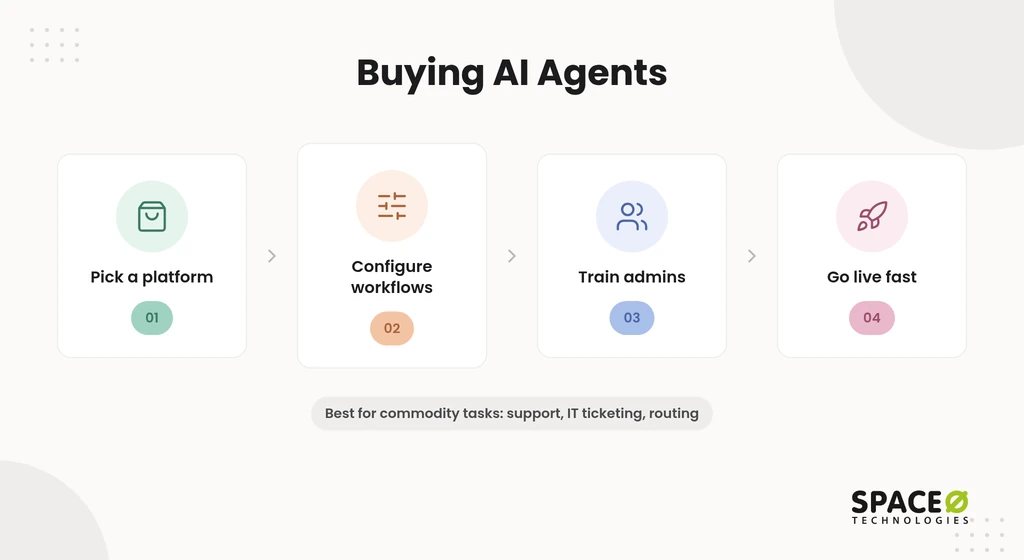
Enterprise options include Salesforce (Agentforce), ServiceNow, Microsoft (Copilot Studio), and SAP. Adopting one still takes work, and a no-code AI app can stop scaling as usage grows. You need setup and configuration, trained administrators, a subscription plan tier, and sometimes paid add-ons.
Best for: Commodity tasks such as customer support, IT ticketing, and data routing, for teams without machine learning (ML) engineers.
Pros
- Speed to market: A packaged platform deploys in days or weeks, because the vendor has already built the core agent.
- Lower upfront cost: Subscription pricing replaces a large build budget, so spending starts small instead of arriving all at once.
- Vendor-managed upkeep: The vendor handles maintenance, security, and governance, and no-code or low-code tools simplify configuration.
Cons
- Limited customization: Workflows follow the vendor’s design, so unique business rules often need workarounds or remain out of reach.
- Vendor lock-in: Your agent logic lives on the vendor’s platform, which exposes you to price hikes, API changes, and outages.
- Shared infrastructure: Your data runs on infrastructure shared with other customers, which raises data privacy questions for sensitive work.
Building Custom AI Agents
Building a custom AI agent gives you control over data, intellectual property (IP), and logic. The tradeoff is a higher cost and a longer timeline. Your edge often lives in a process no vendor has modeled. A custom agent encodes that process exactly as your business runs it.
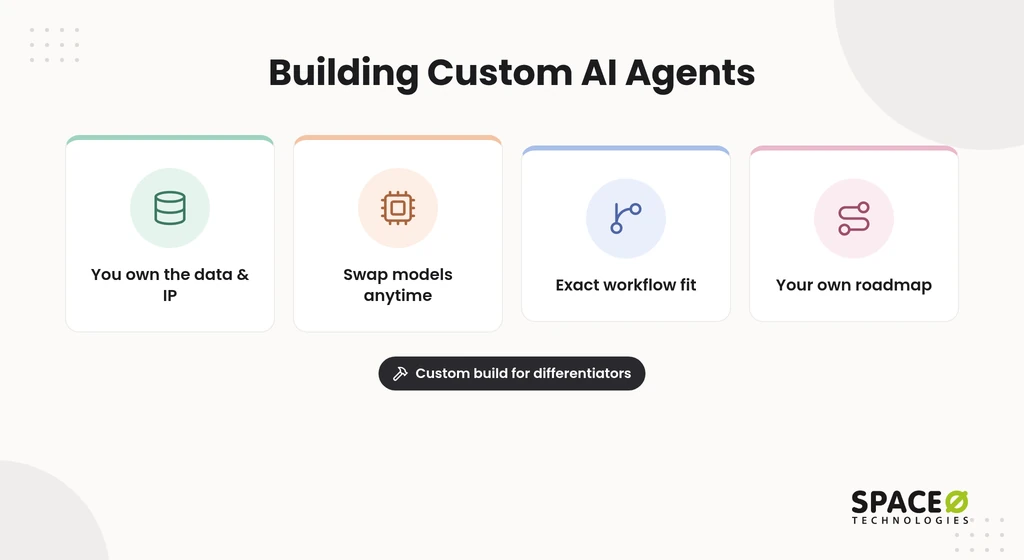
Best for: Core differentiators and complex multi-step workflows, such as claims processing, underwriting, and CRM and ERP orchestration. It also suits strict regulatory or security needs.
Pros
- Ownership and model choice: You own the data and IP, and you can swap large language models (LLMs) as better ones ship.
- Custom integrations: The agent connects across your own systems, such as ERP systems, in the exact sequence your workflow requires.
- Independent roadmap: Your release plan never waits on a vendor’s roadmap, pricing decisions, or feature priorities.
Cons
- High cost: The upfront build is expensive, and ongoing costs continue for hosting, monitoring, and model updates.
- Infrastructure burden: Your team owns orchestration, guardrails, state handling, observability, hosting, monitoring, and debugging after launch.
Decision Framework
Score each workflow against seven factors, then pick buy, build, or hybrid for that workflow alone. Teams often make one company-wide call and regret it later. A per-workflow decision keeps commodity work cheap and protects the work that differentiates you. The same logic applies to a prebuilt vs custom AI model choice.
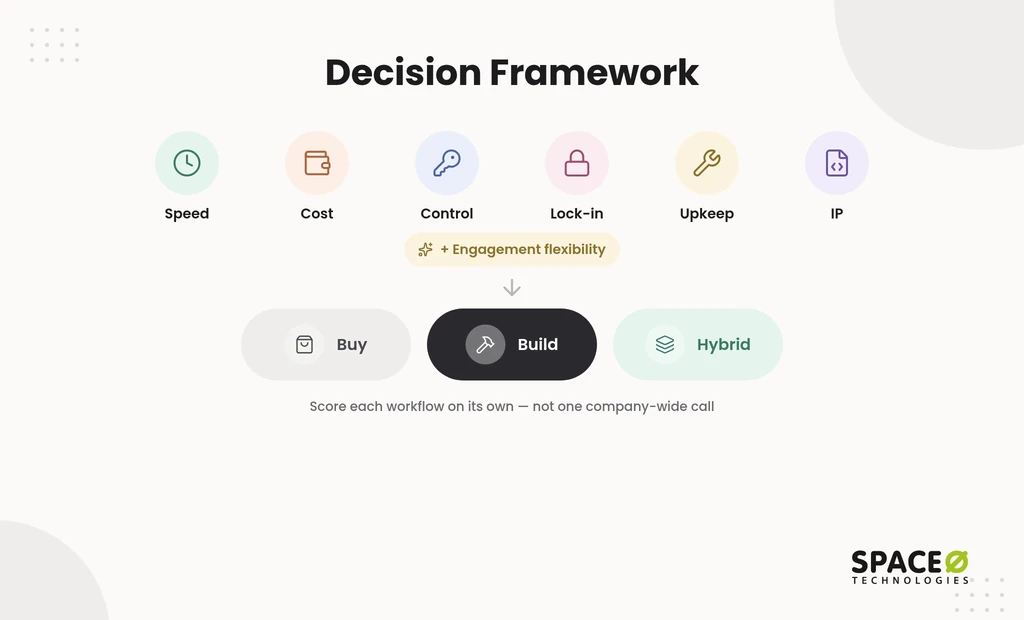
| Factor | Buy | Build | Hybrid |
|---|---|---|---|
| Speed and time-to-value | Days to weeks | Months to production | Weeks for standard tasks, months for the custom layer |
| Cost | Low upfront, recurring subscription | High upfront, plus annual maintenance | Subscriptions for bought parts, build cost for the custom layer |
| Control | Vendor sets workflows and options | Full control of logic, data, and model choice | Full control where it drives advantage |
| Vendor lock-in | High | Low | Limited to the bought components |
| Maintenance | Vendor-managed | Your team or a partner | Vendor for platforms, you for orchestration |
| Code and IP ownership | Vendor owns the platform | You own code, data, and IP | You own the orchestration and business-logic layer |
| Engagement flexibility | Bound by vendor plans and tiers | In-house team or partner, under any engagement model | Platform plans plus a build team of your choice |
Not Sure Whether to Build or Buy?
Our team reviews your workflows, systems, and compliance needs, then recommends buy, build, or hybrid for each one. Share your details and get a free estimate.

The Hybrid Strategy
The hybrid strategy splits the stack: buy where work is routine, own the layer that coordinates it. Neither pure path fits most enterprises. Routine work like HR or IT help desks rarely sets a company apart. The logic that routes work across systems usually does.
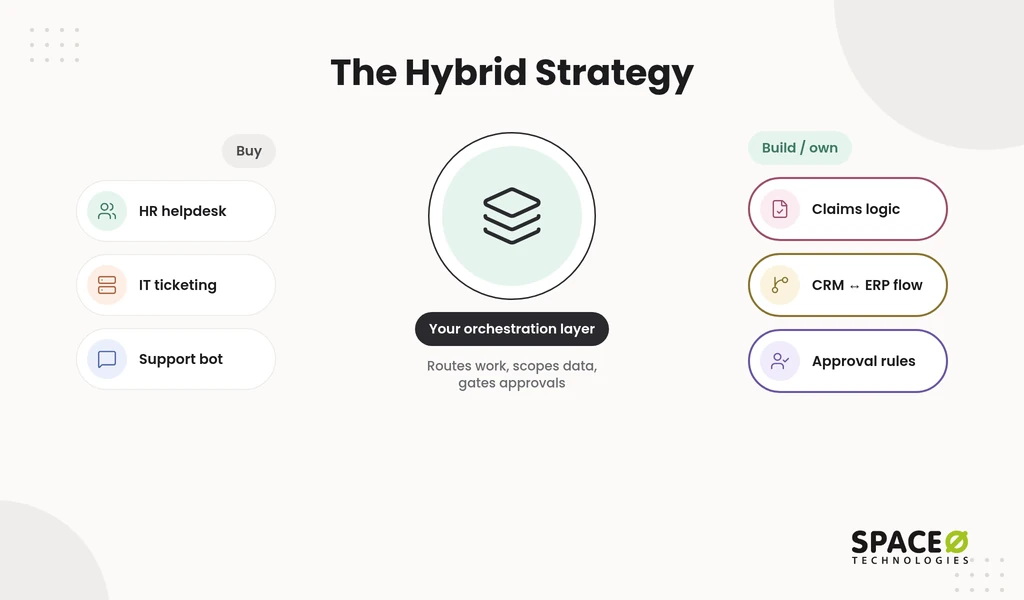
So you buy the commodity agents and own the layer above them. That layer decides which agent acts, which data it sees, and when a person approves. If ServiceNow already runs your IT helpdesk, ServiceNow implementation services can cover the bought layer. Your custom layer then connects to it through API integration services.
Custom AI Agent vs Off-the-Shelf Agent Platform: Quick Comparison
The deciding question here is whether you need deep business logic or fast deployment. If your logic is standard, start off the shelf. If your logic is your advantage, build custom.
What do off-the-shelf agent platforms offer?
Off-the-shelf platforms trade unique logic for fast, predictable setup. Examples: Zapier, Microsoft Power Automate, and pre-built SaaS copilots.
Benefits:
- Deployment in days: Off-the-shelf tools run on prebuilt components, so a simple flow can go live within days.
- Predictable spend: A subscription bills on a fixed cycle, which simplifies budgeting in the first year.
Limitations:
- Logic ceiling: Off-the-shelf platforms handle common patterns well, but your unique decision rules rarely fit their templates.
- Rented foundation: Your flows depend on the vendor’s uptime, pricing, and API decisions, not on your own roadmap.
What do custom AI agents offer?
Custom agents fit your own rules, data, and integrations, but you run them after launch. Examples: LangChain, LangGraph, and Model Context Protocol (MCP) pipelines.
Benefits:
- Logic fit: A custom agent follows your exact business rules, including exceptions that templates cannot express.
- No lock-in: You choose the framework, the model, and the hosting, and you can change any of them later.
Limitations:
- Higher build cost: A custom agent needs design, engineering, and testing before it delivers any value.
- Operational ownership: Your team or partner handles hosting and fixes for as long as the agent runs.
How do they compare side by side?
Off-the-shelf wins on time to deploy, and custom wins on logic fit, ownership, and compliance control.
| Attribute | Off-the-shelf agent platform | Custom AI agent |
|---|---|---|
| Time to deploy | Days to weeks | Months |
| Upfront cost | Low | High |
| 3-year cost | Subscription renewals, exposed to price hikes | Build cost plus annual maintenance |
| Logic fit | Standard patterns | Your exact rules and exceptions |
| Data and IP ownership | Data on vendor infrastructure | You own data, code, and IP |
| Integration depth | Vendor’s connector library | Any system your workflow needs |
| Compliance control | Vendor’s controls and settings | Controls you design and audit |
| Maintenance burden | Vendor-managed | Your team or a partner |
What changes for regulated teams?
For finance and healthcare work, the build side usually wins. Platform settings rarely let you decide data residency and sign-off points. Those outputs carry high stakes, so they face tougher accuracy testing and often a human reviewer. Building your own agent lets you design a HIPAA-compliant data flow. You also place approval checkpoints exactly where decisions happen.
Which two questions settle the choice?
Two questions decide most cases: which workflow are you automating, and which systems must it connect to? A standard workflow touching common apps points to a platform. A proprietary workflow that needs to integrate AI into an existing SaaS platform points to custom or hybrid.
Cost and Maintenance: A 3-Year View
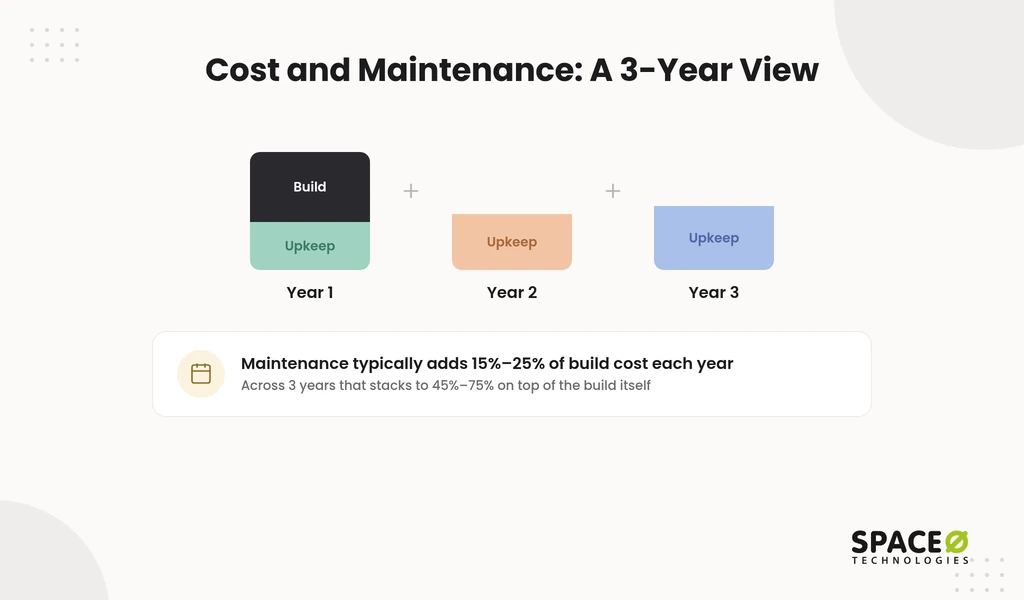
Over 3 years, annual maintenance, not the build fee, decides whether custom beats a subscription. Most comparisons stop at the upfront price. That hides the cost you carry every year after launch.
What does a custom AI agent cost to build?
On the build side of the ledger, entry pricing is MVP-sized and paid in stages. Space-O Technologies prices a basic MVP from $15,000, rising to $50,000+ for a feature-rich scope. Each payment is released against a delivered milestone, as listed on our MVP development services page.
How does 15%-25% annual maintenance add up over 3 years?
Maintenance adds 45%-75% of the build cost across 3 years, on top of the build itself. Annual maintenance typically costs 15% to 25% of the original build, per our AI development cost research.
| Build scenario | Build cost | Maintenance per year (15%-25%) | 3-year maintenance | 3-year total |
|---|---|---|---|---|
| Basic MVP | $15,000 | $2,250-$3,750 | $6,750-$11,250 | $21,750-$26,250 |
| Feature-rich MVP | From $50,000 | From $7,500-$12,500 | From $22,500-$37,500 | From $72,500-$87,500 |
| AI chatbot or virtual assistant | $25,000-$100,000 | $3,750-$25,000 | $11,250-$75,000 | $36,250-$175,000 |
These totals exclude infrastructure, API, and LLM fees, so budget them as a separate line. The chatbot row uses the build range from our AI development cost research.
When should you graduate from a platform to a custom agent?
Graduate when 3-year platform spend, plus workaround effort, exceeds the 3-year custom total for that workflow. Two other triggers count as well. The first is a workflow that becomes a differentiator. The second is a compliance rule the platform cannot meet.
A practical route has three steps:
- Start off the shelf: Launch the standard workflow on a platform and learn real volumes and exceptions.
- Document the logic: Record every rule, exception, and approval the platform forced you to work around.
- Graduate the core: Rebuild that workflow as a custom agent, and keep the platform for commodity tasks.
Build With a Partner: How Space-O Technologies Fits
A build partner gives you custom agent logic without hiring an in-house ML team. Many teams need custom logic but have no ML engineers. Hiring a full team takes months. A partner sits between building in-house and buying a platform.
Since 2010, Space-O Technologies has shipped 300+ software solutions. Our team includes 140+ in-house developers, and we report a 97% client retention rate. We hold ISO 27001 and ISO 9001 certifications.
What do you own at the end of the project?
Choosing to build should leave you owning the result, with nothing tying you to us afterward. We sign an NDA before work begins. At completion, the source code, data, and IP all pass to you. Keeping that custom layer in your hands is the whole reason to build rather than buy.
How do we keep a production agent safe?
Building does not mean giving up safeguards, because evaluation, monitoring, and human review ship with every production agent. We test each model for accuracy, hallucination rate, bias, latency, and cost. Monitoring continues after launch. The agent handles volume automatically, yet no output informs a final decision until a qualified person signs off.
For regulated workflows, we build on HIPAA-ready frameworks and ISO 27001-certified processes.
Which engagement model fits your team?
Your engagement model sets how much of the custom build sits with your own staff. You can choose Dedicated Team, Time & Material, Fixed Cost, or Staff Augmentation. Our team can own the full build, or you can hire AI agent developers who work inside your in-house sprints.
Share your workflow and target systems, and get a free, expert-reviewed estimate for your AI agent.
Frequently Asked Questions
Should you build your own AI agent?
Build only for workflows that pass the “Best for” test under Building Custom AI Agents; buy for commodity work when you have no ML engineers. When a workflow sits on the borderline, use a cost rule instead of a gut call: launch it on a platform, then rebuild it as a custom agent once its 3-year platform spend plus workaround effort exceeds the 3-year custom total.
What is the difference between custom software and off-the-shelf software?
The practical difference is who carries which risk. With off-the-shelf software, the vendor carries upkeep, and you carry the lock-in: its templates, its infrastructure, its price changes. With custom software, you carry the upkeep, typically 15%-25% of the build cost each year, and in return you keep the code, the IP, and the freedom to change direction.
What is agent architecture in AI?
Agent architecture is how a custom agent’s components fit together, the infrastructure listed under Building Custom AI Agents. For the build vs buy call, the part that matters most is the orchestration layer: it is the piece a hybrid strategy keeps in-house while the agents beneath it can be bought.
How do I test a custom AI agent before it goes into production?
Use the evaluation-and-monitoring approach described under “How do we keep a production agent safe?” As a release rule, treat any output that can influence a final decision in finance or healthcare as a gate: it does not go live until a human checkpoint sits in front of it and monitoring is already running.
What costs come on top of an AI agent’s build price?
Two layers sit on top: usage costs (infrastructure, API calls, and model fees), which belong in a separate budget line, and maintenance, which compounds. On a feature-rich MVP from $50,000, maintenance runs from $7,500-$12,500 a year, or from $22,500-$37,500 over 3 years, which is more than the entire $15,000 build of a basic MVP.



 All our projects are secured by NDA




 4.8


