
 By
Contents
- Space-O Technologies is an AI development company that builds custom Natural Language Processing (NLP) features inside your software.
- Services cover custom models, large language model (LLM) fine-tuning, chatbots, document processing, and semantic search.
- Minimum viable product (MVP) pricing starts at $15,000, and AI chatbots run $25,000 to $100,000.
- Share your use case to get a free, expert-reviewed estimate.
Key Takeaways
Many NLP projects stall before reaching real users. Teams struggle with messy data, vague accuracy targets, and unclear budgets. An AI development company with NLP expertise helps you avoid those traps.
Since 2010, Space-O Technologies has served 1,200+ clients, from startups to enterprises. We build custom NLP, LLM, and conversational AI solutions through our AI development services. Our 140+ in-house developers ship them inside your software, mobile, or web product.
This guide covers our NLP services, security controls, costs, and timelines. It also lists six questions to ask any NLP partner. Read on to see whether we fit your project.
What NLP services does Space-O Technologies build?
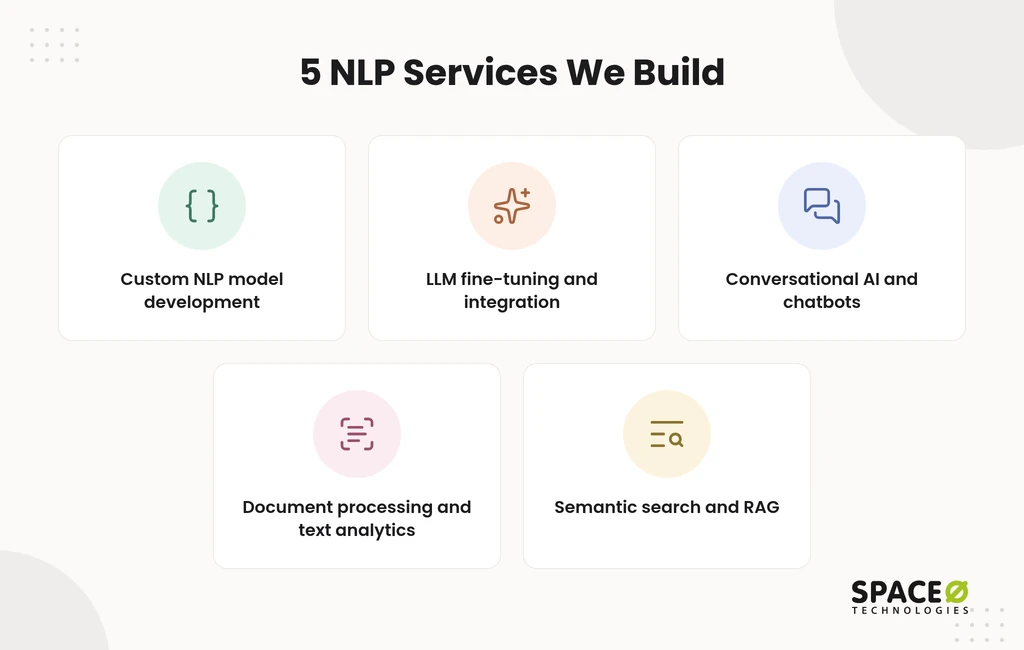
Space-O Technologies builds five kinds of NLP work, each shipped inside your product rather than as a standalone demo. We are a development partner, not a model platform. Your team gets language features that are designed, tested, and maintained as part of real software. Each service below is part of our wider AI development offering.
Custom NLP model development
Custom NLP model development: Space-O Technologies builds NLP models around your data, workflows, and accuracy targets. Generic tools often miss your industry terms, product names, and document formats. We start from the business goal and then pick the model and method that solve it. We deliver this work across healthcare, finance, retail and eCommerce, insurance, education, and real estate.
LLM fine-tuning and integration
LLM fine-tuning and integration: Space-O Technologies connects large language models to your product, then shapes how they respond. A raw LLM answers generically and drifts from the format your users expect. We integrate model APIs and apply prompt engineering. We fine-tune only when prompts and retrieval fall short. For summaries and content tools, see our generative AI development services.
Conversational AI and chatbots
Conversational AI and chatbots: Space-O Technologies builds assistants that answer customers and staff in plain language. Support queues grow faster than headcount, and static FAQ pages leave questions unanswered. We build chatbots and virtual assistants for customer support, FAQ automation, and internal help desks. Each assistant connects to your customer relationship management (CRM) system, help desk, or knowledge base through APIs. Our AI chatbot development services page shows how we scope these builds.
Document processing and text analytics
Document processing and text analytics: Space-O Technologies turns unstructured text into fields, labels, and signals your systems can use. Teams lose hours retyping forms, tagging tickets, and reading reviews by hand. Our NLP builds cover four core tasks:
- Document processing: Optical character recognition (OCR) reads scanned files, and NLP then extracts the fields you need.
- Named-entity recognition (NER): The model tags names, dates, amounts, and product codes inside free text.
- Sentiment analysis: Reviews, tickets, and survey replies are scored so trends surface early.
- Intent classification: Incoming messages are sorted by purpose and routed to the right queue.
Semantic search and retrieval-augmented generation (RAG)
Semantic search and RAG: Space-O Technologies grounds LLM answers in your own documents. Users can trace replies to a source. Keyword search misses meaning, and ungrounded models invent answers. Semantic search finds passages by meaning. RAG passes those passages to the LLM before it answers.
Our default rule is to use retrieval for facts that change and fine-tuning for fixed formats or tone. With retrieval, updated content goes live through re-indexing rather than retraining.
Do you need an NLP development partner or an LLM platform?
Platforms supply the models, while a development partner builds the product around them. Foundation-model providers such as OpenAI, Anthropic, Cohere, and Hugging Face supply models and APIs. Cloud providers such as Microsoft Azure and Google Cloud offer managed language services.
Using either one directly requires your own engineers for integration, evaluation, security review, and ongoing upkeep. A development partner such as Space-O Technologies takes on that engineering work inside your product. Weighing an agency against a contractor? Read our AI development company vs freelancer guide. Statista tracks NLP as its own market, covering chatbots, sentiment analysis, and translation.
How does Space-O Technologies keep NLP secure and accountable?
Space-O Technologies runs every NLP build under documented privacy, testing, and human-review controls. Language data often carries customer names, health details, or financial records. Our posture covers ISO 27001 alignment, GDPR compliance, and HIPAA-compliant builds for healthcare.
Before release, we test every model for hallucination and bias, with human review checkpoints on by default. In lending, clinical, and other high-stakes decisions, the model drafts the output, and your reviewer approves it.
What should you have in place before you build?
Four things decide whether an NLP feature works in production: data, evaluation, privacy, and deployment. Most stalled language projects skip at least one of them. Check each before you sign a statement of work:
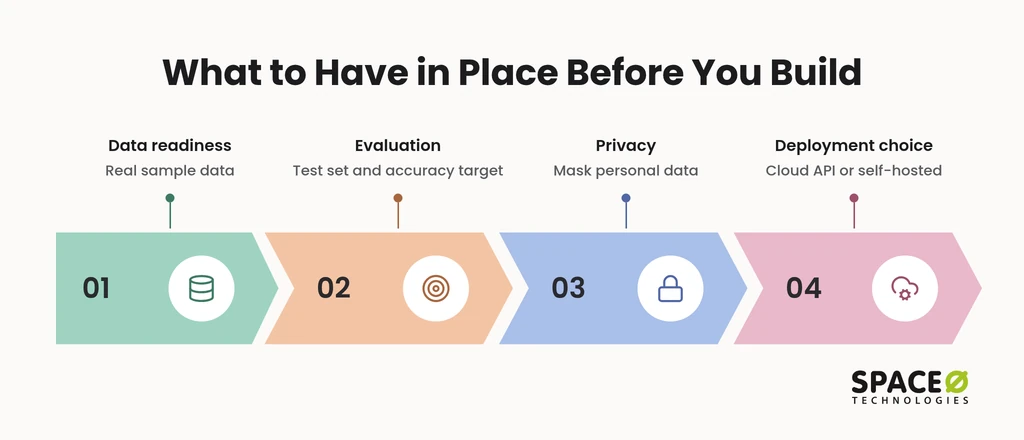
- Data readiness: Gather sample documents, chats, or tickets that reflect how your users really write.
- Evaluation: Agree on a test set and an accuracy target before development starts.
- Privacy: List which fields hold personal data and decide how each one is masked or excluded.
- Deployment choice: Pick a cloud API or a self-hosted model based on data sensitivity and running cost.
If any of these is unclear, an AI consulting engagement can settle it before you commit to a build.
What does NLP development cost?
NLP builds start at MVP pricing and grow with integrations, compliance needs, and monitoring. Buyers are usually asked for a budget before anyone shares a number. These are the figures Space-O Technologies publishes.
| Item | Published figure | Source |
|---|---|---|
| Basic MVP (MVP pricing, not an NLP-specific quote) | From $15,000 | Space-O Technologies MVP development services page |
| Feature-rich MVP (MVP pricing, not an NLP-specific quote) | Up to $50,000 or more | Space-O Technologies MVP development services page |
| AI chatbots and virtual assistants (customer support, FAQ automation, internal assistance) | $25,000-$100,000 | Space-O Technologies published AI cost ranges |
| AI development, all project tiers | $25,000-$500,000+ | Space-O Technologies published AI cost ranges |
| Annual maintenance for an AI build | Annual maintenance for an AI build runs 15% to 25% of the original build cost. The same 15% to 25% share applies every year as a recurring cost, not a one-time fee. | Space-O Technologies AI development cost guide |
| Payment schedule for an NLP build | Milestone-based, tied to deliverables | Space-O Technologies MVP development services page |
How long does an NLP build take?
NLP delivery time depends on scope, from a short proof of concept to a grounded production assistant. These are Space-O Technologies’ published ranges:
- Proof of concept: 4 to 8 weeks to test one use case on your own data.
- RAG chatbot or RAG search: 10 to 20 weeks from build to production.
- Basic AI feature in an existing product: 2 to 4 months.
What changes the price of an NLP build?
Five factors move an NLP quote up or down the published ranges. Our AI chatbot development cost guide breaks them down by chatbot type.
- Model choice: Custom models cost more than a hosted LLM with prompts and retrieval.
- Integrations: Each CRM, enterprise resource planning (ERP), payment, or third-party connection adds scope.
- Security and compliance: Advanced security controls and compliance requirements add build and review time.
- Accuracy stakes: Finance and healthcare outputs need stricter testing and human review.
- Running costs: Infrastructure, API usage, and ongoing monitoring add to the total after launch.
Which engagement model fits your NLP project?
Space-O Technologies offers four engagement models: Dedicated Team, Time & Material, Fixed Cost, and Staff Augmentation.
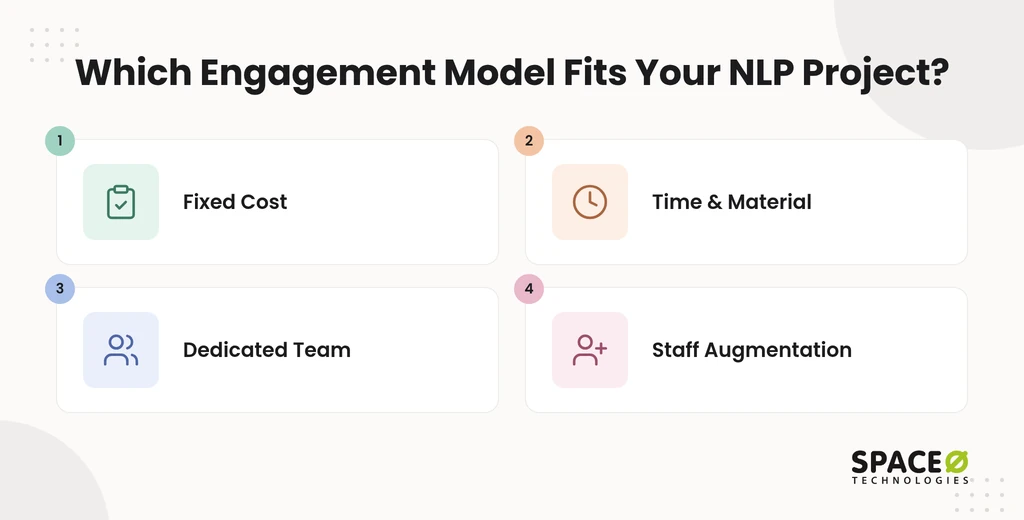
- Fixed Cost: A scoped MVP with a clear scope, timeline, and budget agreed up front.
- Time & Material: Scope that will change as you learn from real users.
- Dedicated Team: A long-term product build with a stable team and a dedicated project manager.
- Staff Augmentation: Vetted engineers join your sprints, such as when you hire AI developers for a missing skill.
Scope Your NLP Project With Our Team
Bring your use case and sample data. We will review them and share a free, expert-reviewed estimate with a realistic timeline.

What to ask an NLP development partner
Ask every NLP partner the same six questions and compare the answers in writing. Clear answers protect your budget, your data, and your roadmap.
| Question | What any buyer should expect | Space-O Technologies |
|---|---|---|
| Does the partner ship to production? | Named systems running with real users | Space-O Technologies reports 50+ AI systems running in production |
| Which engagement models are offered? | More than one, matched to scope | Four models, from Fixed Cost MVPs to Dedicated Teams |
| Who owns the code and IP? | Full transfer written into the contract | All source code, data, and IP transfer to the client at completion |
| Is an NDA signed first? | An NDA before any data changes hands | An NDA is signed before every project starts |
| Can one team build the whole product? | A clear plan for software and AI hand-offs | One team for software, mobile, web, AI, and ServiceNow |
| What will maintenance cost? | A written annual estimate before the build | A published annual range, shared in every proposal |
What has Space-O Technologies shipped?
GPT Vix is our NLP proof, while Glovo and Fyule Video Lab show our product scale.
- GPT Vix (AI recruitment software): Our NLP proof point, an AI recruitment product built by Space-O Technologies.
- Glovo (on-demand delivery app): Per the Glovo project page, the app secured $1.2 billion in funding, was chosen for Apple’s Best of 2016, and passed 30 million downloads. This is scale proof, not an NLP deliverable.
- Fyule Video Lab (video learning platform): Per the project page, it secured $1.4 million through an angel syndicate. This is also scale proof, not an NLP deliverable.
- Client retention: Space-O Technologies reports 97% client retention.
What should you tell us about your NLP project?
Five details let us scope an NLP build quickly: use case, industry, budget, timeline, and deployment model.
- Use case: Chatbot, document extraction, fine-tuning, or semantic search.
- Industry: Your sector and the data rules that apply to it.
- Budget: A working range, using the cost table as a guide.
- Timeline: Your target launch window and any fixed dates.
- Deployment: A cloud API or a self-hosted model.
Frequently Asked Questions
Is natural language processing gen AI?
No, NLP is the wider field, and generative AI is one kind of work within it. NLP covers reading, classifying, and answering human language. Classification, entity recognition, and sentiment analysis are NLP tasks that generate no new text.
What is NLP related to AI?
NLP is the part of AI that lets software read, classify, and answer human language. AI is the wider field that includes NLP. Typical outputs include entity recognition, sentiment analysis, intent classification, semantic search, and chatbots.
What is applied AI?
Applied AI means building AI features into working software to solve a specific business problem. It does not mean offering a model on its own. Space-O Technologies is a development partner, not a model platform. Each language feature is designed, tested, and maintained inside a real product.
What are the top 10 AI development companies?
This article gives no top 10 list, but six questions let you compare any shortlist. Ask whether the partner ships to production and which engagement models it offers. Ask who owns the code and IP, and whether an NDA comes first. Ask whether one team can build the whole product and what annual maintenance costs.
Is NLP a dead field?
No, NLP is not dead; it now sits inside LLM, chatbot, search, and document-processing products. These features still need data preparation, evaluation, privacy controls, and monitoring. That keeps skilled NLP work in demand. The field has shifted from standalone models to language features built into software.
How do you decide between RAG and fine-tuning for a real project?
Choose retrieval when your facts change, and fine-tuning when you need a fixed format or tone. With retrieval, updated content goes live through re-indexing rather than retraining. Fine-tuning suits a narrow need, such as enforcing a response format.



 All our projects are secured by NDA




 4.8


