
 By
Contents
- The right AI chatbot development company depends on your needs: support automation, CRM integration, or regulated compliance.
- Custom engineering suits chatbots that must read and write live CRM, ERP, and internal data.
- RAG grounding cut unsupported answers on GPT Vix, so ask every partner how answers trace to sources.
- Quick takeaway: budget for data preparation and maintenance, because they drive cost more than the chat interface.
Key Takeaways
A chatbot that cannot reach your data stalls right after the demo. Teams then pay twice: once to build and again to rebuild. The right AI chatbot development company helps you avoid that second bill.
Choosing an AI chatbot development company for your business depends on your specific needs. Most buyers need customer support automation, enterprise CRM integration, or regulated industry compliance. Each need points to a different type of partner.
Space-O Technologies has built AI-powered custom software since 2010 through our AI development services. We build chatbots into the CRM, ERP, and systems you already run. This guide compares partner types, shows our process, and explains what drives cost.
Types of AI chatbot development partners
AI chatbot development partners fall into three types: custom engineering, low-code contact center automation, and end-to-end generative AI deployment.
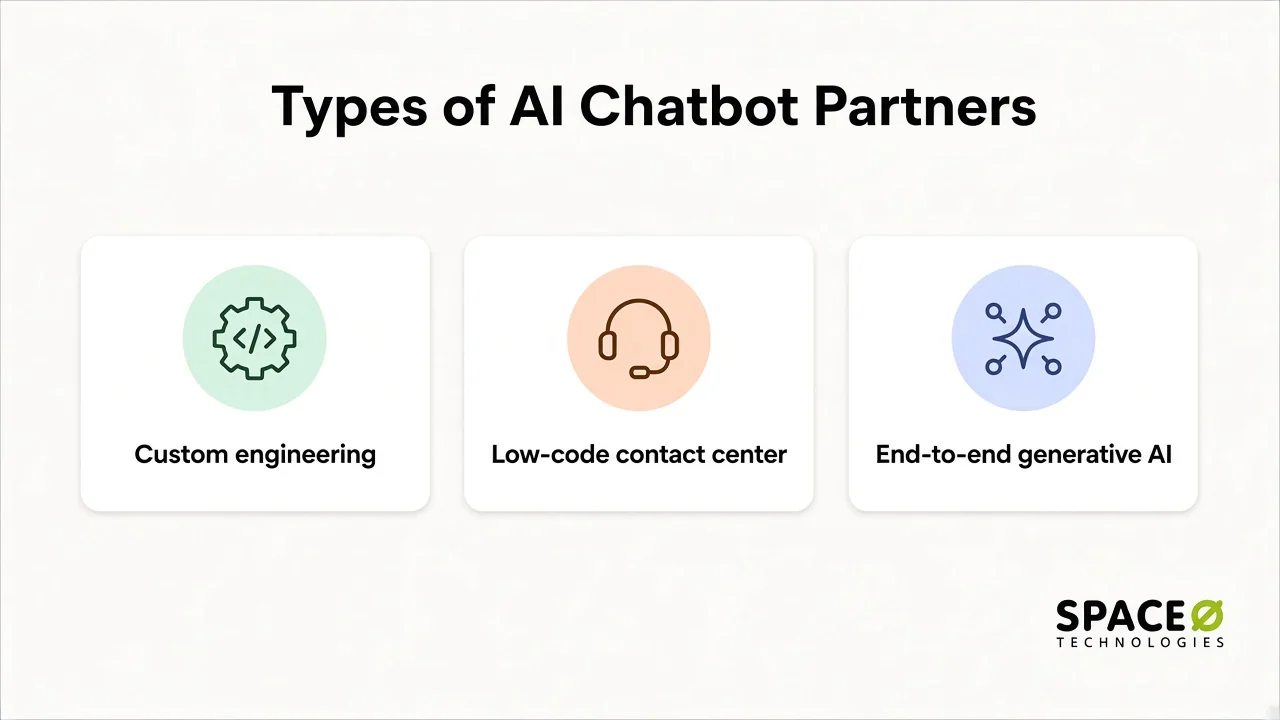
Each type solves a different problem. Demand keeps rising, and Statista expects the worldwide AI market to reach about US$707 billion in 2026. Start by matching the partner type to the job your chatbot must do.
What does a custom engineering partner do?
A custom engineering partner writes the chatbot and its integrations as software your business owns.
Choose this type when your chatbot must act on live business data, not only answer questions. Engineers design the conversation logic and link it to your systems through APIs (application programming interfaces). They also test answers against your own documents. Space-O Technologies works in this category.
What does a low-code contact center automation platform require?
A low-code contact center automation platform suits teams that want fast, configuration-led deployment inside a contact center.
Your team configures flows instead of commissioning code. Adopting one usually requires an administrator to own those flows after launch. Before you sign, check which features sit behind higher plan tiers or paid add-ons. Also check how deep the platform’s connectors reach into your own CRM and ERP.
What does end-to-end generative AI deployment cover?
End-to-end generative AI deployment covers model selection, grounding, evaluation, release, and monitoring under one partner.
This matters when the chatbot generates answers rather than picking from scripted replies. The partner owns accuracy from discovery through production. We deliver this through our generative AI development services, alongside custom engineering.
Which type of AI chatbot partner fits your needs?
Match the partner to your main need, then compare partners on four requirements: systems, data, engagement, and support.
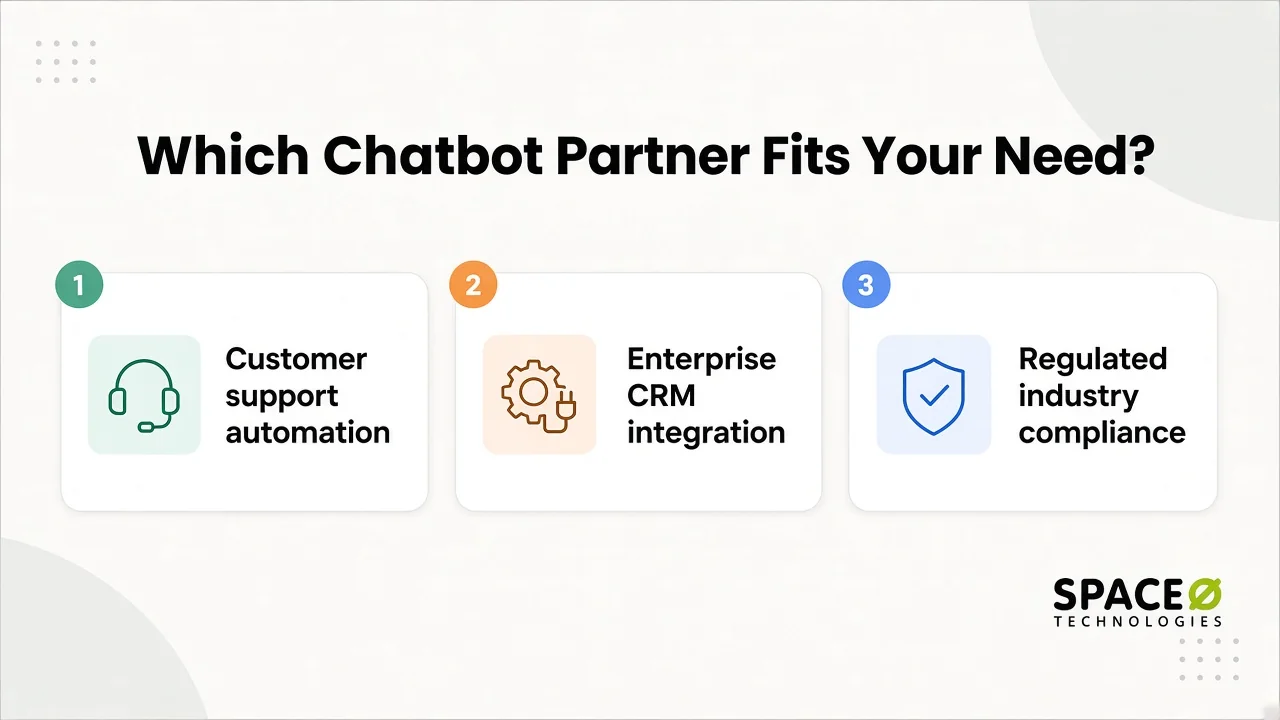
Most chatbot projects stall at the same point. The bot demos well but cannot reach the data that customers ask about. Use this matrix to brief any partner you are evaluating.
| Your need | Connection to existing systems | Data handling and code ownership | Engagement model fit | Support after launch |
|---|---|---|---|---|
| Customer support automation | Reads help content, ticket history, and order status through APIs | Every answer traces to a source document | Fixed Cost for a defined first scope | Re-index content when documents change |
| Enterprise CRM integration | Reads and writes CRM and ERP records, not only reads them | Chatbot access mirrors your CRM user roles | Dedicated Team or Time & Material while integrations grow | Update connectors when CRM or ERP schemas change |
| Regulated industry compliance (healthcare or finance) | Connects only to approved systems | Limits what protected data the model sees, with human sign-off on high-stakes answers | Time & Material while controls are defined | Re-run evaluations after any model or policy change |
In summary: support automation rewards traceable answers. CRM integration rewards a partner who can write to your systems safely. Regulated work rewards human review and repeatable testing. Space-O Technologies fits businesses whose chatbot must read and write data in their own CRM, ERP, or internal systems. We build those systems too, so one partner owns both sides of the integration.
Get a scoped plan for your chatbot
Share your systems and data sources with our team. We return a free, expert-reviewed estimate scoped to your chatbot.

How Space-O Technologies builds an AI chatbot for business
We build the chatbot, ground it in your data, and measure its accuracy before release.
A chatbot that guesses costs you customer trust faster than it saves agent time. Our process controls three things: what the bot connects to, what it may say, and who approves what it does.
Enterprise CRM integration built by one partner
We build the chatbot and the CRM (customer relationship management) system it talks to, so integration is not a handoff.
Many teams buy a chatbot from one vendor and a CRM from another. Then they spend months on the seam between the two. We deliver the chatbot alongside custom CRM development, ERP (enterprise resource planning), HRM (human resource management), and ServiceNow work. Your team gets one backlog, one project manager, and one owner for every connector.
Customer support automation that cites its source
Grounding answers in your own content measurably cuts wrong answers in a support chatbot.
The worst support answer is a confident one that is false. We use RAG (retrieval-augmented generation), which ties each answer to retrieved company documents. On GPT Vix, our AI recruitment software, we added RAG grounding over the product knowledge base. It cut the unsupported-answer rate from 22% to 4%. We measured it on a 500-prompt held-out evaluation set. Human graders scored answers against source documents, and the RAGAS framework measured faithfulness.
AI chatbots for healthcare and finance
In regulated industries, a chatbot must limit the sensitive data it touches and let people approve consequential decisions.
The risk is not a slow bot. It is a bot that exposes protected data or shapes a decision nobody reviewed. In US healthcare, HIPAA (Health Insurance Portability and Accountability Act) governs protected health information. In finance, accountability for credit decisions has to stay with people.
Where does human review sit in a high-stakes workflow?
Human review sits at the point where the AI’s output would reach the customer as a decision.
We built this checkpoint into a lending client’s loan-origination workflow. The model drafts an approve or decline recommendation with its rationale. A human underwriter reviews and signs off on every decision above a set exposure threshold before it reaches the applicant. The model’s role is capped at drafting and retrieving evidence.
How do we scope compliance before building?
We define data boundaries and approval points during discovery, before any model sees real data.
Discovery maps which systems the chatbot may reach and which answers need sign-off. For sector detail, see our healthcare chatbot development guide and our analysis of AI chatbots in banking.
What drives the cost of an AI chatbot for business?
Data preparation, integration depth, evaluation, and ongoing maintenance drive chatbot cost more than the chat interface does.
Budgets usually break on the work buyers cannot see. That means cleaning source content, wiring two-way CRM access, building test sets, and maintaining the bot after launch. Our AI chatbot development cost guide breaks these drivers down. We give scoped ranges after discovery and never quote by the hour.
AI chatbots and virtual assistants for business typically cost $25,000 to $100,000. That covers customer support, FAQ automation, and internal assistance. RAG-grounded support chatbots run $50,000 to $150,000 over 10 to 20 weeks. Enterprise CRM integration and regulated builds cost more. Custom models, multiple integrations, compliance controls, and monitoring add work. Plan data preparation at 25% to 40% of the total project budget. Plan AI maintenance at 15% to 25% of build cost per year.
| Your need | Typical cost (USD) | What moves it higher |
|---|---|---|
| Customer support automation | $25,000-$100,000; RAG-grounded builds $50,000-$150,000 over 10-20 weeks | Number of content sources and channels |
| Enterprise CRM integration | Scoped at discovery; costs more than a standalone support bot | Two-way CRM and ERP writes, multiple integrations |
| Regulated industry compliance (healthcare or finance) | Scoped at discovery; costs more than a standalone support bot | Custom models, advanced security, compliance controls, ongoing monitoring |
Ranges come from our published cost guides, and every project is scoped after discovery.
Why business leaders work with Space-O Technologies
Space-O Technologies has built AI-powered custom software since 2010 for startups, growing businesses, and enterprises.
When you pick a partner, you want proof that the team stays with a product after launch. Our track record in numbers:
- 1,200+ clients served since 2010.
- 97% client retention.
- 300+ software solutions developed.
- 140+ in-house developers.
- Offices in Mesa (Arizona, USA), Brampton (Ontario, Canada), and Ahmedabad (India).
Clients also review our work on GoodFirms, where reviews are verified before they are published.
Frequently Asked Questions
Which businesses need a custom-built chatbot instead of a simple FAQ bot?
Businesses need a custom-built chatbot when it must act on live business data, not only answer FAQs. Engineers link the bot to your CRM, ERP, and internal systems through APIs. They also check answers against your own documents. You own the chatbot and its integrations as software.
Fixed Cost, Dedicated Team, or Time & Material: which engagement model fits a chatbot project?
Fixed Cost fits a defined first scope, such as a support chatbot. Dedicated Team or Time & Material fits enterprise CRM integration while integrations keep growing. Time & Material also fits regulated work while controls are still being defined.
Can an AI chatbot write data to my CRM, or only read it?
Yes, a well-integrated chatbot can read and write CRM and ERP records, not only read them. Its access should mirror your CRM user roles. Writing safely calls for a partner who builds both sides of the integration. Space-O Technologies builds the chatbot and the CRM, so one team owns every connector.
How much does an AI chatbot for business cost?
AI chatbots and virtual assistants for business typically cost $25,000 to $100,000. RAG-grounded support chatbots run $50,000 to $150,000 over 10-20 weeks. Enterprise CRM integration and regulated builds are scoped at discovery. We never quote by the hour.
What should I prepare before a chatbot partner starts work?
Prepare your source content and a list of the systems the chatbot must reach. Also decide what the bot may say and who approves what it does. Then brief partners on four requirements: systems, data, engagement model, and support after launch.
How do I keep a chatbot accurate after launch?
Re-index your content whenever documents change, and update connectors whenever your CRM or ERP schemas change. A retrieval-based design lets answers trace to a specific document version without retraining the model. After any model or policy change in a regulated setting, re-run the evaluations.



 All our projects are secured by NDA




 4.8


