
 By
Contents
- Scope first: Name your AI type, such as LLM integration, RAG, predictive ML, or computer vision, before writing a job brief.
- Model next: Freelancers suit short tasks, while dedicated teams suit AI that must run, be monitored, and be retrained after launch.
- Vet on shipped work: Ask for live systems with monitoring, not notebooks, demos, or thin API wrappers.
- Demand safeguards: Require no training on client data, personal data masking, bias testing, and human review of key outputs.
- Budget past launch: Maintenance usually adds 15% to 25% of build cost every year.
Key Takeaways
To hire AI developers, start with your technical scope. Then choose an engagement model that fits your budget. Finally, vet every candidate for AI shipped to production.
Freelancers fit short, well-defined tasks. Staff augmentation or a dedicated team fits production builds needing MLOps (machine learning operations). Our guide to AI development company vs freelancer explains that choice.
Space-O Technologies has shipped 50+ AI systems to production. A team of 30+ AI engineers builds them. You can hire dedicated AI developers from that same team.
1. Define Your AI Project Scope
Your scope decides which developer you need, so name the type of AI before you write a job brief. “AI developer” covers very different skill sets. Wiring a large language model (LLM) into an app is one job. Training a forecasting model is another. Pick the category first, then match skills and stack to it.
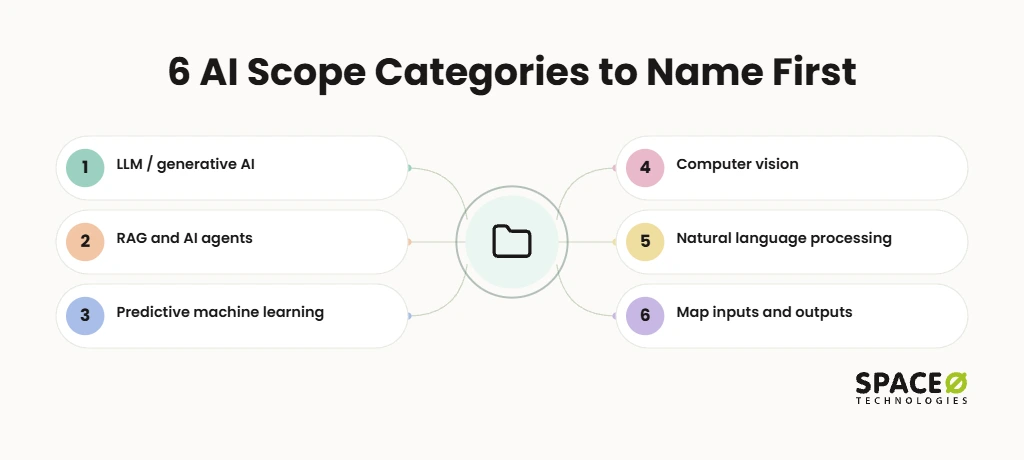
- LLM / generative AI integration: Connects a hosted model such as GPT-4 or Claude to your product through an API. See our generative AI integration services for how this is built. It needs prompt design, output evaluation, and Python or Node.js integration skills. Best for: summaries, smart search, drafting tools, and chatbots.
- RAG and AI agents: Retrieval-augmented generation (RAG) grounds model answers in your own documents and data. AI agents go further and take actions across your tools, as covered in our AI agent development work. Both need Python, LangChain, vector search, and evaluation skills. Best for: support assistants, internal knowledge search, and workflow automation.
- Predictive machine learning (ML): Trains custom models on your historical data to forecast, score, or classify. It needs Python, PyTorch or TensorFlow, data engineering, and MLOps. Best for: demand forecasting, fraud detection, and churn prediction.
- Computer vision: Teaches models to read images and video. It needs PyTorch or TensorFlow, labeled image data, and edge or cloud deployment skills. Best for: defect detection, document capture, and visual inspection.
- Natural language processing (NLP): Extracts meaning from text, such as intent, entities, or sentiment. It overlaps with LLM work but often uses smaller, task-specific models. Best for: classifying tickets, parsing contracts, and routing requests.
- Map your inputs and outputs first: List your data sources and the output format you expect. Note any compliance rules, such as the Health Insurance Portability and Accountability Act (HIPAA). Decide whether you need a prototype or a production system. This one page of notes sharpens every later hiring decision.
Most production AI also runs on a major cloud. Your developers should know AWS, Azure, or Google Cloud, whichever your stack already uses.
2. Choose an Engagement Model
Choose the engagement model by who will manage delivery and how long the AI must run after launch. A model that works for a two-week proof of concept often breaks once the system needs monitoring and retraining. Match the model to the life of the system, not only the build.
Which engagement models can you choose from?
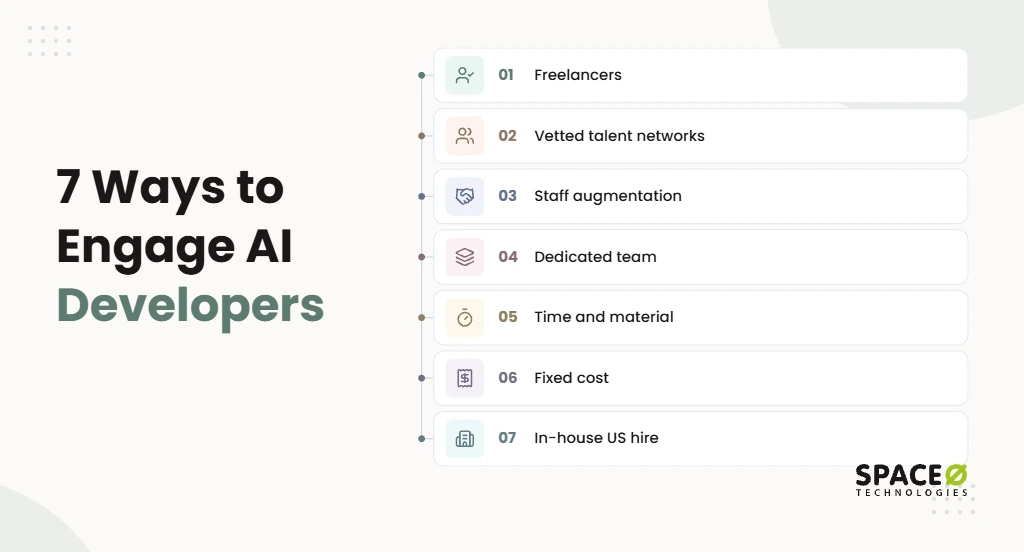
Seven engagement models cover nearly every AI hiring need, from one freelancer to a full in-house team.
- Freelancers: Independent developers hired through freelance platforms or marketplaces, usually billed by the hour. You manage the work and review the output. Best for: short, well-defined tasks and proofs of concept.
- Vetted talent networks: Platforms that pre-screen individual engineers before you see them. You still manage delivery day to day. Best for: adding one pre-screened specialist you can direct yourself.
- Staff augmentation: Vetted engineers join your sprints, tools, and code review. The provider handles hiring, onboarding, and replacements. Best for: CTOs who have a roadmap but need AI skills the team lacks.
- Dedicated team: A cross-functional team that includes AI engineers, a project manager (PM), QA, and MLOps, working only on your product. Best for: long-term AI products that need maintenance, monitoring, and retraining.
- Time and material: You pay for actual effort as scope evolves. Best for: AI features where requirements will change after early user testing.
- Fixed cost: One agreed scope, timeline, and budget. Best for: a scoped AI MVP (minimum viable product). You own the code and IP (intellectual property) from day one.
- In-house US hire: A full-time employee on your payroll. Best for: long-term core IP once the product has proven demand.
How do the models compare on delivery and ownership?
The real differences between models are who runs delivery, who owns the code, and what safeguards come built in. The table compares the six models on those axes. Rows marked Space-O Technologies show how we run that model.
| Model | Who manages delivery | Dedicated PM & daily updates | Code & IP ownership | Production AI track record | Responsible-AI safeguards | Time to start |
|---|---|---|---|---|---|---|
| Freelancer | You | Not included | Set by your contract | Varies by individual; verify each one | Depends on the individual | Depends on your search and screening |
| Vetted talent network | You | Not included | Set by network terms | Pre-screened; production work still needs checking | You define and enforce them | Varies by network |
| Staff augmentation (Space-O Technologies) | You run sprints; we handle vetting, onboarding, and replacements | Support contact included | Full code and IP ownership | 50+ AI systems in production | Applied by default | Within days |
| Dedicated team (Space-O Technologies) | Space-O Technologies, with your product owner | Yes | Full code and IP ownership | 50+ AI systems in production | Applied by default | Scoped at kickoff |
| Fixed cost (Space-O Technologies) | Space-O Technologies | Yes | Full ownership from day one | 50+ AI systems in production | Applied by default | Scoped at kickoff |
| In-house US hire | You | Your own management | You own it | Depends on the hire | You build the policy | A full hiring cycle |
3. Vet for Production, Not Prototypes
Vet every AI developer on systems they have shipped and still support, not on notebooks or demos. Many candidates can show a working prototype. Far fewer have kept a model accurate, secure, and affordable with real users. That gap is where most AI projects stall.
What should you check before you hire?
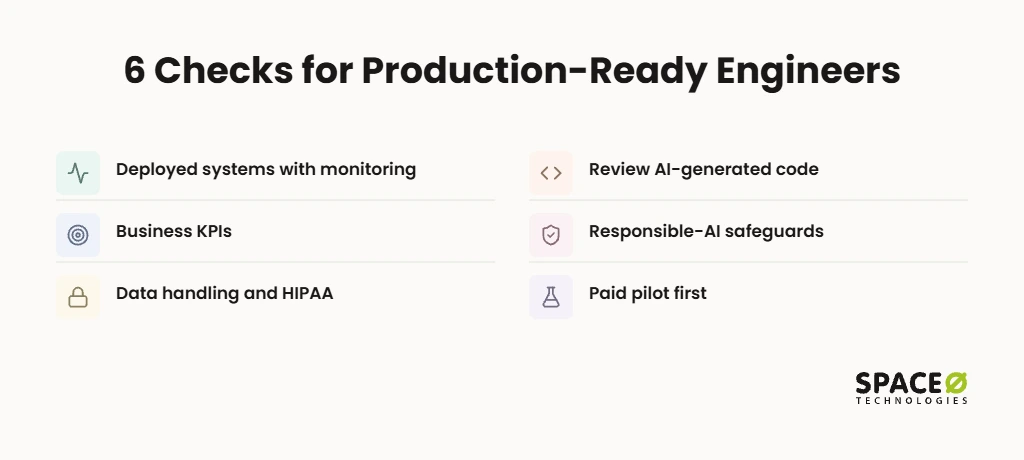
Use six checks that separate production engineers from prototype builders.
- Deployed systems with monitoring: Ask for a live system, how it is monitored, and what broke after launch. A notebook or a thin API wrapper is not production evidence.
- Ability to review AI-generated code: Give a short code sample produced by an AI assistant. Ask the candidate to find and fix its flaws.
- Business KPIs, not only model scores: Ask which key performance indicator (KPI) the last project moved. Accuracy alone does not prove business value.
- Responsible-AI safeguards: Confirm no training on client data. Ask for personally identifiable information (PII) masking, hallucination and bias testing, and human review of consequential outputs.
- Data handling and HIPAA: If you handle health data, ask how the developer keeps systems HIPAA-ready, with encryption at rest and in transit.
- A paid pilot before full commitment: A small, scoped pilot shows how the team works before you sign a long engagement.
How does Space-O Technologies vet its AI engineers?
We vet engineers on production work, then keep the same controls in place on every client build. Our production AI runs with grounding in client data, evaluation before release, and human review for high-stakes decisions.
GPT Vix shows what production work looks like. The recruiting platform combines ChatGPT, Whisper, and Synthesia on React.js, Node.js, and AWS Lambda. A speech-to-text delay held up its screening workflow. Moving that processing onto AWS Lambda fixed it.
A proof of concept can serve as your pilot. We scope its cost and timeline at discovery.
4. What It Costs to Hire AI Developers in the US
Compare total cost per engagement model, not hourly rates alone. Demand is rising: Statista puts the US AI market at nearly 74 billion U.S. dollars, growing about 30 percent a year. Statista’s global forecast expects the market to pass 1,218 billion U.S. dollars by 2030. The market ranges below are not Space-O Technologies rates.
| Model | How it is billed | Market range reported |
|---|---|---|
| Freelance AI developer | Hourly | Rates vary widely by seniority and region |
| In-house US AI engineer | Annual cost | Varies by seniority and region |
| Nearshore dedicated developer | Monthly | Varies by region and seniority |
| Space-O Technologies dedicated AI team | Monthly | 160 hours a month full-time or 80 hours part-time; one-month minimum |
| Space-O Technologies fixed-cost AI MVP | Scoped project range | A basic MVP starts from $15,000 and a feature-rich MVP runs up to $50,000+; payments are milestone-based |
We do not publish hourly rates. Plan for after launch too: maintenance usually adds 15% to 25% of build cost every year, and data preparation can take 25% to 40% of the total budget, as our AI development cost guide explains. For build ranges by tier, see LLM integration project cost.
Want a Cost Estimate Built Around Your AI Project?
Tell us your scope and timeline. We will estimate your build, outline maintenance and data preparation costs, and recommend the engagement model that fits.

Why Teams Hire AI Developers Through Space-O Technologies
Space-O Technologies gives you production AI engineers inside a company that also builds the software around the AI. Many AI projects fail at the edges: the CRM connection, the app, or the approval workflow. We build those parts too.
- Production AI at scale: 50+ AI systems in production, built by 30+ AI engineers. We are an OpenAI Select Partner and an AWS Partner, and our team includes Claude Certified Architects.
- One partner beyond AI: 140+ in-house developers cover software, mobile, web, SaaS, ERP, CRM, and ServiceNow. You do not need a second vendor to ship the full product.
- Enterprise-grade security: NDA-protected work, full code and IP ownership, ISO 27001 alignment, and HIPAA-ready delivery.
- Clients who stay: We have served 1,200+ clients since 2010 and report 97% client retention.
Which Model Fits Your Project?
Three answers will point you to the right model for hiring AI developers on your project. Those answers cover what you are building, your budget and timeline, and who runs it after launch.
- What are you building? Place it in one scope category from section 1. A prototype that tests an idea needs a lighter model than a system serving customers.
- What are your budget and timeline? A fixed scope and a fixed date point to fixed cost. A roadmap that will shift after user feedback points to time and material or a dedicated team.
- Freelancer or team? Choose a freelancer for one bounded task when your own engineer can review the work. Choose a team when the AI needs deployment, monitoring, retraining, and support.
Tell us what you are building. We will send a free, expert-reviewed estimate with the model we recommend: Get your AI project estimate. If you are weighing a tailored build against a ready-made tool, read custom AI development vs off-the-shelf first.
Which Engagement Model Fits Each AI Build?
Each common AI build maps to one engagement model, one team shape, and one definition of “production-ready.” Use the matrix to match your build and stage to a model.
| Use case × stage | Recommended engagement model | Team roles needed | What “production-ready” means for this build | Space-O Technologies’ published timeline or range |
|---|---|---|---|---|
| RAG chatbot, prototype | Fixed cost | AI engineer, backend developer | Answers grounded in approved documents; evaluation set passed | Scoped at discovery |
| RAG chatbot, in production | Dedicated team or time and material | AI engineer, backend developer, QA, MLOps | Monitoring, hallucination testing, PII masking, and a fallback to a human agent | Scoped at discovery |
| AI agent, in production | Dedicated team | AI engineer, backend developer, QA, PM | Human approval on consequential actions; full action logs; scoped tool permissions | Scoped at discovery |
| LLM feature added to an existing SaaS product | Staff augmentation | AI engineer embedded in your team | Feature flags, usage monitoring, and evaluation before each release | Engineers matched within days |
| Computer vision MVP | Fixed cost | ML engineer, data annotator, mobile or web developer | Accuracy measured on real field images; clear handling of low-confidence results | Basic MVP from $15,000; feature-rich MVP up to $50,000+ |
| Predictive ML at scale | Dedicated team | ML engineer, data engineer, MLOps engineer | Drift monitoring, scheduled retraining, and KPI tracking tied to the business goal | Scoped at discovery; dedicated developers billed monthly |
Frequently Asked Questions
What should a CTO with a roadmap but no AI skills on the team hire?
Staff augmentation usually fits a CTO with a roadmap but no AI skills. Vetted AI engineers join your sprints, tools, and code review, while the provider handles hiring, onboarding, and replacements. You keep control of the roadmap and fill the skills gap without a full in-house hiring cycle.
What is the difference between a freelancer and a vetted talent network?
A vetted talent network pre-screens engineers, while a freelancer is hired independently through a marketplace. In both cases you manage delivery day to day, with no dedicated project manager or daily updates. Production experience still needs checking either way, so verify deployed systems for each person you consider.
What data security and compliance safeguards should I require from AI developers?
Require four safeguards: no training on client data, PII masking, hallucination and bias testing, and human review. Humans should approve consequential outputs. If you handle health data, also ask how the developer keeps systems HIPAA-ready, including encryption at rest and in transit.
How much does it cost to hire AI developers?
Cost depends on scope, engagement model, and data readiness, so a scoped estimate beats an hourly rate. At Space-O Technologies, a basic MVP starts at $15,000 and a feature-rich MVP runs up to $50,000+. Payments are milestone-based and tied to deliverables. Maintenance usually adds 15% to 25% of build cost every year.
How do I vet an AI developer for production work?
Vet on systems they have shipped and still support, not on notebooks or demos. Ask for a live system and how it is monitored. Have the candidate review AI-generated code. Ask which business KPI their last project moved.
Which engagement model is best for an AI project?
Match the model to the life of the system: freelancers for short tasks, a dedicated team for long-term AI products. Fixed cost suits a scoped MVP, and time and material suits changing requirements. Staff augmentation fills skill gaps on your own team.



 All our projects are secured by NDA




 4.8


