
 By
By 
Contents
Finding the right telemedicine development company can transform your virtual healthcare vision into reality. Whether you want to launch a video consultation app, build remote patient monitoring systems, or create a complete telehealth platform, your development partner matters. The firm you select must understand clinical workflows, regulatory compliance, and secure data handling.
Many vendors claim telehealth expertise, but few deliver truly scalable solutions. Each provider offers different strengths in AI diagnostics, real-time video integration, wearable connectivity, and patient engagement tools.
What you need is a telemedicine software development company with proven healthcare experience. They should build secure, HIPAA-compliant solutions tailored to your specific use case.
This guide highlights the 10 best telemedicine development companies for your next project. Compare their core services, technology expertise, compliance certifications, and standout capabilities to choose the right telemedicine software development partner.
Our Selection Process for the Top Telemedicine Development Companies
To help you outsource telemedicine development to the right agency, we extensively reviewed and analyzed over 70 telehealth software development vendors. Our evaluation covered portfolios, client testimonials, compliance expertise, and project success rates based on our agency’s shortlisting methodology.
- Clutch Ratings and Client Reviews: We prioritized firms with ratings above 4.7 and verified feedback from healthcare clients on Clutch.
- Telehealth Domain Experience: We assessed each firm’s portfolio of video consultation apps, remote monitoring platforms, and virtual care solutions.
- Regulatory Compliance Knowledge: We verified expertise in HIPAA, FDA regulations, GDPR, HL7 FHIR, and other healthcare standards.
- Industry Tenure: We focused on vendors with 7+ years of experience in telehealth software development.
- Technology Capabilities: We evaluated proficiency in WebRTC, real-time video, AI/ML, cloud infrastructure, and IoMT integration.
- Service Range: Selected firms offer end-to-end services from consulting and design to development, testing, and maintenance.
- Client Success Stories: We analyzed case studies demonstrating measurable improvements in patient care and operational efficiency.
- Global Delivery: We included vendors with distributed teams capable of serving clients across different time zones.
This process helped us identify 10 leading telemedicine development companies. Now, let us compare them side by side for easier evaluation.
Quick Comparison of the Leading Telemedicine Development Companies
Here is an overview of the top telemedicine software development firms to help you quickly evaluate your options.
| Company | Clutch Rating | Hourly Rate | Founded | Location |
|---|---|---|---|---|
 Space-O Technologies | 4.8/5 | $25 – $49 / hr | 2010 | Mesa, AZ |
 ScienceSoft | 4.8/5 | $50 – $99 / hr | 1989 | McKinney, TX |
 TechMagic | 4.9/5 | $50 – $99 / hr | 2014 | Lviv, Ukraine |
 N-iX | 4.8/5 | $50 – $99 / hr | 2002 | Lviv, Ukraine |
 Inoxoft | 4.9/5 | $25 – $49 / hr | 2014 | Lviv, Ukraine |
 Glorium Technologies | 4.8/5 | $50 – $99 / hr | 2010 | New York, NY |
 Interexy | 5.0/5 | $25 – $49 / hr | 2017 | Miami, FL |
 Appinventiv | 4.6/5 | $25 – $49 / hr | 2015 | New York, NY |
 Simform | 4.9/5 | $25 – $49 / hr | 2010 | Orlando, FL |
 Orangesoft | 4.9/5 | $50 – $99 / hr | 2011 | Tallinn, Estonia |
Now, let us explore each telemedicine development company in detail. We will cover their services, expertise, and unique differentiators.
Develop Patient-Centric Telemedicine Platforms With Space-O Technologies
With an experience of serving 1,200+ clients, we help healthcare organizations build reliable telemedicine platforms.

Detailed Overview: 10 Leading Telemedicine Development Companies
1. Space-O Technologies
| Company Overview | Details |
| Hourly Rate | $25-$49/hr |
| Clutch Rating | 4.8/5 |
| Minimum Project Size | $10,000+ |
| Founded Year | 2010 |
| Notable Clients | Nike, McAfee, SAINTGOBAIN |
Space-O Technologies is a trusted healthcare software development company with 15+ years of healthcare software development expertise. They have served 1200+ clients, maintaining a remarkable 98% satisfaction rate. Their team of 180+ skilled engineers specializes in building HIPAA-compliant telehealth solutions.
Space-O Technologies maintains ISO 27001:2022 certification and builds every healthcare solution with compliance from day one. The team integrates AI/ML for clinical decision support alongside cloud and blockchain technologies.
Businesses hire developers from Space-O Technologies to build telemedicine platforms, EHR/EMR systems, patient portals, and remote monitoring solutions. Their experts stay current with HIPAA and HL7 FHIR standards throughout development. Client reviews highlight exceptional documentation, responsiveness, and communication quality.
Core capabilities of Space-O Technologies
- Telemedicine App Development: Custom video consultation platforms with HD video, audio, and text communication.
- Remote Patient Monitoring: Wearable integration, vital sign tracking, and automated health alerts.
- Healthcare Software Consulting: Business analysis, compliance assessment, and technology roadmapping.
- EHR/EMR Integration: HL7 FHIR implementation, API development, and seamless data exchange.
- Patient Portal Development: Self-service tools for appointments, health records, and provider communication.
- Mobile Health Applications: Native iOS/Android and cross-platform apps for virtual care delivery.
- Legacy System Modernization: Cloud migration, interface redesign, and performance optimization.
- Quality Assurance and Testing: Comprehensive functional, security, and compliance testing.
Notable telemedicine projects
Conduet-Med
Space-O developed a cloud-based on-demand telemedicine app connecting concierge patients with board-certified experts. Patients submit inquiries with medical details while doctors respond via video, audio, or text. The platform supports remote consultations for both physical and mental health.
Learn More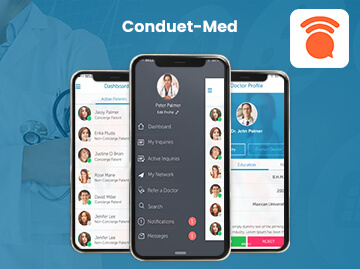
FIYA Fitness Training Platform
Space-O Technologies developed FIYA to deliver engaging workout programs, exercise content, and fitness tracking across iOS, Android, and web.
Learn More
2. ScienceSoft
| Company Overview | Details |
| Hourly Rate | $50-$99/hr |
| Clutch Rating | 4.8/5 |
| Minimum Project Size | $10,000+ |
| Founded Year | 1989 |
| Notable Clients | Walmart, eBay, Nestlé, NASA Jet Propulsion Laboratory (JPL) |
ScienceSoft brings 19+ years of healthcare IT experience to telemedicine development. The firm has completed 150+ successful telehealth projects with MD consultants on their team. They deliver everything from simple video consultation apps to complex AI-powered diagnostic platforms.
Their telehealth portfolio spans mobile, web, and desktop applications. Each solution integrates seamlessly with EHR systems, medical imaging software, and wearable devices. ScienceSoft follows ISO 13485, ISO 27001, and ISO 9001 standards throughout development.
The company engineers HIPAA and GDPR-compliant medical software. They also prepare documentation for FDA submissions and CE marking. They typically build telemedicine MVPs within 2 to 6 months, depending on complexity.
3. TechMagic
| Company Overview | Details |
| Hourly Rate | $50-$99/hr |
| Clutch Rating | 4.9/5 |
| Minimum Project Size | $25,000+ |
| Founded Year | 2014 |
| Notable Clients | Elements.cloud, Etergo, Mamo |
TechMagic specializes in mobile and web telemedicine app development since 2014. Their expertise covers remote patient monitoring platforms, EHR integrations, and patient data management systems. Clutch recognizes them as a top developer in the HealthTech sector.
The firm delivers solutions ranging from simple video consultation apps to enterprise telehealth ecosystems. They build patient portals, provider dashboards, and administrative tools. TechMagic focuses on creating intuitive user experiences for both patients and clinicians.
Their development process emphasizes security and compliance from day one. The team implements HIPAA safeguards, data encryption, and audit logging across the board. They also provide ongoing support to maintain compliance as regulations evolve.
4. N-iX
| Company Overview | Details |
| Hourly Rate | $50-$99/hr |
| Clutch Rating | 4.8/5 |
| Minimum Project Size | $50,000+ |
| Founded Year | 2002 |
| Notable Clients | WEINMANN Emergency, Cure Forward, Galen Data |
N-iX operates as a trusted technology partner with 23 years of software engineering experience. Their team of 3,000+ experts delivers telemedicine software for healthcare providers and hospitals globally. The firm offers deep expertise in cloud, data, AI, and IoT technologies.
N-iX helps clients build secure, scalable, and user-friendly digital healthcare solutions. Their telehealth services improve patient care, optimize operations, and expand access to medical expertise. They partner with organizations like WEINMANN Emergency and Cure Forward.
The company provides comprehensive telemedicine services from system integration to cybersecurity. They specialize in modernizing legacy telehealth applications. Their global presence spans North America, Europe, and Asia.
5. Inoxoft
| Company Overview | Details |
| Hourly Rate | $25-$49/hr |
| Clutch Rating | 4.9/5 |
| Minimum Project Size | $10,000+ |
| Founded Year | 2014 |
| Notable Clients | Broadleaf Financial Group, NTT DATA, BlueWave Logistics |
Inoxoft has delivered 230+ software projects over 10+ years of development experience. They specialize in HIPAA-compliant telemedicine platforms, EHR/EMR systems, and AI-powered diagnostic tools. Clutch, DesignRush, and App Futura recognize them as a top-tier development partner.
The firm partners with Siemens MindSphere and GE Digital Alliance for advanced healthcare solutions. They create secure, user-friendly telemedicine platforms that enable effective virtual consultations. Their remote patient monitoring capabilities enable seamless communication between providers and patients.
Inoxoft aligns all builds with HIPAA, GDPR, FDA, and ISO 27001 standards. Their telemedicine platform development approach prioritizes data security, access control, and audit readiness. Clients praise their timely delivery, strong communication, and responsiveness.
6. Glorium Technologies
| Company Overview | Details |
| Hourly Rate | $50-$99/hr |
| Clutch Rating | 4.8/5 |
| Minimum Project Size | $25,000+ |
| Founded Year | 2010 |
| Notable Clients | Turtle Health, Softhread, BodyO |
Glorium Technologies earned the number one spot on Clutch’s Top Healthcare Custom Software Development Companies list. They have received 80+ industry awards and have appeared on the IAOP Global Outsourcing 100 ranking for 3 consecutive years. Their team specializes in digital health apps, AI diagnostics, and telemedicine platforms.
The firm handles sensitive medical data with robust security measures. They support EHR software, ensure HIPAA compliance, and seamlessly integrate with practice management systems. Glorium connects telemedicine software with medical devices to deliver comprehensive care.
Their notable project includes Getplume, the largest healthcare provider for transgender and nonbinary communities in the US. This telemedicine platform delivers gender-affirming care remotely, with features such as scheduling and secure data exchange.
7. Interexy
| Company Overview | Details |
| Hourly Rate | $25-$49/hr |
| Clutch Rating | 5.0/5 |
| Minimum Project Size | $10,000+ |
| Founded Year | 2017 |
| Notable Clients | SAP, PwC, General Electric, Pampers |
Interexy operates from Miami with development offices in Dubai and Poland. They have earned 120+ five-star reviews across Clutch and Upwork. Their team of 350+ developers has served 300+ global clients, including SAP and General Electric.
The firm provides premium telemedicine app development solutions for chronic disease management and mental health. They build HIPAA-compliant platforms with secure video consultations and real-time chat features. Their solutions include AI-powered diagnostics, e-prescriptions, and EMR/EHR integration.
Interexy excels in enhancing EHR systems with artificial intelligence capabilities. Their expertise in healthcare systems integration improves decision-making and workflow efficiency. Inc. 5000 and Silicon Valley Business Journal recognize their achievements.
8. Appinventiv
| Company Overview | Details |
| Hourly Rate | $25-$49/hr |
| Clutch Rating | 4.6/5 |
| Minimum Project Size | $10,000+ |
| Founded Year | 2015 |
| Notable Clients | IKEA, KFC, Adidas, Domino’s |
Appinventiv employs 1,600+ skilled technical experts across global offices. They have delivered 3,000+ digital solutions, including secure, compliant telemedicine platforms. Deloitte, Statista, and Clutch recognize them for technology excellence.
The firm builds advanced telemedicine solutions enabling real-time health monitoring and remote care management. Their platforms support virtual consultations, appointment scheduling, and patient communication. Appinventiv holds ISO 27001 and ISO 9001 certifications for quality assurance.
Strategic partnerships with AWS, Azure, and GCP power their cloud-based telehealth solutions. They develop HIPAA-compliant software that effectively transforms healthcare operations. The company serves clients with project budgets from $10,000 to over $1 million.
9. Simform
| Company Overview | Details |
| Hourly Rate | $25-$49/hr |
| Clutch Rating | 4.9/5 |
| Minimum Project Size | $25,000+ |
| Founded Year | 2010 |
| Notable Clients | Sony Music, Hilton, and Redbull, |
Simform secured the third position globally in Clutch’s 2025 Spring Rankings for Custom Software Development. They compete against over 41,000 listed firms and rank second in the Leaders Matrix. Clutch also names them the number one AI Services Provider globally.
Their healthcare team develops cloud-first solutions for real-time telemedicine platforms. They build Electronic Medical Records software, medical IoT applications, and clinical decision support systems. All solutions align with GDPR and HIPAA compliance requirements.
The firm offers development and upgrade capabilities for EMR/EHR software with HL7/FHIR/DICOM connectivity. Clients praise their responsiveness, project management, and flexibility. Ninety percent of reviewers highlight their professionalism in project delivery.
10. Orangesoft
| Company Overview | Details |
| Hourly Rate | $50-$99/hr |
| Clutch Rating | 4.9/5 |
| Minimum Project Size | $25,000+ |
| Founded Year | 2011 |
| Notable Clients | CoachNow, Flo Health, Yukon Optics |
Orangesoft has spent 14+ years developing telemedicine platforms for healthcare providers worldwide. The firm specializes in audit-ready telehealth apps that meet HIPAA, GDPR, FDA, and SOC 2 standards. Their team of 100+ engineers delivers transformative digital products for the healthcare and fintech industries.
As a full-cycle development partner, Orangesoft handles everything from regulatory submissions to software documentation. They ensure all deliverables are complete and audit-ready. The company has completed 300+ projects with a strong focus on healthcare innovation.
Clients praise Orangesoft for its deep understanding of healthcare regulations. They consistently deliver projects within agreed timeframes and budgets. Their structured workflow and responsiveness to feedback set them apart.
This concludes our list of the top telemedicine software development companies. Moving forward, let’s explore how to choose the right development partner.
Selecting the Right Telemedicine Development Partner
Your telehealth project’s success depends heavily on choosing the right development partner. Consider these essential factors before making your final decision.
1. Verify telehealth project experience
Review the firm’s portfolio for telemedicine-specific projects similar to yours. Look for video consultation apps, remote monitoring systems, and virtual care platforms. Experience with your specific use case significantly reduces development risks.
Request detailed case studies demonstrating measurable outcomes. Strong partners demonstrate improved patient engagement, operational efficiency, and care quality. Previous telehealth success indicates they understand the unique challenges of virtual care.
2. Confirm regulatory compliance expertise
Telemedicine software must meet strict healthcare regulations worldwide. Verify expertise in HIPAA, GDPR, FDA requirements, and state-specific telemedicine laws. Ask about their compliance implementation process and documentation practices.
Experienced firms integrate compliance from the architecture stage forward. They understand audit requirements and proactively prepare the necessary documentation. This approach prevents costly rework and regulatory issues later.
3. Evaluate video technology capabilities
Real-time video quality makes or breaks telemedicine user experience. Assess the firm’s expertise with WebRTC, video codecs, and bandwidth optimization. Ask about their approach to handling poor network conditions gracefully.
Strong partners have experience with video scalability and reliability. They implement fallback mechanisms and quality adaptation features. Testing processes should cover various devices, browsers, and network scenarios.
4. Assess integration capabilities
Telehealth platforms rarely operate in isolation from other systems. Evaluate experience with EHR/EMR integration, lab connectivity, and pharmacy systems. Check proficiency with HL7 FHIR, DICOM, and other healthcare interoperability standards.
Ask about their API development and third-party integration approach. Strong partners create flexible architectures accommodating future integrations. They document interfaces clearly for ongoing maintenance and expansion.
5. Review security implementation practices
Patient data protection requires robust security measures throughout the platform. Evaluate encryption methods, access controls, and audit logging capabilities. Ask about the frequency of penetration testing and the vulnerability management processes.
Check for certifications like ISO 27001 and SOC 2 compliance. Experienced firms implement security by design rather than as an afterthought. They stay current with evolving threats and update protections accordingly.
6. Consider user experience expertise
Successful telemedicine platforms serve patients and providers with diverse technical abilities. Assess the firm’s approach to accessibility and intuitive interface design. Ask about user research processes and usability testing practices.
Strong partners create experiences that work seamlessly across devices. They consider elderly patients, those with disabilities, and users with limited connectivity. Good UX increases adoption and reduces support burden.
7. Evaluate ongoing support options
Telehealth platforms require continuous maintenance and updates after launch. Verify availability of 24/7 support for critical healthcare applications. Ask about response times for different issue severity levels.
Check their approach to compliance updates as regulations change. Strong partners offer proactive monitoring and performance optimization. Long-term support agreements protect your investment and ensure platform reliability.
8. Compare total value delivered
Telemedicine development cost matters, but value delivered matters more for healthcare technology. Evaluate expertise, quality, timeline efficiency, and support quality together. Consider the hidden costs of poor quality, like rework, delays, and compliance issues.
Request detailed proposals breaking down costs by phase and deliverable. Compare communication quality, cultural fit, and pricing. The right partner balances competitive rates with healthcare-specific expertise.
Build HIPAA-Compliant and Patient-Focused Telemedicine Solutions With Space-O Technologies
Space-O Technologies offers 15+ years of telemedicine development expertise, helping healthcare organizations avoid costly compliance and scalability issues
Build Secure and Scalable Telemedicine Platforms with Space-O Technologies
Choosing the right telemedicine development company fundamentally shapes your virtual care platform’s success. Your partner must navigate complex regulations, integrate diverse healthcare systems, and deliver exceptional patient experiences. Technical excellence alone is not enough for healthcare technology projects.
The best telehealth development firms combine deep domain knowledge with cutting-edge technical capabilities. They understand clinical workflows, patient needs, and provider requirements intimately. This expertise translates into solutions that improve care delivery and operational efficiency.
Space-O Technologies is a leading telemedicine development company with over 15 years of experience in building custom healthcare software solutions. We have successfully served 1,200+ clients and delivered 300+ software products across telemedicine, patient portals, healthcare platforms, and enterprise applications.
Our telemedicine development services cover everything from requirement analysis and UI UX design to secure development, system integration, and post launch support. Whether you are building a new telemedicine platform or enhancing an existing one, our team works closely with healthcare providers to deliver solutions aligned with clinical and business goals.
Talk to our experts today to explore how we can help you build a secure, scalable, and future-ready telemedicine platform.
Frequently Asked Questions About Telemedicine Development
1. What does telemedicine software development cost?
Telemedicine development costs vary based on complexity, features, and compliance needs. Basic video consultation apps cost $50,000 to $100,000 to develop. Mid-range platforms with remote monitoring typically cost $100,000 to $250,000. Enterprise telehealth systems with AI and advanced integrations cost between $250,000 and $500,000.
Factors affecting cost include video quality requirements, EHR integration complexity, and required compliance certifications. The geographic location of your development partner also influences pricing. Request detailed estimates from multiple vendors for accurate budgeting.
2. How long does it take to develop a telemedicine app?
The timeline depends on the project scope, features, and integration requirements. A basic MVP launches in 3-4 months, with core video functionality. Mid-complexity platforms with scheduling and EHR integration take 4 to 6 months. Comprehensive telehealth ecosystems require 6 to 12 months or longer.
Development phases include planning, design, development, integration, testing, and deployment. Compliance validation adds time but prevents regulatory issues post-launch. Agile development approaches deliver features incrementally for faster time-to-market.
3. What compliance standards apply to telehealth software?
Compliance requirements depend on your target markets and patient populations. US telehealth platforms must comply with HIPAA requirements for protecting patient data. FDA regulations apply if the software qualifies as a medical device. European markets require GDPR compliance for data privacy.
Additional standards include HL7 FHIR for interoperability and ISO 27001 for security management. State-specific telemedicine laws govern cross-border virtual care delivery. Experienced development partners integrate compliance throughout the development lifecycle.
4. Should I hire a specialized telemedicine development firm?
Yes, specialized firms offer significant advantages over general software developers. They understand healthcare workflows, regulatory requirements, and integration challenges deeply. Hiring telemedicine developers with this expertise prevents common mistakes that cause delays and compliance issues.
Specialized partners have pre-built components, accelerating development timelines. They maintain relationships with EHR vendors, facilitating smoother integrations. Their compliance experience reduces regulatory risk and the burden of audit preparation.
5. What technologies power modern telemedicine platforms?
Backend technologies include Node.js, Python, Java, and .NET for server development. Frontend frameworks like React, Angular, and Vue.js create responsive user interfaces. Mobile development uses React Native, Flutter, or native iOS/Android development.
WebRTC enables real-time video communication with low latency. Cloud platforms like AWS, Azure, and GCP provide scalable infrastructure. AI frameworks, such as TensorFlow and PyTorch, power diagnostic and decision-support features. HL7 FHIR ensures healthcare system interoperability.
6. How do I ensure my telehealth platform is HIPAA compliant?
HIPAA compliance requires multiple technical and administrative safeguards. Technical measures include encryption for data at rest and in transit. Role-based access controls limit data access to authorized personnel only. Audit logging tracks all access to protected health information.
Administrative requirements include Business Associate Agreements with development partners. Incident response procedures systematically address potential data breaches. Regular security assessments identify and proactively remediate vulnerabilities. Staff training ensures everyone understands their compliance responsibilities.



 All our projects are secured by NDA




 4.8
4.8