
 By
By 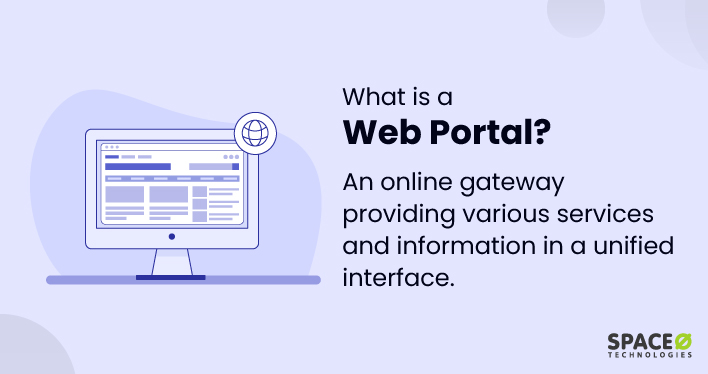
Every business today manages data across dozens of disconnected tools, from CRMs and project management platforms to email, HR systems, and customer databases. Employees waste hours switching between applications, and customers struggle to find the information they need.
A web portal solves this problem by bringing everything into one secure, personalized interface. But what exactly is a web portal? How does it differ from a regular website, and what types exist?
In this guide, we break down the complete web portal definition, walk through 11 types of web portals with real-world examples, compare portals versus websites, and cover the best practices that make portal projects successful.
Table of Contents
What is a Web Portal?
A web portal is a secure, centralized web-based platform that aggregates information, applications, and services from multiple sources into a single, unified interface. Unlike a standard website, a web portal provides authenticated, role-based access, so each user sees content and tools tailored to their specific needs.
Here is a simple web portal definition: a specially designed platform that acts as a single point of access, enabling users to discover, exchange, and collaborate on content without switching between multiple systems.
- A university’s web portal allows students to access their classes, grades, library, and email from a single dashboard.
- A bank’s portal allows users to manage money transfers, check balances, and update personal details from one centralized application.
- A hospital’s patient portal gives patients access to medical records, appointment scheduling, and prescription management through one secure login.
For example:
These web portal examples show the range of features that can be included during custom web portal development. If you want to understand how these platforms are built step by step, read our complete guide on how to create a web application.
People often confuse a web portal with websites, so before we dive deeper into web portals let us clear this confusion.
Web Portal vs Website: What is the Difference?
Understanding the difference between a web portal and a website is essential before investing in either. While they may look similar on the surface, they serve fundamentally different purposes.
A website presents the same static or semi-dynamic content to every visitor. A web portal, on the other hand, is a secure, personalized platform that adapts content, tools, and services based on who is logged in.
| Aspect | Website | Web Portal |
|---|---|---|
| Purpose | Inform, market, or present content to a general audience | Centralize services, tools, and data for specific user groups |
| User Access | Public and open to everyone | Authenticated with role‑based login |
| Content | Static or lightly dynamic | Dynamic and personalized per user |
| Functionality | Limited interactions like forms and downloads | Complex workflows, dashboards, and collaboration tools |
| Data Handling | Minimal user data | Manages sensitive and transactional data |
| Personalization | One‑size‑fits‑all experience | Tailored dashboards, content, and permissions for each role |
| Usage Pattern | Occasional visits | Frequent, repeated use |
Think of it this way: a website is like a brochure that anyone can pick up, while a web portal is like a personalized workspace that requires a key to enter and shows each person exactly what they need.
For a deeper comparison, including when to choose one over the other, read our guide on web app vs website.
When to choose a website
A website works when your primary goal is to inform a general audience: marketing pages, blogs, product catalogs, and landing pages. If every visitor sees the same content and no login is required, a website is a simpler and more cost-effective option.
When to choose a web portal
A web portal is the right choice when users need authenticated access to personalized data, workflows, or tools. Employee intranets, client dashboards, patient health records, and student management systems all require the security, role-based access, and integration capabilities that a portal provides.
Looking to Build a Custom Web Portal for Your Business?
Space-O Technologies has 15+ years of experience building secure, scalable web portal solutions for healthcare, education, finance, and enterprise clients. Get expert guidance on your portal project.
What are the Types of Web Portals?
There are several types of web portals, each serving different purposes and audiences. Here are a few of the many portals available on the Internet:
| Types of Web Portal | Web Portal Examples | Description |
|---|---|---|
| Horizontal Web Portals |
| A horizontal web portal platform offers a wide range of general content, services, and links, catering to a broad audience. This platform includes news, email, and community tools |
| Vertical Web Portals |
| Vertical portals is a portal that focuses on a specific industry or topic, providing specialized information, resources, and services. |
| Government Portal |
| Government portals are designed to enable users with all needful information about specific data, services, or announcements. |
| Student Portals |
| Student portals are also known as knowledge management portals used by educational institutions to offer students access to course materials, assignments, grades, and communication tools. |
| Corporate Portals |
| Corporate portals are online business portals that store, process, and maintain data on one single platform. It helps businesses to streamline workflow processes of customer services. |
| Vendor Portals |
| Vendor portals help in streamlining supply chain processes by aggregate data and managing interaction with suppliers including procurement, orders, invoices, and collaboration. |
| Patient portals |
| Patient portals offer patients access to personal health records, virtual medical personnel, appointment scheduling, prescription management, and communication with healthcare providers. |
To build a successful portal like the ones listed above, businesses often rely on web portal development services. A well-developed portal not only centralizes access to data and services but also delivers a personalized experience tailored to user roles and business needs. Whether you’re planning to create an educational, healthcare, corporate, or government portal, partnering with an experienced development team ensures scalability, security, and long-term performance.
Real-World Web Portal Examples
To better understand how web portals work in practice, here are widely used web portal examples from different industries:
1. Google (Horizontal portal)
Google functions as one of the most recognized web-based portal platforms in the world. Through a single Google account, users access Gmail, Google Drive, Google Calendar, Google Docs, YouTube, and more. Each service is personalized based on user activity and preferences. Google’s portal approach demonstrates how a horizontal portal can unify dozens of services under one authentication layer while maintaining a clean, accessible interface.
2. Microsoft SharePoint (Corporate portal)
SharePoint is a leading corporate portal solution that enables organizations to manage documents, collaborate on projects, automate workflows, and build internal knowledge bases. It integrates with the broader Microsoft 365 ecosystem for a unified employee experience.
3. MyChart by Epic (Patient portal)
MyChart is a widely adopted healthcare portal that allows patients to schedule appointments, view lab results, communicate with doctors, request prescription refills, and manage billing. It serves millions of patients across hospitals and clinics worldwide. Patient portals like MyChart illustrate how web portal solutions can reduce administrative overhead while improving patient satisfaction and care continuity.
4. IRS.gov (Government portal)
The IRS portal allows U.S. citizens to file taxes, check refund status, make payments, and access tax records online. It demonstrates how government web portal solutions can reduce the burden on physical offices while giving citizens 24/7 access to essential services. The portal handles hundreds of millions of transactions annually during tax season.
5. eBay (eCommerce portal)
eBay operates as a dual-sided eCommerce portal that provides distinct experiences for buyers and sellers. Sellers manage listings, track inventory, and process orders, while buyers browse products, place bids, and track purchases through personalized dashboards. This separation of user roles within a single portal is a textbook example of role-based portal design.
6. Workday (HR portal)
Workday is an enterprise HR portal used by organizations to manage the entire employee lifecycle, from recruitment and onboarding to payroll, benefits, learning, and performance reviews, through a single cloud-based interface.
Looking to Build a Portal Like These?
Whether you are planning to create a healthcare, education, corporate, or eCommerce portal, our team has delivered custom web portal solutions across industries for clients worldwide.
Build Use Case-Focused Web Portal Solutions With Space-O Technologies
A web portal is a centralized, role-based digital platform that brings together data, tools, and services in one secure place. From corporate and student portals to patient and government portals, web portals help organizations streamline workflows, improve communication, and deliver personalized user experiences. Choosing the right features, integrations, and architecture is key to ensuring scalability, security, and long-term performance.
For businesses planning to build a web portal, partnering with an experienced development team can make the process faster and more reliable. With 15+ years of experience, 350+ projects delivered, and 80+ in-house web developers, Space-O Technologies helps organizations build secure, scalable web portals across healthcare, education, finance, and enterprise sectors.
Connect with us today for a free consultation and get expert guidance on developing a web portal specifi to your requirements.
6 Top Benefits of Web Portal
Web portals offer numerous benefits for both businesses and users. Here are the 6 top advantages of using web portal:
Centralizes Information
Web portals offer a central hub for diverse information, from news to profiles, streamlining user access and reducing the need for multiple searches across sites.
Improves Communication
Web portals include messaging, forums, and comments to enhance user interaction and company-customer communication, nurturing community and connections.
Offers Data Collection and Analysis
Web portals aid data collection and analysis, tracking user behavior for insights. This informs decisions on management systems, enhancing content effectiveness and customer preferences.
Integrates with Multiple Applications
Web portals integrate with systems like CRM or ERP, enhancing data consistency and reducing manual data entry in online business operations.
Offers Personalization
Web portals often allow for a high degree of personalization. This means that each user can tailor their portal experience to their specific needs and preferences.
Saves Cost
By automating various processes and reducing the need for manual tasks, web portals can result in significant cost savings for businesses.
Provides 24/7 Access
Web portals are typically accessible 24/7, allowing users to access information or complete tasks at their convenience.
With the various benefits of web portals, it is important to discuss the best practices that can be advantageous while developing web portals. So, let’s check the best practices of web portals below.
6 Best Practices of Web Portal Development
Here are the 6 best practices that one should use while developing a web portal to make user experience user-friendly.
- Ensure a simple and intuitive interface that helps the users to navigate relevant information easily.
- Optimize the portal that can be easily operable from both desktop or mobile devices.
- Provide personalization services based on user preference and behavior.
- Keep your content management up-to-date by providing latest information and accurate data.
- Keep your portal upgraded with new features consistently.
- Implement data analytics and use aggregated data to improve your web portal performance.
A web portal is a personalized website that offers user-specific content, catering to specific information needs on one platform. If you are not sure how a portal differs from a website then read our post on web portal vs website with complete differences. This will help you get clarity on both kind of web applications.
Vertical portal, horizontal portal, and governmental portals are few of the most popular web based platforms that offer streamlined digital experience to users by being easily accessible from desktop or mobile device.
The key advantage of web portals lies in their tailored content, boosting customer engagement and delivering a comprehensive customer experience.



 All our projects are secured by NDA




 4.8
4.8