
 By
By 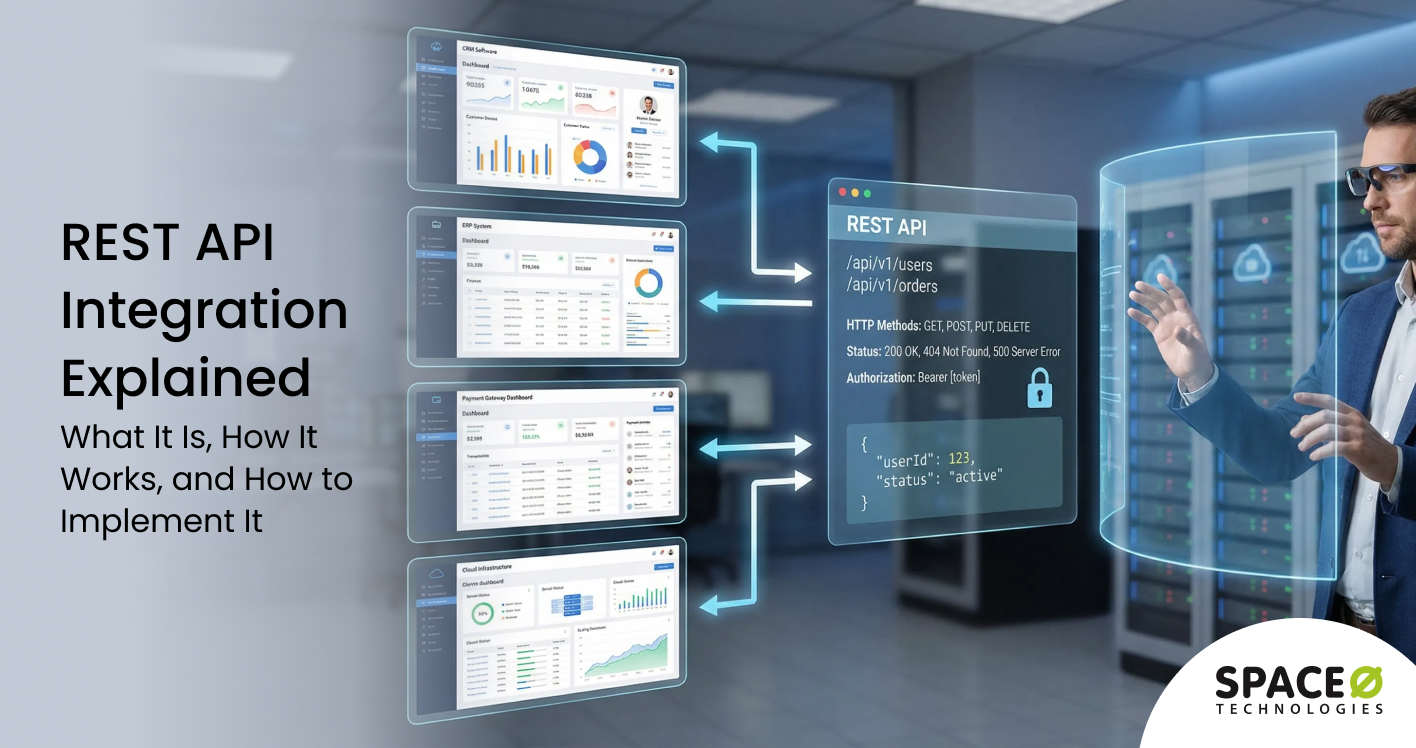
Contents
Every modern business depends on software systems that need to talk to each other. Whether it is a CRM syncing with an ERP, a payment gateway connecting with an e-commerce platform, or a mobile app pulling data from a cloud server, REST API integration makes it all possible.
According to Postman’s 2025 State of the API Report, REST API adoption remains dominant at 93%, making it the standard protocol for connecting business systems worldwide. With 82% of organizations now operating with an API-first approach, the demand for reliable REST API integration has never been higher.
Yet, many businesses still face challenges when connecting their systems. Data silos, inconsistent formats, security gaps, and performance bottlenecks make REST API integration a process that demands careful planning and execution. Without the right strategy, organizations risk broken workflows, duplicated data, and missed revenue opportunities.
This guide covers everything you need to know about REST API integration, from how it works and why it matters to best practices, security standards, and the tools that simplify the process. Whether you are evaluating custom API development services for your organization or planning to connect third-party platforms, this guide provides actionable steps to get it right.
Let’s start by understanding what REST API integration means and how it powers modern business systems.
What Is REST API Integration and How Does It Differ from Other Protocols?
REST API integration is the process of connecting two or more software systems using RESTful Application Programming Interfaces (APIs) that communicate over the HTTP protocol. REST, which stands for Representational State Transfer, is an architectural style that defines a set of rules for building web services that are lightweight, scalable, and easy to maintain.
If you are new to this space, our guide on API development covers the broader fundamentals before diving into integration specifics.
At its core, a REST API exposes endpoints, which are specific URLs that represent resources such as users, orders, or products. Client applications send HTTP requests to these endpoints, and the server responds with the requested data, typically in JSON format. This is the foundation that every custom API development project builds on, whether it is a simple two-system connection or an enterprise-wide integration.
Key components of REST API integration include:
- Endpoints: URLs that represent specific resources (for example, /api/v1/users)
- HTTP methods: GET (retrieve data), POST (create data), PUT (update data), DELETE (remove data)
- Status codes: Standardized response indicators such as 200 (OK), 201 (Created), 404 (Not Found), and 500 (Server Error)
- Headers: Metadata including authentication tokens, content type, and caching directives
- Payload/Body: The data sent or received, most commonly formatted as JSON
REST differs from other API architectures in several important ways. The following table highlights the key distinctions.
| Feature | REST API | SOAP | GraphQL | gRPC |
| Protocol | HTTP/HTTPS | HTTP, SMTP, TCP | HTTP/HTTPS | HTTP/2 |
| Data Format | JSON, XML | XML only | JSON | Protocol Buffers |
| Learning Curve | Low | High | Moderate | High |
| Performance | Good | Moderate | Good | Excellent |
| Caching | Built-in (HTTP caching) | Limited | Complex | Limited |
| Best For | Web services, mobile apps | Enterprise legacy systems | Complex queries | Microservices |
REST APIs are the preferred choice for most web and mobile integrations because of their simplicity, broad tooling support, and compatibility with virtually every programming language and platform.
With this foundation in place, let’s look at how REST API integration works at a technical level.
How REST API Integration Works: The Request-Response Lifecycle Explained
REST API integration follows a client-server communication model where the client sends an HTTP request, and the server returns a response. This exchange is stateless, meaning each request is independent and contains all the information the server needs to process it. The server does not store any client context between requests.
The request-response lifecycle
Every REST API interaction follows a predictable cycle:
- The client constructs a request. This includes the HTTP method (GET, POST, PUT, or DELETE), the endpoint URL, request headers (such as authentication tokens and content type), and an optional request body containing data.
- The server processes the request. The server validates the request, checks authentication and authorization, performs the requested operation (reading from a database, creating a record, or triggering a workflow), and prepares a response.
- The server returns a response. The response includes an HTTP status code, response headers, and a body containing the requested data or confirmation of the operation.
Data exchange patterns
REST API integrations typically follow one of these patterns depending on the business requirement:
- Synchronous request-response: The client sends a request and waits for the server to respond before proceeding. This is the most common pattern for standard CRUD operations.
- Webhooks (event-driven): The server pushes data to the client when a specific event occurs, such as a new order being placed or a payment being processed. This eliminates the need for constant polling.
- Polling: The client periodically sends requests to check for updates. While simpler to implement, polling is less efficient than webhooks for real-time scenarios.
- Asynchronous processing: The server accepts the request, returns an acknowledgment immediately, and processes the operation in the background. The client checks the status later using a separate endpoint.
Authentication in the request flow
Before any data exchange occurs, the client must prove its identity. Common authentication mechanisms include API keys passed in request headers, OAuth 2.0 tokens for delegated access, and JWT (JSON Web Tokens) for stateless authentication. The chosen method depends on the security requirements of the integration.
Organizations that rely on api integration services for connecting multiple platforms must carefully evaluate which authentication pattern fits their architecture.
Understanding these mechanics is essential, but the real value of REST API integration lies in the business outcomes it enables. Let’s explore why organizations across industries are prioritizing it.
Why Businesses Need REST API Integration: Key Benefits That Drive ROI
REST API integration has become a strategic priority for businesses of all sizes. As organizations adopt more software platforms to manage different functions, the need to connect these systems into a unified ecosystem grows stronger every year. Here are the key benefits.
Real-time data synchronization
REST API integration enables instant data exchange between systems, ensuring that inventory levels, customer records, and transaction data stay consistent across every platform without manual intervention. When a customer updates their shipping address in the CRM, that change reflects in the order management system, the shipping platform, and the marketing tools within seconds.
Automated business workflows
By connecting CRM, ERP, marketing automation, and communication tools through REST APIs, businesses eliminate repetitive manual data entry and reduce the errors that come with it. Tasks that previously required employees to copy data between systems, such as updating lead statuses or triggering follow-up emails, happen automatically the moment a qualifying event occurs.
Scalable system architecture
REST APIs are designed around stateless communication, which means each request operates independently. This makes it straightforward to scale horizontally by adding more servers as traffic grows.
Leading API development companies build REST API architectures that handle ten times the traffic without requiring structural changes, giving businesses the flexibility to grow without rebuilding their integration layer.
Cost-effective connectivity
Instead of building custom point-to-point integrations for every system pair, REST APIs provide a standardized interface that any application can consume, significantly reducing development and maintenance costs. A single REST API endpoint can serve a mobile app, a web application, a partner portal, and an analytics dashboard at the same time.
Improved customer experience
Connected systems mean faster order processing, accurate inventory displays, personalized recommendations, and real-time status updates, all of which directly impact customer satisfaction and retention. Customers no longer experience the friction of outdated information or delayed updates caused by disconnected systems.
Faster time-to-market
With REST APIs, development teams can integrate third-party services such as payment processing, geolocation, and analytics in days instead of weeks, accelerating feature delivery and product launches. This speed advantage compounds over time, as each new integration builds on a proven architecture rather than starting from scratch.
These benefits apply across industries. Let’s examine how different sectors use REST API integration to solve specific business challenges.
REST API Integration Use Cases: How Different Industries Apply It
REST API integration powers critical business operations in nearly every industry. The following examples illustrate how different sectors apply it to solve real-world problems.
E-commerce and retail
REST API integration connects payment gateways like Stripe and PayPal, synchronizes inventory across multiple sales channels, automates order fulfillment workflows, and enables real-time shipping rate calculations. Without these integrations, managing a multi-channel retail operation would require extensive manual coordination.
E-commerce platforms also use REST APIs to power product recommendation engines, customer review systems, and dynamic pricing tools that respond to market conditions in real time.
Healthcare
Healthcare organizations rely on REST API integration to exchange patient data between Electronic Health Record (EHR) systems, laboratory information systems, and telehealth platforms.
The HL7 FHIR standard, built on RESTful principles, has become the industry standard for healthcare data interoperability. REST APIs enable healthcare development teams to build compliant solutions that facilitate patient data access while meeting HIPAA requirements.
Fintech and financial services
Financial institutions use REST API integration for payment processing, account management, fraud detection, and open banking compliance. Under regulations like PSD2 in Europe, banks are required to expose REST APIs that allow authorized third-party providers to access account data and initiate payments. This has driven the growth of custom API development focused on secure, compliant API architectures.
SaaS platforms
SaaS companies depend on REST API integration to connect with customer systems, enable data synchronization between platforms, and build integration marketplaces that increase product stickiness. A SaaS development project often involves building both internal APIs for microservice communication and external APIs for customer-facing integrations.
Manufacturing and IoT
In manufacturing, REST API integration connects IoT sensors, supply chain management systems, and production monitoring dashboards. Real-time data from factory floor devices flows through REST APIs to centralized analytics platforms, enabling predictive maintenance, quality control, and supply chain visibility.
Now that you understand where REST API integration fits across industries, let’s look at the tools and technologies that make these integrations possible.
REST API Integration Tools and Technologies: What to Use and When
Choosing the right tools is critical for building, testing, and managing REST API integrations effectively. The right combination of api development tools reduces development time, catches errors early, and provides visibility into how your integrations perform in production.
The following table categorizes the most widely used tools by function.
| Category | Tool | Best For |
| Design and Documentation | Swagger/OpenAPI | Defining API specifications and generating interactive documentation |
| Design and Documentation | Stoplight Studio | Visual API design with collaborative features |
| Testing | Postman | Manual and automated API testing, collection-based workflows |
| Testing | Insomnia | Lightweight REST and GraphQL testing |
| Testing | SoapUI | Comprehensive SOAP and REST API testing |
| Testing | JMeter | Load testing and performance benchmarking |
| API Gateway | AWS API Gateway | Serverless API management with AWS integration |
| API Gateway | Kong | Open-source API gateway with plugin ecosystem |
| API Gateway | Google Cloud Apigee | Enterprise API management and analytics |
| Monitoring | Moesif | API analytics, user behavior tracking, and monetization |
| Monitoring | Datadog | Full-stack monitoring including API performance metrics |
| Integration Platform | MuleSoft Anypoint | Enterprise-grade integration platform (iPaaS) |
| Integration Platform | Zapier | No-code workflow automation for SaaS integrations |
When selecting tools, consider your team’s technical expertise, the number of integrations you need to manage, security requirements, and budget constraints. For simple integrations, Postman and Swagger may be sufficient. For enterprise-scale integrations, platforms like MuleSoft or Apigee provide the governance and analytics capabilities required.
Selecting the right api development tools early in the project lifecycle avoids costly rework and ensures your team can test, monitor, and iterate efficiently from day one.
With the right tools in hand, let’s walk through the step-by-step process of implementing a REST API integration.
How to Implement REST API Integration: A 6-Step Process from Planning to Deployment
Implementing REST API integration requires methodical planning and execution. Rushing through the process often leads to brittle integrations that break when systems change. The approach you take in the early stages, from defining requirements to choosing authentication methods, determines whether your integration will scale reliably or become a maintenance burden within months.
Every successful REST API integration project follows a structured sequence. Skipping steps or cutting corners during planning almost always results in rework later. Here is the process our teams follow across custom API development projects.
Step 1: Define integration requirements and map data flows
Before writing any code, document exactly what data needs to flow between systems, in which direction, and how frequently. This is the foundation that every subsequent decision builds on. A clear requirements document prevents scope creep, eliminates assumptions, and ensures alignment across development, product, and business teams from the start.
- Identify the source and destination systems for each data exchange
- Map the specific data fields that need to be synchronized
- Define data transformation rules for format differences between systems
- Specify frequency requirements (real-time, near-real-time, or batch)
- Document business rules that govern data validation and conflict resolution
Step 2: Select the authentication method
Authentication protects your API from unauthorized access and is one of the first technical decisions in any integration project. The right method depends on your security requirements, the sensitivity of the data involved, and the trust relationship between the systems being connected. Choosing the wrong authentication approach early on creates security gaps that are difficult and expensive to fix after deployment.
- Use API keys for simple, internal integrations with low-risk data
- Choose OAuth 2.0 when users need to grant third-party applications access to their accounts
- Implement JWT (JSON Web Tokens) for stateless, scalable authentication across microservices
- Consider mTLS (mutual TLS) for high-security environments such as financial services or healthcare
Step 3: Design endpoint structure and request/response formats
Well-designed endpoints make your API intuitive for developers and easier to maintain over time. A consistent structure reduces onboarding time and minimizes integration errors. Endpoint design decisions are difficult to reverse once external systems depend on them, so investing time in getting the structure right at this stage pays dividends throughout the lifecycle of the integration.
- Use resource-oriented nouns in endpoint paths (for example, /api/v1/orders instead of /api/v1/getOrders)
- Implement versioning from the start (URL-based versioning like /v1/ is the most common approach)
- Standardize response formats, including data structure, pagination, and error messages
- Define rate limits and document them clearly for consuming applications
Step 4: Develop the integration layer
This is where the actual connection between systems is built. The integration layer handles request construction, response parsing, error handling, and data transformation. A well-architected integration layer abstracts the details of each connected system, making it possible to modify or replace individual connections without disrupting the overall data flow.
- Build middleware or adapter components that translate data between system-specific formats
- Implement retry logic with exponential backoff for transient failures
- Add logging at every integration point for debugging and monitoring
- Use environment-specific configuration for development, staging, and production endpoints
Step 5: Test thoroughly
Testing is non-negotiable for API integrations. A single untested edge case can break data flows and disrupt business operations. Effective API testing goes beyond verifying that endpoints return the correct responses. It must also cover failure scenarios, load conditions, and security vulnerabilities to ensure the integration holds up under real-world conditions.
- Unit tests: Verify individual functions that construct requests and parse responses
- Integration tests: Validate end-to-end data flow between connected systems
- Contract tests: Confirm that the API conforms to its documented specification
- Load tests: Verify performance under expected and peak traffic conditions
- Security tests: Check for common vulnerabilities, including injection attacks and broken authentication
Step 6: Deploy, monitor, and maintain
Deployment is not the end of the process. REST API integrations require ongoing monitoring and maintenance to remain reliable as connected systems evolve. Third-party APIs change their schemas, deprecate endpoints, and update rate limits without advance notice. A proactive monitoring and maintenance strategy ensures these changes do not disrupt your business operations.
- Set up automated monitoring for response times, error rates, and throughput
- Configure alerts for anomalies such as sudden spikes in error rates or latency
- Establish a process for handling API version deprecations from third-party providers
- Schedule regular reviews to identify optimization opportunities
If you need a team to handle this process end-to-end, the decision to hire API developers with deep experience in REST architecture and system integration is often the difference between a project that ships on time and one that stalls in development.
Building on the implementation process, let’s cover the best practices that separate reliable REST API integrations from fragile ones.
Ready to Implement REST API Integration for Your Business?
Our developers have built REST API integrations across healthcare, fintech, e-commerce, and SaaS. Share your integration requirements and get a detailed project roadmap with architecture recommendations and a cost estimate.

REST API Integration Best Practices Every Development Team Should Follow
Following established best practices ensures your REST API integrations are maintainable, performant, and secure. These guidelines come from industry standards and real-world project experience across thousands of API implementations.
Use resource-oriented endpoint design
Structure endpoints around resources (nouns) rather than actions (verbs). For example, use GET /api/v1/users to retrieve users, not GET /api/v1/getUsers. This aligns with REST conventions and makes the API predictable for any developer consuming it. Resource-oriented design also simplifies documentation and reduces ambiguity when multiple teams work on the same API.
Implement API versioning from day one
APIs evolve over time, and breaking changes can disrupt every connected system. URL-based versioning (/v1/, /v2/) is the most widely adopted approach because it is explicit and easy to manage. Starting with versioning from the initial release avoids the painful process of retrofitting it later when external consumers are already depending on your endpoints.
Standardize error responses
Every error response should include a consistent structure with an HTTP status code, a machine-readable error code, and a human-readable message. This enables consuming applications to handle errors programmatically rather than relying on string matching or guesswork.
{
“status”: 400,
“error”: “VALIDATION_ERROR”,
“message”: “The ’email’ field must be a valid email address.”,
“timestamp”: “2026-02-04T10:30:00Z”
}
Use pagination for large datasets
Never return unbounded result sets. Implement cursor-based or offset-based pagination and include metadata such as total count, page size, and navigation links in the response. Unbounded responses cause memory issues on both client and server, degrade performance under load, and create unpredictable latency spikes that are difficult to diagnose.
Apply rate limiting and throttling
Protect your API from abuse and ensure fair resource allocation by enforcing request limits. Return 429 Too Many Requests when limits are exceeded, along with a Retry-After header. Rate limiting also provides a natural feedback mechanism that helps consuming applications identify and fix inefficient request patterns.
Maintain comprehensive documentation
Use OpenAPI (Swagger) specifications to document every endpoint, parameter, request body, and response format. Keep documentation in sync with the actual API at all times. Teams pursuing api modernization services often discover that outdated or missing documentation is the single biggest barrier to upgrading legacy integrations, making this practice essential from day one.
These best practices provide a strong foundation. However, security deserves a dedicated focus given the growing threat landscape for APIs. Let’s examine the security standards that every REST API integration must follow.
Need Expert Help with Your REST API Architecture?
Our team at Space-O Technologies specializes in building scalable, well-documented REST API integrations. Discuss your project with our API architects today.
REST API Integration Security Standards: Authentication, Encryption, and Access Control
API security cannot be an afterthought. As businesses expose more endpoints to connect with partners, customers, and third-party platforms, the attack surface grows. Every REST API integration must implement security measures from the ground up, treating authentication, encryption, and access control as core architectural requirements rather than optional enhancements.
API key authentication
API keys are the simplest form of authentication. The client includes a unique key in the request header, and the server validates it against a registry. While easy to implement, API keys provide identification but not true authorization. They are best suited for internal integrations or low-risk scenarios where granular access control is not required.
OAuth 2.0 for delegated access
OAuth 2.0 is the industry standard for authorizing third-party access to user resources without sharing credentials. It uses access tokens with defined scopes and expiration times. OAuth 2.0 is essential for any integration where users grant applications access to their accounts, such as connecting a marketing tool to a CRM.
JWT for stateless token-based authentication
JSON Web Tokens enable stateless authentication, where the token itself contains all the information the server needs to verify the request. JWTs are compact, self-contained, and widely supported. They are particularly effective in microservices architectures where maintaining server-side sessions is impractical.
mTLS for high-security environments
Mutual TLS requires both the client and server to present certificates during the handshake, providing two-way authentication. This level of security is common in fintech, healthcare, and government integrations where data sensitivity demands the highest assurance. Organizations in these sectors rely on mTLS to meet regulatory compliance requirements for secure data exchange.
Data protection fundamentals
Beyond authentication, every REST API integration must implement:
- HTTPS/TLS enforcement: Encrypt all data in transit. Never allow unencrypted HTTP connections.
- Encryption at rest: Protect stored data, including API keys, tokens, and sensitive business data.
- Role-based access control (RBAC): Limit what each authenticated user or application can access based on assigned roles.
- Input validation: Sanitize all incoming data to prevent injection attacks.
- Audit logging: Record all API access for compliance, forensic analysis, and anomaly detection.
Organizations pursuing api modernization services often find that outdated authentication mechanisms and missing encryption are the first issues that need to be addressed before any other improvements can take effect.
Security challenges are just one category of obstacles that teams face during REST API integration. Let’s look at the full spectrum of common challenges and practical solutions.
Common REST API Integration Challenges and Proven Solutions to Overcome Them
Even with solid planning, REST API integration projects encounter predictable obstacles. Understanding these challenges upfront enables teams to build mitigations into their project plan rather than reacting to problems after deployment.
1. Authentication and security vulnerabilities
Weak authentication, exposed endpoints, and insufficient encryption create attack surfaces that bad actors actively exploit. Organizations often underestimate the complexity of securing APIs that face the public internet. A single misconfigured endpoint can expose sensitive business data or customer information to unauthorized access.
How to overcome:
- Implement OAuth 2.0 or JWT instead of relying solely on API keys for external-facing APIs
- Enforce HTTPS across all environments, including development and staging
- Rotate API keys and tokens on a regular schedule
- Conduct quarterly security audits and penetration tests
- Monitor API traffic for anomalies that indicate credential stuffing or brute-force attacks
2. Data format inconsistencies across systems
Different applications use different data structures, naming conventions, date formats, and encoding standards. A customer “name” field might be a single string in one system and split into “first_name” and “last_name” in another. These mismatches cause integration failures and data quality issues that cascade downstream into reports, dashboards, and customer-facing features.
How to overcome:
- Build a data transformation layer that maps fields between source and destination schemas
- Define canonical data models that serve as a neutral format between systems
- Handle null values, empty strings, and missing fields explicitly in your transformation logic
- Validate incoming data against expected schemas before processing
3. Rate limiting and throttling from third-party providers
External APIs impose request limits to protect their infrastructure. When your integration exceeds these limits, requests get rejected with 429 status codes, causing data synchronization gaps and broken workflows. This is especially problematic during peak business periods when API call volumes surge.
How to overcome:
- Implement request queuing with priority-based processing
- Use exponential backoff with jitter for retry logic
- Cache responses locally to reduce redundant API calls
- Monitor usage against provider limits and set alerts at 80% threshold
4. Versioning and backward compatibility
When API providers release new versions or deprecate endpoints, integrations built against older versions can break without warning. Managing version transitions across multiple integrations compounds this challenge. Organizations that do not plan for version changes end up scrambling to fix broken connections under time pressure.
How to overcome:
- Subscribe to API provider changelogs, deprecation notices, and developer newsletters
- Build integration tests that run against the live API on a regular schedule to catch breaking changes early
- Abstract API calls behind an adapter layer so that version changes require updates in one place only
- Plan version migration sprints into your regular development cycle
5. Performance bottlenecks during peak traffic
REST API integrations that perform well under normal loads can degrade significantly during traffic spikes. Poorly optimized integrations lead to slow response times, timeout errors, and failed transactions. For e-commerce, fintech, and SaaS platforms, performance degradation translates directly into lost revenue and damaged customer trust.
How to overcome:
- Implement caching at multiple levels (HTTP caching headers, CDN, application cache, distributed cache with Redis)
- Use asynchronous processing for operations that do not require immediate responses
- Deploy API gateways with load balancing to distribute traffic across multiple backend instances
- Set up auto-scaling rules that add capacity based on real-time traffic metrics
6. Error handling and failure recovery in distributed systems
When one system in an integration chain fails, the failure can cascade to every connected application. Without proper error handling, a single API timeout can leave data in an inconsistent state across multiple systems. Recovering from partial failures requires deliberate design patterns that most teams overlook during initial development.
How to overcome:
- Implement the circuit breaker pattern to prevent cascading failures
- Use idempotency keys for operations that must not be duplicated (especially payments and order creation)
- Build dead-letter queues for messages that fail processing after multiple retries
- Design compensation logic (rollbacks) for multi-step transactions that fail partway through
If tackling these challenges feels overwhelming, understanding the api development cost of professional integration services can help you make an informed build-versus-buy decision for your project.
Don’t Let Integration Challenges Slow Down Your Business
Stop firefighting broken integrations. Space-O Technologies builds REST API architectures with built-in security, error recovery, and scalability so your systems stay connected as your business grows.
Build Your REST API Integration with Space-O Technologies
REST API integration is the backbone of connected business systems. From automating data exchange and eliminating manual workflows to enabling real-time synchronization across platforms, the right integration strategy directly impacts your operational efficiency and bottom line.
Space-O Technologies has been delivering software solutions since 2010, with 15+ years of hands-on experience, and 1,200+ clients across 35+ countries. We are the team behind Glovo, a $1.2 billion unicorn, and Fyule, an EdTech startup that secured $1.4 million in funding.
Our 140+ in-house developers bring deep expertise in backend development, enterprise software development, and complex system integrations. From custom API development and third-party connectivity to api modernization services and performance optimization, we cover the full integration lifecycle.
Stop letting disconnected systems hold your business back. Schedule a free consultation with our API architects today to discuss your requirements, get a detailed project estimate, and start building integrations that scale with your business.
Frequently Asked Questions About REST API Integration
How much does REST API integration cost?
REST API integration costs vary based on complexity. Simple integrations connecting two systems with standard authentication cost between $5,000 and $20,000. Moderately complex integrations with multiple systems, data transformation, and custom middleware range from $15,000 to $50,000. Enterprise-grade integrations with real-time processing, advanced security, and high-availability requirements can exceed $50,000–$250,000.
What is the difference between REST API and SOAP API?
REST APIs use HTTP protocol, support multiple data formats like JSON and XML, and follow a lightweight architecture. SOAP APIs use XML exclusively, require strict standards like WSDL, and offer built-in security features. REST is preferred for modern applications, while SOAP is used in enterprise environments requiring strict contracts.
How long does it take to integrate a REST API?
Simple REST API integrations take one to two weeks. Integrations involving multiple systems and custom transformations take four to eight weeks. Enterprise integrations with compliance and legacy system connectivity can take three to six months depending on complexity.
What are the most common REST API authentication methods?
The most common methods include API keys, OAuth 2.0, JWT (JSON Web Tokens), and mTLS. OAuth 2.0 and JWT are the most widely used for secure production environments.
Can REST APIs handle real-time data synchronization?
REST APIs support near-real-time synchronization through polling and webhook-based architectures. For true real-time streaming, WebSockets are preferred, but most business use cases work effectively with webhook-based REST integrations.
What tools are best for REST API integration testing?
Postman is widely used for manual and automated testing. Apache JMeter and k6 are used for performance testing, SoapUI supports both REST and SOAP, and Pact is used for contract testing. Teams often combine tools based on testing needs.
How do you secure a REST API integration?
Security includes authentication (OAuth 2.0 or JWT), HTTPS/TLS encryption, role-based access control, input validation, rate limiting, and audit logging. Regular security testing ensures protection against vulnerabilities.
What engagement models does Space-O Technologies offer for API projects?
Space-O Technologies offers dedicated team, time and materials, and fixed-price models. The dedicated team model is often recommended for REST API integrations due to its flexibility and support for iterative development.
Does Space-O Technologies provide post-deployment API support?
Yes. Space-O provides maintenance services including monitoring, security updates, version upgrades, bug fixes, and performance optimization to ensure long-term stability.
What industries has Space-O Technologies built REST API integrations for?
Space-O Technologies has built API integrations for healthcare, fintech, e-commerce, SaaS, manufacturing, logistics, and education, including compliant and high-performance systems tailored to each industry.
How does Space-O Technologies ensure API security and compliance?
They implement multi-layered security including OAuth 2.0, JWT, HTTPS encryption, RBAC, input validation, and audit logging, while adhering to standards like HIPAA, PCI-DSS, SOC 2, and GDPR.
Can Space-O Technologies modernize legacy APIs?
Yes. Space-O offers API modernization services including migration from SOAP to REST, API gateway implementation, modern authentication, containerization, and observability, ensuring scalable and future-ready systems.



 All our projects are secured by NDA




 4.8
4.8