
 By
By 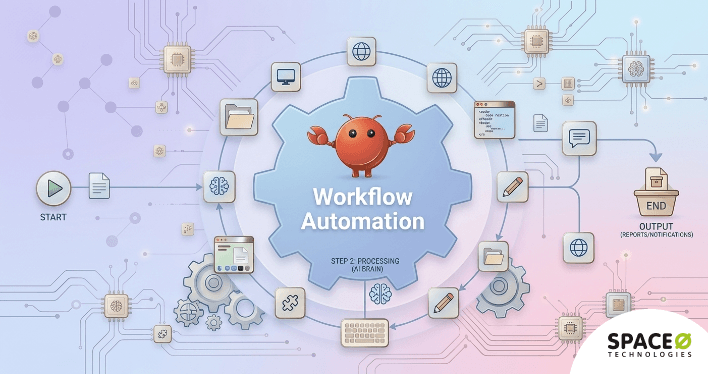
Contents
Workflow automation has stopped being a luxury in modern business. It is now an operational necessity for companies that want to stay competitive. Manual processes waste employee time and create costly errors every single day. OpenClaw has emerged as a powerful, open-source solution to this challenge. If you are new to the platform, start with our guide on what OpenClaw is to understand its core capabilities before diving into OpenClaw workflow automation.
It automates complex, multi-step workflows independently and without cloud dependencies. Your messaging apps become the command center for every automation task your team runs.
According to Gartner, 40% of enterprise applications will include task-specific AI agents by 2026, up from under 5% in 2025. This shift reflects genuine business urgency, not just technology curiosity. Companies that build automation capabilities now will carry structural advantages for years ahead. OpenClaw workflow automation makes enterprise-grade automation accessible to businesses of every size and budget.
The competitive advantage today belongs to companies that move early. Businesses delaying automation fall progressively and measurably further behind. OpenClaw democratizes access to intelligent workflow execution without requiring extensive coding skills. Complex, multi-step processes become manageable with the right approach and the right partner. This guide covers everything your team needs to evaluate, plan, and deploy OpenClaw automation successfully.
What is OpenClaw Workflow Automation?
OpenClaw is an open-source AI agent framework designed specifically for business workflow automation. Unlike traditional automation tools that require rigid, pre-built rule sets, OpenClaw operates through natural language instructions. It runs on any standard server or local machine your organization already manages. The platform executes tasks autonomously based on your specifications and adapts when circumstances change. You send instructions through messaging apps your team already uses, and the agent handles execution end-to-end.
The core strength of OpenClaw lies in its combination of flexibility and intelligent decision-making. It does not just follow rigid, sequential, rule-based processes anymore. The system makes decisions based on context, available data, and defined business rules. Workflows adapt when situations change unexpectedly, without human intervention. Error handling executes gracefully so critical processes continue reliably under real-world conditions.
How OpenClaw differs from traditional automation tools
Traditional automation platforms like Zapier or n8n require fully pre-defined workflows before a single task can run. Every trigger, condition, and action must be manually mapped out before deployment. OpenClaw approaches this problem differently by interpreting your intent and building execution paths dynamically. It considers factors like context, task priority, and available data before acting. This makes it far more capable of handling the unpredictable, variable nature of real business operations.
The table below shows how OpenClaw compares to the most widely used automation platforms across the decisions that matter most to business buyers.
| Feature | OpenClaw | Zapier | n8n | Make (Integromat) |
| Automation style | Agentic AI adapts dynamically to context | Trigger-action, fully pre-defined | Deterministic, step-by-step visual flows | Node-based, manually configured |
| User interaction | Messaging-first via WhatsApp, Slack, Telegram | Web dashboard | Visual editor | Visual node editor |
| Workflow flexibility | High, chains multiple tasks and adapts | Moderate, within pre-defined triggers | Structured, executes exactly as configured | Moderate, requires manual setup |
| Proactivity | Suggests actions, follows up, and prioritizes | Reactive only, runs on triggers | Reactive only, runs on triggers | Reactive only, runs on triggers |
| Data privacy | Local, self-hosted data stays on your infrastructure | Vendor cloud | Self-hostable | Vendor cloud |
| Error handling | Graceful recovery, adapts to failures dynamically | Limited fallback options | Defined error paths per node | Defined error paths per node |
| Ease of setup | Moderate, technical users, under one hour | Very easy, no code needed | Moderate, visual editor | Moderate, some setup complexity |
| Cost model | Free and open-source, pay only for the LLM API | Subscription from $19.99/month | Free self-hosted, paid cloud | Subscription from $9/month |
OpenClaw is not the right choice for every team, and the comparison above makes that clear. But for businesses that need intelligent, context-aware automation with complete data ownership, it holds a clear and measurable advantage. Understanding what problems it solves is the next step before evaluating whether it belongs in your stack.
Why OpenClaw Workflow Automation Matters in 2026
Manual workflows drain productivity from every modern organization at every level. Employees repeat similar tasks dozens of times daily without adding any strategic value. These repetitive actions create mental fatigue, inconsistency, and preventable errors. OpenClaw workflow automation liberates your team for the work that actually drives growth. Boring, repetitive tasks disappear so your people can focus on judgment-based, creative, and relationship-driven work.
According to Grand View Research, the global AI agents market reached USD 7.63 billion in 2025 and is projected to hit USD 10.91 billion by 2026, growing to USD 182.9 billion by 2033. This trajectory confirms that intelligent automation is not a niche technology trend. It is becoming foundational infrastructure for competitive businesses across every industry. Companies that build automation expertise today will not have to play catch-up later.
The business pressure to automate is coming from multiple directions at once. Here is what is driving urgency in 2026:
- Competitor momentum: Early adopters are already compressing costs and response times, creating gaps that widen every quarter for businesses still running manual processes.
- Talent and retention pressure: Skilled employees increasingly expect tools that eliminate busywork. Organizations that do not automate struggle to attract and keep top performers.
- Customer expectations: Buyers now expect instant responses, accurate order tracking, and proactive communication. Manual processes cannot consistently meet that bar.
- Regulatory and audit complexity: Compliance requirements are growing across every regulated industry, and automated workflows with full audit trails are far easier to defend than manual ones.
Accelerate Your Business Workflow Automation Journey
Our workflow automation experts design custom solutions that integrate seamlessly with your existing systems.

Key Benefits of OpenClaw Workflow Automation
OpenClaw delivers value that goes beyond generic automation. Its local-first architecture, natural language interface, and modular plugin system create operational advantages that most commercial platforms cannot replicate. Each benefit compounds over time as your automation footprint grows and your team builds internal expertise. Here are the outcomes organizations report most consistently after deployment.
- Reduced labor costs: OpenClaw eliminates repetitive manual work across your organization, allowing employees to focus on meaningful tasks and driving monthly savings that compound as automations mature and multiply.
- Improved accuracy and consistency: The platform executes workflows identically every single time, which reduces error rates dramatically and makes compliance documentation significantly easier to maintain.
- Faster process completion: Automation removes the bottlenecks that slow operations, completing in minutes what previously took hours and improving competitive positioning through faster delivery.
- Enhanced employee satisfaction: Your team appreciates being freed from tedious, repetitive work, which increases engagement and reduces the turnover that makes recruitment and training so costly.
- Scalability without proportional cost increases: Automations handle growing volumes as demand rises, so business growth does not require proportional increases in headcount or infrastructure spend.
- 24/7 operations without human presence: Workflows execute continuously regardless of business hours, so global teams, time-zone customers, and critical overnight processes are never left waiting.
These advantages make the business case for OpenClaw straightforward to present at every level of an organization. The financial impact becomes even clearer when you examine how the platform actually works under the hood. Understanding the architecture helps both technical and non-technical teams configure it effectively from the start.
How OpenClaw Workflow Automation Works
OpenClaw’s automation architecture operates through four distinct but interconnected layers. Each layer handles a specific responsibility in the execution pipeline. Together, they create seamless, reliable workflow automation across every system your business uses. Understanding how the layers connect helps you design better automations and diagnose issues faster when something does not behave as expected.
1. The triggering and initiation layer
Every workflow starts with a trigger that tells the agent to begin. OpenClaw supports a broad range of initiation methods to fit every business context. Messages sent through Telegram, Slack, or WhatsApp launch task sequences immediately. Scheduled time events trigger routine automations without any human input. API calls from external systems, webhooks, and database changes all activate corresponding workflows. This breadth of trigger options means OpenClaw can plug into virtually any existing process without rebuilding your stack.
2. The decision and logic execution layer
Once triggered, the agent passes the instruction through the decision and logic layer. This is where the intelligence that separates OpenClaw from simple rule-based tools lives. Conditional branches send workflows through different paths based on real-time data and context. Data validation blocks prevent invalid inputs from progressing through the pipeline. Business rules enforce policies consistently across thousands of executions without drift or exception. Error conditions trigger defined recovery procedures, so failures resolve gracefully rather than silently.
3. The action and integration layer
The action layer is where OpenClaw does the actual work inside your connected systems. Database records are updated to reflect new information as soon as conditions are met. External APIs receive calls to coordinate actions across third-party services. Emails, messages, and notifications go to the right recipients automatically based on workflow logic. File operations organize, move, and archive documents without any manual involvement. The platform connects to hundreds of tools through a modular plugin system, and custom connectors extend that coverage to legacy and proprietary software.
4. The monitoring and reporting layer
Every action OpenClaw takes is captured by the monitoring and reporting layer in real time. Detailed execution logs track each step so your team has full visibility into what ran, when, and with what outcome. Performance metrics surface optimization opportunities that would otherwise remain invisible. Error notifications alert administrators immediately when a workflow encounters a problem. Reporting dashboards show cumulative automation impact across departments. This visibility is what enables continuous improvement and gives compliance teams the audit trails they need.
With a clear picture of how the architecture works, you can evaluate OpenClaw’s real-world capabilities with confidence. The next section breaks down practical automation examples across the most common business functions.
Struggling With Manual Workflows?
Let’s identify your highest-impact automation opportunities and build custom solutions that deliver measurable ROI.
Real-World OpenClaw Workflow Automation Examples
OpenClaw’s flexibility makes it genuinely valuable across a wide range of business functions and team types. The examples below represent the highest-impact starting points for most organizations. Each one delivers measurable time savings and error reduction from the very first week of operation. To see a broader set of applications across specific industries and departments, explore the detailed use cases of OpenClaw that teams are running in production today.
Email and communication automation
Email management is one of the first areas most teams automate because the time savings are immediate and visible. New customer inquiries trigger welcome and qualification sequences without any manual involvement. Important messages get flagged automatically for priority handling based on sender, subject, or keyword rules. Routine questions receive templated responses the moment they arrive. Communication workflows commonly save five to ten hours per person each week across support, sales, and operations teams.
Finance and expense management automation
Finance teams waste enormous amounts of time on manual data entry that OpenClaw can eliminate. Receipt images get scanned and categorized automatically as soon as they are submitted. Expense reports are generated without anyone sitting down to type in line items. Budget alerts notify the right managers the moment spending approaches defined limits. The reimbursement requests process has complete, audit-ready trails that require no human assembly.
Customer support automation
Support automation improves both response speed and team capacity simultaneously. Incoming tickets route to the right specialists based on category, urgency, and customer tier. Common questions receive accurate, automated answers pulled from your knowledge base. Ticket status updates notify customers automatically at each stage without agent involvement. Escalation rules ensure urgent issues reach a human immediately, so nothing critical falls through. First-contact resolution rates typically rise by 25% or more after a well-structured deployment.
Infrastructure and DevOps monitoring
Engineering teams use OpenClaw to eliminate manual on-call burden and reduce mean time to recovery. Server performance metrics trigger alerts and corrective scripts as soon as thresholds are crossed. Disk space cleanup runs automatically when capacity approaches a defined limit. Failed services restart without any human intervention during off-hours. Security logs get analyzed continuously for suspicious patterns, not just during business hours.
Project management and coordination
Project coordination becomes largely self-managing when OpenClaw handles the administrative layer. Task assignments trigger notifications to the right team members the moment they are created. Status updates happen without manual effort as linked tasks are completed. Project dashboards refresh automatically with current data from connected tools. Resource allocation becomes visible across the organization without weekly status meetings to gather the information.
The examples above represent a fraction of what teams are running in production across industries today. The business impact compounds as you expand from one automation to a coordinated program. Measuring that impact accurately is what keeps stakeholder support strong as your program scales.
How to Measure ROI and Implementation Success of OpenClaw Workflow Automation
Understanding your return on investment is critical for building and maintaining stakeholder support. OpenClaw workflow automation typically delivers positive ROI within three to six months of initial deployment. Most businesses see measurable cost savings before they encounter any significant implementation complexity. Establishing baseline measurements before launch is the only way to demonstrate impact clearly over time.
1. Labor cost savings
Calculate the total hours your team spends on automatable tasks every month. Multiply those hours by the fully loaded cost per employee to establish your savings target. Most organizations save between one and three thousand dollars monthly per automation deployed. Scale that across ten or fifteen workflows, and the annual impact becomes easy to present to leadership.
2. Process speed improvements
Measure current processing time for each target workflow before automation goes live. After deployment, track new completion times and calculate the reduction. Faster processing enables quicker revenue recognition and improved order-to-cash cycles. These liquidity improvements often exceed the direct labor savings in the first year.
3. Error rate reduction
Calculate your current error rate and the fully loaded cost of each correction, including labor, rework, and customer impact. Reducing errors by 50% through consistent automated execution prevents significant financial damage across operations. Over a full year, error reduction alone commonly justifies the entire OpenClaw investment.
4. Customer satisfaction improvements
Monitor your Net Promoter Score before and after automation deployment. Faster response times, consistent service, and fewer errors all contribute to higher scores. Satisfied customers spend more, stay longer, and refer others. These secondary benefits frequently exceed direct operational savings when measured over 12 months.
5. Time to first ROI
Not all automations deliver value at the same pace. Simple, high-frequency workflows like email triage or invoice categorization often return their implementation cost within the first two to four weeks. Tracking time to first ROI per automation helps you sequence future deployments for maximum early momentum. Quick wins build the internal confidence that sustains a long-term automation program.
6. Workflow performance benchmarking
Once automations are live, compare their performance against the baselines you captured before deployment. Track completion rate, average execution time, and failure rate for each workflow every month. Benchmarking reveals which automations are performing as designed and which need adjustment. This ongoing visibility turns your automation stack from a set-and-forget system into a continuously improving asset.
7. Stakeholder reporting cadence
ROI data only creates organizational buy-in when it is communicated regularly and clearly. Build a monthly one-page summary showing hours saved, errors prevented, and cost reduction per active automation. Share it with leadership, department heads, and the teams whose workflows changed. Consistent reporting keeps budget and resources flowing toward your next automation initiative.
With a clear ROI framework and reporting cadence established, every new automation initiative starts with a defined success target. That discipline turns your program from a technology experiment into a business investment with predictable, defensible returns.
Ready to Measure Your Automation Potential?
Let’s analyze your current processes and build a customized implementation roadmap.
Industry-Specific OpenClaw Automation Solutions
OpenClaw delivers value across a wide range of industries, but the highest-impact use cases vary significantly by sector. Each vertical has specific workflow patterns, compliance requirements, and integration needs that shape how the platform gets deployed. Teams in regulated industries should prioritize security and audit logging configurations before expanding automation scope.
1. Healthcare
Healthcare businesses benefit from automating the administrative layer surrounding patient care. Manual scheduling, insurance verification, and record routing consume hours of staff time that could go toward direct patient service. OpenClaw handles these tasks reliably and consistently without burdening clinical teams.
- Appointment reminders are sent automatically to reduce no-show rates and free staff from outbound calling.
- Insurance verification is completed before patient visits, eliminating last-minute billing disputes.
- Patient follow-ups trigger after treatment milestones without manual outreach scheduling.
- Medical records route to the correct department and provider without manual sorting or handoffs.
2. E-commerce
Online retailers use OpenClaw to accelerate order processing and improve every stage of the post-purchase experience. Speed and accuracy at each fulfillment step directly affect customer satisfaction scores and repeat purchase rates.
- Customer orders trigger inventory checks and fulfillment workflows the moment they are confirmed.
- Shipping notifications are sent automatically after each fulfillment milestone without agent involvement.
- Return requests are processed through consistent, documented workflows that meet marketplace compliance standards.
- Product recommendation emails are personalized automatically based on purchase history and browsing behavior.
3. SaaS platforms
Software businesses implement billing and lifecycle automation to reduce churn and eliminate administrative overhead from revenue operations. Predictable, automated billing cycles improve both customer experience and financial reporting accuracy.
- Subscription renewals process without requiring any customer action at the renewal date.
- Usage-based billing calculates automatically from system logs with no manual data entry.
- Payment failures trigger intelligent retry workflows and customer notification sequences.
- Revenue recognition becomes predictable and audit-ready without manual month-end reconciliation.
4. Manufacturing
Facilities use OpenClaw to keep production workflows running smoothly without constant manual oversight. Automation closes the gap between shop floor data and management decision-making by surfacing the right information at the right time.
- Inventory levels trigger purchase order workflows automatically when stock falls below defined thresholds.
- Equipment maintenance schedules are executed on time without relying on manual calendar management.
- Production metrics feed into reporting systems continuously, so managers always have current data.
- Downtime decreases measurably when preventive maintenance is driven by live data rather than fixed schedules.
5. Logistics and supply chain
Supply chain operations benefit from the continuous visibility that automation provides across complex, multi-party processes. Manual status tracking and exception handling are the two biggest sources of delay and error in logistics workflows.
- Shipment movements trigger corresponding status updates across all connected tracking systems automatically.
- Delivery exceptions escalate immediately to the right handler rather than waiting for a manual review cycle.
- Inventory movements are reflected accurately in warehouse management systems in real time.
- Carrier and vendor performance tracks automatically, giving procurement teams data for informed negotiations.
6. Financial services
Banks, lending platforms, and insurance providers use OpenClaw to accelerate high-volume, compliance-sensitive workflows. Automation reduces processing time while maintaining the audit trails that regulators require.
- Loan application workflows route documents, trigger credit checks, and notify applicants at each stage automatically.
- KYC and AML checks initiate the moment a new customer record is created in the system.
- Claims intake collects required documents, validates submissions, and routes cases to the correct adjuster.
- Compliance reports are generated on schedule with no manual data assembly or formatting required.
7. Legal and professional services
Law firms and consulting practices use OpenClaw to reduce the administrative burden on billable professionals. Automating intake, scheduling, and document management frees attorneys and consultants for the high-value work clients actually pay for.
- Client intake forms trigger conflict checks, engagement letter generation, and onboarding sequences automatically.
- Deadline and court date reminders are sent to the relevant team members well in advance without manual calendar monitoring.
- Document assembly workflows pull client data into standard templates, reducing drafting time significantly.
- Invoice generation and payment follow-ups run on schedule without requiring partner or associate involvement.
8. Real estate
Property management companies and brokerages use OpenClaw to manage high volumes of leads, listings, and tenant communications without growing their administrative headcount.
- New lead inquiries trigger qualification sequences and property match notifications within seconds of submission.
- Lease renewal reminders are sent to tenants automatically based on contract end dates stored in your system.
- Maintenance request workflows route tickets to the right vendor, confirm scheduling, and notify tenants at each step.
- Listing updates push across connected platforms automatically whenever property details or availability change.
9. Education and e-learning
Schools, universities, and online learning platforms use OpenClaw to automate student communication, enrollment processing, and compliance reporting across large populations.
- Enrollment confirmations, onboarding sequences, and course access provisioning trigger automatically after registration.
- Assignment deadline reminders and grade notifications are sent to students without instructor involvement.
- Attendance tracking feeds into compliance reports that satisfy accreditation and funding requirements.
- Student support tickets route to the right department based on category and urgency without manual triage.
OpenClaw’s ability to connect messaging platforms, APIs, and internal systems makes it adaptable across all of these sectors and many more. The real differentiator in any deployment is not the platform itself but how thoughtfully the workflows are designed, maintained, and expanded over time.
Common OpenClaw Workflow Automation Challenges and How to Overcome Them
Every OpenClaw deployment encounters predictable obstacles that proper planning can address before they affect production workflows. Understanding these challenges upfront prevents the frustration and project abandonment that hit teams who discover them mid-implementation. The businesses with the most successful automation programs are those that plan for difficulty rather than assuming a smooth path. Here are the four challenges that appear most consistently and the specific steps for overcoming each one.
1. Integration complexity with existing systems
Many businesses depend on older software that was not designed to work with modern automation tools. Systems without standard REST API support cannot connect to OpenClaw directly. This creates an additional development layer that adds time and specialized technical resources to your project. The complexity scales directly with how deeply embedded the legacy system is in your current workflows.
How to overcome this
- Conduct a full API audit of every target system before writing a single line of automation configuration.
- Prioritize modern, API-enabled tools for your first automations to build momentum and demonstrate value early.
- Engage experienced integration developers for legacy connectors rather than attempting them with internal resources.
- Build and test each custom connector in an isolated environment before connecting it to any live production system.
2. Security and compliance requirements
Regulated industries face additional scrutiny around any system that touches sensitive data or triggers financial actions. OpenClaw’s local-first architecture addresses many of these concerns by keeping data on your own infrastructure. However, misconfigured permissions or missing audit trails can still create compliance gaps. Security must be treated as a design requirement from the first day of planning, not an afterthought applied after deployment. For a full checklist of what to configure before go-live, refer to our dedicated guide on OpenClaw security best practices.
How to overcome this
- Define permission scopes for every connected service before the agent goes live in any environment.
- Enable comprehensive action logging from the start and route logs to your existing SIEM or compliance system.
- Configure human approval gates for every workflow that touches financial data, customer records, or regulated information.
- Conduct a security review with your compliance team before promoting any automation from staging to production.
3. Change management and team adoption
Technology implementation fails far more often because of people than because of code. Teams that have not been involved in the automation design process tend to resist or work around new workflows. Executive sponsorship matters, but it is not sufficient on its own to drive consistent adoption. Building genuine team confidence requires visible early wins and structured support during the transition period.
How to overcome this
- Start with automations that remove work your team already finds tedious, so the benefit is immediately personal and obvious.
- Share measurable results from early automations widely so the team builds confidence through evidence rather than promises.
- Invest in structured training programs for both technical and non-technical staff before each new workflow launches.
- Identify and support an internal OpenClaw champion in each department who can answer questions and troubleshoot day-to-day issues.
4. Workflow design and ongoing maintenance
Building the first automation is the beginning, not the finish line. Connected services update their APIs, change authentication methods, and modify data formats on their own schedules. Each external change can silently break an integration until someone notices that an automation has stopped producing results. Teams that treat deployment as a completed project rather than an ongoing program consistently end up with a degraded and unreliable automation stack.
How to overcome this
- Schedule a monthly integration health check to verify every connected service is still responding correctly.
- Subscribe to changelog and developer notifications from every service your workflows depend on.
- Maintain clear, current internal documentation for each integration so any team member can diagnose and fix issues independently.
- Allocate a defined block of engineering time in every quarterly roadmap specifically for automation maintenance and patching.
Addressing these challenges with a structured plan turns what could be a frustrating implementation into a predictable, well-managed program. Teams that lack in-house automation expertise often accelerate this process significantly by working with specialists. Our overview of OpenClaw implementation companies covers what to evaluate when choosing the right partner for your deployment. The strategy section below gives you the framework for moving forward regardless of which path you take.
Building Your OpenClaw Automation Strategy: A 7-Step Implementation Guide
A well-structured implementation plan is the difference between an automation program that scales and one that stalls after the first deployment. The steps below reflect the methodology that consistently produces the fastest time to value with the fewest avoidable setbacks. Follow them in sequence on your first deployment, then use them as a repeatable framework for every automation initiative that follows.
Step 1: Audit your current processes
Before configuring anything, build a complete picture of where your team’s time currently goes. This baseline is what makes your ROI case credible and your target selection defensible.
- List every repeated manual task your team performs weekly across all departments.
- Estimate the hours consumed by each task and the fully loaded cost per hour for the employees involved.
- Identify the workflows that are most error-prone and quantify the cost of each error type.
- Rank your list by combined impact score: time saved multiplied by frequency multiplied by error risk.
Step 2: Select your initial automation targets
Your first automation sets the tone for your entire program. Choose it carefully to maximize early confidence and demonstrate value to skeptical stakeholders.
- Pick workflows with clear, well-defined rules and predictable inputs and outputs.
- Choose high-frequency processes that generate substantial savings per week, not just per occurrence.
- Avoid workflows with heavy exception handling or subjective decision points for your first deployment.
- Focus on processes that directly affect customer experience or revenue recognition for maximum executive visibility.
Step 3: Map your workflow in detail
Detailed process documentation prevents the most common and costly implementation mistakes. Do this before writing a single line of configuration.
- Document the current state process step by step, including every decision point and conditional branch.
- Identify all systems, tools, and data sources involved in the workflow from start to finish.
- List every exception scenario your team currently handles manually and define the expected behavior for each.
- Have the team members who run the current process review and validate your documentation before proceeding.
Step 4: Design your OpenClaw automation
Translate your documented process into an OpenClaw workflow design that your team can review before any build work begins.
- Define the trigger that will initiate the workflow and confirm it fires consistently under real conditions.
- Specify every action the agent needs to take and which connected service or plugin handles each one.
- Create explicit decision logic and routing rules for every conditional branch identified during mapping.
- Design error handling and recovery procedures for every integration point that could fail.
Step 5: Build and test in a non-production environment
Never build directly in your production environment. Testing in isolation catches the majority of integration failures before they affect real users or live data.
- Configure OpenClaw with your workflow specifications in a dedicated staging environment.
- Run the workflow against a representative sample of real inputs, including known edge cases and exceptions.
- Verify that every integration fires correctly and that outputs match your expected results at each step.
- Have at least one team member who was not involved in building the workflow test it independently before sign-off.
Step 6: Deploy and monitor continuously
Go-live is the beginning of the operational phase, not the end of the project. Plan for active monitoring from the first day in production.
- Communicate the launch and expected behavior changes to all affected team members before the workflow goes live.
- Monitor execution logs daily for the first two weeks to catch unexpected behavior before it compounds.
- Set up automated alerts for failed executions, so your team is notified immediately rather than discovering problems after the fact.
- Collect structured feedback from the team members whose work the automation affects and document it for the next iteration.
Step 7: Iterate, measure, and expand
A single successful automation proves the concept. A systematic expansion program builds the competitive advantage that compounds over time.
- Calculate the actual time saved and error reduction achieved after the first 30 days and compare to your baseline.
- Apply everything learned from the first deployment to the design of your next three to five target workflows.
- Build more complex, multi-system automations once your team has demonstrated confidence with single-system workflows.
- Establish a quarterly automation review to assess program impact, retire outdated workflows, and plan the next expansion cycle.
The discipline of following this process consistently is what separates automation programs that deliver lasting value from those that deliver one impressive demo and then stall. Every step exists because it prevents a specific, documented failure mode that teams encounter when they skip it.
Transform Your Operations With Proven Solutions
Space-O Technologies builds custom OpenClaw automations that fit your specific workflows and business requirements.
Partner With Space-O Technologies for OpenClaw Workflow Automation
Space-O Technologies specializes in AI agent development and custom workflow automation for businesses at every growth stage. Our team brings proven expertise in deploying OpenClaw across industries ranging from early-stage startups to established enterprises. We know what reliable production automation looks like. Security, performance, and long-term scalability are the foundation of every engagement we take on.
We begin every project with a structured workflow audit to identify your highest-impact automation opportunities. Our consultants map your existing processes, quantify the cost of manual execution, and prioritize initiatives by ROI and implementation complexity. Phased delivery ensures early wins appear quickly while more complex integrations are built and validated in parallel. Success metrics are defined upfront, so every result is trackable and attributable from day one.
Custom integration development handles the requirements that standard plugins cannot address. We build connectors for legacy systems, proprietary databases, and specialized industry software. Advanced security configurations protect regulated data environments and meet compliance requirements without slowing automation delivery. Every solution we deploy is designed to run reliably in production from the moment it goes live.
Team training ensures your investment generates value long after our engagement ends. We design tailored OpenClaw training for both technical and non-technical staff at every level. Post-launch support and optimization keep your automations performing as connected services evolve.
Frequently Asked Questions About OpenClaw Workflow Automation
What is OpenClaw workflow automation exactly?
OpenClaw is an open-source AI agent framework that automates business workflows autonomously. It runs on your own infrastructure and uses messaging apps as its primary command interface. The platform executes complex, multi-step automation tasks without requiring extensive coding knowledge from your team. It eliminates manual processes, reduces operational costs, and accelerates business performance across departments.
How long does OpenClaw implementation take?
Implementation timelines depend on your automation complexity and the state of your existing systems. Simple single-workflow automations typically take two to four weeks from kickoff to production. Multi-system integrations require four to twelve weeks for complete deployment and validation. Custom enterprise programs may need three to six months to reach full operational maturity. Phased approaches deliver early wins quickly while more complex workflows are built in parallel.
What systems can OpenClaw integrate with?
OpenClaw supports hundreds of platforms and services through standard REST API integrations. Common connections include email systems, calendar platforms, CRM tools, project management software, and financial applications. Pre-built community plugins simplify the most popular integrations significantly. Custom API development enables connections with specialized or legacy systems that lack standard endpoints. The platform’s modular plugin architecture supports virtually any integration scenario with the right development resources.
How much does OpenClaw workflow automation cost?
The software itself is completely free and open-source. Infrastructure costs start at $3.96 per month for a basic VPS deployment. API costs vary based on your chosen language model, ranging from zero with local Ollama models to $50 to $100 monthly for heavy team usage. Custom development and implementation services range from $5,000 for simple single-workflow projects to $100,000 or more for enterprise-wide programs. Most companies achieve positive ROI within three to six months of their first production deployment.
What ROI should we expect from workflow automation?
Most organizations save one to three thousand dollars monthly per automation deployed. Labor cost reductions combine with process speed improvements and error rate reduction to build the total return. Facilities typically achieve 30 to 40 % efficiency gains within the first year of an active automation program. Secondary benefits like improved customer satisfaction and faster revenue recognition drive additional value beyond direct cost savings. Total annual ROI commonly reaches 200 to 300 % when all impact categories are measured.
Does OpenClaw work for small businesses or only enterprises?
OpenClaw works effectively at every business size. Small companies benefit from its zero software licensing cost and the ability to run it on modest hardware. Larger enterprises value the local-first data privacy model, audit logging, and the ability to build complex, multi-system workflows. The platform scales from a single personal automation to an organization-wide program without requiring a platform change. Starting small and scaling gradually is the recommended path regardless of your current size.



 All our projects are secured by NDA




 4.8
4.8