
 By
By 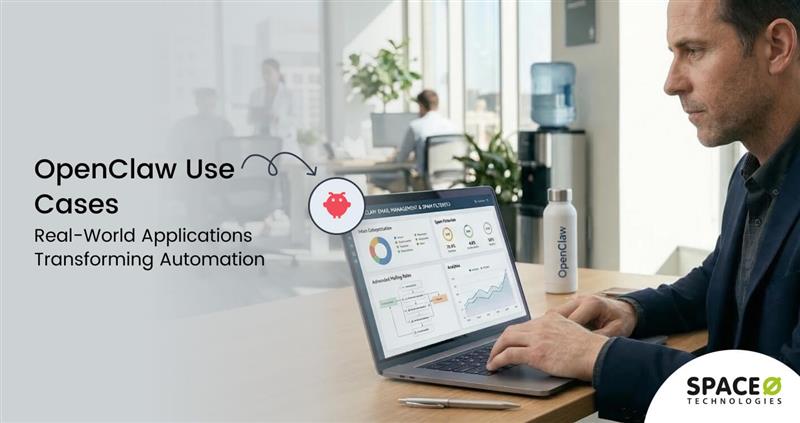
Contents
The adoption of AI agents continues to accelerate as organizations prioritize digital transformation and operational efficiency. According to Gartner, 40% of enterprise applications will feature task-specific AI agents by 2026, up from less than 5% in 2025. This explosive growth reflects the transformative impact of intelligent automation on business operations.
OpenClaw has emerged as the leading open-source personal AI assistant. It runs directly on your machine and takes autonomous action. The platform connects through messaging apps you already use daily. It handles everything from email automation to code deployment automatically.
Think about how many repetitive tasks waste your time every single day. OpenClaw eliminates these productivity bottlenecks. It learns your preferences and automates boring work systematically. Developers save 10+ hours weekly. Business teams reduce manual data entry dramatically. Even personal users gain back precious time.
1. Email Management and Spam Filtering
Managing a high-volume inbox manually is one of the most time-consuming tasks in any professional’s day. OpenClaw connects directly to your email account, reads incoming messages, filters out spam, and surfaces only what actually needs your attention. Users have reported clearing thousands of emails in a single session simply by describing the rules they want applied.
Beyond filtering, OpenClaw can summarize unread messages, create action items from important emails, and send those summaries directly to Slack, WhatsApp, or Notion. You no longer need to open your inbox to stay on top of it. The agent handles triage, and you handle decisions.
What OpenClaw can do with your email
- Scan and remove spam automatically based on rules you define
- Summarize overnight emails into a morning briefing delivered to your preferred messaging app
- Create to-do items from emails that require follow-up
- Sync email-based tasks to your CRM or project management tool
- Draft replies in your tone and voice for routine correspondence
Streamline Your Email Operations With AI Automation
Email management consumes critical team time daily. Let Space-O Technologies help you implement OpenClaw automation to reclaim hours every week.

2. Smart Calendar Management and Time-Blocking
Scheduling is rarely as simple as adding an event to a calendar. It requires juggling priorities, resolving conflicts, estimating time, and adjusting plans as things change. OpenClaw connects to your calendar and handles all of this conversationally, letting you describe what you need rather than manually dragging and dropping blocks across a grid.
Users have configured OpenClaw to time-block tasks based on urgency and importance, notify family members about upcoming commitments, and automatically manage conflicts without any input needed. The agent treats your calendar as a living document and keeps it updated in real time.
How OpenClaw handles your calendar
- Time-block tasks based on priority scoring you define together
- Detects and resolves scheduling conflicts autonomously
- Shares calendar access with family members or teammates for joint planning
- Sends reminders and daily agenda briefings to your phone each morning
- Updates your schedule dynamically when meetings are added or rescheduled
3. Personal Daily Briefing and Morning Digest
Starting the day with the right information changes how effectively you spend the next several hours. OpenClaw can deliver a fully personalized morning briefing that pulls together your calendar events, unread emails, health stats, weather, weekly objectives, and curated reading recommendations, all in one message sent to your phone before you start work.
This use case removes the need to open five different apps just to orient yourself each morning. Everything you need to make decisions and set priorities arrives in one place, assembled overnight while you sleep, at the exact level of detail you specify.
What a morning digest from OpenClaw can include
- Weather forecast and daily schedule overview
- Summary of overnight emails and messages
- Health and fitness stats pulled from a connected wearable
- Curated articles and trending topics matched to your current goals
- Key reminders, deadlines, and task priorities for the day
4. Developer Workflow Automation
Software development involves far more than writing code. Reviews, deployments, configuration changes, documentation updates, and debugging sessions all compete for a developer’s attention throughout the day. OpenClaw integrates with GitHub, Railway, Jira, and other developer tools to handle the surrounding workflow so engineers can stay focused on building.
Users have had OpenClaw review deployment logs, identify root causes, update service configurations, redeploy applications, and confirm successful outcomes, all over a voice message while walking the dog. The agent does not just assist with development tasks; it takes them on and completes them independently.
Developer tasks OpenClaw handles autonomously
- Reviews deployment logs and identifies build failures across services
- Updates service configurations and triggers redeployments
- Opens pull requests, applies code review suggestions, and submits revisions
- Builds and publishes CLI tools, SDKs, and skills to package registries
- Monitors GitHub repositories and flags issues requiring attention
5. Task Management and Project Planning
Keeping track of what needs to be done, who is doing it, and when it is due requires constant maintenance. OpenClaw connects to tools like Linear, Asana, Jira, and Notion to manage your task backlog intelligently. Rather than manually updating tickets, you describe what has happened or what needs to happen, and the agent handles the rest.
For solo founders and small teams, OpenClaw can go further by researching large projects and breaking them down into actionable tasks, scoring each by urgency and importance, and assigning them to appropriate team members or sub-agents. It acts less like a to-do list and more like a project coordinator that never forgets anything.
How OpenClaw manages your task pipeline
- Creates and updates tasks in Linear, Jira, Asana, or Notion from natural language
- Scores tasks by urgency and importance using a custom algorithm
- Breaks large projects into structured subtasks with deadlines
- Spawns background sub-agents to handle parallel research or coding tasks
- Sends daily task summaries to your phone or team messaging channel
6. Smart Home Automation and Control
Smart home devices are powerful individually, but managing them across different platforms typically requires separate apps, separate voice commands, and separate automation rules. OpenClaw unifies control of your smart home through a single conversational interface, letting you manage everything from lights and thermostats to HomePods and Alexa-enabled devices with natural language.
Users have connected OpenClaw to Homey, Apple HomeKit, Alexa, and IoTAWatt energy monitors, then controlled all of them through Telegram or WhatsApp. The agent can also set up routines, troubleshoot device issues, and reconfigure hardware setups through guided conversation rather than requiring technical expertise.
Smart home tasks OpenClaw can handle
- Control lights, thermostats, and smart speakers through a single chat interface
- Set up and manage automation routines based on time, location, or triggers
- Troubleshoot device configuration issues using screenshots and guided steps
- Monitor energy usage and flag unusual consumption patterns
- Build custom CLI skills to extend control to new device categories
7. Research and Meeting Preparation
Walking into a meeting without knowing who you are meeting, what they care about, and what your shared history is puts you at an immediate disadvantage. OpenClaw can research people, companies, and topics before any meeting and deliver a structured briefing document directly to your phone or notes app in advance.
This use case extends beyond individual meetings. OpenClaw can monitor industry news, track competitors, analyze business ideas, and surface insights relevant to projects you are actively working on. Users have described it as having a research analyst who is always working in the background.
How OpenClaw prepares you for meetings and decisions
- Research individuals and companies before scheduled calls
- Creates structured briefing documents saved to Notion or your notes app
- Monitors competitor activity and summarizes relevant developments
- Analyzes business ideas and breaks them into risk-weighted research tasks
- Delivers pre-meeting summaries via WhatsApp or Telegram automatically
8. Multi-Agent Orchestration for Teams and Solo Founders
Running multiple agents across different functions, each with its own context, skills, and responsibilities, requires careful coordination. OpenClaw acts as an orchestration layer that manages a team of specialized agents, assigning tasks, sharing relevant context, and keeping everything aligned without requiring manual handoffs.
Solo founders have built four-agent setups covering strategy, development, marketing, and business operations, each with distinct personalities and areas of expertise. Teams have scaled this to 15 or more agents running across multiple machines, coordinated through a shared Discord server. The coordination happens automatically, and you interact with the whole system through a single chat interface.
What multi-agent orchestration with OpenClaw looks like
- Coordinate specialized agents for development, marketing, research, and operations
- Share memory selectively across agents while keeping individual context separate
- Spawn background sub-agents to handle parallel research or coding tasks
- Run scheduled daily tasks across all agents without manual prompting
- Manage the entire agent fleet from a single Telegram or Discord channel
9. Mobile-First Development and Deployment
Traditional software development is tied to a desk, a laptop, and a local development environment. OpenClaw breaks that dependency by acting as an orchestration layer that lets developers build, review, and deploy software entirely from a mobile phone. Users have rebuilt entire websites, submitted apps to the App Store, and shipped production features without opening a laptop.
The key capability is OpenClaw’s ability to spin up coding agents, manage their progress, review outputs, and push final changes, all through natural language sent via Telegram or WhatsApp. Developers can now move from idea to deployed feature during a commute, between meetings, or in any context where a laptop is unavailable.
What mobile-first development with OpenClaw enables
- Spin up coding agents and assign feature work from your phone
- Review agent progress, approve changes, and request revisions via chat
- Submit builds and manage App Store or TestFlight release processes
- Deploy to servers, update DNS, and migrate content without touching a laptop
- Build and iterate on UIs by describing changes in natural language
10. Automated SEO Analysis and Content Workflows
SEO requires regular analysis of rankings, content performance, site structure, and competitor positioning. Doing this manually across multiple properties is time-consuming and easy to deprioritize. OpenClaw can run fully automated SEO audits on a scheduled basis, deliver results to your phone, and flag issues that need attention before they affect organic performance.
Beyond audits, OpenClaw can research content topics, draft posts based on defined briefs, and summarize YouTube videos for content repurposing, all without requiring manual input for each task. Teams managing multiple client accounts can configure separate agents for each property and receive consolidated reports in a single morning digest.
SEO and content tasks OpenClaw automates
- Runs weekly SEO audits and delivers results to your phone or Slack
- Monitors keyword rankings and flags significant movements
- Summarizes YouTube videos into key takeaways and actionable insights
- Draft LinkedIn and social media posts in your voice based on current topics
- Research content gaps and generate briefs for upcoming posts
11. Health and Fitness Tracking
Fitness data is only useful if you actually review it and act on it. Most people collect data from wearables but rarely find time to analyze trends or connect daily habits to long-term health goals. OpenClaw integrates with Garmin, WHOOP, and other fitness platforms to pull your data, analyze it, and surface insights in plain language on your schedule.
Users have built visual dashboards, heatmaps of workout locations, and daily health summaries using OpenClaw without writing any code themselves. The agent can also proactively check in if your sleep data suggests you are pushing too hard, turning passive data collection into an active health management system.
How OpenClaw supports health and fitness goals
- Pulls daily sleep, activity, and health metrics from connected wearables
- Delivers morning health summaries alongside your calendar and task briefing
- Generates visual dashboards and workout heatmaps from raw fitness data
- Sends proactive alerts when metrics fall outside your normal range
- Organizes lab results and health records into structured databases
12. Shopping and E-Commerce Automation
From grocery orders to car negotiations, OpenClaw can handle purchasing tasks that typically require significant time and attention. The agent can log into accounts using stored credentials, navigate checkout flows, find the best available options, and complete transactions on your behalf while you focus on other things.
Real users have had OpenClaw place supermarket orders triggered by a cleaning service message, negotiate car prices across multiple dealers simultaneously via email and browser, and process insurance claims without any direct involvement. These are not simple reminders or drafts; they are completed end-to-end transactions.
Shopping tasks OpenClaw handles independently
- Places grocery orders from your preferred delivery service automatically
- Researches and compares products across multiple sources before purchasing
- Negotiates with vendors via email and browser to find the best price
- Processes insurance claims and schedules repair appointments
- Maintains and updates shopping lists based on household usage patterns
13. Financial Tracking and Expense Management
Keeping track of spending, splitting costs after shared trips, and summarizing financial activity all require pulling data from multiple sources and organizing it manually. OpenClaw connects to your financial tools and handles this automatically, delivering clear summaries and structured records without requiring you to open a single spreadsheet.
Users have configured OpenClaw to monitor daily spending, track project costs, create invoices, and even blur sensitive financial information from screenshots before sharing them. The agent understands context around your finances and can flag anomalies, remind you of upcoming expenses, and generate reports on demand.
Financial management tasks OpenClaw handles
- Tracks daily spending and delivers weekly summaries to your phone
- Splits shared trip costs and calculates individual amounts automatically
- Creates professional invoices and summarizes billable work
- Organizes receipts and email transactions into structured records
- Monitors budgets and sends alerts when spending approaches defined limits
Automate Your Financial Operations Today
Finance teams spend countless hours on receipt processing and expense tracking. Let Space-O Technologies help you implement OpenClaw to transform your operations.
14. Content Curation and Personal Knowledge Management
The internet produces more content every day than anyone can meaningfully consume. OpenClaw helps you stay informed without spending hours scrolling by monitoring the sources you care about, filtering for relevance, and delivering summaries to your preferred channel on a schedule you define.
Users have set up OpenClaw to monitor Hacker News for topics matching their interests, read X bookmarks and discuss them interactively, and build a rolling knowledge base in Obsidian or Notion that captures ideas across conversations. The agent turns passive information consumption into an active, searchable second brain.
How OpenClaw manages your information diet
- Monitors Hacker News, Reddit, and RSS feeds for topics you care about
- Reads X bookmarks and discusses key takeaways interactively
- Saves research findings and ideas to Obsidian or Notion automatically
- Curates daily reading recommendations matched to your current goals
- Builds a searchable knowledge base from conversations, notes, and saved content
15. Meal Planning and Family Coordination
Planning meals for a household involves coordinating schedules, managing dietary preferences, tracking what is in the pantry, and organizing shopping across multiple stores. OpenClaw can handle the entire meal planning workflow from generating weekly plans to creating categorized shopping lists and reminding you when it is time to cook or shop.
Real users have built year-long meal plan templates in Notion, organized shopping lists by store and aisle, and connected weather forecasts to meal suggestions so grilling nights align with good weather. These are not one-off tasks; they are recurring systems that run automatically and save meaningful time every week.
What OpenClaw can set up for household meal planning
- Generates weekly meal plans and saves them to Notion or your notes app
- Creates shopping lists sorted by store and aisle for efficient trips
- Integrates weather forecasts to suggest appropriate meals for the day
- Catalogues your recipe library by chef or cuisine type
- Sends morning and evening reminders when grocery runs or cooking prep is needed
16. Language Learning and Educational Tools
AI-powered language learning can be far more personalized than any fixed-curriculum app, but building a custom tool has historically required significant development work. With OpenClaw, users have built fully functional language learning systems, including text-to-speech, speech-to-text, pronunciation feedback, spaced repetition tracking, and level-appropriate content generation, in just a couple of days.
The same approach applies to other educational contexts. OpenClaw can build interactive reading tools with adjustable speed and font size, summarize complex documents into digestible formats, and create custom study aids based on the specific material you are working through.
Educational tools users have built with OpenClaw
- Chinese language tutor with TTS, STT, and pronunciation feedback
- Spaced repetition system that adapts content to your current level
- Speed reading tool with adjustable sizing built from a web resource
- Document summarizer that condenses long reports into key points
- Custom flashcard and quiz generators from uploaded study material
17. Infrastructure Monitoring and Deployment Management
Server deployments, build failures, and configuration errors typically require a developer to be at a computer to investigate and resolve. OpenClaw changes this by connecting to your infrastructure through SSH, Railway, Cloudflare, and other platforms, allowing full deployment management from a phone conversation.
Users have had OpenClaw monitor active deployments, detect failed builds, trace root causes in logs, fix configurations, redeploy services, and confirm successful recovery, all without opening a terminal. This capability is especially valuable for developers who want to stay responsive to production issues outside normal working hours.
Infrastructure tasks OpenClaw manages remotely
- Monitors deployment status across Railway, Heroku, and other platforms
- Reviews build logs and identify the root cause of failures
- Updates service configurations and triggers redeployments automatically
- Connects via SSH to diagnose and resolve server-level issues
- Sends status updates and deployment confirmations to your phone in real time
18. Workflow Automation with Third-Party Integrations
OpenClaw’s value compounds significantly when it connects multiple tools together into automated workflows that previously required manual steps between each one. By linking your email, calendar, task manager, CRM, and messaging platforms, OpenClaw can trigger chains of actions from a single input without any human intervention in between.
Users have built morning rollups that pull Gmail and Google Calendar data and deliver a combined summary, set up Slack automations that trigger writing pipelines, and created daily cron jobs that read emails, create tasks, update a CRM, and send a Slack message, all as a single automated sequence. These are the kinds of workflows that previously required dedicated automation tools and technical setup.
Integrated workflow examples that users have built
- Email the task to the CRM pipeline running automatically every morning
- Calendar and email morning rollup delivered to phone via Telegram
- Writing pipeline triggered from Slack that drafts, reviews, and publishes content
- GitHub to Jira sync that creates issues from pull request comments
- A Reddit and Hacker News crawler that filters posts into a personal daily feed
19. Collaborative Multi-Agent Systems
One of the most advanced capabilities emerging from the OpenClaw community is the ability to have multiple independent OpenClaw instances collaborate with each other. Two agents belonging to different users can be placed in a shared group chat and work together on tasks, sharing context and dividing responsibilities just as human collaborators would.
This opens up genuinely new workflows where households manage shared planning through paired agents, teams coordinate across time zones without asynchronous delays, and distributed workloads get handled by agents that communicate and self-organize. The shared memory skill available on ClawHub extends this further by allowing selective context sharing between instances.
What collaborative multi-agent setups make possible
- Two agents from different users are collaborating in a shared WhatsApp or Discord group
- Shared memory layers that give paired agents access to a common context
- Partner agents that coordinate household planning and research together
- Distributed research tasks are divided between multiple agent instances in parallel
- Agent-to-agent status updates and task handoffs without human involvement
OpenClaw is not a single-purpose tool. It is a flexible, programmable agent that adapts to how you work, what tools you use, and what problems you need solved. Whether you are automating a single repetitive task or orchestrating a full team of specialized agents, the use cases above are just the starting point. The most powerful workflows are the ones you build for your own specific needs, and with OpenClaw, building them is as simple as having a conversation.
Common OpenClaw Setup and Security Challenges and How to Solve Them
Every powerful tool comes with a learning curve, and OpenClaw is no exception. While the platform makes AI agent deployment more accessible than ever, teams and individuals often run into similar roadblocks during setup, configuration, and day-to-day use. Understanding these challenges in advance helps you move past them faster and get more out of your deployment from day one.
1. Difficulty setting up the initial configuration
Getting OpenClaw running for the first time can feel overwhelming, especially for non-technical users. Connecting tools, configuring credentials, and defining agent behavior all at once is a lot to manage simultaneously, and small errors in setup can cause agents to behave unexpectedly or fail silently.
How to overcome it:
- Start with a single use case and one connected tool before expanding
- Use the ClawHub skill library to install pre-built configurations rather than starting from scratch
- Test agent behavior in a low-stakes environment before connecting critical accounts
- Follow the official OpenClaw documentation step by step rather than experimenting freely at the start
Managing permissions and access control
Giving an agent the right level of access is harder than it sounds. Too little access and the agent cannot complete its tasks. Too much access and you create unnecessary security exposure. Finding the right balance requires deliberate planning that many users skip in the early stages.
How to overcome it:
- Map out exactly which tools and data sources each agent needs before granting any permissions
- Apply the principle of least privilege and add permissions incrementally as needs become clear
- Review and audit permission sets regularly, especially after adding new integrations
- Use separate credential sets for agents rather than sharing your personal account access
Prompt injection and unexpected agent behavior
Because OpenClaw agents process natural language from multiple sources, they can occasionally act on instructions embedded in external content rather than your own. This can lead to surprising or unintended actions, particularly when agents interact with emails, documents, or web content.
How to overcome it:
- Restrict what actions an agent can take based on where the instruction originated
- Add human-in-the-loop checkpoints for any action with meaningful real-world consequences
- Monitor agent outputs regularly and set up alerts for unusual tool calls or behavior
- Treat any unexpected agent action as a signal to tighten the scope rather than a one-off anomaly
Keeping multi-agent workflows coordinated
As your OpenClaw setup grows from one agent to several, coordination becomes a real challenge. Agents can duplicate work, conflict with each other, or lose shared context if the system is not structured carefully from the beginning.
How to overcome it:
- Assign each agent a clearly defined role with no overlap in responsibilities
- Use shared memory layers deliberately and selectively to keep agents aligned without creating information overload
- Designate one primary agent as the coordinator responsible for delegating to others
- Log inter-agent communication alongside user interactions so you can trace how decisions are being made
Maintaining security and privacy over time
Security is not a one-time configuration. As your agent setup evolves, new tools get connected, user bases grow, and configurations that were appropriate at launch gradually become outdated. Most users set things up correctly at the start, but do not revisit security until something goes wrong.
How to overcome it:
- Schedule quarterly permission reviews as a standing item in your team calendar
- Audit session isolation settings and operator boundaries after every major update
- Back up audit logs offline so they remain available and unmodified for investigation
- Stay connected to the OpenClaw community and changelog to catch newly discovered vulnerabilities early
The challenges above are common, but none of them are blockers. With the right setup habits, a clear security mindset, and a willingness to start simple and scale gradually, most teams move past these hurdles quickly. Following best practices for OpenClaw security from day one, including deliberate permission management, regular audits, and scoped agent access, ensures that your deployment stays resilient as it grows. OpenClaw rewards careful configuration, and the time you invest early in getting it right pays dividends across every workflow you build on top of it.
Partner with Space-O Technologies for Expert OpenClaw Implementation Services
OpenClaw use cases span personal productivity to enterprise automation. The platform adapts to virtually any workflow. Market projections show AI agents becoming standard by 2026. Organizations not adopting are falling behind competitors significantly.
Space-O Technologies specializes in AI agent implementation and custom automation solutions. We help organizations identify high-impact automation opportunities systematically. Our consultants analyze your workflows comprehensively. We prioritize use cases by ROI and implementation complexity. Implementation happens in phases with clear milestones. Training your teams is critical for success.
We provide comprehensive OpenClaw training programs. Documentation gets customized for your organization. Support continues after go-live. Your teams become self-sufficient quickly. Custom workflows get built to match your exact needs. Complex integrations with legacy systems work seamlessly. Security requirements get met without compromise. Performance optimization ensures smooth operations. Partner with Space-O Technologies to unlock OpenClaw’s full potential. Our AI expertise accelerates your automation journey. Talk to our specialists and take the next step with confidence today.
Frequently Asked Questions About OpenClaw Use Cases
What are the most popular use cases for OpenClaw?
Email management, calendar automation, and developer workflow automation are among the most widely used OpenClaw use cases. Other growing use cases include smart home control, multi-agent orchestration, and mobile-first development, offering value to both technical and non-technical users.
Can non-technical users benefit from OpenClaw use cases?
Yes. Many OpenClaw use cases like meal planning, morning briefings, and calendar management require no coding knowledge. Users can set up workflows using natural language and refine them over time without writing code.
How many tools can OpenClaw connect to across different use cases?
OpenClaw integrates with a wide range of tools including Gmail, Google Calendar, Notion, Slack, GitHub, Jira, Linear, Telegram, and WhatsApp. Users can connect multiple tools simultaneously, often more than ten, using libraries like ClawHub to simplify integration.
Can OpenClaw handle multiple use cases at the same time?
Yes. OpenClaw can run multiple workflows in parallel using scheduled tasks, event triggers, and background agents. A single setup can manage emails, monitor systems, run audits, and deliver daily briefings without workflow conflicts.
What is the difference between single-agent and multi-agent OpenClaw use cases?
Single-agent use cases involve one agent handling tasks within a specific domain such as scheduling or email management. Multi-agent setups use multiple specialized agents coordinated by a central system, making them ideal for complex workflows across different functions.
How do I decide which OpenClaw use case to start with?
Start with the most repetitive and time-consuming task in your daily routine, such as email triage or calendar management. These use cases are easy to set up, well-documented, and deliver quick results, making it easier to expand into more advanced workflows later.



 All our projects are secured by NDA




 4.8
4.8