
 By
By 
Contents
Are you a pharmacy owner, healthcare startup, or entrepreneur looking to tap into the rapidly growing digital healthcare market? With more patients expecting the convenience of ordering medicines from their phones, medicine delivery app development has become a strategic priority for businesses that want to stay competitive and reach customers beyond their physical storefront.
The numbers back this up. The global online pharmacy market is growing at a rapid pace, and consumer behavior has permanently shifted toward digital-first healthcare experiences. People no longer want to drive to a pharmacy, wait in line, and risk finding their medication out of stock. They want to upload a prescription, compare prices, and get their medicines delivered, all within a few taps.
This shift creates a massive opportunity for pharmacy chains, healthcare startups, and logistics companies. A purpose-built medicine delivery app does more than enable doorstep delivery. It streamlines your entire operation, from prescription verification and inventory management to route optimization and regulatory compliance. The result is faster fulfillment, fewer errors, and stronger customer retention.
But building an app that actually works at scale requires more than just a good idea. You need the right features, the right technology stack, and the right pharmacy app development company that understands healthcare regulations and user expectations equally well.
This guide covers everything you need to know, from understanding what a medicine delivery app is and the business models available, to the must-have features, the step-by-step development process, and the realistic cost breakdown for 2026.
Medicine Delivery App Market Size, Trends, and Growth Forecast
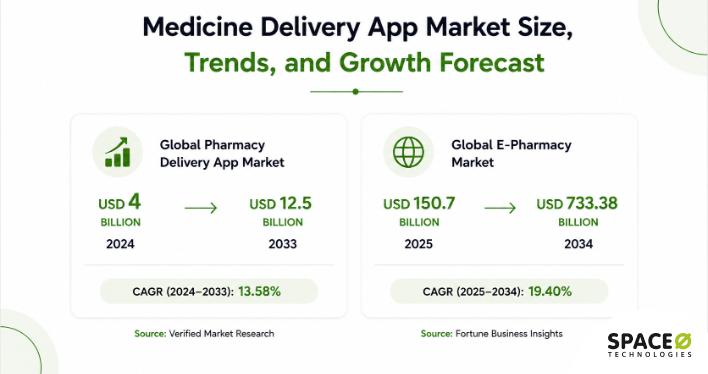
According to a report by Verified Market Research, estimates that the global pharmacy delivery app market was worth USD 4 billion in 2024 and is projected to grow to USD 12.5 billion by 2033. This steady growth reflects the increasing consumer preference for online medicine ordering, doorstep prescription delivery, and digital pharmacy solutions worldwide.
Similarly, data from Fortune Business Insights, the global e-pharmacy market was valued at USD 150.7 billion in 2025 and is expected to reach USD 733.38 billion by 2034, expanding at a CAGR of 19.40% during the forecast period. The report also highlights that North America accounted for 53.43% of the global market share, supported by widespread smartphone adoption, growing demand for digital healthcare services, and an aging population.
Several factors are fueling this growth for pharmacy owners, healthcare startups, and entrepreneurs exploring medicine delivery app development.
Key market drivers behind the e-pharmacy boom
- Shift toward contactless healthcare: Post-pandemic consumer habits have permanently changed. Patients now expect the same on-demand convenience for medicines that they get for food and groceries. This behavioral shift has made on demand medicine delivery app development a necessity, not a luxury.
- Rising chronic disease burden: Chronic conditions like diabetes, hypertension, and cardiovascular disorders require ongoing medication refills. The International Diabetes Federation reports over 537 million adults worldwide living with diabetes. These patients need regular, predictable access to prescription medicines, and medicine delivery apps solve that problem.
- Growing geriatric population: The global population aged 60 and above is projected to reach 1.4 billion by 2030. Elderly patients often face mobility challenges that make pharmacy visits difficult. A well-designed pharmacy delivery app with accessibility features becomes essential for this demographic.
- E-prescription mandates: Regulatory shifts are accelerating digital adoption. In the United States, HTI-4 standards are mandating NCPDP SCRIPT compliance and real-time benefit checks by 2027. The European Union is targeting cross-border e-prescription exchange. These mandates push pharmacies and healthcare systems toward digital-first platforms.
- Telemedicine integration: The rise of telemedicine app development creates a natural pipeline for medicine delivery. Patients consult doctors online, receive e-prescriptions, and order medicines through the same app ecosystem. This seamless flow from consultation to delivery is becoming the expected standard.
What this means for your medicine delivery app
For pharmacy chains looking to invest in medicine delivery app development services, the timing is ideal. The market is large enough to support new entrants but still growing fast enough to reward early movers. For startups and entrepreneurs, partnering with the right pharma app development company while targeting underserved regions or specific niches (chronic condition management, elderly care, or rural medicine delivery) can carve out defensible market positions.
The combination of regulatory tailwinds, consumer behavior shifts, and proven business models makes medicine delivery app development one of the strongest opportunities in digital healthcare today.
Medicine Delivery Apps: Definition, Types, and Workflow
A medicine delivery app is a digital healthcare solution that allows users to order prescription and over-the-counter (OTC) medicines from an online pharmacy and have them delivered directly to their doorstep. These platforms simplify the medicine purchasing process by combining prescription management, inventory management, secure payments, and real-time order tracking into a single system.
Modern e-pharmacy apps connect patients, pharmacists, delivery agents, and healthcare providers through a unified platform. Many advanced solutions also support electronic prescriptions (eRx), electronic health records (EHR), online doctor consultations, and telemedicine integration, creating a seamless digital healthcare experience.
To ensure patient safety and regulatory compliance, medicine delivery apps include features such as prescription verification, healthcare data security, and compliance with standards like HIPAA. Technologies such as OCR prescription scanners, GPS tracking, AI chatbots, and smart medicine recommendations further enhance convenience and operational efficiency.
Types of medicine delivery apps
Current trends, user behavior shifts, and technological advancements are creating unprecedented opportunities in the online pharmacy space. Here are the benefits of developing a medicine delivery app:
-
Standalone pharmacy apps
Standalone pharmacy apps are developed for individual pharmacies or pharmacy chains that want to offer medicine ordering and delivery services directly to their customers. These solutions typically include a pharmacy management system, prescription management tools, inventory management, and payment gateway integration to streamline operations.
-
Multi-vendor pharmacy marketplace apps
A multi-vendor pharmacy platform connects users with multiple licensed pharmacies through a single application. Customers can compare medicine availability, pricing, and delivery times, while pharmacies can reach a larger audience without building their own digital infrastructure.
-
On-demand or hyperlocal delivery apps
On demand medicine delivery app development focuses on rapid fulfillment by sourcing medicines from the nearest partner pharmacy through hyperlocal platforms. These platforms rely on GPS tracking, delivery management systems, and real-time order tracking to provide faster deliveries, often within an hour.
How does a medicine delivery app work?
A medicine delivery platform typically operates through four key modules:
-
Customer app
Users create an account, upload prescriptions using an OCR prescription scanner, search for medicines, schedule medicine refill reminders, consult healthcare professionals online, and complete purchases through secure payment gateways.
-
Pharmacy dashboard
Pharmacists review uploaded prescriptions through a prescription verification process, manage inventory, update medicine availability, and prepare orders for dispatch.
-
Delivery agent app
Delivery personnel receive order requests, access optimized routes through GPS tracking, and manage deliveries using an integrated delivery management system.
-
Admin dashboard
The admin dashboard provides centralized control over users, pharmacies, orders, payments, prescriptions, and analytics. It also helps ensure compliance with healthcare regulations and data privacy requirements.
-
Delivery agent app
Delivery personnel receive order requests, access optimized routes through GPS tracking, and manage deliveries using an integrated delivery management system.
Businesses often rely on medicine delivery app development services that use cross-platform frameworks such as Flutter and React Native to reduce development time and costs. These technologies support integrations with payment gateways, telemedicine platforms, electronic health records, AI chatbots, and other healthcare services, enabling the creation of scalable and feature-rich applications.
Build Your Own Medicine Delivery App Today
Partner with Space-O Technologies to create a secure, scalable, and high-performing pharmacy delivery app tailored to your business model. From UI/UX to compliance, we handle it all.

Step-By-Step Medicine Delivery Mobile Application Development Process
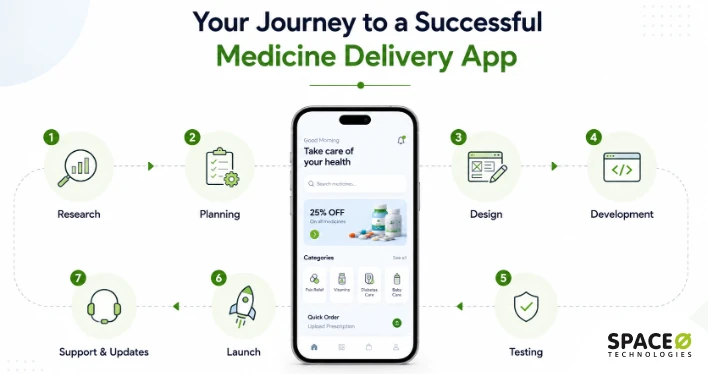
Medicine delivery mobile app development involves several strategic and technical steps to ensure the final product is user-friendly, secure, and scalable. Here’s a breakdown of the key stages:
-
Market Research and Competitor Analysis
Before building an app, it’s crucial to understand the market landscape. This includes:
- Analyzing existing medicine delivery apps to identify strengths and weaknesses
- Studying user preferences and pain points
- Identifying opportunities for differentiation and innovation
- Evaluating regulatory and compliance requirements in target regions
Proper research ensures the app addresses real user needs and positions your business competitively.
-
Define Features and App Roadmap
Once research is complete, define the core features for your app:
- User-side features (search, order, prescription upload, payment, tracking)
- Pharmacy-side features (inventory management, order processing, delivery coordination)
- Optional advanced features (AI recommendations, telemedicine integration, subscription plans)
Create a development roadmap outlining feature priorities, timelines, and milestones for a phased rollout.
-
UI/UX Design
A seamless design is essential for user adoption. Key steps include:
- Designing intuitive navigation and layouts for users and pharmacies
- Creating wireframes and prototypes to visualize the app flow
- Ensuring accessibility, readability, and a consistent brand identity
- Incorporating feedback from potential users to refine the experience
Great UI/UX enhances engagement, reduces churn, and boosts conversions.
-
Backend and Frontend Development
This is where the app comes to life:
- Frontend development focuses on the user interface for iOS, Android, and possibly web platforms
- Backend development handles database management, server-side logic, APIs, and integrations with payment gateways and third-party services
- Security measures are implemented to protect sensitive user data and ensure regulatory compliance
A robust tech stack ensures the app is fast, secure, and scalable.
-
Testing and QA
Before launch, thorough testing and quality assurance are critical:
- Functional testing to ensure all features work correctly
- Performance testing for speed and responsiveness
- Security testing to safeguard user and payment data
- Usability testing to confirm a smooth experience for both users and pharmacies
This phase helps identify and fix issues before they affect real users.
-
Deployment and Launch
After successful testing:
- The app is deployed to app stores (iOS, Android) and production servers
- Marketing campaigns and launch strategies are executed to attract initial users
- Monitoring tools track app performance and user engagement metrics
A smooth launch sets the foundation for positive user reception and growth.
-
Post-Launch Support and Updates
Launching the app is just the beginning. Continuous support is necessary to:
- Fix bugs and resolve technical issues
- Release feature updates based on user feedback
- Ensure compatibility with new OS versions and devices
- Implement enhancements to improve user retention and engagement
Ongoing updates keep the app relevant, secure, and competitive in a fast-growing market. Developing a medicine delivery app requires technical expertise, development experience, and a significant IT infrastructure. However, you can skip the hassle by simply outsourcing your project to a medicine delivery app development company like Space-O Technologies.
Let Space-O Technologies Handle Your End-to-End App Development
From market research to post-launch support, we manage every stage of your medicine delivery app development, ensuring quality, speed, and scalability.
Common Challenges in Developing a Medicine Delivery App (and How to Solve Them)
Every medicine delivery app encounters specific obstacles during development and launch. Learning from these common roadblocks helps you prepare better solutions and avoid costly mistakes. Here are the five critical challenges you’ll face and how to address them effectively.
Challenge 1: Prescription verification accuracy
Blurry images, unclear handwriting, and incomplete prescriptions plague every medicine delivery app. This isn’t just an operational roadblock; it’s a safety issue that could harm patients and expose you to liability.
Uploaded prescriptions can be unclear with varying handwriting quality, while images might be blurry or incomplete.
- Solution: Implement AI-powered OCR for initial scanning, but always include manual pharmacist verification. Create clear guidelines for accepted prescription formats and allow users to re-upload if images are unclear.
Challenge 2: Inventory management across pharmacies
Real-time inventory accuracy makes or breaks user experience. Nothing frustrates customers more than ordering medicines only to discover they’re out of stock, and this challenge multiplies when coordinating multiple pharmacy partners.
In aggregator models, real-time inventory is challenging when pharmacies update stock manually, which causes delays and order cancellations that frustrate users.
- Solution: Build robust API integrations with pharmacy management systems and provide simple mobile apps for pharmacies to update stock easily. Implement buffer stock management and set expiry date alerts.
Challenge 3: Last-mile delivery reliability
Perfect apps with terrible delivery still fail. Traffic, incorrect addresses, unavailable customers, and weather conditions all threaten delivery reliability, so your reputation rides on whether medicines arrive when promised.
Traffic jams, bad addresses, and unavailable customers create delivery delays that frustrate users and damage trust.
- Solution: Partner with established logistics providers who understand local markets while using route optimization algorithms and sending delivery time notifications. Allow users to reschedule deliveries and implement delivery windows instead of exact times.
Challenge 4: Building trust with new users
Medicine purchases involve real health risks, making trust crucial. New users worry about medicine authenticity, prescription privacy, and payment security, so overcoming this initial skepticism determines whether browsers become buyers.
People hesitate to buy medicines online due to quality concerns, authenticity worries, and payment security fears.
- Solution: Partner only with licensed pharmacies and display certifications prominently while offering genuine medicine guarantees and enabling COD initially. Share customer testimonials and start with a soft launch in trusted networks. A reliable pharma app development company can guide you through this trust-building phase.
Challenge 5: Competing with established players
Established pharmacy delivery apps have massive user bases, brand recognition, and deep pockets. Competing head-on in saturated markets burns cash without gaining traction, so smart positioning and niche focus are essential for survival.
Markets already have dominant apps with strong brand recognition and established user bases.
- Solution: Find underserved niches and focus on specific regions or demographics while targeting specialized medicines and offering superior customer service. Compete on experience, not just price, and build community trust through local partnerships.
Challenges are inevitable, but choosing the right medicine delivery app development company helps you navigate them successfully. The selection process itself requires careful planning and evaluation.
Overcome App Development Challenges with Expert Guidance
From compliance to scalability, our medicine delivery app development services help you tackle every challenge in building a secure and high-performing platform.
Recommended Tech Stack for Medicine Delivery App Development
The right technology stack is fundamental to pharmacy delivery app development that performs reliably, scales under growing demand, and meets healthcare compliance standards. Here is a recommended stack organized by layer.
| Layer | Technology | Best For |
|---|---|---|
| Frontend (Mobile) | React Native | Cross-platform iOS and Android apps from a single codebase. Strong native module support for GPS, camera (prescription upload), and push notifications |
| Flutter | High-performance UI with smooth animations for order tracking. Growing healthcare app ecosystem | |
| Swift / Kotlin | Native iOS and Android apps requiring maximum performance and hardware access (biometrics, NFC) | |
| Frontend (Web) | React.js | Pharmacy dashboards and admin panels with complex inventory, order queues, and analytics views |
| Backend | Node.js | Real-time features like live order tracking, instant notifications, and pharmacist chat. Event-driven architecture handles thousands of concurrent connections |
| Laravel (PHP) | Structured API development with built-in authentication, queue management, and routing. Proven for healthcare platforms | |
| Django (Python) | AI and ML feature integration, including drug interaction checking, smart recommendations, and prescription OCR | |
| Spring Boot (Java) | Enterprise-grade pharmacy chain applications requiring strict security protocols | |
| Database | PostgreSQL | Structured transactional data (user profiles, prescriptions, orders, payments). Strong ACID compliance |
| MongoDB | Flexible data like medicine catalogs and pharmacy profiles. Scales horizontally for large product databases | |
| Redis | In-memory caching for session management, real-time inventory counts, and delivery status updates | |
| MySQL | Inventory management and order tracking. Pairs well with Laravel and PHP backends | |
| Cloud | AWS | HIPAA-eligible services (EC2, RDS, S3, Lambda). Most widely used cloud platform for healthcare apps |
| Google Cloud Platform (GCP) | Healthcare API for HL7 FHIR data exchange. Vertex AI integration for AI-powered features | |
| Microsoft Azure | HITRUST-certified services with strong EHR integration. Preferred by enterprise healthcare organizations | |
| DevOps | Docker + Kubernetes | Containerized deployment with zero-downtime updates across development, staging, and live environments |
| Jenkins / GitHub Actions | CI/CD pipelines for automated testing and deployment. Reduces release cycles from weeks to days |
For startups building an MVP, React Native app development offers the fastest path to launching on both platforms. For apps requiring real-time capabilities (live tracking, pharmacist chat), Node.js development handles low-latency communication efficiently.
Essential Third-Party APIs and Integrations
Medicine delivery apps rely on external services for payments, logistics, and healthcare data exchange. Selecting the right APIs early in development prevents integration bottlenecks later.
| Integration | Purpose | Examples |
|---|---|---|
| Payment gateways | Secure transaction processing | Stripe, Razorpay, PayPal, Square |
| Mapping and logistics | GPS tracking, route optimization, delivery ETA | Google Maps API, Mapbox, HERE |
| EHR/EMR systems | Patient record and prescription data exchange | Epic, Cerner, Allscripts via HL7 FHIR APIs |
| E-prescription APIs | Digital prescription transmission and verification | Surescripts (USA), NHS Electronic Prescription Service (UK) |
| Notifications | Order updates, refill reminders, OTP verification | Twilio, Firebase Cloud Messaging, OneSignal |
| Insurance verification | Copay calculation and eligibility checking | Eligible API, Change Healthcare |
| OCR and document scanning | Prescription image parsing and data extraction | Google Cloud Vision API, AWS Textract, Tesseract |
Medicine Delivery App Development Cost Breakdown
Budget planning requires realistic numbers, not wishful thinking. Understanding cost drivers helps you allocate resources effectively and avoid mid-project funding crises. Based on your app’s complexity, your medicine delivery app could be:
- A basic MVP app with just the essential features and functionalities.
- A mid-level app with standard pharmacy delivery features.
- An enterprise-level app with AI-enabled features and advanced modules, such as pathology test booking.
Here’s a cost breakdown for each of these complexity levels:
| Complexity Level | Cost Range | Development Time | What’s Included |
|---|---|---|---|
| Basic MVP | $15,000–$30,000 | 3–4 months |
|
| Mid-Level App | $30,000–$70,000 | 5–7 months |
|
| Enterprise-Level App | $70,000–$150,000+ | 8–12 months |
|
Hidden Costs in Medicine Delivery App Development
Initial development is just the beginning. Ongoing operational costs can surprise unprepared founders and drain budgets quickly. Planning for these expenses from day one prevents cash flow problems down the road.
- App store fees: Apple charges $99 annually for a Developer Account, while Google charges $25 one-time fee.
- Hosting and server costs: Expect $100–$500 monthly for cloud hosting, which scales with the user base.
- Maintenance: Plan for 15–20% of the initial development cost annually for bug fixes, security updates, and OS compatibility updates.
- Marketing: Getting users costs money through App Store Optimization, paid ads, and influencer partnerships, so budget at least $5,000–$10,000 for initial marketing.
- Legal and compliance: Healthcare lawyer consultations, privacy policy drafting, terms of service, and compliance audits typically require a budget of $2,000–$5,000.
Now that we have clarity on the budget for medicine delivery app development, it’s time to understand how to develop a medicine delivery app.
Get a Free Cost Estimate for Your Medicine Delivery App Project
Share your project requirements, and our experts will provide a detailed cost breakdown based on your app’s features, complexity, and goals.
Top Medicine Delivery Apps Leading the Market
Studying successful apps helps identify the features, business models, and user experiences that shape online medicine delivery app development. These platforms have set benchmarks for what users expect when they order medicines online. Here is a breakdown of the leading players, verified against each platform’s official sources.
| App Name | Business Model | Key Features (Verified) | What Makes It Stand Out |
|---|---|---|---|
| CVS Health App | Inventory-based |
|
|
| Capsule Pharmacy | Inventory-based |
|
|
| Amazon Pharmacy (PillPack) | Hybrid |
|
|
| Tata 1mg | Aggregator |
|
|
| Alto Pharmacy | Inventory-based |
|
|
Must-Have Features in Medicine Delivery Application Solution
When planning medicine delivery mobile app development, it is important to balance functionality with simplicity. A medicine app has three key users:
- The end users using the app to purchase medicines
- Pharmacies listing their products on the platform
- Delivery partners that fulfill the orders
Here are the key features for each of these roles:
-
User app features
The patient-facing app is your primary revenue driver. This platform will be used by your end users to purchase medicines. Every feature here directly impacts user satisfaction, order completion rates, and repeat purchases.
Smart user registration
Make onboarding effortless with flexible signup options, such as email, phone number, or social media. For returning users, integrate biometric authentication such as Face ID or fingerprint unlock for fast and secure access. The easier the login, the faster users can start ordering.
Powerful medicine search
Enable users to quickly find what they need through intelligent search by name, category, or health condition. Add filters for brand, generic alternatives, and price ranges. Auto-suggestions and related medicine recommendations help users make informed choices effortlessly.
Upload prescriptions
Allow users to upload prescriptions in multiple formats, such as photos, PDFs, or digital copies. Use AI-powered OCR to automatically extract medicine names and details, minimizing manual entry and speeding up order verification.
Seamless ordering process
Ensure a simple, transparent checkout flow: add to cart, review, and pay without hidden charges. If a medicine is out of stock, suggest substitutes instead of showing “unavailable.” This not only improves conversion rates but also builds trust.
Multiple payment options
Offer a range of secure payment modes, including credit/debit cards, UPI, wallets, net banking, and cash on delivery. More payment choices reduce cart abandonment and cater to varied customer preferences.
Real-time order tracking
Give users complete visibility into their order journey, from prescription verification to packaging, dispatch, and delivery. Live GPS tracking lets them see exactly where their delivery is, ensuring transparency and trust.
Smart medication reminders
Smart medication reminders and medication management app development features help users stay consistent with automated reminders for medication times and refill alerts. This feature is especially valuable for chronic disease patients and improves long-term app engagement.
Complete order history
Display all past orders, prescriptions, and payments in one place. With one-tap reordering, users can quickly repurchase regular medicines, boosting retention and lifetime value.
-
Pharmacy panel features
Pharmacies are your fulfillment partners, and their efficiency directly affects customer satisfaction. A well-designed pharmacy panel streamlines operations, reduces errors, and helps partners manage inventory and orders effectively.
Real-time inventory management
Automatically track stock levels, expiry dates, and low-inventory alerts. Integration with existing pharmacy management systems ensures accuracy and prevents stockouts of essential medicines.
Efficient order management
Provide a clean dashboard showing all orders: pending, processing, packed, and dispatched. Enable quick actions like accept, reject, or suggest alternatives to maintain fast turnaround times.
Prescription verification tools
Allow pharmacists to review uploaded prescriptions easily using zoom, rotate, and enhance options. Verification logs help maintain regulatory compliance and ensure transparency.
Sales analytics and tends
Offer data-driven insights, such as top-selling medicines, high-demand areas, and peak order times. These analytics help pharmacies optimize inventory, staffing, and promotions.
-
Delivery partner app features
Fast, reliable delivery is what separates great apps from mediocre ones. Your delivery partners need tools that make their job easier, routes clearer, and earnings transparent.
Simple order management
Display all available orders with pickup and delivery details. Allow drivers to accept or reject deliveries based on location or time, improving efficiency and satisfaction.
GPS navigation
Use real-time maps with traffic updates to optimize delivery routes. Multi-order routing helps drivers handle several deliveries efficiently, reducing time and fuel costs.
Delivery status updates
One-tap status updates, such as picked up, on the way, delivered, keep customers, pharmacies, and support teams informed. A simple interface ensures ease of use on the go.
Earnings tracking
Give drivers full visibility into their earnings, including daily, weekly, and monthly income. Include digital payment tracking and transparent commission details to build trust and motivation.
With core features defined, you’re ready to think bigger. Advanced features create competitive advantages that basic apps simply can’t match.
Build a Feature-Rich Medicine Delivery App with Our Experts
From intuitive patient interfaces to powerful pharmacy and delivery dashboards, our team delivers medicine delivery app development solutions that delight users and drive revenue.
Best Practices for Building a Successful Medicine Delivery App
Building a medicine delivery app that users trust and pharmacies adopt requires more than good code. These pharmacy delivery app development best practices cover compliance, operations, and strategy.
-
Start with compliance, not features
Building compliance into the foundation is far cheaper than retrofitting it after launch. The key frameworks to address from day one:
- HIPAA (United States): End-to-end encryption, audit trails, and access controls for patient health data.
- GDPR (European Union): Explicit consent for data collection, right to deletion, and 72-hour breach notification.
- FDA and DEA regulations: Required for apps handling e-prescriptions or controlled substances (Schedule II through V).
- SOC 2 compliance: Validates security, availability, and confidentiality. Increasingly expected by pharmacy partners and insurers.
- HL7 and FHIR standards: Required for EHR/EMR integration that enables patient record exchange with hospital systems.
-
Build pharmacy partnerships before launch
Without committed pharmacy partners, the app cannot fulfill orders. For aggregator models, onboard pharmacies that cover the launch geography and can receive digital orders in real time. For inventory-based models, establish distributor and wholesaler relationships with competitive pricing agreements. In both cases, define service-level expectations (order acceptance time, packaging standards, delivery handoff windows) before going live.
-
Design for elderly users and accessibility
Chronic condition management and mobility limitations make doorstep delivery essential for elderly patients. Designing for this segment means larger fonts, high-contrast color schemes, simplified navigation, voice search, and caregiver access features. WCAG (Web Content Accessibility Guidelines) compliance ensures the app meets recognized standards. Medication reminders synced with wearable devices extend alerts beyond the phone screen.
-
Plan for scalability and use data to drive decisions
A microservices architecture separates core functions (order processing, inventory sync, delivery tracking) into independent services that scale individually. Containerization with Docker, orchestration with Kubernetes, and cloud-native infrastructure (AWS, GCP, or Azure) handle demand spikes during flu season or pandemic surges.
Pair scalability with data-driven decision-making. Track order completion rates, cart abandonment, average delivery time, and refill frequency to identify where the experience breaks down. Operational analytics help pharmacies optimize inventory by revealing top-selling medicines, peak order times, and high-demand areas.
-
Plan cold chain logistics for temperature-sensitive medicines
Medicines like insulin, vaccines, and biologics require strict temperature control during delivery. IoT-enabled sensors can track package temperature in real time and alert drivers if conditions fall outside the acceptable range. Insulated packaging and gel packs are standard for last-mile cold chain delivery. Documenting temperature logs for each order maintains compliance and satisfies insurance payer requirements for proof of proper handling.
Future Trends Shaping Medicine Delivery App Development
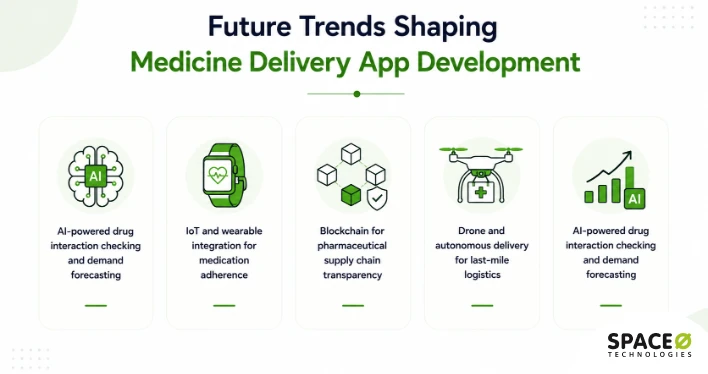
Emerging technologies are creating opportunities for platforms that adopt them early. Here are the trends shaping the next phase of online medicine delivery app development.
-
AI-powered drug interaction checking and demand forecasting
AI is moving beyond chatbots into clinical decision support. Drug interaction checking can scan a patient’s full medication list and flag dangerous combinations before the order is placed. Machine learning algorithms also power personalized recommendations by analyzing purchase history and prescription patterns to suggest generic alternatives, health products, and preventive care items. On the operations side, AI-driven demand forecasting helps pharmacies anticipate seasonal surges (flu medication in winter, allergy medication in spring) and reduce stockouts.
-
IoT and wearable integration for medication adherence
Smart pill dispensers, connected blister packs, and IoT-enabled medicine cabinets can track when patients take their doses and report adherence data to the app. For chronic condition patients managing diabetes, hypertension, or cardiovascular disorders, this data enables contextual refill reminders based on actual consumption rather than calendar estimates. Wearable devices like smartwatches extend medication reminders to the wrist, and health data (heart rate, blood glucose, blood pressure) can trigger proactive alerts when readings suggest a missed dose.
-
Blockchain for pharmaceutical supply chain transparency
The World Health Organization estimates that 1 in 10 medical products in developing countries is substandard or falsified. Blockchain creates immutable records of every handoff in the supply chain, from manufacturer to patient. Users can scan a QR code to verify a medicine’s origin, batch number, and chain of custody. As the FDA continues implementing the Drug Supply Chain Security Act (DSCSA), blockchain-ready platforms will hold a compliance advantage.
-
Drone and autonomous delivery for last-mile logistics
Companies like Zipline and Wing are already delivering medical supplies in parts of Africa, Australia, and the United States. For medicine delivery apps, drones solve the last-mile challenge in remote, rural, or congested urban areas, with delivery times measured in minutes. Autonomous ground vehicles are also being tested for urban routes. While full-scale adoption is limited by airspace regulations, planning for drone integration now (standardized packaging, drone-compatible pickup points, automated dispatch) positions an app for rapid adoption as regulations evolve.
-
AI-powered drug interaction checking and demand forecasting
The future medicine delivery app will function as a comprehensive health hub. Integrating teleconsultations, lab test bookings, health record management, insurance claims, and medicine delivery into one platform creates an ecosystem patients use daily. Personalization driven by AI, EHR data, and wearable inputs will allow proactive health suggestions tailored to individual profiles. For entrepreneurs evaluating on-demand app development, this trend points toward building a platform, not just an app.
Medicine Delivery App Monetization Ideas to Drive Profits
Building a great app means nothing if you can’t monetize it profitably. Multiple revenue streams provide stability and growth potential while keeping prices competitive for users. Successful pharmacy delivery app development incorporates proven monetization models from day one.
-
Primary revenue streams
Understanding your core revenue model shapes everything from pricing to partnerships to growth strategy. Most successful apps combine multiple streams rather than relying on just one. Here are the four primary revenue models used by leading medicine delivery platforms:
- Commission-Based Model: Charge a percentage from each order with a typical range of 10-20% of order value, which works well for aggregator models with lower risk, no inventory costs, and revenue that scales with order volume.
- Delivery Fees: Charge customers for convenience with a typical range of $2–$5 per delivery, while considering free delivery above certain order values to increase average order size.
- Subscription Plans: Monthly or annual memberships include benefits like free delivery, exclusive discounts, priority customer support, and early access to offers, while subscriptions provide predictable recurring revenue.
- Medicine Markup: In inventory-based models, your profit is in the markup with typically 20–30% above wholesale prices, so this balances profitability with competitive pricing.
-
Additional revenue opportunities
Beyond core transactions, medicine delivery apps can monetize in creative ways that benefit all stakeholders. These supplementary revenue streams often have higher margins and provide diversification:
- Featured Pharmacy Listings: Pharmacies pay for premium placement in search results, leading to more visibility and more orders.
- Healthcare Product Ads: Health supplement brands want to reach your users, so display targeted ads and charge based on impressions or clicks.
- Insurance Partnerships: Integrate with health insurance providers, help users claim reimbursements, and earn referral fees from insurance companies.
- Telemedicine Consultation Fees: If you add doctor consultations, take a percentage where doctors earn, you earn, and users get convenience.
- Lab Test Commissions: Partner with diagnostic labs and earn 10–15% on every test booked through your app.
Your Reliable Partner for Medicine Delivery App Development
Building a medicine delivery app requires the right business model, essential features, systematic development, realistic budgets, and strict compliance. Success comes from combining technology with trust, user experience with reliability, and innovation with regulatory adherence.
At Space-O Technologies, we offer comprehensive medicine delivery app development solutions backed by 15+ years of experience and a team of 140+ skilled developers who have helped 1200+ clients worldwide.. Our team understands the complexities of medicine delivery app development, from regulatory compliance to secure payments to scalable architecture.
Our expertise in healthcare workflows, secure payment processing, and scalable architecture helped them grow from a single pharmacy to a regional platform trusted by thousands of patients.
Ready to build your medicine delivery app? Get in touch with a trusted medicine delivery app development company like Space-O Technologies for a free consultation.
FAQs About Medicine Delivery App Development
How to make a medicine delivery app?
Start with market research and competitor analysis to define your target audience and business model (aggregator, inventory-based, or hybrid). Next, outline core features: prescription upload, medicine search, secure payment, order tracking, and pharmacy and delivery partner panels. Choose a tech stack suited for healthcare, such as React Native or Flutter for frontend, Node.js or Laravel for backend, PostgreSQL for database, and AWS for HIPAA-compliant hosting. Then move through UI/UX design, development, QA testing, and deployment. Partnering with an experienced pharmacy app development company can accelerate the process significantly.
Can I create my own medicine delivery app?
Yes. Individual pharmacy owners, healthcare startups, and entrepreneurs can build a medicine delivery app. The approach depends on budget and technical resources. Small pharmacies can start with an MVP covering essential features (medicine catalog, prescription upload, payment, and delivery tracking) for $15,000 to $30,000. Alternatively, outsourcing to a company offering medicine delivery app development solutions eliminates the need for an in-house technical team. The key requirement is compliance with healthcare regulations like HIPAA, GDPR, or local pharmacy licensing laws in your target market.
How much does it cost to develop a pharmacy app?
The cost depends on complexity and feature scope. A basic MVP with core features (user registration, medicine search, prescription upload, payment, and basic tracking) costs $15,000 to $30,000 and takes 3 to 4 months. A mid-level app with cross-platform support, a pharmacy panel, and a delivery partner app costs $30,000 to $70,000. An enterprise-level app with AI recommendations, telemedicine integration, lab test bookings, and advanced analytics ranges from $70,000 to $150,000+. Ongoing costs include app store fees, cloud hosting ($100 to $500 per month), maintenance (15 to 20% of development cost annually), and marketing.
Which medicine delivery app business model is most profitable?
The hybrid model typically offers the strongest profit potential because it combines the low overhead of an aggregator with the margin control of owning inventory. Aggregator models (like Tata 1mg) earn 10 to 20% commission per order with minimal inventory risk. Inventory-based models (like Capsule or NowRx) offer higher per-order margins (20 to 30% markup) but require warehouse and logistics investment. The hybrid approach lets you stock fast-moving medicines for better margins while partnering with local pharmacies for specialized or low-volume items. Additional revenue comes from delivery fees, subscription plans for chronic patients, featured pharmacy listings, and lab test commissions.
What technologies are best for online medicine delivery app development?
A typical medicine delivery app tech stack includes React Native or Flutter for cross-platform mobile development, Node.js or Laravel for backend API management, PostgreSQL or MongoDB for database storage, and Redis for caching. Cloud hosting on AWS or Google Cloud Platform (GCP) provides HIPAA-eligible infrastructure. Essential third-party integrations include Stripe or Razorpay for payments, Google Maps API for delivery tracking, Surescripts for e-prescription transmission (in the U.S.), and Twilio for push notifications and OTP verification.
What regulations must a medicine delivery app follow?
Regulatory requirements vary by market. In the United States, HIPAA governs patient data privacy, the FDA regulates e-prescriptions, and the DEA oversees controlled substance handling. In the European Union, GDPR mandates strict data consent and breach notification rules. SOC 2 compliance validates platform security for pharmacy and insurance partners. For apps integrating with hospital systems, HL7 and FHIR standards govern healthcare data interoperability. The Drug Supply Chain Security Act (DSCSA) requires serialized tracking of medicines across the supply chain. Each target country may also have local pharmacy licensing requirements, so working with a pharma app development company experienced in multi-region compliance is advisable.
Can a medicine delivery app connect with hospital EHR systems?
Yes. Medicine delivery apps can integrate with Electronic Health Record (EHR) systems like Epic, Cerner, and Allscripts using HL7 FHIR APIs. This integration allows the app to access patient prescription data, verify medication history, and check for drug interactions automatically. In the U.S. market, connecting with Surescripts enables digital prescription transmission from over 1.5 million physicians. EHR integration adds clinical credibility to the platform and reduces manual prescription verification, but it requires strict HIPAA compliance and secure API authentication.



 All our projects are secured by NDA




 4.8
4.8