
 By
By 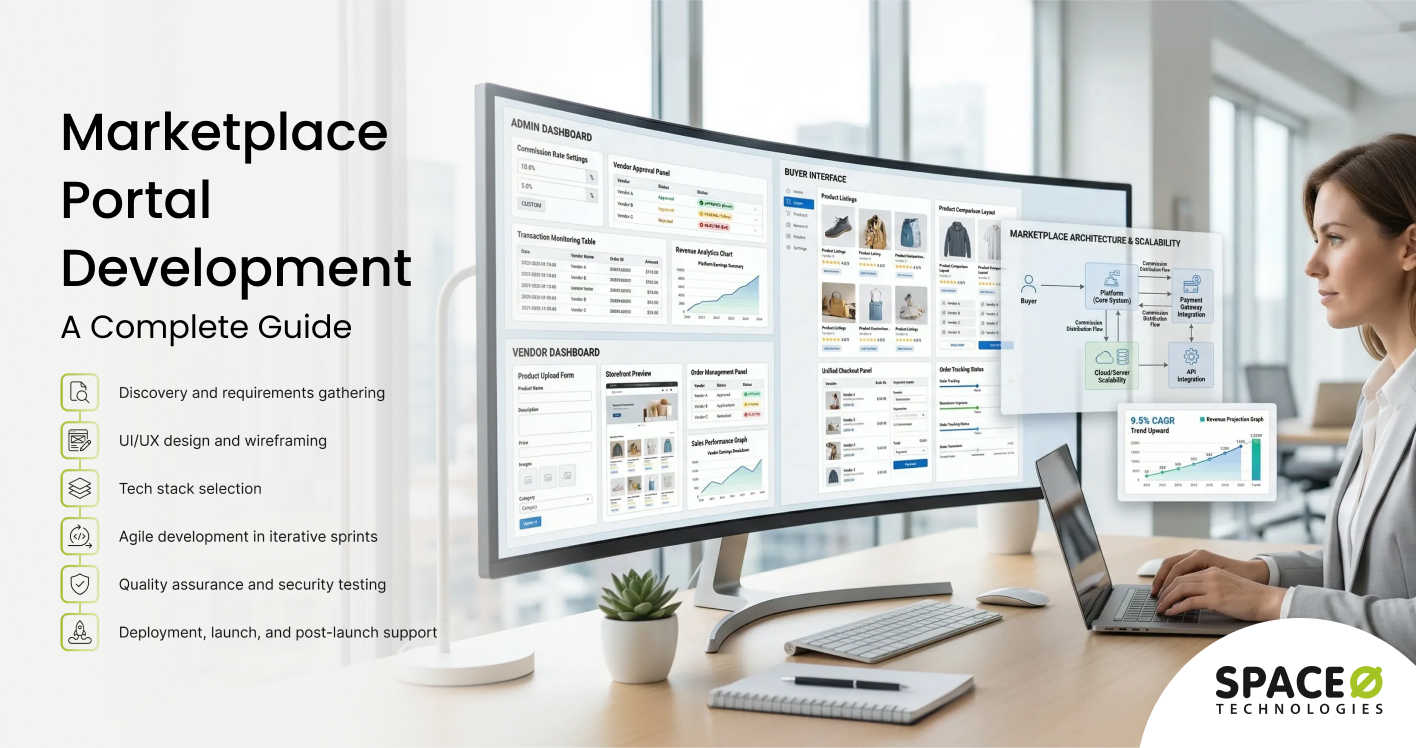
Contents
The marketplace economy is expanding rapidly. From B2B trade platforms to niche service marketplaces, businesses are moving toward digital ecosystems that connect buyers and sellers under one unified platform.
Marketplace portal development is the process of building a centralized digital platform where multiple vendors can list products or services, manage transactions, and interact with customers seamlessly. Unlike single-vendor ecommerce websites, marketplace portals require multi-vendor architecture, complex workflows, commission systems, secure payments, and scalable infrastructure.
Whether you are launching a B2B marketplace, a service aggregation portal, or a niche product marketplace, building a scalable and secure marketplace portal requires strategic planning, the right technology stack, and experienced development expertise.
In this guide, we will cover:
- Key benefits of marketplace portal development
- Features to include in your marketplace portal
- Step-by-step development process
- Cost factors and pricing breakdown
- Common challenges and how to overcome them
- Best practices for building scalable marketplace platforms
Based on our experience as a trusted web portal development agency, we have shared insights to help you understand all it takes to build a successful marketplace web portal. Let’s get started.
What Is Marketplace Portal Development?
Marketplace portal development is the process of designing and building a centralized digital platform where multiple sellers or service providers can connect with buyers, manage listings, process transactions, and operate within a unified ecosystem.
Unlike a traditional ecommerce website that supports a single vendor, a marketplace portal enables multiple vendors to register, create their own storefronts, list products or services, manage orders, track payments, and interact with customers through a shared platform.
At its core, marketplace portal development involves building a multi-vendor architecture that supports:
- Vendor onboarding and verification
- Product or service listing management
- Advanced search and filtering
- Secure payment gateway integration
- Commission and revenue management
- Order processing and tracking
- Ratings, reviews, and feedback systems
- Admin dashboards and analytics
Marketplace portals can serve various business models, including B2B marketplaces, B2C platforms, service marketplaces, rental marketplaces, and niche industry portals.
Three key stakeholders in a marketplace portal
Every marketplace portal serves three distinct user groups, each with different needs and dashboards:
- Platform admin: Manages the entire marketplace, sets commission rates, approves vendors, monitors transactions, and controls platform policies.
- Vendors/sellers: Sign up, create storefronts, upload products, manage orders, track sales, and communicate with customers.
- Buyers/customers: Browse products across multiple vendors, compare options, place orders through a unified checkout, and leave reviews.
How marketplace portals work
The typical workflow of a marketplace portal follows these steps:
- Vendors register on the platform and complete their profile and store setup.
- Vendors list their products with descriptions, images, pricing, and inventory details.
- Customers browse the catalog, compare products across vendors, and add items to the cart.
- The system processes orders, splits them by vendor, and handles payment distribution.
- Each vendor fulfills their portion of the order and updates the shipping status.
- The platform deducts its commission and releases the remaining payment to vendors.
With this foundation in place, let’s explore the different types of marketplace portals you can build.
5 Types of Marketplace Portals: B2B, B2C, C2C, Service, and Rental
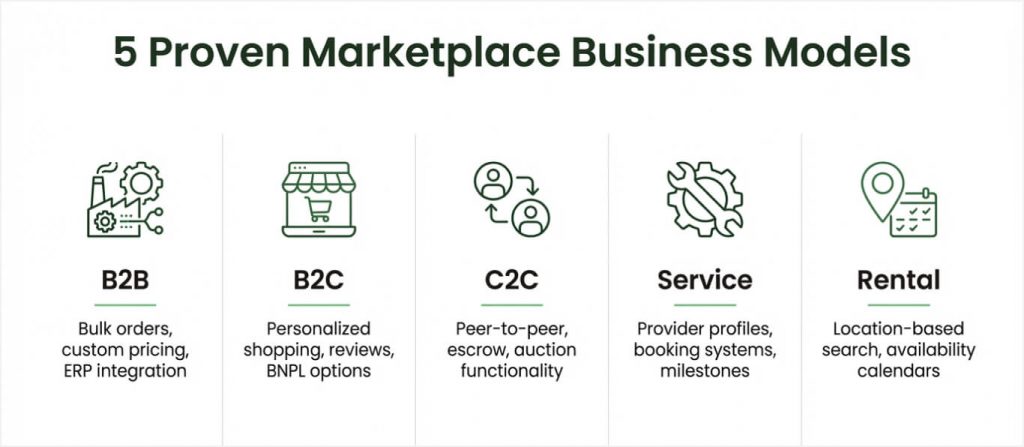
Not every marketplace portal is built the same way. The type you choose depends on your target audience, the products or services you want to facilitate, and your revenue strategy. Understanding these categories will help you define the right scope for your multi-vendor marketplace development project.
The following table provides a quick comparison of the main marketplace types before we go deeper into each one.
| Type | Participants | Examples | Key Characteristics |
|---|---|---|---|
| B2B | Businesses to businesses | Alibaba, ThomasNet | Bulk orders, custom pricing, ERP integration |
| B2C | Businesses to consumers | Amazon, Flipkart | Personalized shopping, reviews, BNPL options |
| C2C | Consumers to consumers | eBay, Etsy, Poshmark | Peer-to-peer payments, escrow, and auctions |
| Service | Service providers to clients | Upwork, Fiverr, TaskRabbit | Booking systems, provider profiles, ratings |
| Rental/Hyperlocal | Owners to renters/local buyers | Airbnb, OfferUp | Location-based search, availability calendars |
Each type requires a different approach to marketplace portal development.
1. B2B marketplace portals
B2B marketplaces connect manufacturers, wholesalers, and distributors with business buyers. These portals require features like bulk ordering, custom catalogs, negotiated pricing, and ERP integration. The sales cycles are longer, and the platform must support complex approval workflows and account hierarchies.
2. B2C marketplace portals
B2C marketplace portals are the most common type. They connect businesses directly with end consumers. Features like personalized product recommendations, customer reviews, wish lists, and buy-now-pay-later options drive conversions. Speed, user experience, and trust signals are critical for success.
3. C2C marketplace portals
C2C platforms enable individuals to sell to other individuals. Escrow-based payments, auction functionality, and dispute resolution systems are essential. The platform must build trust between strangers through verification, reviews, and secure payment handling.
4. Service marketplace portals
Service marketplaces match service providers (freelancers, agencies, professionals) with clients. These require booking systems, provider portfolios, milestone-based payments, and rating mechanisms. Examples include platforms for freelance work, home services, and professional consulting.
5. Rental and hyperlocal marketplace portals
Rental marketplaces facilitate temporary access to assets like properties, vehicles, or equipment. Hyperlocal marketplaces serve buyers and sellers within a specific geographic area. Both require location-based search, availability calendars, and geo-targeted recommendations.
Now that you understand the different marketplace types, let’s look at the business benefits that make marketplace portal development a strong investment.
7 Business Benefits of Investing in Marketplace Portal Development
Investing in marketplace portal development offers significant advantages over building a traditional single-vendor ecommerce store. Here are the key benefits that make marketplace portals attractive for businesses and entrepreneurs.
1. Scalable revenue without inventory risk
Marketplace owners earn commissions on every transaction without holding stock. This reduces capital requirements while enabling revenue growth as more vendors and buyers join the platform.
2. Faster time to market with diverse product offerings
Vendors bring their own products to the platform. The catalog grows organically without the marketplace owner needing to source, warehouse, or manage any physical inventory.
3. Multiple monetization streams beyond commissions
Marketplace portals generate revenue through subscriptions, listing fees, featured product placements, and on-platform advertising. This diversified income reduces dependency on a single revenue source.
4. Built-in network effects that strengthen over time
More vendors attract more buyers, and more buyers attract more vendors. This self-reinforcing cycle increases platform value and builds a competitive moat that becomes harder for competitors to replicate.
5. Lower customer acquisition cost through vendor marketing
Vendors actively promote their own listings and bring their existing customer base to the platform. This reduces the marketplace owner’s marketing spend and accelerates organic growth.
6. Rich first-party data for smarter decisions
Marketplace portals capture buyer behavior, seller performance, and transaction data. This enables data-driven decisions for personalization, pricing optimization, and targeted growth strategies.
7. Higher customer retention through variety and competition
A multi-vendor model offers wider product selection and competitive pricing. Customers have fewer reasons to leave when they can find everything they need in one place with price transparency.
These benefits make a strong case for building a custom marketplace software solution. But the value you deliver depends on the features you build. Let’s explore the core features every marketplace portal needs.
Build a Marketplace That Scales With Your Business
With experience serving 1,200+ clients, our team develops custom marketplace portals that support growth, performance, and seamless user experiences.

Must-Have Core Features for a Multi-Vendor Marketplace Portal
The success of any multi-vendor marketplace development project depends on building the right feature set. These core features form the foundation of a functional, reliable, and user-friendly marketplace web portal.
1. Vendor onboarding and management
A streamlined vendor registration process is critical for attracting sellers. The platform should allow vendors to sign up, submit required documents for verification, create storefronts, and start listing products with minimal friction. Admin approval workflows and KYC verification ensure platform quality.
2. Product listing and catalog management
Vendors need tools to upload products with detailed descriptions, images, pricing, categories, tags, and inventory levels. Advanced filtering and search capabilities help buyers find products quickly across thousands of listings from multiple vendors.
3. Unified customer checkout
Buyers should be able to add products from multiple vendors into a single cart and complete the purchase through one unified checkout. The system automatically splits orders by vendor and routes each sub-order for fulfillment. This buyer-seller web portal experience is what separates marketplaces from simple directories.
4. Commission management and automated payouts
The platform must calculate and deduct commissions from each sale before releasing payments to vendors. Support for flexible commission structures (flat fee, percentage-based, tiered, or category-specific) gives the admin control over monetization. Automated payout scheduling reduces manual work.
5. Admin dashboard and user analytics
Platform administrators need a centralized dashboard to monitor transactions, manage vendors, resolve disputes, track revenue, and analyze user behavior. Real-time analytics on sales, traffic, conversion rates, and vendor performance support data-driven platform management.
6. Rating and review system
Customer reviews and ratings build trust across the marketplace. A transparent review mechanism helps buyers make informed decisions, motivates vendors to maintain quality, and gives the platform social proof that drives organic growth.
As a web portal development company, we’ve seen that these core features are non-negotiable for any marketplace launch. But to stand out in a competitive market, you need to go beyond the basics. Let’s explore advanced features that differentiate high-performing marketplace portals.
Advanced Features That Give Your Marketplace Portal a Competitive Edge
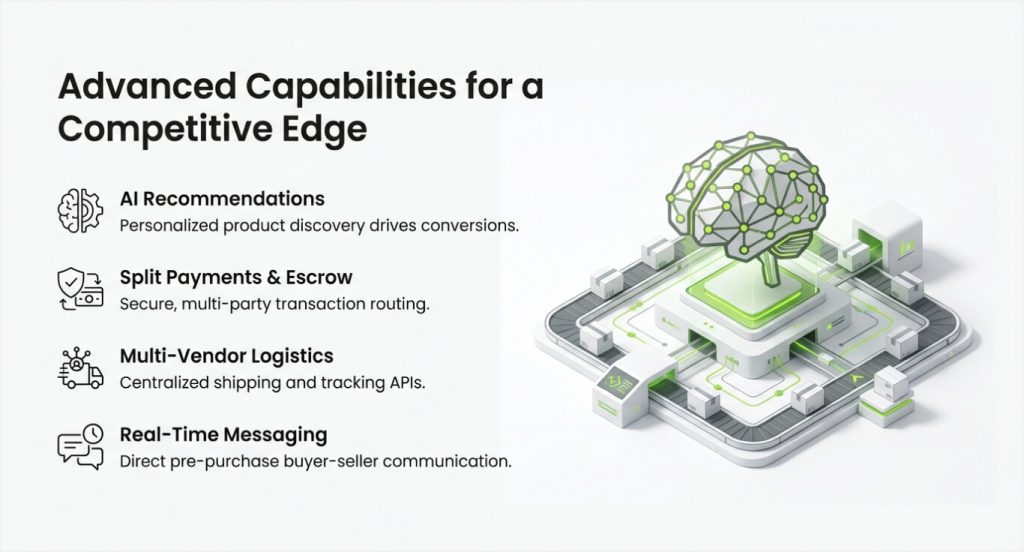
Core features get your marketplace portal running. Advanced features make it competitive. These capabilities help you attract more vendors, improve buyer experience, and scale the platform for long-term growth.
1. AI-powered recommendation engine
An AI recommendation engine in marketplaces analyzes browsing behavior, purchase history, and user preferences to surface relevant products. Personalized recommendations increase average order value, improve conversion rates, and keep buyers engaged longer on the platform.
2. Split payments and escrow integration
Payments and escrow integration ensure secure transactions. When a buyer pays for products from multiple vendors, the system splits the payment and holds funds in escrow until the buyer confirms delivery. This protects both parties and builds platform trust.
3. Multi-vendor shipping and logistics management
Order and inventory management across multiple vendors requires a centralized logistics layer. The platform should integrate with shipping providers, generate tracking numbers per vendor, calculate shipping costs, and support multiple fulfillment options (vendor-shipped, platform-fulfilled, or third-party logistics).
4. Dispute resolution and return handling
A structured dispute resolution system helps resolve conflicts between buyers and vendors. Automated return workflows, refund policies, and mediation tools reduce support burden and maintain buyer confidence. Clear escalation paths ensure fair outcomes for all parties.
5. Mobile marketplace app integration
With over 60% of ecommerce transactions happening on mobile devices, mobile marketplace app integration is essential. A responsive mobile experience or a dedicated mobile app ensures buyers and vendors can access the platform from any device without friction.
6. Real-time messaging between buyers and sellers
A built-in messaging system enables direct communication between buyers and vendors for pre-purchase inquiries, order updates, and support. Real-time chat reduces response times and improves buyer satisfaction without requiring users to leave the platform.
These advanced features are what separate a basic listing site from a scalable marketplace platform. With the feature set defined, the next step is understanding how to build your marketplace. Let’s walk through the development process.
How to Develop a Marketplace Portal from Scratch in 6 Steps
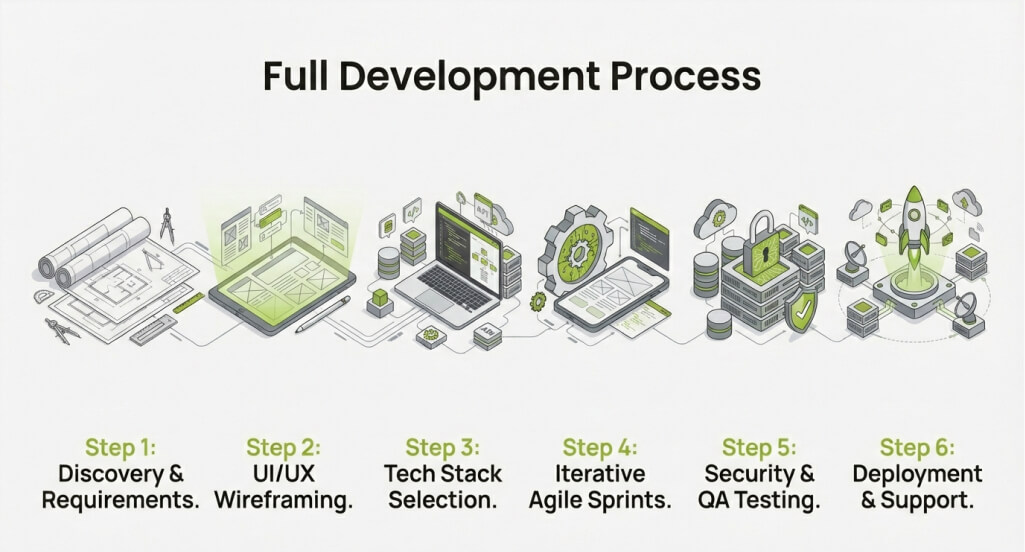
Building a marketplace portal requires a structured development process to ensure the platform meets business goals, delivers a strong user experience, and scales as you grow. Here is a six-step process for marketplace portal development.
Step 1: Discovery and requirements gathering
Start by defining your marketplace’s value proposition, target audience, and core features. Conduct stakeholder interviews to understand the needs of all user groups (admin, vendors, buyers).
Action items
- Identify the marketplace type (B2B, B2C, C2C, or service)
- Define the Minimum Viable Product (MVP) feature set
- Map out user journeys for each stakeholder
- Research competitor platforms and identify gaps
- Document technical and business requirements
Step 2: UI/UX design and wireframing
Translate requirements into visual designs that prioritize usability for vendors, buyers, and administrators. A well-designed marketplace reduces friction and drives higher engagement.
Action items
- Create wireframes for all key user flows (vendor dashboard, product listing, checkout, admin panel)
- Design responsive layouts that work across desktop and mobile
- Conduct usability testing on prototypes before development begins
- Establish a design system for consistency across the platform
Step 3: Tech stack selection
Choose a technology stack that supports scalability, performance, and security. Partnering with an experienced web development company ensures the right architecture decisions are made early, which determines your platform’s ability to handle growth.
Action items
- Frontend: React, Angular, or Vue.js for dynamic, responsive interfaces
- Backend: Node.js, Python (Django), Laravel, or .NET for server-side logic
- Database: PostgreSQL, MongoDB, or MySQL, depending on data structure
- Architecture: Microservices for scalability, API-first approach for integrations
- Cloud: AWS, Azure, or Google Cloud for hosting and infrastructure
Step 4: Agile development in iterative sprints
Break development into two-week sprints with clear deliverables. This approach enables early feedback, reduces risk, and ensures the platform evolves based on real-world input.
Action items
- Develop core features first (vendor onboarding, product catalog, checkout, payments)
- Build an admin dashboard and analytics in parallel
- Integrate third-party services (payment gateways, shipping APIs, communication tools)
- Conduct sprint reviews with stakeholders after each iteration
Step 5: Quality assurance and security testing
Thorough testing ensures the platform performs reliably under real-world conditions. Given that a marketplace handles payments and personal data, security testing is critical.
Action items
- Execute functional, integration, and regression testing across all user roles
- Perform load testing to validate performance under peak traffic
- Conduct security audits for vulnerabilities (SQL injection, XSS, CSRF)
- Test payment workflows end-to-end across multiple scenarios
- Verify PCI DSS compliance for payment processing
Step 6: Deployment, launch, and post-launch support
Deploy the platform to production, monitor performance, and provide ongoing support for bug fixes, updates, and feature enhancements.
Action items
- Deploy using CI/CD pipelines for reliable releases
- Set up monitoring and alerting for uptime, performance, and errors
- Plan a phased launch (invite-only beta, then public launch)
- Gather user feedback and iterate based on real usage data
- Provide ongoing maintenance and portal support
If you need dedicated talent for your project, you can also hire web developers with marketplace and portal development experience.
With the development process clear, the next question on every business owner’s mind is: how much does this cost? Let’s break down the numbers.
Work With an Experienced Marketplace Development Team
From discovery and architecture planning to deployment and optimization, Space-O Technologies ensures a structured, transparent, and result-driven marketplace portal development process.
How Much Does Marketplace Portal Development Cost?
The cost of marketplace portal development depends on the platform’s complexity, feature scope, technology stack, team size, and team location. Below is a marketplace-specific breakdown to help you plan your budget and timeline.
| Complexity | Features | Timeline | Cost Range |
|---|---|---|---|
| Basic MVP | Vendor registration, product listings, basic checkout, and admin panel | 3–4 months | $30,000–$60,000 |
| Mid-range | Advanced search, commission management, ratings, analytics, and mobile responsive | 5–8 months | $60,000–$120,000 |
| Enterprise | AI recommendations, multi-currency, escrow, logistics integration, mobile app | 8–14 months | $120,000–$300,000+ |
These are approximate figures. The actual cost depends on several factors explained below.
Basic MVP ($30,000–$60,000): This tier covers the essentials needed to validate your marketplace idea. It includes vendor registration, product listings with basic filtering, a simple checkout flow, and a lightweight admin panel. A basic MVP is ideal for testing market demand before committing to a larger investment.
Mid-range ($60,000–$120,000): A mid-range marketplace adds features that improve retention and operational efficiency. This includes advanced search and filtering, commission management with automated payouts, ratings and reviews, analytics dashboards, and a mobile-responsive design. Most B2C and service marketplaces fall into this tier.
Enterprise ($120,000–$300,000+): Enterprise-grade marketplaces require advanced capabilities like AI-powered product recommendations, multi-currency and multi-language support, escrow-based payments, logistics and shipping integrations, and a dedicated mobile app. This tier suits platforms targeting high transaction volumes across multiple regions.
For a broader look at portal pricing across all types, refer to our detailed guide on web portal development cost.
Key factors that affect the development cost of the marketplace
- Feature scope: More features (AI, split payments, real-time chat) increase development hours and cost.
- UI/UX design complexity: Custom, research-driven designs cost more than template-based approaches but deliver better user engagement.
- Number of integrations: Each third-party integration (payment gateways, shipping APIs, CRM, ERP) adds development effort.
- Tech stack choices: Choosing a microservices architecture costs more upfront but provides better scalability for growth.
- Team location: Developer rates vary significantly by region.
Working with a web portal development company in South Asian countries often significantly reduces your development cost while maintaining quality, especially when the team follows Agile practices and has experience with multi-vendor marketplace development.
Understanding the cost is only part of the equation. You also need to decide how your marketplace will generate revenue. Let’s explore the most common monetization strategies.
5 Common Marketplace Portal Development Challenges and How to Solve Them
Building a marketplace portal comes with unique challenges that single-vendor platforms do not face. Recognizing these obstacles early and planning solutions will save you time, money, and frustration during development and after launch.
1. Balancing multi-sided dynamics across buyers, sellers, and the platform
A marketplace must deliver value to all three stakeholders simultaneously. If vendors are unhappy with commission rates, they leave. If buyers face poor experiences, they shop elsewhere. Getting this balance wrong can collapse the entire ecosystem.
Solution
- Define clear value propositions for each user group before development begins
- Start with vendor-friendly policies to build initial supply, then optimize for profitability
- Collect feedback from both sides regularly and adjust platform policies
- Use data analytics to identify friction points in the buyer-seller experience
2. Attracting and retaining sellers on the platform
The cold-start problem is real. Without vendors, there are no products. Without products, there are no buyers. Seller acquisition and retention require proactive effort, especially in the early stages.
Solution
- Offer low or zero commission rates during the initial launch phase
- Provide vendors with analytics tools, marketing support, and inventory management features
- Build automated payout systems to ensure vendors get paid quickly and reliably
- Create a vendor success program with onboarding support and best-practice guides
3. Ensuring trust, safety, and fraud prevention at scale
As the marketplace grows, so do the risks. Fake listings, fraudulent transactions, identity theft, and disputes can erode buyer trust and damage the platform’s reputation.
Solution
- Implement KYC verification for all vendors during onboarding
- Use escrow-based payments to protect buyers and sellers
- Build automated fraud detection using transaction pattern analysis
- Create a transparent dispute resolution process with clear escalation steps
4. Maintaining performance and scalability as users grow
A marketplace that slows down during peak traffic or crashes during sales events will lose users permanently. The platform architecture must handle increasing loads without degradation.
Solution
- Choose a microservices architecture that allows independent scaling of components
- Use cloud-based infrastructure with auto-scaling capabilities
- Implement content delivery networks (CDN) for fast asset loading globally
- Conduct regular load testing to identify and fix bottlenecks before they impact users
5. Managing vendor-generated content and marketplace SEO
When vendors create product listings, the content quality varies widely. Duplicate descriptions, poor images, and missing keywords can hurt search rankings and buyer experience.
Solution
- Set content guidelines and minimum quality standards for all product listings
- Build automated content validation tools that flag low-quality submissions
- Implement unique URL structures and schema markup for product pages
- Monitor and deduplicate similar listings to avoid search engine penalties
Addressing these challenges during planning and development ensures your marketplace portal is secure, scalable, and ready for growth. Once the foundation is strong, the next critical step is defining how your marketplace will generate revenue. Let’s explore the most effective monetization models for marketplace portal development.
How Do Marketplace Portals Make Money? 5 Proven Revenue Models
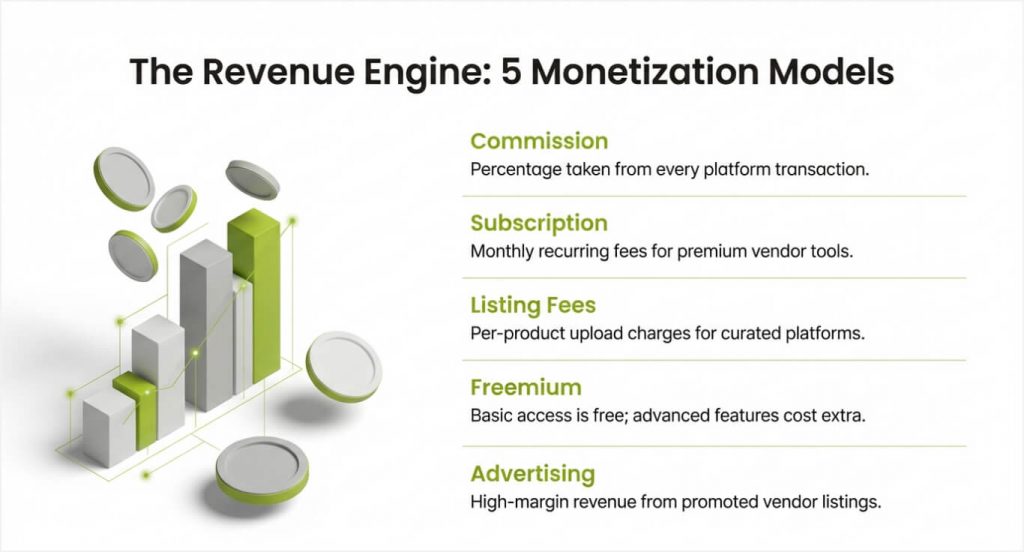
Choosing the right monetization model is a critical decision in marketplace portal development. Your revenue model affects platform pricing, vendor acquisition strategy, and long-term profitability.
The table below compares the five most common monetization models for marketplaces so you can evaluate which fits your business.
| Revenue Model | How It Works | Best For | Pros | Cons |
|---|---|---|---|---|
| Commission | The platform takes a percentage of each sale | High-volume B2C/C2C | Scales with transactions | Vendors may resist high rates |
| Subscription | Vendors pay monthly or annual fees | B2B, service marketplaces | Predictable recurring revenue | Harder to attract early vendors |
| Listing fees | Vendors pay per product listed | Niche, curated marketplaces | Simple to implement | Can limit catalog growth |
| Freemium | Basic listing is free, and premium features are paid | Early-stage platforms | Low barrier to vendor entry | Slower revenue growth |
| Advertising | Featured products and promoted listings | Large-scale marketplaces | High-margin revenue stream | Requires significant traffic |
Many successful marketplaces combine two or more models. For example, a platform might charge a base commission on every sale while offering vendors the option to pay for promoted listings or a premium subscription tier with advanced analytics.
The right combination depends on your industry, target audience, and competitive landscape. If you are building a B2B portal, subscription models tend to work well because B2B buyers expect ongoing relationships. For consumer-facing marketplaces, commission-based models scale naturally with transaction volume.
Not Sure Which Revenue Model Fits Your Marketplace Idea?
Our experts help you design profitable monetization strategies tailored to your niche, whether commission-based, subscription-driven, or hybrid marketplace models.
Build a Scalable Marketplace Platform with Space-O Technologies
From choosing a revenue model to building scalable vendor workflows, marketplace portal development demands decisions that shape your platform’s future. This guide gave you the framework to navigate those decisions with clarity and confidence.
Space-O Technologies has been turning complex platform ideas into production-ready software since 2010. With 350+ web projects delivered for clients across the globe, we bring the kind of experience that reduces guesswork and accelerates your launch.
Our team of 80+ developers has hands-on experience with multi-vendor architectures, split payment systems, and real-time analytics dashboards. We have built marketplace portals for ecommerce, B2B, and service verticals using React, Node.js, Laravel, and cloud-native infrastructure.
Bring your marketplace idea to our team for a free consultation. Contact us, and within 24 hours, you will have a clear scope, a recommended tech approach, and a detailed cost estimate tailored to your requirements.
Frequently Asked Questions on Marketplace Portal Development
1. How much does it cost to develop a marketplace portal?
The cost of marketplace portal development ranges from $30,000 to $300,000 or more, depending on complexity, features, and team location. A basic MVP starts around $30,000–$60,000, while enterprise-grade platforms with AI, escrow, and mobile apps can exceed $300,000.
2. How long does it take to build a multi-vendor marketplace?
Building a multi-vendor marketplace typically takes 3–14 months. A basic MVP takes 3–4 months, a mid-range platform takes 5–8 months, and an enterprise marketplace with advanced features can take 8–14 months or longer.
3. What is the difference between a marketplace portal and an ecommerce website?
An ecommerce website sells products from a single brand or company. A marketplace portal hosts multiple independent vendors who list and sell their own products on the platform. Marketplaces involve more complex features like vendor management, commission handling, and multi-vendor checkout.
4. What tech stack is best for marketplace portal development?
Common tech stacks for marketplace portal development include React or Angular for the frontend, Node.js or Laravel for the backend, PostgreSQL or MongoDB for the database, and AWS or Google Cloud for hosting. A microservices architecture with an API-first approach is recommended for scalability.
5. How do marketplace portals make money?
Marketplace portals generate revenue through several models: commission on each transaction (most common), vendor subscription fees, listing fees, freemium tiers, and advertising or featured placements. Most successful marketplaces combine two or more revenue streams.
6. Can I integrate a marketplace portal with my existing CRM or ERP system?
Yes. Custom marketplace software can be built with API integrations to connect with your existing CRM, ERP, accounting, shipping, and marketing tools. This ensures data flows between systems and eliminates manual data entry. A supplier and distributor ecosystem portal benefits especially from ERP and CRM integration.
7. How does a marketplace portal scale as the number of users and vendors grow?
A scalable marketplace web portal is built using cloud infrastructure, microservices architecture, and an API-first approach. This allows independent scaling of services such as payments, search, messaging, and analytics. Auto-scaling cloud environments, CDN integration, optimized database design, and load testing ensure the platform performs reliably as vendor listings, traffic, and transactions increase.



 All our projects are secured by NDA




 4.8
4.8