
 By
Contents
- Start with a paid proof of concept before you commit budget to a full AI agent build.
- Production agents need tool-calling, memory, retries, and guardrails, not prompt engineering alone.
- Pick a fixed-scope build for stable requirements and a dedicated team for evolving ones.
- Write ownership of agent logic, vector databases, and source code into the contract.
Key Takeaways
Why do AI agent pilots stall before they reach production? Hire AI agent developers as a full team that owns the path to production. An outsourced AI agent development team designs, builds, integrates, tests, and maintains multi-step agents.
Hiring single developers leaves guardrails, integrations, and QA on your team. Space-O Technologies has served 1,200+ clients since 2010 with 140+ in-house developers. Our AI agent development company team runs discovery, build, integration, and support as one team.
This page covers roles, engagement models, stack, safeguards, handover, and costs. It suits founders, CTOs, and business leaders who want agents inside real workflows. You can also hire dedicated AI agent developers for a scoped team plan.
Hiring AI Agent Talent Alone Leaves Production Risk on Your Team
Hiring AI agent developers costs more than the rate card, because production agents need skills one hire rarely covers. Most buyers compare hourly rates first. The higher costs come from missing guardrails, failed integrations, and rework after launch.
Our guide to in-house vs outsourced AI development covers that trade-off in depth. This section focuses on three blockers buyers meet first.
Market rates vary widely by hiring route
Rates for AI agent developers vary by hiring route, and a low rate rarely covers the full job. The routes below differ in what your own team still manages.
- Freelance developers: Rates are lowest, but your team manages vetting, architecture, QA, and delivery.
- Offshore and nearshore developers: Rates sit mid-range, with time-zone and oversight effort on your side.
- Senior US developers: Rates are highest, and one hire still rarely covers every production skill.
- Boutique agencies: Rates run mid to high, and the price follows the scope in the proposal.
- Project-based builds: The price follows integrations, guardrails, and handover scope, and the cost section below shows build and run together.
Space-O Technologies does not publish hourly rates, so the skills below matter more than any rate card.
Prompt engineering alone does not ship a production agent
A production agent needs engineering skills that go well beyond writing good prompts. Space-O Technologies vets AI agent developers on these five skills before they join a client team.
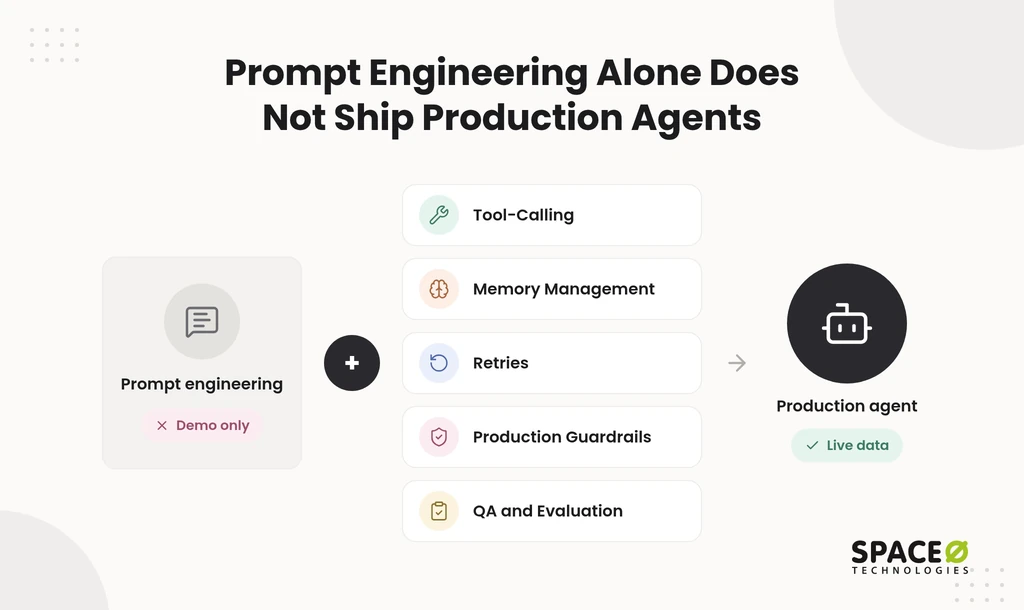
- Tool-calling: The agent calls the right system with the right inputs and handles bad responses.
- Memory management: The agent keeps the context it needs across steps without leaking data.
- Retries: The agent recovers from timeouts and failed calls without looping or duplicating actions.
- Production guardrails: The agent works within set limits on actions, data, and spend.
- Quality assurance (QA) and evaluation: The agent passes tests for accuracy and safety before every release.
Integration and compliance gaps keep pilots from going live
AI agents stall when they cannot reach your business systems or pass a security review. A pilot that reads sample data rarely survives contact with live permissions and legacy records. Our team plans integration and compliance at intake, so they do not block the release later.
These three blockers shape how the team is built, staffed, and governed.
A Production-Ready AI Agent Team Built Around Your Systems
Space-O Technologies gives you an AI agent team that scopes, builds, integrates, secures, and runs your agent with you. Each part below solves one of the blockers above. Together they cover the full path from first workflow to supported production agent.
Dedicated team roles matched to your agent
A dedicated AI agent team combines four core roles, sized to your workflow. A single-agent tool may need two people, while a multi-agent system needs all four.
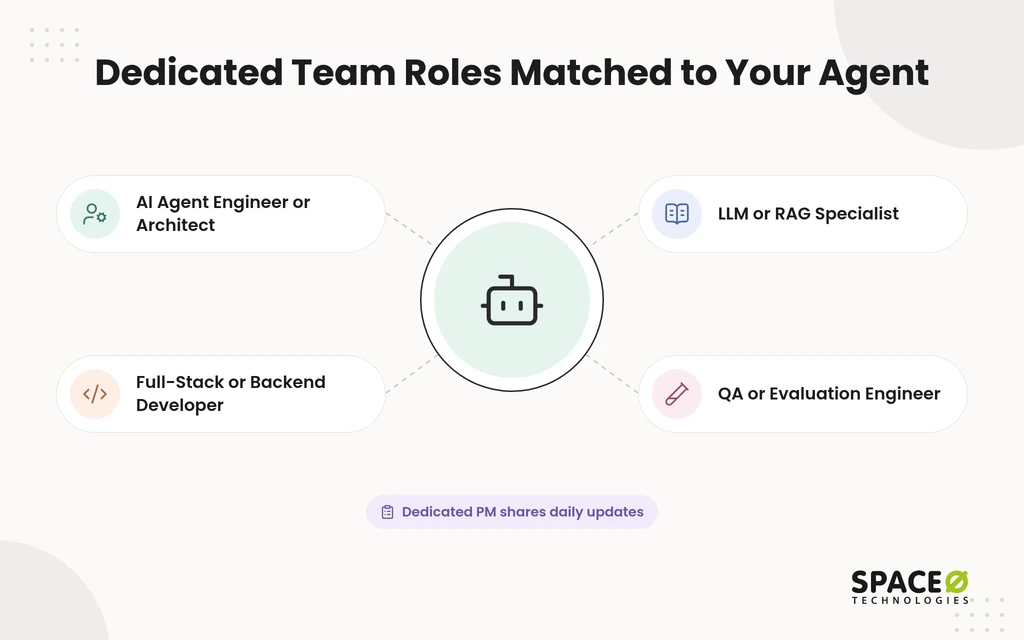
- AI Agent Engineer or Architect: This role designs the agent’s reasoning, tools, memory, and autonomy limits.
- Full-Stack or Backend Developer: This role builds the services, APIs, and interfaces the agent runs on.
- LLM or RAG Specialist: This role handles large language model (LLM) selection, prompts, and retrieval quality.
- QA or Evaluation Engineer: This role tests accuracy, safety, and cost before each release.
A dedicated project manager (PM) shares daily updates, so your team stays informed without managing every engineer.
Four engagement models for scoped builds or embedded talent
The four engagement models split between a scoped build and embedded talent. Choose a scoped build when requirements are stable. Choose embedded talent when they will change as you learn.
| Engagement model | Type | Best fit |
|---|---|---|
| Fixed Cost | Scoped build | A clearly defined agent with an agreed scope, timeline, and budget. |
| Time & Material | Scoped build, flexible | An agent whose needs change after the proof of concept. |
| Dedicated Team | Embedded talent | A long-term agent program that needs a full team on your product. |
| Staff Augmentation | Embedded talent | An in-house team needing AI agent engineers inside its sprints. |
With Staff Augmentation, we handle vetting, onboarding, and replacements. Teams that need long-term capacity beyond agents can also add dedicated developers for web, mobile, and backend work.
Match Your Agent to the Right Engagement Model
Tell us your workflow, systems, and budget today. Our team recommends Fixed Cost, Time and Material, Dedicated Team, or Staff Augmentation, with a clear reason.

Agent frameworks and stack chosen for your use case
Agents are built on LangGraph, CrewAI, or the OpenAI Agents SDK, chosen by your workflow. The framework follows the problem, not the other way around.
- Orchestration frameworks: LangGraph suits stateful workflows, CrewAI suits role-based agent teams, and the OpenAI Agents SDK suits OpenAI-centered builds.
- Supporting libraries: LangChain and LlamaIndex connect models to data sources and tools.
- Tool access: Model Context Protocol (MCP), function calling, and FastAPI services expose your systems to the agent.
- Retrieval: Retrieval-augmented generation (RAG) grounds answers in your data using Pinecone, Qdrant, or PGVector.
- Multi-agent systems: Specialized agents split complex work and hand off tasks under one orchestration layer.
Our overview of AI agent frameworks compares these options in more detail.
Integration with CRM, ERP, legacy databases, and APIs
AI agents connect safely to the systems your team already runs. Each connection gets scoped permissions, so the agent reaches only the data it needs.
- Customer relationship management (CRM): The agent reads and updates customer records within set permissions.
- Enterprise resource planning (ERP): The agent works with orders, inventory, and finance data under approval rules.
- Legacy databases: The agent queries older systems through controlled access layers.
- Data lakes and application programming interfaces (APIs): The agent pulls analytics data and calls third-party services through managed connections.
Guardrails, compliance, and human review by default
Every agent ships with guardrails, role-based access, and human approval for high-stakes actions. Automation handles the volume, but a qualified human reviews and approves before any output influences a final decision.
- Role-based access: Each agent and user gets only the permissions its task requires.
- Compliance posture: Space-O Technologies’ compliance posture covers ISO 27001 alignment and HIPAA-ready frameworks for healthcare AI engagements.
- Regulated data: Builds support HIPAA-compliant workflows and GDPR data protection duties.
- Responsible AI defaults: Agents never train on client data, and personally identifiable information (PII) is masked.
- Evaluation suite: Every production model is tested for accuracy, hallucination rate, bias, latency, and cost.
For a lending client, our agent only drafts an approve-or-decline recommendation with its reasoning. A human underwriter signs off on every case above the exposure threshold, keeping high-value decisions at 100% human approval.
Post-launch monitoring, evaluation, and retraining
Agents stay reliable after launch through monitoring, drift evaluation, and retraining. You can run this as a managed service or take it over at handover.
- Monitoring: Continuous checks flag failed actions, cost spikes, and latency problems.
- Drift evaluation: Scheduled tests catch accuracy loss as your data and processes change.
- Prompt regression testing: Every prompt change runs against a fixed test set before release.
- Retraining and support: Engineers update models, tools, and integrations as your systems evolve.
Documented handover with full code and IP ownership
Every Space-O Technologies engagement ends with a documented handover, and all code, data, and intellectual property (IP) transfer to you. An external team works with your organization to design, build, test, and hand over your AI agent.
AI agent development delivered by an outsourced partner should end with five handover items:
- Source code and repositories: Your organization receives all agent logic, prompts, and pipelines in your own repositories.
- Documentation: Your team receives architecture, tool, and runbook documents.
- Deployed environments: Your accounts host the production and staging environments.
- Acceptance walkthrough: Your team signs off after a live review against agreed criteria.
- Support terms: Your contract states what support continues after handover and for how long.
Unlike a staffing vendor, the partner shares delivery risk, covers QA, and stays for post-launch support. With roles, models, stack, and handover defined, the next step is how the work moves.
Six Steps That Take Your AI Agent to Production
Every AI agent moves from intake to production in six steps, with a checkpoint after each. Each step reduces one kind of risk before more budget is spent. Our AI agent development process guide covers the engineering details.
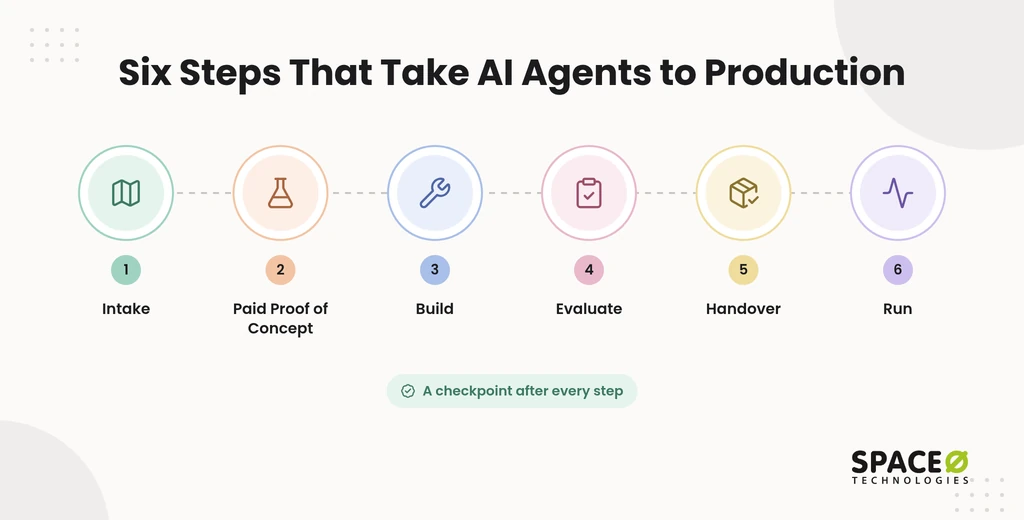
- Intake: We map the workflow, systems, data, and autonomy boundaries for the agent.
- Paid proof of concept: We test the riskiest assumption on your real data before the full build.
- Build: Our engineers build the tools, memory, and guardrails. We keep prompts and pipelines under version control and CI/CD (continuous integration and continuous delivery).
- Evaluate: Our QA engineers run the evaluation suite described above before release.
- Handover: Your team receives the five handover items listed above and signs off.
- Run: We monitor, evaluate drift, and retrain, or your team takes over operations.
The proof of concept is the step buyers skip most often, and it causes the most expensive rework later.
Verified Delivery Record Backing Every AI Agent Team
Space-O Technologies backs its AI agent teams with a delivery record built since 2010. Every figure below is a verified fact that helps you weigh the benefits of outsourcing AI development.
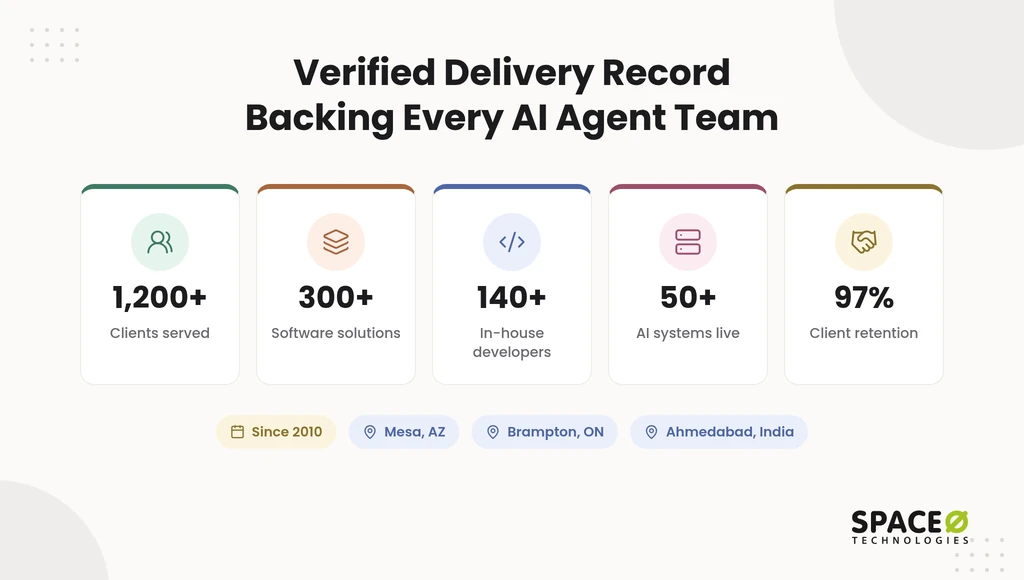
- 1,200+ clients: Space-O Technologies has served 1,200+ clients since 2010.
- 300+ software solutions: Space-O Technologies has developed 300+ software solutions.
- 140+ in-house developers: Space-O Technologies has 140+ in-house software developers.
- AI in production: For agent work, 30+ AI engineers run 50+ AI systems live.
- 97% client retention: Space-O Technologies reports 97% client retention.
- Compliance delivery: Space-O Technologies built custom software for a medical devices company that significantly improved its data protection and compliance processes.
- Offices: Space-O Technologies has offices in Mesa (Arizona), Brampton (Ontario), and Ahmedabad (India).
Track records matter, but fit matters more when you choose an AI agent development partner. The next section shows where Space-O Technologies fits and where other routes may suit you.
Why Space-O Technologies Fits Agents Moving from Pilot to Production
Space-O Technologies fits teams that need an agent running inside real systems, not another demo. The sections below show where that fit is strongest, what other routes involve, and how to vet any provider.
Best for production agents inside existing systems
Best for: Space-O Technologies suits teams and founders moving AI agents from pilot to production. The fit is strongest when the agent must run inside existing CRM, ERP, or legacy systems or a live product. It also suits buyers who want responsible AI defaults and full code and IP transfer.
Other ways to hire AI agent developers
Talent networks, freelance marketplaces, and consultancies are the other common routes to hire AI agent developers. Each route is described by how you engage and what your team still manages.
- Talent networks: You engage pre-screened individual developers, and your team manages scope, architecture, QA, and delivery.
- Freelance marketplaces: You engage freelancers by project or hour, and your team manages vetting, scope, QA, and delivery.
- Consultancies and agencies: You engage through a scoped proposal, and your team manages vendor oversight and internal approvals.
Vetting checklist before you sign
Before you sign with any provider, check four things that separate production teams from demo teams.
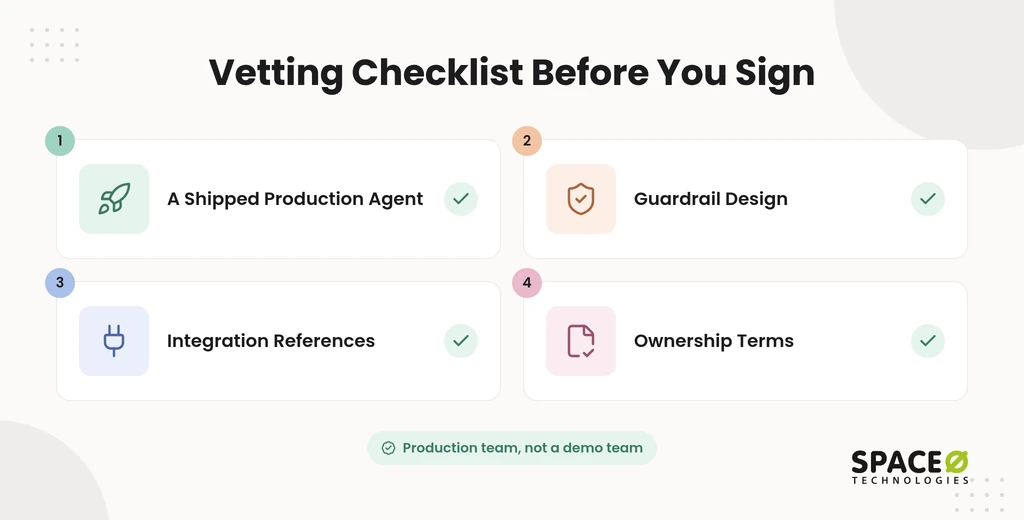
- A shipped production agent: Ask for an agent that runs on live data today, not a demo.
- Guardrail design: Ask how the agent limits actions, handles failures, and routes decisions to people.
- Integration references: Ask for references on systems similar to your CRM, ERP, or databases.
- Ownership terms: Ask whether the contract assigns agent logic, prompts, vector databases, and code to you.
A cost view that covers build and run
Space-O Technologies quotes the build and the cost of running the agent, so your budget covers both. A basic MVP can start from $15,000, while more feature-rich MVPs can go up to $50,000 or more. These are MVP prices, not agent-specific prices, and payments are milestone-based and tied to deliverables.
Infrastructure, model or API usage, and maintenance add to the total. Our guide to AI agent maintenance cost after launch models a three-year total cost of ownership for an MVP-sized agent on those prices. The figures are arithmetic on published ranges, not a measured bill from one engagement.
| Line | Low case | High case |
|---|---|---|
| Build (one-time) | $15,000 | $50,000+ |
| Maintenance, 3 years (15% / 25% of build) | $6,750 | $37,500+ |
| Usage, 36 months ($700 / $7,000 a month) | $25,200 | $252,000+ |
| Three-year total | $46,950 | $339,500+ |
Usage is the largest share of the three-year total in both the low and high cases. So the token budget matters more than the build price when you plan agent costs. Our breakdown of AI agent development cost explains each line. Once the budget is clear, the quickest next step is a scoping call.
Bring Your Agent Workflow and Get a Clear Team Plan
A short scoping call with Space-O Technologies turns one workflow into a team plan, a model, and a budget range. You leave knowing whether a proof of concept, a full build, or added engineers fits best. Come ready to answer three questions:
- Workflow: Which manual, multi-step process should the agent handle first?
- Systems and stack: Which CRM, ERP, databases, and APIs the agent must reach.
- Budget, timeline, and model: Whether you need a full build or a dedicated team, and by when.
Frequently Asked Questions
What legal, data privacy, and security issues should you consider when hiring AI developers?
Do not sign unless the contract assigns agent logic, prompts, vector databases, and source code to you. It must also rule out training on your data. For HIPAA- or GDPR-covered data, run the security review at intake, before the paid proof of concept. Confirm in writing which actions need human approval and which PII fields are masked.
How much does it cost to hire AI agent developers?
US market rates run from about $25 to $150 an hour, depending on the hiring route. Offshore and nearshore developers run $25-#75 an hour, and senior US developers run $60-$150. Project-based builds run $5,000-$100,000+. At Space-O Technologies, a basic MVP can start from $15,000, within the project-based range above. More feature-rich MVPs at Space-O Technologies can go up to $50,000 or more, per project. Infrastructure, model or API usage, and maintenance add to the total.
What skills should an AI agent developer have?
A production AI agent developer needs skills beyond prompt writing. Look for tool-calling, memory management, retries, and production guardrails. Add QA and evaluation skills, so the agent passes accuracy and safety tests before every release. Ask for a shipped agent that runs on live data as proof.
Timeline to hire a dedicated AI agent development team and ship an AI agent
Simple AI solutions typically take 2 to 3 months, mid-level applications 4 to 8 months, and enterprise systems 6 to 12 months, so get your timeline written into the scoped plan. The work runs in six steps: intake, paid proof of concept, build, evaluate, handover, and run. Each step ends with a checkpoint. A narrow scope with stable requirements usually suits Fixed Cost, which agrees a timeline up front.
Why hire an outsourced AI agent team instead of building in-house?
An outsourced team gives you a full agent team without an in-house machine learning department. It covers design, build, integration, testing, and post-launch support. A development partner also shares delivery risk and covers QA, which a staffing vendor does not. You still own the code, data, and IP at handover.
What are the limits of AI agents in a business workflow?
AI agents work within set limits and still need human review for high-stakes actions. A pilot that reads sample data often fails against live permissions and legacy records. Weak guardrails, failed integrations, and compliance gaps cause most delays. Agents also drift as your data and processes change, so they need monitoring and retraining.
What does it cost to run an AI agent after launch?
Running costs include model or API usage, hosting, monitoring, and maintenance. Space-O Technologies’ AI development cost guide puts annual maintenance at 15% to 25% of the original build cost. Over three years, usage can outweigh the build price, so review token spend every month. Ask for build and run costs in the same quote. Then decide whether to buy a managed service or take over operations at handover.



 All our projects are secured by NDA




 4.8


