
 By
Contents
- Hiring enterprise AI consultants starts with one choice: strategy, implementation, or both.
- Four partner types exist: global consultancies, systems integrators, specialized AI build partners, and freelance networks.
- Verify production proof, governance, IP ownership, and knowledge transfer before you sign.
- Hire for the gap you have, and tie every payment to a delivered milestone.
Key Takeaways
Most enterprise AI projects stall between a promising pilot and production. That gap is often a hiring problem, not a technology problem. If you plan to hire AI consultants for enterprise work, the first choice matters most.
Partners differ widely in scope, cost, and delivery proof. Some advise, some build, and some add engineers to your team. Picking the wrong type wastes budget and months of effort.
This guide covers partner types, costs, and what to verify. Space-O Technologies has built custom software since 2010, with 50+ AI systems in production. Use it to shortlist partners and ask sharper questions.
What Do Enterprise AI Consultants Actually Deliver?
Enterprise AI consultants deliver two kinds of work: strategy and roadmapping, and technical implementation. Some firms do one. Some do both. Your first hiring decision is which of the two your enterprise is missing.
What does AI strategy and roadmapping cover?
AI strategy and roadmapping decide which AI use cases to pursue, in what order, and with what data. Many enterprises run scattered pilots with no shared priority. A strategy engagement, such as machine learning consulting, fixes that with these outputs:
- Use-case discovery: A ranked list of AI opportunities, scored by business value and feasibility.
- Data readiness audit: An assessment of whether your data is clean, accessible, and governed enough to use.
- Roadmap: A sequenced plan that moves the top use cases from pilot to production.
- Business case: Expected key performance indicators (KPIs) tied to each use case before money is spent.
What does enterprise AI implementation include?
Enterprise AI implementation is building, integrating, and deploying AI into the systems your teams already use. Most enterprise AI stalls between demo and production. Implementation work closes that gap with these deliverables:
- Custom builds: AI agent development, chatbots, generative AI features, machine learning, and computer vision built for your workflows.
- Retrieval-augmented generation (RAG) systems: Large language models (LLMs) grounded in your own documents and data.
- Integration: Generative AI integration services link AI to enterprise resource planning (ERP), customer relationship management (CRM), and legacy systems.
- Machine learning operations (MLOps): Deployment, monitoring, and retraining pipelines that keep models reliable after launch.
Strategy, Implementation, or Both? Define the Gap First
Hire for the gap you actually have, not the full menu a firm sells. Enterprises often overbuy strategy when they need builders, or hire builders before anyone has set priorities. Use these rules:
- If you lack strategy: Hire an advisor to prioritize use cases and build the roadmap.
- If you lack execution: Hire an implementation partner to build, integrate, and deploy.
- If you lack engineering capacity: Add vetted AI engineers through staff augmentation or a dedicated team.
The third rule fits enterprises with a roadmap and an internal team. They need more hands to meet a deadline.
Types of Enterprise AI Consulting Partners
The enterprise AI consulting market has four partner types: strategy consultancies, integrators, build partners, and freelance networks. Each type suits a different scope, and each entry below uses the same three parts. To compare firms, browse the verified AI company reviews on GoodFirms.
Global strategy consultancies
Global strategy consultancies include Accenture, Deloitte, IBM Consulting, McKinsey QuantumBlack, and BCG X.
- Scope the market ties to them: Enterprise-wide AI transformation and governance programs.
- What hiring one requires: Executive sponsorship, a formal procurement process, and internal owners for each workstream.
- Pricing: Quoted per engagement; no verified public figures are used on this page.
IT systems integrators
IT systems integrators include Capgemini, Cognizant, Infosys, and Tata Consultancy Services (TCS).
- Scope the market ties to them: Connecting AI to legacy ERP and CRM platforms.
- What hiring one requires: Detailed documentation of your current systems and a dedicated internal integration lead.
- Pricing: Also quoted per engagement, as with global consultancies.
Specialized AI build partners
Specialized AI build partners are smaller firms focused on engineering production AI.
- Scope the market ties to them: Moving AI from pilot to production.
- What hiring one requires: A defined use case, access to your data, and a business owner who can approve milestones.
- Pricing: Usually scoped as fixed-cost, time and material, or dedicated team proposals.
Vetted freelance networks
Vetted freelance networks supply individual AI consultants on a fractional basis. For a deeper comparison, read AI development company vs freelancer.
- Scope the market ties to them: Fractional advisory and narrow technical tasks.
- What hiring one requires: Your team handles vetting, coordination, security review, and governance.
- Pricing: Set by each consultant.
Where Space-O Technologies Fits
Space-O Technologies is a specialized AI build partner. It suits enterprises that need production AI inside surrounding software. Examples include custom apps, SaaS, ERP, CRM, and ServiceNow. One partner stays accountable for all of it, with responsible-AI controls on by default.
Enterprise AI rarely lives alone. A model has to sit inside a CRM, an approval flow, or a ServiceNow module. Our AI development services cover both the AI and the system around it, so you are not coordinating several vendors.
- Track record: 1,200+ clients since 2010.
- Team: 140+ in-house developers, including 30+ AI engineers.
- Partnerships: OpenAI Select Partner, AWS Partner, and Claude Certified Architects.
How to Evaluate an Enterprise AI Consultant
Evaluate enterprise AI consultants on production proof, technical depth, governance, ownership, and knowledge transfer. A strong pitch deck tells you little. Check these eight criteria before shortlisting:
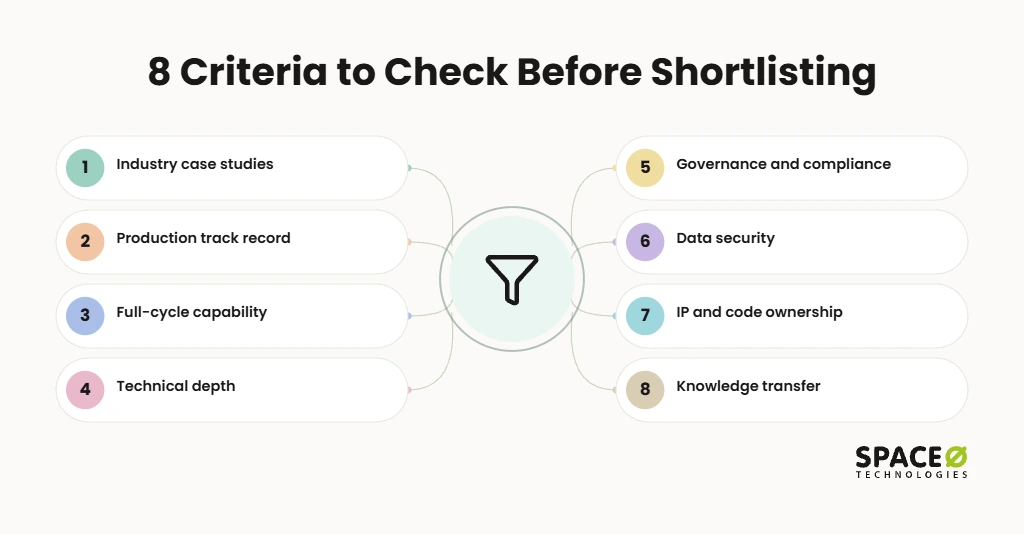
- Industry case studies: Ask for case studies from your industry with named outcomes, not generic AI examples.
- Production track record: Confirm how many systems are live in production, not just delivered as slide decks or demos.
- Full-cycle capability: Check coverage of strategy, data readiness, minimum viable product (MVP) build, scaling, and team enablement.
- Technical depth: Test hands-on skill with LLMs, RAG, MLOps, and vector databases.
- Governance and compliance: Verify experience with HIPAA, SOC 2, GDPR, and the EU AI Act where they apply.
- Data security: Ask how private corporate data is stored, accessed, and encrypted during and after the project.
- Intellectual property (IP) and code ownership: Confirm you own custom code, prompts, fine-tuned model weights, and pipelines.
- Knowledge transfer: Require documentation and training so your team can run the system without an ongoing retainer.
How Should Enterprise AI Consultants Handle Governance, Compliance, and Security?
Governance, compliance, and security belong in the hiring decision, not in a later phase. An enterprise AI system that fails an audit never reaches production. Ask every candidate to show these controls:
- Risk controls: Documented processes for model risk, access control, and incident response.
- Regulatory fit: Builds aligned with the Health Insurance Portability and Accountability Act (HIPAA) and System and Organization Controls (SOC) reporting. Add GDPR and the EU AI Act if you serve EU customers.
- Data handling: Clear rules on where data lives, who can access it, and how long it is kept.
- Audit trail: Logs that show which model version produced each output.
What changes in regulated industries?
Finance, lending, insurance, and healthcare need stricter defaults before any AI goes live. One wrong lending or clinical decision creates legal exposure. For these sectors, Space-O Technologies builds with:
- Encryption: Data encrypted at rest and in transit.
- Human review: Checkpoints on by default for high-stakes decisions (see the responsible-AI defaults below).
- HIPAA-ready builds: Healthcare systems designed to meet HIPAA requirements from the first sprint.
- Data residency: Hosting options in the US, EU, and India.
Responsible-AI Questions to Ask Before You Sign
Before signing, get written answers on training data, PII, testing, human review, and ownership. Most hiring checklists skip these questions. Each one becomes a contract term later. Here are our defaults:
- Will the consultant train models on your data? Our default: no. Your data is never used to train models. Our model provider contracts prohibit training on client inputs and outputs.
- Is personally identifiable information (PII) masked before it reaches a model? Our default: yes. PII masking is applied before model calls.
- Are hallucination and bias tested before release? Our default: yes. Every release goes through hallucination and bias testing. Each production model runs an evaluation suite covering accuracy, hallucination rate, bias, latency, and cost. New releases are red-teamed, and outputs that fail validation are rejected.
- Is human review enforced for high-stakes decisions? Our default: yes, for lending, clinical, and claims decisions. People approve consequential outcomes. Low-confidence outputs also route to a qualified person for review.
- Who owns prompts, weights, and evaluation sets after handoff? Our default: you do, along with all custom code and IP. Everything transfers at project completion, and nothing is retained after handover.
A consultant who cannot answer these in writing has not yet run governed AI in production.
How Much Do Enterprise AI Consultants Cost?
Enterprise AI costs depend on scope, from small pilots to programs worth hundreds of thousands of dollars. Budgets fail when strategy and build costs are mixed. The ranges below come from our LLM integration project cost guide.
| Project tier | Typical range (USD) |
|---|---|
| Simple chatbot | $5,000-$15,000 |
| RAG or tool-using integration | $15,000-$60,000 |
| Agentic workflow | $50,000-$150,000 |
| Enterprise multi-agent system | $150,000-$500,000+ |
How do Space-O Technologies engagement models map to these ranges?
Space-O Technologies offers four engagement models, each suited to different rows of the table.
- Fixed cost: Suits simple chatbots and scoped MVP builds with a clear scope.
- Time and material: Suits implementation projects where requirements will change during the build.
- Dedicated team: Suits agentic workflows and long-running enterprise programs.
- Staff augmentation: Suits enterprises that need vetted AI engineers inside an existing team.
We do not publish set rates. Each scope gets its own reviewed estimate.
Plan beyond the build as well. Data preparation takes 25% to 40% of the total project budget, and yearly maintenance runs 15% to 25% of build cost. See our AI development cost guide for the breakdown.
Share your use case, industry, and tech stack, and get a free, expert-reviewed estimate for your AI scope.
What Are the Phases of an Enterprise AI Consulting Engagement?
A well-run enterprise AI engagement moves through seven phases, with a decision point at each one. Clear phases protect your budget because you can stop or adjust before major spend.
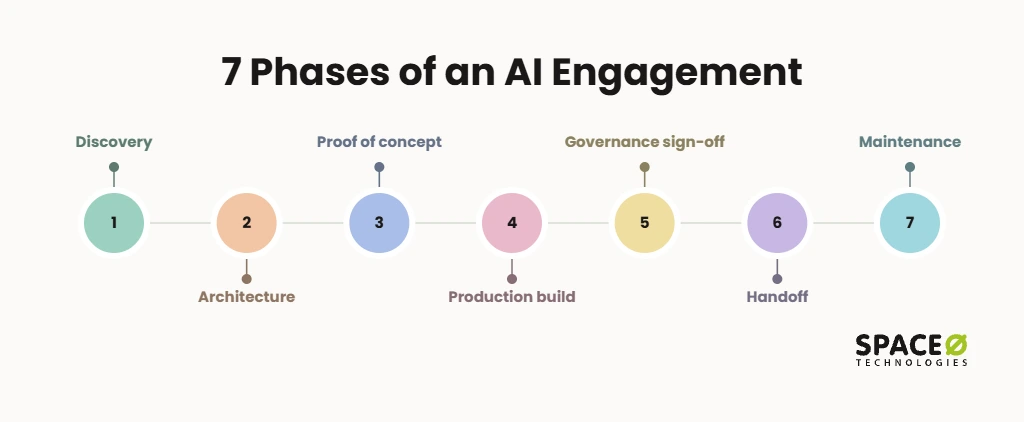
- Discovery and readiness: A data and use-case assessment, typically 2-4 weeks.
- Architecture and stack choice: The team picks RAG or fine-tuning based on what solves the problem most cost-effectively.
- Proof of concept (PoC) on your own data: A working test against real data, not sample datasets.
- Production build with milestones: Payments tied to delivered milestones, not open-ended hours.
- Governance sign-off: Security, compliance, and testing approval before go-live.
- Handoff: Documentation, team training, and full IP transfer.
- Optional maintenance: Monitoring, updates, and support once the system is live.
Red Flags When Hiring an AI Consultant
Walk away from consultants who promise outcomes before seeing your data or who make you dependent on them. These warning signs predict stalled pilots and budget overruns:
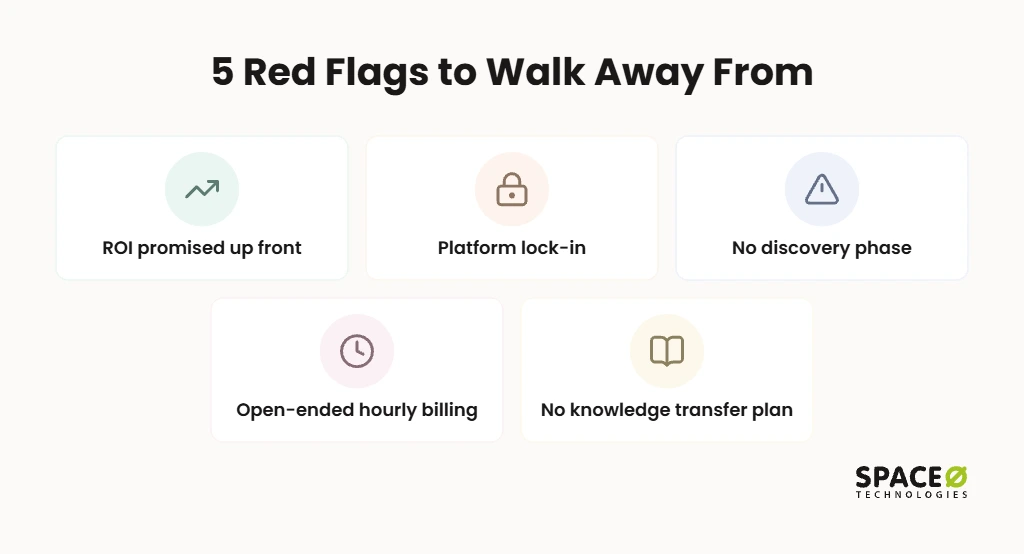
- ROI promised up front: Return on investment figures quoted before anyone has seen your data.
- Platform lock-in: A design that ties you to one vendor’s platform without a stated reason.
- No discovery phase: A proposal that jumps straight to building.
- Open-ended hourly billing: Hours billed with no milestones or deliverables attached.
- No knowledge transfer plan: No documentation or training included in the scope.
When Does Hiring an AI Consultant Make Sense?
Hiring an AI consultant makes sense when the consultant transfers knowledge to your team and ties deliverables to business KPIs. The “implement and walk away” model leaves internal teams unable to maintain what was built. That is why every Space-O Technologies engagement ends with the phase 6 handoff above. If a consultant cannot name the KPI a deliverable moves, the engagement is not ready to start.
Frequently Asked Questions
How much does AI consulting typically cost?
Enterprise AI builds range from $5,000 for a simple chatbot to $500,000 or more for multi-agent systems. Strategy work is quoted per engagement. Ask for strategy and build to be priced as separate line items. Treat any quote that folds both into one number as a budgeting risk.
How should I structure payments to an AI consultant to limit budget risk?
Tie every payment to a delivered milestone, not to open-ended hours. Each phase then ends in a stop-or-adjust decision before the next spend. If a proposal bills hours with no deliverables, ask for a revised proposal before signing.
Who inside my enterprise should own an AI consulting engagement?
One business owner with authority to approve milestones should own the engagement. That is the minimum. Without that person, milestone-based payments have no one to sign them off. Larger partner tiers add internal roles on top of that, as listed under each tier’s “What hiring one requires.”
What does a RAG system do, and how do consultants decide between RAG and fine-tuning?
A retrieval-augmented generation (RAG) system grounds a large language model in your own documents and data. The RAG-versus-fine-tuning choice is made in the architecture phase on cost-effectiveness. Ask the consultant to justify it for your use case in writing before the proof of concept begins.
How do I run a proof of concept that actually predicts production success?
Run the proof of concept (PoC) on your own data, not on sample datasets. A result on sample data says little about production. Treat the PoC as a gate: move to the milestone-based build only if it holds up. Keep governance sign-off as a second gate before go-live.
What should I verify before hiring an enterprise AI consultant?
Verify production proof, technical depth, governance, IP ownership, and knowledge transfer. Ask how many systems run live in production. Test hands-on skill with LLMs, RAG, and MLOps. Confirm in writing that you own the code, prompts, and model weights.



 All our projects are secured by NDA




 4.8


