
 By
By 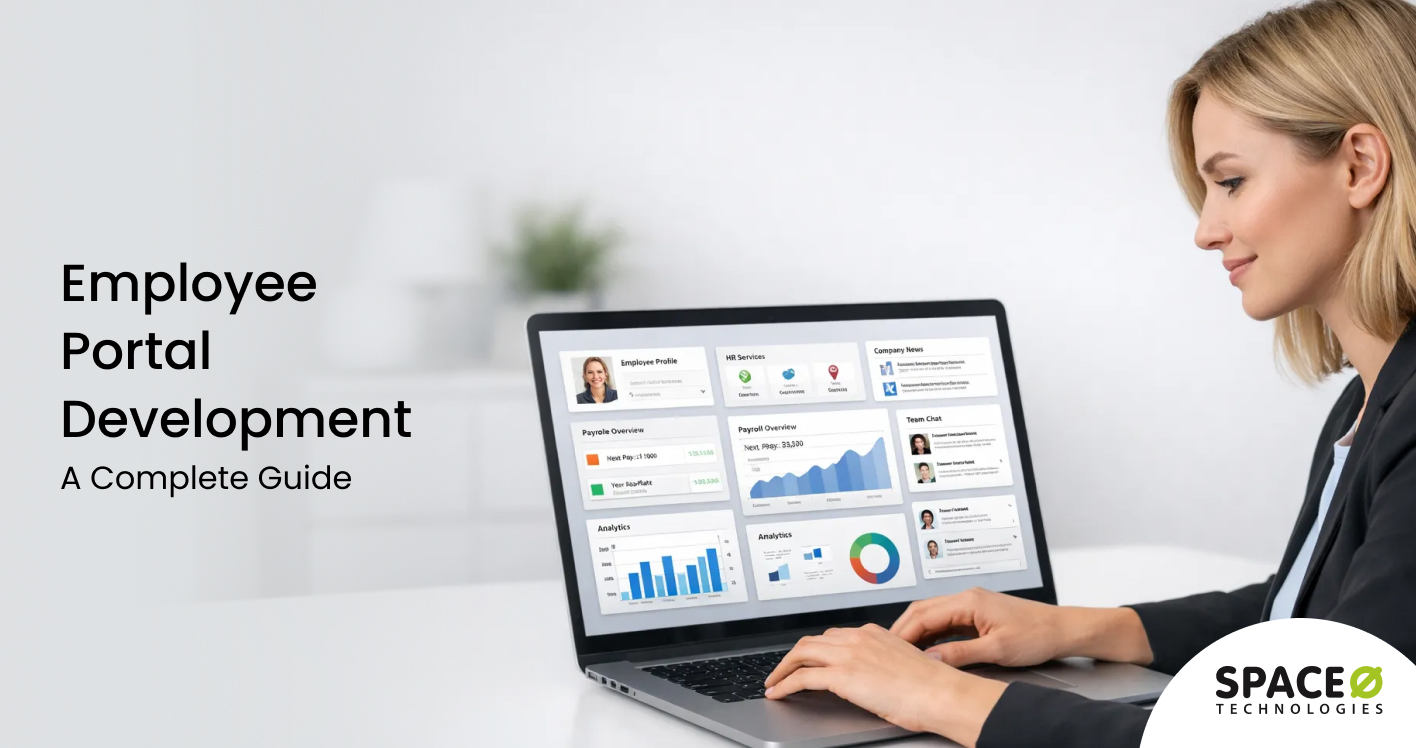
Contents
Modern organizations face significant challenges in managing their workforce efficiently. HR teams struggle with scattered employee data, manual request processing, and fragmented communication channels. These operational inefficiencies impact employee satisfaction and productivity. A well-designed employee portal solves these problems by creating a centralized digital workplace.
The demand for employee self-service solutions continues to grow rapidly. As per GrandViewResearch, the global workforce management market was valued at USD 8.07 billion in 2022 and is expected to expand to USD 19.35 billion by 2030. This growth reflects organizations’ increasing investment in digital tools that empower their employees.
Employee portal development enables businesses to create unified platforms for workforce management. Staff members can access HR services, company resources, and internal communications through a single interface. While ready-made solutions exist, many enterprises need custom portals that align with their unique processes and compliance requirements.
In this guide, we cover employee portal development comprehensively. You will learn about essential features, the development process, cost factors, and best practices. We have shared insights as a leading web portal development company to help you build secure and scalable solutions for your workforce.
What is an Employee Portal?
Employee portal development is the process of designing and building a centralized digital platform that enables employees to access company information, tools, and services from a single interface. It serves as a secure internal hub where employees can manage day-to-day tasks, communicate with teams, and interact with organizational systems without switching between multiple applications.
An employee portal typically integrates HR systems, document management tools, internal communication channels, and workflow automation into one unified environment. Depending on business needs, it may include features such as employee self-service, payroll and leave management, policy access, knowledge bases, training modules, and collaboration tools.
From a development perspective, employee portal development focuses on usability, role-based access, data security, and seamless integration with existing enterprise systems. When built correctly, an employee portal not only reduces administrative workload but also enhances employee engagement by giving teams faster access to the resources and information they need to perform effectively.
Advantages of Developing an Employee Portal for Your Organization
Building a custom employee portal delivers advantages that generic HR software cannot provide. Organizations gain control over their workforce technology while addressing specific operational challenges. Let us explore the key benefits of investing in employee portal development.
1. Centralized access to HR services and resources
Employee portals eliminate the frustration of navigating multiple systems for different tasks. Staff members access everything they need through a single login. This centralization saves time and reduces confusion across the organization.
Generic software forces employees to remember multiple credentials and interfaces. Custom portals create unified experiences that match your organizational structure. Employees find information faster and complete tasks more efficiently.
2. Reduced administrative burden on HR teams
HR departments spend countless hours processing routine requests manually. Employee portals automate leave applications, expense claims, and document submissions. This automation frees HR professionals to focus on strategic initiatives.
Self-service capabilities shift routine tasks from HR staff to employees themselves. Workers update their contact information, download tax documents, and check benefit balances independently. HR teams handle fewer repetitive inquiries each day.
3. Improved internal communication and engagement
Employee portals create dedicated channels for company announcements and updates. Staff members stay informed about policy changes, events, and organizational news. Consistent communication builds stronger connections between leadership and employees.
Discussion forums and social features encourage collaboration across departments. Employees share knowledge, celebrate achievements, and support each other. These interactions strengthen company culture and improve retention rates.
4. Enhanced data accuracy and compliance
Manual data entry introduces errors that cascade through HR processes. Employee portals ensure data accuracy by letting workers verify and update their own information. Automated validation prevents common mistakes before they enter the system.
Compliance documentation becomes easier to manage through centralized storage. Required training certifications, policy acknowledgments, and legal documents stay organized. Audit trails track who accessed or modified sensitive information.
5. Better employee experience and satisfaction
Modern employees expect digital convenience in their workplace. Employee portals deliver mobile-friendly interfaces that match consumer app experiences. Workers appreciate having 24/7 access to their employment information.
Satisfied employees demonstrate higher productivity and loyalty. Self-service capabilities empower staff and respect their time. Organizations with strong employee experience outperform competitors in talent retention.
6. Scalable solution for growing organizations
Off-the-shelf HR software often struggles as headcount increases. Custom employee portals scale seamlessly as organizations grow. Architecture designed for expansion prevents performance degradation over time.
Multi-location enterprises benefit particularly from custom scalability. Regional customizations, language options, and local compliance rules integrate smoothly. New offices or acquisitions onboard quickly using established portal infrastructure.
7. Integration with existing enterprise systems
Most organizations operate multiple specialized applications for different functions. Custom employee portals connect payroll systems, time tracking tools, and learning management platforms. Data flows automatically between integrated systems.
Integration eliminates redundant data entry and synchronization headaches. Changes in one system are reflected immediately across connected platforms. IT teams manage fewer manual processes and troubleshoot fewer data discrepancies.
Looking to Build a Powerful Employee Portal?
Hire experienced developers who understand enterprise HR workflows and security requirements. Build a portal that empowers your workforce and streamlines HR operations.

Core Features of Employee Portal Software
Successful employee portal development requires careful feature selection. Some capabilities serve every organization while others address industry-specific needs. Understanding these components helps prioritize your development investment.
1. Employee self-service dashboard
The personal dashboard serves as each employee’s home base within the portal. This module displays relevant information, pending tasks, and quick access links. Staff members see their customized view immediately upon logging in.
- Personal profile management with contact and emergency information.
- Quick links to frequently used features and recently accessed documents.
- Notification center displaying pending approvals and important alerts.
- Task reminders for upcoming deadlines and required actions.
- Personalized content based on role, department, and location.
- Widget customization allows employees to arrange their dashboard layout.
Effective dashboards reduce the time employees spend searching for information. Workers complete common tasks directly from the dashboard without navigating deeper. Mobile-responsive design ensures a consistent experience across devices.
2. Leave and attendance management
Managing time-off requests creates significant administrative overhead without proper tools. Modern leave management features automate the entire request and approval workflow. Both employees and managers save time while maintaining accurate records.
- Leave balance displays show available vacation, sick, and personal days.
- Online request submission with date selection and reason documentation.
- Manager approval workflows with email notifications and mobile access.
- Team calendar views showing colleague availability for planning purposes.
- Automatic accrual calculations based on tenure and policy rules.
- Integration with payroll systems for accurate compensation processing.
- Holiday calendar management for multiple locations and regions.
Advanced leave management includes conflict detection that alerts managers about scheduling overlaps. Automated policy enforcement prevents requests that violate company rules. Historical data support workforce planning and coverage analysis.
3. Payroll and compensation information
Employees frequently have questions about their pay and benefits. Self-service access to compensation information significantly reduces HR inquiries. Secure document storage keeps sensitive financial data protected.
- Pay stub access with detailed earnings and deduction breakdowns.
- Tax document retrieval, including annual tax forms and summaries.
- Direct deposit setup and bank account management.
- Bonus and commission tracking with payment schedules.
- Salary history viewing for personal financial planning.
- Benefits enrollment and cost information during open enrollment periods.
Integration with payroll systems ensures employees always see the most up-to-date information. Document archival maintains access to historical records for tax purposes. Security controls protect sensitive compensation data from unauthorized access.
4. Document management and digital forms
Organizations generate massive volumes of employee-related documents. Centralized document management organizes this information while ensuring compliance with retention requirements. Digital forms replace paper-based processes entirely.
- Secure document storage with role-based access controls.
- Electronic form submission for HR requests and approvals.
- E-signature integration for contracts and policy acknowledgments.
- Document version control tracks changes over time.
- Automated retention policies with archival and destruction schedules.
- Search functionality across all stored documents and forms.
- Template library for commonly used forms and documents.
Document management reduces physical storage costs and retrieval delays. Staff locate needed documents within seconds rather than searching filing cabinets. Audit trails document who accessed or modified files.
5. Internal communication tools
Effective workplace communication requires dedicated channels beyond email. Employee portals provide structured communication features that keep everyone informed. Social features encourage collaboration and community building.
- Company news feeds with department and location filtering.
- Announcement broadcasting with read receipt tracking.
- Discussion forums organized by topic or interest group.
- Employee directory with profile photos and contact information.
- Direct messaging for quick colleague communication.
- Event calendars with registration and reminder capabilities.
- Recognition features for celebrating achievements and milestones.
Communication tools strengthen organizational culture and transparency. Employees feel connected to leadership decisions and to the company’s direction. Searchable archives preserve institutional knowledge for future reference.
6. Training and development resources
Continuous learning supports both employee growth and organizational capability. Learning management integration within employee portals creates convenient access to training. Progress tracking motivates completion of development activities.
- Course catalog browsing with enrollment capabilities.
- Progress tracking and completion certificates.
- Mandatory training assignment and compliance monitoring.
- Skill assessment tools measuring competency development.
- Development plan creation with manager collaboration.
- External learning resource integration and tracking.
- Certification expiration alerts and renewal reminders.
Training integration supports compliance requirements across regulated industries. Healthcare workers track continuing education credits. Safety certifications renew automatically based on portal reminders.
7. Performance management integration
Performance reviews benefit from continuous feedback rather than annual surprises. Portal integration brings performance tools into daily workflows. Managers and employees collaborate on goals and development throughout the year.
- Goal setting and progress tracking dashboards.
- Continuous feedback exchange between managers and employees.
- Self-assessment submission for review cycles.
- Performance review history and documentation access.
- Recognition and appreciation features for immediate acknowledgment.
- Career path visualization and planning tools.
- Succession planning support for leadership development.
Performance management integration creates transparency around expectations and progress. Employees understand how their work contributes to organizational objectives. Managers coach more effectively with accessible performance data.
How To Build an Employee Portal: 6 Steps
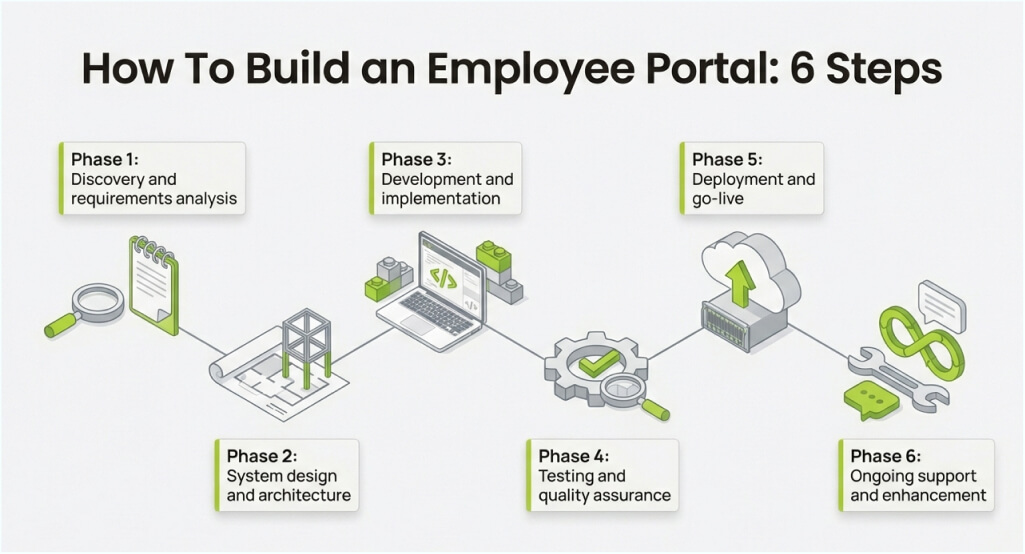
Building effective employee portal software follows a structured process. Each phase contributes to successful outcomes. Understanding this process helps set realistic expectations and ensures proper planning.
Phase 1: Discovery and requirements analysis
Timeline: 4-8 weeks
Discovery establishes the foundation for your entire project. This phase documents current HR processes, identifies pain points, and defines success criteria. Thorough discovery prevents costly changes later in development.
Key activities
- Stakeholder interviews: Conversations with HR leaders, IT staff, managers, and employees reveal diverse perspectives. Each group has different needs and priorities for the portal.
- Process documentation: Mapping existing HR workflows exposes inefficiencies and automation opportunities. Visual diagrams clarify handoffs and approval chains.
- Technical assessment: Evaluating current systems identifies integration requirements and the scope of data migration. Infrastructure capabilities determine deployment options.
- Security and compliance review: Analyzing data protection requirements shapes security architecture. Industry regulations and company policies define access control needs.
- Feature prioritization: Stakeholders rank capabilities by business value and implementation complexity. This prioritization guides development sequencing.
Discovery delivers comprehensive requirements documentation and technical recommendations. Investing adequate time prevents requirement gaps that surface as expensive changes later.
Phase 2: System design and architecture
Timeline: 3-6 weeks
Design transforms requirements into technical specifications and visual representations. This phase defines system structure, user interfaces, and integration approaches. Stakeholder approval before development prevents costly revisions.
Key activities
- Technical architecture: Engineers define database structure, application components, and infrastructure requirements. Scalability and security considerations guide foundational decisions.
- User experience design: Designers create wireframes and interactive prototypes showing system behavior. User testing validates designs before coding begins.
- Integration planning: Detailed specifications define connections with HRIS, payroll, and other enterprise systems. API designs establish data exchange protocols.
- Security design: Authentication methods, encryption standards, and access controls are explicitly defined. Role-based permissions protect sensitive employee data.
Design deliverables include technical specifications, interface mockups, and integration documentation. Clear designs accelerate development and reduce misunderstandings.
Phase 3: Development and implementation
Timeline: 12-32 weeks, depending on scope
Development transforms designs into working software through iterative delivery. Agile methodologies enable early feedback and course corrections. Regular demonstrations keep stakeholders informed throughout the process.
Key activities
- Sprint-based development: Two-week sprints deliver testable functionality regularly. Product owners review progress and adjust priorities based on feedback.
- Continuous integration: Automated testing validates code quality with each change. Issues surface immediately rather than accumulating for later discovery.
- Environment management: Development, testing, and staging environments mirror production configurations. Environment consistency prevents deployment surprises.
- Documentation creation: User guides, training materials, and technical documentation are developed alongside the software. Documentation supports successful adoption.
Development follows the prioritized roadmap while maintaining flexibility for scope adjustments. Completed features become available for user feedback early in the process.
Phase 4: Testing and quality assurance
Timeline: 4-8 weeks overlapping with development
Comprehensive testing ensures the portal meets requirements while maintaining performance standards. Multiple testing types catch different issue categories. Quality assurance cannot be compressed to meet deadlines.
Key activities
- Functional testing: Test cases verify every feature works as specified. Edge cases and error conditions receive explicit attention.
- Integration testing: End-to-end workflows validate data flows between connected systems. Employee data synchronizes correctly across platforms.
- Performance testing: Load testing confirms system capacity under expected usage patterns. Performance optimization addresses bottlenecks before launch.
- Security testing: Penetration testing and vulnerability scanning identify weaknesses. Security audits verify compliance with data protection standards.
- User acceptance testing: Real employees validate system behavior in realistic scenarios. Feedback drives final refinements before deployment.
Thorough testing prevents post-launch issues that frustrate users and damage adoption. Undiscovered defects require expensive emergency fixes.
Phase 5: Deployment and go-live
Timeline: 2-4 weeks
Deployment transitions the portal from development to production use. Careful planning minimizes disruption while ensuring smooth adoption. Training prepares employees for new workflows.
Key activities
- Data migration: Historical employee data transfers from legacy systems to the new portal. Validation confirms accuracy and completeness.
- Training delivery: Role-based training prepares different user groups for their portal interactions. Hands-on practice builds confidence before go-live.
- Cutover planning: Detailed runbooks define every step of production transition. Rollback procedures provide a safety net in case issues arise.
- Go-live support: Dedicated support teams provide intensive assistance during initial operations. Quick issue resolution maintains user confidence.
Phased rollouts reduce risk for large implementations. Starting with one department validates processes before deployment across the organization.
Phase 6: Ongoing support and enhancement
Timeline: Continuous
Post-launch support ensures system stability while enabling continuous improvement. Employee portals require ongoing attention to maintain their value. User feedback drives enhancement priorities.
Key activities
- Bug fixes and patches: Production issues receive prompt resolution based on severity. Critical problems get immediate attention.
- Performance monitoring: System health metrics identify capacity needs and degradation. Proactive intervention prevents user-facing problems.
- Feature enhancements: New capabilities are added to the development backlog for prioritization. The portal evolves as organizational needs change.
- Security updates: Regular patches address newly discovered vulnerabilities. Compliance requirements drive security maintenance schedules.
Budget for ongoing support from project start. Systems without maintenance degrade over time and eventually require costly replacements.
Let Our Experts Build Your Employee Portal
With 15+ years of experience and 300+ software products delivered, Space-O Technologies helps enterprises build reliable and secure employee portal platforms.
Employee Portal Development Cost Breakdown
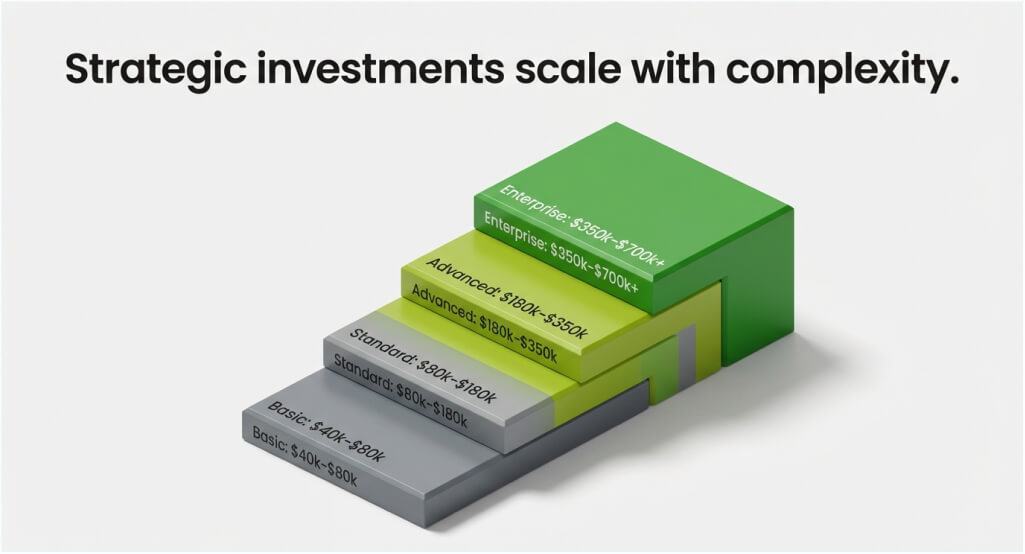
Understanding cost components helps organizations budget accurately for their projects. Employee portal development costs vary based on complexity, features, and development approach. Let us examine the key cost factors.
Cost by implementation scope
| Scope Level | Features Included | Development Cost Range | Timeline |
|---|---|---|---|
| Basic Portal | Employee directory, leave management, document storage | $40,000 – $80,000 | 3-4 months |
| Standard Portal | Basic features + payroll integration, self-service dashboard, communication tools | $80,000 – $180,000 | 4-7 months |
| Advanced Portal | Standard features + learning management, performance integration, analytics | $180,000 – $350,000 | 7-12 months |
| Enterprise Portal | Advanced features + multi-location support, mobile apps, AI capabilities | $350,000 – $700,000+ | 10-16 months |
Cost breakdown by development phase
| Phase | Budget Allocation | Activities |
|---|---|---|
| Discovery and Requirements | 8-12% | Stakeholder interviews, process documentation, and technical assessment |
| Design and Architecture | 10-15% | UX design, technical architecture, integration planning |
| Development | 45-55% | Core feature development, integration, and implementation |
| Quality Assurance | 15-20% | Functional testing, security testing, performance optimization |
| Deployment and Training | 8-12% | Data migration, user training, and go-live support |
| Project Management | 10-15% | Coordination, communication, risk management |
Factors that increase development costs
Several variables push costs toward higher ranges:
- Integration complexity: Each enterprise system integration adds $8,000 to $40,000, depending on API availability. Legacy systems without modern interfaces require custom middleware development.
- Security requirements: Enhanced security for sensitive employee data adds 15-25% to baseline costs. SOC 2 compliance, advanced encryption, and multi-factor authentication increase scope.
- Mobile application development: Native iOS and Android apps double the user interface development effort. Cross-platform frameworks reduce costs but limit native functionality.
- Multi-location support: Regional customizations, multiple languages, and location-specific policies add architectural complexity. International deployments require additional compliance considerations.
- Custom reporting: Advanced analytics, custom dashboards, and predictive insights significantly expand the development scope.
Ongoing cost considerations
Initial development represents only part of the total ownership cost. Plan for continuing expenses:
- Annual maintenance: 15-20% of the initial development cost covers bug fixes, security patches, and minor updates.
- Infrastructure: Cloud hosting costs range from $300 to $3,000 per month, depending on user volume and storage needs.
- Security maintenance: Annual security audits and penetration testing cost $8,000 to $25,000.
- Feature enhancements: Budget $40,000-$120,000 annually for new capabilities and improvements.
| Get an Accurate Employee Portal Development Estimate Share your requirements with our technical team for a detailed cost breakdown. We analyze complexity, integration needs, and security requirements to provide realistic budget expectations. Request Your Free Quote |
Get an Accurate Employee Portal Development Estimate
Share your requirements with our technical team for a detailed cost breakdown. We analyze complexity, integration needs, and security requirements to provide realistic budget expectations.
Common Challenges in Developing an Employee Portal and How to Overcome Them
Even well-planned projects encounter obstacles along the way. Anticipating these challenges enables proactive solutions rather than reactive crisis management. Let us examine common issues and their solutions.
Challenge 1: User adoption resistance
Employees comfortable with existing processes often resist new systems. Poor adoption undermines return on investment regardless of feature quality. Change management requires deliberate attention throughout the project.
How to overcome this challenge
- Involve employees in requirements gathering to build ownership and understanding.
- Design intuitive interfaces that minimize learning curves and match familiar patterns.
- Provide comprehensive training tailored to different roles and technical comfort levels.
- Identify enthusiastic users who can champion the portal among their colleagues.
- Address concerns promptly to prevent negative sentiment from spreading widely.
Challenge 2: Integration complexity with HR systems
Existing HRIS, payroll, and time tracking systems often lack modern APIs. Undocumented data formats and inconsistent data quality compound integration challenges. Legacy systems create unexpected technical debt.
How to overcome this challenge
- Conduct a thorough technical assessment of all integration targets during discovery.
- Budget additional time for reverse engineering poorly documented legacy systems.
- Build data validation layers to gracefully handle format inconsistencies.
- Plan parallel operation periods before fully decommissioning old systems.
- Thoroughly document integration specifications for future maintenance.
Challenge 3: Data security and privacy concerns
Employee portals contain sensitive personal information that must be protected. Data breaches damage employee trust and create legal liability. Security requirements add complexity throughout development.
How to overcome this challenge
- Engage security expertise from project initiation rather than as an afterthought.
- Build the security architecture before beginning feature development.
- Implement automated security testing continuously within development pipelines.
- Conduct regular penetration testing to proactively identify vulnerabilities.
- Thoroughly document security measures for compliance demonstrations.
Challenge 4: Scope creep during development
Requirements evolve as stakeholders interact with developing software features. Feature requests accumulate and expand scope beyond initial estimates. Uncontrolled scope growth delays delivery and increases costs.
How to overcome this challenge
- Establish formal change request processes that assess impact before approval.
- Build contingency budgets of 15-20% for approved scope additions.
- Use phased delivery to defer non-essential features to subsequent releases.
- Maintain clear prioritization criteria tied to measurable business value.
- Document decisions thoroughly to prevent requirement regression later.
Challenge 5: Mobile accessibility requirements
Modern employees expect mobile access to portal features anytime and anywhere. Mobile development adds significant complexity and cost to projects. Platform fragmentation creates testing challenges across devices.
How to overcome this challenge
- Define mobile requirements clearly during discovery to scope appropriately.
- Consider responsive web design as an alternative to native mobile apps.
- Prioritize the most critical mobile features rather than replicating everything.
- Thoroughly test across representative devices and operating system versions.
- Plan for ongoing mobile maintenance as platforms release updates continuously.
Challenge 6: Content migration and organization
Moving existing documents, policies, and resources into the new portal requires significant effort. Poor content organization dramatically reduces a portal’s usefulness. Outdated content damages credibility with employees.
How to overcome this challenge
- Audit existing content before migration to identify outdated materials.
- Define clear content ownership and maintenance responsibilities upfront.
- Create a logical information architecture that aligns with employees’ mental models.
- Establish content governance processes for ongoing quality management.
- Train content owners on portal administration and publishing procedures.
Best Practices for Successful Employee Portal Development
Following proven practices dramatically increases project success rates. These guidelines represent accumulated wisdom from successful implementations. Apply these recommendations throughout your development journey.
1. Start with a thorough discovery
Invest adequate time in understanding current HR workflows before designing new ones. Rushed discovery creates requirements gaps that surface as expensive changes later. Interview users at every level to capture diverse perspectives.
Observe actual work processes rather than relying solely on described procedures. Staff often work around system limitations in ways they do not mention. Visual process maps reveal inefficiencies invisible in verbal descriptions. Document everything in writing for reference throughout development.
2. Prioritize user experience above features
Employee portals succeed or fail based on staff members’ actual usage. Systems that employees avoid using never deliver the intended benefits, regardless of their capabilities. Focus on making common tasks simple and intuitive.
Design interfaces that align with how employees think about their work. Test designs with real users before development begins. Iterate based on feedback rather than assumptions about what workers need. Consider the complete user journey from login through task completion.
3. Plan integrations carefully from the start
Integration complexity often exceeds initial estimates by a significant margin. Each connected system brings unique data models, authentication needs, and reliability characteristics. Map all integration points during discovery.
Assess API availability, documentation quality, and vendor support responsiveness. Budget additional time for integrations with poor documentation or legacy systems. Build error handling and monitoring from day one, since integrations will fail occasionally.
4. Build security into the foundation
Security requirements should shape architecture decisions from project start. Retrofitting security onto completed systems creates vulnerabilities and requires rework. Engage security expertise early in the planning process.
Implement role-based access controls to appropriately protect sensitive employee information. Employee data requires the same protection as customer data. Document security measures comprehensively for audit purposes.
5. Implement iterative delivery with feedback loops
Delivering functionality incrementally provides multiple benefits for portal projects. Stakeholders see progress and provide feedback early. Course corrections happen before significant investment accumulates.
Two-week sprints work well for most projects. Prioritize delivery of core self-service features first. Employees can begin using the portal while additional capabilities develop. Early value delivery builds organizational support.
6. Invest in comprehensive training and change management
Technology alone does not transform HR operations. Employees need training to use new tools effectively. Change management addresses the human factors that determine adoption success.
Develop role-specific training that focuses on relevant features for each audience. Create reference materials that employees can consult after initial training sessions. Identify and support champions who enthusiastically advocate for the portal.
7. Plan for ongoing evolution and improvement
Employee portals are never truly complete. Business needs change over time. User feedback reveals improvement opportunities continuously. Regulations evolve and require system updates.
Build systems that accommodate change through modular architecture and clean code. Budget for ongoing development from project start. Systems without enhancement resources stagnate and eventually need to be replaced.
Build Your Custom Employee Portal with Space-O Technologies
Employee portal development transforms how organizations manage their workforce. Custom solutions eliminate compromises that off-the-shelf HR software requires. Your portal matches your exact processes, culture, and security requirements.
Success requires more than technical capability alone. Understanding HR workflows, compliance obligations, and adoption challenges determines whether projects deliver lasting value. The right development partner brings both technical excellence and domain expertise.
Space-O Technologies brings 15+ years of expertise in custom software development to employee portal projects. Our team of 200+ professionals has delivered 300+ software solutions across multiple industries. We understand the challenges of enterprise integration, data security, and user adoption.
Contact our consultants to discuss your employee portal requirements. We provide detailed assessments, realistic cost estimates, and development roadmaps tailored to your organization.
FAQs on Employee Portal Development
1. What is employee portal development?
Employee portal development is the process of building custom digital platforms that provide staff with centralized access to HR services, company resources, and internal communication tools. Development includes requirements analysis, system design, coding, testing, deployment, and ongoing maintenance. These platforms combine self-service capabilities with collaboration features tailored to organizational needs.
2. How much does it cost to develop an employee portal?
Employee portal development costs range from $40,000 for basic systems to $700,000+ for enterprise platforms. Basic portals with leave management and document storage cost $40,000 to $80,000. Standard systems with payroll integration cost $80,000 to $180,000. Advanced portals with learning management and analytics cost $180,000 to $350,000. Enterprise systems with mobile apps and AI capabilities exceed $350,000.
3. How long does employee portal development take?
Development timelines range from 3-4 months for basic systems to 10-16 months for enterprise implementations. Basic portals with core features take 3-4 months. Standard implementations requiring multiple integrations take 4-7 months. Advanced projects with comprehensive features require 7-12 months. Enterprise deployments across multiple locations take 10-16 months, including phased rollouts.
4. What features are essential in an employee portal?
Essential employee portal features include self-service dashboards, leave and attendance management, payroll information access, document management, and internal communication tools. Additional valuable features include training and development resources, performance management integration, employee directory, and mobile accessibility. The specific feature set depends on organizational size and HR processes.
5. Should I build a custom employee portal or use off-the-shelf software?
Custom development suits organizations with unique HR workflows, complex integration requirements, or specific security needs. Enterprises with 200+ employees often benefit from custom solutions. Off-the-shelf software is better suited to smaller organizations with standard processes and limited budgets. Consider factors like scalability needs, existing system integration, and long-term total cost of ownership.
6. Can an employee portal integrate with existing HR systems?
Yes, modern employee portals integrate with HRIS, payroll, time tracking, and learning management systems. Integration uses APIs, middleware, or direct database connections, depending on the system’s capabilities. Common integrations include bidirectional data synchronization for employee information, leave balances, and payroll data. Integration complexity depends on the existing system documentation and the availability of APIs.
7. What ongoing support does an employee portal require?
Employee portals require continuous maintenance, including bug fixes, security patches, and feature enhancements. Budget 15-20% of the initial development cost annually for maintenance. Additional costs include cloud hosting ($300 to $3,000 monthly), security audits ($8,000 to $25,000 annually), and feature development ($40,000 to $120,000 annually). Systems without adequate support degrade over time.



 All our projects are secured by NDA




 4.8
4.8