
 By
Contents
- Custom AI fits your workflows, data, and rules, so your team stops working around generic tools.
- Custom AI automates invoice processing, data entry, and routing, while people approve consequential decisions.
- You own the code, data, and IP, but budget 15%-25% of build cost yearly for maintenance.
- Grounding, evaluation, and human review turn a custom AI pilot into software that ships.
Key Takeaways
Custom AI software is built around your own workflows, data, and goals. It automates repetitive work and keeps proprietary data under your control. It also connects to your customer relationship management (CRM) and enterprise resource planning (ERP) systems.
Generic AI tools force your team to work around them. Per-user fees also grow with every seat you add. Space-O Technologies is an AI development company serving 1,200+ clients since 2010.
This guide covers eight business benefits of custom AI software. It also covers costs, when off-the-shelf is smarter, and the controls that ship a build. If you are still weighing options, compare custom AI development vs. off-the-shelf first.
Key Business Benefits of Custom AI Software
Custom AI software delivers eight core business benefits, led by workflow fit, deep integration, and data control. Each one exists because the software is built for your operation rather than sold to everyone at once. Together, they extend the wider benefits of custom software development into automation, prediction, and personalization.
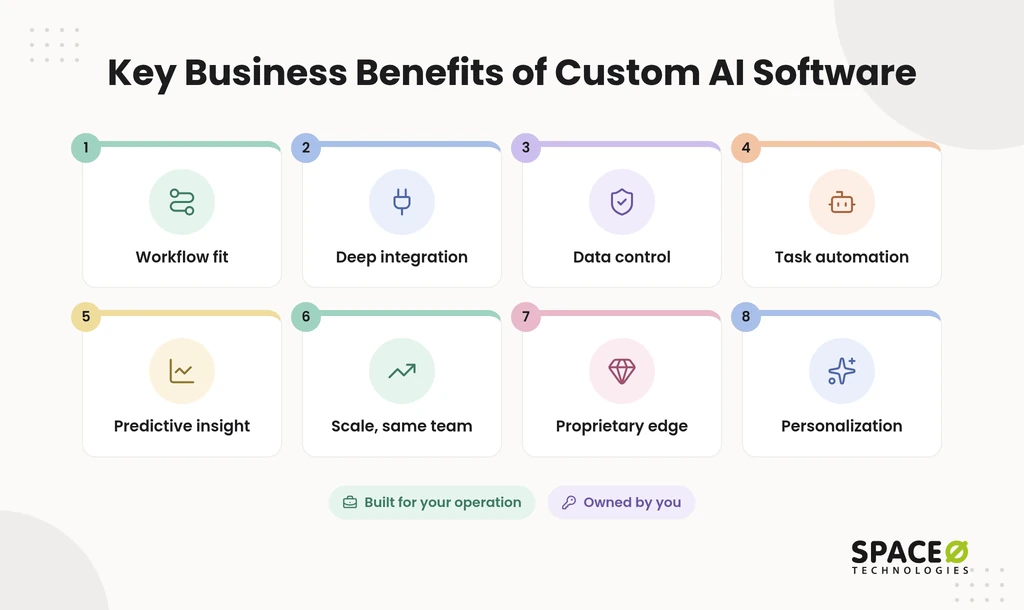
1. Exact workflow fit
Custom AI is built around your exact processes, metrics, and business logic, not a vendor’s defaults. Off-the-shelf tools make your team bend its process to the software, and every workaround costs hours. You also pay for platform features your team never uses.
A custom system maps to your real operational flow instead. A booking-heavy small or mid-sized business, for example, gets scheduling logic that matches its own rules. That beats a generic calendar feature bolted on afterward.
2. Deep integration with CRM, ERP, and legacy systems
Custom AI connects to the CRMs, ERPs, legacy systems, and databases you already run, at the architecture level. Disconnected tools force your staff to enter the same data in several places. Many add-on tools connect only through shallow APIs, which leaves data scattered across systems.
Custom AI is built to fit your stack, so integration is designed in from discovery rather than retrofitted. A growing business can wire AI into its ERP, human resource management (HRM) tools, and payment stack through custom APIs. That is the core of our generative AI integration services, and it beats running a parallel, disconnected tool.
3. Data security, ownership, and compliance
Custom AI keeps proprietary data inside your own infrastructure, and you control the data pipelines and model access. Regulated teams cannot risk routing patient or financial records through a shared public model. A private architecture lets you enforce encryption, access controls, and audit logs.
It also supports the Health Insurance Portability and Accountability Act (HIPAA) and the California Consumer Privacy Act (CCPA). Anomaly detection adds another layer by flagging unusual activity in real time. Privacy and security also improve when you fine-tune on data you own.
All source code, data, and intellectual property (IP) built during a project transfer to you at completion. Our compliance approach includes HIPAA-ready frameworks for healthcare AI engagements.
4. Automation of repetitive business tasks
Custom AI automates repetitive, business-specific tasks such as invoice processing, data entry, document processing, and routing. Manual queues slow your team down, and errors rise with volume. Intelligent document processing uses machine learning and natural language processing (NLP) to extract, validate, and route data.
The system learns from your own documents and rules, so it handles edge cases. Deloitte’s State of AI in the Enterprise report finds two-thirds of organizations report productivity and efficiency gains from AI.
Space-O Technologies built ReadGenie, an iOS app that automates image-to-text conversion. It pairs optical character recognition (OCR) with GPT-3.5 to turn photos into editable text.
5. Predictive analytics and decision support
Custom AI turns proprietary data into forecasts and decision support, not just historical records. A standard CRM logs what already happened, so leaders decide from stale reports. A custom model trained on your records can predict which leads will convert.
Your inventory system can forecast demand instead of only tracking stock. Machine learning finds patterns across structured and unstructured data faster than manual review can. Because the model learns from your own operation, its predictions can sharpen with each retraining cycle.
6. Scalability without proportional headcount
Custom AI lets output grow without a matching rise in headcount or a forced platform migration. Many standard tools hit limits as volume rises, which forces costly tier upgrades or a move to new systems. A custom system is architected for your expected load from the start.
Work that once needed another hire now runs through the same pipeline at higher volume. Your team grows when the strategy demands it, not because a queue got longer.
7. Proprietary competitive advantage
Custom AI creates proprietary capabilities that competitors relying on the same off-the-shelf tools cannot replicate. When every rival subscribes to the same platform, nobody gains an edge from it. A model trained on your data and shaped around your niche stays yours.
Proprietary recommendation engines and routing logic are common examples. eComChat, our AI eCommerce search bot, grounds search in a store’s own product data.
Some companies go further and license a proprietary AI tool to others as a new revenue line.
8. Personalized customer experiences
Custom AI personalizes recommendations, search, and support using your own CRM and customer behavior data. Generic chatbots give every customer the same scripted answer. Custom chatbots and virtual assistants respond in context from your records.
Recommendation engines suggest products in real time, and semantic search finds relevant items even when shoppers use different words.
All eight benefits trace back to fit and ownership. The next question is whether those gains justify building rather than buying.
See Which Custom AI Benefits Fit Your Workflow
Tell us how your team works and which systems you run. Our AI consultants will map the right benefits to a scoped build and a free, expert-reviewed estimate.

Custom AI Versus Off-the-Shelf: How the Choice Breaks Down
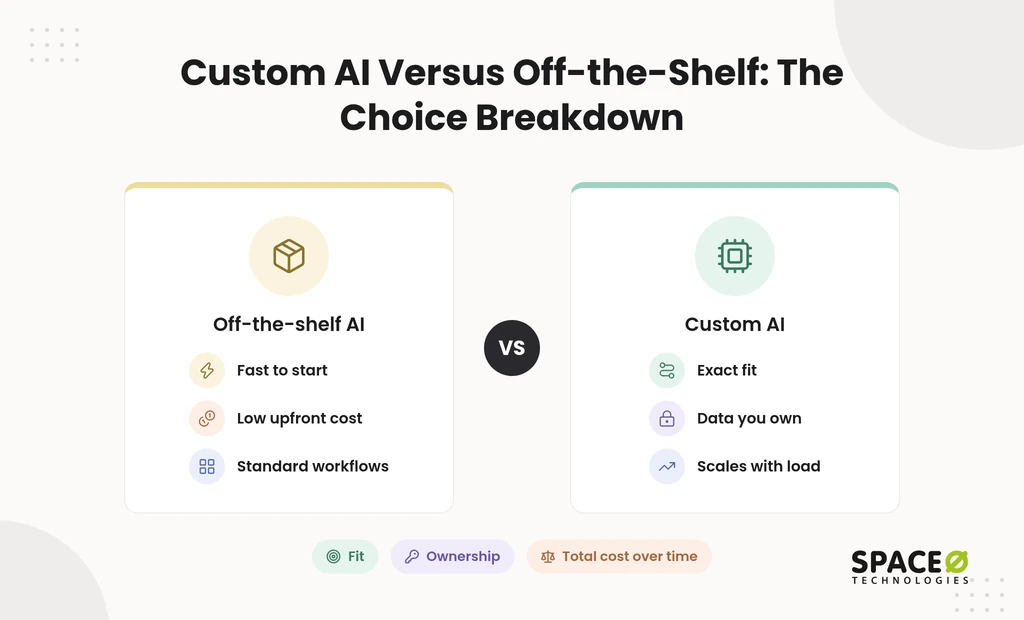
Off-the-shelf AI wins on speed and low upfront cost, while custom AI wins on fit, ownership, integration, and scale. The build-versus-buy decision is not just about sticker price. It comes down to how well a tool fits, who controls the data, and what it costs over time.
| What matters | Off-the-shelf AI | Custom AI (built by Space-O Technologies) |
|---|---|---|
| Workflow fit | Adapt your process to the tool | Built around your exact workflows |
| Integration depth | Add-on connectors, often shallow | Designed into your CRM, ERP, and legacy systems |
| Data ownership | Data often leaves your control | Kept in your infrastructure; full IP transfer at handover under NDA |
| Ongoing cost | Recurring per-user fees and tier upgrades | Higher upfront build; no subscription lock-in |
| Scalability | Plan limits and forced migrations | Architected for your expected load |
| Delivery | Self-serve, no partner | Full cycle under one team: requirement analysis, user interface and user experience (UI/UX) design, agile development, quality assurance (QA), deployment, and maintenance |
| Engagement | Fixed plans | Four models: Dedicated Team, Time & Material, Fixed Cost, and Staff Augmentation |
| Production controls | Vendor-defined | Grounding, evaluation, and human review by default |
Custom AI adds the workflow fit and data ownership that generic tools cannot offer. Our AI-powered software development team delivers that fit end to end. It comes at a price, so the next section covers cost.
What Custom AI Software Costs and When It Pays Off
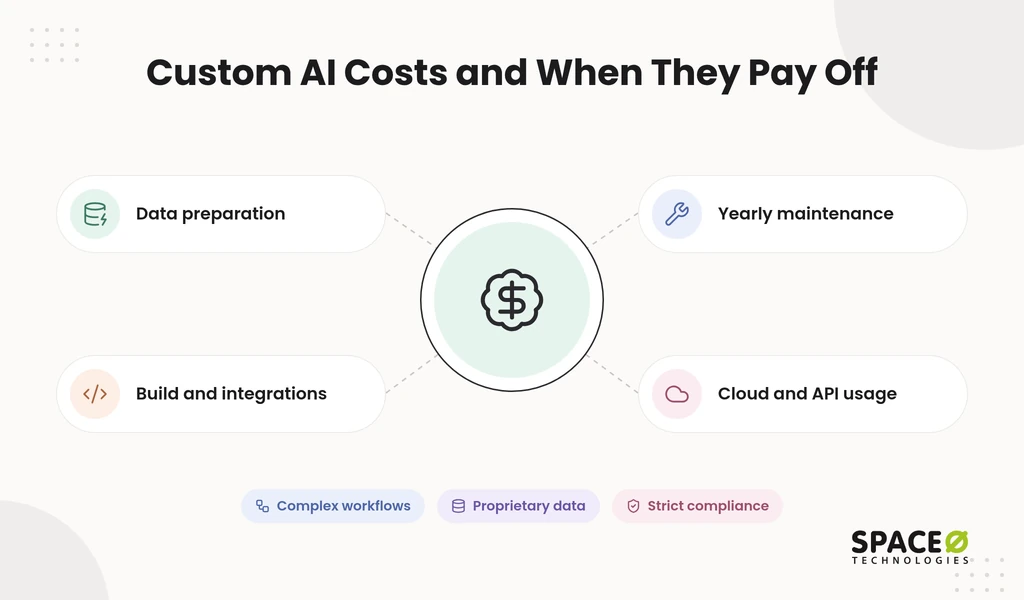
Custom AI costs more upfront than a subscription, but you own the asset and skip per-user fees. The two subsections below cover when custom pays off and what a budget includes.
When custom AI is worth building
Custom AI is worth building when you have complex workflows, high-volume proprietary data, or strict compliance requirements. Simpler needs are often better served by off-the-shelf tools first. If your process is standard and your data volume is modest, a pre-built model may deliver most of the value.
That often comes at a fraction of the upfront cost of a custom build. The math shifts toward custom once generic tools start forcing expensive workarounds. It shifts too when those tools hold your data outside your control.
What a custom AI budget includes
AI development cost varies widely with scope, data readiness, and integrations. A basic MVP starts from $15,000, and a feature-rich MVP runs $50,000 or more. The table below compares the two tiers.
| Project tier | Typical cost | Typical scope |
|---|---|---|
| Basic MVP | From $15,000 | Core features for first users |
| Feature-rich MVP | $50,000 or more | Broader features before scaling |
Our AI development cost guide shows data preparation can consume 25% to 40% of the total project budget. That makes it the single largest cost driver in an AI build. Maintenance typically costs 15% to 25% of the original build cost every year.
Plan separately for retraining cycles, cloud infrastructure, and API usage fees. Payments are milestone-based and tied to deliverables. A defined MVP suits a Fixed Cost model, while larger builds suit a Dedicated Team or Time & Material.
A free, expert-reviewed estimate gives you a number tied to your actual workflows.
The Benefit Most Guides Skip: Proof That Custom AI Works in Production
A custom AI benefit only counts once the system runs in production with measured accuracy and human review. Benefit lists rarely say how you will know the gains are real. Many custom AI projects stall at the pilot because they are built as demos, not production software.
PwC’s 2026 AI Business Predictions note that only a few companies are realizing extraordinary value from AI today. Grounding, evaluation, and human review help close that gap.
Three controls that move custom AI into production
Three controls move a custom system from pilot to shipped software: grounding, evaluation, and human review.
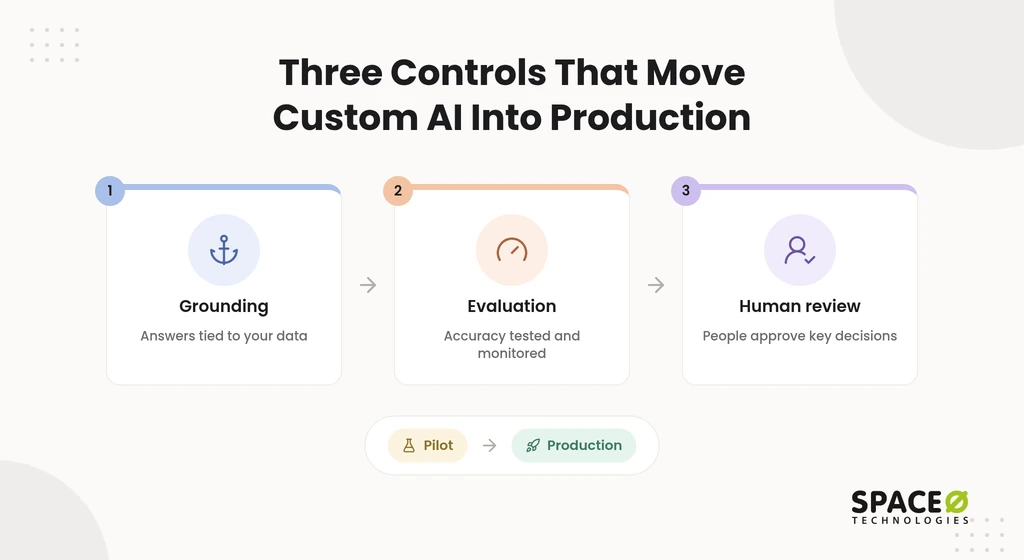
- Grounding ties every answer to your own data.
- Evaluation measures accuracy before launch and monitors it after.
- Human review keeps people approving consequential hiring, lending, clinical, and legal decisions.
Every model we put into production is wrapped in an evaluation suite. It covers accuracy, hallucination rate, bias checks, latency, and cost, with continuous monitoring in place. Outputs below a confidence threshold route to a qualified person for review.
Automation handles the volume, but a qualified human reviews and approves before any output influences a final decision.
What does a shipped custom AI build look like?
A shipped build pairs grounding, evaluation, and human review with a real workflow. On GPT Vix, our AI recruitment software, speech-to-text delays held up the candidate-screening workflow. Space-O Technologies moved that processing onto AWS Lambda to fix it.
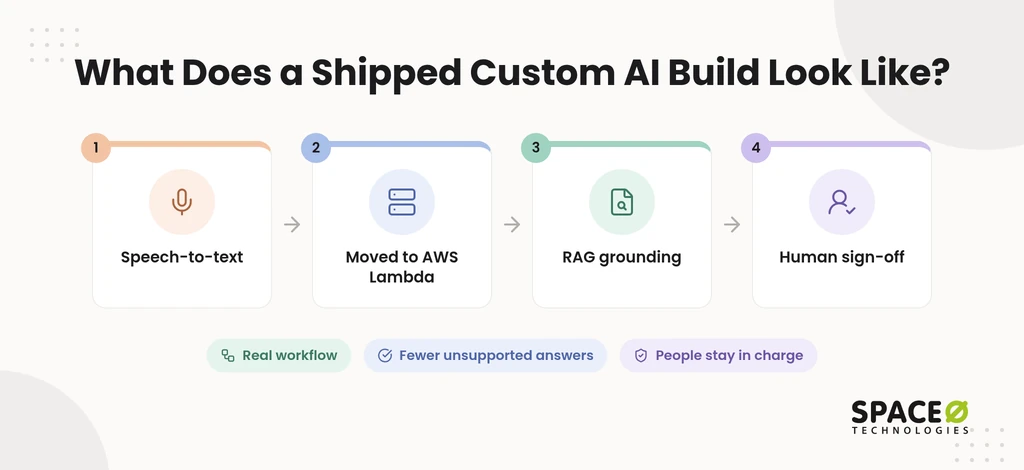
Retrieval-augmented generation (RAG) grounding then reduced unsupported answers.
For consequential decisions, people stay in charge. In a lending workflow, for example, the model drafts a recommendation and an underwriter signs off above a set threshold.
Production controls like these separate a benefit claim from a shipped system.
What to Decide Before You Build Custom AI
Two decisions tell you whether custom AI will pay off for your business. A list of benefits only helps once you tie it to your own operation. Start with these two points:
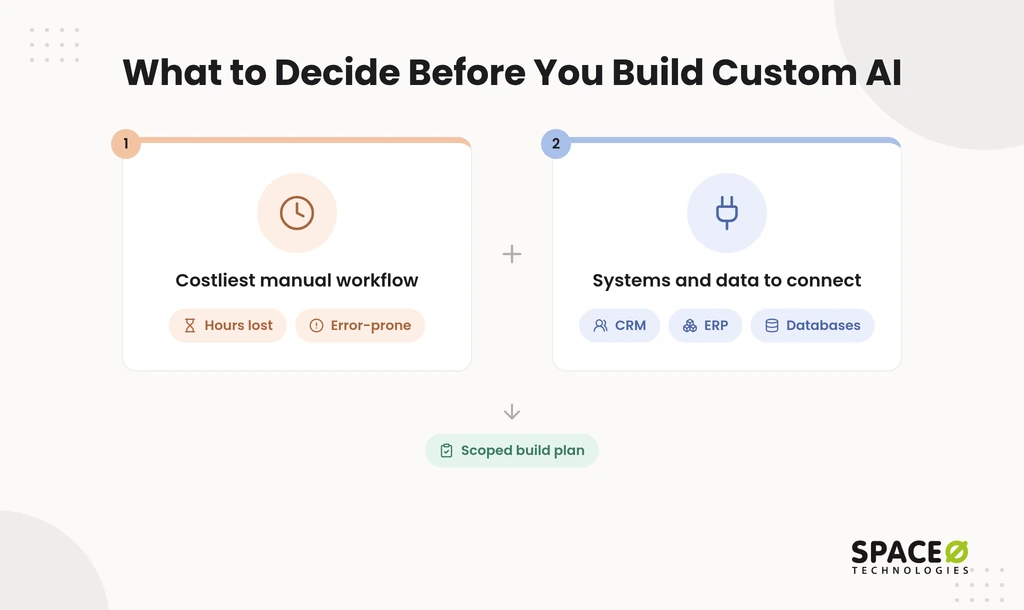
- Name the workflow that costs your team the most manual hours today.
- List the systems and data sources the AI must connect to.
Share both with our engineers through a free estimate request. You get a free, expert-reviewed estimate and a clear build plan, with no obligation to proceed.
Frequently Asked Questions
Is artificial intelligence (AI) beneficial for business?
Yes, when the workflow is valuable enough to justify the build and its ongoing costs. Deloitte’s State of AI in the Enterprise report says most organizations see productivity and efficiency gains from AI. Custom AI also adds workflow fit, data ownership, and integration with existing systems that generic tools often lack.
How is AI used in business?
Businesses use AI to automate invoice processing, data entry, and document routing. They also use it to forecast demand, predict lead conversion, and power recommendation engines and semantic search. Chatbots then answer from company records. Custom versions are trained on the company’s own documents and rules, so they handle its edge cases.
What are the 5 benefits of AI?
The five core benefits are workflow fit, CRM and ERP integration, data security, task automation, and predictive analytics. Scalability, proprietary advantage, and personalized experiences complete the full set of eight.
Is custom AI software worth the investment for a small business?
It can be, but only when the workflow justifies the cost. Small and mid-sized businesses with booking-heavy or otherwise unusual processes can get logic that matches their own rules. Budget for ongoing maintenance of 15%-25% of build cost per year. If your process is standard, start with off-the-shelf tools.
What is custom AI development?
Custom AI development builds AI software around your own workflows, data, and goals. Generic tools that competitors also use cannot match that fit. It typically covers requirements analysis, UI/UX design, agile development, QA, deployment, and maintenance. The result connects to your CRM, ERP, and legacy systems, and you own the code, data, and IP.
What are the downsides and risks of building custom AI?
Custom AI costs more upfront than a subscription, and maintenance typically adds 15%-25% of build cost every year. Many projects stall at the pilot stage because they are built as demos rather than production software. Accuracy and hallucination risks need an evaluation suite and human review, especially for hiring, lending, clinical, and legal decisions.
How does custom AI improve data security compared to public AI tools?
Custom AI keeps your proprietary data inside your own infrastructure instead of routing it through a shared public model. This lets you enforce encryption, access controls, and compliance rules such as HIPAA. Because the model is fine-tuned on internal data you own, sensitive records never have to leave your environment.
How much does custom AI software cost to build?
A basic MVP starts at $15,000, and a feature-rich MVP runs $50,000 or more. Final cost depends on scope, data readiness, integrations, and engagement model.



 All our projects are secured by NDA




 4.8


