
 By
Contents
- A US AI software development company builds machine learning models, generative AI, and AI agents for your business.
- Cost follows build type: a basic MVP starts at $15,000, and enterprise multi-agent systems run $150,000 to $500,000+.
- Plan data preparation at 25% to 40% of budget and yearly maintenance at 15% to 25% of build cost.
- Judge partners on tech stack, engagement model, data privacy, and code ownership before you sign.
Key Takeaways
Many US teams have an AI demo that never reaches production. Picking the wrong AI software development company in the USA makes that gap wider. A good partner ships AI that runs inside your real workflows.
An AI software development company builds machine learning models, generative AI, and AI agents. Space-O Technologies has built AI-powered software since 2010 for 1,200+ clients. Our generative AI integration services connect that work to your existing systems.
This guide covers services, controls, costs, and how to choose a partner. It also compares delivery models and shows which build type fits your goal. Use it to build a shortlist and a realistic budget.
Space-O Technologies: AI Development Partner for US Teams
Space-O Technologies builds production AI inside custom software, mobile apps, and SaaS for startups, SMEs, and enterprises.
Only about one-third of organizations have scaled AI across the enterprise, according to McKinsey’s State of AI survey. We start from your business goal and then choose the technology that solves it most cost-effectively.
- Space-O Technologies (Mesa, AZ): We are an AI-powered custom software development company with AI systems in production. We build AI agents, generative AI, and RAG into custom software, mobile apps, and SaaS. We never train models on client data.
What stands behind that entry:
- Team: 140+ in-house developers, including 30+ AI engineers.
- Partnerships: OpenAI Select Partner, AWS Partner, and Claude Certified Architects on staff.
- Clients: 1,200+ clients served since 2010, including Nike, McAfee, Toshiba, and HP.
- Delivery record: a portfolio spanning unicorn products, mobile apps, SaaS products, and software solutions.
- Retention: 97% client retention, plus 5.0 Clutch ratings for quality, schedule, cost, and willingness to refer.
- Breadth: One partner for software, mobile, web, SaaS, AI, ERP, CRM, and ServiceNow work.
Core AI Development Services
We build five types of AI work, each tied to a business outcome rather than a model name.
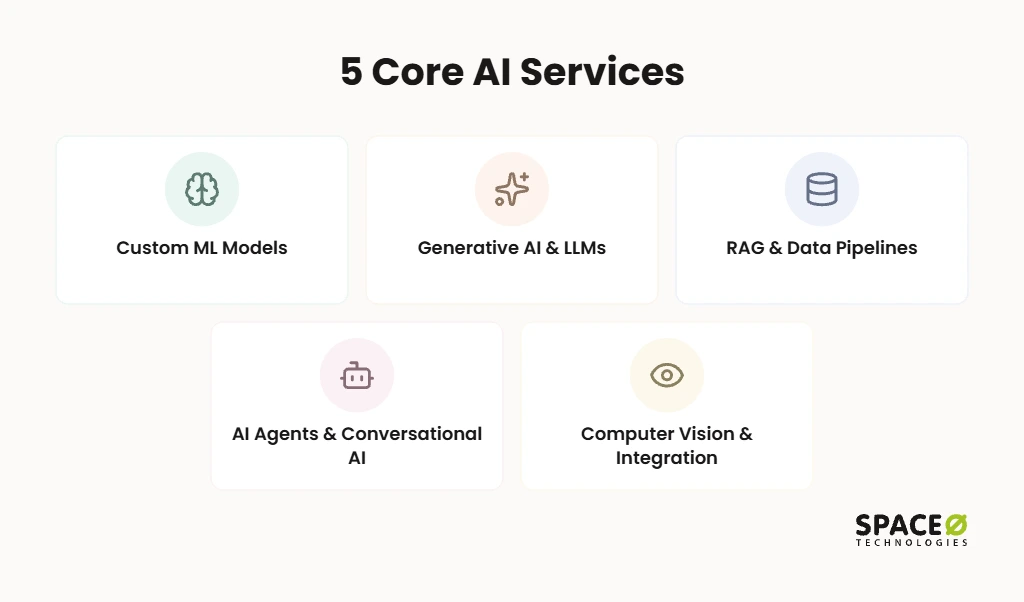
Your team may be juggling separate vendors for the app, the data, and the AI. We deliver all three as one product.
- Custom Machine Learning Models: We train and deploy machine learning (ML) models for forecasting, fraud detection, and predictive analytics on your data.
- Generative AI & LLMs: We build large language model (LLM) features such as summaries, smart search, and content tools. Where a task needs it, we fine-tune the LLM.
- RAG & Data Pipelines: Retrieval-augmented generation (RAG) grounds AI answers in your documents and databases. We build the pipelines that keep that data current.
- AI Agents & Conversational AI: Our AI agent development builds task-executing agents and chatbots for support, scheduling, and internal queries. They automate approvals, reporting, and order management.
- Computer Vision & AI Integration: We add computer vision for defect detection. We also integrate AI into your customer relationship management (CRM), enterprise resource planning (ERP), and legacy platforms.
Each service can start as a minimum viable product (MVP) or prototype. From there, it can scale to an enterprise-grade deployment without a rebuild.
Production-Ready AI for Regulated and Privacy-Sensitive US Teams
We build AI for teams that handle sensitive data, with privacy, testing, and human review on by default.
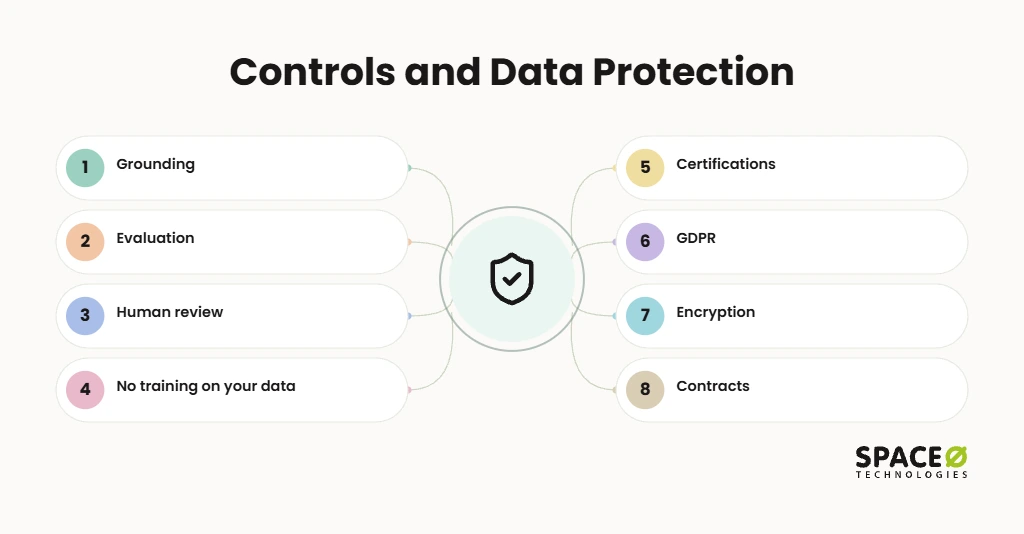
In healthcare, fintech, lending, and insurance, a model that guesses wrong or leaks data risks legal exposure. Because of that, every production system we ship carries three controls: grounding, evaluation, and human review.
What controls does a production AI system need?
A production AI system needs grounding, evaluation, and human review before it touches consequential decisions.
- Grounding: We tie answers to your approved data through RAG, so outputs cite real records.
- Evaluation: We test for hallucination and bias before every release.
- Human review: People approve high-stakes outcomes. Review checkpoints are on by default for lending and clinical decisions.
How is client data protected?
Your data stays yours: we never train models on it, and we mask personally identifiable information (PII).
- Compliance: We hold ISO 27001 and ISO 9001 certifications. We deliver HIPAA-compliant builds under the Health Insurance Portability and Accountability Act.
- GDPR: We also comply with the General Data Protection Regulation (GDPR) where EU data applies.
- Encryption: Healthcare and fintech platforms encrypt data at rest and in transit.
- Contracts: All work is NDA-protected, and you get full code and intellectual property (IP) ownership.
Estimated Development Costs
AI project cost depends mostly on build type, from a simple API integration to a multi-agent production system.
Cost depends on the data you have, the model you choose, and the systems it must connect to. A basic MVP starts from $15,000, and a feature-rich MVP runs up to $50,000+ with milestone-based payments. See our MVP development services for how scoping works.
Two line items catch teams off guard. Data preparation can take 25% to 40% of the total project budget. Annual maintenance typically costs 15% to 25% of the original build cost. Our AI development cost guide breaks both down.
Our cost ladder by build type, at the end of this page, maps price to what you are building.
We price by scope, not by the hour. You can choose one of four engagement models:
- Fixed cost: Best for a clearly scoped MVP. You get a set timeline and budget.
- Time and material: Best for evolving AI work, where scope shifts as you test.
- Dedicated team: Best for long-term product builds with steady roadmaps.
- Staff augmentation: Best for adding vetted AI engineers to your in-house team.
How to Choose an AI Software Development Company in the USA
Judge partners on four points: core tech stack, engagement model, data privacy and security, and code ownership.
Shortlists often look alike on paper. These questions separate firms that ship from firms that demo. Read verified GoodFirms reviews and compare custom AI development vs. off-the-shelf options first.
- Core Tech Stack: Ask which models they use and which application frameworks wrap them. Frameworks might include Node.js, React.js, or Ruby on Rails (RoR). Ask how they choose between RAG and fine-tuning.
- Engagement Model: Confirm they offer the model your budget needs. The options are a fixed-cost MVP, time and material, a dedicated team, or staff augmentation. Weigh an AI development company vs freelancer before you commit.
- Data Privacy & Security: Put US frameworks first: HIPAA for health data, plus independent security audits. Then check GDPR, ISO 27001, and US data residency.
- Code & IP Ownership: Get full ownership of code, prompts, and model artifacts in writing, under a nondisclosure agreement (NDA).
Space-O Technologies vs. Offshore Staffing Vendor vs. In-House Hire
Each delivery model shifts the work of discovery, design, and AI controls onto someone different.
The table below compares three ways to get AI built on six points. It shows what you take on under each one.
| What you compare | Space-O Technologies | Offshore staffing vendor | In-house hire |
|---|---|---|---|
| AI systems in production | 50+ live systems | Production experience varies by developer | One person’s track record |
| Responsible-AI controls | Grounding, evaluation, and human review by default | Your team defines and enforces them | Your team defines and enforces them |
| Engagement flexibility | Fixed cost, time and material, a dedicated team, or staff augmentation | Headcount | A full recruiting cycle |
| Code and IP ownership | Full ownership from day one | Depends on your contract | Rests with your company |
| Product breadth | Software, mobile, SaaS, AI, and ServiceNow under one team | Separate hires or vendors for each | Separate hires or vendors for each |
| Project management | Dedicated project manager (PM) and daily updates | Your own leads manage delivery | Your own leads manage delivery |
What Are You Building? Tell Us Your Project Type
The right AI build starts with your project type, budget, and timeline, not a model choice.
Tell us four things:
- Your industry.
- What you are building: an internal tool, a customer-facing AI agent, a mobile app, or a SaaS product.
- Your budget.
- Your timeline.
Here is where most readers start:
- Startup founders: A fixed-cost MVP with a clear scope and full code ownership.
- SMEs: A custom CRM or ERP with AI that automates manual workflows.
- Enterprises: Secure AI integration with existing platforms, under NDA.
- Regulated teams: AI with human review checkpoints on high-stakes decisions.
- CTOs adding capacity: Vetted AI engineers who join your sprints within days.
Get Your Free Expert-Reviewed AI Project Estimate
Share your industry, build type, budget, and timeline. Our AI engineers review your scope and send a clear, free estimate with realistic cost and delivery timelines. Get My Estimate

Other AI Development Firms US Buyers Shortlist
Several US-serving AI firms appear often on buyer shortlists, each tied to a distinct focus.
We did not rank the firms. Each entry gives location and focus.
- Azumo: Known for production-grade AI, RAG, and LLM fine-tuning. Named clients include Meta and Discovery.
- Krazimo: Known for multi-agent orchestration, with a former-Google engineering pedigree.
- Simform: Known for scalable machine learning and data engineering within product engineering.
- Coherent Solutions: Known for hybrid delivery and coverage across foundation models.
- Talentica: Cites over 50 shipped AI/ML solutions.
- Innovacio: Known for proof-of-concept (PoC) builds for founders.
AI Development Cost by Build Type
Cost tracks build type, which is why flat MVP-to-enterprise price ladders disagree. Each row below is a different build, priced by Space-O Technologies’ published guides where a range exists.
| Build type | What you get | Typical cost (USD) | Typical timeline | When it fits |
|---|---|---|---|---|
| LLM API integration/chatbot | An off-the-shelf model connected to your app or support channel | $5,000-$15,000for a simple chatbot | Scoped at discovery | General tasks where public model knowledge is enough |
| RAG over company data | AI answers grounded in your documents and databases | $15,000-$60,000 | Scoped at discovery | Answers must cite current internal data |
| LLM fine-tuning | A model adjusted to your format, tone, or task | Scoped at discovery | Scoped at discovery | Evaluation shows RAG alone cannot hold required behavior |
| Custom model training | An ML or computer vision model trained on your data | Scoped at discovery | Scoped at discovery | No existing model fits your data or prediction task |
| Multi-agent production system | Coordinated AI agents executing workflows with human review | $50,000-$500,000+, from agentic workflows to enterprise multi-agent systems | Scoped at discovery | Multi-step processes across several enterprise systems |
Ranges come from our LLM integration project cost guide.
Earlier stages cost less. A basic LLM integration MVP or proof of concept typically costs $15,000 to $25,000.
Frequently Asked Questions
What does an AI software development company in the USA do?
It builds custom machine learning models, generative AI applications, and AI agents. It also integrates them into your existing systems and maintains them after launch.
How much does AI software development cost?
A basic MVP starts at $15,000, and enterprise multi-agent systems run $150,000 to $500,000+. Data preparation can take 25% to 40% of the budget. Annual maintenance adds 15% to 25% of build cost.
How do I choose an AI software development company?
Judge partners on tech stack, engagement model, data privacy, and code ownership. Ask for production references, evaluation methods, and written IP terms before you sign.
How is my data protected in an AI project?
We never train models on client data, and we mask personally identifiable information. All work is NDA-protected, and you receive full code and IP ownership.
What are some notable AI engineering companies?
US buyers often shortlist Azumo, Krazimo, Simform, Coherent Solutions, Talentica, and Innovacio. Azumo is associated with production-grade AI, RAG, and LLM fine-tuning, with Meta and Discovery as named clients. Krazimo is associated with multi-agent orchestration, Simform with scalable machine learning and data engineering, and Coherent Solutions with hybrid delivery and foundation-model coverage. Talentica cites over 50 shipped AI/ML solutions, and Innovacio focuses on proof-of-concept builds for founders.
How do I decide between RAG, fine-tuning, and custom model training?
Match the build to the need. A general task where public model knowledge is enough fits an off-the-shelf LLM API. If answers must draw on current internal data, use RAG. Consider fine-tuning only once evaluation shows RAG alone cannot deliver the behavior you require. Custom model training fits when no existing model suits your data or prediction task.



 All our projects are secured by NDA




 4.8


