
 By
Contents
- Canada’s main AI hubs are Toronto, Montreal, and Vancouver.
- Only custom build partners write your software; product vendors license models and labs publish research.
- Buy standard tools, integrate models into workflows, and build when your logic is unique.
- Data readiness, compliance, and human review move AI cost more than location does.
- Confirm engagement terms and code ownership in writing before you sign.
Key Takeaways
Canada is a major hub for AI software development. Toronto, Montreal, and Vancouver are its largest centers. Toronto is home to the most AI firms.
Space-O Technologies is an AI-powered custom software partner serving Canadian and US businesses since 2010. We build production AI agents and chatbots, and offer generative AI integration services. Our Brampton, Ontario office supports Canadian clients.
This guide lists leading Canadian firms and explains how they differ. It also compares custom AI development vs off-the-shelf options. You will see what drives cost before you request quotes.
Editorial disclosure: Space-O Technologies publishes this page and appears in the list below. Other firms are described from public directory sources.
Top AI Software Development Companies in Canada
These firms build custom AI and software for clients, rather than selling a single AI product. Each entry gives the firm’s city and its main focus.
- Space-O Technologies (serving Canada and the US): Builds production AI agents, chatbots, and generative AI. It also builds machine learning inside custom software, SaaS, and mobile apps. It uses human review for high-stakes decisions.
- Osedea (Montreal, QC): Combines AI, custom software development, design, and robotics in client build projects.
- datarockets (Toronto, ON): Builds AI agents and custom software for companies adding agent-based automation.
- Essential Designs (Vancouver, BC / Toronto, ON): Develops custom software focused on AI that automates business workflows.
- Architech (Toronto, ON): Delivers software consulting focused on redesigning business workflows around AI.
How do these firms compare on location, engagement, and IP ownership?
Engagement terms and code ownership are often unpublished, so confirm them in writing before you sign. The table lists only what each firm’s public sources state. Space-O Technologies offers four engagement models to fit different project scopes.
| Firm | City (HQ) | Experience | Main focus | Proof stated on its site | Engagement models | Code & IP ownership |
|---|---|---|---|---|---|---|
| Space-O Technologies | Offices in Brampton, ON and Mesa, AZ | Since 2010 | AI-powered custom software, AI agents, chatbots, generative AI integration | 50+ AI systems in production; 97% client retention; ISO 27001 and ISO 9001 | Dedicated team, time and material, fixed cost, staff augmentation | Full code and IP ownership for the client; NDA-protected work |
| Osedea | Montreal, QC | Founded in 2011 | AI, software development, digital product design, robotics, data and business intelligence | Client case studies for energy, mining, health and transit projects | Not named on its site; Clutch lists a $50,000+ minimum project | Not published in the sources reviewed for this page |
| datarockets | Toronto, ON | 12+ years | AI-native product development, AI engineering, AI strategy consulting | 65+ projects shipped; 5.0 rating from 22 Clutch reviews | Not named on its site; Clutch lists IT staff augmentation and a $50,000+ minimum project | Not published in the sources reviewed for this page |
| Essential Designs | Vancouver, BC / Toronto, ON | 18+ years | Custom web, mobile and AI software, business platforms, UI/UX design | 5-star rating from 34 Clutch reviews; clients include Teck Resources, Schneider Electric and Honeywell | Scope-agreed, staged delivery with client reviews at each stage: planning, wireframing, design, development, testing, deployment | Source code and IP belong to the client when the project is completed |
| Architech | Toronto, ON | Founded in 2004 | AI workflow redesign and engineering | First workflow live in 5 to 7 weeks | Fixed-fee steps: free workshop, 2-week Transformation Blueprint from $9,900 CAD, fixed-fee build, then a monthly retainer from $2,500 per workflow | The client owns the code, built in its own cloud tenancy and repository, with no lock-in to an Architech platform |
Key AI Hubs in Canada: Toronto, Montreal, and Vancouver
RevenueBase recorded 1,926 AI software development firms based in Canada as of September 28, 2026. Most of them cluster in three cities, and each city has a distinct strength.
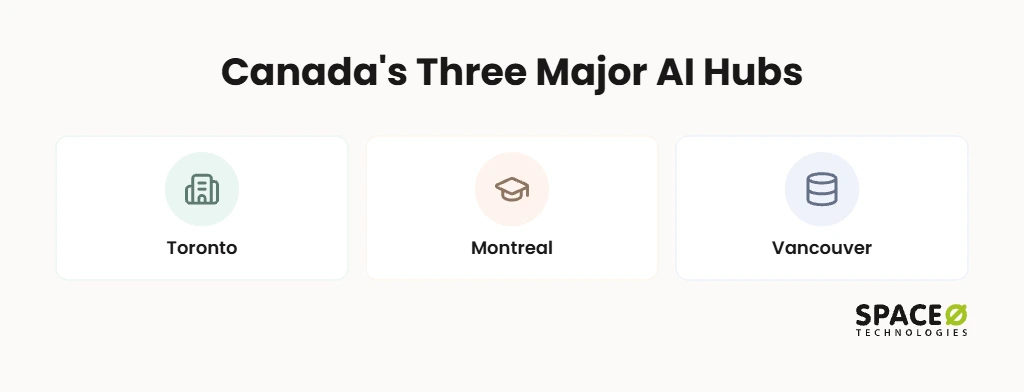
- Toronto: Canada’s largest concentration of AI firms.
- Montreal: Home to Mila, Montreal’s world-renowned AI research institute, and a deep learning research base.
- Vancouver: Strong in applied AI and data engineering. RevenueBase lists 59 AI software developers and 94 custom AI software developers in Vancouver.
Published Toronto counts differ between directories and dates. Always check a figure’s category and recorded date before you compare it with another.
Build Partner, AI Product, or Research Lab? Who Actually Builds Your AI in Canada
Many “AI company” lists mix three different kinds of organization, and only one of them builds software for you. Sorting them first saves weeks of calls with the wrong vendors. Also weigh a team against solo help with this AI development company vs freelancer comparison.
What separates a build partner from an AI product or a research lab?
A build partner writes your software, a product vendor licenses you its model, and a research lab publishes research.
| Type | What you get | Examples in Canada | What adopting it requires |
|---|---|---|---|
| Custom build partner | AI designed, built, and maintained inside your own software | Space-O Technologies, Osedea, datarockets, Essential Designs, Architech | A scoped project, your data access, and a contract that sets IP ownership |
| AI product and model vendor | A licensed model or platform | Cohere offers enterprise large language models (LLMs). They focus on data privacy and controllability. Ada: conversational customer-support automation | Integration into your systems, a vendor license, and review of the vendor’s data terms |
| Research institute | Published research, methods, and talent | Mila (Montreal) | Partnership or academic channels, not a client build engagement |
Should you build custom AI, integrate an existing model, or buy a product?
Buy when your need is standard, and integrate when you need a model inside your workflow. Build when your logic is unique.
| Option | Fits when | What it requires |
|---|---|---|
| Buy a ready-made product | Your use case matches what the product already does | License fees, configuration, and acceptance of the vendor’s roadmap |
| Integrate an existing model | You need LLM capability grounded in your own data and tools | Retrieval-augmented generation (RAG) or fine-tuning, evaluation, and integration engineering |
| Build custom AI | Your data, decisions, or compliance rules are specific to your business | Data readiness, machine learning engineering, monitoring, and human review design |
Most production systems combine two options, such as a licensed model inside custom software. We recommend RAG or fine-tuning based on which solves the problem most cost-effectively. See typical LLM integration project cost ranges before you commit to an integration.
Where does Space-O Technologies fit?
Space-O Technologies is built for taking AI from pilot to production in regulated workflows. We cover integrate and build work, plus the software around a bought product.
Pilot-to-production work in regulated settings relies on approval checkpoints, audit trails, and compliance controls.
How Space-O Technologies Ships Production AI
Most AI stalls between demo and daily use, so we design every build for production from the first sprint. Our team has 50+ AI systems live in production.
What does a production AI build include?
Every build includes grounding, evaluation, and human review before consequential decisions reach users.
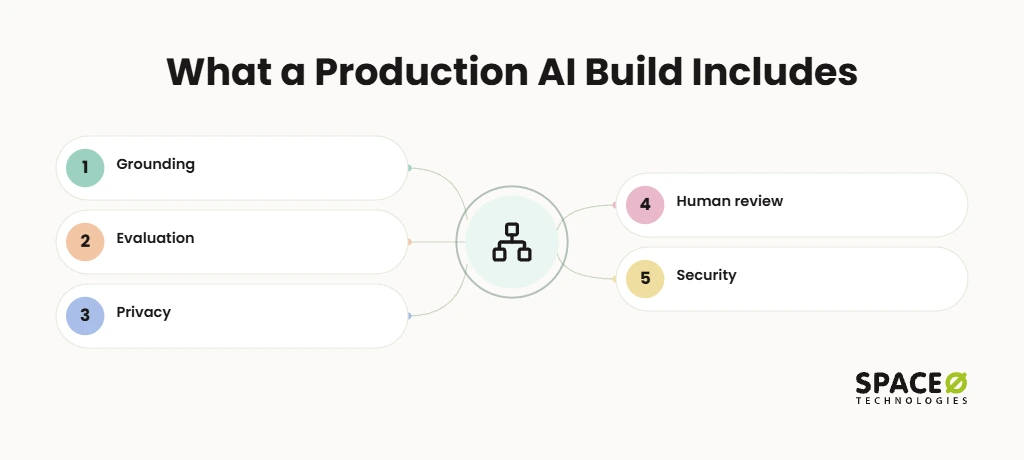
- Grounding: Answers draw on your approved data, not the model’s guesses.
- Evaluation: We test for hallucination and bias before release.
- Privacy: We never train on client data, and we mask personally identifiable information (PII).
- Human review: Checkpoints stay on by default for lending, clinical, and other high-stakes decisions.
- Security: Builds for healthcare and fintech follow GDPR and HIPAA requirements. The team will confirm which certifications apply.
What credentials and proof back this?
Our partner credentials and client record are public and verifiable.
- Certifications include ISO 27001, ISO 9001, and ISTQB-certified QA.
- Partnerships include AWS Partner, OpenAI Select Partner, and Claude Certified Architect.
- 1,200+ clients served since 2010.
- 140+ in-house developers across software, mobile, web, SaaS, AI, ERP, CRM, and ServiceNow.
- Unicorn projects include Glovo, MrSool, and FTcash.
- 97% client retention across engagements.
See what your AI build would take: get a free, expert-reviewed estimate.
What AI Development Costs (USD)
AI project cost depends on scope, data, and compliance, not on a city’s hourly rate. We give scoped ranges after a short discovery call.
These five factors move your budget most:
- Data readiness: Data preparation takes 25% to 40% of the total project budget.
- Integrations: Each CRM, ERP, or payment system connection adds engineering work.
- Compliance scope: Healthcare, privacy, or security-certification requirements such as HIPAA and PIPEDA add controls and testing.
- Human review design: High-stakes workflows need approval steps and audit trails.
- Deployment and monitoring: Production AI needs ongoing evaluation, and annual maintenance runs 15% to 25% of build cost.
You can fund the work as a fixed-cost MVP, time and material, a dedicated team, or staff augmentation. Fixed cost suits a tightly scoped first release. A basic MVP starts from $15,000 through our MVP development services. Our AI development cost guide explains the data and maintenance figures.
Working With a Canadian AI Partner From the US
US companies can hire AI talent from Canada without schedule friction. Vancouver shares Pacific Time with California. Toronto and Montreal run 3 hours ahead.
Cross-border data is the bigger question. Canadian user data falls under the Personal Information Protection and Electronic Documents Act (PIPEDA). US healthcare data falls under HIPAA.
We build to both from day one. Your team gets a dedicated project manager and daily updates throughout the build.
Review flags (12) — clear before publishing
The sentences in red above stay on the page until a reviewer clears or rewrites them.
- R7 — No outcome percentages outside the verified fact set (only 97%) — “50+ AI systems in production; 97% client retention; ISO 27001 and ISO 9001” Why: The only verified first-party percentage is 97% client retention. 98% Upwork job success and eComChat’s 23% are on file but unverified. To clear it: Use 97% retention, link a sourced third-party figure, or state the claim without a number.
- R17 — Sentences run to 20 words at most — “| datarockets | Toronto, ON | 12+ years | AI-native product development, AI engineering, AI strategy consulting | 65+ projects shipped; 5.” Why: Long sentences are harder to read and harder for an AI answer to quote cleanly. A bold bullet label ending in a colon is a label, not part of the sentence after it, so it is not counted. To clear it: Split it into two sentences of 15 to 17 words.
- R7 — No outcome percentages outside the verified fact set (only 97%) — “97% client retention across engagements.” Why: The only verified first-party percentage is 97% client retention. 98% Upwork job success and eComChat’s 23% are on file but unverified. To clear it: Use 97% retention, link a sourced third-party figure, or state the claim without a number.
- H-SRC-2 — A statistic with no source — “97% client retention across engagements.” Why: The client’s editor (17 Sep 2026) wrote “No source.” against “28% of adults aged 50–80”. A percentage, a large count or a “three in ten” with no link in its sentence asks the reader to take the number on trust. Soft, because the page’s own case-study figures and a table’s cells are sometimes legitimately unlinked — a person clears those. To clear it: Link the source, or take the number from a vouched brand fact.
- R7 — No outcome percentages outside the verified fact set (only 97%) — “Data readiness: Data preparation takes 25% to 40% of the total project budget.” Why: The only verified first-party percentage is 97% client retention. 98% Upwork job success and eComChat’s 23% are on file but unverified. To clear it: Use 97% retention, link a sourced third-party figure, or state the claim without a number.
- H-SRC-2 — A statistic with no source — “Data readiness: Data preparation takes 25% to 40% of the total project budget.” Why: The client’s editor (17 Sep 2026) wrote “No source.” against “28% of adults aged 50–80”. A percentage, a large count or a “three in ten” with no link in its sentence asks the reader to take the number on trust. Soft, because the page’s own case-study figures and a table’s cells are sometimes legitimately unlinked — a person clears those. To clear it: Link the source, or take the number from a vouched brand fact.
- R7 — No outcome percentages outside the verified fact set (only 97%) — “Deployment and monitoring: Production AI needs ongoing evaluation, and annual maintenance runs 15% to 25% of build cost.” Why: The only verified first-party percentage is 97% client retention. 98% Upwork job success and eComChat’s 23% are on file but unverified. To clear it: Use 97% retention, link a sourced third-party figure, or state the claim without a number.
- H-SRC-2 — A statistic with no source — “Deployment and monitoring: Production AI needs ongoing evaluation, and annual maintenance runs 15% to 25% of build cost.” Why: The client’s editor (17 Sep 2026) wrote “No source.” against “28% of adults aged 50–80”. A percentage, a large count or a “three in ten” with no link in its sentence asks the reader to take the number on trust. Soft, because the page’s own case-study figures and a table’s cells are sometimes legitimately unlinked — a person clears those. To clear it: Link the source, or take the number from a vouched brand fact.
- S-SIBLING-REMAINS — Copied from “AI Software Development Company for US Businesses (2026)” — “You can fund the work as a fixed-cost MVP, time and material, a dedicated team, or staff augmentation. Fixed cost suits a tightly scoped fir…” Why: Shares 12 consecutive words with the page for “ai software development company usa”: “a fixed-cost mvp time and material a dedicated team or staff augmentation … You can fund the work as a fixed-cost MVP, time and material, a dedicated team, or …”. The client’s rule: no run of 12+ words and no sentence 85% alike may appear on two pages of the cluster. To clear it: Say what is specific to THIS page here, or cut it to one sentence and link to “AI Software Development Company for US Businesses (2026)”, which keeps the full version.
- H-SAME-STORY — These figures are already quoted on another page — “Data readiness: Data preparation takes 25% to 40% of the total project budget.” Why: The same figure set (25 %, 40 %) appears on #81 “How to Integrate AI into Existing Software: A 5-Step Guide”, #94 “How AI Development Improves Business Efficiency”, #98 “Why Businesses Invest in Custom AI Solutions”, #83 “How to Outsource AI Development Successfully” and 10 more. Figures belong to the page that tells their story. To clear it: Drop the figures here and point to the page that tells the story, or keep the one figure this page’s argument needs.
- H-SAME-STORY — These figures are already quoted on another page — “Deployment and monitoring: Production AI needs ongoing evaluation, and annual maintenance runs 15% to 25% of build cost.” Why: The same figure set (15 %, 25 %) appears on #39 “AI Integration Cost for Existing Software: A 2026 Pricing Guide”, #81 “How to Integrate AI into Existing Software: A 5-Step Guide”, #92 “Business Benefits of Custom AI Software”, #86 “How to Scale an AI MVP Into a Production Product” and 25 more. Figures belong to the page that tells their story. To clear it: Drop the figures here and point to the page that tells the story, or keep the one figure this page’s argument needs.
- H-SAME-STORY — This comparison is already used on another page — “Most production systems combine two options, such as a licensed model inside custom software.” Why: “Licensed model inside custom software” is also the example on #11 “What Are Machine Learning Development Services?”. An invented comparison is used once per project. To clear it: Invent a comparison from this page’s own subject, or make the point without one.
Frequently Asked Questions
Which engagement model suits an AI project: fixed cost, time and material, dedicated team, or staff augmentation?
Fixed cost suits a tightly scoped first release, such as an MVP. Time and material, a dedicated team, and staff augmentation suit work that changes as it goes. Space-O Technologies offers all four.
What costs are easy to miss when budgeting a custom AI build?
Compliance, integrations, human review, and post-launch monitoring are the costs buyers miss most. HIPAA or PIPEDA controls add testing. Each extra CRM, ERP, or payment connection adds engineering. Ask every vendor to itemize these in the scoped estimate.
What do I need in place before hiring an AI development partner?
You need a scoped project, access to your data, and a contract that sets IP ownership. Clean, accessible data also shortens the build.
What security and compliance proof should I request from a Canadian AI vendor?
Ask whether the vendor trains on client data and masks personally identifiable information (PII). Space-O Technologies never trains on client data, masks PII, and holds ISO 27001 and ISO 9001 certifications. Also confirm code ownership and engagement terms in writing before you sign.
How do I keep human review in an AI workflow for high-stakes decisions?
Build approval checkpoints so people sign off on consequential decisions such as lending or clinical ones. High-stakes workflows also need audit trails. Specify both during scoping, because they add design and testing work.
What types of AI development services do Canadian build partners offer?
Canadian build partners offer AI agents, chatbots, generative AI, and machine learning inside custom software. Some also automate business workflows, redesign workflows around AI, or combine AI with design and robotics. Product vendors differ: Cohere offers enterprise large language models, and Ada offers customer-support automation.



 All our projects are secured by NDA



 4.8


