
 By
Contents
This guide ranks ten specialized firms, then explains when a specialized partner beats a platform. It compares each firm on Clutch rating, project size, team size, and stack.
The guide below compares ten machine learning development companies on Clutch rating, minimum project size, team size, and technology stack. It adds a “Best for” buyer profile so you can match the slot to your stage. Coverage also includes what a machine learning development company actually does and how the cloud platforms fit the landscape. It adds a decision framework no ranked list usually gives you.
The global machine learning market was valued at $100.0 billion in 2025 and is projected to reach $684.4 billion by 2033, growing at a 26.0% CAGR from 2026 to 2033. This rapid market growth highlights why choosing the right machine learning services company matters more than ever.
The top machine learning development companies in 2026 include Space-O Technologies, EffectiveSoft, N-iX, ELEKS, and Itransition. Each is assessed on Clutch rating, minimum project size, technology stack, and proven delivery in a named industry.
CTOs, product managers, and data leaders will get the most from this guide. Most arrive after they already know their business problem and want a machine learning solutions company that can take a model from prototype to production. Below you get a comparison table, ten company profiles, and an honest look at the cloud platforms. A decision tool then matches buyer profile to engagement model.
What Do Machine Learning Development Companies Do?
Machine learning development companies build, train, deploy, and scale systems that learn from data to automate predictions, decisions, and repetitive tasks. Such systems help businesses forecast demand, catch fraud, and personalize recommendations at a scale manual analysis cannot match, with computer vision use cases covering defect detection specifically.
Their services typically cover:
- Machine Learning Consulting: Define the business problem, feasibility, and success metrics before any model gets built.
- Data Engineering: Collect, clean, and structure the data a model needs to learn from.
- Model Development: Train, test, and tune machine learning and deep learning models.
- MLOps and Deployment: Move a model into production and monitor it once it is live.
- Ongoing Optimization: Retrain and adjust models as real-world data shifts over time.
Some providers only handle model development, while full-service firms manage the project from consulting through deployment and maintenance. Businesses exploring what machine learning development actually involves often use that broader picture to scope their first conversation with a vendor.
How We Selected the Top Machine Learning Firms
Building this list meant verifying real production experience, not marketing claims about AI. We followed a structured listicle research methodology to assess each company against practical delivery and credibility factors.
Our selection criteria included:
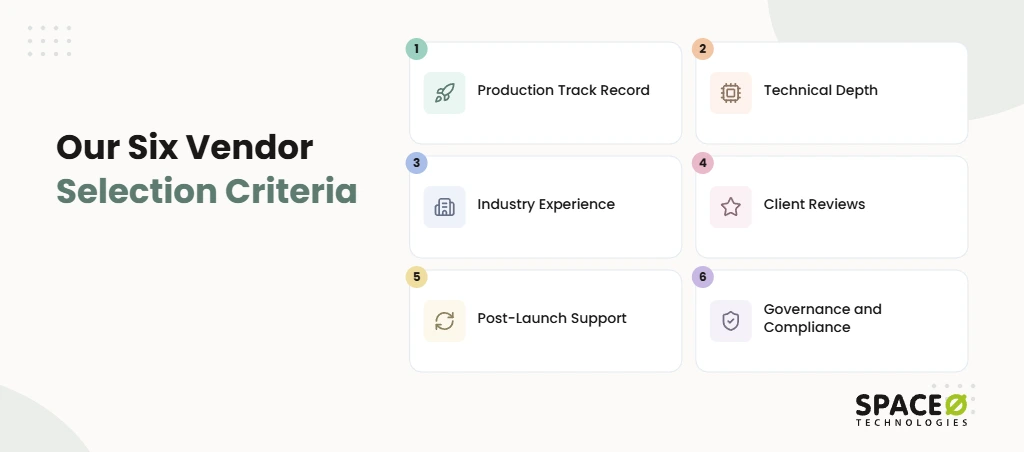
Based on this methodology, we shortlisted the ten best machine learning development companies for this list.
Best Machine Learning Companies: Quick Comparison
| Company | Clutch Rating | Min. Project Size | Location | Best for |
|---|---|---|---|---|
| Space-O Technologies | 4.8/5 | $10,000+ | Mesa, AZ, USA | Startups and SMEs moving an MVP into production AI |
| EffectiveSoft | 4.9/5 (19 reviews) | $25,000+ | San Diego, CA | Consultative scoping across healthcare and fintech |
| N-iX | 4.8/5 | $100,000+ | Florida, USA | Large enterprise and supply-chain ML |
| ELEKS | Clutch Top 1000 B2B Provider | $10,000+ | Tallinn, Estonia | R&D-heavy data science programs |
| Itransition | 4.9/5 (42 reviews) | $25,000+ | Decatur, GA | Platform implementations via an in-house AI/ML center |
| BairesDev | 4.9/5 | $50,000+ | San Francisco, CA | Scaling nearshore ML talent in parallel |
| Coherent Solutions | 4.7/5 | $50,000+ | Minneapolis, MN | Regulated-industry deep learning |
| QBurst | 4.6/5 | $10,000+ | Kerala, India | Chatbots, sentiment analysis, and fraud detection |
| Appinventiv | 4.6/5 (90 reviews) | $50,000+ | Manhattan, NY | Compliance-heavy enterprise ML |
| Daffodil Software | 4.6/5 (88 reviews) | $10,000+ | Delaware, USA | Multilingual, globally distributed delivery |
Now you have seen the top machine learning agencies and their key details. Let us look at what sets each of these companies apart.
Turn Your Machine Learning Idea Into a Working System
Space-O Technologies takes you from data assessment through full deployment. Our engineers scope the build against your data, accuracy targets, and timeline.

Top 10 Machine Learning Development Companies
1. Space-O Technologies
Space-O Technologies: Builds custom, production-ready machine learning, such as predictive analytics and fraud detection. It also delivers recommendation engines, demand forecasting, and natural language processing. Work is grounded in company data with evaluation and human review, delivered full-cycle from MVP to scale.
Best for: Startups and SMEs taking an MVP into production AI.
Building custom software since 2010, with 300+ software solutions delivered to 1,200+ clients worldwide, Space-O Technologies has earned a 97% client retention rate across projects run from offices in the USA, Canada, and India. The team applies machine learning consulting to help businesses validate a use case before committing engineering resources to the build.
Shipped AI products include GPT Vix, eComChat, and ReadGenie, each taken from MVP into production. The team of data scientists and machine learning engineers works with TensorFlow, PyTorch, and Scikit-learn. They run cloud-native MLOps pipelines supporting models built for industry-specific accuracy and scale. Production AI is grounded in the client’s own data, with retrieval-augmented generation (RAG) considered before fine-tuning.
Evaluation and human review cover hiring, lending, clinical, and legal decisions, so people approve consequential calls. Every engagement follows ISO 9001 and ISO 27001-certified development processes under one team. That covers requirement analysis, UI/UX, agile development, QA, deployment, and maintenance. Businesses that already have an internal roadmap can instead hire dedicated ML developers for a defined engagement, and the scope can extend into the team’s broader AI software development services.
| Company Overview | Details |
|---|---|
| Clutch Rating | 4.8/5 |
| In Business Since | 2010 |
| Software Solutions Delivered | 300+ |
| Team Size | 140+ in-house developers |
| Minimum Project Size | $10,000+ |
| Certifications | ISO 9001, ISO 27001 |
| Notable Clients | Nike, McAfee, Saint-Gobain |
| Shipped AI Products | GPT Vix, eComChat, ReadGenie |
| Engagement Models | Dedicated Team, Time & Material, Fixed Cost, Staff Augmentation |
| Industries Served | Healthcare, Retail, Manufacturing, Banking and Finance, Real Estate, Logistics |
2. EffectiveSoft
EffectiveSoft: Delivers machine learning built around consultative scoping. This covers deep learning models, predictive analytics, and computer vision for healthcare, fintech, e-commerce, and logistics.
Best for: Businesses that want use-case scoping before a technical approach is chosen.
EffectiveSoft has delivered 800+ projects since its founding in 2003, running a 300-person team out of San Diego, California, with a 4.9/5 Clutch rating across 19 reviews. The team identifies which machine learning use cases justify the investment before recommending a technical approach. Development covers NLP pipelines, knowledge-based architectures, and integration with CRMs, ERPs, and internal databases, with analytics and optimization built in to refine model performance using real interaction data.
| Company Overview | Details |
|---|---|
| Clutch Rating | 4.9/5 (19 reviews) |
| In Business Since | 2003 |
| Team Size | 300+ specialists |
| Minimum Project Size | $25,000+ |
| Headquarters | San Diego, CA |
| Industries Served | Healthcare, Fintech, E-commerce, Logistics, Telecommunications |
3. N-iX
N-iX: Delivers enterprise machine learning, including fraud detection, natural language processing, and neural network integration. It serves Fortune 500 clients across a 25-country footprint.
Best for: Large enterprise and industrial supply-chain ML.
N-iX has operated as a European software development company for more than two decades, growing to 2,400+ engineers with a 4.8/5 Clutch rating and offices spanning 25 countries. Its client list includes Fortune 500 companies alongside named partners such as BOSCH, SIEMENS, and eBay. One notable project involved a Fortune 100 industrial supply chain vendor, where N-iX built an automated machine learning system to scan barcodes and textual information across warehouse operations. The company holds ISO 27001 and ISO 9001 certification, alongside GDPR and PCI DSS compliance.
| Company Overview | Details |
|---|---|
| Clutch Rating | 4.8/5 |
| Team Size | 1,000-9,999 |
| Minimum Project Size | $100,000+ |
| Headquarters | Florida, USA (with offices across 25 countries) |
| Notable Clients | BOSCH, SIEMENS, eBay |
4. ELEKS
ELEKS: Delivers data science and AI, including machine learning model development, NLP solutions, and deep learning integration. It works out of R&D centers across Europe, the US, and Canada.
Best for: R&D-heavy data science programs with wide budget ranges.
In business since 1991, ELEKS runs a team of more than 2,000 experts, holding a spot on Clutch’s Top 1000 B2B Service Providers list and IAOP’s Top 100 Global Outsourcing Company ranking. The company has delivered 1,000+ end-to-end projects, with a Net Promoter Score of 64 and named clients including Aramex. Its data science and AI practice covers machine learning model development, NLP solutions, and deep learning integration, with project costs ranging from $10,000 to more than $4 million depending on engagement size and complexity.
| Company Overview | Details |
|---|---|
| Recognition | Clutch Top 1000 B2B Service Provider, IAOP Top 100 Global Outsourcing Company |
| In Business Since | 1991 |
| Team Size | 2,000+ |
| Minimum Project Size | $10,000+ |
| Headquarters | Tallinn, Estonia |
| Notable Clients | Aramex |
5. Itransition
Itransition: Delivers machine learning through an in-house AI/ML Center of Excellence. It combines rule-based logic with large language models by use case.
Best for: Platform implementations backed by Microsoft and AWS partnerships.
Itransition has provided IT services since 1998, running its own in-house AI/ML Center of Excellence alongside standing Microsoft and AWS partnerships. The company holds a 4.9/5 Clutch rating across 42 reviews, with ISO 9001 and ISO 27001 certification. The team combines rule-based logic with large language models depending on the use case, rather than defaulting to one architecture. Engagements typically start with consulting on a client’s workflows and current tech environment, then move through model architecture design, integration, and ongoing support. Itransition publishes no hourly rate; its services are sold by quote (vendor’s own page as of Sep 25, 2026).
| Company Overview | Details |
|---|---|
| Clutch Rating | 4.9/5 (42 reviews) |
| In Business Since | 1998 |
| Minimum Project Size | $25,000+ |
| Headquarters | Decatur, GA |
| Industries Served | Healthcare, Retail, Manufacturing, Automotive, Finance, Insurance |
6. BairesDev
BairesDev: Delivers machine learning built for scale across Python, TensorFlow, and PyTorch. Its strength is cloud computing integration for big data workloads.
Best for: Running several ML initiatives in parallel with nearshore talent.
BairesDev runs a team of 1,000 to 9,999 engineers, backed by high recruiting standards and a 4.9/5 Clutch rating, with the flexibility to scale from individual specialists to entire teams. Notable clients include Pinterest, Salesforce, and Adobe. Its large talent pool lets it run multiple ML initiatives in parallel, which suits businesses running several digital transformation programs at once. Like Itransition, BairesDev sells by quote with no published hourly rate.
| Company Overview | Details |
|---|---|
| Clutch Rating | 4.9/5 |
| Team Size | 1,000-9,999 |
| Minimum Project Size | $50,000+ |
| Headquarters | San Francisco, CA |
| Notable Clients | Pinterest, Salesforce, Adobe |
7. Coherent Solutions
Coherent Solutions: Delivers deep learning such as CNNs, RNNs, and GANs on TensorFlow, PyTorch, and Keras. It serves large enterprises in regulated industries.
Best for: Regulated industries where compliance is not optional.
Founded in 1995, Coherent Solutions has put three decades of software engineering experience into machine learning work for large enterprises, earning a 2025 Spring Global Award from Clutch in the AI, NLP, and Robotics services category. The company holds a 4.7/5 Clutch rating. ISO certification makes the company a fit for businesses in strictly regulated industries.
| Company Overview | Details |
|---|---|
| Clutch Rating | 4.7/5 |
| In Business Since | 1995 |
| Team Size | 1,000-9,999 |
| Minimum Project Size | $50,000+ |
| Headquarters | Minneapolis, MN |
| Notable Clients | Anytime Fitness, Life Time, WEX |
8. QBurst
QBurst: Delivers machine learning services spanning deep learning, cognitive chatbot development, sentiment analysis, and fraud detection software.
Best for: Chatbots, sentiment analysis, and process automation at scale.
QBurst has grown to a team of 1,000 to 5,000 engineers since its founding in 2004, running R&D centers across India and Poland. The company holds a strong aggregate review rating built on thousands of client engagements. The team applies its expertise to build applications that use machine learning to automate processes and improve customer experiences at scale.
| Company Overview | Details |
|---|---|
| Clutch Rating | Not published by the vendor |
| In Business Since | 2004 |
| Team Size | 1,000-5,000 |
| Minimum Project Size | $10,000+ |
| Headquarters | Kerala, India |
9. Appinventiv
Appinventiv: Delivers enterprise-grade machine learning trained on domain-specific data. Compliance is built into its development process across common data-protection and security standards.
Best for: Compliance-heavy enterprise ML handling regulated data at scale.
Appinventiv delivers machine learning solutions backed by 200+ dedicated data scientists and AI engineers and 300+ AI-powered solutions delivered. The company holds a 4.6/5 Clutch rating across 90 reviews, was founded in 2014, and is headquartered in Manhattan, New York. The team trains machine learning models directly on a client’s own data rather than generic datasets, then configures security layers and integrations to match how the business operates.
| Company Overview | Details |
|---|---|
| Clutch Rating | 4.6/5 (90 reviews) |
| In Business Since | 2014 |
| Team Size | 1,700+ |
| Minimum Project Size | $50,000+ |
| Headquarters | Manhattan, NY |
10. Daffodil Software
Daffodil Software: Builds machine learning and AI-integrated systems with NLP. These handle sentiment analysis, context understanding, and intent recognition, plus multilingual support.
Best for: Multilingual, globally distributed delivery.
As a machine learning development company with 25+ years of software engineering experience, Daffodil Software runs offices in Delaware, USA, London, Dubai, and Gurugram, India. The company holds a 4.6/5 Clutch rating across 88 reviews. Third-party integrations connect these systems to CRM platforms, payment gateways, and marketing automation tools. This enables automated data flow without manual intervention.
| Company Overview | Details |
|---|---|
| Clutch Rating | 4.6/5 (88 reviews) |
| In Business Since | 1999 |
| Minimum Project Size | $10,000+ |
| Headquarters | Delaware, USA |
The list above covers the specialized machine learning development companies worth shortlisting. Before you sign with any of them, it helps to see where the big cloud platforms fit.
Cloud and Platform Providers: The Other Half of the Landscape
The three hyperscaler platforms are Google Cloud Vertex AI, Amazon SageMaker, and Microsoft Azure Machine Learning. They give teams managed infrastructure to build, train, deploy, and scale machine learning models themselves. That differs from a partner who builds the system for you.
- Google Cloud Vertex AI: An end-to-end environment for training, tuning, and serving custom models. AutoML helps teams without deep ML staff.
- Amazon SageMaker: AWS’s managed service for building, training, and deploying models, sitting inside a three-layer AI stack.
- Microsoft Azure Machine Learning: Azure’s managed ML service, paired with Azure OpenAI Service for generative AI workloads.
These platforms are the right choice when you have in-house data scientists and MLOps engineers ready to own the pipeline. They supply the rails, not the build. For reference pricing and feature comparisons, independent directories such as Clutch publish regularly updated tables. Vendor comparison guides keep similar tables current.
When to Choose a Specialized Partner vs. a Cloud Platform
Choose a cloud platform when you already have ML engineers to run it. Choose a specialized partner when you need the system built, shipped, and maintained for you. The decision usually comes down to whether model-building is your team’s job or someone else’s.
A platform rewards teams that can self-serve: you own the account, the pipeline, and the on-call rotation. A specialized firm earns its fee on the stages a platform leaves to you. These include scoping the business problem, engineering the data, shipping to production, and keeping the model accurate as data shifts.
Still comparing vendors? Send us your use case and current data position. Our engineers will return a scoped estimate covering timeline, accuracy targets, and integration work. Get a Scoped Estimate.
How to Choose a Machine Learning Partner by Buyer Profile
No ranked list tells you which engagement model fits your stage. This one does. The table below pairs buyer profile with the need, the engagement model, and typical scope. It is grounded in named shipped products rather than generic advice.
| Buyer profile | Typical need | Engagement model | Typical scope | Grounded example |
|---|---|---|---|---|
| Startup / founder | MVP to production AI | Fixed Cost or Time & Material | Scoped MVP on web, iOS, and Android built to reach users | Glovo ($1.2B), Fyule Video Lab ($1.4M) |
| SME / growing business | Custom business system | Time & Material or Fixed Cost | CRM, ERP, or booking platform mapped to existing workflows | Scoped to the business’s existing systems |
| Enterprise | Legacy modernization or production AI | Dedicated Team | Rebuild on-premise systems as cloud web platforms on AWS, Azure, or GCP | Cloud rebuild on AWS, Azure, or GCP |
| Product / ops team | AI into production | Time & Material or Dedicated Team | Chatbots, agents, and generative AI grounded in company data | GPT Vix, eComChat |
| CTO adding capacity | Dedicated developers | Staff Augmentation | Vetted developers inside your sprints, repos, and tools | Vetted developers embedded in your team |
Where the comparison tables above stop at Clutch rating and minimum project size, the axis that actually separates partners is engagement flexibility and ownership:
- Engagement flexibility: Fixed Cost MVP, Time & Material, Dedicated Team, and Staff Augmentation, not an enterprise-only minimum.
- IP ownership: Full code and IP transferred at handover, with an NDA signed before kickoff.
- Shipped, funded products: A portfolio that includes products that went on to raise funding, not just prototypes.
- In-house delivery: 140+ in-house developers rather than a subcontracted bench.
Across every profile, the recurring differentiator is end-to-end lifecycle ownership. That means data engineering, model training, deployment, and ongoing MLOps, rather than one-off model building.
How to Pick the Right Machine Learning Development Company
Choosing the right machine learning partner is about fit against your specific data and industry, not brand recognition. The right team should understand your business problem and recommend the right technical approach. It should stay involved well after the model reaches production. Here are the factors worth evaluating.
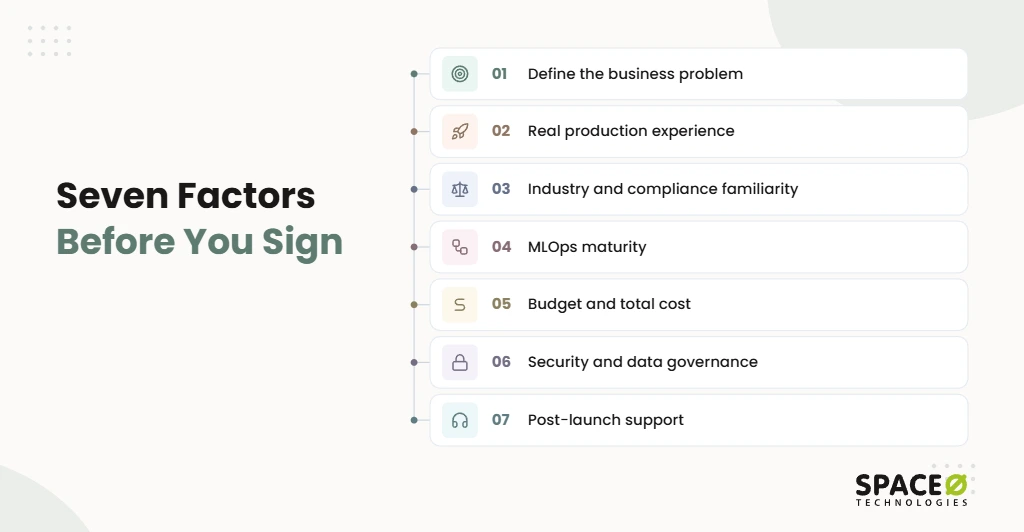
1. Define the business problem before evaluating any vendor
Know exactly what you are trying to solve in plain terms before comparing companies. “We want AI” is not a scope. “We want to cut inventory forecasting error by a set target” is. Clarity here helps you match the vendor’s actual expertise to your specific need.
2. Check for real production experience
Ask for examples of models the company has deployed and maintained in production on real data volumes. Avoid relying on prototypes shown in a sales call. A working demo and a system running in production on real data volumes are two different things.
3. Confirm industry and compliance familiarity
A vendor that built forecasting models for retail may not understand the compliance constraints of healthcare or financial data. Ask directly about experience in your specific regulatory environment.
4. Evaluate MLOps maturity
Find out how the company handles deployment, monitoring, retraining, and version control once a model goes live. Without strong MLOps practices, model performance degrades quietly as real-world data shifts.
5. Consider budget and total cost of ownership
Cost varies based on team location, expertise level, and engagement model. Compare vendors on total cost of ownership, including deployment, monitoring, and retraining, rather than rate alone. For a scoped range tailored to your build, use a free, expert-reviewed estimate instead of a headline figure.
6. Verify security and data governance practices
Check for relevant certifications such as ISO 27001. Ask how the vendor handles data privacy, access controls, and regulations such as GDPR or HIPAA where applicable.
7. Understand what happens after launch
Some vendors treat delivery as the finish line. Ask directly what support looks like six months after go-live, since model accuracy typically requires ongoing monitoring and retraining.
Evaluate companies against these factors to choose a machine learning partner that delivers long-term value. The alternative is a model that stops working once real-world data shifts.
Where a Machine Learning Partner Fits in Your Adoption Journey
Machine learning projects rarely succeed because of the model alone. Success comes from the company understanding where the model fits in a longer process. That process starts before development and continues well after launch.
The typical path looks like this:
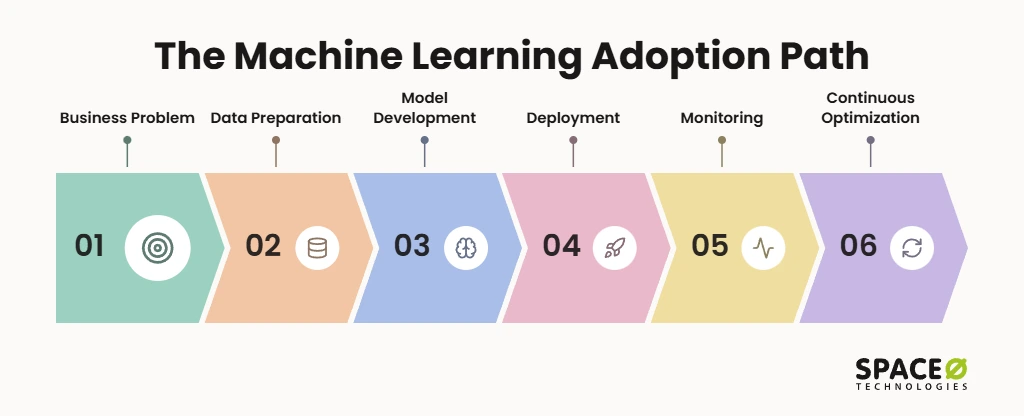
Most vendor conversations focus heavily on model development, since that is the most visible part of the work. The stages on either side matter just as much. Data preparation determines whether a model has anything reliable to learn from. Monitoring determines whether that model still works months after launch, once real-world data starts to shift.
Why Businesses Choose Space-O Technologies for Machine Learning Development
The right partner understands your business challenge and ships to production. It is not simply the one with the largest team. The companies covered in this guide each bring genuine strengths, from enterprise-scale deployment to specialized industry expertise.
Building custom software since 2010, Space-O Technologies operates as a machine learning software development firm. It handles every stage of the process under one team. For businesses whose roadmap extends beyond a single model, machine learning is one part of the team’s work. That work spans broader AI and custom software, from MVP through legacy modernization and dedicated development teams.
Tell us your industry, project goals, and data position to help us understand your needs. That could be a startup MVP, a custom business system, or AI moving to production.
Frequently Asked Questions
What is the difference between a machine learning platform and a machine learning development company?
A machine learning platform supplies managed infrastructure to build, train, deploy, and scale models yourself. You own the account, the pipeline, and the on-call rotation. A machine learning development company builds the system for you, earning its fee on the stages a platform leaves undone. That work covers scoping the business problem, engineering the data, shipping to production, and keeping the model accurate. Platforms reward teams that can self-serve; firms suit teams that need end-to-end delivery.
What is the average cost of machine learning development?
Minimum project sizes among leading specialized firms start at $10,000+ for Space-O Technologies, ELEKS, QBurst, and Daffodil Software. They rise to $25,000+ (EffectiveSoft, Itransition), $50,000+ (BairesDev, Coherent Solutions, Appinventiv), and $100,000+ (N-iX). ELEKS reports project costs ranging from $10,000 to more than $4 million depending on engagement size and complexity. Cost varies by team location, expertise level, and engagement model, so weigh these factors before comparing vendors. Compare on total cost of ownership, including deployment, monitoring, and retraining, rather than hourly rate alone.
How can I verify a machine learning company’s technical capabilities?
Beyond deployment history, weigh three signals together: a named client outcome you can trace and a concrete MLOps answer. Ask how often they retrain, who owns version control, and whether they hold a security credential such as ISO 27001. If a vendor can only show prototypes or dodges the retraining question, treat it as a red flag. A working demo is not the same as a maintained production system.
How do machine learning companies handle data privacy and security?
Leading firms hold recognized certifications, for example, ISO 9001 and ISO 27001. [TEAM: confirm which vendors hold these certifications before publishing.]
What services do machine learning software companies offer?
Machine learning development services usually bundle consulting, data engineering, model development, deployment, and ongoing optimization. Stronger vendors also handle MLOps, model monitoring, and retraining as real-world data shifts. Weaker vendors stop at a trained model and leave deployment to you, which is where many projects stall.
How long does it take to develop a machine learning solution?
A proof of concept typically takes 6 to 12 weeks, and a production-ready system takes 3 to 6 months. Timelines depend more on data readiness than on model choice. Enterprise-scale implementations can take 6 to 12 months because they require extensive data engineering and phased rollouts.
What questions should I ask before hiring a machine learning company?
Ask about experience with similar projects, relevant case studies, and how the company measures model accuracy after launch. Discuss timeline estimates, team structure, data requirements, and what post-launch support actually includes.
Should I hire a local company or an offshore machine learning developer?
Local companies offer easier communication and shared time zones at higher rates. Offshore developers can reduce costs and widen the available talent pool. Many teams use a hybrid model with local management and offshore development, particularly for long-running ML projects.



 All our projects are secured by NDA




 4.8


