
 By
Contents
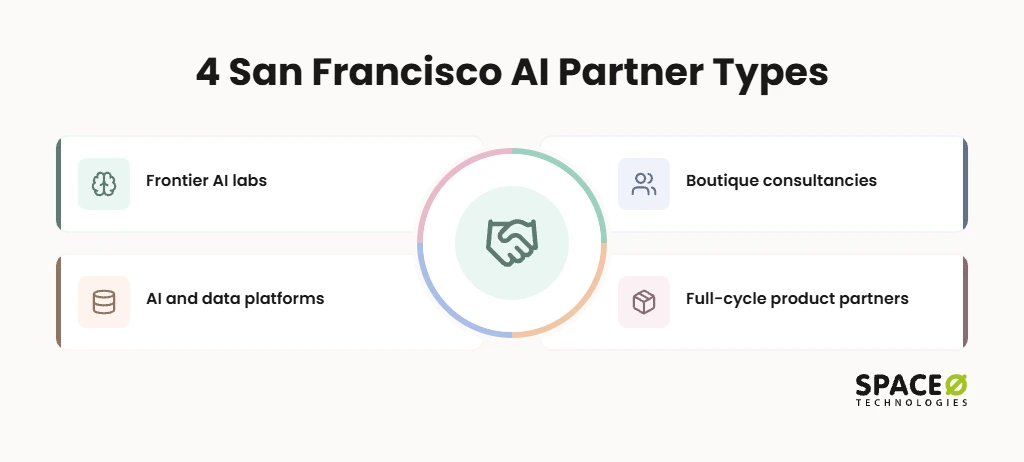
- San Francisco AI partners fall into four types: labs, data platforms, boutique consultancies, and full-cycle product partners.
- Match your project type to a partner type and engagement model before you compare vendors.
- Custom AI projects in San Francisco are commonly quoted at $50,000-$150,000, depending on scope, integrations, and compliance.
- Verify data-training policy, PII handling, code and IP ownership, and compliance evidence in writing before a partner touches your data.
- Space-O Technologies has run 50+ AI systems in production and transfers all code and IP to you at completion.
Key Takeaways
Choosing an AI development company in San Francisco is hard with so many options. Labs like OpenAI and Anthropic build models, not your finished product. Custom AI development companies turn those models into working systems inside your business.
Many buyers struggle to compare labs, platforms, boutiques, and full-cycle partners. Space-O Technologies has built custom software since 2010 and runs 50+ AI systems in production. We serve San Francisco, the Bay Area, and South San Francisco teams.
This guide explains the four partner types and the AI services we build. It also gives a project-to-partner matrix, a cost range, and a signing checklist. Use it to shortlist the right partner before you request a quote.
Space-O Technologies: An AI Development Company Serving San Francisco
Space-O Technologies: an AI-powered custom software development company, operating since 2010, with 50+ AI systems in production. Our AI engineers hold OpenAI Select Partner, AWS Partner, and Claude Certified Architect credentials. San Francisco teams use us when a model subscription is not enough. They need a system running inside real workflows.
- Focus: Custom AI, software, mobile, web, SaaS, ERP, CRM, and ServiceNow, all from one team.
- Proof: 50+ AI systems in production, 300+ software solutions, 350+ web solutions, and 500+ SaaS products. This includes 5 unicorn products, among them Glovo ($1.2B funding).
- Reviews: Read verified client reviews of Space-O Technologies on GoodFirms.
- Clients: 1,200+ clients worldwide since 2010, from startups to enterprises.
- Ratings: 5.0 on Clutch for quality, schedule, cost, and willingness to refer. We also have a high client retention rate and a strong Upwork success score.
- Team: 140+ in-house developers, including 30+ AI engineers.
- Responsible AI: We never train on client data. Every system includes PII masking, grounding, hallucination and bias evaluation, and human approval for high-stakes decisions.
- Security: NDA-protected work, full code and IP ownership, ISO 27001 alignment, HIPAA-compliant builds, and GDPR compliance.
- Engagement: Fixed cost, time and material, dedicated team, or staff augmentation, with a dedicated project manager and daily updates.
- Serves: San Francisco, the Bay Area, and South San Francisco, from our US office in Mesa, Arizona.
AI Development Services We Build for San Francisco Companies
We build six kinds of AI work for San Francisco teams. Each is designed to run in production rather than in a demo.
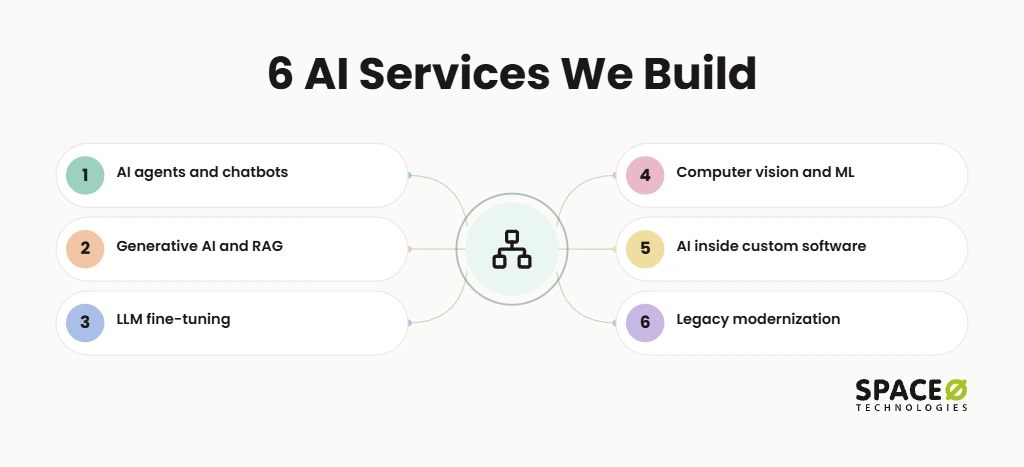
AI agents and chatbots
AI agents and chatbots: we build agents that answer, route, and act inside the tools your team already uses. Support, scheduling, and internal questions are common first workloads for our AI agent development team. Each agent draws its answers from approved company sources. We test it against real queries before launch. Actions with financial, legal, or customer impact go to a person for approval.
Generative AI and retrieval-augmented generation (RAG)
Generative AI and RAG: we connect large language models (LLMs) to your own documents and systems. RAG retrieves the right internal content at query time, so answers reflect current information. Typical features, delivered through our generative AI integration services, include summaries, smart search, and content tools inside your product. Grounding in your sources reduces invented answers. Evaluation sets show you accuracy before users see the feature.
LLM fine-tuning
LLM fine-tuning: we fine-tune a model only when retrieval cannot fix the problem. We start with RAG when the gap is access to your data. We fine-tune when the gap is model behavior, such as a fixed output format or a narrow task. This keeps spend tied to the problem and avoids training a model you do not need.
Computer vision and machine learning (ML)
Computer vision and ML: we build models for forecasting, fraud detection, and visual defect detection. Built by our computer vision development team, these systems support decisions in operations, finance, and quality control. We measure performance on your own historical data before deployment. Our machine learning development services include post-launch monitoring that flags accuracy drift, so your team knows when to retrain.
AI inside custom software and SaaS
AI inside custom software: we build the AI and the product around it, so features ship together. Our team also delivers mobile apps, web applications, SaaS platforms, CRM, ServiceNow, and ERP software development. You avoid handoffs between an AI vendor and a software vendor. AI features land in the same codebase, release cycle, and support plan.
Legacy modernization
Legacy modernization: we move monolithic and on-premises systems to cloud architectures that can run AI. Typical work includes migrating legacy monoliths to microservices and moving workloads to AWS, Azure, or GCP. We also connect existing tools through API modernization services. The result is clean, accessible data that AI features can actually use.
Types of AI Development Partners in San Francisco
San Francisco AI firms fall into four partner types, and each requires something different from your team. Knowing the type tells you who builds, who hosts, and who maintains your system.
Frontier AI labs
Frontier labs build foundation models, and your team or a partner builds the application around them.
- OpenAI: A San Francisco–based lab and the creator of the GPT models and ChatGPT.
- Anthropic: A San Francisco–based lab and the developer of the Claude family of models.
Adopting a lab’s models means API access, prompt and data design, and engineers to build the product layer.
AI and data platforms
AI and data platforms supply infrastructure for data, training, and deployment. Adopting one usually means licensing costs, administrators to run the platform, and engineers to build on top of it. Your application still needs its own design and code.
Boutique AI consultancies
Boutique AI consultancies offer small, senior teams focused on AI strategy and pilots. Before signing, confirm who will build, host, and maintain the system once the pilot ends. Some boutiques hand that work to a separate team.
Full-cycle product partners
Full-cycle product partners design, build, and maintain the AI system and the software around it. This model suits teams without in-house AI engineers or with a fixed release date. Space-O Technologies works in this category.
Which AI Partner Fits Your Project?
Match your project type to a partner type and engagement model, then run one specific check before signing. Most San Francisco buyers start with a project, not a vendor list, and weigh custom AI development vs off-the-shelf tools first. The table below starts there.
| Project type | Partner type that fits | Engagement model | Check before you sign | Space-O Technologies’ published range |
|---|---|---|---|---|
| Custom LLM application | Full-cycle product partner | Fixed cost for a scoped first release | How many AI systems the partner runs in production | Generative AI app: $100,000-$300,000 |
| AI agent or chatbot | Full-cycle partner with integration experience | Fixed cost or time and material | How the agent is grounded, evaluated, and escalated to people | $10,000-$150,000; RAG chatbot $50,000-$150,000 over 10-20 weeks |
| Fine-tuned LLM for a narrow task | Partner with ML engineers and an evaluation practice | Time and material | Whether your data trains anything beyond your own model | Scoped at discovery |
| Workflow automation | Partner that also builds your business software | Time and material | Who owns and maintains each integration | Scoped at discovery |
| AI added to an existing SaaS product | Partner with multi-tenant SaaS delivery | Dedicated team | How tenant data stays isolated | Basic AI feature: $40,000-$100,000 over 2-4 months |
| Legacy modernization with AI | Full-cycle partner covering cloud migration | Dedicated team | Full code and IP transfer terms | Scoped at discovery |
| AI on regulated data (healthcare, fintech, lending, insurance) | Partner with HIPAA and GDPR controls | Dedicated team or fixed cost | PII masking and human review checkpoints | Scoped at discovery |
Ranges depend on scope and are confirmed in a free, expert-reviewed estimate.
Two shipped systems map to these rows. GPT Vix is a custom LLM application built on ChatGPT, Whisper, and Synthesia. eComChat added an AI-powered eCommerce search bot to an existing store.
What should you verify before you sign with an AI partner?
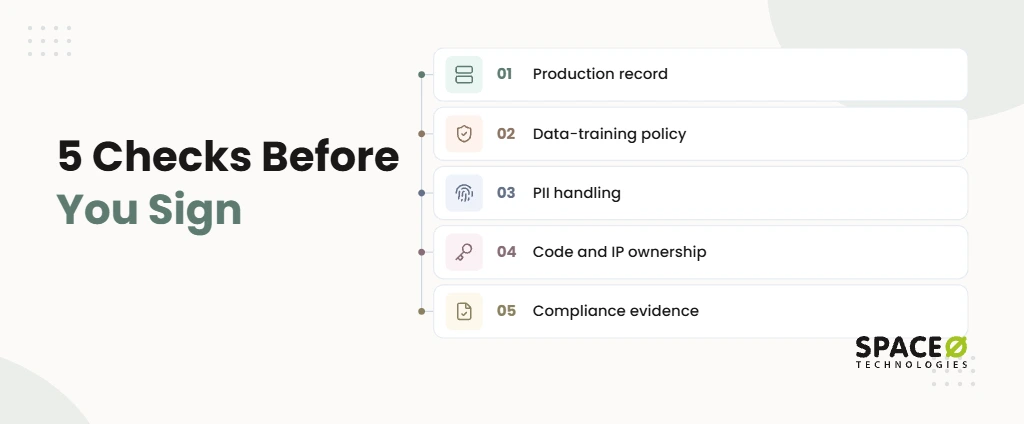
Verify five things in writing before any AI partner touches your data.
- Production record: Ask how many AI systems the partner runs in production today, not how many demos it has built.
- Data-training policy: Confirm in the contract that your data never trains shared or third-party models.
- PII handling: Ask where personal data is masked and who can see unmasked records.
- Code and IP ownership: Confirm that you own the code and IP, and from what date.
- Compliance evidence: Request the partner’s compliance documentation, plus HIPAA and GDPR controls where they apply.
Here is how Space-O Technologies answers points 2 to 4. Our model provider contracts prohibit training on client inputs and outputs. PII is masked before it reaches any third-party model. All code, data, and IP transfer to you at project completion.
Cost of AI Development in San Francisco (2026)
Custom AI projects in San Francisco are commonly quoted at $50,000-$150,000. Scope, integrations, and compliance needs decide where a project lands in that range. Our AI development cost guide breaks down the main drivers. For market context on AI adoption, see McKinsey’s State of AI survey.
- Typical project range: Custom AI projects are usually scoped and quoted per project. They are rarely sold at a fixed published price. For LLM builds, see our LLM integration project cost breakdown.
- Agency rates: Many San Francisco agencies bill hourly. Space-O Technologies quotes scoped project ranges instead.
- Freelance or independent: Usually billed hourly. Your team then owns architecture, testing, and ongoing support. Compare an AI development company vs. a freelancer before you choose.
- Engagement models: Fixed cost, time and material, dedicated team, or staff augmentation.
Get a Scoped AI Cost Estimate
Every Space-O Technologies range starts from your scope, not a rate card. Our experts review your project and return a free estimate.

Which San Francisco Teams Do We Build AI For?
We build AI for six kinds of San Francisco and Bay Area teams, each with a different starting problem.
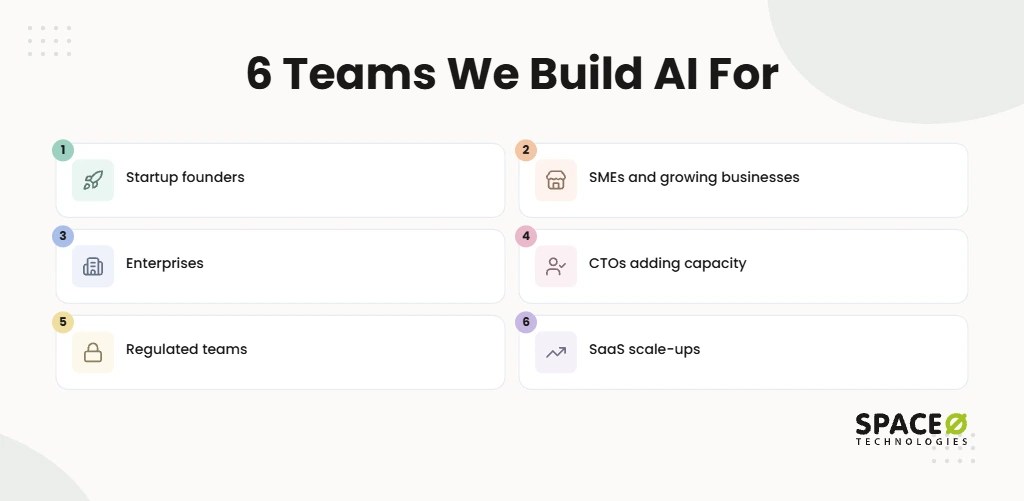
1. Startup founders
Founders need a first release that reaches users and supports the next raise. We build scoped MVPs across web, iOS, and Android on a fixed-cost or time-and-materials model. The architecture is planned so version two grows from it without a rebuild.
2. SMEs and growing businesses
Growing businesses outgrow spreadsheets and off-the-shelf tools before they outgrow their teams. We build custom CRM, ERP, and inventory systems shaped around your workflows. We then add AI automation for approvals, reporting, and order management.
3. Enterprises
Enterprises need AI that fits existing platforms, security reviews, and procurement rules. We modernize legacy systems, build enterprise portals, and implement or migrate ServiceNow across ITSM, ITOM, and custom modules. Data residency options cover the US, EU, and India.
4. CTOs adding capacity
Engineering leads often need AI skills on the team this quarter, not after a hiring cycle. Vetted AI, backend, and full-stack engineers join your sprints, tools, and code review within days. Space-O Technologies handles vetting, onboarding, and replacements.
5. Regulated teams
Healthcare, fintech, lending, and insurance teams cannot ship AI that skips compliance. We encrypt data at rest and in transit. Human review checkpoints are on by default for lending, clinical, and other high-stakes decisions.
6. SaaS scale-ups
SaaS products with early traction need a platform that holds up as users and tenants grow. We plan multi-tenant architecture, containerization, and CI/CD pipelines for scale. We also add AI features that improve retention and set your product apart.
Frequently Asked Questions
What types of AI development companies are in San Francisco?
San Francisco AI firms fall into four types: frontier labs, AI and data platforms, boutique consultancies, and full-cycle product partners. Frontier labs such as OpenAI and Anthropic build foundation models. Full-cycle partners design, build, and maintain the AI system and the software around it. Space-O Technologies works in that last category.
Should I choose fixed-cost or time-and-material pricing for an AI project?
Choose fixed cost for a scoped first release and time and material when scope will change. Fixed cost suits a scoped first release such as a custom LLM application. Either fixed cost or time and material fits an AI agent or chatbot. Time and materials fit fine-tuned LLMs and workflow automation. A dedicated team suits long-running work like AI added to an existing SaaS product or legacy modernization. Space-O Technologies quotes scoped project ranges rather than hourly rates.
How much does AI development cost in San Francisco?
Custom AI projects in San Francisco are commonly quoted at $50,000-$150,000. Scope, integrations, and compliance needs decide where a project lands in that range. Space-O Technologies scopes each project and offers a free, expert-reviewed estimate.
What controls should a production AI system include?
A production AI system should ground its answers in approved company sources and mask PII. It should be evaluated for hallucination and bias before release, and send high-stakes actions to a person for approval. Data should be encrypted at rest and in transit. For lending, clinical, and similar high-stakes decisions, human review checkpoints should be on by default.
What do I need to have ready before starting an AI project?
Know your scope, the systems and integrations the AI must connect to, and any compliance needs. These decide where a project lands in price. Your data also needs to be clean and accessible. Legacy or on-premises systems may need migration or API connections first, so AI features can use that data.
How do I test an AI feature before real users see it?
Build an evaluation set from real queries or your own historical data and measure accuracy against it before launch. For agents, test against real queries and send financial, legal, or customer-impact actions to a person for approval. After launch, monitor for accuracy drift so you know when a model needs retraining.



 All our projects are secured by NDA



 4.8


