
 By
Contents
- Write model ownership into the contract, covering weights, fine-tuned checkpoints, prompts, and generated outputs.
- Set SLA uptime as a monthly availability target, excluding scheduled maintenance, with monthly service credits for misses.
- Define hallucination thresholds against an agreed evaluation set, sampling method, and cure period before launch.
- Sign a Business Associate Agreement before any AI vendor touches protected health information.
Key Takeaways
Most software contracts were not written for AI apps. An AI app development contract and SLA checklist closes that gap. Four terms matter most: model ownership, API uptime, hallucination thresholds, and data privacy.
Space-O Technologies has delivered 300+ software solutions since 2010. All source code, data, and intellectual property (IP) transfer to you at completion. Use this checklist to compare any AI app development company on written terms, not promises.
This page gives you a three-part checklist, an SLA metrics table, and our delivery steps. It is not legal advice, so have counsel review your final contract. Share your draft terms with our AI development services team for a scoped estimate.
Standard Software Contracts Leave AI Risks Unassigned
A standard software contract leaves the biggest AI risks without a named owner. Traditional agreements assume code behaves the same way every time. In the AI app vs. traditional app split, AI output varies, depends on outside providers, and draws on your data. That gap creates five risks that buyers often discover only after signing:
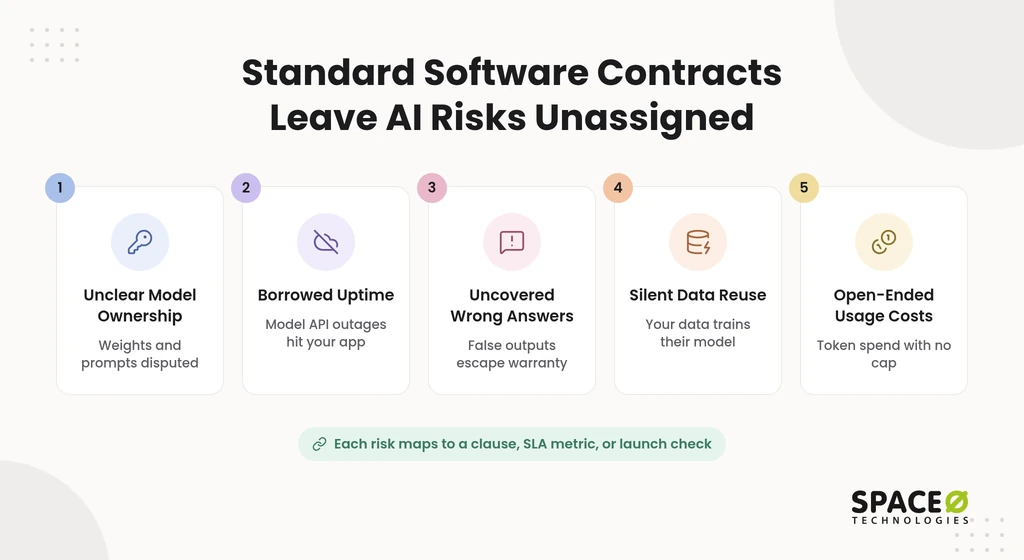
- Unclear model ownership: Fine-tuned weights and prompts become disputed property when the contract is silent.
- Borrowed uptime: Your app inherits every outage from the model API it calls.
- Uncovered wrong answers: A confident but false output sits outside most warranty language.
- Silent data reuse: Client data can end up training a provider’s model unless the contract forbids it.
- Open-ended usage costs: Token spend climbs with traffic when no cap is agreed.
Each of these risks maps to a clause, an SLA metric, or a launch check in the next section.
Three Checklist Parts That Cover Contract, SLA, and Launch
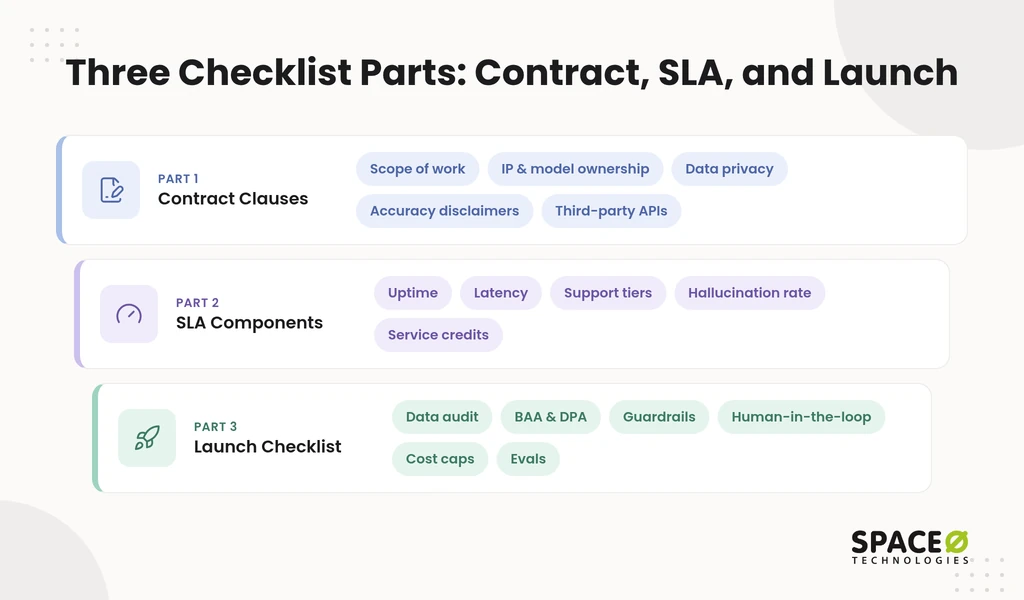
Space-O Technologies organizes AI agreements in three parts: contract clauses, SLA components, and a launch checklist. Keep this order when you draft. Each part depends on the one before it.
1. Key contract clauses for an AI build
The contract must name the build approach, the IP owner, the data rules, and every third-party dependency. Each clause below names the term to demand and the risk it covers.
- Scope of work: State whether the build uses retrieval-augmented generation (RAG), fine-tuning, or a custom network. Each approach carries different data needs, costs, and failure modes, so the scope must name one.
- IP and model ownership: State whether IP belongs to the developer, the client, or both jointly, split three ways.
- Client: Owns application code, project data, prompts, and generated outputs.
- Vendor: Keeps pre-existing tools and libraries and licenses them to the client for continued use.
- Model: Fine-tuned weights and checkpoints get a named owner, while base models stay under the provider’s license.
- Data privacy and training restrictions: Cover how you collect, process, store, and share data under the California Consumer Privacy Act (CCPA). Health data also falls under the Health Insurance Portability and Accountability Act (HIPAA). Add the General Data Protection Regulation (GDPR) where EU data is involved. Ban training on your data, and attach a Data Processing Agreement (DPA).
- Accuracy disclaimers: AI output is probabilistic, so vendors disclaim perfect accuracy. Accept that disclaimer only when the SLA sets a measured threshold and a remedy.
- Third-party API dependencies: List each external service, such as GPT-4 from OpenAI, Claude from Anthropic, AWS Bedrock, or Pinecone. Assign who pays usage fees and who carries the risk of a provider outage. Builds that use AI app development using OpenAI models should also name the model version in scope.
With ownership and data rules settled, the SLA turns performance into numbers you can enforce.
2. AI SLA components with measurable targets
An AI service level agreement (SLA) defines uptime, latency, support response, and hallucination targets, plus credits when the vendor misses them. The AWS guide to service level agreements explains that an SLA lists metrics such as uptime and response time. The SLA also sets the remedy when standards slip, such as service credits.
Treat the values below as negotiating starting points, not Space-O Technologies commitments. Latency targets depend on how your app serves real-time inference, so set them per use case.
| Metric | What to specify | How it is measured | Remedy |
|---|---|---|---|
| Uptime | Monthly availability target set in the SLA, excluding scheduled maintenance | Automated checks against the production endpoint, reported monthly | Service credit on the monthly fee |
| Latency | Time-to-first-token (TTFT) and full response time, such as under 2 seconds | Percentile timings from production logs | Service credit or an agreed fix plan |
| Support response | Response time for each severity tier | Ticket timestamps | Service credit or escalation |
| Hallucination rate | Maximum error rate on an agreed evaluation set | Scheduled evals on sampled outputs | Cure period, then credit or termination right |
| Usage and cost | Token caps and rate limits per billing period | Provider billing and gateway logs | Alert and client approval before overage |
- Support tiers: Tie the required response time to the severity of the issue.
- Critical: Production is down, or output is unsafe, with a response in under 1 hour.
- High: A core feature is degraded, with a response in under 4 hours.
- Low: A minor defect or question, with a response in under 24 hours.
- Credits and penalties: The vendor deducts service credits from the monthly fee when it misses a target. Repeated misses should give you the right to terminate.
Numbers on paper still need checks before real users arrive.
3. Launch checklist before go-live
Six checks belong in the contract as launch conditions, starting with the data audit. Write each one as a milestone that must pass before release.
- Data audit: Confirm that every data source is legally acquired, consented, and cleaned before model work begins.
- BAA and DPA: Any vendor handling protected health information (PHI) signs a Business Associate Agreement (BAA) under HIPAA. The BAA includes terms to return or destroy PHI when the contract ends. A DPA covers personal data from other sources.
- Guardrails: Require prompt-injection defense, personally identifiable information (PII) redaction, and output filters. Test each one against adversarial inputs before release.
- Human-in-the-loop (HITL): A qualified person approves outputs before they affect a high-stakes decision. Teams scoping agents with an AI agent development company should define where each approval sits.
- Cost monitoring and rate limiting: Set token caps, rate limits, and spend alerts for each billing period.
- Evals: Run regression evaluations on the agreed set before each release and each model change.
The weight you give each of these six items depends on your role and the type of app.
Match the checklist to your role and app type
The same checklist shifts weight depending on who signs and what you build. Use this chooser to set your negotiating priorities.
- Client-side buyer: Push hardest on IP transfer, the no-training clause, and service credits.
- Vendor or delivery team: Define exclusions for provider outages and cap liability for third-party failures.
- RAG chatbot: Weight document freshness, source citation, and hallucination evals. Teams buying AI chatbot development services should add escalation to a human agent.
- Classifier: Weight accuracy or F1 score on a labeled evaluation set.
- Voice agent: Weight TTFT latency and a clean handoff to a live person.
Hallucination threshold and change-control clauses
A hallucination threshold is only enforceable when the contract defines six elements. The structure below is illustrative, not a Space-O Technologies guarantee. Fill in each value with your vendor before signing, and set reviewer duties using an AI agent governance framework.
- Agreed evaluation dataset: A versioned set of representative questions with approved answers, owned by the client.
- Sampling method: The fixed evaluation set, plus a random sample of production outputs in each period.
- Measurement period: A monthly scoring cycle run by named reviewers.
- Threshold: A maximum hallucination rate, stated as a percentage.
- Cure period: A set number of days for the vendor to fix a missed threshold.
- Remedy: A service credit first, then a termination right after repeated misses.
Two change-control terms belong beside the threshold clause.
- Model or API deprecation: When a provider retires a model, the vendor migrates the app and re-runs evals before cutover.
- Pricing change: When a provider raises token prices, the contract states the pass-through and requires approval above a set level.
Once your priorities are clear, the next step is turning these terms into a delivery plan.
How Space-O Technologies Turns These Terms Into Delivery
We build contract terms into five delivery steps, so every clause has an owner and a check. Clauses only protect you when the delivery process can measure them.
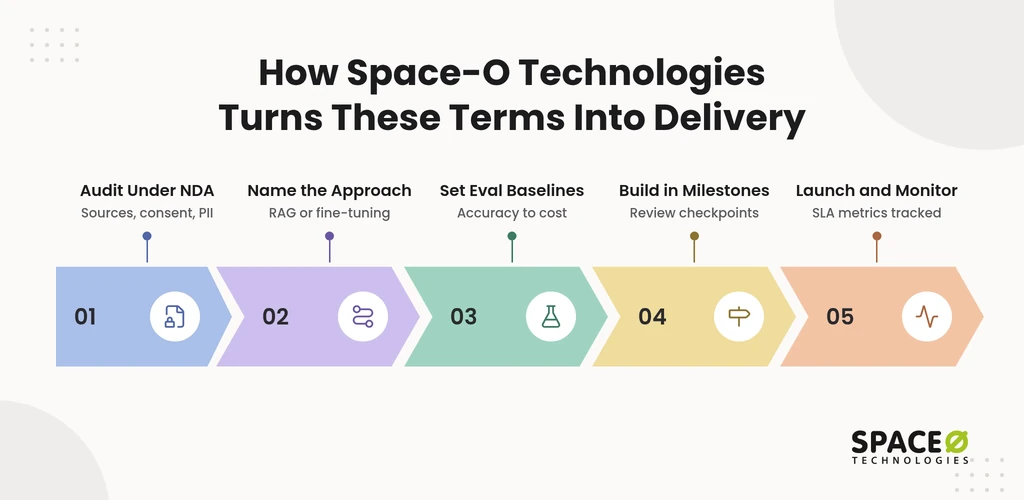
- Audit data under NDA. With a non-disclosure agreement (NDA) signed, we review data sources, consent, and PII before scoping. This is the first stage of data management for AI app development.
- Name the approach in scope. We recommend RAG, fine-tuning, or a custom model based on what solves the problem most cost-effectively.
- Set evaluation baselines. Every production model we ship runs inside an evaluation suite. The suite covers accuracy, hallucination rate, bias checks, latency, and cost.
- Build in milestones with review checkpoints. Payments follow deliverables, and each checkpoint applies the human-in-the-loop approval from the launch checklist.
- Launch and monitor continuously. Monitoring tracks the SLA metrics after go-live, and ownership transfers as the contract states.
This process gives you an SLA your team can measure from the first release.
Map Your SLA Metrics to a Real Build
Our AI engineers turn uptime and hallucination targets into an evaluation plan. You also get a scoped estimate and a support model to take into negotiation.

Delivery Record That Backs Our Contract Terms
Our contract terms rest on a delivery record you can check. Terms are only as strong as the team behind them. Our software development portfolio shows what that team has shipped.
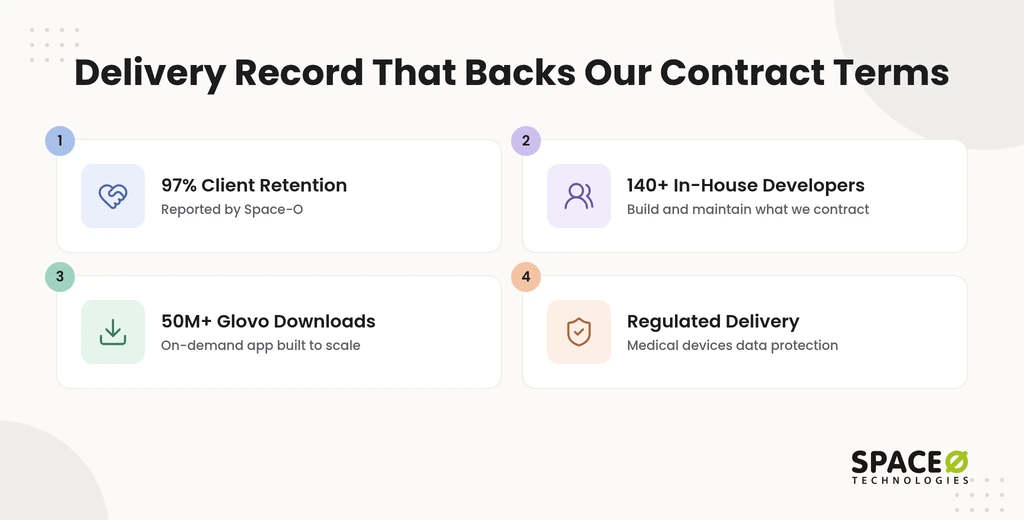
- Client retention: Space-O Technologies reports 97% client retention.
- In-house team: 140+ in-house developers build and maintain the systems we contract for.
- Scale under load: Glovo, an on-demand delivery app we built, passed 50M+ downloads.
- Regulated delivery: For a medical devices company, we delivered a system that significantly improved the client’s data protection and compliance processes.
This record shapes how we set commercial terms.
Contract Terms Backed by One Team From Build to Maintenance
Space-O Technologies ties commercial terms to the same team that builds and maintains your AI app. Founders, growing businesses, and enterprises each need terms that match how certain their budget is.
You choose from four engagement models: Dedicated Team, Time & Material, Fixed Cost, and Staff Augmentation. Payments are milestone-based and tied to deliverables. A basic MVP starts at $15,000. A feature-rich MVP can reach $50,000 or more, per our MVP development services page.
Your SLA should budget for the two AI cost lines most often left out of a build quote. Annual maintenance is a recurring cost on top of the original build, according to our AI development cost guide. Data collection and preparation is the other line to price before model work starts. Write both into the SLA support clause and the data audit milestone.
Regulated buyers need contract terms tied to audit trails and human checkpoints. We build healthcare and fintech software alongside custom software for many other industries. In these sectors, demand a BAA, an audit trail for every AI action, and human review of high-stakes decisions.
Templates give a starting draft, not delivery terms
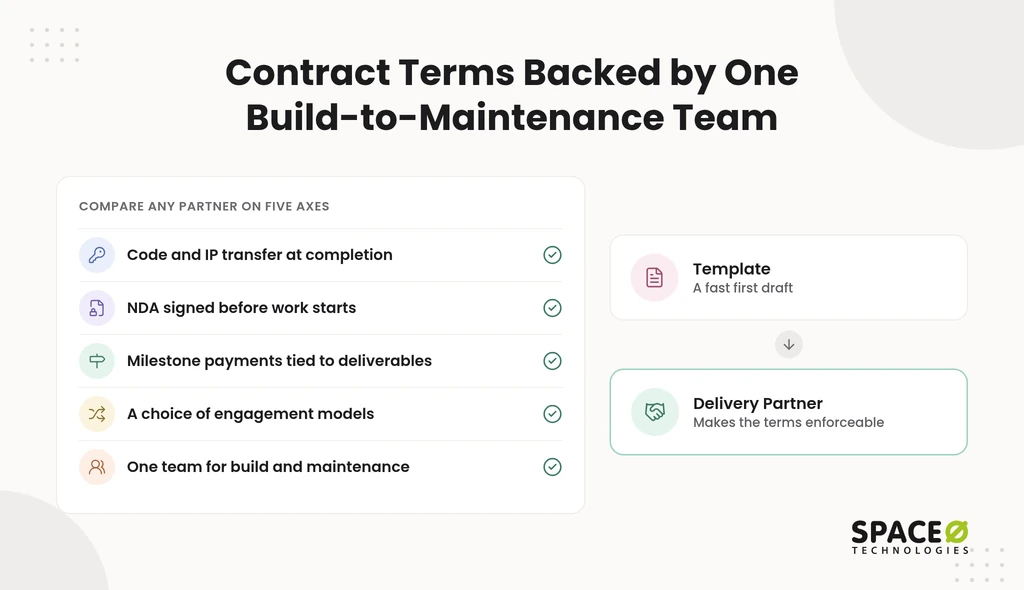
Contract templates and SLA generators give you a fast, free first draft. They show you the clause list and standard wording. They cannot tie those terms to how a specific team builds, tests, and maintains your app. When outsourcing AI development, compare any delivery partner on five axes:
- Code and IP transfer at completion.
- An NDA signed before work starts.
- Milestone payments tied to deliverables.
- A choice of engagement models.
- One team covering build and maintenance.
A template starts the draft, and a delivery partner makes it enforceable.
Get Measurable AI Contract Terms Before You Sign
Bring your draft contract, and we will map each clause to a build plan. Our AI team checks your scope, ownership terms, SLA targets, and launch checks against your use case. You leave with a scoped, expert-reviewed estimate and clear next steps. Talk to our AI team about your contract and SLA.
Frequently Asked Questions
Why do regulated buyers need human review and audit trails written into an AI contract?
Regulated launches need proof of oversight. Write human approval and the audit trail as release milestones that must pass before go-live. A missing checkpoint then blocks launch instead of surfacing in an audit.
What do I need in place before an AI vendor handles health data?
Run the data audit first to find which sources hold protected health information. Get the BAA signed before any PHI moves to the vendor. Send no health data to a vendor that refuses. Personal data that is not health data goes under the DPA instead.
What is a service level agreement (SLA) in an AI app contract?
An SLA is the part of the contract that sets measurable service targets and remedies. For AI apps, it covers uptime, latency, support response, and hallucination rate. It also states the service credits owed when the vendor misses a target.
What is a hallucination threshold?
It is the maximum error rate the vendor may reach on an agreed evaluation set. The contract also fixes the sampling method, measurement period, cure period, and remedy. Without those five items, the threshold cannot be enforced.
Which do I need, a BAA or a DPA?
Sign a BAA when a vendor handles protected health information. Use a DPA for other personal data, such as EU data under GDPR. Many AI apps need both.
Who owns the model in an AI app development contract?
The contract must name the owner. The client usually owns application code, project data, prompts, and generated outputs. Fine-tuned weights need a named owner, and base models stay under the provider’s license.
How do I claim service credits after a missed SLA target?
Report the miss in writing within the claim window the contract sets. The vendor checks it against monitoring data and applies the credit to the next invoice. Write these claim steps into the SLA before you sign.
Why should a model, provider, prompt, or data change trigger a re-test?
Any of these can change output quality without changing the code. Re-running the agreed evaluation set before cutover shows whether the hallucination threshold still holds. Make that re-test a contract condition.



 All our projects are secured by NDA




 4.8


