
 By
Contents
- Hire an AI engineer and software engineers first; add ML depth only when a custom model enters scope.
- Hire a data scientist or ML engineer only when you must train a model on proprietary data.
- An API-only build still needs upkeep: plan 15% to 25% of its build cost per year.
- Skipping a data scientist still leaves testing, security, data infrastructure, and maintenance on the budget.
Key Takeaways
No, you do not need a data scientist to build most AI apps. AI engineers and software developers build them using pre-trained large language models (LLMs) through APIs. Data scientists analyze data and train custom machine learning (ML) models.
Founders and CTOs often ask this while planning to build an AI app. AI sounds like data science, so a data scientist seems like the obvious first hire. The answer turns on one choice: use an existing model or train your own.
This guide maps each role, the cases that flip the answer, and the remaining costs. Our AI app development services follow the same logic for startups and enterprises. Each section opens with a short answer, so you can scan fast.
Data Scientist vs. AI Engineer: What Each Role Does
A data scientist studies data and trains custom models, while an AI engineer turns existing models into working products. Teams often stall here because the job titles overlap in job posts and vendor pitches. Sorting the roles by what each one produces makes the hiring decision clearer.
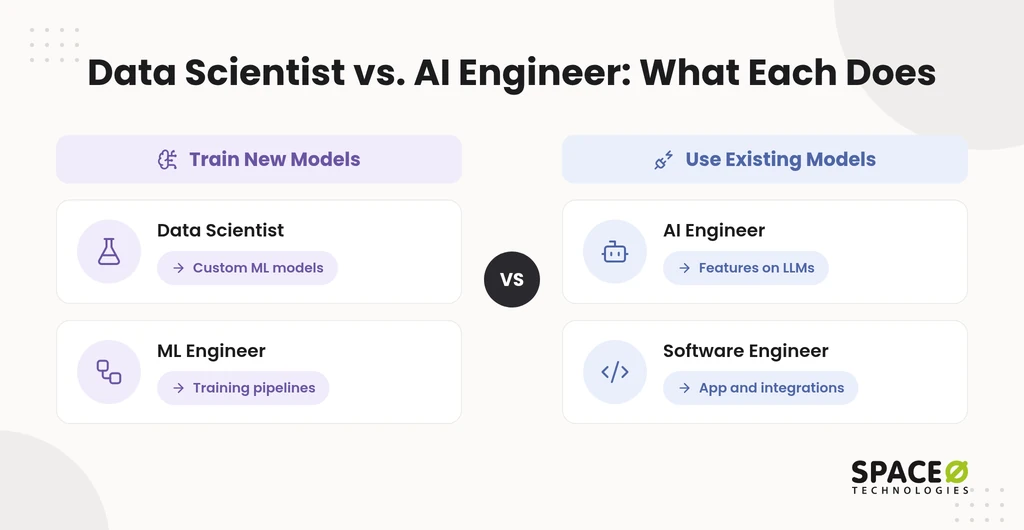
- Data scientist: Analyzes data, runs statistical experiments, and trains custom machine learning models.
- ML engineer: Builds the pipelines that train, deploy, and retrain custom models in production.
- AI engineer or AI developer: Connects pre-trained models, LLMs, and APIs, then shapes them into product features.
- Software engineer: Builds the interface, backend, integrations, and deployment around the AI feature.
The same split holds when you compare staffing options side by side.
| Aspects | Data scientist | In-house AI engineer | Development partner |
|---|---|---|---|
| What they build | Custom ML models, statistical analyses, and experiments | AI features on pre-trained models and LLMs inside your product | The full app, from discovery through AI features, software, testing, and maintenance |
| When you need them | A custom model trained on proprietary data | A long-term AI roadmap your company wants to own internally | A first AI product or feature without an in-house AI team |
| How engagement works | Full-time hire on your payroll | Full-time hire on your payroll | Scoped project or team engagement |
The staffing choice also shifts the budget. Space-O Technologies’ AI development cost guide puts an in-house AI team at $500,000 or more yearly. That figure includes salaries and infrastructure. A specialized AI agency usually charges $30,000 to $150,000 per project.
If your roadmap uses existing models rather than creating new ones, the data scientist column stays empty. The next section shows which products fall into that group.
When You Don’t Need a Data Scientist
You don’t need a data scientist when your app uses pre-trained models through an API. Most business AI features belong here. The model already exists, and the remaining work is product engineering.
- Chat and support assistants: An AI engineer connects an LLM from OpenAI, Anthropic, or Google Gemini to your product.
- Answers from your own documents: Retrieval-augmented generation (RAG) feeds your files to the model at query time without retraining it.
- Summaries and content tools: A pre-trained model drafts, condenses, or rewrites text using prompts and guardrails.
- Open-source models: Pre-trained models from Hugging Face run inside your stack through engineering work, not model training.
Our guide to RAG-based AI application development explains how the retrieval layer is built.
When an off-the-shelf model stops being enough, our comparison of prebuilt vs custom AI model options covers the trade-offs.
None of these products needs a model trained on your own data. Once that requirement appears, the answer changes.
When You Do Need a Data Scientist or ML Engineer
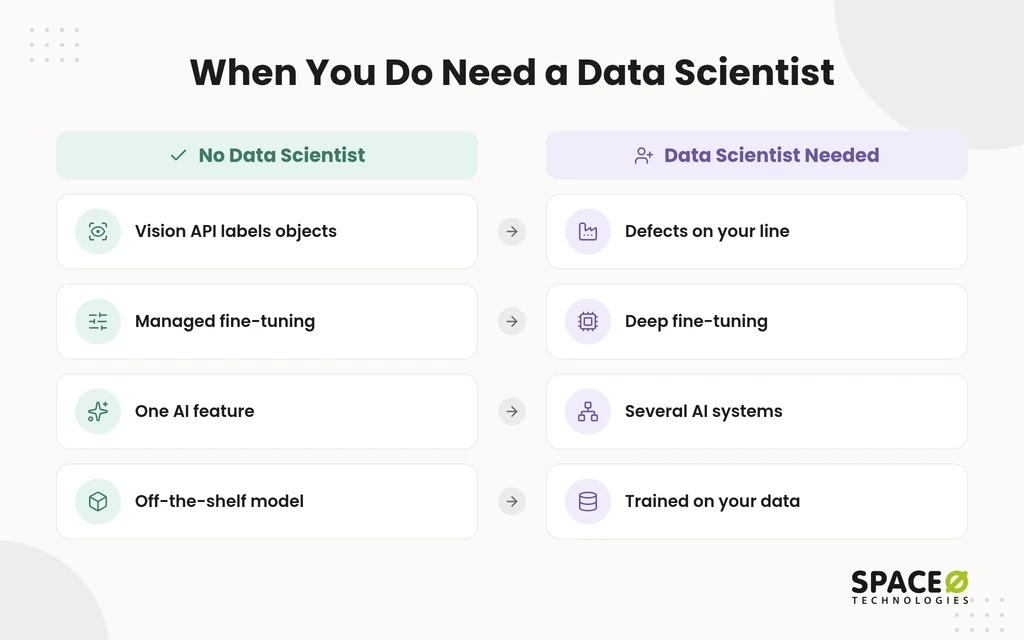
The answer flips to “yes” the moment a model must learn from data no pre-trained model has seen. The four cases below show where that line falls in practice.
Custom models trained on proprietary data
A data scientist earns a place on the team when the model must learn patterns that only your data contains. An API model cannot learn your customers’ behavior or your transaction history out of the box. These products need that custom training.
- Custom recommendation engine: Ranks products or content using your own user behavior data.
- Fraud detection: Flags unusual transactions using patterns in your historical records.
- Demand forecasting: Predicts volume from your sales, seasonality, and operational data.
- Data pipelines and validation: Cleans training data and checks model results with statistical tests.
Where computer vision crosses the line
Off-the-shelf image recognition through an API needs no data scientist, but custom-trained computer vision does. A vision API can read text or label common objects from the first day. Detecting a defect specific to your production line is different, because the model must train on your labeled images. That training work belongs to a data scientist or ML engineer.
When fine-tuning needs a specialist
Managed fine-tuning through a cloud API is often engineering work, while deep fine-tuning needs a specialist. Providers now automate many fine-tuning workflows behind their APIs. Fine-tuning in PyTorch with your own training data and evaluation still calls for an ML engineer or data scientist. Our guide to custom LLM development explains how teams choose between the two paths.
Cost follows the same order. Space-O Technologies’ AI development cost guide shows that pre-trained APIs and RAG cost the least. Fine-tuning adds dataset and compute costs, and custom models cost the most.
When several AI systems run in parallel
A dedicated data scientist can become worthwhile once several AI systems run in parallel and need ongoing tuning. At that scale, comparing models, watching for drift, and planning retraining become a standing workload. Below that point, the work usually fits inside an engineering team or a partner engagement.
Each of these four cases comes down to custom training or ongoing tuning. That makes a quick pre-hire test possible.
Three Questions That Decide Whether You Need a Data Scientist
Three questions settle the data scientist decision for most AI apps. Answer them before you write a job post or sign a contract.
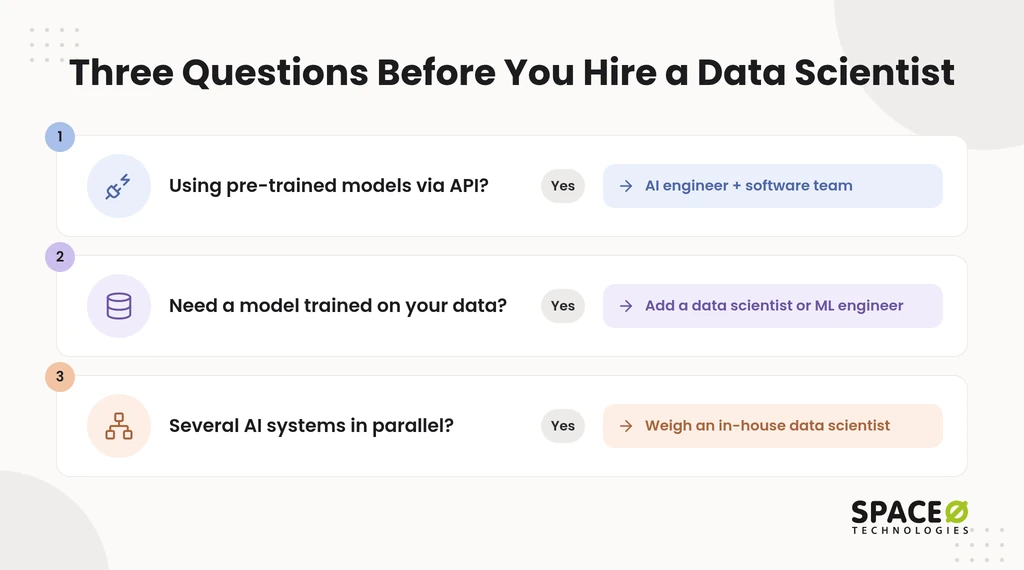
- Do you use pre-trained models through an API? If yes, start with an AI engineer and a software team.
- Do you need a model trained on proprietary data? If yes, add a data scientist or ML engineer for that model.
- Will several AI systems run in parallel? If yes, weigh a dedicated in-house data scientist.
A “yes” to question 2 or 3 changes the staffing plan. These answers settle who you hire, but they do not settle the budget.
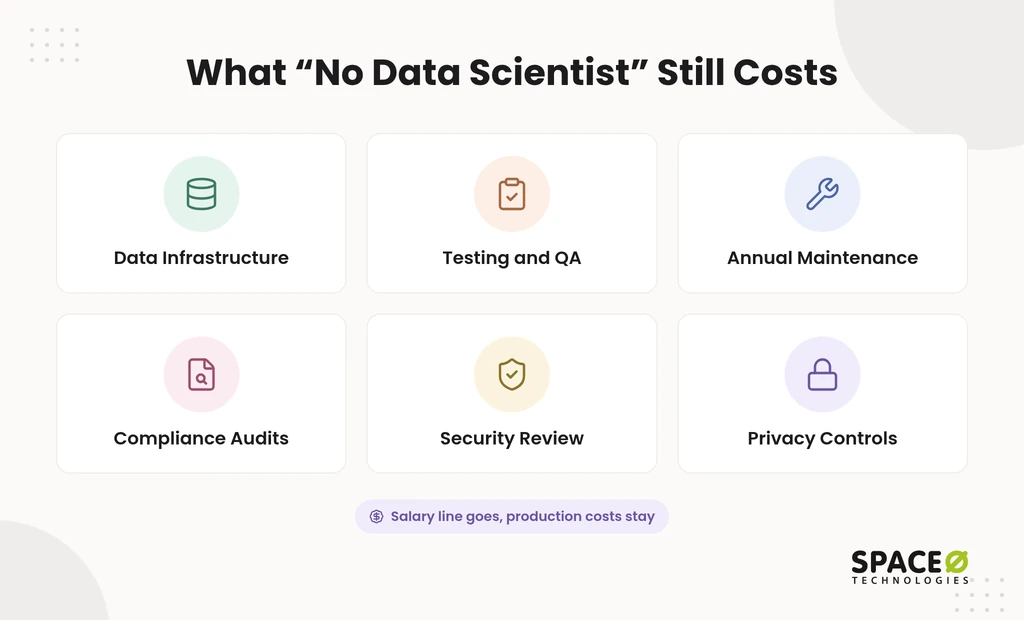
What “No Data Scientist” Still Costs
Dropping the data scientist hire cuts a salary line, not the production work that keeps AI safe. Many teams trim their budget after hearing “no hire,” then raise it again once real users reach the pilot. Data work, integrations, and production engineering still need budget.
Testing, security, and privacy still need people
Even without a data scientist, someone must test, secure, and review what the AI produces. Engineers, testers, and your business owners share this work.
- Evaluation: A test suite measures accuracy, hallucination rate, bias, latency, and cost before and after release.
- Human review: Low-confidence outputs route to a person; no data scientist required.
- Security: Engineers review how API keys, prompts, and responses move through your systems.
- Privacy: Your team decides what user data reaches a model provider and what stays inside your environment.
Space-O Technologies wraps every production model in this kind of evaluation suite, with continuous monitoring. Our guide to AI development cost breaks these lines down by project type.
Cost lines that stay on the budget
Data infrastructure, testing, maintenance, and audits stay on budget whether or not you hire a data scientist. The ranges below come from Space-O Technologies’ AI development cost guide. The same guide gives timelines. Simple AI solutions take 2 to 3 months. Mid-level applications take 4 to 8 months, and enterprise systems take 6 to 12 months. Rows marked “custom models only” are the costs that a data scientist’s work adds.
| Cost line | Planning range | Applies to |
|---|---|---|
| Data infrastructure | $500-$5,000 per month | Every production AI app |
| Testing, quality assurance (QA), and compliance | 10%-15% of the build budget, or $10,000-$50,000 | Every production AI app |
| Annual maintenance | 15%-25% of the original build cost per year | Every production AI app |
| Audits | $10,000-$40,000 per year, depending on scope | Apps in regulated sectors such as healthcare, finance, and legal |
| Retraining cycles | $15,000-$60,000 per year | Custom models only |
| Custom recommendation engine build | $50,000-$150,000 | Custom models only |
Building on pre-trained models keeps the first build lean. The same guide notes that pre-trained models can save $100,000 or more on initial development. An AI MVP can keep initial spend as low as $20,000. A basic MVP starts from $15,000, and a feature-rich MVP can reach $50,000 or more. Payments follow milestones tied to deliverables, as in our MVP development services.
Space-O Technologies built these planning ranges from its AI delivery work, including the eComChat and GPT Vix platforms.
Price Your AI App Before You Hire
Tell us your use case and where your data lives. Our experts send a free estimate covering build, data work, testing, hosting, and staffing.

Set these cost lines first, and the staffing choice gets easier to make.
Who to Hire Instead of a Data Scientist
For most AI apps, hire AI and software engineers; add ML depth only when a custom model enters scope. The right mix depends on where your product sits today. Match your situation to one of these staffing patterns.
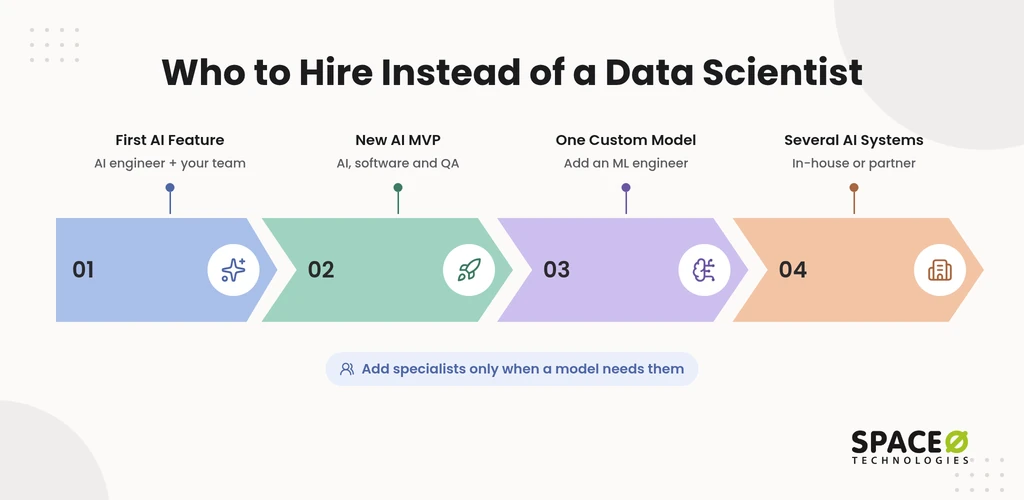
- First AI feature in an existing product: Pair one AI engineer with your current software team.
- New AI MVP: Staff an AI engineer, software engineers, and QA against a fixed scope.
- Product with one custom model: Add an ML engineer or data scientist for that model’s training and retraining.
- Several AI systems in production: Weigh a dedicated in-house hire against a long-term partner team.
Start small and add specialists when a specific model needs them, not before. If you are unsure which pattern fits, contact us for a scoped staffing plan.
How Space-O Technologies Staffs an AI App Build
Space-O Technologies settles the API-or-custom-model question first, then staffs your build to match it. Your team gets engineers matched to the model decision instead of a generic AI team. The track record behind that approach is below.
- History: Since 2010, our engineers have delivered AI-powered custom software.
- Scale: 140+ in-house developers, 300+ software solutions shipped, and 1,200+ clients served.
- Retention: We report 97% client retention.
- Shipped products: We built Glovo, an on-demand delivery app now past 30 million downloads, with $1.2 billion in funding secured.
- Protection: Your use case and data stay confidential under an NDA signed before work starts.
- Ownership: At completion, you keep full rights to the source code, data, and intellectual property (IP).
- Flexibility: Pick Staff Augmentation, Fixed Cost, Time & Material, or a Dedicated Team to fit your AI scope.
Staff Augmentation fits teams that only need an AI engineer added to their sprints. A Dedicated Team, Time & Material, or Fixed Cost engagement fits a scoped AI MVP.
Frequently Asked Questions
Are data science and machine learning related?
Yes, but the two roles split at production. Data science covers analysis and model training; ML engineering takes a trained model live and keeps it current through retraining. Apps that only call pre-trained models need neither role at launch. One custom model usually needs one specialist, not a data team.
Can you use AI without a data center?
Yes. Calling a pre-trained model through a provider’s API leaves the hardware to that provider. Data infrastructure still lands on your budget (planning ranges above). GPU workloads, low-latency responses, or hybrid and on-premises hosting push up build and monthly costs.
Can an AI engineer build an AI app without a data scientist?
Yes. An AI engineer connects pre-trained models and LLMs through APIs. A software engineer builds the interface, backend, and integrations around them.
When do I need a data scientist for an AI app?
You need one when a model must learn from your own data. Custom recommendation engines, fraud detection, demand forecasting, and custom computer vision are typical cases.
What is the difference between a data scientist and an ML engineer?
A data scientist analyzes data and trains custom models. An ML engineer builds the pipelines that deploy, monitor, and retrain those models in production.
Do I need a data scientist for fine-tuning?
Not always. Managed fine-tuning through a cloud API is often engineering work. Deep fine-tuning with your own training data and evaluation needs an ML engineer or data scientist.
Do I need a data scientist for a RAG app?
No. Retrieval-augmented generation (RAG) feeds your documents to a pre-trained model at query time. That is engineering work, not model training.
What costs remain if I skip a data scientist?
Skipping the hire removes a salary, not the other costs. Testing, security, data infrastructure, and maintenance still need budget. The cost table above lists planning ranges.



 All our projects are secured by NDA




 4.8


