
 By
Contents
- Audit logs prove what an agent did, while observability explains why it acted.
- Record the trace ID, agent and model version, user, tool call, and policy decision for every action.
- Mask personal data, strip secrets, and chain records by hash so tampering shows up.
- Build audit logging into the agent and export it to a platform, rather than choosing only one.
Key Takeaways
AI agent audit logs and observability show what an agent did and why. An agent just changed a customer record, and someone asks who allowed it. Container logs cannot answer that question.
Standard application and Kubernetes logs stop at server requests and container scheduling. They miss the decisions, tool calls, and policy checks auditors need. Agent logs capture all three at the application layer.
Space-O Technologies has built AI-powered custom software since 2010. This guide covers what to record, how to mask data, and how to build it. Use it to design logging your auditors will accept.
What are AI agent audit logs and observability?
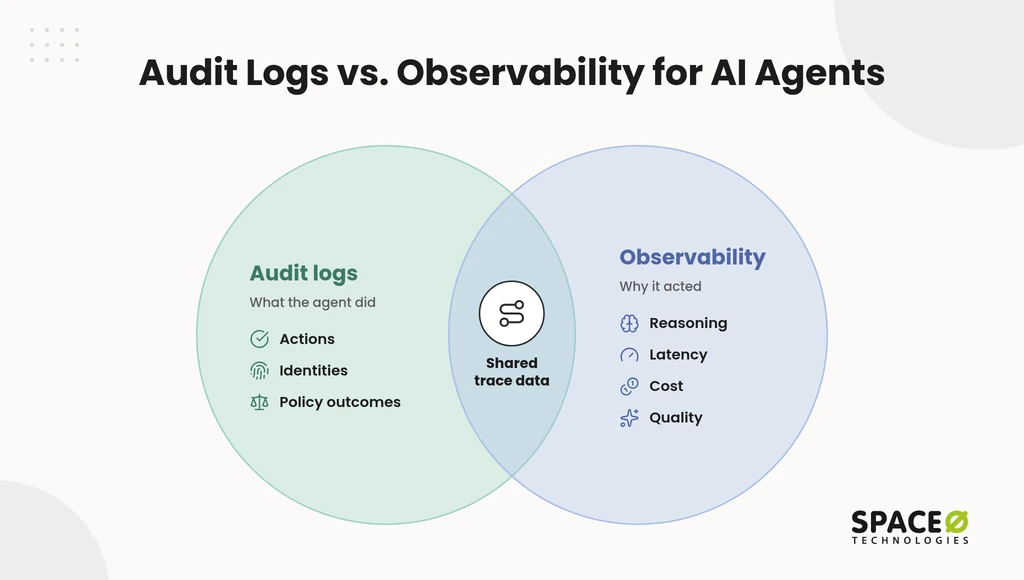
Audit logs prove what an agent did, while observability explains why it did it. Most teams need both once an agent touches customer data or business systems. Adoption is wide: McKinsey’s State of AI survey found that 88% of organizations use AI in at least one business function.
Your problem is simple to state. An agent approved a refund, updated a record, or sent an email. Someone now asks who authorized it. A container log cannot answer that.
- Audit logs: An evidence trail of actions, identities, and policy outcomes, kept for accountability and compliance review.
- Observability: Live insight into agent reasoning, latency, cost, and quality, used for debugging and tuning.
- The shared foundation: Both draw on the same trace data, so one well-designed pipeline serves both purposes.
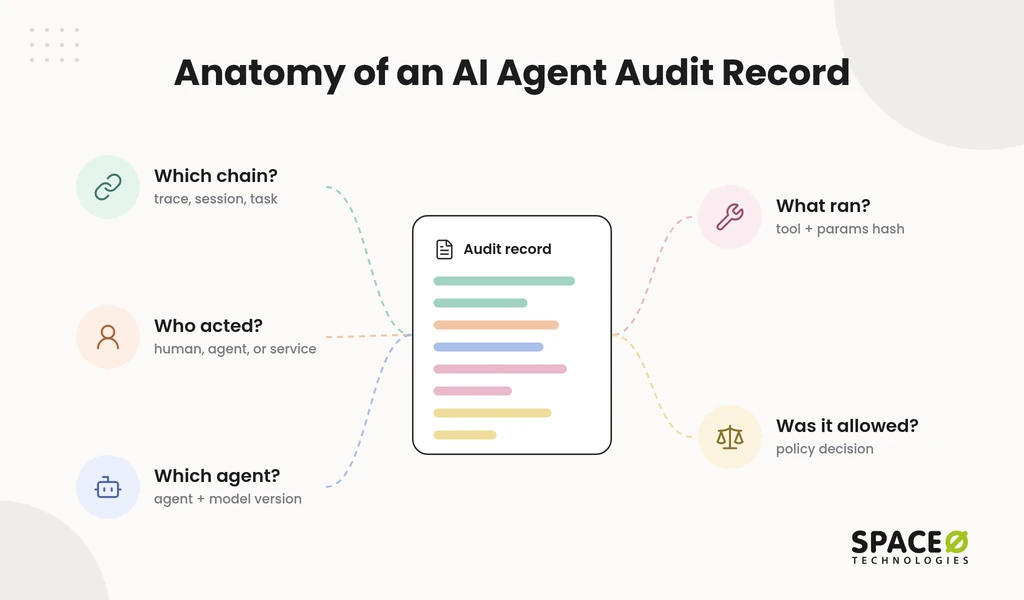
A production audit record ties each action to a trace or session ID. It also names the agent, model version, and authenticated user. It adds the tool used, a hash of its parameters, and the policy decision.
Core components of AI agent telemetry
Agent telemetry has four core components: execution traces, identity tracking, tool-call logs, and policy decisions. Missing any one leaves a gap an auditor or incident responder will find. These four sit inside a broader AI agent architecture.
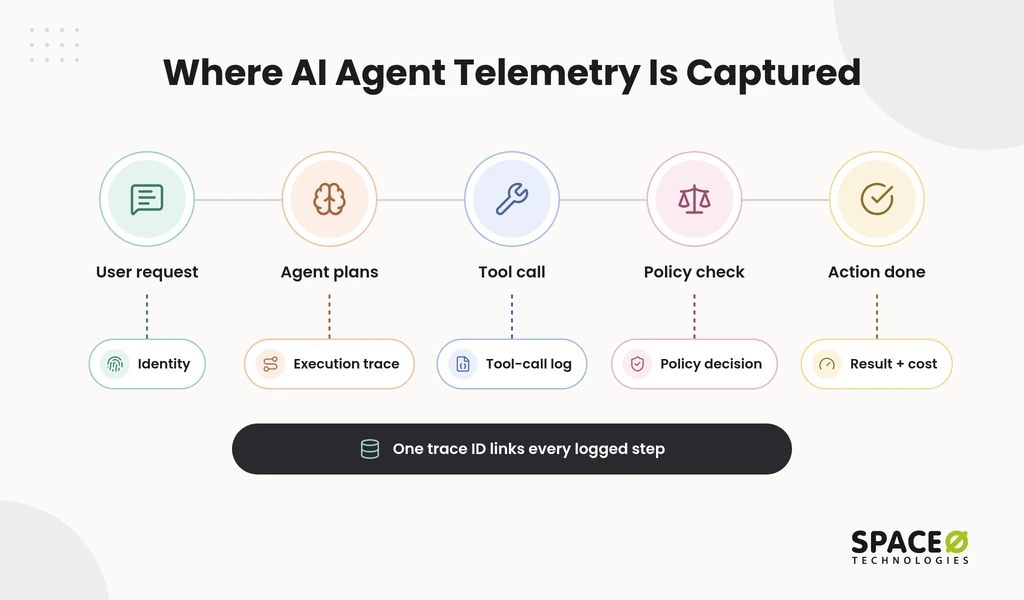
- Execution traces (“Black Box Recorder”): The full path from prompt to final answer, including plans, retrieved context, branching, and intermediate reasoning steps.
- Triple-identity tracking: Every action records three identities: the user, the agent identity and version, and the tool. This replaces the shared human admin credential many early agents run under.
- Tool-call and action logs: Each tool call, its parameters (often hashed), API (application programming interface) requests, database queries, and responses.
- Policy and guardrail decisions: Whether each check passed, failed, or required human approval before the agent continued.
Retrieved context deserves special care. On a manufacturer’s field-service assistant, we chose retrieval-augmented generation (RAG) over fine-tuning first. That way, every answer is traced to a specific document version, which is exactly what a trace should capture.
What to include in an audit field matrix
A usable audit field matrix links every agent action to a trace, an identity, a tool, and a policy outcome. Without fixed field names, logs from different agents cannot be searched or correlated. Cost fields also help you catch AI software development budget overruns early.
| Field | What it records | Why it matters |
|---|---|---|
| trace_id / session_id / task_id | The trace, conversation, and task the action belongs to | Rebuilds the full multi-step chain behind one outcome |
| agent_id + model version | Which agent and which model version acted | Ties behavior changes to a specific release |
| actor_type + authenticated user | Whether a human, agent, or service started the action, and who | Answers “who authorized this?” |
| tool_name + tool_params_hash | The tool called and a hash of its inputs | Proves what ran without storing sensitive payloads |
| policy_decision | Allowed, blocked, escalated, or human-approved | Links each action to your governance rules |
| Latency, tokens, status codes | Speed, cost, and success of each step | Supports cost control and performance debugging |
What does a complete AI agent audit record look like?
A complete audit record holds every matrix field in one entry, plus a link to the record before it. The structure below is an illustrative template, not a record from a live system.
{
  "trace_id": "<trace identifier>",
  "session_id": "<session identifier>",
  "task_id": "<task identifier>",
  "agent_id": "<agent name>",
  "model_version": "<model and version>",
  "actor_type": "human | agent | service",
  "user_ref": "<authenticated user reference, masked>",
  "tool_name": "<tool called>",
  "tool_params_hash": "<hash of tool inputs>",
  "policy_decision": "allowed | blocked | escalated | human-approved",
  "latency_ms": "<value>",
  "tokens": "<value>",
  "status_code": "<value>",
  "prev_record_hash": "<hash of previous record>"
}
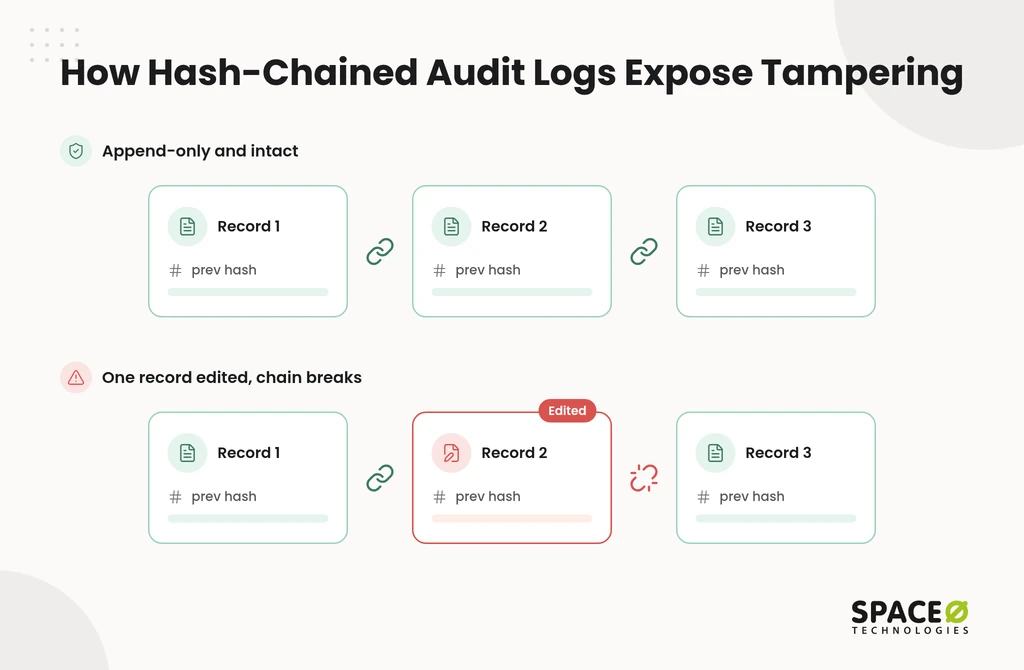
Records go to append-only, write-once storage. Each record carries the hash of the previous record. Any edit to an earlier record then breaks the chain, so tampering shows up on verification.
Privacy and governance best practices
Audit logs must protect sensitive data before it is ever written to storage. A log that stores raw prompts can become your largest privacy liability.
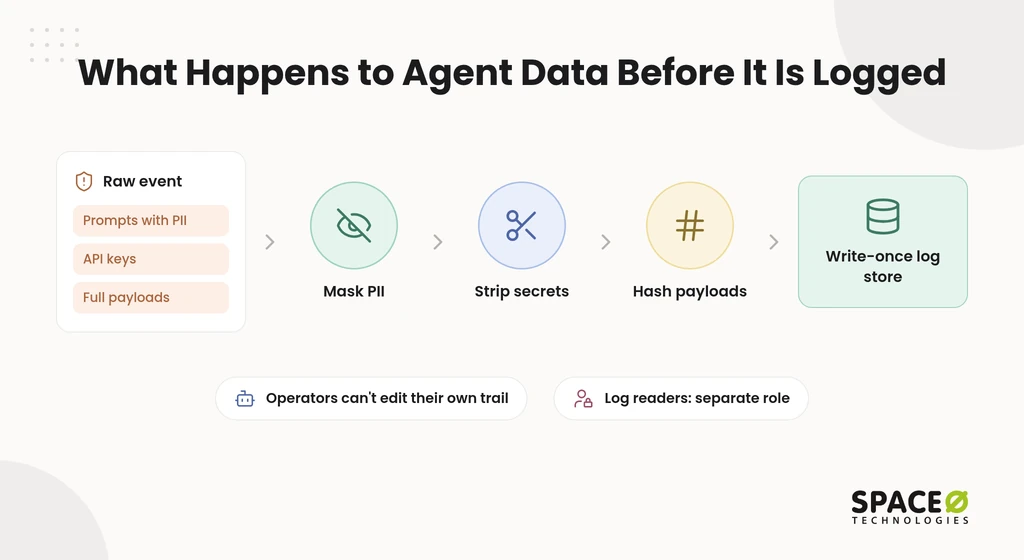
- PII masking: Redact or mask personally identifiable information (PII) in prompts, responses, and tool inputs before persisting them.
- Secret stripping: Remove API keys, tokens, and credentials from tool parameters and error messages.
- Payload hashing: Hash sensitive payloads so you can verify what ran without keeping the content.
- Access separation: Give log readers a different role from agent operators, so no one edits their own trail.
How do AI agent audit logs support compliance?
Agent audit logs supply the evidence that AI governance frameworks and audits ask for. Your compliance team cannot attest to controls it cannot see.
- NIST AI RMF: The National Institute of Standards and Technology framework expects traceable risk management. Logs make that demonstrable.
- Control audits: Audits that test controls over time mean agent actions need durable records.
- HIPAA: Agents handling health data under the Health Insurance Portability and Accountability Act must keep protected data out of logs.
- ISO/IEC 42001: This AI management system standard benefits from documented, reviewable agent behavior.
- EU AI Act (Article 12): Article 12 sets record-keeping duties for high-risk AI systems, relevant when agents serve European Union users.
How do you detect silent failures in AI agents?
Silent failures are wrong answers that look healthy on infrastructure dashboards. Flat CPU and latency graphs say nothing about whether the agent gave a correct answer.
- LLM-as-a-judge evaluators: A second large language model (LLM) scores outputs for faithfulness, relevance, and policy fit.
- Behavioral monitors: Alerts on unusual patterns, such as repeated tool retries or sudden spikes in blocked actions.
- Grounding checks: Comparisons of answers against the sources the agent actually retrieved.
Measured evaluation turns these signals into decisions. On GPT Vix, our AI recruitment software, RAG grounding cut the unsupported-answer rate from 22% to 4%. Human graders scored a 500-prompt held-out set, with faithfulness measured via the RAGAS framework.
Tooling and standards for agent observability
OpenTelemetry is the common standard for exporting agent traces, and OpenLLMetry extends it to LLM calls. Standards let you change observability vendors without re-instrumenting every agent.
- OpenTelemetry: A vendor-neutral standard for traces, metrics, and logs across your stack.
- OpenLLMetry: OpenTelemetry-based instrumentation for prompts, completions, and token usage.
- Specialized platforms: Tools such as Arize AI need agent instrumentation and retention settings. You also map their schema to your policy engine.
- Agent frameworks: LangGraph, CrewAI, and AutoGen each structure agent steps differently, which shapes how you group spans into traces.
Build vs. buy: designing auditable agents with a development partner
Most production teams combine both approaches: they build audit logging into the agent and export it to a platform. The real decision is who designs the schema around your workflows. It mirrors the wider choice between custom AI development vs off-the-shelf tools.
| Axis | Off-the-shelf observability platform | Audit logging built into your agent |
|---|---|---|
| Custom workflow fit | Generic trace views; custom fields need configuration | Fields match your approval chains and policies |
| Integration with CRM, ERP, and ServiceNow | Depends on available connectors | Logged directly where your agent calls these systems |
| Human-review checkpoints | Usually observed after the fact | Enforced and recorded inside the workflow |
| Code and IP ownership | Platform holds the tooling | You own the logging code and schema |
| Time to first dashboard | Fast once instrumented | Needs design work up front |
Space-O Technologies has built AI-powered custom software since 2010 for 1,200+ clients, with 140+ in-house developers. Our AI agent development company team builds PII masking, hallucination testing, and human review for high-stakes decisions into every agent. We sign an NDA before every project. All source code, data, and IP transfer to you at completion.
We hold ISO 27001 and ISO 9001 certifications and build HIPAA-ready agents. Your agent data and logs can stay in the US, the EU, or India.
Regulated teams in healthcare, fintech, lending, and insurance gain the most from this approach. Their logs must capture human approvals and keep sensitive data masked. We wire logging into existing systems through API integration services. Our maintenance team then keeps schemas current as agents change.
You can engage us through Dedicated Team, Time & Material, Fixed Cost, or Staff Augmentation. Teams with in-house engineers can also hire AI agent developers to add audit design to an existing build.
Make Your Agent Logs Ready For Audits
Our engineers design trace, identity, and policy logging around your workflows. Share your agent plans and get a scoped build approach.

Frequently Asked Questions
What challenges do teams face when implementing AI agent observability?
Teams struggle most with keeping sensitive data out of logs and with inconsistent schemas across frameworks. Raw prompts can become the largest privacy liability. LangGraph, CrewAI, and AutoGen group spans differently, so design field schemas up front. Platforms also need instrumentation, retention settings, and schema mapping to your policy engine.
Can audit logs for a human-approved agent decision still fail an audit?
Yes, a human-approved decision still fails an audit if the log does not record the approval. The policy_decision field should hold allowed, blocked, escalated, or human-approved. Recording human-approved links the checkpoint to your governance rules. It also shows who authorized the action.
What is the difference between AI agent audit logs and observability?
Audit logs prove what an agent did, while observability explains why it did it. Audit logs hold actions, identities, and policy outcomes for compliance review. Observability covers reasoning, latency, cost, and quality for debugging. Both draw on the same trace data.
What should an AI agent audit log record?
An audit log should record the trace ID, agent and model version, user, tool call, and policy decision. Store a hash of the tool parameters instead of raw payloads. Latency, tokens, and status codes support cost control and debugging. Chain each record to the previous one by hash.
How do you keep sensitive data out of AI agent logs?
Mask personally identifiable information and strip secrets before anything is written to storage. Redact personal data in prompts, responses, and tool inputs. Remove API keys and tokens from parameters and error messages. Hash sensitive payloads so you can verify what ran without keeping the content.
Which standards do AI agent audit logs support?
Agent audit logs support the NIST AI RMF, ISO/IEC 42001, HIPAA duties, and EU AI Act Article 12. Article 12 sets record-keeping duties for high-risk AI systems. HIPAA requires protected health data to stay out of logs. Control audits expect durable records of agent actions.



 All our projects are secured by NDA




 4.8


