
 By

Contents
- Most enterprise artificial intelligence (AI) agent pilots fail because of the system around the model, not the model.
- Five gaps cause most failures: integration, workflow context, cost, governance, and organizational ownership.
- Clear one pass/fail gate per root cause before you approve scale.
- Plan annual maintenance at 15% to 25% of the original build cost.
- Production-first builds test on live systems and name an owner from the start.
Key Takeaways
Your AI agent pilot passed the demo, but scaling it keeps stalling. Gartner predicts over 40% of agentic AI projects will be canceled by the end of 2027. This guide explains why enterprise AI agent pilots fail and how to fix each cause.
The model usually works in testing. The failures sit in the data, workflows, costs, controls, and ownership around it. Each of the five causes below maps to one pass/fail gate.
Space-O Technologies has built AI-powered software since 2010. We have served 1,200+ clients and report 97% client retention. Read on to see the causes, the gates, and a pilot-only versus production-first comparison.
Root causes of enterprise AI agent pilot failures
Five gaps explain most failures: data and integration, workflow context, cost, governance, and organization.
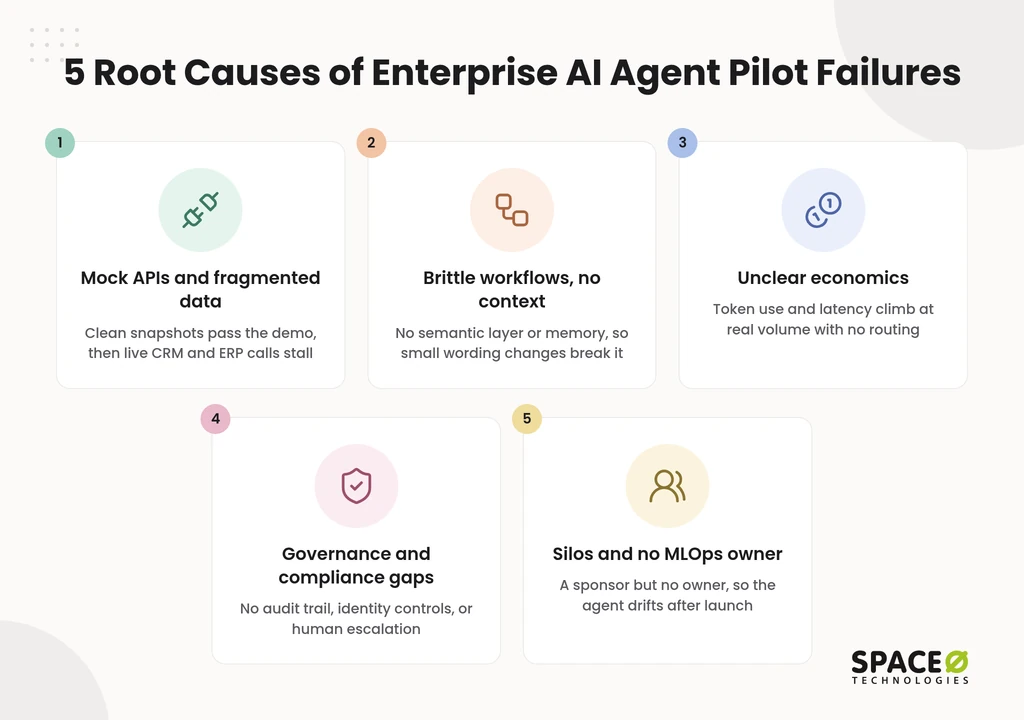
In most cases, the model is not the problem. The system around the model is. The causes below follow the order in which pilots tend to hit them.
1. Mock APIs and fragmented data
Pilots fail at integration because they run on clean snapshots and mock application programming interfaces (APIs), not live systems.
In production, the agent must work inside customer relationship management (CRM) platforms and legacy enterprise resource planning (ERP) systems. It must also work with third-party tools at the same time. Each brings rate limits, authentication hurdles, and uncleaned data. A workflow that passed on a static export can stall on its first real API call.
Our API integration services connect agents to live CRMs and ERPs before scale. See our guide to LLM integration project cost before you scope the work.
2. Brittle workflows and no contextual learning
Agents turn brittle when they lack a governed semantic layer and persistent memory.
Without shared business definitions, the agent guesses what each field means in each system. Without memory, it cannot learn from past sessions or corrections. On raw database schemas, accuracy often drops sharply. Small changes in wording or data then break the workflow.
Grounding closes much of this gap. On GPT Vix, we added retrieval-augmented generation (RAG) over the product knowledge base. Human graders scored answers against source documents, and the RAGAS framework measured faithfulness.
3. Unclear economics and escalating costs
Pilots hide their true cost until real volume makes token consumption and latency climb.
Many pilots send every task to one large model. A simple lookup then costs as much as complex reasoning. Without routing to smaller specialized models, cost per task rarely falls as usage grows. Leaders are left without a business case they can defend. Gartner lists escalating costs and unclear business value among the reasons projects get canceled. McKinsey’s State of AI survey found 88% of organizations use AI in a function, yet only about one-third have scaled it. Our guide to AI software development budget overruns shows how token use and agent loops replace fixed costs.
4. Governance, security, and compliance gaps
Agents stall at compliance review when audit trails, identity controls, and human escalation are missing.
Every agent action needs an audit trail. Identity controls must limit what the agent can read and change. Multi-agent setups need safety checks between agents. Financially material decisions need human-in-the-loop escalation before any outcome reaches a customer.
A safe pattern caps the model at drafting and evidence retrieval. A named human approves every high-value decision before it reaches a customer.
5. Organizational silos and missing MLOps ownership
Many pilots have a sponsor but no owner, so the agent degrades after launch.
Silos between IT, data, and business teams slow every decision. When change management is skipped, users work around the agent. Without machine learning operations (MLOps) ownership, nobody handles maintenance, versioning, or monitoring. Drift goes unnoticed until results slip.
Our software maintenance services give a live agent a named team for monitoring, versioning, and updates.
How do you move an AI agent pilot into production?
Clear one pass/fail gate for each root cause before you approve scale.
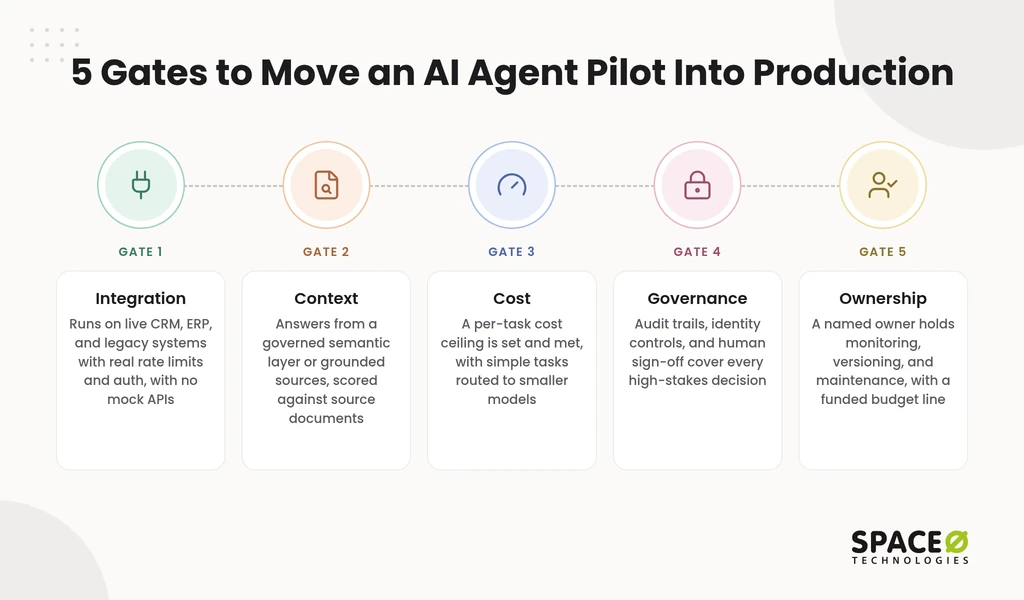
Your team should not ask whether the demo worked. Ask whether the agent passed every gate below. If any gate fails, the pilot stays a pilot.
- Integration gate. Pass when the agent runs against live CRM, ERP, and legacy systems. Test with real rate limits and authentication. Fail if any test relied on mock APIs.
- Context gate. Pass when the agent answers from a governed semantic layer or grounded sources. An evaluation set must score its accuracy against source documents.
- Cost gate. Pass when a per-task cost ceiling is set and met. Route simple tasks to smaller specialized models. Budget for upkeep too: our AI development cost guide puts annual maintenance at 15% to 25% of build cost.
- Governance gate. Pass when audit trails, identity controls, and human-review sign-off cover every high-stakes decision type.
- Ownership gate. Pass when a named owner holds monitoring, versioning, and maintenance, with a funded budget line.
Our AI consulting services run this gate review before any build starts. Gaps then surface while they are still cheap to fix.
Need Help Clearing These Five Gates?
Our AI consulting team reviews your pilot against each gate before you scale. Share your stack, and we will flag gaps while they are cheap to fix.

Pilot-only build vs. production-first build
A pilot-only build proves the model works. A production-first build proves the business can run it.
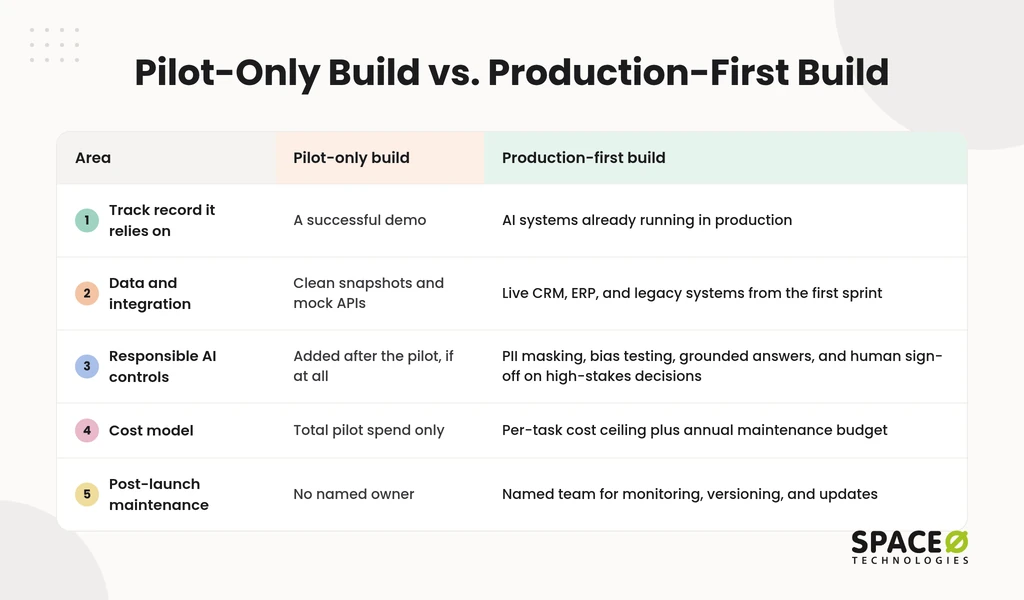
The difference shows up in what each approach tests, funds, and assigns. Use the table to check which approach your current pilot follows.
| Area | Pilot-only build | Production-first build |
|---|---|---|
| Track record it relies on | A successful demo | AI systems already running in production |
| Data and integration | Clean snapshots and mock APIs | Live CRM, ERP, and legacy systems from the first sprint |
| Responsible AI controls | Added after the pilot, if at all | Personally identifiable information (PII) masking, bias testing, grounded answers, and human sign-off on high-stakes decisions |
| Cost model | Total pilot spend only | Per-task cost ceiling plus annual maintenance budget |
| Post-launch maintenance | No named owner | Named team for monitoring, versioning, and updates |
Space-O Technologies works production-first, with those responsible-AI controls on by default. Our AI agent development work runs under an NDA signed before every project. The client owns all code and IP at completion.
Teams with an in-house lead can add vetted AI agent developers instead. We offer four engagement models: Dedicated Team, Time & Material, Fixed Cost, and Staff Augmentation.
Frequently Asked Questions
Why do most enterprise AI agent pilots fail?
Most pilots fail because the system around the model is not ready for production. Mock APIs, fragmented data, brittle workflows, unclear costs, weak governance, and missing ownership cause the breakdown. The model itself usually performs well in testing.
What percentage of agentic AI projects get canceled?
Gartner predicts over 40% of agentic AI projects will be canceled by the end of 2027. It cites escalating costs, unclear business value, and inadequate risk controls. Treat that as a forecast, not a measured failure rate.
What evidence proves an AI agent is ready to scale?
Show a passed gate for integration, context, cost, governance, and ownership. Score the agent’s answers on a held-out evaluation set against source documents. Add a per-task cost ceiling and a named owner.
How do I tell whether a pilot failed because of the model or the system around it?
Test the agent against live systems before you blame the model. Run it against real CRM, ERP, and legacy systems with real rate limits instead of mock APIs. If accuracy, cost, or governance breaks only under those conditions, the cause is structural.
Should I use RAG or fine-tuning first for an enterprise agent?
Use retrieval-augmented generation (RAG) first, and fine-tune only if retrieval fails. RAG fits content that changes often, because answers trace to a document version. It updates by re-indexing rather than retraining. Fine-tuning suits a fixed response format the base model keeps missing.
How much should I budget to keep an AI agent running after launch?
Budget 15% to 25% of the original build cost every year for maintenance. That covers monitoring, versioning, and updates. It sits on top of the build and usage costs.



 All our projects are secured by NDA




 4.8


