
 By
Contents
- Generative AI drafts content, while agentic AI completes multi-step actions inside your business systems.
- Both run on the same large language models, so the real choice is how much the system may do.
- Agentic AI needs stronger controls, because its mistakes become actions rather than drafts.
- Set aside 15% to 25% of build cost each year for maintenance.
- Start with generative AI for drafting bottlenecks and agentic AI for repeatable, rule-based processes.
Key Takeaways
Generative AI creates content and ideas, while agentic AI takes action. Choosing between agentic AI vs generative AI for business is harder than it looks. Both promise faster work, but they solve different problems.
Pick the wrong one first and a pilot stalls or wastes budget. Leaders also worry about control, AI development cost, and risk once a system goes live. This guide compares both types and shows what production takes.
Space-O Technologies has built AI-powered custom software since 2010. We build both types for startups, growing businesses, and enterprises. Read on to find which one fits your first workflow.
Do agentic AI and generative AI use the same technology?
Yes. Both rely on large language models (LLMs) and machine learning, but they play different operational roles.
Many leaders assume they must choose between two technology stacks. In practice, the choice is about the role you want artificial intelligence (AI) to play in a workflow.
Generative AI produces an output for a person to use. Agentic AI uses that kind of reasoning to decide on a next step and then carries it out. The model underneath can be the same. What changes is how much the system is allowed to do.
Core differences between agentic AI and generative AI
Generative AI hands your team a draft. Agentic AI completes a task inside your business systems.
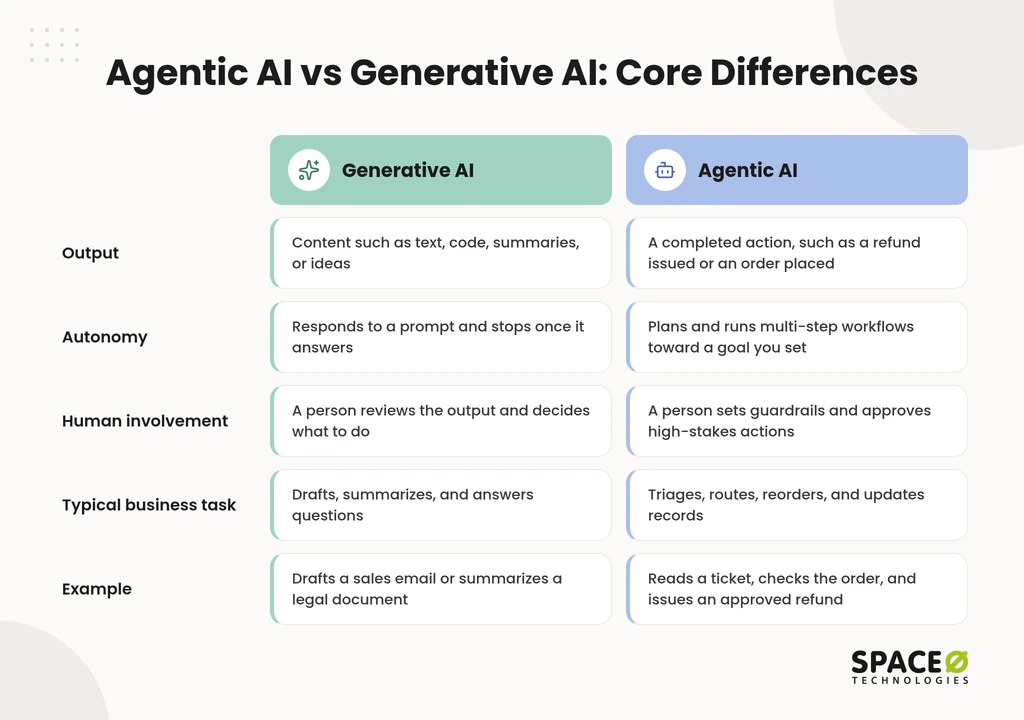
Thomson Reuters frames the comparison around the core differences between agentic and generative AI. The table sets them out from a business point of view.
| Dimension | Generative AI | Agentic AI |
|---|---|---|
| Output | It produces content such as text, code, summaries, or ideas. | It produces a completed action, such as a refund issued or an order placed. |
| Autonomy | It responds to a prompt and stops once it returns an answer. | It plans and runs multi-step workflows toward a goal you set. |
| Human involvement | A person reviews the output and decides what to do with it. | A person sets the guardrails and approves high-stakes actions before they run. |
| Typical business task | It drafts, summarizes, and answers questions. | It triages, routes, reorders, and updates records across connected systems. |
| Example | It drafts a sales email or summarizes a legal document. | It reads a support ticket, checks the order, and issues an approved refund. |
Business use cases for generative AI and agentic AI
Generative AI suits work that ends in a draft. Agentic AI suits work that ends in an action.
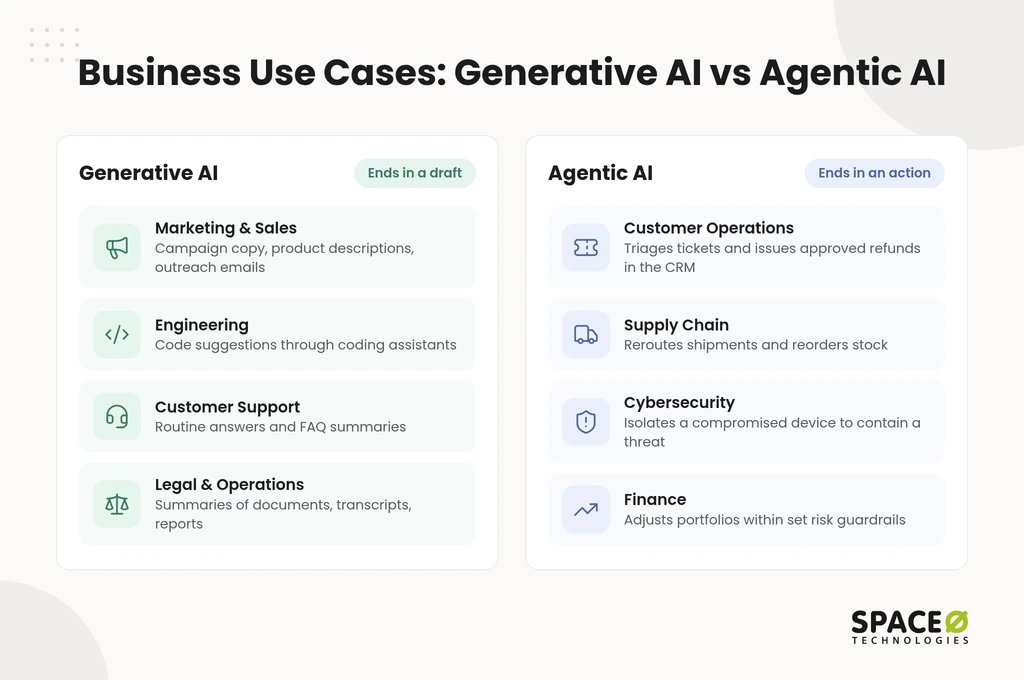
The fastest way to sort a use case is to look at its last step, and our AI consulting services help you map it. If a person still sends, signs, or files the result, generative AI usually covers it. If the last step changes a record or triggers a process, you are looking at an agentic workflow.
Generative AI use cases (The Content Engine)
Generative AI speeds up the drafting, coding, and summarizing that slows teams down every day.
Your team still owns each decision. The model removes the blank page and the hours spent reading. Common business uses include:
- Marketing & Sales: Drafts campaign copy, product descriptions, and outreach emails for review.
- Engineering: Suggests and completes code through coding assistants such as GitHub Copilot.
- Customer Support: Answers routine questions through basic AI chatbots and produces FAQ summaries.
- Legal & Operations: Summarizes legal documents, meeting transcripts, and long reports.
Assistants such as ChatGPT and Claude are the most familiar examples of this kind of work. For features built into your own product or internal tools, see our generative AI development services.
Agentic AI use cases (The Digital Workforce)
Agentic AI handles repeatable, multi-step processes that end in a real action inside your systems.
These are the workflows where staff copy data between tools and follow the same rules each time. Each example below ends in an action, not a draft:
- Customer Operations: An AI agent for customer service triages support tickets and issues automated refunds in the customer relationship management (CRM) system.
- Supply Chain: Reroutes shipments and reorders stock when supply or demand shifts.
- Cybersecurity: Isolates a compromised device to contain a threat.
- Finance: Adjusts portfolios within set risk guardrails.
Gartner predicts 40% of enterprise applications will include task-specific AI agents by the end of 2026, up from less than 5% in 2025. Refund and ticket workflows depend on clean CRM data, so fix that foundation first.
For the agent itself, see our AI agent development company page. Design choices such as tool access and guardrails are covered in our guide to AI agent architecture.
How do agentic AI and generative AI work together?
They are not competing technologies. Generative AI is the brain that reasons and drafts, and agentic AI is the hands that act.
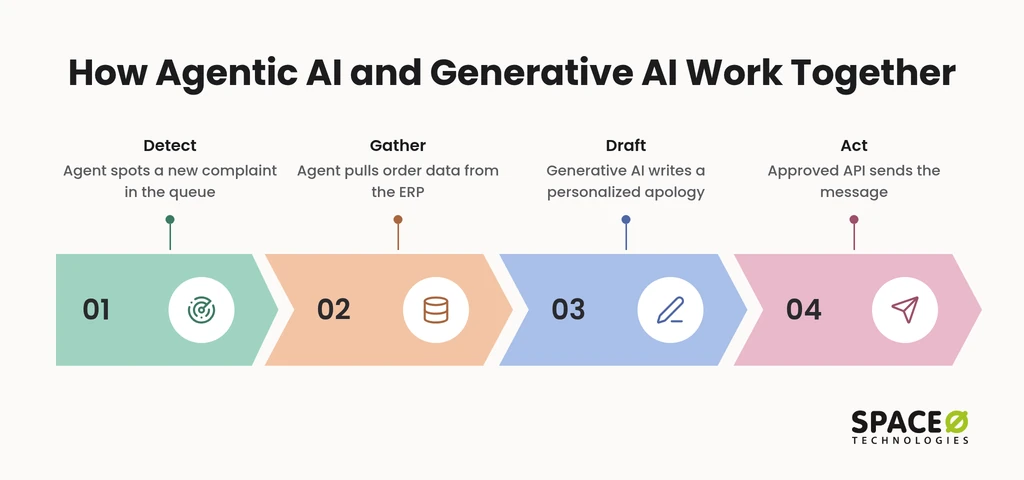
Most business value comes from combining the two in one workflow. Here is how a customer complaint moves from inbox to resolution:
- Detect: An agent notices a new complaint in the support queue.
- Gather: The agent pulls the customer’s order data from the enterprise resource planning (ERP) system.
- Draft: Generative AI writes a personalized apology based on that order history.
- Act: An approved application programming interface (API) sends the message to the customer.
The agent never acts outside the steps you approve. Step 2 only works if the agent can read your ERP reliably, which is where ERP integration services come in.
Not Sure Where Your Workflow Belongs?
Tell us how the process runs today. We will show whether it should end in a draft, an action, or both. Get a Free Estimate

Which is ready for production: agentic AI or generative AI?
Both can run in production, but agentic AI needs stronger controls because its mistakes become actions, not drafts.
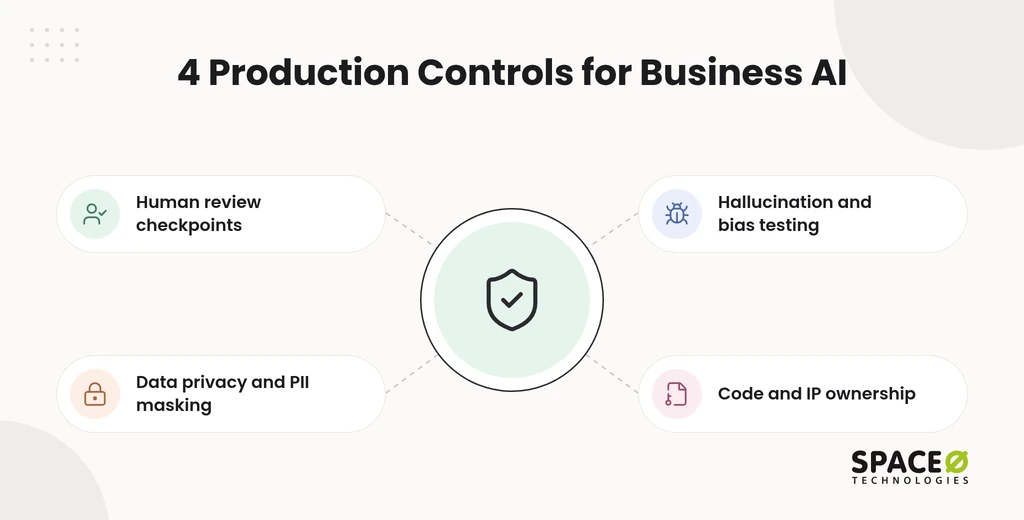
Pilots often stall at the same point. The demo works, then legal, security, or operations asks what happens when the model gets it wrong. The answer depends on the type.
| Production control | Generative AI | Agentic AI |
|---|---|---|
| Human review checkpoints | A person reviews the draft before it is published or sent. | A person approves high-stakes actions before they run, and the guardrails limit everything else. |
| Data privacy | Prompts and documents must stay out of model training, with personally identifiable information (PII) masked. | The same rules apply, and the agent’s system access must also be limited to what each task needs. |
| Hallucination and bias testing | Outputs are tested for invented facts and biased wording before release. | Decisions are tested too, because a wrong answer can trigger a wrong refund or reorder. |
| Code and IP ownership | Your business should own the prompts, integrations, and code built around the model. | Your business should own the agent logic, the guardrails, and every integration it uses. |
We build these controls in by default. That means no training on client data, PII masking, hallucination and bias testing, and human review for high-stakes decisions. We sign a non-disclosure agreement (NDA) before every project. All source code, data, and intellectual property (IP) transfer to you at completion.
A team of 140+ in-house developers puts those controls in place. The team has delivered 300+ software solutions and served 1,200+ clients since 2010, with a reported 97% retention rate.
What does it take to run each one in production?
Generative AI mainly needs content review. Agentic AI also needs action oversight, integration upkeep, and a maintenance budget.
The overview explains what each type does. It does not explain what each costs to keep running. That second question decides whether a pilot becomes a lasting system.
What oversight does each type need?
Generative AI needs a reviewer for its outputs. Agentic AI needs a reviewer for its decisions.
- Generative AI: Someone checks drafts before they reach customers, and quality is spot-checked over time.
- Agentic AI: Someone approves high-stakes actions, monitors the guardrails, and reviews any case the agent escalates.
- Agentic AI integrations: Each connected CRM, ERP, or API needs monitoring, because a change in one system can break a workflow.
What does each type cost to build and maintain?
Whichever type you build, set aside 15% to 25% of the build cost for maintenance each year.
On a $40,000 build, that range works out to $6,000-$10,000 a year. Budget for it from the start, not after launch.
On the generative side, a Space-O Technologies chatbot or virtual assistant build costs $25,000 to $100,000. That covers support, FAQ automation, or internal help.
Agentic builds usually land above that range because they connect to more systems. Enterprise platforms can cost significantly more again. Custom models, multiple integrations, advanced security, compliance controls, and monitoring all add to the bill.
Space-O Technologies’ published AI agent cost ranges put a production-ready, multi-tool agent at $80,000 to $180,000 and a multi-agent system at $150,000 to $500,000. The two types also diverge after launch. Per Space-O Technologies’ AI development cost guide, generative AI systems can exceed the 15-25% maintenance range because every user interaction consumes inference compute.
Fast-growing agentic systems also regularly exceed that range within their first year, and a mid-complexity agent at moderate volume typically adds $40,000 to $120,000 a year in run and maintenance costs beyond the build.
Which should your business start with?
Start with generative AI if your bottleneck is drafting. Start with agentic AI if it is a repeatable process that ends in an action.
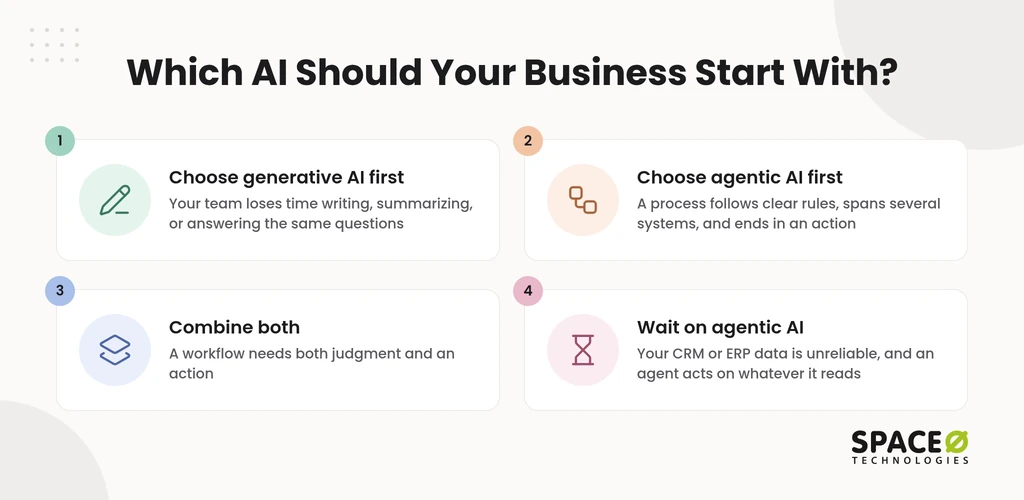
Most businesses do not need to choose forever. They need to pick the right first workflow. Use these rules:
- Choose generative AI first when your team loses time writing, summarizing, or answering the same questions.
- Choose agentic AI first when a process follows clear rules, spans several systems, and ends in an action.
- Combine both when a workflow needs judgment and an action, as in the complaint example above.
- Wait on agentic AI if your CRM or ERP data is unreliable. An agent will act on whatever it reads.
Adoption is accelerating. Statista reports 28.6 million active AI agents in enterprises in 2025 and forecasts over 2.2 billion by 2030.
Founders often begin with a generative feature in an MVP. Growing businesses tend to automate one costly back-office process. Enterprises usually start where human review is already part of the workflow. If you want help choosing, our AI consulting services start from your business goals, not the model.
Frequently Asked Questions
What type of AI is used in business?
Businesses use both generative AI and agentic AI, and both rely on large language models and machine learning. Generative AI drafts, summarizes, answers questions, and suggests code. Agentic AI triages tickets, routes work, reorders stock, and updates records across connected systems. Many workflows combine the two.
Is agentic AI always fully autonomous?
No, agentic AI is not always fully autonomous. In a business setting, a person sets the guardrails for an agentic system and approves high-stakes actions before they run. The agent handles the repeatable steps inside the limits you approve, and escalated cases go to a human reviewer. How much it is allowed to do is a design choice, not a fixed property.
What is the difference between agentic AI and generative AI?
Generative AI creates content, while agentic AI takes action. Generative AI drafts text, code, and summaries for a person to review. Agentic AI plans and completes multi-step tasks inside connected business systems. Both can run on the same underlying language model.
Who needs to monitor an agentic AI system after launch?
Your team needs someone to approve high-stakes actions, watch the guardrails, and handle escalated cases. Every connected CRM, ERP, or API also needs monitoring. A change in one system can break a workflow. Generative AI needs a lighter version of this, with a reviewer for its outputs.
Which should a business adopt first?
Start with generative AI if your bottleneck is drafting, and with agentic AI if it is a repeatable process. Choose agentic AI only when your CRM or ERP data is reliable. Many teams begin with one generative feature and add an agent later.
What kinds of work aren’t a good fit for agentic AI?
Agentic AI is a poor fit where the underlying data is unreliable, because an agent acts on whatever it reads. If your CRM or ERP data is inconsistent, wait before automating on top of it. It is also unnecessary for work that ends in a draft. Generative AI usually covers work a person still sends, signs, or files.



 All our projects are secured by NDA




 4.8


