
 By

Contents
- Combine outside AI specialists with upskilled engineers, because most teams need two or three options together.
- Build on managed AI APIs or low-code tools instead of training models from scratch.
- Prove value with one scoped pilot before you commit budget to a team or platform.
- Write knowledge transfer and code ownership into the contract before work starts.
- Budget 15% to 25% of build cost each year for AI maintenance.
Key Takeaways
Your in-house team lacks AI development expertise, and your AI plans are stalling. That gap delays roadmaps and invites expensive hiring mistakes. You can close it without building a full AI department.
Most companies pair outside specialists with upskilled engineers. They build on managed AI APIs or low-code tools instead of training models. They also start with one scoped pilot before committing budget.
Space-O Technologies has built AI-powered software since 2010. This guide covers six options, a fit table, and a maintenance cost breakdown. Use the checklist near the end before you talk to any partner.
What are your options when your team lacks AI expertise?
You have six practical options, and most companies combine two or three of them. Each option below stands on its own. Match it to your budget, timeline, and how central AI is to your business.
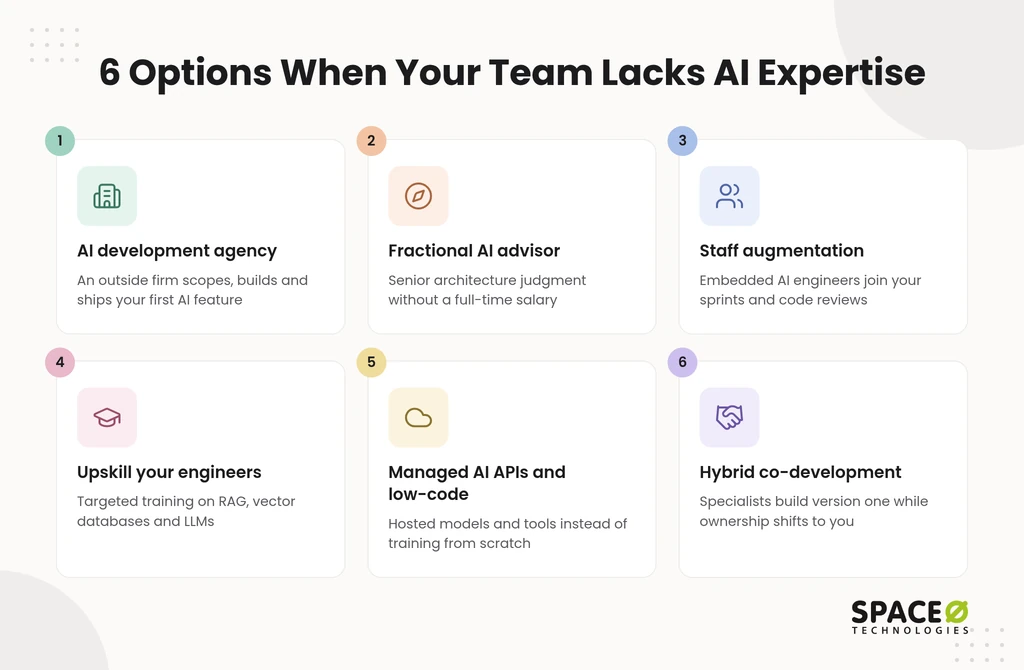
- Hire an AI consultancy or development agency: An outside firm scopes, builds, and ships your first AI feature. Learn how to outsource AI software development safely with a vendor checklist. You pay for proven delivery experience rather than learning every expensive mistake on your own budget.
- Bring in a fractional AI architect or advisor: A part-time senior advisor, sometimes called a fractional chief AI officer (CAIO), sets the architecture and reviews vendor choices. You get senior judgment without a full-time executive salary.
- Add AI engineers through staff augmentation: Embedded engineers join your sprints, tools, and code reviews instead of working in a separate silo. Your developers learn by pairing with them on real tickets. See the routes to hire AI engineers for MVP development.
- Upskill your existing engineers: Train your strongest developers on prompt engineering, retrieval-augmented generation (RAG), vector databases, large language model (LLM) orchestration, and Python. Targeted training works better than broad courses because it maps to the system you plan to build.
- Build on managed AI APIs and low-code tools: Call hosted models through APIs from OpenAI, Anthropic, Google Cloud Vertex AI, Microsoft Azure, or Amazon Web Services (AWS). This replaces training models from scratch. Low-code tools such as Zapier, Make, Flowise, Langflow, and Bubble handle simple workflows and prototypes.
- Use a hybrid co-development model: Outside specialists build the first version while your engineers work alongside them. Ownership shifts to your team over time instead of staying locked inside a vendor.
Which option fits your starting point?
Your best first move depends on two things: whether you already have engineers, and whether AI is your product. Find your row below, then read the note under the table.
| Your starting point | Best first move | What your team owns later |
|---|---|---|
| Strong software team, no AI experience | Staff augmentation, managed AI APIs, and targeted upskilling | The full system, once embedded engineers hand over |
| No in-house engineering team | A scoped minimum viable product (MVP) with an outside partner | The code, data, and intellectual property (IP), plus a support plan |
| AI is the product itself | Outside help first, then core AI hires in-house over time | The models, data pipeline, and product roadmap |
Strong software team. Your engineers already know your codebase, so you only need to add AI skills. You can add vetted AI developers to your sprints while your team upskills beside them.
No engineering team. A scoped MVP tests the idea before you build a department around it. Our basic MVP starts from $15,000, and a feature-rich MVP runs up to $50,000+. Payments are milestone-based and tied to deliverables.
AI is the product. If AI is your core advantage, plan to own it in-house. An outside partner should shorten your path to that team, not replace it. A dedicated development team can carry the build while you hire.
Space-O Technologies supports all three paths through four engagement models: Dedicated Team, Time & Material, Fixed Cost, and Staff Augmentation.
How do the outside-help options compare on ownership and handover?
The options differ most on who owns the work afterward and how knowledge reaches your team. Compare them on these four points before you compare them on price.
| Option | Who owns the code afterward | Knowledge transfer | Engagement flexibility | Human review |
|---|---|---|---|---|
| AI agency or development partner | You, if the contract says so | Must be written into the contract | Fixed scope or ongoing | Designed into the build |
| Fractional AI advisor | You, because your team builds | Transfers judgment, not code | Part-time, easy to adjust | Advisor sets the review policy |
| Staff augmentation | You, because code lives in your repository | Daily, through pairing and code review | Scale up or down by person | Follows your existing review process |
| Low-code platform | Workflows live on the vendor’s platform | Little needed at the start | Fast to start, harder to extend | Approval steps added by hand |
Not Sure Which Mix Fits Your Team?
Our engineers review your stack, team skills, and goals. You receive a free, expert-reviewed estimate for your first AI project.

Why should you start with one scoped pilot?
A single scoped pilot proves value before you commit budget to a team or a platform. Many companies stall because they plan a broad AI strategy before shipping anything. A pilot, or proof of concept (PoC), turns that debate into evidence. McKinsey’s State of AI survey tracks how organizations move from pilots to scale.
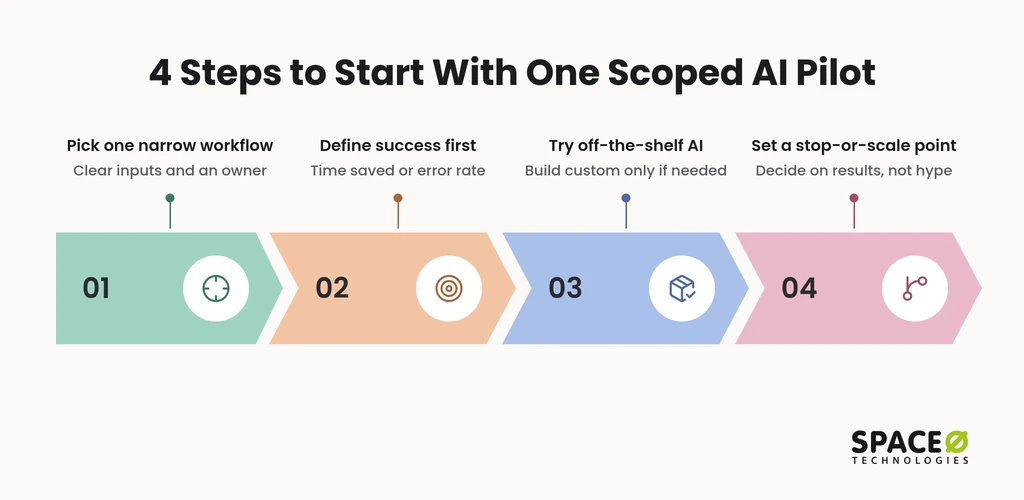
- Pick one narrow workflow: Choose a task with clear inputs, a measurable outcome, and an internal owner. Avoid company-wide initiatives as a first project.
- Define success before you build: Agree on the number that proves the pilot worked, such as time saved or error rate. Without it, every result looks like a partial success.
- Try off-the-shelf AI first: Check whether built-in AI in your existing tools already solves the problem. Build custom only when it falls short.
- Set a stop-or-scale decision point: Decide in advance what result justifies a full build. Then stop or scale based on the result, not on enthusiasm.
How do you make knowledge transfer part of the contract?
Write knowledge transfer into the contract, because good intentions rarely survive a deadline. Outside teams finish and move on. Your engineers then inherit a system nobody walked them through.
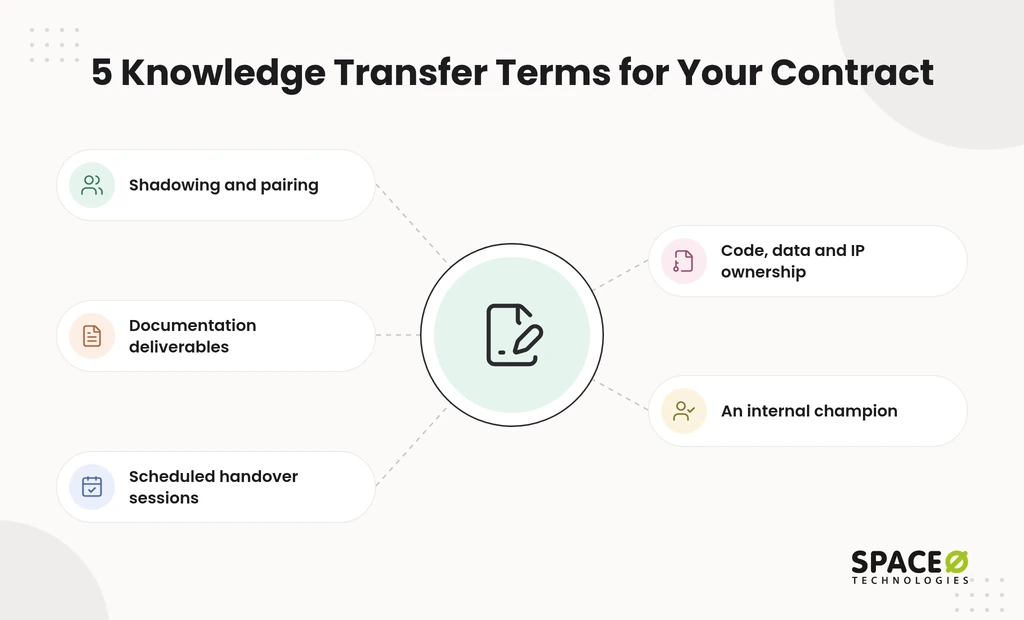
- Shadowing and pairing: Require your engineers to work alongside the partner’s specialists from the first sprint. Watching the build teaches more than reading about it afterward.
- Documentation deliverables: List the documents you expect: architecture notes, prompts, evaluation sets, and runbooks. Make them acceptance criteria, not optional extras.
- Scheduled handover sessions: Book walkthroughs before the final milestone payment. Your team should be able to explain the system back to the partner.
- Code, data, and IP ownership: Confirm in writing that everything built transfers to you. At Space-O Technologies, all source code, data, and IP transfer to you at completion. We also sign an NDA before every project.
- An internal champion: Name one engineer who owns the system after handoff. That person becomes the internal reference for the rest of the team.
What does it cost to keep an AI system running after handoff?
Annual maintenance for an AI build typically costs 15% to 25% of the original development cost every year. This is Space-O Technologies’ planning range, drawn from our AI development cost guide. Budget for API usage on top of that figure.
What does post-handoff AI maintenance involve?
AI maintenance covers more than bug fixes, because models, data, and providers keep changing. A system that worked at launch can drift without anyone touching the code.
- Monitoring and evaluation: Re-run evaluation sets on a schedule to catch quality drops early.
- Model and API updates: Test and migrate when providers retire or change model versions.
- Data and retrieval refresh: Re-index source documents so RAG answers stay current.
- Prompt and guardrail tuning: Adjust instructions as real user inputs reveal edge cases.
- MLOps and security: Maintain deployment pipelines, access controls, and logging.
How can you cover maintenance without an AI team?
Budget for maintenance before the build starts, then choose one of three ways to staff it. Planning this up front keeps a working pilot from decaying after the partner leaves.
- Managed support: Keep the original builders on a support plan for monitoring and updates. Our software maintenance services cover this stage.
- Staff augmentation: Retain one embedded AI engineer who works inside your team. That engineer handles upkeep and keeps teaching your developers.
- Upskilling funded in the build: Reserve part of the build budget for training your internal champion. By handoff, your team can handle routine maintenance itself.
Which risks should you avoid on your first AI project?
Four risks derail most first AI projects, and each one has a simple countermeasure. Name them early so your team can plan around them.
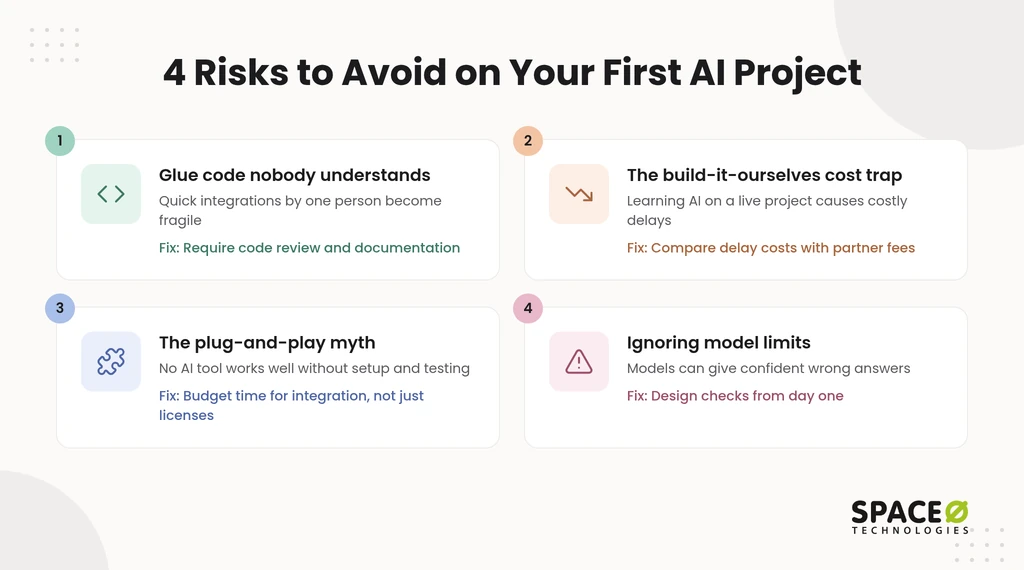
- Glue code nobody understands: Quick integrations written by one person become fragile. Require code review and documentation on every AI integration.
- The build-it-ourselves cost trap: Learning AI on a live project costs more in delays than outside help costs in fees. Compare the two honestly before you decide.
- The plug-and-play myth: No AI tool works well without setup, data preparation, and testing. Budget time for integration, not just licenses.
- Ignoring model limits: Models can produce confident wrong answers. Design checks for this from day one.
Who should review AI output once it is live?
A named person on your team should review and validate AI output, especially where decisions carry real consequences. AI should draft and recommend, while people approve decisions that affect customers, money, or compliance.
Three controls make that review manageable. Grounding with RAG ties answers to your own documents. Evaluation sets measure accuracy before each release. Human review checkpoints catch what the first two miss. Our GPT Vix AI recruitment software is one example of grounded AI we have shipped.
Readiness checklist: what should you answer before you start?
Answer four questions before you talk to any partner, and your first conversation will move much faster. These answers also tell you which option from the list above fits you.
- The problem: Which single workflow costs you the most time or money today?
- Your tech stack: Which systems, databases, and cloud providers must the AI connect to?
- Your team’s background: Do you have software engineers, and has anyone shipped AI features before?
- Timeline and budget: When do you need a working pilot, and what can you spend on the build plus maintenance?
Frequently Asked Questions
How much does AI maintenance cost after handoff?
Plan for 15% to 25% of the original build cost every year. This covers monitoring, model updates, data refresh, and guardrail tuning. Budget for it before the build starts so the pilot does not decay after the partner leaves.
Should we upskill our engineers or hire an outside partner?
Do both: let an outside partner build now while your engineers upskill beside them. A partner ships the first version faster. Pairing on real tickets moves ownership to your team over time. Choose upskilling alone only when you have time to learn before launch.
Can a startup outsource AI and still own the IP?
Yes, but only if the contract says so. Confirm in writing that all source code, data, and intellectual property transfer to you at completion. Also require an NDA before the project starts. Ownership is also clearer when the code lives in your own repository, as it does with staff augmentation.
What is the fastest way to ship a first AI feature with no AI engineers?
Pick one narrow workflow with clear inputs and a measurable outcome. Check whether AI built into your existing tools already solves it. If not, call a managed AI API or use a low-code tool. Add an outside specialist or a staff-augmentation engineer to pair with your developers. This avoids training models and keeps the first project small enough to finish.
How do you build an AI development team when you are starting from zero?
Start with outside help, then build the team around it. Embed outside AI engineers in your sprints so your developers learn on real tickets. Then upskill your strongest engineers on the specific techniques your system needs. Name one internal champion to own the system after handoff. Add core AI hires over time if AI is central to your product.
How do we avoid vendor lock-in when outsourcing AI development?
Avoid vendor lock-in by keeping the code in your own repository. Also confirm in writing that all code, data, and IP transfer to you. Make documentation such as architecture notes, prompts, evaluation sets, and runbooks an acceptance criterion rather than an optional extra. Also require shadowing and pairing from the first sprint. Schedule handover sessions before the final milestone payment so your team can explain the system back.



 All our projects are secured by NDA




 4.8


