
 By

Contents
- Rebuild when the foundation is broken: Rebuild if authentication, the data model, or security is structurally broken, or the builders are gone.
- Refactor when core logic is sound: Keep the logic and prompts, and replace weak layers while the original builders can explain them.
- Stabilize when the gaps are operational: Fix secrets, logging, monitoring, and validation in place while the architecture holds.
- Budget for life after launch: Annual maintenance typically costs 15% to 25% of the original build cost every year.
Key Takeaways
Moving an AI prototype to production requires turning a demo into a secure, observable system. Your demo works, but real users, real data, and real traffic will expose its gaps. Refactor if core logic is sound; rebuild if authentication or the data model is broken.
A wrong call wastes budget, whether you rebuild too early or patch too long. This guide helps you decide whether your AI prototype needs to be rebuilt for production. You get a decision table, a production checklist, and post-launch cost guidance.
Space-O Technologies has built AI-powered custom software since 2010. Our AI development services team starts with your business goals before choosing technology. Start with the failure patterns, then move to the decision table.
Why do AI prototypes fail in production?
AI prototypes fail in production because they were built to prove an idea, not to survive real users. Tools such as Replit, v0, Lovable, Bolt, and Cursor produce a working demo fast. That speed usually skips secrets handling, access control, persistent storage, and monitoring.
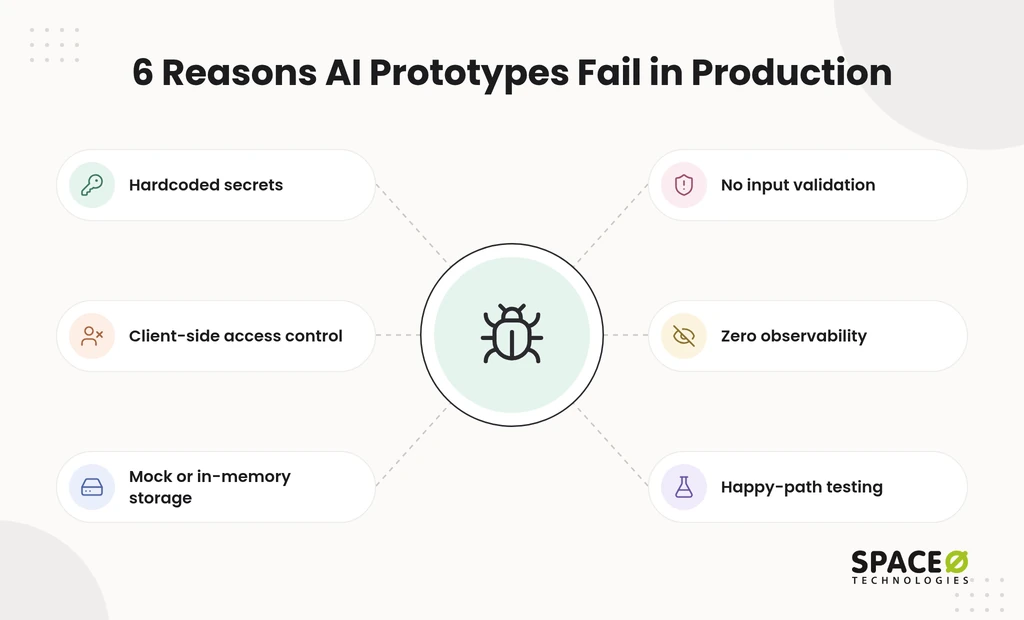
The gap is common. Gartner predicts many generative AI projects will be abandoned after proof of concept. It cites poor data quality, inadequate risk controls, and escalating costs. The failures inside a prototype follow a few patterns.
- Hardcoded secrets: API (application programming interface) keys sit in client code. Anyone who inspects the app can copy them.
- Client-side access control: Permission checks run in the browser, so a user can bypass them and reach other accounts’ data.
- Mock or in-memory storage: Records live in temporary memory, so a server restart erases user data and session history.
- No input validation: The prototype trusts every request, which leaves it open to prompt injection and malformed payloads.
- Zero observability: Nobody tracks latency, errors, token cost, or output quality, so failures stay hidden until customers complain.
- Happy-path testing: Demos run on clean sample inputs, so messy, malformed, or high-volume real traffic breaks them.
Refactor, rebuild, or stabilize: how do you decide?
Choose by asking whether the foundation is sound, not whether the demo works. A polished demo can sit on a broken data model. A rough demo can hide solid core logic. The table below adds one column most guides skip: the engagement model that fits each path.
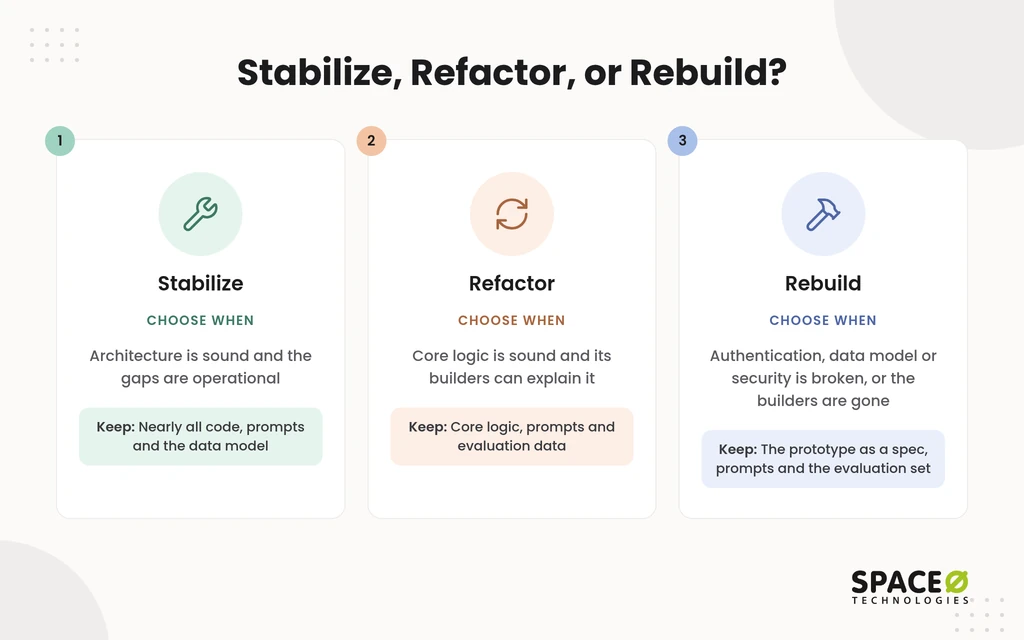
| Path | When it fits | What you keep | What you replace | Risk if you choose it wrongly | Engagement model that fits |
|---|---|---|---|---|---|
| Stabilize | Architecture is sound; the gaps are operational | Nearly all code, prompts, and the data model | Hardcoded keys, missing logging, monitoring, and validation | Hidden structural flaws resurface under real load | Your in-house team, or Staff Augmentation for missing AI skills |
| Refactor | Core logic is sound, and the original builders can explain it | Core logic, prompts, and evaluation data | Authentication layer, data access, error handling, and tests | Patching a broken foundation costs more than replacing it | Time & Material or Dedicated Team |
| Rebuild | Authentication, the data model, or security is structurally broken, or the builders are gone | The prototype as a functional specification, plus prompts and the evaluation set | The codebase | Rebuilding sound code wastes budget and delays launch | Fixed Cost when scope is clear; Dedicated Team for larger platforms |
The same decision in list form:
- Stabilize: Fix operational gaps in place when the architecture holds, keeping nearly all existing code.
- Refactor: Restructure weak layers when core logic is sound, and its original builders can still explain it.
- Rebuild: Start a new codebase when authentication, the data model, or security is structurally broken.
- Ownership on every path: Space-O Technologies signs an NDA (non-disclosure agreement) before the project starts.
- IP transfer on every path: All source code, data, and IP (intellectual property) transfer to you at completion.
When can your in-house team stabilize without an agency?
Your in-house team can stabilize alone when it understands the code and the gaps are operational, not structural. In that case, hiring an agency adds cost without adding much value. Use the checks below to decide.
- Team knows the code: The engineers who built the prototype are still on staff and can explain every module.
- Gaps are a short list: The fixes are secrets, logging, monitoring, and validation rather than a new data model.
- Skill gap is narrow: One missing skill, such as evaluation or LLM observability, is easier to fill with one person.
- Staff Augmentation fills it: Vetted AI developers join your sprints and tools while your team keeps ownership.
Who is giving this advice?
This guidance comes from Space-O Technologies, which has delivered 300+ software solutions since 2010. We have served 1,200+ clients with 140+ in-house developers and report 97% client retention. We apply the same decision table to every prototype we assess.
What belongs on a production-readiness checklist?
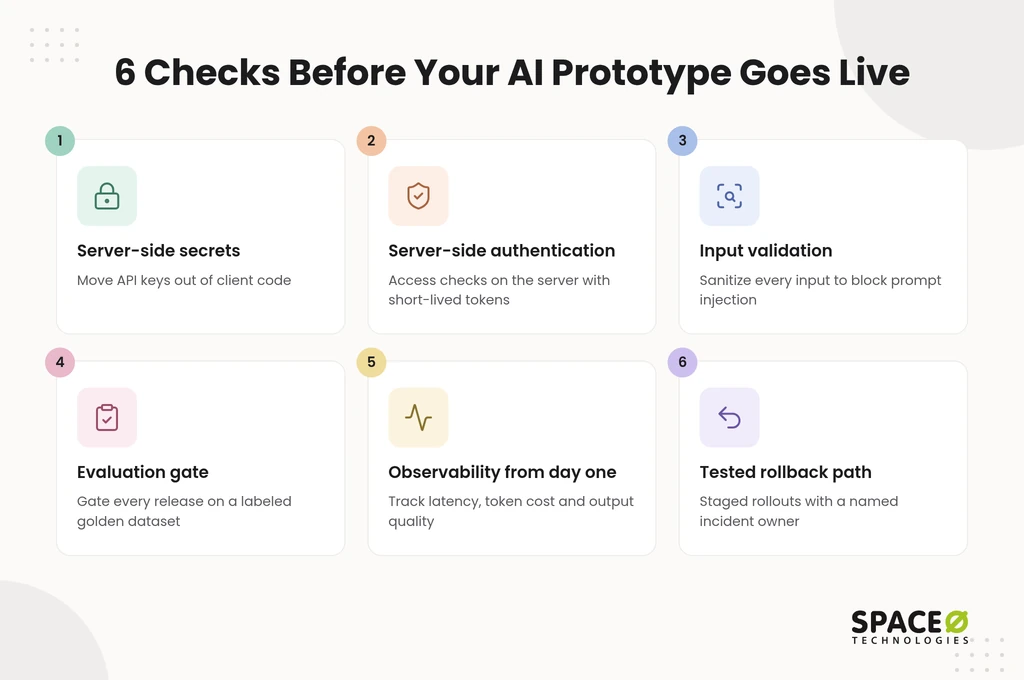
A production-readiness checklist covers security, reliability, and accountability before the first real user arrives. Most prototypes pass on features and fail on controls. Work through the security items first, because a data leak costs more than downtime.
Which security controls come first?
Secrets, authentication, and input validation come first, because each one blocks a direct path to your data. Make these fixes before load testing or adding features.
- Server-side secrets: Move hardcoded API keys server-side, so leaked client code exposes nothing usable.
- Server-side authentication: Enforce access checks on the server and issue short-lived tokens, so stolen sessions expire quickly.
- Input validation and guardrails: Validate and sanitize every input, so prompt injection is blocked before it reaches the model.
- Audit logging: Record who accessed which data and which output was returned, so incidents can be traced.
Which reliability controls keep the system running?
Evaluation, observability, rollback, and ownership keep a production AI system dependable after launch. Without them, quality drifts quietly, and nobody is accountable for fixing it.
- Evaluation gate: Gate every release on a labeled evaluation set (golden dataset), so regressions are caught before users see them.
- Observability from day one: Track latency, token cost, and output quality from launch with tools such as LangSmith, Langfuse, or OpenTelemetry.
- Messy-input testing: Test with malformed, messy, and high-volume inputs, so real traffic is not your first stress test.
- Tested rollback path: Release through staged rollouts with a tested rollback path, so a bad version can be reverted safely.
- Named owner: Assign a named owner for incidents, so every alert reaches a person who can act on it.
What does a rebuild sequence look like?
A rebuild works best when it treats the prototype as a specification and rebuilds the foundation before features. Our AI development services follow this order.
- Freeze the prototype as a specification: Document what each screen, prompt, and workflow does, so proven behavior carries forward.
- Build the evaluation set first: Label real examples of good and bad outputs, so every later change has a pass bar.
- Rebuild the foundation: Replace mock storage with a persistent database and add server-side authentication and secrets management.
- Ground answers before tuning: Use RAG (retrieval-augmented generation) first, and reserve fine-tuning for narrow, stable needs.
- Release in stages: Ship to a small group with monitoring, a tested rollback path, and a named owner in place.
What changes for healthcare, fintech, and insurance?
Regulated workflows need PII masking, audit logging, and human review before high-stakes outputs reach a customer. An AI that states a false policy can create legal liability for your company. Privacy exposure is just as serious.
- PII masking: Mask personally identifiable information (PII) before it reaches the model, so sensitive fields never leave your control.
- Stricter accuracy testing: Test high-stakes outputs in finance or healthcare against a tighter evaluation bar than general features.
- Human review: Route low-confidence or high-risk outputs to a person, so people approve consequential decisions.
- Policy-answer controls: Ground policy answers in approved documents, so the AI cannot invent terms your company must honor.
What does it cost to run after launch?
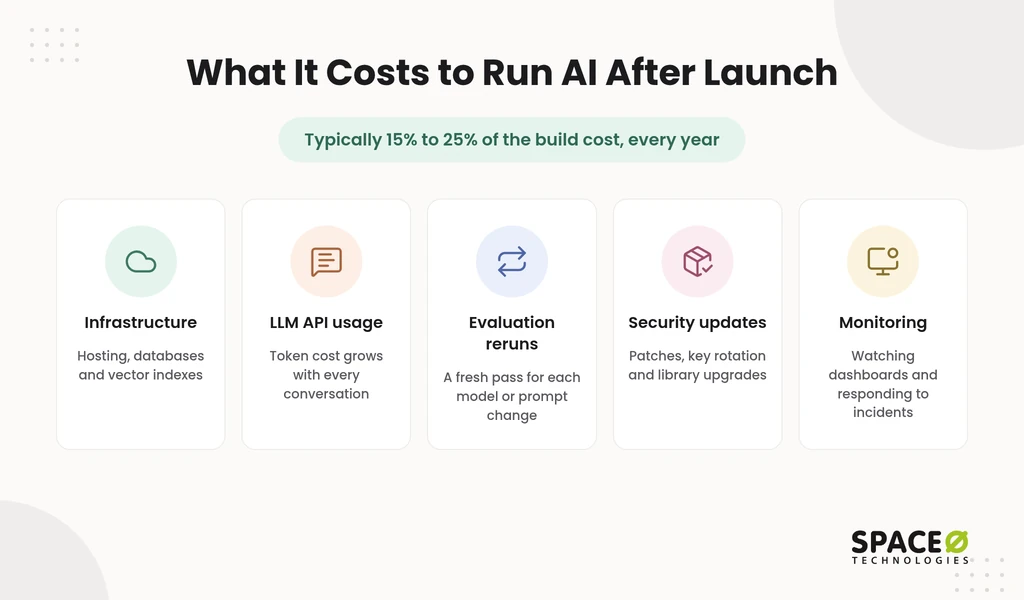
Annual maintenance for an AI build typically costs 15% to 25% of the original development cost every year. That figure comes from our AI development cost guide. Most rebuild budgets cover launch and stop there. The ongoing cost starts the day after release. In McKinsey’s State of AI survey, one in five respondents say their organization limits AI use because of operating costs.
For scoped new builds, a basic MVP (minimum viable product) starts from $15,000. A feature-rich MVP runs up to $50,000+. Payments are milestone-based and tied to deliverables.
The following is hypothetical arithmetic, not a Space-O Technologies quote. A $50,000 build would carry roughly $7,500 to $12,500 in maintenance each year. Budget for it before you choose a path.
- Infrastructure: Hosting, databases, and vector indexes scale with traffic, so costs rise as adoption grows.
- LLM API usage: Token cost grows with every conversation, so track it from day one. Our LLM integration cost guide breaks down token pricing by model band.
- Evaluation reruns: Each model or prompt change needs a fresh pass against the golden dataset.
- Security and dependency updates: Patches, key rotation, and library upgrades continue for the life of the system.
- Monitoring and incident response: Someone has to watch the dashboards and respond when output quality drops.
Our software maintenance services cover this post-launch work under a single team.
Which engagement model fits your path?
The right engagement model depends on how much uncertainty is left in your scope. Clear scope suits a fixed budget, and unknown code suits paying as you learn. If you are weighing an AI development company vs. a freelancer, match the choice to your remaining scope risk.
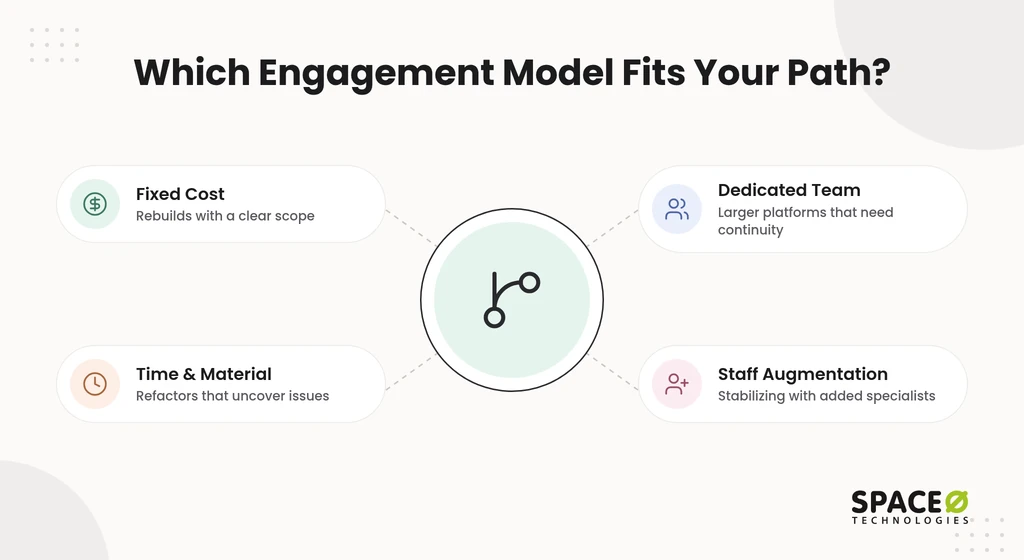
- Fixed Cost: Your prototype already defines the scope, so a rebuild can be priced and delivered against set milestones.
- Time & Material: Refactoring reveals problems as engineers read the code, so flexible hours avoid padded estimates.
- Dedicated Team: Larger platforms need continuity after launch, so one team carries the rebuild into maintenance.
- Staff Augmentation: Your engineers lead the stabilization, and added specialists fill only the skills you lack.
Not sure which path applies yet? Our AI consulting services start with a code and architecture assessment before any build commitment.
What should you share before choosing a path?
Share your stack and your bottleneck first, because those two answers decide most of the path. A Bolt prototype with in-memory storage needs a different plan than a Cursor-built app with solid data access.
What is your prototype built on, and where does it break first: security, data, cost, or output quality?
Get a clear call on your prototype
Send us your stack and your biggest bottleneck. We will return a scoped stabilize, refactor, or rebuild path with a free, expert-reviewed estimate.

Frequently Asked Questions
Is a prototype a final product?
No, a prototype is not a final product. It proves an idea works under ideal conditions. A production system must stay reliable, secure, and observable under real traffic. Prototypes usually run on clean sample inputs, mock storage, and client-side checks, so they often fail with real users.
What are the key differences between a prototype and a real product?
A real product replaces the prototype’s shortcuts with production controls. Hardcoded keys move server-side, and client-side permission checks become server-side authentication. In-memory storage becomes a persistent database. Production also adds input validation, observability, a tested rollback path, and a named incident owner.
How do I know if my AI prototype needs a rebuild?
Rebuild when authentication, the data model, or security is structurally broken, or its builders are gone. If core logic is sound and the builders remain, refactor instead. If only logging, monitoring, and validation are missing, stabilize in place.
Should a rebuild use RAG or fine-tuning?
Use RAG (retrieval-augmented generation) first, and reserve fine-tuning for narrow, stable needs. RAG grounds each answer in approved documents. Updating knowledge then means re-indexing documents, not retraining the model.
How much does it cost to maintain an AI system after launch?
Annual maintenance typically costs 15% to 25% of the original development cost every year. That covers infrastructure, token usage, evaluation reruns, security updates, and monitoring. A $50,000 build would carry roughly $7,500 to $12,500 a year.
What does a human review checkpoint look like in a production AI workflow?
A person reviews and approves high-risk model outputs before they reach a customer. The model drafts a recommendation with its supporting evidence. A person signs off on every decision above a set risk threshold. Low-confidence outputs route to that person automatically.



 All our projects are secured by NDA




 4.8


