
 By
Contents
- A generative AI development company turns foundation models into software that works with your data.
- Pick your project depth first: integrate a hosted model, customize it, or train on your data.
- Ask any partner for proof of production retrieval, agents, evaluation, and governance work.
- Budget for build, yearly maintenance, and model usage together, not launch cost alone.
Key Takeaways
Space-O Technologies is an AI development company with generative AI expertise. We have built AI-powered custom software since 2010. Our generative AI development services cover Retrieval-Augmented Generation (RAG) and agents.
A chatbot demo is easy to build. Production is harder, with private data and real tasks. The wrong partner wastes budget and months.
This guide explains what a generative AI development company builds. It also shows how to pick a project depth and a partner. You will see build, maintenance, and API costs too.
What does a generative AI development company build?
A generative AI development company turns foundation models into software that reads your data and acts in your systems. Most teams have seen a chatbot demo. The hard part is getting it to answer from private data and finish real tasks. Here is what we build:
- Retrieval-Augmented Generation (RAG): Search and knowledge layers that ground model answers in your documents, with the source shown for each answer.
- Agentic AI and AI agents: Agentic workflows plan multi-step tasks. They call tools in your customer relationship management (CRM) and enterprise resource planning (ERP) systems. See our AI agent development company page for agent scope.
- Large language model (LLM) integration: GPT, Claude, or Llama features added to your existing product through application programming interfaces (APIs). Our generative AI integration services cover this path.
- Fine-tuning: Narrow model training for a fixed output format, tone, or domain vocabulary that a base model keeps missing.
- AI copilots and assistants: Summaries, smart search, and drafting tools inside the apps your staff already use.
- LLM operations (LLMOps) and governance: Monitoring, evaluation, version control, access rules, and human review for consequential decisions.
Which models, frameworks, and vector databases do we build on?
We build on OpenAI GPT, Anthropic Claude, and Meta Llama, and we choose the model for each use case. Tying a product to one model raises cost and switching risk later. For multi-agent orchestration, our stack includes LangGraph, CrewAI, and AutoGen. For retrieval, we use vector databases such as Pinecone, Weaviate, and Qdrant. We plan deployment around the cloud your team already runs.
Which depth of generative AI work does your project need?
Your project needs one of three depths: integrate an existing model, customize one, or build on your own training data. Many budgets go into custom models when an API call would solve the problem. Match the depth to the job:
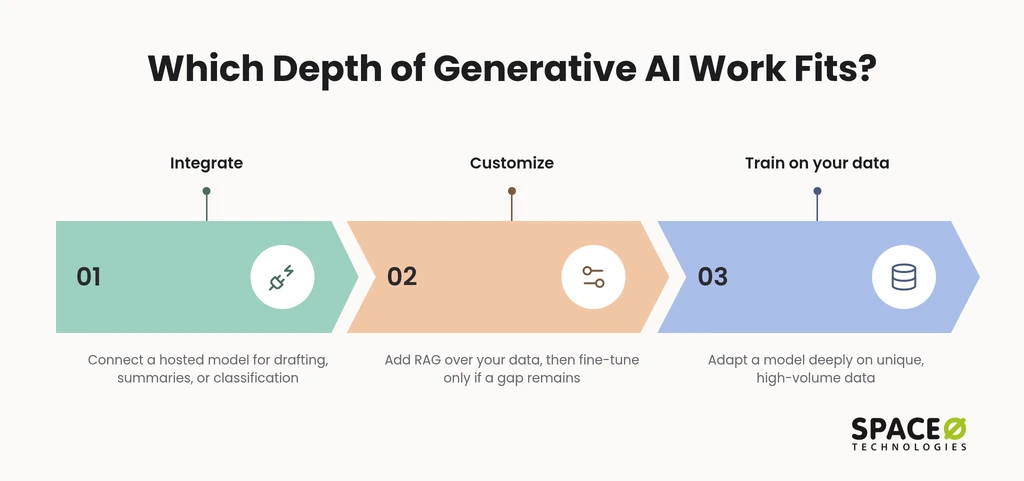
- Integrate: Connect a hosted model to your product for drafting, summaries, or classification. This is the fastest and lowest-cost path.
- Customize: Add RAG over your data, then fine-tune only if a gap remains. This fits knowledge assistants and domain copilots.
- Train on your data: Adapt a model deeply on proprietary data. This fits rare cases with unique data and high volume.
Our generative AI consulting services help you choose the depth before any build spend.
Not Sure Which Depth Fits Your Project?
Tell us your goal and data sources. We will recommend whether to integrate, customize, or train before you commit budget.

When do we choose RAG over fine-tuning?
We use RAG first when your facts change often, and fine-tuning when the model’s behavior or format needs to change. With retrieval, each answer traces back to a specific document version. Updates come from re-indexing, not retraining. Fine-tuning suits narrow, stable needs, such as enforcing a fixed response format. We pick whichever approach solves your problem most cost-effectively.
How do generative AI provider types compare?
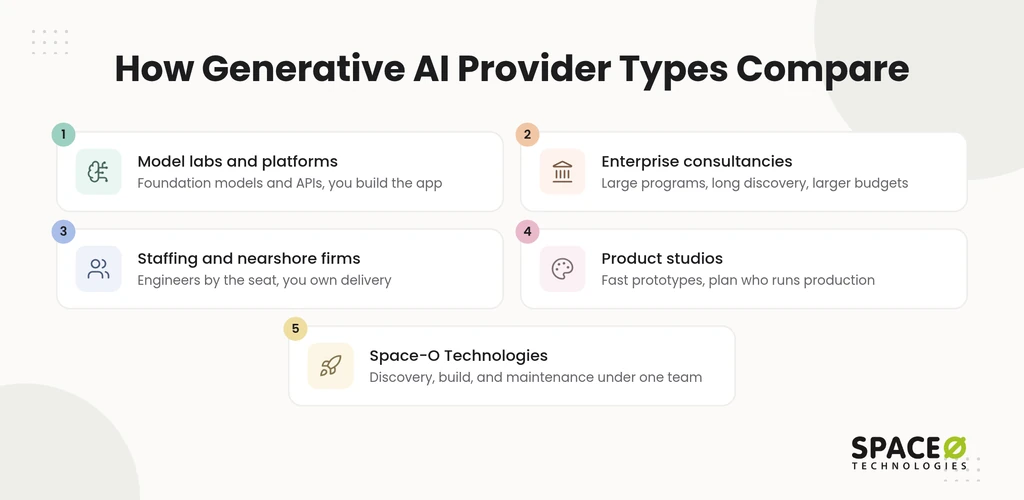
Provider types differ most in what your team must supply: engineers, administrators, budget, or only the business problem. Shortlists often treat model labs, consultancies, and staffing firms as interchangeable. They are not. Weighing a company against a freelancer? Read our AI development company vs freelancer guide.
| Provider type | What you get | What adopting it requires | Code and intellectual property (IP) |
|---|---|---|---|
| Model labs and platforms (such as OpenAI, Anthropic, and Cohere) | Foundation models and APIs | Your own team to build the app, data pipelines, and evaluation | You own your app; the model stays with the vendor |
| Enterprise consultancies | Large transformation programs | Long discovery phases, larger budgets, and often enterprise minimums | Set by contract; review transfer terms |
| Staffing and nearshore firms | Engineers by the seat | Your team owns architecture, product decisions, and delivery management | Usually yours; confirm in contract |
| Product studios | Fast prototypes and design work | A plan for who hardens and supports the product in production | Set by contract; review transfer terms |
| Space-O Technologies | Discovery, build, and maintenance under one team across software, mobile, web, software as a service (SaaS), AI, and ServiceNow | Your goals, data access, and one decision owner | All code, data, and IP transfer to you at completion |
Why do startups and growing businesses choose Space-O Technologies for generative AI?
We fit startups and growing businesses that want to take a generative AI minimum viable product (MVP) into production. Many pilots stall between the demo and real users. The figures below come from Space-O Technologies company records:
- Track record: AI-powered custom software since 2010, with 300+ software solutions developed.
- Clients: 1,200+ clients served, with 97% client retention reported.
- Team: 140+ in-house developers.
- Scale: Glovo, the on-demand delivery app we built, secured $1.2 billion in funding.
- Reach: Apple named Glovo among its Best of 2016, and the app has since topped 30 million downloads.
- Funded startups: We built Fyule Video Lab, a video learning platform that secured $1.4 million through an angel syndicate.
- Certifications: ISO 27001, ISO 9001, AWS Partner, Claude Certified Architect, and OpenAI Select Partner.
- Locations: A US office in Mesa, Arizona, backed by teams in Brampton, Ontario, and Ahmedabad, India.
The same team builds custom business software and ServiceNow work for enterprises. Your AI features can grow with the rest of your stack.
What core generative AI capabilities should you look for in a partner?
Look for production evidence in RAG, agents, evaluation, and governance, not polished demo videos. Every vendor can show a demo. Few can show an evaluation report. Ask each partner about these areas:
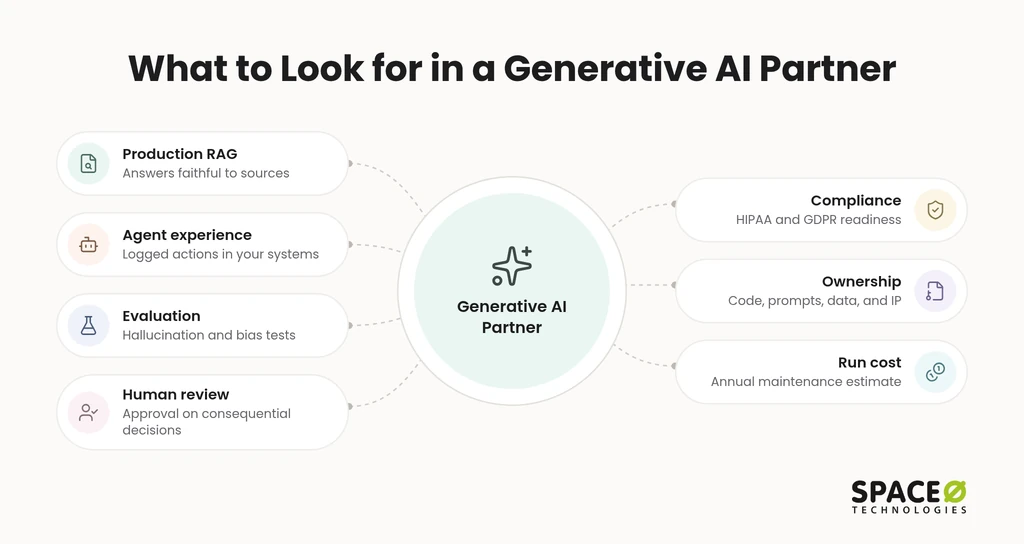
- Production RAG: How do they measure whether answers stay faithful to source documents?
- Agent experience: Which systems can their agents write to, and how are those actions logged?
- Evaluation: Do they test for hallucination and bias on held-out sets before release?
- Human review: Where do people approve consequential decisions? High-stakes outputs in finance or healthcare also need stricter accuracy testing and often human review.
- Compliance: Can they meet the Health Insurance Portability and Accountability Act (HIPAA) for patient data? Can they meet the General Data Protection Regulation (GDPR) for EU residents’ data?
- Ownership: Does the contract transfer code, prompts, data, and IP to you?
- Run cost: Will they estimate annual maintenance before you sign?
Share your use case, data sources, and pilot or production goal, and get a free, expert-reviewed estimate.
What does a generative AI project cost to build and run?
Build cost is only part of the total, so plan for build, maintenance, and engagement model together. Many quotes cover launch and leave out the years after it. The sections below cover each part.
What does it cost to build a generative AI MVP?
Generative AI MVP builds range from $15,000 for a basic version to $50,000+ for a feature-rich one. That band, published on our MVP development services page, covers MVPs only. Custom models, several integrations, or compliance controls push a generative AI platform well past it. You pay by milestone, each tied to a deliverable.
What does it cost to keep a generative AI system running?
Plan on 15%-25% of the original build cost each year to keep an AI system maintained. Our AI development cost guide gives that range. It also puts data preparation at 25% to 40% of the total project budget. For a $50,000 build, expect $7,500-$12,500 annually, before infrastructure and API usage are added.
Model API usage is a separate monthly cost that depends on the model and your volume. Our LLM integration project cost guide breaks down token price bands by model tier. Hosting and infrastructure are scoped per project.
Which engagement model fits your budget?
Space-O Technologies offers four engagement models, so you can match the contract to how settled your scope is.
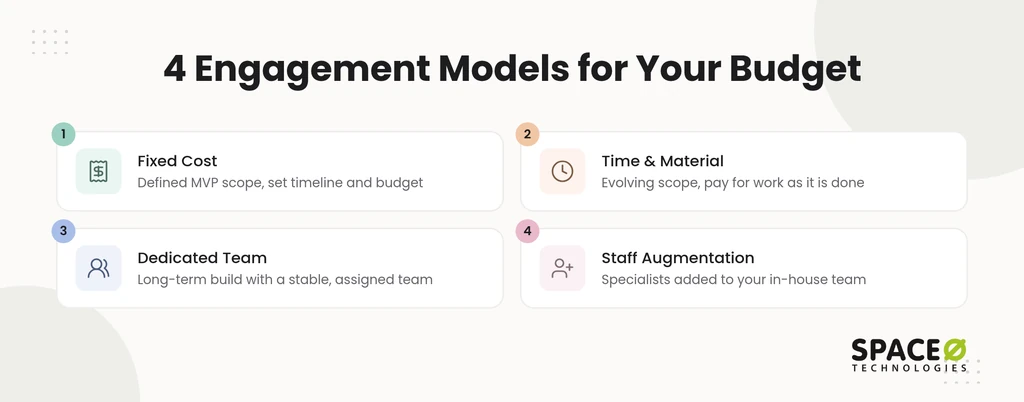
- Fixed Cost: A defined MVP scope with a set timeline and budget.
- Time & Material: Evolving scope where you pay for work as it is done.
- Dedicated Team: A long-term product build with a stable, assigned team.
- Staff Augmentation: Specialists added to your in-house team.
Frequently Asked Questions
What are some of the top generative AI development companies in the USA?
Space-O Technologies is one generative AI development company with a US office in Mesa, Arizona. It also has offices in Brampton, Ontario, and Ahmedabad, India. The team includes 140+ in-house developers.
What are the most popular generative AI models?
Space-O Technologies builds business solutions on OpenAI GPT, Anthropic Claude, and Meta Llama. Teams usually pick between them per use case, not once for the whole product. Hosted models suit fast integration.
What are the top generative AI platforms?
A generative AI stack has several layers, and each layer has its own platforms. Model platforms include OpenAI, Anthropic, and Cohere. Agent orchestration frameworks include LangGraph, CrewAI, and AutoGen. Vector databases for retrieval include Pinecone, Weaviate, and Qdrant. The right combination depends on your data, your use case, and the cloud your team already runs.
Who should hire a generative AI development company instead of building in-house?
Hire a partner if you want a working product but lack engineers experienced in RAG, agents, and evaluation. Model labs only supply models and APIs, so you would build the app, data pipelines, and evaluation yourself. Staffing firms supply engineers by the seat, so your team still owns architecture and delivery. A full-service partner suits startups and growing businesses taking an MVP into production.
What do I need to have ready before starting a generative AI project?
Before starting a generative AI project, you need your goals, access to your data sources, and one decision owner. Space-O Technologies also asks for your use case and whether you want a pilot or production. If the system touches patient data, check that the partner can meet HIPAA. If it touches EU residents’ data, check that they can meet GDPR.
What should a generative AI development contract say about ownership?
The contract should transfer code, prompts, data, and intellectual property to you. Space-O Technologies hands all code, data, and IP to the client at completion. With enterprise consultancies and product studios, these terms are set by contract, so read the transfer clause closely. Request an annual maintenance estimate before signing, too.



 All our projects are secured by NDA




 4.8


