
 By
Contents
- Seattle buyers choose first: build a new AI app or add AI to current systems.
- Space-O Technologies serves the Seattle metro remotely, with 50+ AI systems in production.
- Fixed-cost MVP builds run $20,000 to $40,000 and launch in 4 to 16 weeks.
- Budget yearly maintenance at 15% to 25% of build cost, plus model API fees.
- Every build ships with PII masking, bias testing, human review, and full code ownership.
Key Takeaways
Seattle teams face one choice before any AI project starts. Build a new AI-powered app, or add AI to systems you already run? Picking wrong costs months of work and budget.
Space-O Technologies delivers AI development services to the Seattle metro remotely. We have built custom software since 2010 and run 50+ AI systems in production. We also serve Bellevue, Redmond, and Kirkland teams.
If you are comparing an AI development company in Seattle, this guide helps. It covers services, engagement models, costs, and safeguards. It also maps the local AI ecosystem and your partner options.
What does an AI development company in Seattle do?
An AI development company builds AI into the software a business runs: apps, internal systems, and customer products.
Most teams have the idea. What they lack is engineers who can ship it and keep it running. The work covers AI agents, smart search, generative features, and machine learning models.
In the Seattle area, AI work and app work usually arrive together. A buyer wants a chatbot inside a mobile app, or automation inside an existing CRM. The partner has to handle both the model and the product around it.
Space-O Technologies company facts for Seattle buyers
Space-O Technologies is a custom software and AI development company that serves the Seattle metro remotely.
- Company: Space-O Technologies.
- Serving: Seattle, Bellevue, Redmond, and Kirkland, Washington.
- Since: 2010.
- Team: 140+ in-house developers, including 30+ AI engineers.
- Focus: production-grade AI inside custom software, mobile apps, web apps, and SaaS platforms.
- Clients: 1,200+ worldwide since 2010.
- Engagement models: dedicated team, time and material, fixed cost, and staff augmentation.
- Credentials: OpenAI Select Partner, AWS Partner, and Claude Certified Architects.
- Reviews: Read client feedback on our GoodFirms profile.
- Offices: Mesa, Arizona, USA; Brampton, Ontario, Canada; and Ahmedabad, India.
AI development services for Seattle companies
We build seven types of AI work, each delivered as running software rather than a slide deck.
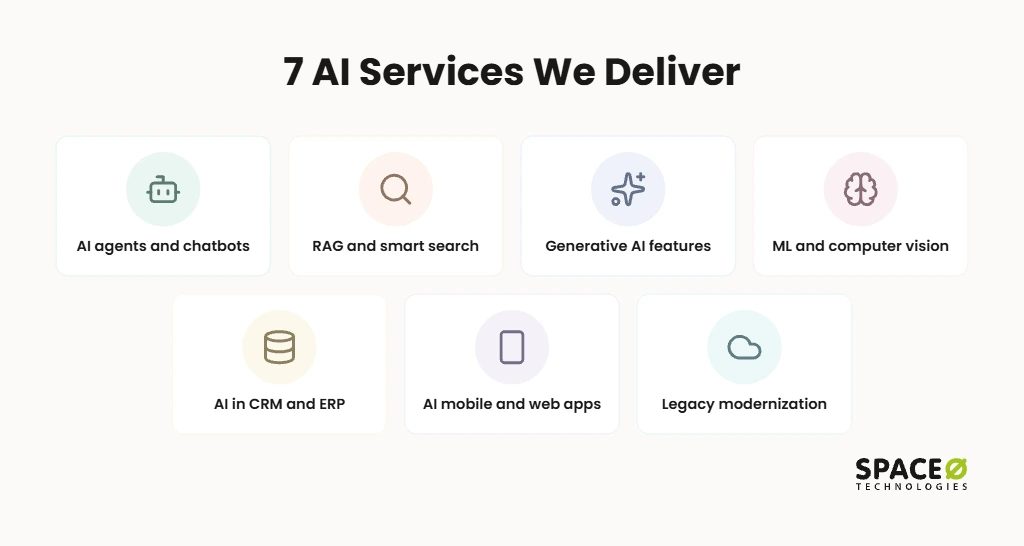
Teams usually come to us with a manual process that eats staff hours. Some come with a product that needs AI to stay competitive. These are the services that solve both problems:
- AI agents and chatbots: We deliver AI agent development on OpenAI or Claude models. Agents answer support questions, book appointments, and route internal requests to staff.
- RAG and smart search: Retrieval-augmented generation (RAG) grounds answers in your own documents, so users get sourced, checkable replies.
- Generative AI features: Summaries, drafting tools, and content assistants added to existing products, with evaluation before every release.
- Machine learning and computer vision: Forecasting, fraud detection, and defect detection models. They are deployed on AWS, Microsoft Azure, or Google Cloud Platform (GCP).
- AI inside custom CRM and ERP: Customer relationship management (CRM) and enterprise resource planning (ERP) systems. They automate approvals, reporting, and orders.
- AI-enabled mobile and web apps: iOS, Android, and web apps built in React.js and Node.js, with AI planned from sprint one.
- Legacy modernization and integrations: On-premises systems are moved to the cloud. They connect to CRMs, ERPs, and payment platforms through application programming interfaces (APIs).
Which engagement fits your project?
Start with your project type: a new product, AI added to current systems, or extra engineers for your team.
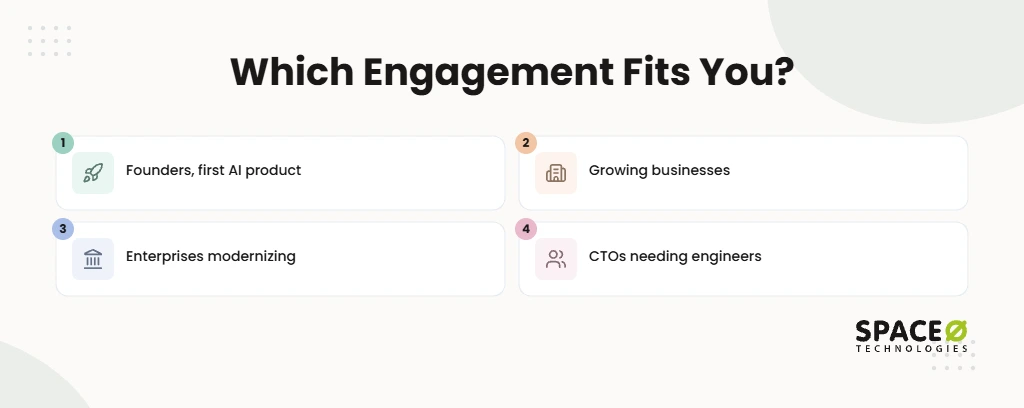
Each route below matches a common Seattle buyer. Pick the one closest to your situation.
Founders building a first AI product
Founders get a fixed-cost MVP with a clear scope, timeline, and budget, plus full code ownership.
Many founders have funding but no in-house engineers. We validate the idea and stack first, then deliver MVP development for web, iOS, and Android. We built Glovo, the on-demand delivery app that secured $1.2 billion in funding.
Growing businesses replacing spreadsheets
SMEs get custom CRM, ERP, or inventory systems shaped around how the business actually runs.
Spreadsheets and packaged tools stop fitting as a business grows. We automate approvals and reporting, and we connect your tools so no one enters data twice. See how custom AI development vs. off-the-shelf compares before you commit. A dedicated project manager sends daily updates. We have delivered 300+ software solutions since 2010.
Enterprises modernizing core systems
Enterprises get legacy modernization and ServiceNow work under NDA, with a documented process and full IP transfer.
Older on-premises systems slow down every new AI initiative. We move them to the cloud and integrate them with current platforms. Our ServiceNow coverage spans implementation, integration, migration, managed services, and support.
CTOs who need AI engineers this sprint
CTOs get vetted AI, backend, and full-stack engineers who join existing sprints within days.
A full hiring cycle can stall a release. Our engineers work inside your tools, sprint cycles, and code review from week one. We handle vetting, onboarding, and replacements. Weighing a contractor instead? Read AI development company vs freelancer.
How much does AI development cost in Seattle?
Cost depends on scope and engagement model, so we quote scoped ranges instead of hourly rates.
Budgets often break on running costs nobody listed up front. We separate build cost from monthly operating cost.
Build cost by engagement model:
- Fixed cost: An MVP-first AI build costs $20,000 to $40,000 and launches in 4 to 16 weeks.
- Dedicated team: Developers are billed monthly at 160 hours full-time or 80 hours part-time. The minimum commitment is one month.
- Staff augmentation: AI engineers are matched within 48 to 72 hours and onboarded within days.
- Larger builds by project size: A basic AI feature runs $40,000 to $100,000 over 2 to 4 months. A mid-level AI app runs $80,000 to $200,000 over 4 to 7 months.
Monthly operating cost, listed separately:
- Model API fees: Billed per token, so cost follows model tier and usage; see LLM integration project cost for the bands.
- Maintenance: 15% to 25% of the original build cost each year, as covered in our AI development cost guide.
- Vector database and cloud hosting: Scoped per project, based on your usage and cloud.
Get a Scoped Estimate for Your AI Project
Share your project type and goals with our team. You will receive a free, expert-reviewed estimate with scope, timeline, and engagement model.

How do we keep production AI safe for Seattle health-tech and fintech teams?
Every system ships with four defaults: no training on client data, PII masking, hallucination and bias testing, and human review.
One wrong AI output can become a compliance incident, so regulated teams move carefully. We mask personally identifiable information (PII) before data reaches a model. Answers are grounded in approved sources, and outputs are tested for hallucination and bias before release. People approve consequential decisions, and review checkpoints are on by default.
Which rules apply to health and financial data in Washington?
Seattle health-tech teams handle data under HIPAA and Washington’s My Health My Data Act (MHMDA).
We build HIPAA-ready platforms with encryption at rest and in transit.
What security baseline do enterprise buyers get?
We sign an NDA before every project. All source code, data, and IP transfer to you at completion.
Seattle’s AI ecosystem
The metro’s AI activity clusters around a handful of anchors, from Redmond to the downtown waterfront.
- Microsoft: Headquartered in Redmond, and a regional anchor for enterprise AI and the Azure cloud.
- Amazon and AWS: Headquartered in Seattle, with a large campus in South Lake Union.
- Allen Institute for Artificial Intelligence (AI2): A nonprofit AI research institute founded by Paul Allen.
- AI2 Incubator: Ai2’s startup incubator, based at AI House Seattle.
- AI House Seattle: An AI community hub in the historic Pier 70 building at 2801 Alaskan Way.
- University of Washington: A research anchor for computer science and AI in the region.
- Bellevue and Kirkland: Eastside cities where many software and engineering teams operate.
Many local teams already run on Azure or AWS. We build on the cloud you have, rather than forcing a migration. Compare a few providers on track record, security practices, and code ownership before you shortlist one.
How does an AI project run from discovery to production?
Projects follow five steps, with a dedicated project manager and daily updates throughout.
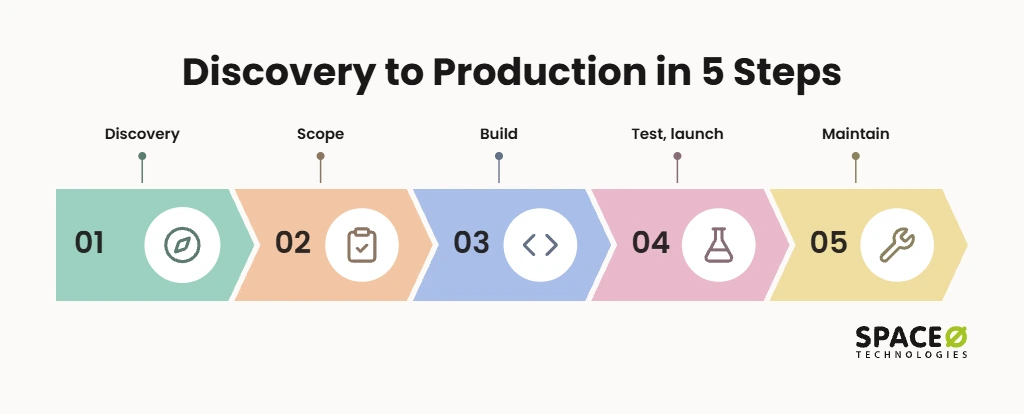
Teams often stall between a promising pilot and a system staff use daily. These steps close that gap:
- Discovery and AI readiness: We map your goal, data, and systems through our AI consulting services, then name the first workflow worth automating.
- Scoped first system: We fix the scope, success measures, and engagement model before any code is written.
- Build with your team: Engineers ship in sprints, and your project manager reports progress every day. You can also hire AI developers to join your sprints.
- Test and launch: We run grounding, evaluation, and human-review checks before real users see the feature.
- Maintain and hand over: We monitor, update, and support the system, or hand it to your team with documentation.
Comparison of Seattle AI Development Options
Seattle buyers can choose a local boutique, a full-cycle remote partner, an in-house team, or staff augmentation. Each option trades speed, control, and cost differently.
| Option | Time to first production system | AI systems already in production | Responsible-AI controls | Code and IP ownership | Engagement flexibility |
|---|---|---|---|---|---|
| Local Seattle boutique | Varies by firm; no verified benchmark | Varies by firm; ask each vendor for a count | Varies; request a written policy | Depends on contract terms | Varies by firm |
| Full-cycle partner (Space-O Technologies) | Proof of concept in 4-8 weeks; MVP in 4-16 weeks | 50+ | No training on client data, PII masking, hallucination and bias testing, human review | Full code and IP transfer at project completion | Dedicated team, time and material, fixed cost, staff augmentation |
| Building an in-house AI team | Depends on hiring time; no verified benchmark | Starts at zero for a new team | Your team designs and maintains them | Full, by default | Low: fixed salaries and hiring cycles |
| Staff augmentation | Depends on your existing team | Depends on your existing team | Your team owns them | Depends on contract terms | High for headcount; you own delivery |
Where a local boutique fits better: A local Seattle boutique can suit teams that need frequent in-person workshops at their own office.
Frequently Asked Questions
How much does AI development cost in Seattle?
A fixed-cost AI MVP costs $20,000 to $40,000, and a mid-level AI app runs $80,000 to $200,000. A basic AI feature runs $40,000 to $100,000. Monthly model API, hosting, and maintenance costs come on top.
How long does it take to build a production AI system?
A proof of concept takes 4 to 8 weeks, and an MVP launches in 4 to 16 weeks. A basic AI feature takes 2 to 4 months. A mid-level AI app takes 4 to 7 months.
Should a Seattle team choose a local firm or a remote partner?
Choose a local boutique if you need frequent in-person workshops at your own office. A remote partner suits teams that want a full delivery team, daily updates, and flexible engagement models. Ask each vendor for production examples and a written responsible-AI policy first.
Can an AI partner build HIPAA-ready software for Washington health-tech teams?
Yes. We build HIPAA-ready platforms with encryption at rest and in transit. Washington’s My Health My Data Act (MHMDA) also covers consumer health data. Ask any vendor how they handle consent, data mapping, and deletion.
Who owns the code and IP when you hire us to build an AI project?
You own it. All source code, data, and IP transfer to you at project completion. We also sign an NDA before every project.
Do we need to already be on AWS or Azure before starting an AI project?
No. A development partner can build on the cloud you already use. That may be AWS, Microsoft Azure, or Google Cloud Platform (GCP). On-premises systems can be moved to the cloud and connected through APIs. Before kickoff, list your current systems and who owns access to each.



 All our projects are secured by NDA



 4.8


