By

Contents
- Data privacy in AI covers training data, prompts, models, outputs, and logs.
- The four key risks are leakage, unconsented use, re-identification, and proprietary data exposure.
- U.S. teams juggle state laws, HIPAA, and FERPA, plus GDPR and the EU AI Act for EU data.
- Minimize, mask, and limit data before any model sees it.
- Retrieval-augmented generation (RAG) usually makes deletion easier than fine-tuning, which bakes data into weights.
Key Takeaways
Data privacy in AI development projects involves protecting data from collection to outputs. It covers training data, deployed models, user prompts, and generated responses. Teams manage it with data minimization, de-identification, and differential privacy.
Your team wants to ship AI without exposing customer records. One leaked prompt or memorized record can trigger fines and lost trust. Fixing privacy after launch usually means rebuilding the architecture.
This guide covers the key risks, U.S. and EU laws, and practical controls. It also compares RAG and fine-tuning for deletion and leakage. Use it with our AI development project roadmap when you plan your build.
How does Space-O Technologies keep client data private in AI builds?
Space-O Technologies applies privacy controls by default, before any client data enters an AI pipeline. Your team should not have to choose between shipping AI and protecting customer records. These controls are standard on our builds:
- No training on client data: We do not use your data to train models outside your project.
- PII masking: We mask personally identifiable information (PII) before data reaches a pipeline, prompt, or model.
- Hallucination and bias testing: We test every AI feature for fabricated answers and biased outputs before release.
- Human review for high-stakes decisions: People approve consequential outputs, such as lending or clinical decisions, before they take effect.
- NDA-protected work with full ownership: Your team owns the code and intellectual property (IP) from day one.
- Security and compliance: We hold ISO 27001 and ISO 9001 certifications, and our builds are HIPAA-ready and GDPR compliant.
- Data residency options: You choose where your data is hosted: the U.S., the EU, or India.
These controls come from production work, not slide decks. Space-O Technologies has 50+ AI systems live in production, built by 30+ AI engineers. We are an OpenAI Select Partner and an AWS Partner, and our team includes Claude Certified Architects. We have served 1,200+ clients since 2010. Our generative AI integration services apply these same controls.
What are the key privacy risks in AI development projects?
The four key privacy risks are data leakage, unconsented data use, re-identification, and proprietary data exposure. Each one can expose customer records or trade secrets before anyone notices.
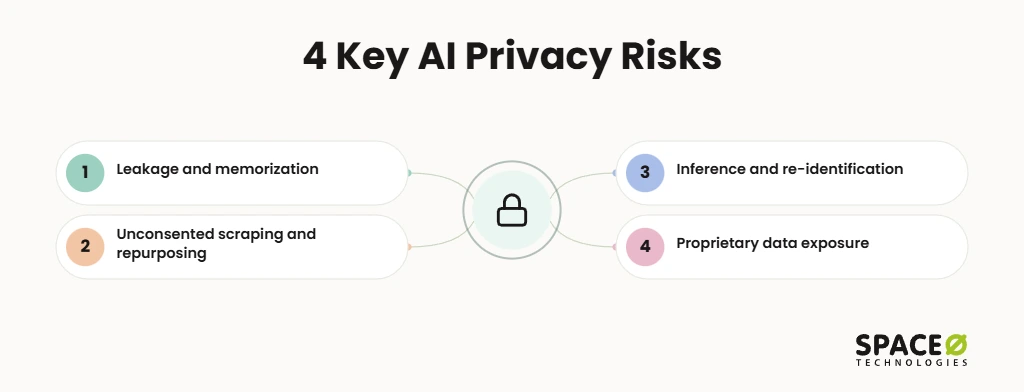
- Data leakage and memorization: Inputs retained by public AI platforms can surface to other users. Models can also memorize and repeat PII from training data.
- Unconsented scraping and repurposing: Scraping data or reusing customer data for model training without explicit consent violates user expectations and privacy law.
- Inference and re-identification: De-identified data can be re-identified when it is cross-referenced with other datasets, exposing individuals the team believed were anonymous.
- Proprietary data exposure: Source code, trade secrets, and confidential business data pasted into public AI tools can leave your control permanently.
Attackers also target models directly. Model inversion attacks try to reconstruct training records from model outputs. Membership inference attacks test whether a specific person’s record was in the training set. Agent-based systems add more exposure, so review our AI agent security best practices.
The trend is upward, and mature teams plan for it. McKinsey’s state of AI research finds that high performers manage more AI-related risks than their peers.
Which U.S. privacy laws apply to AI development projects?
No single federal law governs AI privacy in the U.S. Obligations come from state laws, sector laws, and frameworks. For most product teams, the hard part is mapping which rules apply to which datasets. These are the ones that come up most:
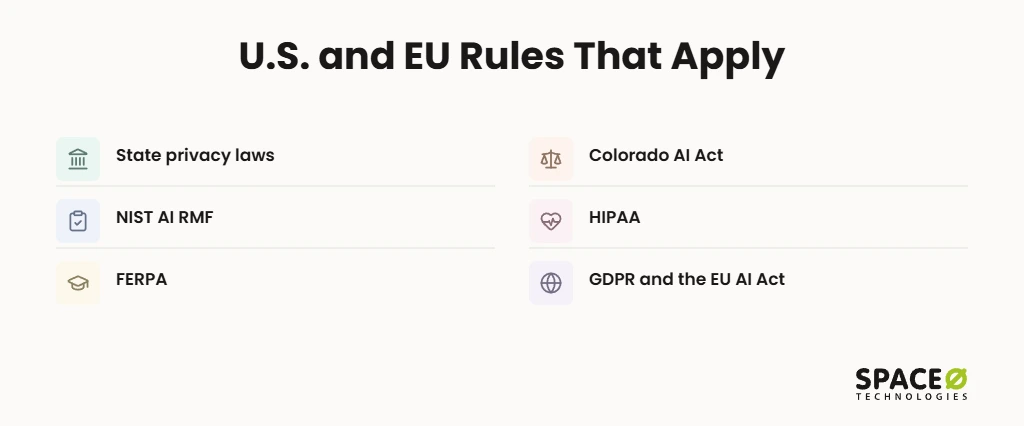
- State Privacy Laws: The California Consumer Privacy Act and California Privacy Rights Act (CCPA/CPRA) apply. Colorado and Virginia laws also govern how personal data is used.
- Colorado AI Act: The Colorado AI Act adds AI-specific obligations for systems used in consequential decisions about Colorado residents.
- NIST AI Risk Management Framework: NIST’s AI Risk Management Framework gives teams a structured way to identify, measure, and manage AI risks. Privacy is among the AI risks that this framework helps teams identify, measure, and manage.
- HIPAA: The Health Insurance Portability and Accountability Act (HIPAA) governs protected health information (PHI) used in healthcare AI.
- FERPA: The Family Educational Rights and Privacy Act (FERPA) governs student education records used in AI systems.
- GDPR and the EU AI Act: The General Data Protection Regulation (GDPR) and the EU AI Act apply when you process EU residents’ data. This holds even for the U.S.
What are the best practices for privacy in AI development?
The best practices are to collect less data, strip what you collect, protect it during training, and lock down deployment. Each layer covers gaps the others leave open. The sections below group these practices by where they sit in the build.
Which practices protect data before it reaches a model?
Minimize, limit, and de-identify data before any model sees it. Data that never enters the pipeline cannot leak from it.
- Data minimization: Feed the model only the specific data points it truly needs for the task, and nothing more.
- Purpose limitation: Use data only for the purpose users agreed to, and get fresh consent before repurposing it for training.
- Privacy by design: Build privacy controls into the architecture from day one, not as an afterthought before launch.
- Anonymization, masking, and tokenization: Remove or replace identifiers before training. Tokenization can be reversible, so protect the token vault carefully.
- Synthetic data: Generate synthetic data that mimics real statistical patterns without exposing any real customer records.
- Data protection impact assessment (DPIA): Run a DPIA before high-risk processing to document risks, legal basis, and controls.
Which privacy-enhancing technologies (PETs) belong in an AI project?
Privacy-enhancing technologies let a model learn from data without exposing individual records. They add engineering cost, so match each one to a real risk.
- Privacy-enhancing technologies (PETs): Techniques that protect data mathematically or architecturally during training and computation.
- Differential privacy: Differential privacy adds controlled statistical noise so individual records cannot be singled out or reverse-engineered.
- Federated learning: Federated learning trains models across decentralized devices or servers without centralizing the raw data.
- Homomorphic encryption: Homomorphic encryption runs computations on encrypted data without decrypting it first.
How do you control deployment, vendors, and logs?
Treat every AI vendor, prompt, and log as part of your data perimeter. Many leaks happen after launch, not during training.
- Private deployments: Use enterprise APIs with zero data retention terms, or host models in an isolated virtual private cloud (VPC) or on-premises. Many teams hire dedicated AI developers to build these environments.
- Vendor due diligence: Confirm whether a vendor trains on your inputs and how long it retains data. Ask if it signs a data processing agreement.
- Prompt and log governance: Apply the same retention and deletion rules to prompt histories and input/output logs as to primary databases.
- Access controls and audit logging: Use role-based access control (RBAC) and log every model interaction for later review.
Which privacy controls apply at each AI project phase?
Each phase of an AI project has its own privacy checkpoint. Teams that defer privacy to launch usually rework architecture under deadline. PwC’s Responsible AI survey tracks how well companies build AI governance into risk, privacy, and security processes. Map the controls to phases instead:
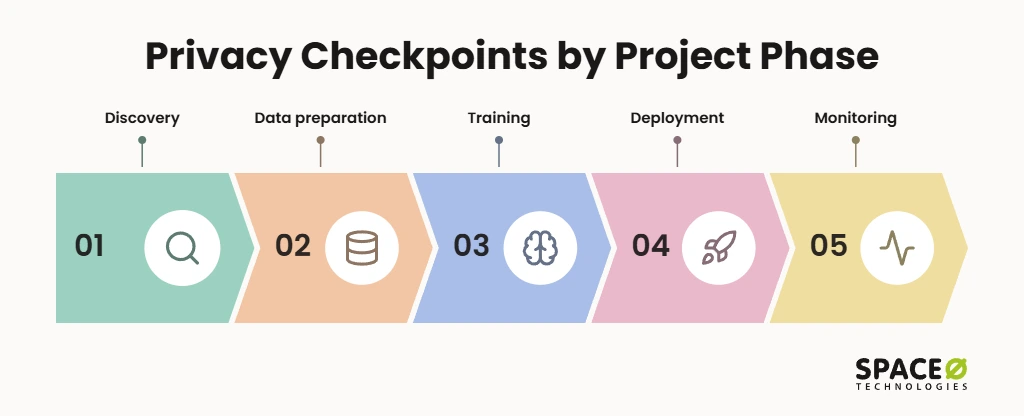
- Discovery: Run the DPIA, classify data types, and decide whether the use case needs personal data at all. Our machine learning consulting services support this step.
- Data preparation: Apply data minimization, masking, tokenization, or synthetic data before any dataset reaches engineers.
- Training or fine-tuning: Apply differential privacy or federated learning where the risk justifies the extra engineering cost.
- Deployment: Use zero data retention APIs or VPC hosting, RBAC, and human review for high-stakes outputs.
- Monitoring: Audit logs, track data lineage, and test outputs for memorized PII on a regular schedule.
How this plays out depends on what you are building:
- A startup fine-tuning an LLM for an MVP: Use synthetic or masked data first, then add real data only where the large language model (LLM) needs it.
- An SME connecting a chatbot to its CRM: Scope chatbot access to the customer relationship management (CRM) fields each user may already see.
- A healthcare or fintech team: Keep PHI and lending data in HIPAA-ready environments, with human review. See our healthcare software development services for regulated builds.
- An enterprise moving AI to a private cloud: Pair VPC hosting with vendor contracts that forbid training on your inputs.
Spot Data Privacy Gaps in Your AI Project Not sure where your project’s data flows carry risk?
Get a privacy review and leave with a clear, prioritized list of gaps to fix before launch.

RAG vs. fine-tuning: which keeps your data more private?
Retrieval-augmented generation (RAG) usually keeps data more controllable than fine-tuning, because the data stays outside the model’s weights. This choice decides how hard it will be to honor a deletion request later. Many teams make it on accuracy and cost alone, then hit the privacy cost in production.
Where does your data live in each approach?
In RAG, your data stays in a separate store. In fine-tuning, it shapes the model itself. That difference drives everything else.
| Factor | RAG | Fine-tuning |
|---|---|---|
| Where data lives | Document store or vector database, retrieved at query time | Encoded into model weights during training |
| Deletion requests | Remove the record and its embeddings from the index | Data is “baked into” weights; full removal may require retraining |
| Leakage path | Over-broad retrieval returns records a user should not see | Model memorizes and regurgitates training examples |
| Main control point | Access rules and filters on the retrieval layer | Training data selection, masking, and differential privacy |
| Prompt and log exposure | Prompts and retrieved context are logged | Prompts and outputs are logged |
The same comparison in list form:
- RAG data location: RAG keeps its source data in a document store or vector database. RAG retrieves that stored data only at the moment a query needs it for an answer.
- Fine-tuning data location: Fine-tuning encodes training data into model weights, so the data becomes part of the model itself.
- RAG deletion: In RAG, deleting a record from the store and its embeddings stops it from appearing in future answers.
- Fine-tuning deletion: In fine-tuning, data baked into weights is hard to remove, and full removal may require retraining the model.
- RAG leakage risk: RAG pipelines and vector databases are exposure points themselves when retrieval ignores user permissions.
- Fine-tuning leakage risk: Fine-tuned models can memorize and regurgitate training examples, including PII and confidential text.
- Shared risk: Both approaches log prompts and outputs, so log governance applies regardless of the architecture you choose.
How should you choose between RAG and fine-tuning for privacy?
Choose RAG when the data is personal, changes often, or may face deletion requests. Fine-tune only on data you can keep permanently. Fine-tuning still fits when you need a consistent tone, format, or domain behavior. In that case, train on masked or synthetic data so the weights hold patterns, not people.
We pick the approach by what solves the problem most cost-effectively, not by habit.
Space-O Technologies decides between RAG and fine-tuning during discovery, based on your data and deletion needs. We weigh pre-built versus custom AI models and the LLM integration project cost alongside privacy. PII is masked before it reaches any third-party model, whichever approach is chosen.
Deciding between RAG and fine-tuning for sensitive data? Talk to our AI engineers about your architecture and get a recommendation matched to your data.
Frequently Asked Questions
What is AI privacy?
AI privacy means protecting personal and proprietary data across the AI lifecycle. It applies to training datasets, deployed models, user prompts, and generated responses. Its goal is to prevent leakage, re-identification, and use of data without consent.
Can AI systems access sensitive enterprise data?
Yes, an AI system can reach any data it is connected to or fed. Access scoping decides what it sees, so limit it to fields each user may already view. Over-broad retrieval in a RAG pipeline can return records a user should not see.
Can synthetic data replace real data when building AI features?
Synthetic data can stand in for real data early in a project, but not everywhere. It mimics real statistical patterns without revealing real customer records. Begin with synthetic or masked data, then add real data only where the model needs it.
What does a high-risk AI system need in place before launch?
A high-risk AI system needs documented safeguards before launch. Run a data protection impact assessment (DPIA) to record risks, legal basis, and controls. Add human review, role-based access control, and audit logging of every model interaction. Check whether laws such as the Colorado AI Act apply.
How do you check whether a deployed model is leaking memorized personal data?
Test model outputs for memorized PII on a regular schedule. Back those tests with audit logs and data lineage tracking, so leaked content traces to its source dataset. If the leak comes from training data, add masking, tokenization, or differential privacy.
Is RAG or fine-tuning safer for private data?
RAG is usually safer for private data because the data stays outside the model’s weights. Deleting a record and its embeddings stops it from appearing in answers. Fine-tuned weights may need retraining to remove data.



 All our projects are secured by NDA