
 By
Contents
- Separate build-and-run contracts from customer-facing product pricing before comparing any ML quote.
- Fixed price fits a scoped PoC with clean data; capped T&M fits uncertain data.
- Get compute terms in writing, because GPU time is a separate cost line.
- Budget data preparation as a large share of the project and upkeep as a yearly share of the build.
Key Takeaways
Machine learning development pricing models define how you pay to build ML and how ML products get charged. Build pricing covers Fixed-Price/Milestone, Time & Materials (T&M), and Dedicated Team, Time & Materials, Fixed Cost, and Staff Augmentation/Retainer contracts. Compute is billed pay-as-you-go or reserved. Product pricing covers Usage-Based, Tiered Subscription, Seat-Based, Hybrid (Commitment + Usage), and Outcome-Based models.
Most ML budgets break down on a line nobody priced, such as data preparation, graphics processing unit (GPU) time, or upkeep. This guide covers paying for ML development, not using ML to set your own product prices. Space-O Technologies has built AI-powered custom software since 2010, including machine learning development services for startups, SMEs, and enterprises.
Below, each model gets a definition, a best-fit line, and a caveat. You also get US market cost ranges and a worked three-year cost example. If you are still scoping what machine learning development involves, start there, then use the main models at a glance below.
| Model | Bucket | Who carries cost risk | Best fit |
|---|---|---|---|
| Fixed-Price/Milestone | Build | Vendor, priced into the quote | Scoped proof of concept (PoC) or minimum viable product (MVP) with clean data |
| Time & Materials (T&M) | Build | Client, or shared at an agreed cap | Data exploration and pilots |
| Dedicated Team/Retainer | Build and run | Client, as a monthly fee | Machine learning operations (MLOps) and retraining |
| Outcome-Based | Build or product | Shared, tied to a key performance indicator (KPI) | Proven use case with a baseline |
| Hybrid (phased) | Build | Moves from vendor to client by phase | Full lifecycle |
| Pay-as-you-go, reserved, or spot compute | Run | Client, unless bundled | Training and inference |
| Usage-Based | Product | Customer pays per unit used | Variable workloads |
| Tiered Subscription | Product | Seller absorbs use within each tier | Predictable customer budgets |
| Seat-Based | Product | Seller absorbs heavy users | Per-user tools |
| Hybrid (Commitment + Usage) | Product | Shared between seller and customer | Base plan plus overages |
1. Engagement Models for ML Builds
Engagement models decide how you pay a development team, and each splits budget and data risk differently. Founders and CTOs often sign a contract before they know whether their data will hold up. Our guide on how to outsource AI development starts with that data audit. The five models below run from the most fixed to the most blended.
Fixed-price/milestone
Fixed-Price/Milestone pricing sets one agreed price for defined deliverables, paid as each milestone is approved. Phases such as data audit, PoC, pilot, and production are priced and signed off in turn. The vendor absorbs overruns and prices that risk into the quote, so the buffer can be substantial. A fixed-price AI app quote shows how agreed scope sets that price.
- Best for: A PoC or MVP with frozen specs, such as churn prediction on clean customer relationship management (CRM) data.
- Watch for: Messy data triggers change requests, and Gartner explains why generative AI projects stall after the proof of concept.
Time & materials (T&M)
Time & Materials (T&M) bills the hours worked and the compute used, in regular cycles. It is the standard model for exploratory ML work where scope and data quality are still unknown. Discovery comes first in what machine learning development services include. Capped T&M adds a hard spending ceiling, so at the cap, work pauses or scope is renegotiated.
- Best for: Feasibility research, such as testing whether sensor data can predict equipment failure.
- Watch for: Without a cap, you carry the budget risk, so ask for one before a pilot heads to production.
Dedicated team/retainer
A Dedicated Team/Retainer gives you a standing ML pod for a predictable monthly fee. A common pod is a data engineer, an ML scientist, and an MLOps engineer. The pod keeps a live model accurate as real-world data shifts. Compare an AI development company vs. staff augmentation if you only need extra hands.
- Best for: Post-launch monitoring, drift detection, retraining, and roadmap features.
- Watch for: You pay for capacity whether or not you use all of it.
Outcome-based pricing
Outcome-Based pricing ties part of the fee to a measured business result, on top of a base fee. The KPI might be fraud losses avoided or stockouts held below an agreed level. Our guide to the ROI of AI software development shows how to set that baseline. McKinsey’s State of AI survey tracks how companies scale AI use cases.
- Best for: Proven use cases with a clean, agreed baseline metric.
- Watch for: The vendor shares performance risk, so the base fee and terms reflect it.
Hybrid phased pricing
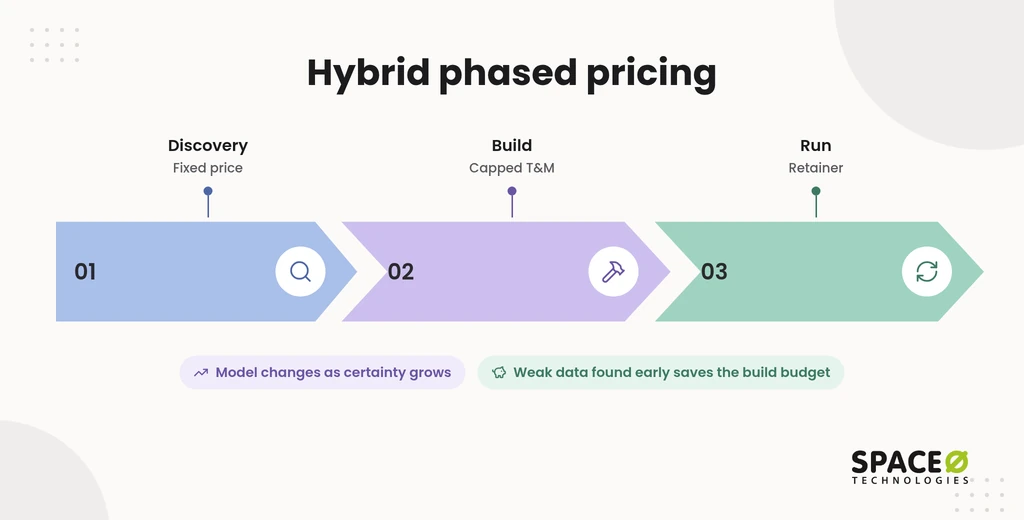
Hybrid pricing uses a different model for each phase as certainty grows. A common pattern is fixed-price discovery, then capped T&M for the build, then a retainer to run it. A discovery phase that shows the data cannot support the use case saves the build budget. Our breakdown of AI software cost by engagement model shows how billing models change the total.
- Best for: A clear first step with an uncertain path to scale, such as a recommendation-engine PoC.
- Watch for: Risk shifts from the vendor in fixed phases to you in flexible ones.
Contracts price the people. The next layer prices the machines your model trains and runs on.
Match Your ML Build to the Right Contract
Tell us your use case, data readiness, and budget limits. Our ML team recommends the engagement model that fits and shares an expert-reviewed estimate for your scope.

2. Compute and Token Pricing for Training and Inference
Compute is billed separately from development: GPU-hours for training, and tokens, calls, or hosting for inference. It is the cost line most ML contracts leave vague. It also grows with every experiment and retraining cycle. GPU time is commonly priced at $8-$25 per GPU-hour.
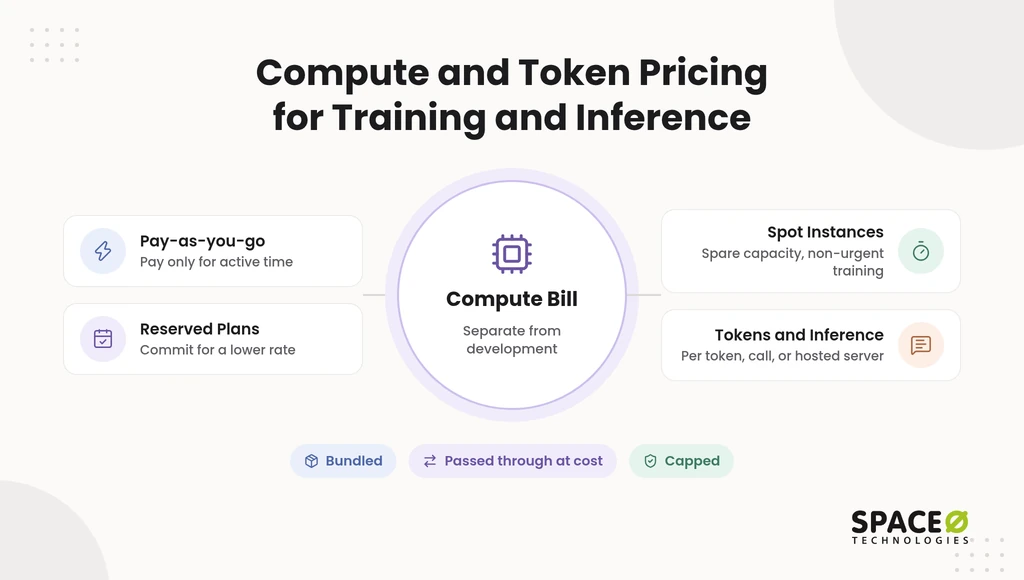
- Pay-as-you-go: AWS, Azure, and Google Cloud charge only for active compute time.
- Reserved/savings plans: Reserved Instances and Savings Plans, on services like SageMaker, trade a usage commitment for a lower rate.
- Spot instances: Spare capacity runs well below on-demand prices and suits non-time-critical training.
- Tokens and inference: Hosted models bill per token or application programming interface (API) call, while dedicated servers cost money even when idle.
Training a model from scratch scales with its size. GPUnex’s training-cost table gives these AWS estimates.
| Model size | Approximate GPU-hours | Training cost on AWS (USD) |
|---|---|---|
| 1B parameters | ~1,000 | $4,000-$7,000 |
| 7B parameters | ~10,000 | $40,000-$70,000 |
| 13B parameters | ~25,000 | $100,000-$175,000 |
| 70B parameters | ~200,000 | $800,000-$1.4M |
Most business projects fine-tune an existing model instead. CloudZero’s cost-to-train guide puts fine-tuning at tens to thousands of dollars. For inference at scale, our AI chatbot development cost guide puts API fees for 10,000 monthly conversations at $500 to $3,000.
Every contract should state whether compute is bundled, passed through at cost, or capped. It should also say who absorbs overruns and how retraining is billed. Those choices shape what you charge customers, too.
3. How ML Products Are Priced to Customers
If you sell an ML product, monetization models set what customers pay, separate from what you paid to build it. Software as a service (SaaS) founders feel this first, because every AI request carries a real compute cost. Stripe’s guide to AI pricing models lists the same families, plus capability-based pricing.
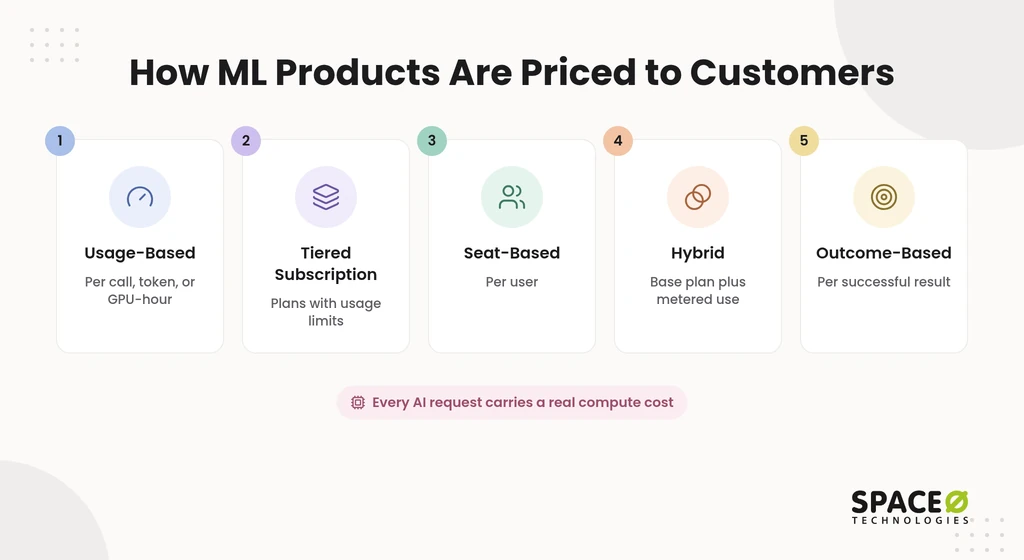
- Usage-Based: Customers pay per API call, token, or GPU-hour, so revenue tracks cost but bills are harder to predict.
- Tiered Subscription: Customers buy fixed monthly plans with rising usage limits, and overages apply above each tier.
- Seat-Based: Customers pay per user, as with GitHub Copilot, though Alguna notes heavy users can turn unprofitable.
- Hybrid (Commitment + Usage): Customers pay a base subscription for included usage, and metered charges apply above it.
- Outcome-Based: Customers pay per successful result, such as a resolved ticket.
Whichever model you sell on, your margin depends on what the build and its upkeep cost you.
4. ML Development Cost by Project Stage
Published benchmarks put an ML PoC at $25,000-$80,000 and a full custom ML solution at $120,000-$400,000. Founders and CTOs need a budget range before they choose a model. These market tiers repeat across many agency pricing guides.
| Scope | Typical cost (USD) | Typical timeline |
|---|---|---|
| Proof of concept (PoC) | $25,000-$80,000 | 4-8 weeks |
| Production AI feature | $60,000-$180,000 | 2-4 months |
| Full custom ML solution | $120,000-$400,000 | 3-8 months |
| Enterprise AI platform | $150,000-$500,000+ | 6-12+ months |
Space-O Technologies’ own AI development cost guide puts a proof of concept at $15,000 to $40,000 over 4 to 8 weeks. A basic AI feature runs $40,000 to $100,000 over 2 to 4 months. A mid-level AI application runs $80,000 to $200,000.
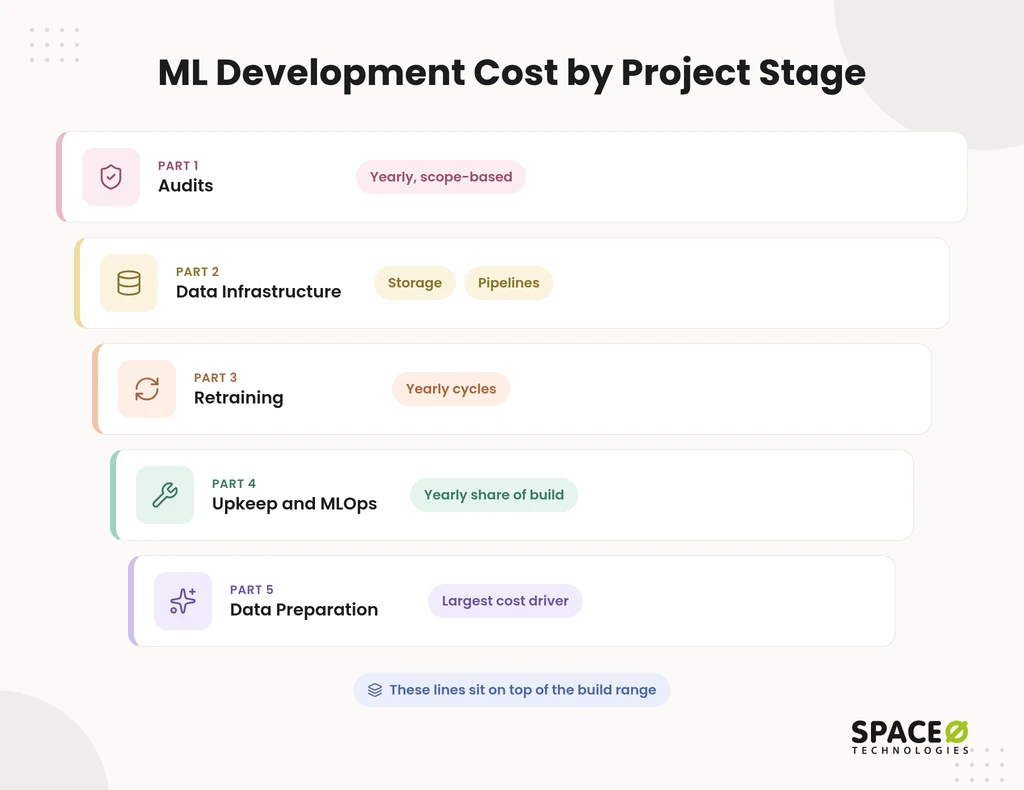
In most projects, data work, integrations, and production engineering cost more than the model itself, so these five cost lines sit on top of the build ranges above:
- Data preparation: A large share of the total project budget, and the single largest cost driver in an AI build.
- Upkeep and MLOps: A recurring yearly share of the original build cost.
- Retraining: $15,000 to $60,000 per year on retraining cycles.
- Data infrastructure: $500 to $5,000 per month for storage and pipelines.
- Audits: $10,000 to $40,000 per year, depending on the scope.
With costs mapped, the next question is which contract fits your project.
5. How to Choose an ML Pricing Model
Choose by two factors: how clearly your scope is defined and how ready your data is. Most budget overruns happen when the pricing model does not match how uncertain the project is. Use this decision guide.
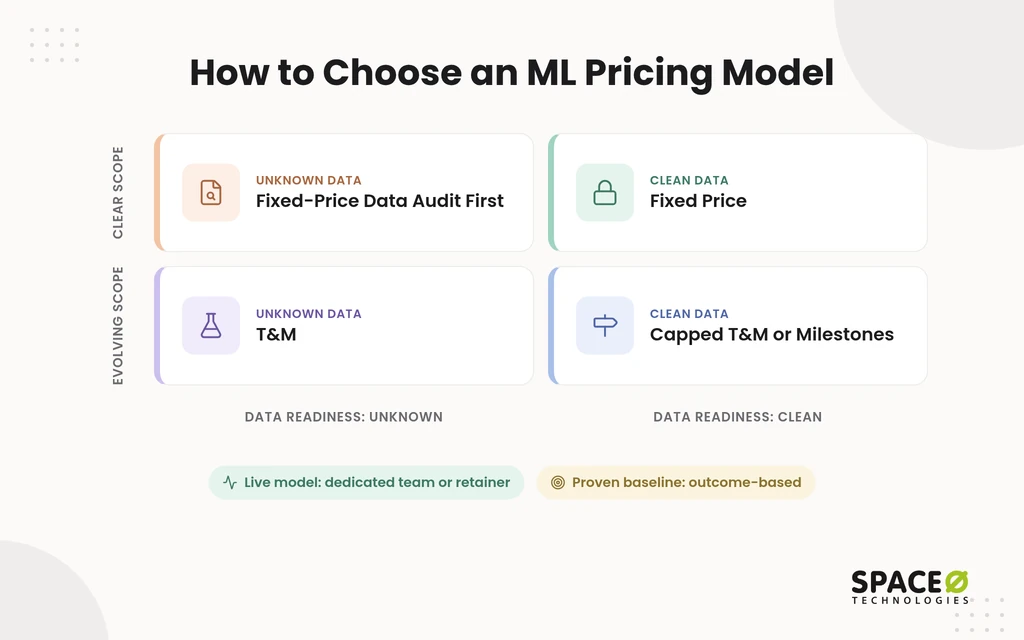
- Clear scope and clean data: Fixed price.
- Clear scope and unknown data: A fixed-price data audit or PoC, then milestones or capped T&M.
- Evolving scope and clean data: Capped T&M or milestones.
- Evolving scope and unknown data: T&M.
- Model live in production: A Dedicated Team, Time & Material, Fixed Cost, and Staff Augmentation or retainer for MLOps and retraining.
- Proven use case with a measurable baseline: Outcome-based terms.
Space-O Technologies offers four engagement models: Dedicated Team, Time & Material, Fixed Cost, and Staff Augmentation. Each one fits a different ML stage.
| Space-O Technologies model | Best-fit ML stage | Why it fits |
|---|---|---|
| Fixed Cost | Scoped MVP or PoC | Scope, timeline, and budget are agreed before work starts. |
| Time & Material | Data-uncertain experimentation | You pay for actual time and resources while the data is tested. |
| Dedicated Team | Ongoing retraining and MLOps | A standing pod owns the model after launch. |
| Staff Augmentation | ML engineers joining an in-house team | Your CTO keeps control without a hiring cycle. |
Fixed Cost payments are milestone-based and tied to deliverables. For our MVP development services, a basic MVP starts at $15,000 and a feature-rich MVP runs up to $50,000+. Treat that as software MVP pricing, not an ML quote.
Dedicated Team, Time & Material, Fixed Cost, and Staff Augmentation engagements bill weekly or monthly, with a 25-hour minimum. When you hire ML developers as a dedicated team, billing is monthly at 160 hours full-time or 80 part-time, with a one-month minimum. Capped T&M, milestone gates, and outcome-based terms fall outside these four models, so ask us about them.
An external vendor is not always the right answer:
- In-house build: This wins when you already employ ML engineers and own a long roadmap.
- API-only use of a hosted model: This wins when a general model already handles the task.
- Hyperscaler platforms such as SageMaker or Azure ML: These win when your team can run MLOps itself.
If you are unsure which route applies, machine learning consulting can settle it before you sign a build contract.
6. Worked Example: Three-Year ML Total Cost
A $150,000 ML build comes to about $ 213,000- $ 405,000 over three years before compute. Cost guides list these lines separately, so budgets rarely show the full commitment in one number. This example adds them up using the ranges in section 4.
The assumptions are:
- The build is $150,000, an illustrative figure inside the market production-feature and full-custom tiers, not a Space-O Technologies quote.
- Data preparation sits inside the build as its own large line item.
- Upkeep starts in year two as a recurring yearly share of the build.
- Data infrastructure runs $500-$5,000 per month, or $6,000-$60,000 per year, for all three years.
| Cost line | Year one (USD) | Years two and three, combined (USD) |
|---|---|---|
| Build, including data preparation | $150,000 | $0 |
| Data infrastructure | $6,000-$60,000 | $12,000-$120,000 |
| Upkeep and MLOps | $0 | $45,000-$75,000 |
| Total before compute | $156,000-$210,000 | $57,000-$195,000 |
Compute adds to every column. Every 100 GPU-hours at 8-25 adds 800-2,500, and token fees scale with traffic. Scheduled retraining and audits from section 4 sit on top where they apply.
The takeaway: the build is only part of the three-year bill before compute. Price the run years before you choose a contract.
See Your Three-Year ML Cost Before You Commit
Send your scope and data sources. We map build, data preparation, compute, and upkeep into a one-year and three-year budget you can plan around.
7. Get a Pricing Model Matched to Your Project
Space-O Technologies matches a pricing model to your project after a business-first discovery of your data and tech stack. Buyers putting AI into production need proof that the team ships and that its controls hold up. Here is what backs each engagement:
- Delivery record: 1,200+ clients served since 2010, 300+ software solutions, and 50+ AI systems in production.
- Team: 140+ in-house developers and 97% client retention.
- Scale proof: Glovo, an on-demand delivery app we built, grew into a unicorn with 50M+ downloads.
- Partnerships: OpenAI Select Partner, AWS Partner, and Claude Certified Architects.
- Production controls: Grounding, evaluation, and hallucination and bias testing before release, with people approving consequential decisions.
- Protection: A non-disclosure agreement (NDA) before every project, no training on client data, and personally identifiable information (PII) masking.
- Ownership and transparency: Full code and intellectual property (IP) ownership at completion, plus a dedicated project manager with daily updates.
To get a matched recommendation, share three things:
- Your project stage, from idea to live model.
- Your data readiness, including volume, labels, and access.
- Whether you need vendor build pricing, product pricing, or both.
Send them through our contact page to receive a free, expert-reviewed ML estimate with a recommended pricing model.
Frequently Asked Questions
Who should choose staff augmentation instead of a dedicated ML team?
Staff augmentation adds ML engineers to your in-house team without a hiring cycle. A Dedicated Team, Time & Material, Fixed Cost, and staff augmentation suit companies that need ongoing MLOps and retraining once the model is live. Choose augmentation for extra hands, and a dedicated team for a pod that owns post-launch ML work.
When should I choose capped T&M over milestone-based pricing?
Choose capped T&M when scope may shift but the budget cannot. A hard spending ceiling pauses work or reopens scope at the cap, so the budget risk is shared. Choose milestone-based pricing when you move from PoC to production in phases, each signed off before the next.
What data readiness should I confirm before picking a pricing model?
Confirm whether your data is clean and whether your scope is clearly defined. A clear scope with clean data points to fixed price. An evolving scope with unknown data points to T&M. A clear scope with unknown data points to a fixed-price data audit first. Data preparation typically takes a large share of the total project budget, so the answer changes your quote.
Does an ML pricing model cover maintenance and retraining after launch?
Not automatically, so confirm retraining terms in the contract before you sign. A retainer or dedicated team covers post-launch monitoring, drift detection, and retraining. Budget a yearly share of the original build cost for upkeep, and a separate yearly amount for retraining.
Is outcome-based pricing realistic for a founder with an early-stage ML idea?
Usually not. Outcome-based pricing suits proven use cases with a clear, agreed baseline metric. An unproven idea with unknown data fits T&M or a fixed-price PoC better.
Which ML pricing model should I start with?
Start with fixed price or T&M, then move to a hybrid model as the project scales. Fixed price suits a scoped PoC with clean data. T&M suits exploratory work where the data is still unknown. A hybrid model joins the two once the path to production is clear.
What does an ML project cost under these pricing models?
Published benchmarks put an ML proof of concept at $25,000-$80,000. A full custom ML solution runs $120,000-$400,000. Data preparation, upkeep, and compute sit on top of those build ranges.
Not Sure Which ML Pricing Model Fits Your Project?
Tell us your scope, data, and timeline. Our ML engineers review it and send a free, expert-reviewed estimate with the pricing model that fits.



 All our projects are secured by NDA




 4.8


