
 By
By 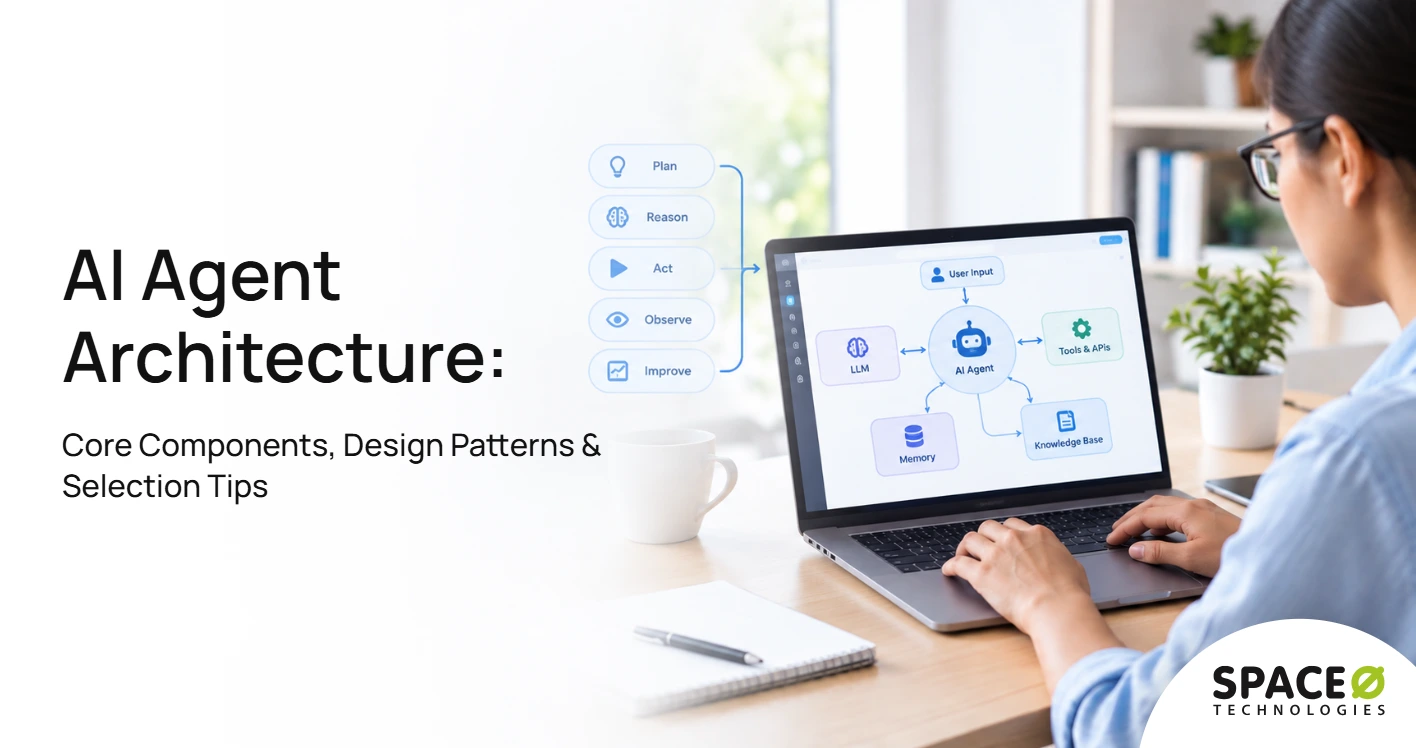
Contents
- AI agent architecture rests on five components working together: perception, reasoning, memory, tools, and orchestration, connected by a repeating decision loop.
- The right pattern, whether ReAct, Plan-and-Execute, or multi-agent orchestration, depends on task complexity and latency constraints, not which one is trending.
- Security and governance, including guardrails against excessive agency and prompt injection, are architectural decisions made upfront, not optional features added later.
Key Takeaways
A demo agent can answer ten questions correctly. Then it fails when a real user needs three lookups across two systems. AI agent architecture provides the structure that connects perception, reasoning, memory, tools, and orchestration into a working decision loop. Patterns such as ReAct, Plan-and-Execute, and multi-agent orchestration build on this foundation.
Model quality gets most of the attention. Architecture determines whether that model works reliably in production. Gartner projects that 40% of enterprise applications will incorporate AI agents by 2026, up from less than 5% in 2025. As adoption grows, choosing the right architecture becomes critical for reliability, scalability, security, and control.
This guide breaks down the core components of AI agent architecture and the design patterns used in 2026. You’ll also learn how to choose an architecture, address key security considerations, and avoid common design mistakes. If you’re new to AI agents, start with this AI agent explainer to understand how they work before diving into their architecture.
For businesses planning to build production-ready AI agents, the architecture is only one part of the development process. Our AI agent development services cover architecture, development, integration, testing, and deployment around specific business workflows.
What Is AI Agent Architecture?
AI agent architecture is the full stack that enables an AI agent to perceive context, reason through tasks, use tools, and take action toward a goal. It defines how the agent receives information, decides what to do next, accesses external systems, and maintains the context needed across multiple steps.
A single prompt-response call is not an agent. An agent operates in a loop: the model interprets context, selects an action, receives the result, and decides what to do next. This loop continues until the agent reaches its goal or requires human intervention.
Four questions form the foundation of an effective AI agent architecture:
- What context does the agent need? This includes user inputs, conversation history, retrieved knowledge, memory, and data from external systems.
- How does the agent decide what to do next? The reasoning layer determines whether to answer, retrieve information, call a tool, ask for clarification, or take another action.
- What actions can the agent perform? Tools and integrations connect the agent to APIs, databases, CRMs, search systems, and other software.
- How is the agent kept safe and controlled? Permissions, validation, guardrails, monitoring, and human approval help prevent unwanted or unsafe actions.
Memory supports agents that need context across multiple interactions. Short-term memory maintains the current task context, while long-term memory preserves relevant information for future interactions. Some architectures also use graph databases to represent relationships between entities, users, documents, and events, giving agents structured context for more complex reasoning. Together, these components determine how information moves through the agent’s perception, reasoning, memory, tool use, action, and feedback loops.
Agentic vs. non-agentic systems
The main difference is how the system determines its next action. Non-agentic systems follow predefined workflows, while agentic systems dynamically choose actions based on context, goals, and results.
| Non-agentic systems | Agentic systems |
|---|---|
| Follow predefined workflows. | Decide the next action dynamically. |
| Execute fixed steps in a specific order. | Select tools and actions based on context. |
| Produce predictable outputs from defined inputs. | Adapt their behavior as new information arrives. |
| Work well for structured, repeatable tasks. | Work well for multi-step, changing tasks. |
| Example: retrieve ten tickets and summarize them. | Example: search tickets, check a knowledge base, and escalate when needed. |
The distinction is not about choosing one approach over the other. Many production architectures combine both, using deterministic workflows for predictable operations and agentic loops where dynamic decision-making adds value.
Don’t Let the Wrong Architecture Slow Your AI Project
Choose the right agent pattern, tools, memory, and orchestration before development starts and avoid costly changes later.

Core Components of AI Agent Architecture
Every production AI agent architecture relies on five components working together: perception, reasoning, memory, tools, and orchestration. Weakness in any single layer shows up as unreliable behavior, regardless of which model powers the system.
1. Perception
Perception transforms raw input into a structured format the reasoning engine can actually use. Coverage spans user messages, retrieved documents, tool outputs, and any event or sensor data the agent subscribes to.
A common failure mode skips this step entirely. Dumping raw API responses or unprocessed PDFs into the context window leads to poor decisions, no matter how capable the model is. A deliberate extraction step, one that parses what matters and discards what does not, prevents this problem before it starts.
2. Reasoning
The reasoning engine is the model plus the loop that drives it, handling planning, tool selection, and self-correction. Here the agent decides what to do next, based on the current state and goal.
Cost concentrates in this layer too, since each reasoning step is a model call, often against a long context window. Clear tool descriptions and explicit decision criteria change how reliably the model picks the correct next step. Prompt design remains a real architectural concern for this reason, not just a writing task.
3. Memory
Memory systems store the context an agent needs within a session and across multiple sessions over time. Short-term memory tracks the ongoing conversation. Long-term memory persists user- or application-level data across separate interactions.
Long-term memory further splits into three types. Semantic memory retains facts and concepts. Episodic memory recalls past events and actions. Procedural memory stores the rules for how to perform a task. Vector search handles semantic recall well but struggles with relationship-heavy questions. Connecting several pieces of information through shared attributes often needs structured or graph-based retrieval alongside the vector layer.
4. Tools
The tool layer lets an agent reach into external systems: APIs, databases, code execution, and other agents. Tool design matters as much as model choice. A poorly named tool with vague parameters confuses even a capable model.
Research suggests agent performance degrades once a single agent manages more than roughly 10 to 20 tools at once. Such tool explosion pushes many teams toward multi-agent designs instead. Splitting a large tool catalog across several specialized agents beats overloading one. A list of top AI agent frameworks helps clarify which platforms handle tool orchestration most cleanly for a given stack.
5. Orchestration
Orchestration coordinates execution, manages state, and decides how the other four components work together across a multi-step task. Frameworks often call this layer the agent harness or runtime.
The orchestration layer mediates between the model and everything outside it. The layer handles retries, timeouts, structured output parsing, and persistence. More autonomy given to the model means this layer needs to observe and constrain that autonomy more closely.
Know Your Use Case. We’ll Map the Architecture.
Share your workflow with our AI team to identify the components, integrations, and agent pattern your project actually needs.
AI Agent Architecture Patterns
Several design patterns have become standard for structuring how an agent reasons and acts. Each suits a different kind of task. Matching the pattern to the actual problem matters more than defaulting to whichever pattern gets discussed most.
| Pattern | What It Does | Best Fit |
|---|---|---|
| ReAct | Reasons, acts, observes results, and repeats in a single loop | Narrow tool surface, well-defined tasks |
| Plan-and-Execute | A planner decomposes the task; an executor runs each step | Long-horizon work where drift is a risk |
| Reflection | A critic agent reviews and requests revisions to output | Quality-sensitive tasks like code or analysis |
| Tool Use | The agent calls external systems to complete a task | Any task needing live data or computation |
| Orchestrator-Worker | A lead agent delegates subtasks to specialized workers | Open-ended research, parallel exploration |
| Routing and Supervisor | A supervisor agent directs requests to the right specialist | Systems handling varied request types |
| Human-in-the-Loop | A human approves high-impact actions before execution | Actions with real financial or legal risk |
| LLM Skills | Modular, reusable capability packages loaded on demand | Domain expertise without full agent proliferation |
The LLM Skills pattern deserves particular attention as the newest shift in this table. Rather than building a separate agent for every task, a single agent loads modular skill packages only when needed. Each package bundles instructions and scripts together. Doing so reduces tool explosion without the coordination overhead multi-agent systems introduce.
Most production systems combine several of these patterns rather than picking one in isolation. A research agent might use Plan-and-Execute to structure work, Tool Use to gather information, and Reflection to review output.
Single-Agent vs. Multi-Agent Architecture
Single-agent architecture suits tasks with a narrow, well-defined tool set, while multi-agent architecture suits tasks needing multiple specialized perspectives. The decision point usually arrives once a single agent’s tool catalog or reasoning load grows too large to manage.
When single-agent architecture works best
A single agent works well when the tool set stays small, and the task follows a fairly predictable path. Adding coordination overhead before it’s needed usually slows a project down rather than improving it.
When multi-agent architecture works best
Multi-agent architecture earns its added complexity once a task genuinely needs multiple specialized perspectives working in parallel. Anthropic’s own published research on its multi-agent system found real gains from this split. A lead agent coordinating specialized subagents outperformed a single agent by 90.2 percent on internal evaluations.
That improvement carries a real cost. The same research noted multi-agent systems use roughly 15 times more tokens than a single chat interaction, so the reliability gain comes with a proportional rise in operating expense.
Common multi-agent patterns
- Orchestrator-worker: A planner fans out to several subagents running in parallel.
- Sequential pipelines: Specialized agents run in a fixed order instead.
- Coordination tracking: Explicit tracking of which agent owns which task, since a complex workflow can fragment silently without it.
Reactive vs. Deliberative Architecture
Reactive agents respond directly to current input, while deliberative agents maintain an internal model of the world and plan before acting. This split predates large language models by decades and still shapes how modern agents are designed.
Reactive agents
A reactive agent acts only on the current input, similar to a thermostat, without weighing alternatives. Speed matters more than nuance here, which suits fast, well-bounded decisions.
Deliberative agents and BDI
A deliberative agent builds a structured model of its situation and reasons through options before committing to an action. The most established deliberative model is belief-desire-intention architecture, commonly shortened to BDI.
| BDI Component | Represents | Modern Agent Equivalent |
|---|---|---|
| Beliefs | What the agent currently knows | Working memory and retrieved context |
| Desires | What the agent is trying to achieve | The goal defined in a prompt |
| Intentions | The specific plan it has committed to | The active plan the agent is following |
Why most production agents end up hybrid
Most real production agents combine both approaches rather than picking one exclusively. A reactive layer handles fast, routine responses. A deliberative layer activates for novel situations needing replanning or escalation. The real architectural question comes down to where the line sits between the fast path and the slow one.
RAG-Grounded Agent Architecture
Retrieval-augmented generation grounds an agent’s responses in current or private data the underlying model was never trained on. Grounding matters most when an agent needs information that changes frequently or lives inside a business’s own systems.
Vector search and its limits
Vector search remains the default retrieval method for semantic recall, matching a query against similar content by meaning rather than exact keywords. Vector-only approaches struggle with questions requiring several connected facts, since baseline retrieval treats each stored chunk independently.
Graph-based retrieval as a complement
Graph-based retrieval complements vector search well for relationship-heavy queries that vector search alone handles poorly. It does add real infrastructure and maintenance overhead worth weighing carefully before adoption, so this is a genuine tradeoff rather than an automatic upgrade.
When an agent actually needs RAG
Standardized protocols are changing how agents connect to this kind of data. The Model Context Protocol has emerged as a common way to connect a reasoning engine to external tools, removing custom integration work for every new source. Whether an agent needs RAG at all should follow directly from whether the task depends on information that changes after the model’s training cutoff.
From Workflow Complexity to the Right Agent Design
Turn complex business workflows into a practical AI agent architecture with the right balance of autonomy, control, and scalability.
Security, Observability, and Governance in AI Agent Architecture
Security failures in agent architecture usually trace back to prompt injection or excessive agency, both intrinsic to the agent loop rather than implementation bugs. Designing for these risks upfront costs far less than fixing them after an incident.
1. Prompt injection
Prompt injection happens when input, often from an external webpage or document, alters the agent’s behavior in unintended ways. Indirect prompt injection is the more dangerous variant for agentic systems specifically. An agent fetching external content and acting on hidden instructions inside it hands a stranger access to its tools.
2. Excessive agency (OWASP LLM06)
Excessive agency, tracked as LLM06 in the OWASP Top 10, describes damaging actions taken in response to unexpected or manipulated model output. The root cause almost always combines excessive functionality, excessive permissions, or excessive autonomy granted beyond what a task actually requires.
3. Observability and evaluation
Continuous monitoring is what turns a security policy into something actually enforced, rather than a document nobody checks. Logging every tool call and its source lets a team trace exactly what an agent did and why, once something goes wrong.
Practical guardrails
- Grant each tool the narrowest possible scope, so a read-only tool cannot also write.
- Route high-impact actions, such as refunds or deletions, through human approval before execution.
- Log the source of every piece of retrieved data the agent acts on.
- Run continuous evaluation against known-good and known-bad inputs on a regular schedule.
Governance extends beyond these technical controls into ongoing processes. A dedicated guide on AI agent development best practices covers the oversight practices that sit on top of whatever architecture a team chooses.
How to Choose the Right Architecture for Your Use Case
The right AI agent architecture depends on task complexity, response speed, governance requirements, tool usage, and the level of autonomy the workflow needs. The goal is not to choose the most advanced architecture, but to choose the simplest design that can reliably handle the task.
Use these considerations to narrow down the right architecture:
- Start with a single-agent architecture when the task has a clear goal, limited tools, and a predictable workflow. A ReAct-style design often fits agents that need to reason, use a few tools, and respond quickly.
- Choose Plan-and-Execute when the agent must complete several dependent steps. Separating planning from execution provides more control when tasks become longer or more prone to drift.
- Consider multi-agent architecture when one agent must handle too many tools, responsibilities, or specialized tasks. Delegating work to specialized agents can reduce complexity within each agent.
- Add Human-in-the-Loop controls when an agent can trigger financial, legal, operational, or safety-sensitive actions. Human approval creates a control point before high-impact actions are executed.
- Use RAG when the agent needs current, private, or frequently changing information that is not available in the model’s training data.
- Consider reactive architecture when speed matters and decisions depend mainly on the current input. Deliberative approaches fit tasks that require planning, evaluation, or reasoning across multiple possible actions.
Before selecting a pattern, map the workflow the agent needs to complete. The AI agent development process provides a broader sequence for moving from workflow definition to architecture and implementation. This prevents teams from choosing an architecture before they understand the actual decisions, tools, data, and human approvals the workflow requires.
Cost should also influence the architecture decision. More complex designs can introduce additional model calls, token usage, infrastructure, and coordination overhead. Reviewing AI agent development cost before committing to a multi-agent or highly autonomous design helps teams balance technical requirements with the expected value of the solution.
Common AI Agent Architecture Mistakes
Most architecture failures come from a small, repeatable set of avoidable decisions made early in a project. Recognizing these patterns before they happen saves significant rework later.
- Skipping the perception layer and feeding raw, unstructured data directly into the model’s context.
- Choosing a multi-agent design before a single agent has genuinely reached its practical limits.
- Treating memory as an afterthought instead of a first-class architectural component.
- Granting tools broader permissions than the actual task requires.
- Deploying without logging or evaluation, leaving no way to diagnose a failure after it happens.
These mistakes are easier to prevent when architecture decisions are reviewed against the actual workflow, technical requirements, and development capabilities. If you’re evaluating an external team to build or refine an agent, comparing AI agent development companies can help you assess their architecture expertise, development approach, and experience with production AI agents.
Turn Complex Workflows Into A Clear Agent Architecture
Break down tasks, decisions, tools, and dependencies into an architecture your development team can build and maintain.
How Space-O Technologies Approaches AI Agent Architecture
Space-O Technologies designs AI agent architecture around the workflow, data, tools, and level of autonomy each business requires. Instead of forcing every project into a single-agent or multi-agent pattern, the team evaluates the use case first and selects the architecture that fits its technical and business requirements.
The process starts with workflow mapping and architecture planning. Our team evaluates the tasks an agent needs to perform, the systems it must connect with, the information it needs to access, and where human approval should remain in the loop. This helps define the right combination of reasoning, memory, tools, orchestration, and security controls before development begins.
For teams that already have a defined use case and need additional engineering expertise, they can hire AI agent developers to design, build, integrate, test, and deploy the solution. The architecture can then evolve as tool requirements, workflows, and business needs change.
Frequently Asked Questions
What is the difference between single-agent and multi-agent architecture?
A single-agent architecture handles reasoning, planning, and execution within one agent, while multi-agent architecture distributes those responsibilities across specialized agents. Multi-agent designs add coordination overhead and cost but handle complex, multi-perspective tasks more reliably.
What is agentic AI?
Agentic AI refers to systems that autonomously plan, decide, and take action toward a goal across multiple steps. A standard AI feature instead follows a fixed, predefined path regardless of what it encounters along the way.
What is the ReAct pattern in AI agents?
ReAct combines reasoning and acting in a single repeating loop, where the agent thinks, acts, observes the result, and repeats. The pattern works well for narrow tasks with a small, well-defined set of available tools.
What is excessive agency in AI agent security?
Excessive agency is a security risk where an agent takes damaging actions from too much functionality, permission, or autonomy. OWASP tracks this as LLM06 in its Top 10 for large language model applications.
What is BDI architecture?
Belief-desire-intention architecture models an agent’s beliefs, its desired goals, and the specific intentions it has committed to. Modern deliberative agents reimplement this same structure using working memory, goal prompts, and active plans.
What common frameworks are used to implement these architectures?
Popular frameworks include LangChain, LangGraph, CrewAI, AutoGen, and the OpenAI Agents SDK, each supporting different orchestration patterns. Framework choice should follow the architecture pattern a task requires, not the other way around.
Do I need RAG for every AI agent?
No, retrieval-augmented generation only becomes necessary when an agent needs current or private information beyond what the model already knows. Agents working with stable, well-known information often perform well without the added retrieval complexity.
What is the difference between LLM architecture and AI agent architecture?
LLM architecture describes the model’s internal structure. Agent architecture describes how that model connects to memory, tools, and orchestration. An agent architecture can swap its underlying model without changing its overall structure.



 All our projects are secured by NDA




 4.8
4.8