
 By
By 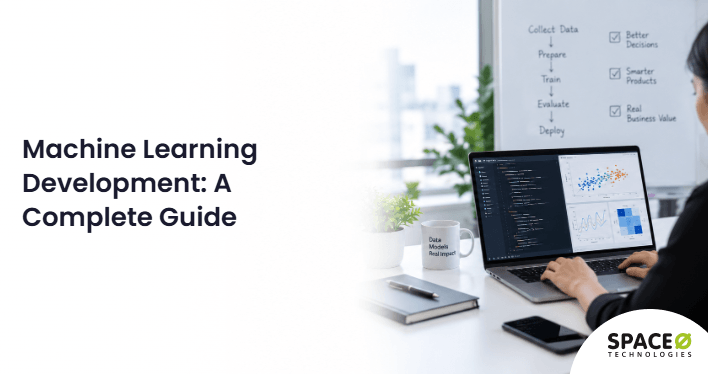
Contents
Key Takeaways
- Machine learning development follows six stages: data collection, preparation, training, evaluation, deployment, and monitoring, and skipping any one is the most common reason a model never ships.
- The global machine learning market is worth $135.8 billion in 2026 and is projected to reach $684.4 billion by 2033, per Grand View Research.
- Data preparation, not model training, is where most project time actually goes in our engagements.
- Services, not software licenses, capture the largest share of ML market revenue, 55.2 percent in 2025, which tracks with how much of the value gets delivered through hands-on consulting and implementation.
- A trained model is not the finish line. Production systems need MLOps in place to keep monitoring accuracy and retraining on schedule.
- Choosing between an in-house team and a machine learning development company comes down to timeline and how core ML is to your long-term roadmap.
Machine learning helps businesses turn data into predictions, automate repetitive tasks, and make more informed decisions. But developing an ML solution requires more than selecting an algorithm or training a model. Businesses need to understand the development process, technologies, platforms, and resources involved before investing in an ML project.
The global machine learning market is valued at $135.8 billion in 2026. Grand View Research projects it will reach $684.4 billion by 2033, growing at a 26.0% CAGR.
This rapid growth reflects the increasing demand for machine learning across industries and business functions. Understanding machine learning development can help you determine how an ML solution is planned, built, trained, tested, and deployed. You can also explore our machine learning development services if you are evaluating a custom solution for your business.
In this guide, you will learn what machine learning development is, how the development process works, key approaches, technologies and platforms, use cases, development costs, and common challenges. We will also cover the factors to consider before starting an ML development project.
What is Machine Learning Development?
Machine learning development is the discipline of designing, training, testing, and deploying models that predict outcomes from data. Traditional software has every rule written by hand. A machine learning model learns its own rules by studying examples instead. A fraud-detection model is never told what fraud looks like line by line. Engineers show it thousands of past transactions labeled fraudulent or legitimate, and the model learns the pattern.
The output of machine learning development is not a static program. Teams treat it as a living system that keeps learning as new data flows in, gets monitored for accuracy, and gets retrained on a schedule. Development teams shape most decisions below around that distinction, from tool choice to project timelines. In our own project reviews, the systems that hold up longest are the ones where the client understood upfront that a shipped model is the start of the work, not the end of it.
How is Machine Learning Development Different From Traditional Software Development?
Machine learning development centers on data and probability, while traditional software centers on fixed logic. A traditional application returns the same output for the same input every time. A machine learning model produces a probability-weighted prediction instead. The output can shift as the underlying data shifts, so monitoring continues long after launch.
| Aspect | Traditional Software Development | Machine Learning Development |
|---|---|---|
| Core logic | Written explicitly by developers as if/then rules. | Learned by the model from labeled or unlabeled data. |
| Output behavior | Deterministic; same input gives the same output. | Probabilistic; output can vary as data and context shift. |
| Testing focus | Unit tests and QA against known expected results. | Accuracy, precision, recall, and bias testing on unseen data. |
| Post-launch work | Bug fixes and feature updates on request. | Continuous monitoring, retraining, and drift detection. |
| Core skill set | Software engineering and system design. | Data science, statistics, and MLOps alongside engineering. |
Neither discipline replaces the other. Most production systems wrap a trained model inside conventional software. Space-O Technologies builds systems this way, pairing APIs, databases, and interfaces that traditional engineering already handles well.
Not Sure Where Your ML Project Should Start?
Space-O Technologies scopes machine learning projects around your data, your timeline, and a realistic first use case worth shipping.

What Are the Key Stages of the Machine Learning Development Process?
The machine learning development process moves through six stages, from data collection to ongoing monitoring. Skipping any one of these stages is the most common reason a promising model never reaches production.
1. Data collection
Engineers gather raw numbers, text, images, or transaction logs relevant to the business problem. Quality matters more than volume here. A small clean dataset often outperforms a large messy one.
2. Data preparation
Raw data is cleaned, de-duplicated, and structured so an algorithm can read it. Data preparation regularly consumes more project time than model training itself, and that has held true across the machine learning engagements we have run, regardless of industry.
3. Model training
Prepared data is fed into an algorithm that searches for statistical patterns. The algorithm builds a mathematical model of the problem. Teams try several algorithms and compare results before settling on one.
4. Evaluation
The model is tested against data it has never seen. Metrics such as accuracy, precision, and recall guide the review. A model that only performs well on training data is not ready to ship.
5. Deployment
The trained model is packaged into a live application, API, or service, letting it generate real-world predictions, a step known as inference. AI development services and machine learning development work start to overlap heavily at this stage.
6. Monitoring
Once live, the model is tracked for accuracy loss and data drift over time. Business conditions change constantly. A model trained on last year’s data can quietly lose relevance without ongoing checks.
What Types of Machine Learning Are Used in Development Projects?
Development teams choose between supervised, unsupervised, and reinforcement learning. The choice depends on the data available and the problem being solved, and it shapes which tools, timelines, and skills a project needs.
- Supervised learning
The model trains on labeled data, where each example already has a known answer attached. Fraud detection, demand forecasting, and churn prediction typically use this approach. - Unsupervised learning
The model works with unlabeled data and looks for hidden structure on its own. Customer segmentation and anomaly detection often rely on unsupervised learning. - Reinforcement learning
The model learns through trial and error, receiving rewards or penalties for its actions over time. Recommendation engines and route optimization systems increasingly draw on this method.
ML projects can also combine these approaches with other AI technologies to address broader business requirements. For example, a retail platform can use computer vision development services to monitor shelves, products, and inventory.
Conversational capabilities can further support customer-facing workflows. Businesses can use AI chatbot development services to add automated customer support alongside their ML-powered applications.
Which Tools and Technologies Power Machine Learning Development?
Machine learning development leans on programming languages, ML frameworks, cloud platforms, and MLOps tooling. Python remains the dominant language for this work, while TensorFlow, PyTorch, and scikit-learn support different development needs. Businesses can also explore machine learning platforms to understand the environments available for building, training, and deploying ML models.
- Programming languages: Python is the primary choice, with R used for statistics-heavy work.
- ML frameworks: TensorFlow and PyTorch handle deep learning; scikit-learn covers classical algorithms.
- Cloud platforms: AWS SageMaker, Google Vertex AI, and Azure Machine Learning provide managed training and hosting.
- MLOps tooling: MLflow, Kubeflow, and Airflow manage versioning, pipelines, and retraining schedules.
- Data infrastructure: Spark and data warehouses handle the volume that training pipelines depend on.
Teams researching broader AI capabilities may also consider generative AI development services alongside traditional machine learning solutions. These technologies can address different use cases depending on the project’s goals, data, and expected outputs.
Before selecting a technology stack, businesses should also evaluate the development expertise available to them. Reviewing AI development companies can help teams understand different capabilities before committing to a specific approach.
Where Does Machine Learning Development Deliver the Most Business Value?
Machine learning development delivers the strongest returns in personalization, fraud prevention, forecasting, and automated review work. The services segment held 55.2 percent of the global machine learning market in 2025, according to Grand View Research. The figure reflects how much of this value comes through custom consulting and implementation, rather than off-the-shelf software, which matches what we see with our own clients.
Space-O Technologies has shipped machine learning components into products across several industries. eComChat, an AI-powered ecommerce search assistant we built, improved search speed by 23 percent for its users. GPT Vix applies multiple AI models to recruitment workflows, cutting down manual resume screening. Glovo, a delivery platform that raised $1.2 billion in funding, relies on data-driven logistics that machine learning underpins.
What Challenges Do Companies Face During Machine Learning Development?
The most common challenges are data quality, a shortage of skilled talent, and weak production readiness. Grand View Research names the shortage of skilled AI and machine learning professionals as a direct restraint on market growth. Building and maintaining advanced models takes specialized expertise many in-house teams lack, and it is the reason clients most often come to us after a first attempt stalled internally.
- Data quality: Incomplete or inconsistent data undermines model accuracy before training even begins.
- Talent gaps: Data scientists and ML engineers remain hard to hire and retain, especially for smaller teams.
- Production readiness: A model that performs well in a notebook still needs infrastructure and monitoring to run reliably.
- Cost management: Cloud training and inference costs can grow quickly without careful budget planning.
- Governance and bias: Models trained on biased data can produce unfair or non-compliant outcomes if left unchecked.
Working with an experienced AI consulting services partner helps close these gaps. Businesses avoid building an entire in-house data science function from scratch this way.
How Does MLOps Support Machine Learning Development at Scale?
MLOps applies DevOps discipline to machine learning, giving teams a repeatable pipeline for training and deployment. Without it, individual data scientists often manage models manually, an approach that does not scale past a handful of projects.
A mature MLOps setup automates retraining when a model’s accuracy drops. Datasets get versioned alongside code, and a bad deployment rolls back the same way a broken software release would. These practices become especially important when businesses manage multiple AI models across different applications.
For teams exploring broader AI solutions, generative AI development companies should also demonstrate how they manage model deployment, monitoring, and ongoing maintenance. A strong MLOps process helps keep these systems reliable as their usage and complexity grow.
Computer vision projects face similar challenges when models need continuous training, testing, and deployment. Businesses evaluating computer vision development companies should therefore ask how their development process handles model monitoring, versioning, and production updates.
Long-term reliability depends on having these processes in place before an ML solution reaches production. This is why MLOps should be considered early when scoping and planning a machine learning development project.
Ready to Move From Prototype to Production?
Space-O Technologies handles the full machine learning development lifecycle, from data pipelines to MLOps, so your model ships and stays accurate.
Should You Build an In-House Team or Hire a Machine Learning Development Company?
Build in-house if machine learning is core to your roadmap for years to come. Hire a machine learning development company instead if you need a working model shipped within months. Building in-house means recruiting data scientists, ML engineers, and MLOps specialists. Assembling that team from scratch often takes six months or longer.
Space-O Technologies has operated since 2010 and holds ISO 9001 and ISO 27001 certifications. The company has delivered 300-plus software solutions across 1,200-plus clients.
If you already have a defined ML use case and need additional technical expertise, you can hire dedicated ML developers to extend your existing team. This approach can help businesses add specialized skills without building an entire ML team from scratch.
However, some businesses need to validate the use case, technical approach, or project requirements first. In those cases, machine learning consulting services can help define the right development strategy before implementation begins.
How Does Space-O Technologies Approach Machine Learning Development?
Space-O Technologies pairs a research-first discovery phase with an MLOps-driven build process. Every model ships with a monitoring plan attached this way. Each engagement starts by validating that the business problem truly needs machine learning, since not every prediction task justifies the complexity, and we have turned clients away from a model-based solution more than once when a simpler rules-based fix would do the job just as well.
Projects then move through the same six stages covered above. Data collection, preparation, training, evaluation, deployment, and monitoring each get a client checkpoint. The same structure let eComChat, GPT Vix, and Glovo move from concept to a shipped, measurable product.
Frequently Asked Questions
What does a machine learning developer actually do day to day?
A machine learning developer spends most of a typical week on data work, not model-building, pulling data from source systems, cleaning it, and checking it for gaps or bias before any algorithm sees it. Once a model is trained, the same developer evaluates it against business metrics, works with backend engineers to wire it into an API or application, and sets up the monitoring that flags when accuracy starts to slip after launch.
How long does a typical machine learning development project take?
A focused proof of concept, built to prove one use case works on your own data, usually takes 6 to 10 weeks. A full production deployment with MLOps in place, including monitoring, retraining pipelines, and integration into an existing application, typically runs 4 to 9 months. Timelines stretch when historical data needs significant cleanup or when the model has to integrate with several existing systems.
Do we need our own data science team to start a machine learning project?
No. Many businesses hire a machine learning development company for the first project, then decide whether to build an in-house team once the use case is proven. Going that route is usually the lower-risk path, since it avoids a multi-month hiring process before you even know whether the model will deliver a return. Companies that go on to build in-house teams typically do so once they have two or more ML use cases running in production.
What is the difference between machine learning development and AI development?
Machine learning development is a subset of AI development focused on models that learn from data. AI development also covers rule-based systems, robotics, computer vision pipelines that combine learned and hard-coded logic, and generative AI applications built on large language models. A project can use AI without using machine learning, for example a chatbot built entirely on scripted decision trees, though most modern AI products blend both approaches.
How much does machine learning development cost?
Cost depends on data readiness, model complexity, and whether MLOps infrastructure already exists. A proof of concept using clean, already-available data can cost a fraction of a full production deployment, since production work adds infrastructure, security review, and ongoing monitoring on top of the model itself. Cloud compute for training and inference is a separate, ongoing line item that scales with usage after launch.
What data do we need before starting a machine learning project?
You need enough historical data to represent the pattern the model is meant to learn, along with a labeled outcome if the project uses supervised learning. Volume matters less than consistency. A smaller dataset that is clean and representative of real conditions trains a more reliable model than a large dataset full of gaps, duplicates, or inconsistent labeling.
How do we know if a machine learning model is actually working after launch?
Track the same accuracy, precision, and recall metrics used during evaluation, but on live production data rather than a test set. A drop in any of these signals data drift, meaning the real-world data has shifted away from what the model was trained on. Most teams set a review cadence, monthly or quarterly depending on how fast the underlying data changes, and retrain the model once performance drops below an agreed threshold.



 All our projects are secured by NDA




 4.8
4.8