
 By
By 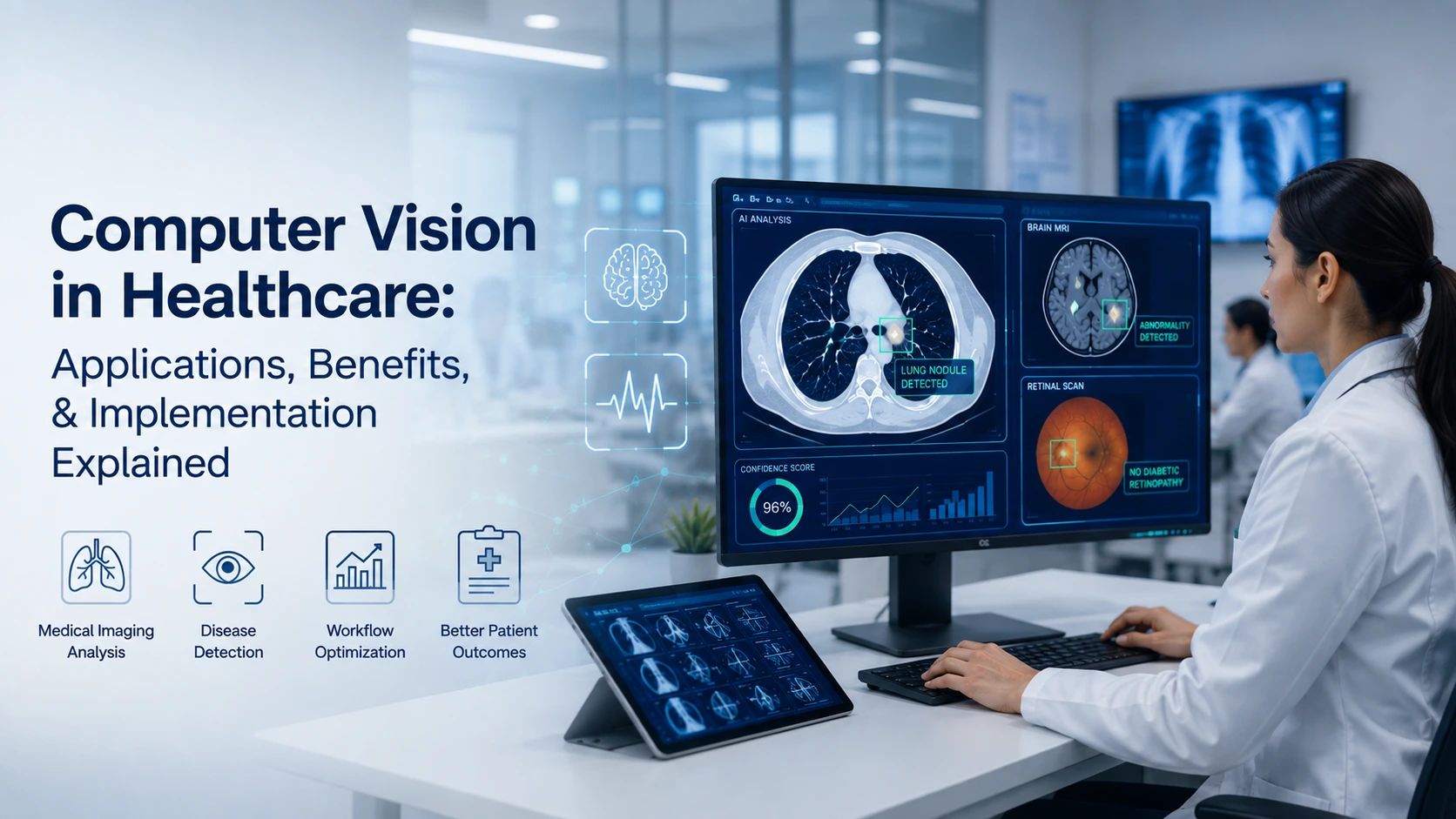
Contents
You would be hard-pressed to find a hospital that does not run on a mountain of images. X-rays, CT scans, MRIs, pathology slides, endoscopy footage, surgical cameras, and ward feeds pile up faster than anyone can read them. Imaging volume keeps climbing, and the supply of radiologists and pathologists reviewing it does not.
Computer vision in healthcare closes part of that gap by using artificial intelligence to analyze medical images and video. Nothing here replaces a qualified clinician’s judgment. Computer vision systems identify patterns a model was trained to look for, then pass those findings to someone who can actually make a decision. Our guide to understanding computer vision covers how models learn those patterns.
Regulators have already absorbed a lot of it. The FDA has authorized 1,451 AI-enabled medical devices through the end of 2025, roughly three-quarters of them in radiology, so the question is no longer whether the technology works in principle.
So what should healthcare providers, hospital operations leaders, medical device companies, and healthtech teams settle before funding a project? Where does this actually work, and what does implementing computer vision demand in data, effort, and oversight? The answers are below.
What Is Computer Vision in Healthcare?
Computer vision in healthcare is the use of artificial intelligence to analyze medical images and video. Computer vision algorithms examine X-rays, scans, pathology slides, and camera feeds, then identify abnormalities, anatomical structures, objects, or events. Healthcare organizations use that output for clinical decision support and operational visibility. Reaching that output usually takes custom computer vision development, because clinical data and workflows rarely match packaged software.
The main clinical applications
- Medical imaging and medical image analysis
- Disease detection and screening
- Tumor and lesion detection
- Digital pathology
- Surgical assistance and guidance through video analysis
Beyond diagnosis: computer vision in healthcare operations
- Patient monitoring and fall detection
- Equipment and asset tracking
- Analysis of how staff spend their time
- Hospital safety and hygiene compliance
- Visual records and data extraction from those records
One point matters more than any other. Nearly all computer vision applications in clinical practice are decision support tools, so the system presents a finding and a clinician decides what to do with it. Autonomous diagnosis, where software reaches a conclusion without a reviewer, is a different category carrying far heavier regulatory weight. Computer vision technology assists diagnosis and helps medical professionals spot abnormalities faster, and nothing about it replaces medical professionals.
What Healthcare Problems Can Computer Vision Actually Solve?
| Healthcare challenge | Computer vision application |
|---|---|
| Large volumes of medical images | Automated image analysis |
| Difficult to detect abnormalities | AI-assisted detection |
| Manual pathology analysis | Digital pathology analysis |
| Patient falls | Video-based monitoring |
| Surgical complexity | Surgical video analysis |
| Manual documentation | Visual data extraction |
| Equipment visibility | Asset tracking |
| Long review times | Automated image pre-screening |
Buying image recognition software because a competing hospital bought image recognition software is a recipe for a pilot that never leaves the lab. Identify the actual bottleneck first, then work out where computer vision fits. Start with AI computer vision consulting to validate the use case, assess feasibility, and avoid investing in the wrong solution.
Most Hospital Vision Pilots Die Before Anyone Uses Them
Space-O Technologies checks your data, workflow, and integration reality before you spend, then tells you which use case survives contact with your radiologists.

How Does Computer Vision Work in Healthcare?
Computer vision systems process medical images, videos, or other visual data using AI models to identify patterns, objects, and abnormalities. The typical workflow includes data collection, image preprocessing, model training, detection or analysis, and integration of results into clinical workflows for healthcare professionals to review.
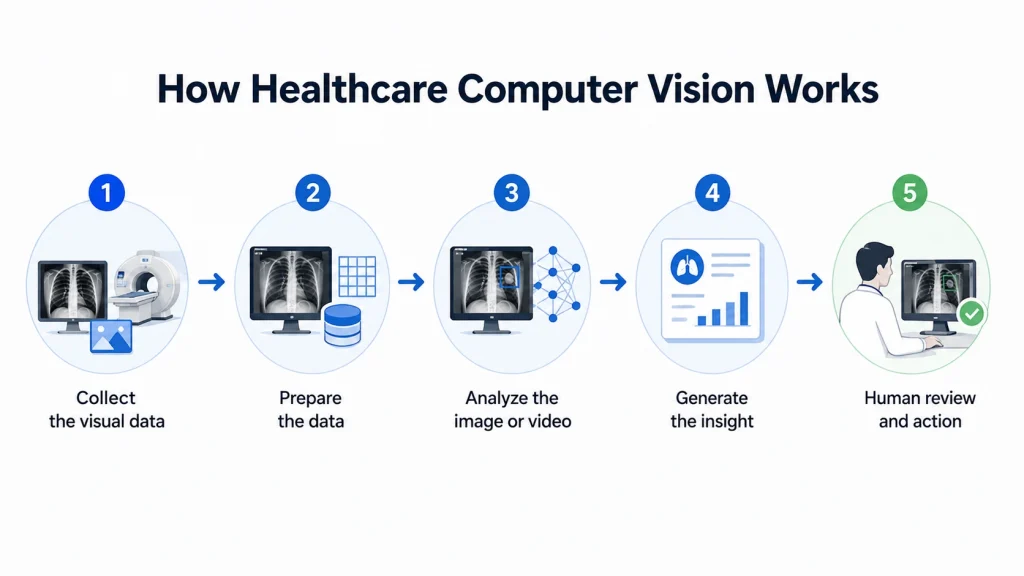
Step 1: Collect the visual data
Sources include X-rays, CT scans, MRIs, pathology slides, endoscopy footage, and ward video. Every source carries its own format, resolution, and protocol, and each variation affects how a model behaves downstream.
Step 2: Prepare the data
Preprocessing gets the data into a form the model can use: image normalization, resizing, noise reduction, contrast enhancement, and conversion from DICOM output.
Step 3: Analyze the image or video
The model applies computer vision techniques such as image classification, object detection, image segmentation, optical character recognition, object tracking, and video analysis to find patterns in the data.
Step 4: Generate the insight
The output is a structured finding: a classified image, an instance of automated detection, a segmented tumor region, OCR-verified medication text, or a tracked patient fall.
Step 5: Human review and action
Findings go to qualified healthcare professionals who review the output and decide what happens next. Clinical accountability still rests with the reviewer, and audit trails record both halves.
How Is Computer Vision Actually Used in Healthcare? Top 11 Computer Vision Applications
Computer vision is used across diagnosis, medical imaging, surgery, patient monitoring, and hospital operations to analyze visual data and automate time-consuming tasks. From detecting abnormalities in scans to monitoring patients and tracking medical assets, these applications help clinicians work more efficiently while supporting better patient care. Clinical imaging is only one branch of the wider applications of computer vision now running across industry.
1. Medical imaging and diagnosis
Medical imaging is the biggest area of computer vision applications in healthcare. Quantitative image analysis remains the most common use case across FDA authorizations. Automated analysis cuts diagnostic turnaround times by pre-screening studies, flagging critical findings, and reordering worklists.
1.1 X-ray analysis
Chest X-ray analysis for lung abnormalities and consolidation patterns is one clear win, and musculoskeletal analysis for fracture detection is another. The workflow stays standard: image, AI analysis, potential finding, clinician review, with the AI narrowing possibilities rather than issuing a verdict.
1.2 CT and MRI analysis
CT and MRI generate a huge amount of data across hundreds of slices, and computer vision helps with tumor detection, lesion identification, organ segmentation, and tracking volume changes over time. Image segmentation carries the ball here, because the system does not just report that an abnormality exists. Outlining the region lets a radiologist sit down and take a closer look.
1.3 Ultrasound image analysis
Ultrasound is tricky, since results depend heavily on operator skill. Computer vision uses a deep learning system with handheld ultrasound devices to identify anatomical structures, guide the scan, estimate right atrial pressure in real time on a consumer tablet, and keep measurements aligned with agreed protocols.
2. Cancer detection and tumor analysis
Oncology sits at the top of the research list for computer vision medical diagnostics, covering tumor detection and segmentation, lesion detection, quantifying size, and tracking change across serial scans.
Accuracy claims deserve a grain of salt. Published studies show deep learning models matching specialist readers on narrow tasks, though live clinic performance rarely matches curated dataset performance. A more realistic framing: computer vision models help identify and quantify visual patterns associated with tumors or lesions, supporting clinicians during diagnosis and treatment planning.
3. Digital pathology
A single whole-slide image can run to tens of gigapixels, and manual review means a pathologist poring over it at high magnification for hours. Digital pathology uses computer vision to identify and quantify cellular patterns across the slide, freeing the pathologist to focus on interpretation.
3.1 Cell detection and classification
Models count and classify cells, mitotic figures, and nuclei at a scale manual counting cannot match.
3.2 Tissue segmentation
Segmentation separates tumor regions, stroma, necrosis, and healthy tissue, all of which matter for grading and reporting.
3.3 Cancerous tissue identification
Models highlight regions of interest and prioritize the slides most likely to contain malignancy.
3.4 Biomarker and pattern analysis
Computer vision quantifies staining intensity and morphological patterns linked to biomarkers, which removes a layer of subjective estimation.
4. Ophthalmology and eye care
Retinal imaging is ripe for automation, because images are standardized and volumes are enormous. Diabetic retinopathy screening, retinal vessel analysis, and glaucoma indicators all use computer vision to triage, sorting images that need a closer look from those that do not.
5. Dermatology and skin analysis
Computer vision helps distinguish benign moles from melanoma by analyzing lesion borders, color variation, asymmetry, and texture, with applications in lesion analysis, mole classification, and image-based monitoring over time. Skin tone representation in training data is no footnote. A Stanford study found state-of-the-art dermatology models dropping sharply in AUC on a diverse, biopsy-confirmed image set, with the worst performance on darker skin tones and uncommon diseases.
6. Surgical computer vision
Surgical video analysis answers four questions in real time: what is happening, where, which instrument is in use, and which phase is underway. Applications run from instrument tracking to phase recognition, anatomy identification, navigation, and robotic surgery assistance.
7. Patient monitoring and fall detection
Smart cameras and depth sensors in ICUs track patient movement without contact sensors, and AI-powered fall detection alerts caregivers when a patient falls. Related applications cover bed-exit detection, irregular breathing or posture changes, and behavioral monitoring in care settings. Privacy shapes every one of them, so depth-only sensing, on-device processing, and strict retention rules detect an event without storing identifiable footage.
8. Hospital safety and infection control
Computer vision improves hygiene compliance by tracking hand hygiene events and PPE use, which helps keep hospital-acquired infections at bay. Applications extend to restricted area monitoring and safety protocol checks, though deployment needs staff consultation and policy alignment first.
9. Healthcare asset and equipment tracking
Nurses can spend hours per shift hunting for equipment, and computer vision tracks wheelchairs, infusion pumps, beds, and surgical instruments around a facility. Asset visibility is only part of the value, because availability and utilization improve too, and nurses get time back for patient care.
10. Medication and packaging verification
Visual verification checks medication labels, packaging integrity, product identity, and barcodes at the point of dispensing. Computer vision automates the check so medication tracking and adherence are easier to monitor, which lifts patient safety without adding a manual step.
11. Remote patient monitoring
Computer vision supports remote patient monitoring by extending patient care beyond traditional clinical settings, with camera-based analysis of movement, posture, gait, therapy exercise form, and activity levels at home. Some of it is in routine use, and some is still research, so be clear about which is which. Teams here usually pair vision models with a broader telemedicine software development stack for scheduling and escalation.
Build a Computer Vision System for Your Hospital
Space-O Technologies handles model development, validation, and integration with your existing imaging and record systems.
What Are the Benefits of Implementing Computer Vision in Healthcare?
Computer vision can help healthcare organizations analyze visual data faster, automate repetitive tasks, and support clinicians with consistent insights. Its value extends beyond diagnosis, with applications across clinical workflows, patient safety, hospital operations, and preventive care.
- Faster medical image analysis: Automating pre-screening and worklist prioritization can shorten the time between image acquisition and interpretation, which is especially valuable in time-sensitive stroke and trauma cases.
- Support for earlier detection: Computer vision can process large volumes of medical images and highlight subtle patterns that may require further review, helping clinicians focus their attention on potential abnormalities.
- Less repetitive manual work: Tasks such as counting cells, measuring lesions, reading labels, and monitoring video feeds can be automated, allowing clinical staff to spend more time on tasks that require human judgment.
- Smoother healthcare operations: Asset tracking, workflow analysis, and automated documentation can reduce repetitive visual tasks, improve resource utilization, and give healthcare professionals more time for patient care. Hospital stores and central supply gain the same visibility that computer vision in supply chain operations provides elsewhere.
- Improved patient safety: Computer vision can support fall detection, medication verification, and hygiene monitoring, helping healthcare organizations identify potential safety risks and respond more quickly.
- Greater consistency in visual analysis: A properly validated model applies consistent criteria across images, which can reduce variation between assessments and provide clinicians with standardized measurements and findings.
- Data-driven clinical decisions: Quantified findings from computer vision can complement clinical records and professional expertise, giving healthcare providers additional data to support screening, diagnosis, monitoring, and treatment decisions.
Overall, computer vision is most valuable when it complements clinical expertise rather than replacing it. By combining AI-driven analysis with human judgment, healthcare organizations can improve efficiency, consistency, patient safety, and the quality of clinical decision-making.
What Technologies Go Into Healthcare Computer Vision?
Healthcare computer vision combines AI, image processing, medical imaging standards, and cloud or edge technologies to analyze clinical images and video.
- Image classification: Classification looks at a whole image and assigns a label, normal versus abnormal, for instance, which is essentially triage.
- Object detection: Detection spots findings, instruments, or people within a frame and boxes them.
- Image segmentation: Segmentation labels images pixel by pixel, which is what makes tumor, organ, cell, and lesion work possible.
- Optical character recognition: OCR lifts text off medication labels, requisition forms, and device displays.
- Object tracking: Tracking follows a subject across frames, supporting instrument monitoring, patient movement analysis, and equipment location.
- 3D computer vision: Volumetric reconstruction supports surgical navigation, anatomical modeling, and implant planning.
- Deep learning: Modern medical image analysis runs on convolutional neural networks and vision transformers. A deep learning model, trained through supervised machine learning on labeled images, picks up feature hierarchies that hand-coded computer algorithms never captured, and transfer learning cuts the annotation volume a project needs.
- Computer vision with generative and multimodal AI: Multimodal models combine imaging with text from electronic health records to produce draft reports or summaries. The technology is advancing faster than clinical validation, so pilots should stay supervised.
The technology stack depends on the use case, accuracy requirements, data volume, deployment environment, and healthcare system integrations.
What Data Is Needed to Build a Healthcare Computer Vision System?
The quality and availability of healthcare data can determine whether a computer vision project succeeds long before model development begins. A reliable system needs more than a large image dataset. It requires clinically relevant images or videos, accurate annotations, diverse patient data, consistent quality, and strong privacy controls.
1. Medical images and video
The type and volume of data depend on the computer vision task, disease prevalence, and required accuracy. Rare conditions typically require carefully curated datasets with enough positive cases, while imaging systems may need thousands of studies to capture variations in anatomy, disease presentation, and acquisition conditions.
2. Annotation and labeling
Computer vision models rely on accurately labeled data, including bounding boxes, segmentation masks, classification labels, and clinical findings. Because medical annotation requires clinical expertise, it can become one of the most time-consuming parts of development. Pre-labeling and automated data curation can speed up the process, but qualified experts should still review and validate the annotations. Defect labeling for computer vision in manufacturing moves faster because a line technician can mark flaws without specialist training. Healthcare rarely has that option.
3. Data quality
Image resolution, acquisition protocols, file formats, and equipment can vary significantly between healthcare facilities. Poor-quality images and inconsistent labels can directly affect model performance, making data cleaning, quality checks, and standardized annotation practices essential before training begins.
4. Dataset diversity
A healthcare computer vision model should represent the patient populations, disease stages, imaging devices, and clinical environments where it will eventually be used. Including diverse datasets helps reduce performance gaps across patient groups and improves the likelihood that the model will generalize beyond the institution where it was trained.
5. Data privacy and security
Healthcare datasets require strict controls to protect sensitive patient information throughout collection, storage, annotation, and model development. De-identification, encryption, role-based access, audit logging, and clear data governance policies should be established before data enters the training pipeline. Financial institutions work under a comparable regime for identity documents and transaction records. Our guide to computer vision in the finance industry sets out those controls.
In short, building a dependable healthcare computer vision system starts with dependable data. Investing in representative datasets, expert-quality annotations, rigorous quality checks, and appropriate privacy controls can reduce model failures and make clinical validation and deployment significantly smoother.
Need Computer Vision Skills Your Team Lacks
Bring in developers experienced with medical imaging, model training, and healthcare integration for as long as you need.
How to Successfully Deploy Computer Vision in Healthcare
Successfully deploying computer vision in healthcare requires more than training an accurate AI model. Organizations need to align the solution with a clear clinical use case, validate its performance, integrate it into existing workflows, and establish the right security, regulatory, and monitoring processes.
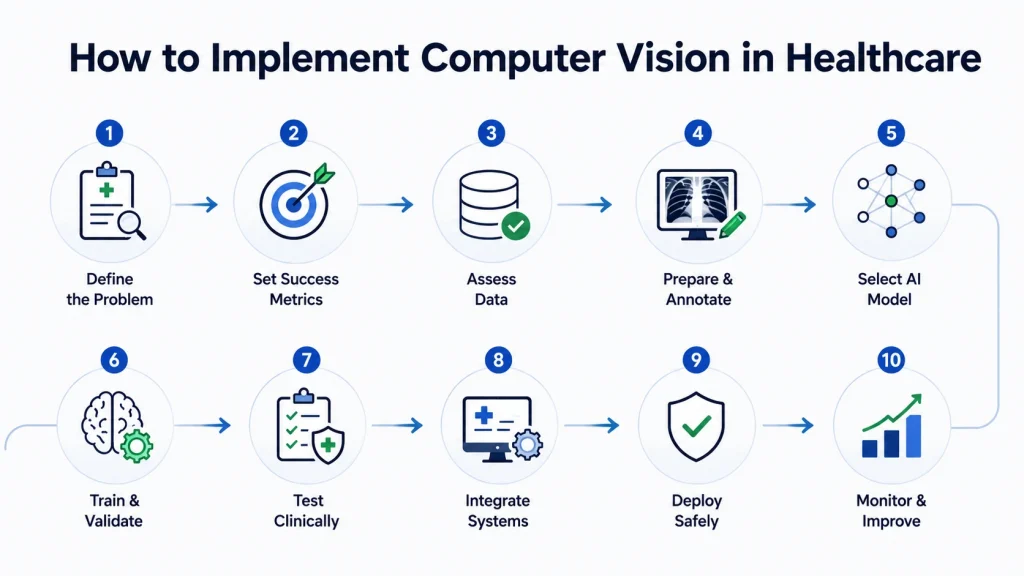
1. Identify the healthcare problem you want to solve
Implementing computer vision starts with the clinical or operational problem, not model selection. Hold off until the workflow, the baseline, and the decision the output informs are all clear.
2. Define clinical and operational success metrics
Metrics span sensitivity, specificity, precision, recall, false positive and false negative rates, processing time, and diagnostic accuracy. Accuracy alone will not cut it, because a model that misses one case in twenty may be useless for screening yet fine for prioritization.
3. Assess data availability
Answer four honest questions. What data exists, is it labeled, is it representative, and can you legally use it?
4. Prepare and annotate the dataset
Strip identifying information, annotate with clinical input, run quality control on labels, then split data by patient so no patient shows up in both training and test sets.
5. Choose the computer vision approach
Model choice follows the task, dataset size, accuracy requirement, explainability need, latency budget, and deployment environment, and edge deployment on a portable device imposes constraints a cloud pipeline never faces.
6. Train and validate the model
Training, internal validation, and held-out testing come first. Validation should measure diagnostic accuracy against expert review and, where possible, on real-world clinical cases rather than only curated test sets. Clinical validation against expert consensus follows, and regulated products may require clinical trials before market entry.
7. Test it in real clinical environments
A model that does well on a curated dataset behaves differently across scanner vendors, patient populations, and clinical workflows. Zech and colleagues showed pneumonia detection performance dropping when a model trained at one hospital system was tested at another. Silent mode testing in live clinical environments surfaces those gaps without patient risk.
8. Integrate with healthcare systems
Integration targets include PACS for imaging, RIS for radiology workflow, electronic health records for results and context, and connected devices. Seamless integration rarely happens by default, so findings have to land inside existing workflows, in the viewer clinicians already use, or adoption stalls. Record side work runs alongside an EHR software development roadmap.
9. Deploy with human oversight
Define who reviews the output, what happens when there is disagreement, how overrides get logged, and how staff reports errors.
10. Monitor and retrain
Track model drift, performance by subgroup, and shifting clinical workflows. Scanner upgrades, protocol changes, and population shifts degrade performance quietly, and planned revalidation catches the drop first.
Hiring One Computer Vision Engineer Takes Roughly 3 to 5 Months
Space-O Technologies places vetted computer vision developers on your team in weeks. You direct the work, and we handle vetting and onboarding.
What Are the Challenges of Computer Vision in Healthcare?
While computer vision can improve diagnosis, monitoring, and clinical workflows, its implementation comes with several challenges. From data privacy and model accuracy to regulatory compliance and system integration, healthcare organizations must address these barriers before deployment.
| Challenge | Description | Resolution |
|---|---|---|
| Data Privacy | Medical images can contain sensitive and identifiable patient information. | Use de-identification, on-device processing, and minimal data retention. |
| Limited or Inconsistent Labeling | Poor-quality or inconsistent annotations can reduce model accuracy. | Create clear labeling guidelines, use expert consensus, and conduct quality audits. |
| Model Bias | Models may perform poorly for underrepresented patient groups. | Evaluate performance across patient subgroups and conduct regular fairness checks. |
| False Positives & Negatives | Incorrect results can cause unnecessary procedures or missed diagnoses. | Tune model thresholds based on the clinical impact of each error type. |
| Generalization Across Hospitals | Differences in scanners, protocols, and patient populations can affect performance. | Perform external validation across different hospitals before wider deployment. |
| Explainability | Clinicians may hesitate to trust AI results they cannot interpret. | Provide confidence scores, saliency maps, and segmentation overlays for review. |
| System Integration | Legacy PACS, EHRs, and medical devices can make AI integration complex. | Use compatible APIs and plan system integration alongside model development. |
| Regulatory Requirements | Healthcare AI must meet regulations based on its intended use and market. | Address regulatory requirements from the beginning of the development process. |
| Clinical Validation | High retrospective accuracy does not always prove clinical benefit. | Validate the solution in real-world clinical workflows before deployment. |
| Cybersecurity | Connected AI systems can introduce additional security vulnerabilities. | Apply access controls, network segmentation, monitoring, and vulnerability management. |
Addressing these challenges requires more than accurate AI models. A successful computer vision solution also needs secure data practices, clinical validation, regulatory planning, and seamless integration with existing healthcare systems.
How Much Does Healthcare Computer Vision Development Cost?
Healthcare computer vision development can cost anywhere from $30,000 to $1 million+, depending on project complexity, clinical requirements, data needs, validation, and integration scope. The table below provides an estimated cost breakdown, from basic proof-of-concept solutions to enterprise-grade clinical platforms.
| Project Type | Estimated Cost | Specifications & Use Cases |
|---|---|---|
| Proof of Concept (PoC) | $30,000–$75,000 | Basic feasibility testing, non-diagnostic image sorting, or simple feature verification. |
| Mid-Level Solution / MVP | $80,000–$200,000 | Single-use-case solutions such as automated posture tracking or a standalone dermatology screening application. |
| Clinical Diagnostic System | $150,000–$500,000 | AI-assisted radiology, pathology, or ophthalmology solutions for X-ray, MRI, CT, or other medical imaging. |
| Enterprise / Custom Platform | $500,000–$1,000,000+ | Advanced platforms such as 3D surgical navigation or multi-department hospital deployments. |
Note: These are indicative development ranges. The actual cost can vary significantly based on data preparation, model complexity, clinical validation, regulatory requirements, integrations, and deployment infrastructure. Rates and minimum project sizes also differ by vendor, which our guide to the best computer vision development companies compares.
Validation and Integration Cost More Than the Model Itself
Send your use case, data position, and integration targets. Space-O Technologies returns a scoped number that includes the work vendors leave out.
How Do You Measure ROI and Performance?
Split model performance from clinical and business impact, because strong numbers in one column say nothing about the other.
- Model metrics: sensitivity, specificity, precision, recall, F1 score, AUC, and diagnostic accuracy where relevant, reported overall and by subgroup.
- Operational metrics: review time per study, workflow cycle time, staff workload, throughput, and resource utilization.
- Clinical metrics: time to review, time to intervention, screening throughput, missed case rate, and the downstream patient outcomes those numbers move.
An accurate model is not automatically a successful one, because performance has to hold up in the clinical workflow it supports. A baseline measured before deployment makes a fair comparison possible later, and plenty of disappointing ROI numbers can be traced back to a missing baseline rather than a flawed model.
What Is the Future of Computer Vision in Healthcare?
Computer vision in healthcare is moving beyond basic image analysis toward real-time decision support, multimodal intelligence, personalized monitoring, and AI-enabled clinical workflows. The future will depend not only on better models, but also on clinical validation, data quality, interoperability, patient safety, and regulatory acceptance.
1. AI-assisted medical imaging
AI is already supporting radiologists with image triage, abnormality detection, segmentation, and quantitative measurements. The next step is more advanced decision support, including AI-generated preliminary findings and draft reports that radiologists can review, modify, and approve.
The next generation of healthcare AI will look beyond medical images. Models will increasingly combine imaging with clinical notes, laboratory results, patient history, and other clinical data to provide more context-aware insights and support better-informed clinical decisions.
2. 3D medical computer vision
3D computer vision enables AI systems to analyze the volume, shape, and spatial relationships of anatomical structures rather than treating medical images as individual 2D slices. This can support surgical planning, implant design, tumor assessment, treatment planning, and post-operative monitoring.
3. AI-assisted surgery
Computer vision is helping surgical systems recognize instruments, anatomy, and different stages of a procedure. These capabilities can support surgeons with navigation and workflow awareness, while fully autonomous surgical tasks will require extensive clinical validation, safety controls, and regulatory oversight.
4. Real-time clinical video analysis
Computer vision is expanding from static medical images to continuous video analysis. Endoscopy is one of the strongest examples, with AI assisting clinicians in identifying abnormalities such as colorectal polyps during procedures. Future applications could extend to procedural monitoring and patient safety. Continuous video analysis is already routine in other sectors, including computer vision in retail operations.
5. Personalized patient monitoring
Computer vision can enable continuous monitoring of movement, posture, mobility, and activity patterns. By establishing an individual’s baseline and detecting meaningful changes, these systems could support rehabilitation, post-acute care, elderly care, and remote patient monitoring.
6. Edge AI in medical devices
Running AI directly on medical devices can deliver faster responses while reducing the need to transfer sensitive visual data to the cloud. For example, a deep learning system on handheld ultrasound devices can guide scanning and estimate right atrial pressure locally in real time. This makes edge computer vision valuable for portable imaging, point-of-care ultrasound, and other environments where low latency and privacy are critical.
7. Computer vision and robotics
Computer vision gives robots the ability to perceive and interpret their surroundings, including instruments, objects, and anatomical structures. As healthcare robotics advances, vision-guided systems could support increasingly sophisticated clinical tasks, although autonomous manipulation will require rigorous safety and regulatory validation.
The future of computer vision in healthcare is ultimately about augmenting clinical expertise, not replacing it. The strongest solutions will combine reliable visual intelligence with clinical data, existing healthcare workflows, and appropriate human oversight.
Not Sure Which Use Case to Start With
Space-O Technologies reviews your workflow and data, then recommends where computer vision fits your hospital first.
Why Partner With Space-O Technologies for Healthcare Computer Vision?
Space-O Technologies combines computer vision, AI, and healthcare software expertise to build solutions around real clinical and operational needs. From medical image analysis and patient monitoring to intelligent video systems, our team develops computer vision solutions designed for accuracy, scalability, and practical adoption.
Our developers work across OpenCV, YOLO, TensorFlow, and PyTorch to build, train, and integrate custom computer vision models. We can also connect AI capabilities with existing healthcare systems and workflows, helping organizations move from proof of concept to production. Teams with an in-house roadmap can instead hire computer vision developers for a defined engagement.
We take an end-to-end approach, covering data preparation, model development, testing, integration, deployment, and ongoing optimization. This allows healthcare organizations to work with one technology partner throughout the development lifecycle while keeping clinical requirements, security, and scalability in focus.
FAQs About Computer Vision in Healthcare
What is computer vision in healthcare?
Computer vision in healthcare is AI technology that analyzes medical images, videos, and visual data to identify patterns, abnormalities, structures, and events. These systems can process X-rays, CT scans, MRI images, pathology slides, and clinical video, then present relevant findings to healthcare professionals for review and decision-making.
How is computer vision used in healthcare?
Computer vision is used in healthcare to analyze medical images, detect abnormalities, monitor patients, and automate visual tasks. Common applications include cancer detection, digital pathology, eye screening, surgical video analysis, patient monitoring, asset tracking, medication verification, and clinical workflow support.
What are the applications of computer vision in healthcare?
Computer vision applications in healthcare span both clinical care and hospital operations. Clinical applications include medical imaging, pathology analysis, disease screening, and surgical assistance, while operational applications include patient monitoring, safety surveillance, equipment tracking, medication verification, and workflow automation.
How does computer vision help medical diagnosis?
Computer vision supports medical diagnosis by identifying visual patterns, highlighting regions of interest, and quantifying findings in medical images. It can also prioritize potentially urgent studies for faster review, while a qualified healthcare professional remains responsible for interpreting the results and making the final diagnosis.
Can computer vision detect diseases?
Yes, computer vision can detect visual patterns associated with specific diseases when the model has been properly validated for that intended use. It can assist with conditions such as certain cancers, diabetic eye disease, and other image-detectable abnormalities, but detection is intended to support clinical assessment rather than replace a medical diagnosis.
How is computer vision used in medical imaging?
Computer vision analyzes medical images such as X-rays, CT scans, MRI scans, and ultrasound to identify abnormalities and extract clinically relevant information. Models can perform tasks including detection, segmentation, measurement, image classification, comparison with prior studies, and worklist prioritization.
How is computer vision used in radiology?
Computer vision helps radiologists analyze images, prioritize urgent cases, automate measurements, and identify potentially critical findings. It can also compare current and previous studies to highlight changes, helping radiologists focus their attention on findings that may require closer evaluation.
How is computer vision used in pathology?
Computer vision analyzes digital pathology and whole-slide images to identify cells, segment tissue structures, detect tumor regions, and quantify biomarkers. This can help pathologists handle large volumes of visual information more consistently and support the assessment of diseases such as cancer.
Can computer vision be used in surgery?
Yes, computer vision can be used in surgery to track instruments, recognize surgical phases, identify anatomical structures, and support robotic systems. It can also enable real-time procedural analysis and post-operative video review, although more advanced autonomous surgical applications require extensive clinical validation and regulatory oversight.
How does computer vision monitor patients?
Computer vision monitors patients by analyzing camera or depth-sensor data to detect movement, posture, falls, bed-exit events, and other predefined behaviors. These systems can alert healthcare staff to potentially important events while privacy-preserving processing can reduce the need to store identifiable video.
What are the benefits of computer vision in healthcare?
Computer vision can help healthcare providers analyze visual data faster, detect potential problems earlier, and reduce repetitive manual tasks. Other benefits include more consistent measurements, improved workflow efficiency, enhanced patient monitoring, faster prioritization of urgent cases, and better use of clinical staff time.
How do you develop a healthcare computer vision solution?
Healthcare computer vision development typically starts by defining the clinical problem and success metrics, followed by data collection, annotation, model development, validation, integration, and deployment. The solution should then be tested in its intended environment, deployed with appropriate clinical oversight, and continuously monitored for accuracy, safety, and performance.



 All our projects are secured by NDA




 4.8
4.8