
 By
By 
Contents
Computer vision in finance uses artificial intelligence to turn images, documents, and video into actionable financial data. Banks, insurers, lenders, and fintech companies process millions of IDs, checks, loan files, invoices, and claim images, many of which still require manual review.
As financial services become increasingly digital, the demand for intelligent automation is growing. The global fintech market was valued at $394.88 billion in 2025 and is projected to reach $460.76 billion in 2026 and $1.76 trillion by 2034, growing at a CAGR of 18.20%.
Computer vision can help automate repetitive visual tasks, speed up processing, and improve consistency. This guide covers key use cases, benefits, data requirements, technologies, development costs, implementation steps, and challenges. The guide is designed for operations leaders, risk managers, fintech founders, and CTOs looking to work with a computer vision development company to build their first solution.
Choosing the right development partner can make the difference between a successful pilot and a solution that delivers measurable value in production. Space-O Technologies has been building financial software solutions since 2010, with a focus on practical, scalable solutions that deliver measurable business value.
What Is Computer Vision in Finance?
Computer vision in finance is a branch of artificial intelligence that enables machines to extract meaningful data from images, videos, and documents to automate visual tasks. It helps financial organizations recognize text, detect patterns, identify anomalies, and process visual information with less manual intervention.
Banks, insurers, lenders, and fintech companies use computer vision for KYC and identity verification, document processing, check analysis, fraud detection, claims processing, and security monitoring. By connecting these capabilities with existing financial systems, organizations can speed up workflows, reduce manual effort, and improve consistency.
What types of data can financial institutions start using?
Most financial institutions are sitting on a ton of visual data that they’re not even using. Some of the common types of data include:
- ID documents and customer selfies
- Checks, invoices, and financial statements
- Loan applications and trade documentation
- Insurance forms and claim photos
- Property and vehicle images
- Branch, ATM, and CCTV footage
The Alan Turing Institute studied how AI is being used in the financial services industry. Researchers found that condition detection, facial recognition, and optical character recognition are the top three capabilities.
What Financial Problems Can Computer Vision Help Fix?
Start with the problem, not the model. We find that computer vision applications solve these pain points most of the time.
| Financial problem | Computer vision solution |
|---|---|
| Manual data entry from paper forms | OCR and document analysis |
| Slow KYC and onboarding | ID and selfie verification |
| Identity fraud | Face matching and liveness checks |
| Forged or altered paperwork | Visual authenticity analysis |
| Manual check handling | Check image recognition |
| Insurance claim delays | Photo-based damage assessment |
| ATM and branch security gaps | Video analysis |
| Compliance review workload | Automated document extraction |
| Poor branch visibility | Queue and occupancy analytics |
If you see yourself in two or more of these rows, then you owe it to yourself to see if a pilot project might make sense. Our computer vision consulting services can help you decide which workflow to pilot first.
How Does Computer Vision Technology Work in Finance?
Every deployment is the same six-stage pipeline. The key components stay the same whether you’re processing checks or claim photos.
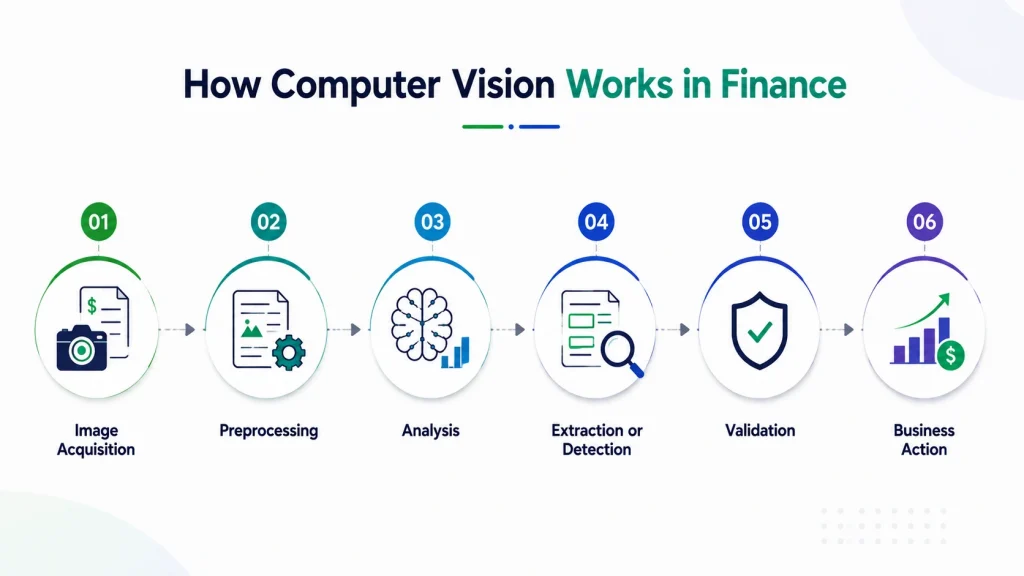
- Image acquisition: A customer uploads a document through your mobile apps, a branch scanner captures a form, or a camera streams video.
- Preprocessing: The system makes the pictures easier to read by enhancing contrast, reducing noise, correcting skew, and rejecting any unusable frames. Poor quality input, not weak models, is the biggest cause of project failures.
- Analysis: Computer vision models perform feature extraction, which might mean OCR, image classification, object detection, segmentation, or scene understanding.
- Extraction or detection: The model gives you a result, so that might be a name and ID number, a dent on a rear bumper, or an altered amount field.
- Validation: The result is checked against customer records, transaction data, policy details, or business rules before it actually does anything.
- Business action: The workflow approves, routes, flags, requests more documentation, or alerts staff.
Stage six is where the real value sits. Nothing actually changes until the computer vision system triggers a decision.
Detection Means Nothing Until Your Core System Acts
Space-O Technologies designs the validation and routing layer that turns model output into an approval, a flag, or a queued exception.

What Are the Use Cases of Computer Vision in Finance?
Computer vision helps financial organizations automate visual tasks, analyze financial documents, detect fraud, and verify identities. Its applications range from document processing and KYC to check verification, claims analysis, and security monitoring. Banking is one of ten sectors covered in our guide to computer vision use cases.
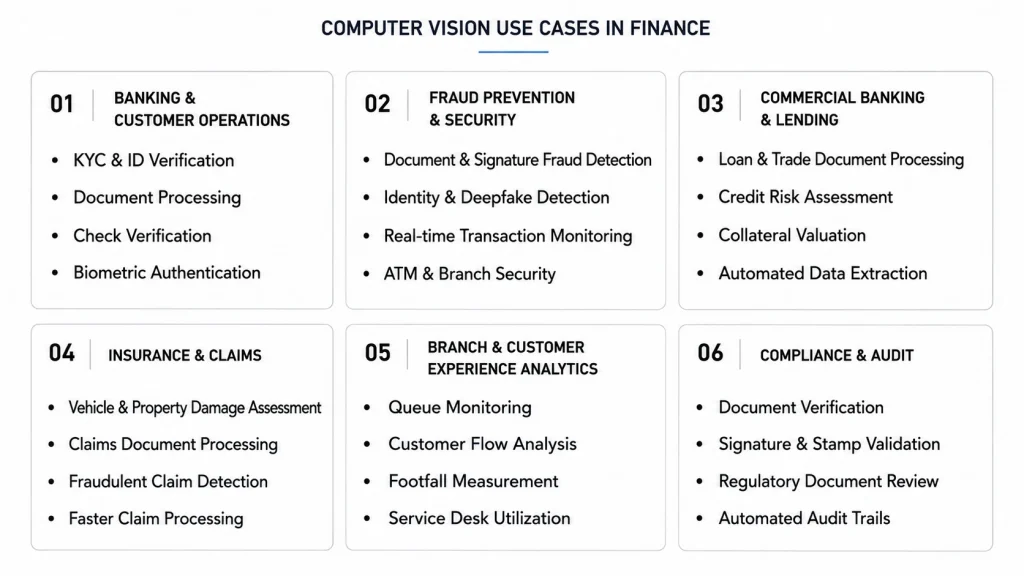
1. Banking and customer operations
1.1 KYC, document verification, and customer identification
Trying to figure out who someone is can be a major bottleneck in retail banking, so computer vision can really help by automating document verification and face matching.
The process runs from ID capture to visual analysis, data extraction, identity validation, and a KYC decision. Facial recognition compares the selfie against the document photo, and liveness detection makes sure a real person is there.
By automating this path, you can cut your KYC processing time from hours to minutes. The model gives a score to each match, so borderline cases get escalated automatically. But humans still review the high-risk ones and the exceptions.
1.2 Automated financial document processing
Processing financial documents is the biggest use case in the finance industry, and most computer vision systems in banking start with that. Optical character recognition pulls the text out of scanned documents, while classification and layout analysis identify what each page actually is.
Typical inputs include loan applications, bank statements, tax forms, invoices, and contracts, all the usual suspects. And you can’t just rely on OCR on its own. Production systems mix OCR with document classification, field-level extraction, and confidence scoring. The goal is getting a good read on what each document actually contains.
Automated systems also apply the same rules to every document, which cuts out the human error you get across dozens of reviewers.
1.3 Check processing and verification
Check volumes may be falling, but check fraud isn’t. FinCEN logged 682,276 check-fraud suspicious activity reports in 2024, according to Thomson Reuters.
Computer vision picks out the courtesy amount, legal amount, payee, and date from a check image on its own, while the system also uses handwriting recognition to tackle the trickier fields. The system then checks the signature region against stored references to pick out any likely forgeries.
1.4 Customer authentication
Facial recognition is part of secure biometric authentication, covering app logins, high-value transfers, and ATM access. Several banks are now letting customers just use face verification to get cash instead of fumbling for cards. Biometric checks inside mobile apps also help enhance security on financial transactions.
Biometrics do carry a heavy load when it comes to privacy and regulatory compliance. Be careful not to make facial recognition the default, and confirm your legal basis in every single jurisdiction you operate in.
2. Financial fraud prevention and security
2.1 Document and signature fraud detection
Computer vision algorithms spot forged signatures, altered fields, odd fonts, mismatched layouts, and duplicate submissions. Deep learning models do a like-for-like comparison with thousands of genuine examples, then score the differences.
Just be clear on this one. Computer vision is providing visual signals to help with fraud detection. Those signals then combine with transaction data, rules engines, and machine learning models to give a risk score.
2.2 Real-time transaction and identity monitoring
When you run visual checks through the payment path in real time, you can actually halt suspicious transactions before they get settled. Computer vision picks out anomalies in submitted evidence, while machine learning models look over transaction patterns for any signs of fraud.
Synthetic identities and deepfakes make identity fraud a whole lot harder to spot, and it’s not just about the data anymore.
2.3 ATM and branch security
Cameras monitor bank branches for intruders, tampering, and loitering near ATMs. Video analysis raises an alert for a human to take a look, rather than trying to make the call itself.
3. Commercial banking and lending
3.1 Loan and trade document processing
Commercial lending means paperwork galore for teams, but computer vision is here to help. The models classify loan packages, extract covenants and financial figures, and route exceptions to analysts.
JPMorgan’s COiN platform is a good example. Bloomberg reported that it interprets commercial loan agreements all on its own. The same work used to take about 360,000 hours of lawyer and loan officer time every year.
3.2 Credit risk assessment
Credit risk assessment depends on documents that come in as PDFs, photographs, and scans. OCR technology digitizes those files so that underwriting models receive structured data rather than raw data trapped inside images.
Machine learning models then evaluate creditworthiness using bank statements, tax filings, and supporting evidence. Removing manual data entry errors helps keep predictive models accurate and on time.
Asset-backed lending adds another layer, using images of equipment, inventory, or vehicles to support collateral valuation.
4. Insurance and claims
4.1 Vehicle and property damage assessment
Insurance is where visual evidence really comes into its own. A policyholder takes a photo of a damaged vehicle, and object detection picks out the affected panels, damage type, and severity indicators.
Property claims follow the same path for roof, water, structural, and fire damage. Processing insurance claims this way cuts first-notice-of-loss cycles from days to hours.
4.2 Claims document processing and fraudulent claims
Claim forms, invoices, and repair estimates all go through the same document pipeline. Computer vision then cross-checks the photos against the claim narrative, policy details, and prior submissions.
If a claim looks suspicious, whether from a recycled image, edited metadata, or staged damage patterns, the visual signals will usually show it. Just don’t let a model decide a claim on its own, because adjusters should still have the final say.
5. Branch and customer experience analytics
Computer vision can improve branch customer experiences without collecting any identity data at all. Monitoring queue lengths, tracking customer movements in aggregate, and measuring service desk utilization all help managers get the staffing right. The same footfall and heatmapping techniques behind computer vision for retail stores apply directly to a branch floor.
The system can do all this anonymously, giving you valuable insights about customer behavior that you can use to improve customer satisfaction. Enhanced customer service comes from shorter waits, not from knowing who’s who, so keep biometrics out of this one.
Customer experiences get better from better staffing decisions, not from individual recognition. So don’t bother collecting any biometric data here.
6. Compliance and audit automation
Compliance teams review massive document volumes against fixed deadlines. Computer vision can automate extraction, verify stamps and signatures, and build an audit trail for every decision.
Regulatory compliance can also benefit from environment monitoring in branches and document authenticity checks. Reviewers can then focus on the judgment calls rather than data entry.
Build Smarter Financial Solutions With Computer Vision
Turn document processing, fraud detection, and identity verification challenges into scalable computer vision solutions built around your workflows.
What Are the Benefits of Computer Vision in Finance?
Instead of just listing off some benefits, take every one and tie it to a specific workflow, because these gains help the financial industry adopt innovative solutions as part of its digital transformation.
| Capability | Process improvement | Business outcome |
|---|---|---|
| ID and face verification | Automated KYC checks | Cut the time to onboard from hours to minutes |
| OCR and extraction | No manual data entry is needed | We’re talking days reduced to hours for document processing |
| Visual flags for fraud | Catch problems earlier rather than later | Financial institutions see a reduction in losses from financial fraud |
| Damage assessment | Faster triage lets you get straight to work on resolving issues | That’s good news for shorter claims cycles |
| Aggregate branch analytics | Gives you a better handle on staffing | Increases in customer satisfaction |
| Automated audit trails | Consistent records all the time | Cleaner regulatory reporting thanks to automated tracking |
The one area where most institutions see a quick payback is in document-heavy operations, which are often the fastest place to streamline processes and improve financial processes.
Key Components of Computer Vision Technology in Finance
Computer vision technology in finance is built by integrating computer vision with other AI components across financial workflows.
- Optical character recognition lets you turn printed and handwritten text into data.
- Image classification sorts documents into categories or flags them as suspicious, with machine learning algorithms supporting pattern recognition and anomaly detection.
- Object detection finds damage, security events, or specific elements inside an image.
- Image segmentation picks out the exact damage or defect areas.
- Facial recognition and face matching help with customer ID and authentication.
- Object tracking and video analysis monitor movement across frames in branch footage.
- Convolutional neural networks, along with related deep learning architectures, power most image recognition and object recognition tasks, enabling more complex tasks with unprecedented accuracy.
- Recurrent neural networks handle sequential data like handwriting and video sequences.
- Multimodal AI combines computer vision with natural language processing so you can evaluate images, text, and financial records in a single go.
Multimodal deep learning is the big shift in finance computer vision over recent years. When you can read a claim photo and the claim description in a single pass, you know you’re onto something. Our computer vision overview covers how these components fit together across sectors.
Transform Financial Workflows With Custom Computer Vision
Automate visual tasks and improve processing accuracy with custom computer vision solutions designed for your financial operations and business goals.
What Data Do You Need to Build a Computer Vision Solution for Finance?
High-quality, representative data is the foundation of any successful computer vision solution for finance. The model needs enough real-world examples to learn how documents, transactions, identities, and financial environments vary in production.
1. Financial images and videos
Start with the visual data your use case requires, such as bank statements, invoices, checks, identity documents, receipts, claim documents, transaction images, or surveillance footage. The dataset should reflect the quality, formats, and conditions the system will encounter after deployment.
2. Annotated training data for computer vision models
Computer vision models need accurately labeled examples to learn what to detect and extract. Depending on the use case, annotations may include bounding boxes, classification labels, segmentation masks, OCR regions, and document field mappings. For financial applications, expert review is often essential to maintain annotation accuracy.
Defect labeling for computer vision in manufacturing moves faster because a line technician can mark a flaw without specialist training. Financial documents rarely allow that shortcut.
3. Diverse and representative data
A model trained on uniform data may perform well in testing but struggle in production. Include variations in lighting, image quality, cameras, devices, document templates, languages, currencies, resolutions, and regional formats to improve model generalization.
4. Privacy and security controls
Financial computer vision systems often process sensitive financial information and personally identifiable information (PII). Data collection and training should therefore include de-identification, encryption, role-based access, audit trails, and defined data retention policies from the beginning.
5. Production-ready data volume
There is no universal number of images required to train a financial computer vision model. Data requirements depend on the use case, model complexity, number of classes, and variation in real-world inputs. A smaller, diverse, accurately labeled dataset can be more valuable than a much larger dataset containing duplicates or low-quality examples.
The goal is not simply to collect more data, but to collect the right data. A representative, well-annotated dataset gives your computer vision model a stronger foundation for accuracy, reliability, and performance in real financial environments.
How to Implement Computer Vision in Finance
A successful computer vision implementation starts with a clear financial use case, representative data, and measurable business outcomes. The goal is not just to build an accurate model, but to integrate it into existing workflows and deliver reliable results in production, which is how many financial institutions operate more efficiently with production AI.
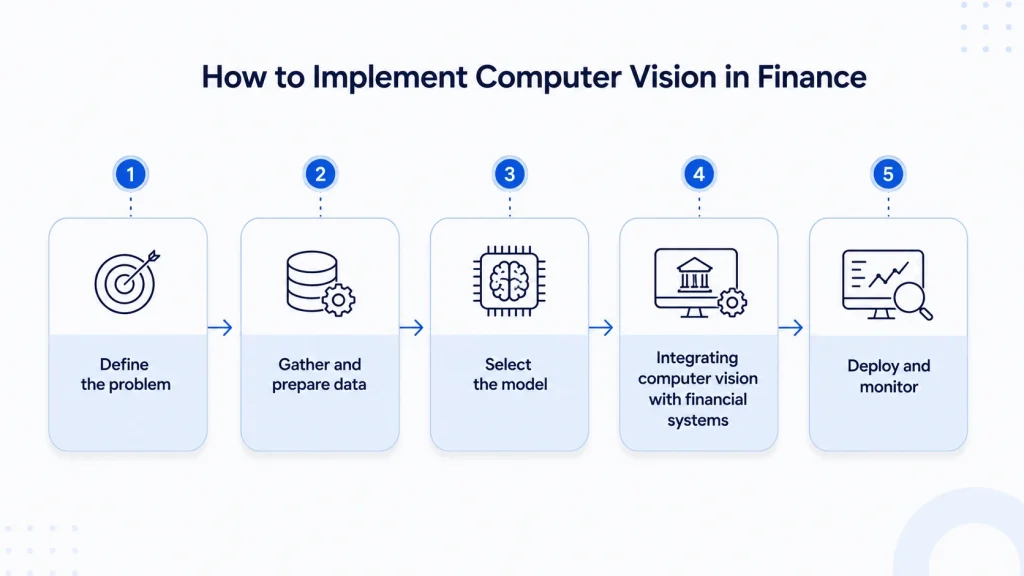
1. Define the problem
Identify a manual, visual-heavy workflow with measurable costs or inefficiencies, such as invoice processing, claims triage, document verification, or customer onboarding.
2. Gather and prepare data
Collect representative, high-quality images or video from real financial workflows. Clean and organize the data, then annotate it for the specific computer vision task.
3. Select the model
Choose the right approach based on your accuracy, complexity, and scalability requirements. Pre-trained vision models and OCR APIs can work well for standard documents, while custom computer vision models may be better for specialized use cases.
4. Integrating computer vision with financial systems
Connect the computer vision pipeline with existing financial systems through secure APIs. Test the solution against edge cases, poor-quality inputs, and potential spoofing or fraudulent attempts.
5. Deploy and monitor
Deploy the solution with appropriate security and human oversight. Continuously monitor accuracy, precision, recall, latency, false positives, and privacy compliance, and retrain the model as data and financial workflows change.
Integration often requires more effort than model development itself. Plan for API integration, security, testing, workflow changes, and ongoing monitoring to ensure the computer vision solution delivers value beyond the initial proof of concept and supports later-stage capabilities such as predictive analytics.
Ready to Build Your Finance Vision Solution?
From use case discovery to deployment, our computer vision experts can help build a solution that fits your financial workflows.
What Are the Challenges of Computer Vision in Finance?
Computer vision can automate document processing, identity verification, fraud detection, and other visual workflows, but financial institutions face several challenges when moving these systems into production. The biggest concerns involve data security, model reliability, integration, bias, and maintaining performance as financial data and fraud patterns change.
| Challenge | What It Means | How to Address It |
|---|---|---|
| Privacy and data protection | Financial documents and identity data often contain sensitive personal and financial information. | Use encryption, data minimization, access controls, de-identification, and clear retention policies. |
| False positives and false negatives | Incorrectly flagging legitimate customers or missing fraudulent activity can create financial and operational costs. | Set thresholds based on business risk and continuously evaluate precision, recall, and error rates. |
| Poor image quality | Glare, blur, shadows, folded documents, and low-resolution phone images can reduce recognition accuracy. | Apply image preprocessing, quality checks, and collect training data that reflects real-world conditions. |
| Bias and unequal performance | Models may perform differently across demographic groups, document types, or customer segments. | Test performance across relevant groups and monitor accuracy and error rates after deployment. |
| Explainability | Financial teams may need to understand why an AI system flagged a document, transaction, or identity. | Use interpretable outputs, confidence scores, audit trails, and human review for uncertain cases. |
| Legacy system integration | Older banking and financial platforms may lack modern APIs or standardized integration methods. | Use secure APIs, middleware, and integration layers to connect computer vision with existing systems. |
| Model drift | New document formats, devices, customer behaviors, and fraud techniques can reduce model performance over time. | Continuously monitor performance, collect new production data, and retrain models when necessary. |
| Cybersecurity | Computer vision systems introduce additional data, APIs, models, and endpoints that can expand the attack surface. | Apply encryption, authentication, access controls, vulnerability testing, and continuous security monitoring. |
Accuracy claims should always be tested against your actual financial use case. A model that performs well on a benchmark may behave differently with your documents, customers, devices, and fraud patterns, so production-like testing and continuous monitoring are essential.
Security and Compliance in Financial Computer Vision
Financial computer vision systems can process identity documents, bank statements, checks, transaction records, and biometric data, so security and compliance need to be considered from the start. A production-ready solution should protect sensitive data, meet applicable regulations, and maintain clear accountability throughout the AI lifecycle.
Protect sensitive financial data
Encrypt visual data both at rest and in transit, restrict access using role-based permissions, and maintain audit logs for data access and model activity. Define retention periods and securely delete information when it is no longer needed.
Handle biometric data carefully
Facial recognition and identity verification can involve highly sensitive biometric information. Define a lawful purpose for collection, obtain required consent, limit data use, and apply appropriate biometric privacy safeguards based on the jurisdictions where the solution operates.
Address regulatory requirements
Compliance requirements depend on the data, use case, and location of the financial organization. Depending on the application, requirements may include GDPR, CCPA/CPRA, state biometric privacy laws, financial regulations, and other applicable data protection standards. Teams building computer vision for healthcare face the same architecture question under HIPAA.
Secure third-party services
If the solution uses cloud platforms, OCR APIs, or third-party computer vision services, understand where data is processed, how long it is retained, who can access it, and whether it is used for model training. Conduct vendor security assessments and establish appropriate data-processing agreements before sharing sensitive information.
Establish model governance
Document training datasets, annotation processes, model versions, validation results, and significant model changes. Monitor performance across relevant customer segments and assign clear ownership for reviewing and addressing model-related risks.
Plan for incidents and failures
Financial systems need safeguards when an AI model, API, or infrastructure component fails. Establish incident response, rollback, human-review, and business continuity procedures so critical financial workflows can continue without relying entirely on the computer vision system.
Build privacy into the workflow
Collect and retain only the data the application actually needs. De-identification, data masking, controlled access, and privacy-preserving processing can reduce exposure while allowing the computer vision system to perform its intended function.
Security and compliance should be built into the computer vision pipeline rather than added after development. This protects customer information, reduces regulatory and operational risk, and creates a stronger foundation for scaling AI across financial workflows.
Turn Financial Data Into Actionable Visual Intelligence
Build computer vision systems that extract insights from documents, images, and videos while reducing repetitive manual financial processes.
How Much Does Computer Vision Deployment Cost in Finance?
The cost of deploying Computer Vision (CV) in the financial sector generally ranges from $50,000 for a pilot project or Proof of Concept (PoC) to over $500,000+ for a full-scale, enterprise-grade deployment. The cost will depend on several factors:
- The volume and complexity of data you need to collect and annotate.
- Whether you’re developing your own models or licensing someone else’s.
- Your infrastructure setup, whether that’s cloud, on-premises, or a combination of the two.
- The cost of getting everything security-hardened and compliant.
- Integrating with your existing financial systems.
- Testing, deploying, and keeping everything up to date.
Set a budget by stage instead of trying to nail down a single number. A proof of concept is all about validating feasibility on a small dataset. A pilot is where you run side by side with human reviewers on live data. Production is where things get really complicated, with monitoring, retraining, and ongoing support. Pricing bands vary by vendor, which our comparison of computer vision software development companies breaks down.
Institutions that succeed start small, and computer vision in financial operations rewards a narrow approach. So test out one workflow, measure its progress honestly, and then expand from there.
How Do You Measure ROI From Computer Vision in Finance?
Match the metric to the workflow. What you’re trying to measure will vary depending on what you’re trying to do.
| Workflow | Metrics to track |
|---|---|
| Document processing | Cost per document, manual hours spent, error rate |
| KYC | Onboarding time, manual review rate, drop-off |
| Insurance | Claim cycle time, assessment hours, claim leakage |
| Fraud | False positives, investigation hours, losses avoided |
Don’t just look at model accuracy. A model that’s 96% accurate but that nobody acts on is basically worthless. On the other hand, a model that’s only 89% accurate but has a good exception route can make a big difference.
Future of Computer Vision in Finance
Computer vision in finance is already used for document processing, identity verification, and fraud detection. The next stage will focus on making these systems more adaptive, intelligent, privacy-preserving, and capable of handling complex financial workflows and extending into financial markets.
- Multimodal financial intelligence: Combine documents, images, transaction data, customer history, and behavioral signals to provide more complete risk insights, detect market trends, and support investment analysis; investment firms already analyze satellite imagery to predict company revenues and broader economic trends. Shipping terminal imagery is the same signal that powers computer vision in supply chain operations.
- AI-powered document understanding: Move beyond OCR to compare documents, identify inconsistencies, understand context, and automatically route exceptions for review.
- Adaptive fraud detection: Detect emerging threats such as sophisticated document manipulation, synthetic identities, and AI-generated or altered financial documents.
- Privacy-preserving computer vision: Use techniques such as edge processing, federated learning, and data minimization to reduce exposure of sensitive financial and biometric data.
- Explainable vision AI: Show why a document, identity, or transaction was flagged, making AI decisions easier for compliance teams and human reviewers to understand.
- Human-AI collaboration: Let AI handle routine analysis and identify exceptions while humans review high-risk, uncertain, or sensitive cases.
- Edge-based vision AI: Run computer vision directly on ATMs, mobile devices, branch cameras, and other edge devices to enable faster processing with less data transfer.
The future is not simply about recognizing financial documents or images. It is about combining visual AI with financial data and automation to create smarter, faster, and more trustworthy financial workflows.
Why Choose Space-O Technologies for Computer Vision in Finance?
Space-O Technologies helps financial businesses turn computer vision from a proof of concept into a production-ready solution, helping the finance sector adopt and scale these systems. We combine computer vision, AI, and machine learning expertise to solve practical challenges across document processing, identity verification, fraud detection, and financial workflow automation.
With 1,200+ clients served, 140+ in-house developers, and a 97% client retention rate, we bring experience in building and scaling complex software solutions. Our ISO 9001 and ISO 27001 certifications reinforce our focus on quality and information security.
From data preparation and model development to system integration, deployment, and optimization, we handle the complete development lifecycle. We focus on measurable outcomes, helping you build a computer vision solution that fits your existing financial workflows and is ready to scale. Teams that already have an internal roadmap can instead hire dedicated computer vision developers for a defined engagement.
Build Custom Computer Vision for Financial Automation
Automate document verification, fraud detection, claims processing, and other visual workflows with a computer vision solution built for your business.
FAQs About Computer Vision in Finance
What is computer vision in finance?
Computer vision in finance is the use of AI models to read images, documents, and video and produce structured data for financial workflows. Financial institutions use it to read identity documents, process checks, assess claim photographs, and monitor physical environments. The technology complements transaction-based AI rather than replacing it.
How is computer vision used in banking?
Banks use computer vision for KYC verification, document processing, check reading, customer identity verification, and monitoring branches and ATMs. Each application takes visual input and converts it into a format that core banking systems can use. Most banks start with high-volume paperwork processes where results are easy to measure.
Can computer vision help prevent financial fraud?
Computer vision can identify visual warning signs associated with financial fraud, but it cannot determine fraud on its own. Models can flag suspicious documents, forged signatures, manipulated images, or duplicate submissions. These signals are then combined with transaction records, customer history, and rules to support fraud detection and decision-making.
How does computer vision speed up the KYC (Know Your Customer) process?
Computer vision can reduce KYC processing time by automating document checks and face matching. The system reads an identity document, compares the photo with a live selfie, and performs a liveness check to confirm that a real person is present. Compliance teams can then focus on complex or higher-risk applications instead of reviewing every application manually.
How do insurers use computer vision?
Insurers use computer vision to assess vehicle or building damage from photographs, extract information from documents, and flag photo evidence that appears inconsistent or manipulated. These capabilities can accelerate claims processing, while claims adjusters remain responsible for making final claim decisions.
How much is a computer vision solution for finance going to set me back?
The cost of a computer vision solution for finance depends on factors such as document volume, model complexity, infrastructure requirements, compliance needs, and integration work. There is no fixed price because each project has different requirements. A small proof of concept typically costs less than a full production system, so budgeting in stages from proof of concept to pilot and production can provide a clearer cost estimate.
Is computer vision a secure way to handle sensitive financial data?
Computer vision can be used to process sensitive financial data securely when appropriate controls are implemented from the beginning. These controls include encryption, access management, audit logging, and model governance. Space-O Technologies follows ISO 27001 information security practices for projects involving sensitive financial data.



 All our projects are secured by NDA




 4.8
4.8