
 By
By 
Contents
A pallet leaves a supplier, passes a loading dock, gets loaded onto a trailer, then ends up in a receiving bay and settles into a rmited investment, while a multi-facility solution with real-time analytics and automation will require significantly more.ack. Cameras are watching nearly every step of that journey, but almost none of what they see ever reaches the WMS.
That’s the key issue in supply chain management right now. We’ve got warehouses, distribution centers, loading docks, and delivery fleets all generating a ton of data, but most of it is just sitting there, not being turned into anything useful. Video feeds run all day across the logistics industry and get retained for thirty days without anyone acting on them.
Computer vision in supply chain uses cameras, sensors, and artificial intelligence to automatically spot, count, inspect, track, and monitor goods and activities all the time. What the cameras see gets turned into data that actually means something to the business.
Adoption is happening fast now, and the global market is moving with it. Gartner reckons 50% of companies with warehouse operations will be using AI vision systems by 2027, replacing scanning-based cycle counting, and that’s up from 20% back in December 2023.
This guide is about what computer vision in the supply chain does, the problems it solves, how it actually works, 16 real-world computer vision applications across warehousing and logistics operations, the benefits, what it costs, how to measure the return on investment, and how to find a partner to implement it. All written from our experience as a custom computer vision development company.
What Is Computer Vision in the Supply Chain?
Computer vision in the supply chain is essentially using cameras, sensors, and AI to understand what those cameras are seeing and turn that into useful supply chain information. We use computer vision technology to automate what’s normally a manual process, like having someone go out and count stock.
Modern computer vision systems can pick out products, packages, pallets, barcodes, labels, vehicles, people, equipment, damage, and movement in the physical world. It’s turning all of that into records rather than just moments that nobody actually logged.
| Traditional process | With computer vision |
|---|---|
| Manual inventory counting | Automated visual counting |
| Manual package inspection | Automated inspection |
| Manual visual label check | OCR and barcode recognition |
| Manual monitoring | Continuous monitoring |
We’re not talking about moving from zero data to some data. A modern supply chain goes from where we only had sampled, delayed data entered by hand to continuous machine-captured data.
What Supply Chain Problems Can Computer Vision Help With?
Supply chain management teams don’t search for object detection. They’re searching for the operational failure that is actually costing them money this quarter.
| Supply chain problem | Computer vision solution |
|---|---|
| Inventory inaccuracies | Automated counting |
| Misplaced goods | Item and location tracking |
| Shipping errors | Label and package verification |
| Damaged shipments | Damage detection |
| Slow sorting | Automated sorting |
| Loading errors | Loading verification |
| Safety risks | Forklift and pedestrian monitoring |
| Limited visibility | Real-time visual tracking |
Every supply chain management project that is going to be a success starts here, with an actual problem, not with the technology itself. Working out which problem to pick first is where computer vision consulting earns its keep.
How Does Computer Vision Work in the Supply Chain?
Computer vision works by capturing visual data, analyzing it with AI models, converting detections into structured data, and connecting the insights to supply chain systems. These insights can then trigger real-time actions, such as updating inventory, detecting damaged packages, or redirecting shipments.
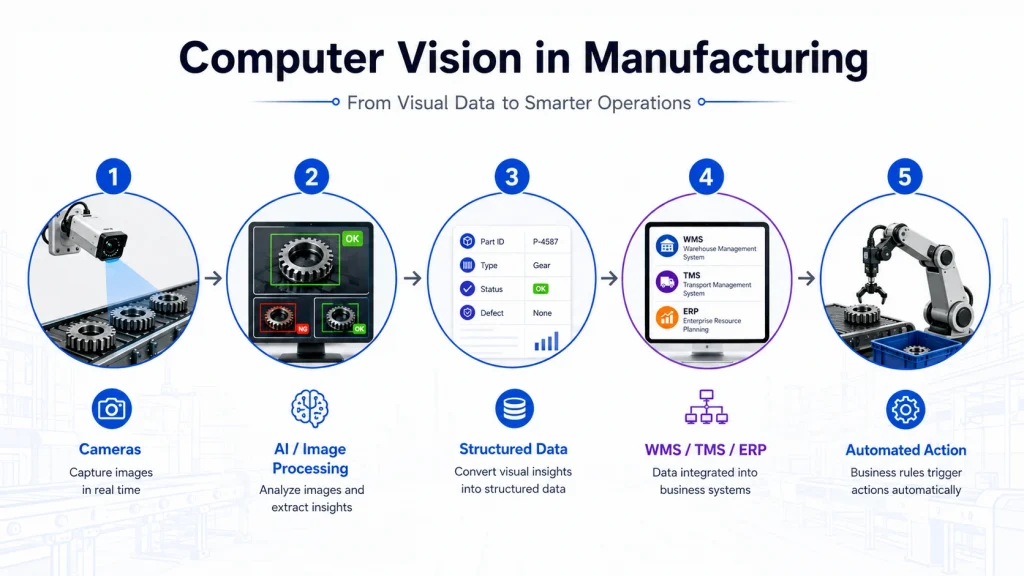
1. Capture that visual data
You can use CCTV, industrial cameras, warehouse ceiling units, vehicle-mounted cameras, mobile devices, or drones. Anything that can capture images all day long, feeding into the system.
2. Process those images or video
You need to make sure the frame is right first, and then computer vision algorithms go to work. They do object detection, classification, segmentation, OCR, and so on, depending on what you’re actually trying to do. Deep learning and machine learning models plus image recognition systems are doing the heavy lifting under the hood, and video analysis runs frame by frame. It’s not working on some saved clip. Our computer vision guide defines each of those tasks with worked examples.
3. Turn that visual information into data
Raw detections become actual structured records that people can use. Twenty-five boxes detected. Damaged package detected. Pallet moved from Zone A to Zone B. Visual intelligence only matters when it reads like a database row.
4. Connect with supply chain systems
The output from the AI model needs to flow into the systems running the business: warehouse management, transport management system, ERP, or inventory management. Without seamless integration into your existing systems, what you’ve got is a flashy dashboard, not a real tool.
5. Trigger an action
It needs to trigger some action. Alert the warehouse staff, update the inventory records, stop the conveyor belt, redirect a package. You’ve only got real value out of that AI vision output if somebody or something is going to do something about it.
How Does Computer Vision Actually Get Used Across the Supply Chain?
The applications are grouped by operation rather than by type of technology, because that’s how logistics operations are budgeted and owned.
Warehouse and Inventory Operations
- Inventory Counting and Tracking: You can identify and count boxes, pallets, products, and containers without anyone scanning or touching a thing. Automated drone or fixed-camera scanning replaces manual inventory tracking, and cameras can scan the shelves to update counts in real time. The warehouse inventory stops depending on some quarterly count that is plain out of date by the time it finishes. The same shelf-scanning idea runs at the store end of the chain, which we cover in another resource how computer vision used in retail.
- Raw Material Tracking: Visual monitoring tracks raw materials moving through to the production areas. Material availability feeds into production continuity, and visibility into inventory levels means far fewer stockouts that stop a line in its tracks.
- Warehouse Location and Movement Tracking: Goods go missing, but computer vision brings them back into focus. By mapping out where goods are stored and how they move between the warehouse, the picking zones, receiving, and dispatch, all that lost stock becomes findable rather than written off as a loss.
- Picking, Packing and Palletizing: Vision-guided robots in warehouses need to know not just what they’re picking up, but exactly where it sits and how to handle it. Computer vision supplies that crucial information, meaning location, size, shape, and orientation, which allows a robot to pick reliably from an unfixtured surface.
- Automated Sorting: Package sorting gets a lot smarter with computer vision. Packages are identified and routed by destination, what’s in them, size, label, or shipping category. Computer vision in logistics reduces those pesky sorting errors and raises operational speed without adding headcount.
Transportation and Logistics
- Loading and Unloading Monitoring: Computer vision in logistics starts at the dock, where cameras watch over trucks, containers, and package movement. The question worth answering from all this is pretty simple. Did the right shipment get loaded up, and did it get loaded up right? Loading verification catches those errors while the trailer is still at the dock. The same shipping documents reach a lender later in the trade cycle. Our guide to computer vision in financial services covers how banks read them.
- Inventory Tracking in Transit: Cameras capture goods entering and leaving facilities and cross-check this against shipping and receiving records. It’s a simple check: visual count, shipping record, receiving record, discrepancy alert. Computer vision systems can also detect any anomalies that pop up in real time during transit.
- Fleet and Vehicle Monitoring: Vehicle identification, fleet activity, dock utilization, and movement patterns become trackable. Computer vision doesn’t do route optimization on its own, but logistics AI feeds visual data into fleet management and predictive analytics systems that do.
- Delivery Monitoring: Delivery sites are watched, as are vehicle activity and package handoff, all to give you better last-mile visibility. The value is verification, not surveillance. You need to keep an eye on things, not just watch them.
Quality and Shipment Inspection
- Package Damage Detection: Crushed boxes, torn packaging, dents, broken containers, leaks, and visible damage all get caught before dispatch, at handover, or at receiving. Catching damage early is worth a lot, because it decides who pays for it.
- Label, Barcode, and QR Code Verification: OCR, that’s Optical Character Recognition, scans shipping labels, SKU numbers, batch numbers, and expiry dates, while barcode scanning handles coded data. Every field gets validated against the order record before the package moves.
- Product and Shipment Quality Inspection: Computer vision gives quality control a big boost by verifying that the right product is packed up right, in the right quantity, packaging, and label. Detecting defects and mislabeling early means defect detection catches the error before it spreads and turns into a return. Defect detection cut its teeth on the factory floor, and our guide to computer vision in manufacturing covers how those inspection models get built.
Safety and Asset Monitoring
- Forklift and Pedestrian Safety: Cameras watch forklift traffic and detect pedestrians, restricted zones, and anything that suggests unsafe proximity. Camera-based systems detect unsafe behaviors in real time and flag unauthorized access to areas you shouldn’t be in. AI vision surveillance enforces safety protocols automatically across logistics facilities.
- Equipment Monitoring and Predictive Maintenance: Equipment detection flags up wear, damage, leaks, conveyor problems, and forklift faults. High-resolution cameras spot early signs of failure that no schedule would have picked up. Machine vision sees visible symptoms while sensor data gives you internal conditions, and that’s when predictive maintenance really starts to pay off.
- Cold Chain and Condition Monitoring: Package condition, container condition, and refrigeration equipment get visually inspected, and OCR reads temperature displays on units that don’t even have digital output. Thermal imaging gets used when you need to check temperatures. Standard RGB cameras cannot measure temperature.
Turn the Visual Data Your Facility Already Captures Into Operational Data
Our engineers audit your camera coverage, WMS integration points, and your most costly manual processes, then figure out which application will give you the best return first.

What Are the Benefits of Computer Vision in Supply Chain?
Computer vision helps supply chain businesses automate visual tasks, improve inventory accuracy, reduce errors, and gain real-time visibility across warehouses and logistics operations. By turning camera data into actionable insights, it can improve efficiency while reducing operational costs.
Improve inventory accuracy
Automated counting and scanning put operational data front and center. Computer vision cuts down on manual errors from silly things like key entry and skipped counts, keeping inventory records aligned with master data.
Reduce manual inspection
Repetitive visual tasks like label checks, count verification, and damage screening, the things that are tedious and time-consuming, get moved off people and onto camera-based systems. Clinical teams automate cell counting and image pre-screening for the same reason, among other healthcare computer vision applications.
Improve shipment accuracy
Label and package verification catches the wrong item before it goes out. Fewer shipping mistakes, fewer returns, and higher customer satisfaction.
Increase supply chain visibility
Continuous monitoring fills the gap between system updates. Cameras watch inventory movements all the time, so you don’t have to guess what happened from timestamps.
Improve warehouse safety
Computer vision spots workplace accidents and identifies damage before it’s too late. AI vision alerts you to risks while you still have time to do something.
Increase operational efficiency
Automating tasks raises throughput and operational speed. That’s what computer vision in logistics does for logistics processes in distribution centers, and it helps improve efficiency across order fulfillment too.
Reduce operational costs
There isn’t one magic percentage that applies everywhere. What computer vision in logistics does affect is specific: inspection hours, counting labor, error rates, returns, damage claims, and rework. Accenture research found companies with AI-mature supply chains are 23% more profitable than their peers, though that’s broad AI maturity, not computer vision alone.
From inventory tracking and shipment verification to warehouse safety and operational efficiency, computer vision can improve multiple stages of the supply chain. When integrated with existing supply chain systems, it turns visual data into actionable insights that help businesses make faster, more accurate decisions.
Most Vision Projects End as a Dashboard Nobody Opens
The difference is whether detections write back into your WMS. Tell us which platform you run and we will tell you what that integration actually involves.
What Technologies Are Used in Supply Chain Computer Vision?
- Object detection is what picks up packages, pallets, vehicles, people, and all that other stuff in live shots.
- Image classification is how it figures out whether things are damaged or not, helping with quality control.
- Image segmentation gets really precise about where exactly an object or a bit of a problem is, when a simple box just won’t do.
- OCR reads all the writing on packaging and labels, like dates and what have you.
- Object tracking follows a package or vehicle through the video feeds and keeps track of it throughout.
- 3D computer vision uses deep learning to work out the dimensions and position of stuff for robot picking to work.
- Edge AI does all the processing on site, in warehouses, on trucks, and at loading docks. Basically, it’s about keeping latency down, keeping the data on local networks, and keeping important stuff private and in your control. Visual inputs get processed where they’re captured.
- Computer vision and IoT team up, with cameras working alongside RFID, GPS sensors, stock control systems, and transport systems instead of replacing them.
Deep learning and the neural networks that go with it are the foundation of all of the above. Machine learning algorithms trained on your own images of your own products outperform a generic model any day, and that’s why data quality is more important than picking the right architecture. Those same building blocks turn up in real-world computer vision use cases across manufacturing, retail, healthcare, and finance.
How to Implement Computer Vision in Supply Chain
Implementing computer vision in the supply chain involves identifying the right use case, selecting cameras and AI models, training the system, and integrating it with existing supply chain software. After testing its accuracy, the solution can be deployed and continuously optimized.
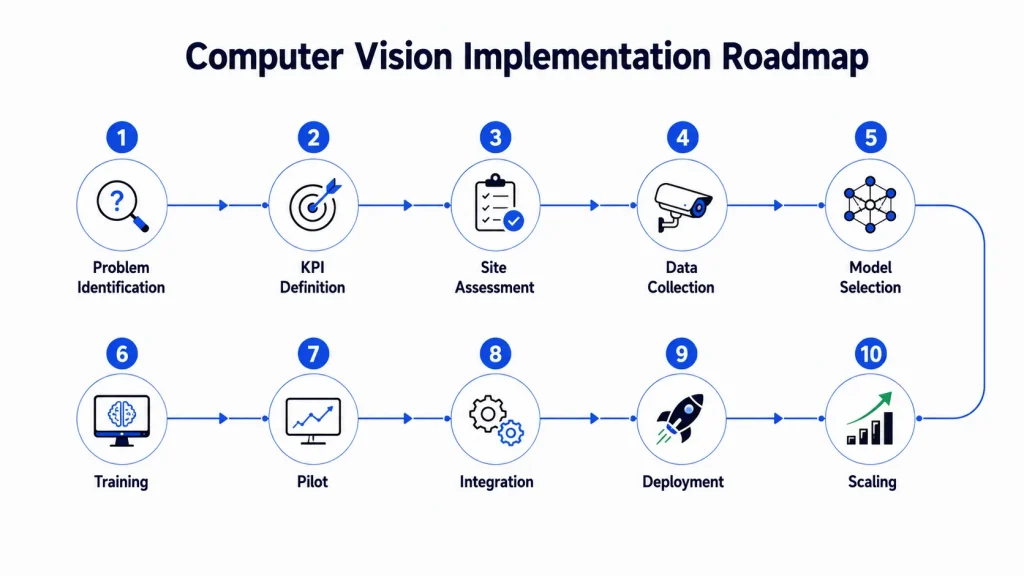
1. Identify one high-value supply chain problem that needs solving
Don’t start by wondering where AI might fit in. Start by asking which of your processes is expensive, is a lot of work, is prone to errors, and is a pain to keep an eye on. That gives you a clear scope. The other way round just makes for a workshop.
2. Choose what you’re going to measure and how you’re going to judge success
Pick the numbers that really matter before you even start building: inventory accuracy, detection accuracy, how long things take to process, error rate, labor hours, throughput, and safety events. Don’t just focus on how well the model does. It needs to actually fix the problem it was built to fix.
3. Get a feel for the place it’s going in
Where the cameras go, how the lighting is, what the warehouse layout is like, how fast things are moving, how much stuff is in the way, and what state your network is in. Map your existing process first, because all that affects what’s possible a lot more than which model you pick.
4. Get hold of some real-world images and label them up
Get some photos from your own place across different products, lighting conditions, and weird situations, with good and bad examples of all the different things. A model can’t pick out things it’s never seen before.
5. Decide which computer vision approach to use
What you choose depends on what you’re trying to detect, how accurate it needs to be, how fast it needs to be, how much data you have, and what kind of hardware you’re using, not to mention what kind of environment it’s going to be operating in. No architecture is best for everything, whatever the sales deck might say.
6. Train and test the model
Training, testing, and validating is where you get to see how well it actually does. Look at false positives and false negatives separately, because in logistics they have different costs.
7. Put it through its paces in the real supply chain environment
Your test data and your live warehouse are not always going to agree. Lighting changes, stuff gets in the way, cameras move, and packaging gets refreshed. All of that will degrade performance that looked great in the lab.
8. Integrate with all the other systems you use
At this point, the model needs to start doing real work for you. Make sure the data it comes up with actually gets written into the master data, and that you’ve worked out how to deal with any conflicts. And find out what happens if the network goes down.
9. Get it deployed and keep an eye on it
Choose whether to run the inference on the edge, in the cloud, or a bit of both, based on latency needs. Then keep monitoring for all the things that can go wrong, like the model drifting away from what it used to be. Retrain on schedule, and track performance.
10. Start small and scale up carefully
Do a proof of concept or a pilot, then move on to production. Implementing computer vision across the whole enterprise in one go usually isn’t going to work.
With the right implementation strategy, computer vision can turn visual data into real-time insights that improve supply chain accuracy, visibility, and efficiency.
Get a Custom Computer Vision System Built for Your Warehouse
We design, train, and deploy computer vision models for inventory counting, damage detection, and loading verification, then integrate them with your WMS.
What Challenges Should You Expect With Computer Vision in Supply Chain?
| Challenge | Why it happens | How to address it |
|---|---|---|
| Poor or inconsistent lighting | Dock doors, skylights, and old fixtures keep changing the lighting levels | Control it at the inspection point, and train using real production conditions |
| Camera blind spots | Products and equipment keep getting in the way | Map it out in the planning phase, add some extra angles |
| Occluded products | Stacked and wrapped goods are always getting in the way | Get more angles, accept it won’t be perfect, and reconcile with your stock counts |
| High-speed operations | The conveyor belt is moving way too fast for the camera | Get the shutter speed right for the movement; compress the model a bit |
| Large warehouse coverage | You need a lot of cameras to cover that much space | Prioritize the areas with the most value, rather than blanketing the whole place |
| Limited training data | Most of the weird stuff happens once every thousand times | Use anomaly detection, and think about generating synthetic data |
| False positives and negatives | Every threshold you set will create trade-offs | Report on them separately, and tune based on real operational costs |
| WMS, TMS, and ERP integration | Those old systems were never built to work with AI systems | Get the IT team involved from the get-go, and work out how to budget for it |
| Network and edge limits | Connectivity is spotty in warehouses | Process at the edge, and design the system to work offline |
| Privacy and worker monitoring | Safety cameras are pointed at people | Anonymize the footage at the edge, and get the workers’ views first |
Get a Scoped Estimate for Your Facility, Not Industry Averages
Send us your facility layout, camera inventory, and target process. Our engineers will come back with a cost breakdown, timelines, and WMS integration requirements.
How Much Will You Really Pay for Computer Vision in Your Supply Chain?
Implementing computer vision in a supply chain typically costs $50,000 to $250,000 for a production-grade solution, while smaller PoCs may start around $10,000 and complex, multi-site deployments can exceed $500,000. The final investment depends on the number of cameras, AI model complexity, infrastructure, and deployment scale.
Beyond development, you also need to account for data labeling, WMS/TMS/ERP integration, edge hardware, rollout, and ongoing maintenance. A simple inspection system may require limited investment, while a multi-facility solution with real-time analytics and automation will require significantly more. Minimum project sizes differ sharply between vendors, which our roundup of the top computer vision development companies sets out.
How Do You Measure Return on Investment From Computer Vision in Supply Chain?
You need to measure how the operation changes, not just the model. Computer vision technology at 95% accuracy that nobody acts on isn’t going to bring you any returns.
| Use case | What to measure |
|---|---|
| Use case | What to measure |
| Inventory | Inventory accuracy, counting time, labor hours, stock discrepancies |
| Package inspection | Damage detection rate, inspection time, shipping errors, returns |
| Warehouse automation | Throughput, processing time, manual intervention required |
| Safety | Safety violations detected, alert response time, incident count |
Get a baseline before deployment. Without one, every post-launch number about your supply chain operations is just an argument, not evidence. Tie it back to how supply chain operations actually ran before.
The Future of Computer Vision in Supply Chain
Where might supply chain teams be using computer vision next? Some of this is already running, and some of it isn’t.
| Direction | Maturity | What supply chain teams could use it for |
|---|---|---|
| Vision-guided robotics | In use | Automated Guided Vehicles and Autonomous Mobile Robots navigate using deep learning |
| 3D computer vision | In use | Dimensioning, volume capture, and space utilization by analyzing warehouse layouts |
| Edge AI | In use | Local inference where connectivity is unreliable |
| Computer vision and IoT | In use | Camera data fused with RFID and sensor telemetry |
| Autonomous warehouse operations | Emerging | Coordinated robotic picking, movement, and replenishment |
| Multimodal AI | Emerging | Models reasoning across images, sensor readings, and order records together |
| Digital twins and visual data | Emerging | Testing layout and process changes before committing them |
We tend to treat emerging tech like it’s already here, which is the most common way technology trends turn a roadmap into a lost year.
Why Space-O Technologies is Your Best Bet for Computer Vision Development?
Space-O Technologies is no newcomer to software development, having spent the last 15+ years perfecting their skills and building up a team of 140+ in-house developers who can craft custom computer vision solutions that really make a difference in supply chain operations. You can also hire computer vision developers to work alongside your own team.
With an incredible client list that includes 1,200+ businesses and a 97% retention rate that speaks for itself, we have what it takes to help you develop, integrate, and get up and running with computer vision systems that are tailored to your exact needs.
We handle the whole shebang, from building those all-important AI models and getting your visual inspection systems up and running through to actually integrating and supporting the systems after they’re installed. And with those coveted ISO 9001 and ISO 27001 certifications under our belt, you can rest easy knowing we have quality and data security running through the very heart of everything we do.
FAQs About Computer Vision in Supply Chain
What is computer vision in supply chain?
Computer vision uses cameras, sensors, and artificial intelligence to automatically spot, count, inspect, and track goods in your warehouse, docks, and vehicles. Visual data from those locations becomes the records that WMS, TMS, and ERP systems use to inform their decisions.
How is computer vision used in supply chain management?
Cameras capture images, machine learning models analyze them, and the results trigger an inventory update, damage flag, or safety alert. Supply chain management applications cover everything from counting and sorting to loading verification, inspection, and safety monitoring.
What are the main ways computer vision comes in handy in supply chain management?
The main computer vision applications are inventory counting, stock tracking, product picking, sorting, loading verification, in-transit tracking, fleet monitoring, package damage detection, label verification, and forklift safety monitoring. Most logistics operations start with one application and expand as needed.
How does having computer vision improve warehouse inventory management?
Instead of relying on periodic manual counts, computer vision continuously monitors inventory to improve accuracy. It reduces errors caused by manual data entry and missed products, helping warehouse teams identify inventory discrepancies within hours rather than waiting until the end of a reporting period.
Can computer vision be used to track inventory in real time?
Fixed cameras and drones can continuously scan shelves and storage areas to provide real-time inventory visibility. This works best in areas with good lighting and consistent storage locations. When inventory is stacked or covered by packaging, periodic physical counts may still be necessary.
Can computer vision detect packages that are damaged?
Computer vision can detect package damage such as crushing, tearing, dents, and leaks at touch points including dispatch, handover, and receiving. Early detection helps supply chain teams identify where and when damage occurred and determine responsibility for the loss.
How does computer vision make warehouses a safer place?
Computer vision can detect situations such as a forklift approaching a pedestrian or a person entering a restricted area. While it is not a foolproof safety system, it can help reduce incidents and identify near misses that would be difficult to track manually.
How does computer vision work with a Warehouse Management System?
Computer vision detections can be written into a WMS as inventory updates, exception flags, or task triggers through an API or middleware layer. The depth of the integration determines whether the computer vision system simply provides operational visibility or actively triggers warehouse processes.
What kind of tech gets used in supply chain computer vision?
Supply chain computer vision systems commonly use object detection, image classification, segmentation, OCR, and object tracking, built with technologies such as OpenCV, TensorFlow, PyTorch, and YOLO. Deep learning underpins many of these capabilities, and most logistics solutions run inference at the edge.
How accurate is computer vision in supply chain applications?
Accuracy depends on factors such as lighting, occlusion, packaging consistency, camera setup, and training data quality rather than the model alone. Businesses should evaluate vendors based on performance in real-world facilities and conditions similar to their own rather than relying only on benchmark datasets.
How expensive is computer vision in supply chain management?
Cost depends on the number of cameras, lighting requirements, data annotation, model complexity, edge hardware, integration depth, and the number of sites covered. Integration with WMS and ERP systems is also an important cost factor that businesses often underestimate.
How long does it take to get a computer vision system up and running in a warehouse?
A proof of concept usually takes 6 to 12 weeks, while a full production deployment can take around 4 to 8 months. Timelines depend largely on access to WMS integration interfaces and the quality and availability of training data.
How can I calculate the ROI of computer vision?
Start by establishing a baseline for the operational KPI you want to improve, then measure the same KPI after deployment. Track metrics such as labor hours, error rates, inventory accuracy, and throughput. Model accuracy is a diagnostic metric, while ROI should be measured through measurable operational and financial improvements.



 All our projects are secured by NDA




 4.8
4.8