
 By
By 
Contents
AI adoption has reached an inflection point for product development. Companies across industries are racing to embed intelligence into their products and services. According to a Gartner report, total worldwide AI spending will reach $2.5 trillion in 2026, a 44% increase over the previous year. This massive investment reflects how critical AI capabilities have become for competitive advantage.
But with this surge in AI investment comes a harsh reality. Most attempts at AI MVP development never make it past early validation, not because the technology falls short, but due to poor validation strategy, unclear problem-market fit, and incomplete planning. Partnering with an experienced AI development services provider can help bridge this gap by establishing the right foundation from the start. Without it, the space between AI ambition and execution is where most founders lose time, money, and momentum.
This guide explains how to build an AI MVP successfully, from initial concept through launch. Drawing from our experience as an MVP development company, we share proven insights on AI integration approaches, cost breakdowns, validation frameworks, and architecture decisions.
What is AI MVP Development?
AI MVP development is the process of building a minimum viable product that incorporates artificial intelligence or machine learning at its core. Unlike traditional MVPs, where you’re mainly testing user demand, an AI MVP carries an additional burden. You need to prove the AI engine actually works before committing to full-scale development.
This means an AI MVP must validate three elements at once: that customers genuinely want your AI-powered solution, that your AI approach solves the stated problem with acceptable accuracy, and that customers are willing to pay for the capability. Getting even one of these wrong can derail the entire product.
What makes this more practical today is the availability of pre-built AI services. APIs from OpenAI, Google, and AWS now offer pre-trained models for language, vision, and speech that eliminate the need to train anything from scratch. This allows your team to focus on building the unique customer experience and business logic around these capabilities, significantly reducing both cost and time to validation.
That said, AI MVP development still differs fundamentally from traditional software development. The technical risk sits somewhere between simple application builds and end-to-end AI development. You’re not just testing whether users click a button; you’re testing whether an AI model performs reliably enough in real-world scenarios to deliver genuine value.
Why AI MVP Development Matters: 5 Key Benefits
The window for launching AI-powered products has never been more favorable, but it’s also never been more competitive. Two years ago, simply adding AI to your product was a differentiator. Today, customers expect it. The companies that validate their AI ideas quickly through a focused MVP approach are the ones capturing market share.
1. AI infrastructure has matured beyond experimentation
Building AI products in 2023 or 2024 meant stitching together fragile tools and dealing with unreliable outputs. That era is over. Foundation models from OpenAI, Google, and Anthropic now support production-grade features without maintaining your own ML pipeline. This maturity means your AI MVP development timeline has compressed from six to eight months down to as little as eight to twelve weeks.
2. Customer expectations have permanently shifted
AI is no longer a novelty. People interact with it daily and now judge AI products on whether they deliver a better outcome than the alternative. You’re not just proving demand for the concept; you’re proving your AI performs well enough that users prefer it over existing solutions.
3. The cost barrier has dropped significantly
What once required a dedicated data science team can now be achieved with API calls and prompt engineering. Pricing has dropped steadily, open-source models offer free alternatives, and an MVP development company can help you go from idea to working prototype at a fraction of what it cost even eighteen months ago.
4. First-mover advantage is narrowing fast
Every month you spend perfecting in isolation, competitors are shipping and iterating with real users. The AI startup landscape in 2026 moves fast, which raises the stakes for MVP development for startups. A six-month delay can mean entering a market with three established players. An AI MVP lets you stake your claim early and build a feedback loop that compounds over time.
5. Investor expectations now favor validated AI products
Raising capital for an AI idea on a pitch deck alone has become significantly harder in 2026. Investors want to see working prototypes, early user data, and proof that the AI model performs in real scenarios. A validated AI MVP gives you leverage at the fundraising table that no slide deck can match.
The bottom line is this: 2026 rewards speed and validation over perfection. The tools, infrastructure, and market conditions make building an AI MVP faster and cheaper than ever. But these same conditions also mean more competition enters every week. The advantage goes to founders who validate first and iterate based on what they learn.
Develop Your AI MVP With Experienced Developers
Our MVP specialists help you design, develop, and launch AI-powered products that validate your idea and accelerate innovation.

Three-Tier AI Integration Framework for MVPs and Which One to Choose
The foundation of successful AI MVP development is selecting the right AI approach. The decision directly impacts development timeline, cost, technical risk, and launch speed. Understanding the tradeoffs enables smart choices aligned with your constraints.
Tier 1: API-based AI integration (fast, simple, affordable)
API-based integration uses pre-built AI models from established providers. You integrate third-party intelligence into your application through API calls. Your team handles the user experience, data processing, and business logic.
When to choose this approach
- You need to launch quickly within two to four months.
- Your budget is limited to $50,000 to $100,000 total investment.
- You want to minimize technical risk from building custom ML.
- Customer problems align with existing AI capabilities in the market.
- You prioritize validation speed over proprietary differentiation.
Technology stack example
- Frontend: React, Next.js, or Vue.js for web interface.
- Backend: Node.js, Python, or Go for API orchestration.
- AI services: OpenAI API, Google Cloud Vision, AWS Textract.
- Database: PostgreSQL or Firebase for data persistence.
- Hosting: Vercel, Render, or AWS Lambda for serverless scale.
Cost breakdown for API-based AI integration
- Development team (2-3 people): $40,000 to $80,000.
- Third-party AI API costs: $5,000 to $15,000 monthly.
- Infrastructure and hosting: $500 to $2,000 monthly.
- Total three-month launch investment: $50,000 to $110,000.
Timeline for API-based AI integration
- Weeks 1-2: Project setup and API integration planning.
- Weeks 3-6: Core application development with AI integrations.
- Weeks 7-8: User testing and refinement based on feedback.
- Week 9-12: Bug fixes, performance optimization, and launch.
Advantages of the API approach
- Fastest time to market among all AI approaches available.
- Lowest development cost and smallest team required.
- Proven AI models reduce technical risk significantly.
- Easy to iterate on features without major rewrites.
- Minimal infrastructure and DevOps expertise needed.
Disadvantages of the API approach
- Limited differentiation since competitors use the same APIs.
- Ongoing API costs scale with usage and can become expensive.
- Dependency on third-party providers for AI improvements.
- Less control over model performance and customization.
- Potential vendor lock-in for core AI functionality.
Real-world example: ChatGPT-powered productivity tools launched using OpenAI APIs achieved product-market fit quickly. Companies built valuable products without training any machine learning models.
Tier 2: Fine-tuned model development (balanced approach)
Fine-tuning takes pre-trained models and adapts them to your specific use case. You provide labeled training data, and the service fine-tunes the model on your behalf. This approach offers more customization than pure API usage.
When to choose this approach
- You need moderately customized AI behavior within four to six months.
- Your budget allows $100,000 to $200,000 for MVP development.
- Your domain has specific language, patterns, or requirements.
- You want some competitive differentiation through customized AI.
- You’re willing to invest in preparing training data.
Technology stack example
- Frontend: React with TailwindCSS for polished interfaces.
- Backend: Python with FastAPI for ML-aware architecture.
- Model training: OpenAI fine-tuning, Anthropic Claude, or Cohere.
- Vector database: Pinecone or Weaviate for semantic search.
- Hosting: AWS SageMaker or Google Cloud for managed ML.
Cost breakdown for fine-tuned model development
- Development team (3-4 people): $80,000 to $140,000.
- Fine-tuning service costs: $10,000 to $25,000.
- Vector database and tools: $3,000 to $8,000.
- Infrastructure: $2,000 to $4,000 monthly.
- Total six-month launch investment: $125,000 to $210,000.
Timeline for fine-tuned model development
- Weeks 1-3: Data collection and annotation planning.
- Weeks 4-6: Data preparation and quality assurance.
- Weeks 7-10: Fine-tuning and model evaluation.
- Weeks 11-16: Application development with fine-tuned models.
- Weeks 17-20: Testing, iteration, and optimization.
- Week 21-24: Launch preparation and go-live support.
Advantages of fine-tuning
- Greater customization than pure API approaches.
- Better performance on domain-specific tasks.
- Moderate development timeline and cost.
- More competitive differentiation than pure APIs.
- Retains flexibility to switch providers if needed.
Disadvantages of fine-tuning
- Requires significant time and effort for training data.
- Limited by what base models support fine-tuning.
- Ongoing costs for inference and model hosting.
- Less control than fully custom ML models.
- Regulatory constraints for sensitive domains.
Data requirements: Start with one hundred labeled examples. Scale to five thousand for strong results. Ensure clear labeling guidelines and quality validation.
Tier 3: Custom machine learning (maximum differentiation, high risk)
Custom ML development builds proprietary models trained on your data. You own the model, the data, and the underlying IP. This approach maximizes competitive advantage but requires serious technical depth.
When to choose this approach
- You have eighteen to thirty months to launch.
- Your budget exceeds $250,000 for MVP development.
- Your competitive advantage depends on custom ML.
- You have access to large amounts of proprietary data.
- You’re building models that no vendor provides.
Technology stack example
- Frontend: React with D3.js for visualization.
- Backend: Python with Django or FastAPI.
- ML frameworks: PyTorch or TensorFlow for model development.
- Data pipeline: Apache Spark or AWS Glue for processing.
- MLOps: MLflow or Kubeflow for model management.
- Hosting: Kubernetes on AWS, Azure, or Google Cloud.
Cost breakdown for custom machine learning
- Development team (6-8 people): $200,000 to $400,000.
- Infrastructure and compute: $30,000 to $80,000.
- Data acquisition and annotation: $20,000 to $60,000.
- ML tooling and services: $5,000 to $15,000.
- Total MVP investment: $250,000 to $550,000+.
Timeline for custom machine learning
- Months 1-3: Data strategy, collection, and infrastructure setup.
- Months 4-8: Data cleaning, feature engineering, and model baseline.
- Months 9-14: Iterative model improvement and optimization.
- Months 15-18: Production hardening and deployment infrastructure.
- Months 19-24: Integration, testing, and market validation.
- Months 25-30: Scaling and model maintenance.
Advantages of custom ML
- Complete competitive differentiation through proprietary models.
- Full ownership of model, data, and IP rights.
- Flexibility to optimize for your specific use case.
- Scalable approach for long-term business building.
- Reduced dependency on external vendors.
Disadvantages of custom ML
- Longest timeline to launch among all approaches.
- The highest development cost and the biggest team are required.
- Significant technical risk in model development.
- Ongoing costs for data, infrastructure, and ML engineers.
- Requires deep ML expertise in-house or contracted.
Data requirements: Start with ten thousand to one hundred thousand examples. Ensure diverse, representative data covering edge cases and rigorous validation.
AI MVP Development Process: Step-by-Step Implementation
Building an AI MVP follows a disciplined process that balances speed with thoroughness. Understanding each phase prevents costly mistakes while maintaining momentum.
Phase 1: Problem validation and AI approach selection
Before writing code, validate your problem and confirm AI adds genuine value. Many founders jump to AI because it’s trendy, not because it solves critical problems. This phase determines whether you should pursue Tier 1, Tier 2, or Tier 3.
Stakeholder interviews:
- Talk to 20-30 potential customers about their current solutions.
- Ask specifically why AI would improve their situation.
- Explore whether customers would pay for AI-powered capabilities.
- Understand the competitive landscape and incumbent solutions.
AI approach evaluation
- Map your problem to existing AI capabilities in the market.
- Assess whether off-the-shelf APIs could solve your problem sufficiently.
- Determine if customization through fine-tuning adds real value.
- Identify whether custom ML provides a defensible advantage.
- Compare the timeline and cost implications of each approach.
Technical feasibility assessment
- Consult with ML experts about your problem’s solvability.
- Understand the performance level customers require.
- Assess data availability and collection feasibility.
- Identify potential technical blockers early.
This phase typically takes two to three weeks and requires minimal investment.
Phase 2: Data strategy and infrastructure planning
AI systems depend on quality data and solid infrastructure. Planning your data strategy upfront prevents expensive mistakes. Identify available data sources, assess quality, and plan collection processes. Choose your cloud platform and design data pipelines for processing. Plan for model training, validation, and deployment. This phase takes three to four weeks.
Phase 3: MVP development and integration
Development transforms your architecture into a working product using agile methodology. Divide work into two-week sprints with clear deliverables and prioritize core AI functionality first.
- Tier 1 development focuses on implementing third-party API integrations with robust error handling. Optimize API calls to minimize costs and monitor performance metrics carefully.
- Tier 2 development involves preparing training data, running fine-tuning jobs, and integrating fine-tuned models. Evaluate performance against baselines and implement feedback loops for continuous improvement.
- Tier 3 development trains custom models on collected data and builds model serving infrastructure. Evaluate multiple architectures and optimize hyperparameters for your use case.
Development timelines vary dramatically. Tier 1 takes 4 to 8 weeks. Tier 2 requires 10 to 16 weeks. Tier 3 demands 18 to 24 weeks.
Phase 4: Validation and user testing
AI MVPs require specialized validation beyond traditional software testing. Validate both that customers want your product and that the AI works effectively.
Validation activities:
- Measure model accuracy on representative test data.
- Deploy to early users and gather feedback on AI behavior.
- Monitor whether users trust the AI outputs.
- Track whether the AI solves stated user problems.
- Measure willingness to pay for AI capabilities.
Most AI MVPs require two to three iterations based on validation feedback. Plan time for iteration in your development schedule.
Phase 5: Launch and monitoring
A successful launch requires careful execution and post-launch support. Establish service level agreements for AI performance and build monitoring systems. Start with a phased rollout and monitor user feedback intensively. Be ready to roll back if problems arise. Plan continuous model monitoring and retraining post-launch.
Validate Your AI Product Idea Faster
Partner with Space-O Technologies to build an AI MVP that allows you to test your concept, gather user feedback, and scale confidently.
AI MVP Development Costs: Real Numbers for 2026
Understanding AI MVP costs helps founders budget accurately and raise appropriate funding. Costs vary dramatically based on your AI approach, team location, and complexity.
Cost based on the AI approach
| Approach | MVP Cost | Timeline | Team Size | Best For |
| API-Based Integration | $50K – $110K | 2-4 months | 2-3 people | Fast validation, low risk |
| Fine-Tuned Models | $125K – $210K | 4-6 months | 3-4 people | Customization, differentiation |
| Custom ML | $250K – $550K+ | 18-30 months | 6-8+ people | Proprietary advantage, scaling |
Cost breakdown components
Development team costs represent the largest expense. ML engineers cost $80,000 to $200,000 annually. Backend developers cost $70,000 to $160,000. Frontend developers cost $60,000 to $140,000. Contract rates for outsourced developers range from $50 to $250 per hour.
Infrastructure and AI service costs depend on your approach and usage volume. Third-party AI APIs cost $0 to $50,000 monthly. Cloud hosting costs $1,000 to $10,000 monthly. Data annotation services cost $5,000 to $40,000 total.
Other essential costs: Legal and compliance review ($5,000 to $20,000). Security audits ($10,000 to $30,000). Domain expert consultation ($5,000 to $25,000).
Cost factors that impact your budget
- Team location significantly affects development costs: North American developers cost $100 to $200 per hour. Eastern European developers charge $40 to $80 per hour. South Asian developers typically cost $25 to $50 per hour.
- Specialized AI expertise commands premium rates: Developers experienced in ML deployment cost 30% to 50% more than typical software engineers. ML specialists with experience in your specific domain cost even more.
- Data complexity directly impacts timeline and cost: Simple datasets with clean, labeled examples reduce development time. Complex, unstructured data requiring significant preprocessing increases costs substantially.
- Regulatory requirements in your industry increase costs: Healthcare, financial services, and other regulated industries require compliance expertise. Security and compliance testing costs $10,000 to $50,000 additional.
Ongoing operational costs
AI MVP success requires budgeting for ongoing expenses after initial development. Plan for infrastructure costs of $2,000 to $20,000 monthly. Budget $5,000 to $50,000 monthly for model updates. Include data annotation costs of $2,000 to $10,000 monthly as you scale. Plan team growth of 30% to 50% annually for sustained development.
Building an AI MVP is about validating your idea quickly while preparing for future scale. The right approach depends on your goals, whether you choose faster API-based solutions or invest in custom models for differentiation. It is also important to budget for AI development beyond the MVP, including infrastructure, updates, and team growth, to ensure a smooth path to a scalable product.
Build Your AI MVP Without Blowing Your Entire Development Budget
Define your core AI features in the calculator, and our consultants send back a lean cost estimate built specifically around your MVP scope.
Why AI MVP Development Fails: Prevention Strategies
The high failure rate of AI MVPs reflects common mistakes that could be prevented. Understanding these failure modes helps you sidestep expensive pitfalls.
Failure #1: Building AI when it’s not necessary
Many founders choose AI because it’s trendy, not because customers need it. They build AI solutions searching for problems rather than solving real problems with AI.
Prevention strategy
- Validate that customers actually want AI-powered solutions.
- Compare the cost and performance of AI versus simpler alternatives.
- Ensure AI provides a meaningful advantage over the status quo.
- Talk to customers before building any AI.
- Measure whether AI genuinely improves user outcomes.
Failure #2: Insufficient data for model development
Custom and fine-tuned AI approaches fall apart when training data is inadequate, biased, or poorly labeled. Many founders assume they’ll figure out the data problem after building the model. It works the other way around.
Prevention strategy
- Audit all available data sources before selecting your AI approach.
- Assess data volume, variety, and labeling accuracy against model requirements.
- Invest in professional data annotation services if internal data quality is low.
- Consider pre-trained API approaches if proprietary data is limited.
- Establish a data pipeline early so quality improves as you iterate.
Failure #3: Wrong AI approach for your constraints
Founders often jump straight to custom ML when a simple API integration would validate the same hypothesis in a fraction of the time. Choosing the wrong approach burns budget and delays validation.
Prevention strategy
- Default to the simplest AI approach that tests your core hypothesis.
- Use pre-built APIs from OpenAI, Google, or AWS before investing in custom models.
- Match your approach to your team’s actual technical capabilities.
- Consult experienced AI development companies to objectively assess which tier fits your timeline, budget, and technical constraints before committing.
- Only move to custom ML once API-based validation confirms product-market fit.
- Factor in maintenance costs, not just build costs, when choosing your approach.
Failure #4: Insufficient validation of AI accuracy
Founders launch AI systems that perform well in controlled tests but break with real-world data. The gap between lab accuracy and production accuracy is where most AI products lose user trust.
Prevention strategy
- Test AI outputs against real customer data, not just curated test sets.
- Validate model performance across different data distributions and edge cases.
- Define minimum accuracy thresholds before launch and measure against them.
- Build feedback loops so users can flag incorrect AI outputs.
- Monitor accuracy continuously post-launch, not just during development.
Failure #5: Poor user experience around AI
Building powerful AI means nothing if the interface confuses users. People need to understand what the AI can do, where its limits are, and how to correct it when it’s wrong.
Prevention strategy
- Test interface designs with real users before development, not after.
- Set clear expectations about what the AI can and cannot do.
- Provide easy ways for users to override or correct AI decisions.
- Design graceful fallbacks for when the AI produces low-confidence results.
- Prioritize user trust over AI sophistication in every design decision.
Understanding these failure patterns is the first step. The rest of this guide walks you through the frameworks, approaches, and decisions that help you avoid each one as you build your AI MVP.
AI MVP Validation Framework: Measuring Success
Validating an AI MVP requires more than measuring software metrics. You must prove that your AI system creates genuine business value for customers.
1. Technical metrics to track
- AI model accuracy, precision, and recall on real customer data.
- System uptime and error rates in production conditions.
- Inference latency and cost per prediction as usage scales.
2. User metrics to measure
- Percentage of users utilizing the AI feature regularly.
- Net Promoter Score for the AI feature specifically.
- User retention and satisfaction with AI recommendations.
3. Business metrics that matter
- Time saved compared to manual approaches.
- Revenue impact or cost savings achieved.
- Willingness to pay for the AI versus the non-AI version.
- Market demand for your specific AI application.
Partner With Our MVP Development Experts
ExpertsSpace-O Technologies helps startups and enterprises develop AI MVPs that are scalable, efficient, and ready for real-world testing.
Why Space-O Technologies for Your AI MVP Development?
Building an AI MVP isn’t just about choosing the right model or framework. It’s about making smart decisions at every stage, from selecting the right AI approach to validating with real users before scaling. That’s where having the right development partner changes the outcome.
At Space-O Technologies, we’ve helped startups and enterprises ship 50+ AI-powered products since 2010. Our team doesn’t just write code. We work with you to identify the right AI approach for your constraints, build validation into every sprint, and ensure your MVP is architected to scale when the market responds.
Here’s what working with us looks like:
- Approach-first thinking: We evaluate whether your product needs API integration, fine-tuned models, or custom ML before writing a single line of code.
- Validation built into the process: Every milestone includes real-user testing so you’re not building in the dark.
- Speed without shortcuts: Our streamlined AI MVP development process gets you from concept to working product in 8 to 12 weeks.
- Post-launch support: We don’t disappear after delivery. Our team stays with you through iteration, optimization, and scaling.
Browse our AI development projects to see how we’ve delivered custom AI solutions that improve efficiency, automate operations, and support business growth.
GPT Vix: AI Recruitment Platform
A New Jersey staffing agency partnered with us to build an intelligent recruitment system that makes video interviews and applicant evaluation far less time-consuming. We wired in OpenAI ChatGPT to craft tailored interview questions, Whisper to turn candidate audio into accurate transcripts, and Synthesia AI avatars that communicate fluently in upwards of 120 languages.
Learn More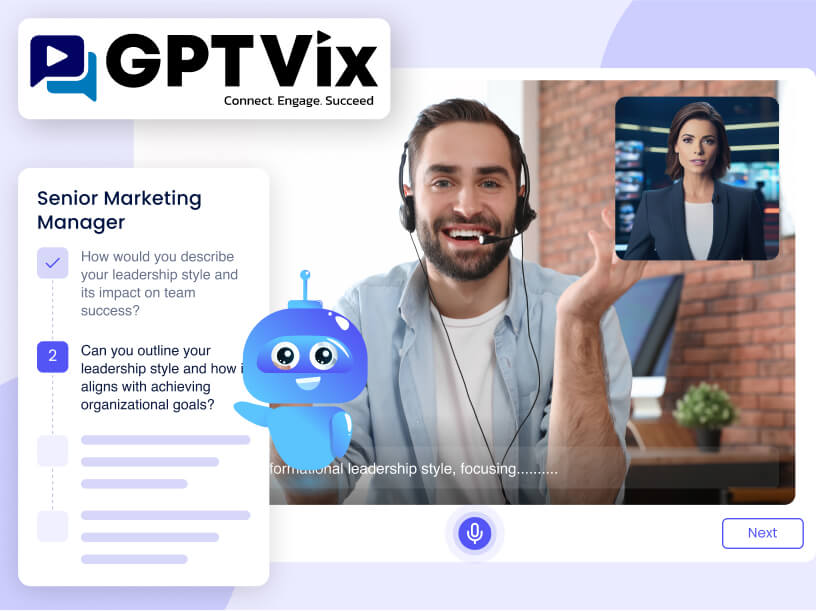
eComChat: AI Ecommerce Search Bot
To help a US ecommerce brand make sense of a 47,000-plus product inventory, we crafted an AI search engine that points shoppers to the right items fast. By tapping OpenAI embeddings together with vector search, we sharpened result accuracy, boosted sales by 23%, and trimmed the bounce rates that came from customers failing to locate products.
Learn More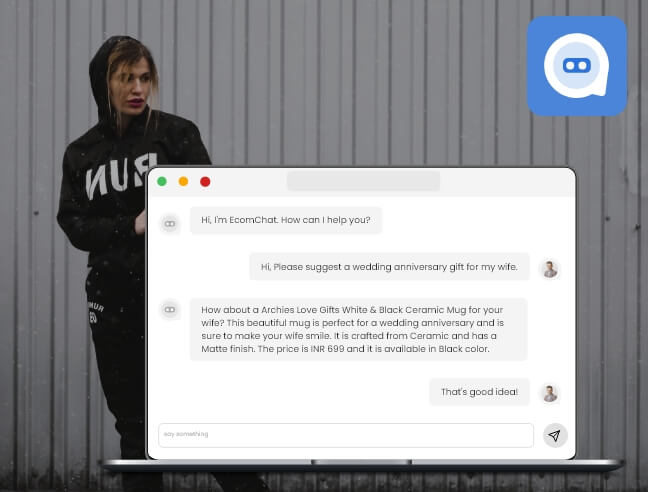
ReadGenie: AI Reading Assistant App
Our team shipped an iOS reading helper that extracts text from images via OCR, boils down dense passages into clear summaries, and drafts original content using GPT-3.5. The app racked up over 525 downloads in just its opening week and supports translation between English, French, Spanish, and Japanese.
Learn More
Have an AI product idea you want to validate? As an AI consulting company, Space-O Technologies helps you discuss your AI MVP requirements and define a tailored development plan.
FAQs on AI MVP Development
1. What is the fastest way to launch an AI MVP?
API-based integration launches in two to four months using existing models from OpenAI, Google Cloud, and AWS. You focus on building the user experience around pre-built AI. This minimizes technical risk while maximizing speed to market. Launch fast to validate demand before investing in custom solutions.
2. How much should I budget for building an AI-powered MVP?
API-based MVPs cost $50,000 to $110,000. Fine-tuned models cost $125,000 to $210,000 and require four to six months. Custom ML solutions exceed $250,000 and require eighteen to thirty months. Team location, domain complexity, and regulatory requirements significantly impact costs.
3. What is the biggest mistake founders make with AI MVPs?
Building custom ML solutions too early is the most common mistake. Validate demand using API approaches first, then invest in custom ML after confirming market demand. This sequenced approach reduces risk.
4. What data do I need to build an AI MVP?
API approaches need minimal custom data. Fine-tuned models require one hundred to five thousand labeled examples. Custom ML systems need ten thousand to one hundred thousand examples. Data quality matters more than quantity.
5. How long does it take to build an AI MVP?
API-based MVPs launch in two to four months. Fine-tuned approaches require four to six months. Custom ML solutions take eighteen to thirty months. Timeline also depends on team size and domain complexity.



 All our projects are secured by NDA




 4.8
4.8