
 By
By 
Contents
Travel planning has become almost entirely digital, with travelers expecting instant search results, real-time availability, and frictionless booking experiences across devices. Whether it’s flights, hotels, holiday packages, or local experiences, modern users rely on online platforms to compare options and make confident travel decisions within minutes.
This shift toward digital travel commerce is reflected in the market’s rapid growth. According to Statista, the global online travel market is projected to reach US$1.07 trillion in revenue by 2026, underscoring the massive opportunity for travel businesses that invest in robust, scalable travel portals.
In this guide, we break down everything you need to know about travel portal development. Drawing from our hands-on experience as a web portal development company, we have shared insights on core concepts, business benefits, essential features, development process, cost considerations, and proven best practices to help you build effective travel portal solutions.
What is a Travel Portal?
Travel portal development refers to the process of designing, building, and deploying a digital platform to help travel businesses manage travel-related services through a single interface. These portals enable users to search, compare, and book travel offerings such as flights, hotels, tour packages, car rentals, and activities, while allowing businesses to manage inventory, pricing, bookings, and customer interactions efficiently.
A travel portal typically integrates multiple third party systems such as GDS, airline APIs, hotel aggregators, payment gateways, and CRM tools to deliver real time availability and seamless booking experiences. Depending on the business model, travel portals can be built for B2C, B2B, or B2B2C use cases, supporting agents, suppliers, and end customers on the same platform.
Types of Travel Portals You Can Develop
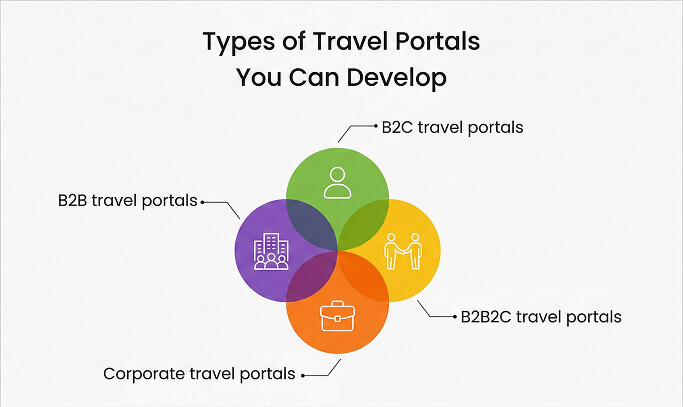
Understanding different portal types helps you choose the right model for your business. Each type serves distinct customer segments and requires specific features and integrations.
1. B2C travel portals
B2C portals serve individual travelers directly. These platforms focus on user experience, offering intuitive search, comparison tools, and seamless booking flows. Customers browse destinations, compare prices, and complete purchases without intermediaries.
B2C portals require strong visual design and mobile responsiveness. Travelers often research on phones and tablets before booking. Features like customer reviews, destination guides, and loyalty programs enhance engagement and drive repeat bookings.
2. B2B travel portals
B2B portals serve travel agents, tour operators, and corporate clients. These platforms provide wholesale rates and bulk booking capabilities. Travel agencies use B2B portals to access inventory and create packages for their customers.
B2B systems require robust commission management and agent hierarchy features. Credit limit controls, subagent management, and white-label options are essential capabilities. These portals prioritize functionality and speed over consumer-facing design elements.
3. B2B2C travel portals
B2B2C portals combine both models into a hybrid platform. They serve travel agents who then sell to end consumers through branded interfaces. This model gives businesses flexibility to operate in multiple market segments.
These portals require more complex architecture to handle different user types. Agent-facing dashboards differ from consumer booking interfaces. The underlying inventory and pricing systems must seamlessly support both wholesale and retail transactions.
4. Corporate travel portals
Corporate portals serve businesses managing employee travel. These platforms enforce company travel policies automatically during the booking process. Integration with expense management and approval workflows streamlines corporate travel programs.
Policy compliance, cost controls, and reporting capabilities define the requirements for a corporate portal. Features such as preferred vendor enforcement, budget tracking, and duty-of-care support business travel needs. These systems often integrate with HR and finance platforms.
Benefits of Custom Travel Portal Development
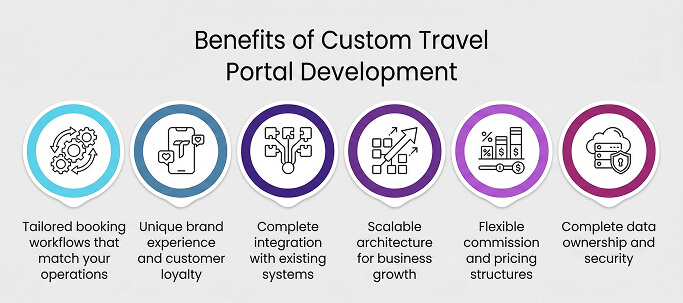
Building a custom travel portal offers advantages that off-the-shelf solutions cannot provide. Travel businesses gain complete control over their technology while addressing specific operational requirements.
1. Tailored booking workflows that match your operations
Every travel business operates differently. Custom development creates booking flows that mirror your actual processes. Your supplier relationships, pricing rules, and service combinations work exactly as your business needs.
Generic platforms force you into predefined workflows. Custom solutions eliminate those constraints. Staff productivity increases when technology supports rather than limits their sales processes.
2. Unique brand experience and customer loyalty
Custom portals deliver brand experiences that template-based solutions cannot match. Your visual identity, tone, and service philosophy extend throughout the booking journey. Customers associate their positive experience with your brand, not a generic platform.
Travel businesses increasingly compete on customer experience. Custom technology enables experiences that differentiate you from competitors using the same white-label solutions. This differentiation builds loyalty and reduces price-based competition.
3. Complete integration with existing systems
Most travel businesses operate multiple specialized tools. Accounting software, CRM platforms, marketing automation, and supplier systems all contain valuable data. Custom portal development connects these systems into unified workflows.
Integration eliminates manual data transfer between platforms. Staff enter information once and see it reflected everywhere. Error rates drop while productivity rises significantly.
4. Scalable architecture for business growth
Ready-made solutions hit performance limits as booking volumes increase. Custom development builds scalability into the architecture from day one. Your system handles traffic spikes during peak seasons without degradation.
Multi-location travel agencies benefit from custom scalability. Centralized management with location-specific customization becomes possible. You avoid purchasing additional licenses as your business expands.
5. Flexible commission and pricing structures
Travel businesses require complex pricing rules that standard platforms struggle to accommodate. Custom portals implement markup strategies, commission splits, and dynamic pricing exactly as you need. Your competitive advantage stays protected within proprietary systems.
Pricing flexibility extends to promotional campaigns and partner arrangements. Custom rules for seasonal offers, volume discounts, and loyalty rewards integrate naturally. You control your profit margins without platform limitations.
6. Complete data ownership and security
Custom development gives you control over where data resides and how it is protected. You implement security measures specific to your risk profile. Third-party vendor security decisions do not affect your business continuity.
Data ownership transfers completely to your organization. No vendor sunset decisions threaten your operations. Your customer data and booking history remain under your control permanently.
Looking to Build a Custom Travel Booking Platform?
Work with experienced developers who understand travel technology, GDS integrations, and payment processing. Build software that fits your business model perfectly.

Core Features of Travel Portal Development
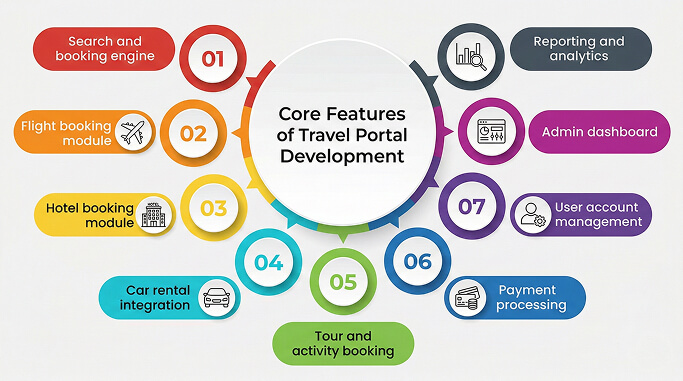
Successful travel portals combine foundational capabilities with specialized features for the travel industry. Understanding these components helps prioritize your development investment effectively.
1. Search and booking engine
The search engine forms the core of any travel portal. It processes user queries against multiple supplier inventories simultaneously. Results must display quickly and accurately to keep users engaged throughout their booking journey.
Essential capabilities include:
- Multi-criteria search for destinations, dates, and traveler counts.
- Flexible date search showing price variations across date ranges.
- Filter options for price, star rating, amenities, and airlines.
- Sort functionality by price, duration, departure time, and ratings.
- Real-time availability checks before booking confirmation.
- Multi-city and round-trip search for complex itineraries.
Advanced search features include AI-driven recommendations based on user behavior. Predictive search suggests destinations based on past bookings. These capabilities significantly improve conversion rates and user satisfaction.
2. Flight booking module
Flight booking requires connections to GDS systems and direct airline APIs. The module handles complex fare rules, baggage policies, and seat selection options. Real-time inventory updates prevent booking failures.
Essential capabilities include:
- Multi-GDS connectivity for comprehensive flight inventory.
- Fare comparison across different booking classes.
- Seat map display and selection functionality.
- Baggage allowance information and add-on purchases.
- Flight status tracking and delay notifications.
- Cancellation and refund processing automation.
- Ancillary service upselling for meals and extra baggage.
Flight modules must accurately handle fare rule complexity. Refund policies, change fees, and blackout dates vary by airline. Clear presentation prevents customer disputes and support escalations.
3. Hotel booking module
Hotel booking connects your portal to property inventory worldwide. Aggregating content from multiple sources ensures competitive rates and a wide selection. Room descriptions, photos, and amenity details must display attractively.
Essential capabilities include:
- Integration with major hotel aggregators and direct contracts.
- Room type display with photos, descriptions, and amenities.
- Rate comparison showing different cancellation policies.
- Map-based property browsing for location-conscious travelers.
- Guest review aggregation from multiple sources.
- Special request handling for room preferences.
- Group booking capabilities for multiple rooms.
Hotel content quality directly impacts conversion rates. High-resolution images, accurate descriptions, and verified reviews build traveler confidence. Content management tools help maintain inventory accuracy.
4. Car rental integration
Car rental functionality enhances the portal’s value for travelers who need ground transportation. API connections to major rental companies provide real-time availability. Location-based search shows pickup options near airports and hotels.
Essential capabilities include:
- Multi-vendor inventory aggregation with price comparison.
- Vehicle category browsing with photos and specifications.
- Pickup and drop-off location search with map integration.
- Insurance and add-on option selection during booking.
- Driver age and license requirement notifications.
- Fuel policy and mileage limit display.
Car rental adds revenue opportunities through upselling and cross-selling. Suggesting rentals during flight or hotel bookings increases average transaction value. Package deals combining multiple services improve customer convenience.
5. Tour and activity booking
Tours and activities represent high-margin products for travel portals. These experiences differentiate your offerings from commodity flight and hotel bookings. Integration with activity providers significantly expands your product catalog.
Essential capabilities include:
- Category-based browsing for tours, attractions, and experiences.
- Date and time slot availability display.
- Participant type selection with different pricing tiers.
- Meeting point information with map directions.
- Cancellation policy and refund rule display.
- Customer review integration for social proof.
- Multi-language tour descriptions for international travelers.
Activity booking requires handling diverse supplier systems. Standardizing content presentation across different providers improves user experience. Automated confirmation delivery ensures customers receive the necessary details.
6. Payment processing
Secure payment processing builds customer trust and enables global transactions. Supporting multiple payment methods accommodates different customer preferences. Compliance with payment industry standards protects both your business and customers.
Essential capabilities include:
- Multiple payment gateway integration for redundancy.
- Credit card, debit card, and digital wallet support.
- Multi-currency processing with real-time conversion.
- Split payment options for group bookings.
- Partial payment and installment plan handling.
- Refund processing automation for cancellations.
- PCI DSS compliance for cardholder data security.
Payment failure rates directly impact revenue. Optimizing checkout flows reduces abandonment. Supporting local payment methods improves conversion in specific geographic markets.
7. User account management
User accounts store booking history, preferences, and payment methods. Registered users complete bookings faster and receive personalized recommendations. Account features drive loyalty and repeat purchases.
Essential capabilities include:
- Profile management with traveler document storage.
- Booking history access with rebooking options.
- Saved payment methods for faster checkout.
- Travel preference storage for personalized search results.
- Loyalty point tracking and redemption.
- Wishlist functionality for trip planning.
- Family and group traveler profile management.
Account features reduce booking friction for returning customers. Stored preferences and payment methods accelerate checkout. Personalization based on booking history improves recommendations.
8. Admin dashboard
Administrative tools give your team control over portal operations. Inventory management, booking oversight, and reporting capabilities support daily operations. Role-based access ensures appropriate permissions for different staff members.
Essential capabilities include:
- Booking management with modification and cancellation tools.
- Supplier inventory and rate management interfaces.
- Commission and markup configuration controls.
- User and agent account administration.
- Content management for destinations and promotions.
- Customer support tools with communication history.
- Financial reporting and reconciliation features.
Dashboard usability impacts operational efficiency. Intuitive interfaces reduce training requirements and errors. Mobile access enables management from anywhere during travel.
9. Reporting and analytics
Data-driven decisions require comprehensive reporting capabilities. Travel portals generate valuable data about customer behavior and booking patterns. Analytics reveal opportunities for optimization and growth.
Essential capabilities include:
- Sales reports by destination, supplier, and agent.
- Conversion funnel analysis identifying drop-off points.
- Customer segmentation and behavior tracking.
- Revenue and commission tracking dashboards.
- Supplier performance comparison reports.
- Search pattern analysis for demand forecasting.
- Custom report builder for specific business needs.
Analytics reveal which marketing channels deliver profitable customers. Supplier performance data informs negotiation strategies. Search pattern analysis identifies emerging destination trends.
Process for Developing a Travel Portal
Building an effective travel portal follows a structured process balancing thorough planning with iterative delivery. Understanding each phase helps set realistic expectations for your project.
Phase 1: Discovery and requirements gathering
Discovery establishes the foundation for your travel portal project. This phase documents your business model, target audience, and technical requirements. Thorough discovery prevents expensive changes during development.
Key activities
- Business model analysis: Understanding your revenue model, supplier relationships, and target markets shapes portal architecture decisions.
- Competitor research: Analyzing existing travel portals identifies features your customers expect and opportunities for differentiation.
- User journey mapping: Documenting how travelers search, compare, and book reveals interface and workflow requirements.
- Technical assessment: Evaluating required API integrations, GDS connections, and payment gateways determines development complexity.
- Feature prioritization: Stakeholders rank capabilities by business value to guide development sequencing.
Discovery delivers comprehensive requirements documentation and a prioritized feature roadmap. Rushing this phase creates expensive rework later in development.
Phase 2: UI/UX design
Design translates requirements into visual interfaces and user flows. This phase defines how travelers interact with your portal across devices. User testing validates designs before development begins.
Key activities
- Wireframe creation: Low-fidelity layouts establish page structure and navigation patterns before visual design starts.
- Visual design: Brand-aligned interfaces create engaging experiences that differentiate your portal from competitors.
- Responsive design: Layouts adapt seamlessly across desktop, tablet, and mobile devices for a consistent user experience.
- Prototype development: Interactive prototypes enable user testing to validate design decisions.
- Design system creation: Reusable component libraries ensure consistency and accelerate future development.
Design directly impacts conversion rates and customer satisfaction. Investing in quality design delivers measurable returns by improving booking completion rates.
Phase 3: Development and API integration
Development transforms designs into functional software. This phase builds booking engines, integrates supplier APIs, and implements payment processing. Agile methodologies deliver features incrementally for early feedback.
Key activities
- Frontend development: Building responsive interfaces that deliver fast, engaging user experiences across all devices.
- Backend development: Creating server-side logic for search, booking, and transaction processing.
- GDS integration: Connecting to Amadeus, Sabre, Travelport, or other distribution systems for flight inventory.
- Hotel API integration: Implementing connections to aggregators and direct suppliers for accommodation inventory.
- Payment gateway setup: Integrating secure payment processing with fraud prevention capabilities.
- Database architecture: Designing data structures for bookings, users, and supplier information.
Development complexity depends heavily on integration requirements. Well-documented APIs integrate faster than legacy supplier systems.
Phase 4: Testing and quality assurance
Comprehensive testing ensures your portal functions correctly under real-world conditions. This phase verifies booking flows, payment processing, and system performance. Testing catches issues before they affect customers.
Key activities
- Functional testing: Verifying every feature works according to specifications across different scenarios.
- Integration testing: Confirming API connections return accurate data and handle errors gracefully.
- Payment testing: Validating transaction processing, refunds, and multi-currency handling.
- Performance testing: Load testing confirms system capacity during peak booking periods.
- Security testing: Penetration testing and vulnerability scanning identify potential weaknesses.
- User acceptance testing: Real users validate that the system meets business requirements.
Testing should not be compressed to meet deadlines. Undiscovered defects create customer frustration and support overhead after launch.
Phase 5: Deployment and launch
Deployment transitions your portal from development to production use. Careful planning minimizes risks and ensures a smooth launch. Support readiness prepares your team for customer inquiries.
Key activities
- Infrastructure setup: Configuring production servers, databases, and content delivery networks.
- Data migration: Transferring existing customer data, booking history, and supplier information.
- Staff training: Preparing your team to use administrative tools and handle customer support.
- Soft launch: Limited release to a controlled audience validates production readiness.
- Go-live support: Intensive monitoring and rapid issue resolution during initial operations.
Phased rollouts reduce launch risks. Starting with limited traffic allows issue identification before full-scale promotion.
Phase 6: Maintenance and optimization
Post-launch maintenance ensures ongoing system stability and continuous improvement. Travel portals require regular updates to maintain supplier connections and add new capabilities.
Key activities
- Bug fixes and patches: Resolving issues discovered in production promptly.
- API maintenance: Updating integrations when suppliers modify their systems.
- Performance monitoring: Tracking system health and proactively addressing degradation.
- Feature enhancements: Adding new capabilities based on user feedback and business needs.
- Security updates: Applying patches and maintaining compliance with security standards.
Budget for ongoing maintenance from project inception. Portals without regular updates degrade and eventually require expensive overhauls.
Transform Your Travel Business with Custom Portal Development
With 15+ years of experience and 300+ software products delivered, Space-O Technologies helps travel businesses build reliable and scalable booking platforms.
Travel Portal Development Cost Breakdown
Understanding cost components helps travel businesses budget accurately for portal development. Costs vary significantly based on complexity, features, and development approach.
Cost by portal complexity
| Scope Level | Development Cost | Timeline | Features Included |
|---|---|---|---|
| Basic Portal | $40,000 – $80,000 | 3-4 months | Single service booking (flights or hotels), basic search, payment processing |
| Standard Portal | $80,000 – $200,000 | 4-7 months | Multi-service booking, user accounts, admin dashboard, basic reporting |
| Advanced Portal | $200,000 – $400,000 | 7-12 months | Multiple GDS integrations, dynamic packaging, loyalty program, and mobile apps |
| Enterprise Portal | $400,000 – $800,000+ | 12-18 months | Full B2B2C capabilities, white-label options, advanced analytics, multiple currencies |
Factors that influence development costs
Several variables push costs toward higher ranges. Understanding these factors helps you budget more accurately.
- Integration complexity: Each GDS or supplier API adds development effort. Well-documented APIs with sandbox environments integrate faster. Legacy systems without modern APIs require custom middleware solutions.
- Number of booking services: Single-service portals cost less than multi-service platforms. Adding flights, hotels, cars, and activities multiplies the development scope. Package building features add additional complexity.
- Geographic coverage: Multi-currency and multi-language support increase development requirements. Regional payment methods and local supplier integrations add scope. Compliance with different jurisdictions adds testing needs.
- Mobile applications: Native iOS and Android apps significantly increase costs compared to web-only solutions. Responsive web design offers mobile access at a lower cost. Native apps provide better performance for frequent users.
- Custom features: Loyalty programs, dynamic packaging, and AI recommendations require substantial development. Standard features cost less than innovative capabilities. Differentiating features justify their higher investment through competitive advantage.
Ongoing cost considerations
Initial development represents only part of the total ownership cost. Plan for these ongoing expenses:
- Annual maintenance: 15-20% of the initial development cost covers bug fixes and updates.
- API subscription fees: GDS access and aggregator connections require ongoing payments.
- Infrastructure hosting: Cloud hosting costs $500 to $5,000 per month, depending on traffic.
- Payment processing fees: Transaction fees typically range from 2% to 4% of the booking value.
- Feature enhancements: Budget $50,000-$150,000 annually for new functionality.
Get an Accurate Travel Portal Development Estimate
Share your requirements with our technical team for a detailed cost breakdown. We analyze integrations, features, and complexity to provide realistic budget expectations.
Common Challenges in Travel Portal Development
Even well-planned projects encounter obstacles during development. Anticipating these challenges enables proactive solutions rather than reactive crisis management.
Challenge 1: Complex API integrations
Travel portals depend on multiple external APIs that behave differently. GDS systems, hotel aggregators, and payment gateways each have unique requirements. Integration failures disrupt booking flows and customer experience.
How to overcome this challenge
- Assess API documentation quality and sandbox availability before committing to suppliers.
- Implement robust error handling for API failures and timeouts.
- Implement fallback suppliers for critical inventory sources.
- Create monitoring systems that immediately alert teams to integration issues.
- Maintain relationships with supplier technical teams for escalation support.
Challenge 2: Real-time inventory accuracy
Travel inventory changes constantly as bookings occur across multiple channels. Displaying outdated availability frustrates customers and creates failed bookings. Maintaining accuracy requires sophisticated synchronization.
How to overcome this challenge
- Implement cache invalidation strategies that balance performance with accuracy.
- Use confirmation flows that verify availability before accepting payment.
- Display inventory confidence indicators when real-time checks are not possible.
- Build automated alerts to detect high failure rates.
- Negotiate direct API connections with priority suppliers.
Challenge 3: Payment processing complexity
International travel bookings involve multiple currencies, payment methods, and fraud risks. Failed transactions lose revenue. Security breaches damage reputation and incur regulatory penalties.
How to overcome this challenge
- Integrate multiple payment gateways for redundancy and coverage.
- Implement intelligent fraud detection without blocking legitimate transactions.
- Support local payment methods in key geographic markets.
- Obtain PCI DSS compliance certification for cardholder data protection.
- Create clear refund and dispute resolution processes.
Challenge 4: Mobile performance optimization
Travelers increasingly research and book on mobile devices. Slow-loading pages and clunky interfaces drive users to competitors. Mobile optimization requires careful attention throughout development.
How to overcome this challenge
- Design mobile-first interfaces that prioritize essential booking functions.
- Optimize images and assets for fast loading on cellular connections.
- Implement progressive web app features for app-like mobile experience.
- Test extensively on various devices and network conditions.
- Monitor mobile-specific metrics and address performance issues promptly.
Challenge 5: Supplier content management
Travel suppliers provide content in different formats and quality levels. Inconsistent descriptions, varying image sizes, and incomplete information create poor user experiences.
How to overcome this challenge
- Build content normalization layers that standardize supplier information.
- Create content quality scoring to prioritize high-quality inventory display.
- Implement content enrichment through AI-powered description enhancement.
- Establish supplier content requirements and quality standards.
- Develop content management tools for manual quality improvements.
Challenge 6: Seasonal traffic management
Travel booking follows seasonal patterns with dramatic peak periods. Holiday seasons and promotional events create traffic spikes that overwhelm underprepared systems.
How to overcome this challenge
- Design architecture for horizontal scaling during peak periods.
- Implement content delivery networks for static asset distribution.
- Use cloud infrastructure that scales automatically with demand.
- Conduct load testing simulating peak traffic before high seasons.
- Create graceful degradation strategies for extreme load scenarios.
Best Practices for Travel Portal Development
Following proven practices dramatically increases project success rates. These guidelines represent accumulated wisdom from successful travel portal implementations.
1. Prioritize search speed and accuracy
Search performance directly impacts conversion rates. Slow searches frustrate users who expect instant results. Inaccurate results waste user time and damage trust.
Optimize database queries and caching strategies for fast response times. Implement search result ranking that surfaces relevant options first. Test search functionality extensively with realistic query patterns.
Balance speed and accuracy with intelligent caching strategies. Fresh inventory data matters more for high-demand routes. Less popular options tolerate slightly older cache data.
2. Design for mobile users first
Mobile traffic dominates travel research and increasingly drives bookings. Desktop-first designs adapted for mobile deliver inferior experiences. Starting with mobile constraints ensures usability across all devices.
Simplify navigation and reduce the number of form fields in mobile booking flows. Touch-friendly interfaces with appropriately sized buttons improve usability. Test extensively on actual mobile devices during development.
Progressive disclosure shows essential information first, with details available on demand. Users find what they need without scrolling through excessive content. This approach benefits both mobile and desktop experiences.
3. Build trust through transparency
Travel purchases involve significant money and emotional investment. Unclear pricing, hidden fees, and confusing policies erode customer trust. Transparent communication builds confidence and reduces support inquiries.
Display total pricing early in the booking flow. Break down fare components clearly. Highlight cancellation policies and change fees before payment.
Include verified customer reviews and ratings throughout the booking journey. Social proof reassures uncertain travelers. Respond professionally to negative reviews to demonstrate service commitment.
4. Invest in robust error handling
API failures, payment declines, and system errors will occur. How your portal handles these situations determines customer experience during problems. Graceful error recovery maintains user confidence.
Display helpful error messages that guide users toward solutions. Avoid technical jargon that confuses non-technical users. Provide clear next steps for resolving booking issues.
Implement automatic retry logic for transient API failures. Queue failed transactions for manual processing when automated recovery fails. Notify customers proactively about booking issues.
5. Implement comprehensive analytics
Data-driven optimization requires detailed tracking throughout the booking funnel. Understanding where users drop off reveals opportunities for improvement. Analytics inform marketing, product, and operational decisions.
Track search patterns to identify popular destinations and emerging trends. Monitor conversion rates at each booking step. Analyze customer segments to understand different user needs.
Use analytics to measure the impact of changes and new features. A/B testing validates design decisions with real user behavior. Continuous optimization improves results over time.
6. Plan integrations carefully
Integration complexity often exceeds initial estimates. Each connected system brings unique data formats and reliability characteristics. Thorough planning prevents integration surprises during development.
Document all integration points and requirements early in the discovery phase. Assess API reliability and support quality before committing to suppliers. Build monitoring and alerting for all external dependencies.
Create abstraction layers between your portal and external systems. These layers simplify supplier changes and reduce code modification when APIs update. Standardized interfaces improve maintainability.
7. Prepare for regulatory compliance
Travel businesses face regulations covering data protection, consumer rights, and financial transactions. Non-compliance creates legal exposure and undermines customer trust. Building compliance from the start costs less than retrofitting.
Implement GDPR-compliant data handling for European customers. Display required booking terms and conditions clearly. Support customer data access and deletion requests.
Payment processing requires PCI DSS compliance. Consumer protection regulations mandate clear cancellation policies. Stay current with evolving regulatory requirements in your markets.
Build Future-Ready Travel Portals With Space-O Technologies
Travel portal development transforms how travel businesses reach and serve customers. Custom solutions deliver booking experiences that ready-made platforms cannot match. Your unique business model deserves technology that supports rather than constrains your operations.
Success requires more than technical capability. Understanding travel industry requirements, API integration challenges, and customer experience expectations determines project outcomes. Experienced development partners navigate these complexities efficiently.
Space-O Technologies brings 15+ years of expertise in custom software development to travel technology projects. Our team of 200+ professionals has delivered 300+ software solutions across diverse industries. Check out our portfolio to see how we’ve built secure and scalable web portals for businesses with diverse operational needs.
Fyule Video Lab: Online Learning Platform
A modern education platform designed to support digital classrooms with video lessons, skill-based activities, and student engagement tools. Built using Flutter, Laravel, PHP, and MySQL.
Learn More
Parts Express: eCommerce Marketplace
An equipment trading platform built for the waste management sector, offering vendor storefronts, inventory management, and seamless payment processing. Developed with Laravel, PHP 8.1, MySQL, and AWS.
Learn More
RaeCRM: NDIS Fund Management Software
A web application created for Australia’s NDIS ecosystem, enabling efficient budget monitoring, claim submissions, and payment administration. Powered by Laravel, MySQL, and Amazon S3.
Learn More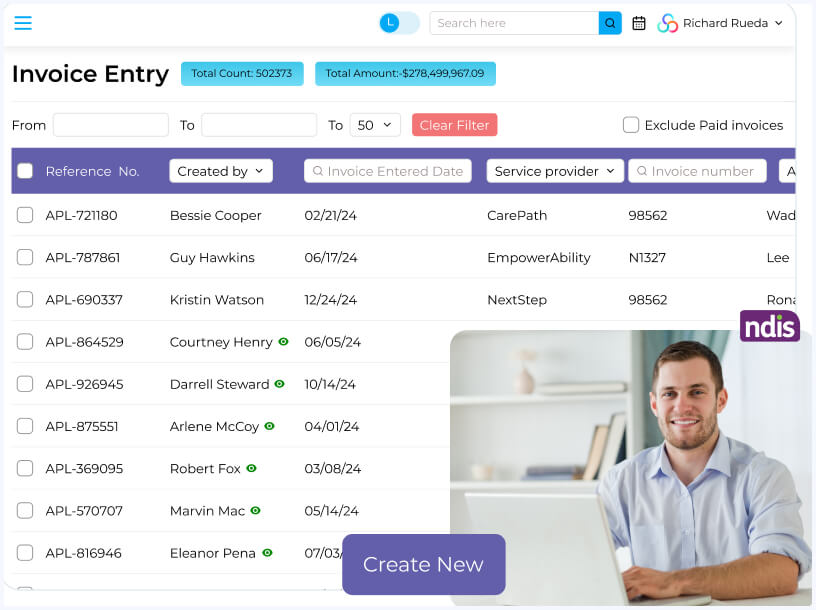
We hold ISO 27001:2022 certification for information security and ISO 9001:2022 for quality management. Our expertise in complex integrations and high-performance systems ensures your travel portal meets market demands.
Contact our technical consultants to discuss your travel portal requirements. We provide detailed assessments, realistic cost estimates, and development roadmaps tailored to your specific business model.
FAQs on Travel Portal Development
1. How much does it cost to develop a travel portal?
Travel portal development costs range from $40,000 for basic single-service platforms to $800,000+ for enterprise solutions. Basic portals with single service booking cost $40,000 to $80,000. Standard multi-service portals cost $80,000 to $200,000. Advanced portals with multiple integrations cost $200,000 to $400,000. Enterprise platforms with full B2B2C capabilities exceed $400,000. Final costs depend on features, integrations, and geographic coverage requirements.
2. How long does travel portal development take?
Development timelines range from 3 months for basic portals to 18 months for enterprise implementations. Basic single-service portals take 3 to 4 months. Standard multi-service platforms require 4 to 7 months. Advanced portals with complex integrations need 7 to 12 months. Enterprise solutions with full B2B2C functionality take 12 to 18 months, including phased rollouts.
3. What features are essential in a travel portal?
Essential travel portal features include search and booking engines, flight and hotel booking modules, payment processing, user account management, and admin dashboards. Additional important features include car rental integration, tour booking, multi-currency support, and reporting analytics. The specific feature set depends on your business model and target market requirements.
4. What is the difference between B2B and B2C travel portals?
B2C travel portals serve individual travelers directly with consumer-friendly interfaces and retail pricing. B2B portals serve travel agents and businesses with wholesale rates, commission management, and agent hierarchy features. B2C focuses on user experience and visual design, while B2B prioritizes functionality, bulk booking capabilities, and white-label options. B2B2C portals combine both models within a single platform.
5. What APIs are needed for travel portal development?
Travel portals typically require GDS APIs such as Amadeus, Sabre, and Travelport for flight inventory. Hotel integrations include aggregator APIs and direct supplier connections. Car rental services, activities, and payment gateways require additional API integrations. The specific APIs depend on your service offerings and target markets. Well-documented APIs integrate more efficiently than legacy systems.
6. Can I build a travel portal with white-label capabilities?
Yes, travel portals can include white-label functionality, allowing partners to brand the platform as their own. This requires customizable interfaces, branding configuration tools, and partner management systems. White-label capabilities increase development complexity but enable additional revenue opportunities through partner networks.
7. How do travel portals handle multiple currencies?
Multi-currency support requires real-time exchange rate integration and currency conversion logic. Travel portals display prices in user-preferred currencies while processing transactions in supplier currencies. Transparent display of conversion rates and final charges in local currency builds customer trust. Payment gateways must support multi-currency transaction processing.



 All our projects are secured by NDA




 4.8
4.8