
 By
By 
Contents
The insurance industry is experiencing rapid digital transformation as insurers adopt technology to improve efficiency, customer experience, and regulatory compliance. According to Grand View Research, the global insurance software market was valued at USD 5.45 billion in 2022 and is expected to reach USD 152.43 billion by 2030, highlighting the scale and pace at which digital insurance platforms are being adopted.
This growth reflects a strong shift toward centralized insurance portals that streamline policy management, claims processing, document handling, and communication across stakeholders. Manual processes and fragmented systems no longer support the speed, accuracy, and transparency expected by policyholders, agents, and internal teams.
Insurance portal development focuses on building secure, scalable platforms that connect insurers, brokers, agents, and customers through a unified digital interface. In this blog, we cover everything you need to know to build an insurance portal. With 15+ years of experience as a leading web portal development company, we have shared insights on the key benefits, essential features, development cost, implementation process, and best practices to build a future-ready insurance portal.
What is Insurance Portal Development?
Insurance portal development is the process of designing and building a secure digital platform that enables insurers to manage interactions with policyholders, agents, brokers, and internal teams through a centralized system. An insurance portal serves as a single point of access for managing policies, claims, documents, payments, and customer communications in a structured and compliant manner.
Unlike generic customer portals, insurance portals are built to handle complex data structures, regulatory requirements, and multi-role user access. Custom insurance portal development focuses on aligning the platform with insurance-specific workflows such as policy issuance, renewals, endorsements, claims submissions, underwriting processes, and compliance reporting.
A well-developed insurance portal improves operational efficiency by automating manual processes and reducing dependency on emails and paperwork. It also enhances transparency by allowing users to track policy status, claim progress, and documentation in real time. For insurers, portals provide better visibility into operations while maintaining data security and audit readiness.
What Are the Benefits of Insurance Portal Development?
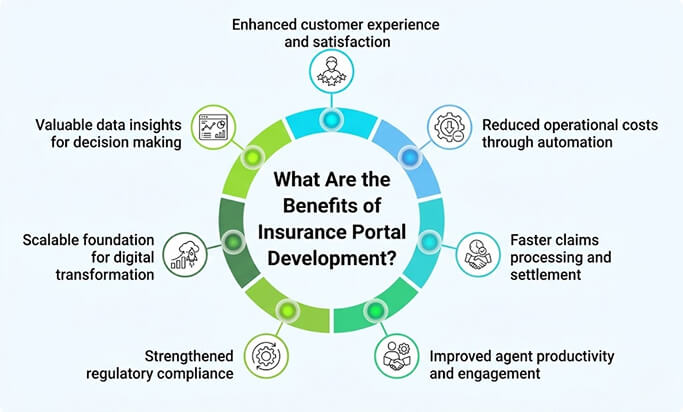
Custom insurance portal development delivers advantages that packaged software cannot provide. Organizations gain control over their digital experience while addressing specific operational challenges unique to their business model.
1. Enhanced customer experience and satisfaction
Today’s policyholders demand digital convenience similar to what they experience in banking and retail. Self-service portals let customers access policy information, make payments, and file claims anytime. This availability reduces frustration and builds loyalty.
Personalized dashboards display relevant information based on each user’s policies and preferences. Customers quickly find what they need without navigating complex menus or waiting on hold. An improved experience directly translates into higher retention rates and positive reviews.
2. Reduced operational costs through automation
Manual processes consume significant staff time and introduce errors. Portal automation handles routine tasks like policy endorsements, payment processing, and document generation. Staff focus on complex cases that require human judgment.
Self-service capabilities deflect call volume from customer service centers. Policyholders resolve common questions independently through knowledge bases and account dashboards. Each self-service interaction costs a fraction of the cost of agent-assisted support.
3. Faster claims processing and settlement
Claims represent the moment of truth in insurance customer relationships. Portal-based claims submission captures complete information upfront, reducing back-and-forth communication. Digital document uploads eliminate mailing delays and lost paperwork.
Automated claims routing directs submissions to appropriate adjusters based on claim type and complexity. Integrated workflow tools track progress and ensure timely follow-up. Faster claims resolution improves customer satisfaction while reducing administrative burden.
4. Improved agent productivity and engagement
Agent portals provide tools that streamline client management and sales activities. Real-time access to policy information enables agents to answer customer questions during calls. Quote generation and binding capabilities accelerate sales cycles.
Commission tracking and performance dashboards motivate agents while reducing inquiries to accounting staff. Digital onboarding processes help new agents become productive faster. Better tools improve agent satisfaction and reduce turnover.
5. Strengthened regulatory compliance
Insurance operates under strict regulatory oversight. Portal systems embed compliance controls directly into workflows. Automated audit trails document every transaction for regulatory examination.
Electronic signature capture and document retention meet regulatory requirements for policy documentation. State-specific rules and rate filings integrate into quoting engines. Compliance becomes systematic rather than dependent on individual vigilance.
6. Scalable foundation for digital transformation
Custom portals create a flexible platform for ongoing digital innovation. New features and integrations build on existing infrastructure without starting over. APIs enable connections to emerging technologies and partner ecosystems.
Cloud-based portal architecture scales automatically as the business grows. Adding policyholders, agents, or product lines requires no infrastructure investment. Organizations adapt quickly to market opportunities without being constrained by technology.
7. Valuable data insights for decision making
Portal interactions generate rich data about customer behavior and preferences. Analytics dashboards reveal patterns invisible in traditional reporting. Insurers understand which products attract interest and where customers struggle.
Predictive models identify cross-sell opportunities and retention risks. Claims data analysis spots fraud patterns and loss trends. Data-driven decisions improve underwriting accuracy and marketing effectiveness.
Looking to Build a Smart Insurance Portal Solution?
Hire experienced developers from Space-O Technologies who understand insurance workflows and compliance requirements. Build a portal that fits your business, not the other way around. Start your custom development journey today.

Core Features of Insurance Portal Development
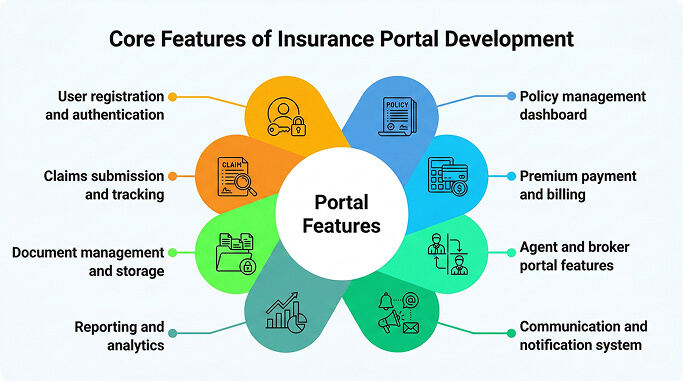
Building an effective insurance portal requires careful selection of features based on user needs and business objectives. The following capabilities form the foundation of successful insurance portal implementations.
1. User registration and authentication
Secure access controls prevent unauthorized access to sensitive insurance information. Multi-factor authentication adds layers of security beyond passwords. Single sign-on integration simplifies access for users with multiple accounts.
Essential capabilities include:
- Self-service registration with identity verification workflows.
- Password management with strength requirements and recovery options.
- Multi-factor authentication via SMS, email, or authenticator apps.
- Role-based access controls limit visibility by user type.
- Session timeout and automatic logout for inactive users.
- Audit logging of all authentication events.
Proper authentication balances security with user convenience. Overly complex login processes frustrate users and drive call volume. Thoughtful design protects data while maintaining accessibility.
2. Policy management dashboard
The policy dashboard serves as the central hub for insurance account management. Users can view coverage details, make changes, and access documents from a single location. Clear information presentation reduces confusion and supports inquiries.
Essential capabilities include:
- Policy summary displaying coverage types, limits, and premiums.
- Coverage detail pages with terms, conditions, and exclusions.
- Policy document download including declarations and certificates.
- Policy change requests for endorsements and modifications.
- Renewal status tracking and online renewal processing.
- Multi-policy views for customers with multiple coverage lines.
Effective dashboards present complex insurance information in understandable formats. Visual indicators highlight important dates and action items. Users find answers independently without having to interpret dense policy language.
3. Claims submission and tracking
Claims functionality transforms frustrating experiences into streamlined digital processes. Guided submission workflows capture complete information on the first attempt. Real-time status updates keep claimants informed throughout processing.
Essential capabilities include:
- Step-by-step claim submission with required field validation.
- Document and photo upload for supporting evidence.
- Claim status tracking with milestone notifications.
- Communication tools for adjuster-claimant interaction.
- Settlement acceptance and payment preference selection.
- Claim history viewing for past and current claims.
Claims portals reduce submission errors through intelligent form design. Required fields and validation rules ensure complete information is provided. Clear status communication reduces anxious follow-up calls.
4. Premium payment and billing
Payment functionality directly impacts revenue collection and customer satisfaction. Multiple payment options accommodate different customer preferences. Automated billing reduces administrative effort and late payments.
Essential capabilities include:
- Online payment processing via credit card, debit, and ACH.
- Automatic payment enrollment with schedule management.
- Payment history and receipt access for record keeping.
- Billing statement viewing and download capabilities.
- Payment reminder notifications before due dates.
- Installment plan management for premium financing.
Secure payment processing meets PCI DSS requirements for protecting cardholder data. Integration with accounting systems automates reconciliation. Customers appreciate flexible payment options that fit their financial preferences.
5. Document management and storage
Insurance generates substantial documentation throughout the policy lifecycle. Centralized document storage provides anytime access to important records. Version control ensures users always see the current documents.
Essential capabilities include:
- Secure document storage with encryption at rest.
- Document categorization by type, policy, and date.
- Search functionality for quick document retrieval.
- E-signature integration for policy applications and forms.
- Document sharing between users and external parties.
- Retention policy automation for compliance requirements.
Digital document management eliminates physical storage costs while improving accessibility. Users retrieve documents instantly rather than requesting copies by mail. Audit trails document who accessed which records and when.
6. Agent and broker portal features
Agent-facing portals require specialized tools for client management and sales activities. Production tracking and commission visibility motivate performance. Streamlined workflows help agents serve clients efficiently.
Essential capabilities include:
- Client book management with contact and policy details.
- Quote generation and online binding for new business.
- Commission tracking with payment history and projections.
- Marketing material access and co-branded content generation.
- Client communication tools integrated with email and messaging.
- Training resources and product information library.
Agent portals balance carrier requirements with usability. Complex products require guided selling tools. Mobile access enables productivity outside the office.
7. Reporting and analytics
Data-driven insights inform strategic and operational decisions. Standard reports address common information needs. Custom analytics explore specific business questions.
Essential capabilities include:
- Dashboard displays of key performance indicators.
- Standard operational reports for claims, policies, and payments.
- Custom report builder for unique analytical needs.
- Data export capabilities for external analysis.
- Trend analysis comparing periods and segments.
- Automated report scheduling and distribution.
Analytics reveal opportunities hidden in transaction data. Customer behavior patterns inform product development. Claims trends guide loss prevention programs.
8. Communication and notification system
Proactive communication keeps users informed and engaged. Multi-channel notifications reach users through their preferred methods. Message history maintains a complete record of all communications.
Essential capabilities include:
- Email notification triggers for key events and deadlines.
- SMS alerts for urgent information and reminders.
- In-portal messaging with read receipts and threading.
- Notification preference management by channel and type.
- Template management for consistent communication.
- Broadcast messaging for policy updates and announcements.
Timely communication improves customer experience and reduces inbound inquiries. Automated reminders prevent policy lapses and late payments. Personalized messages build stronger customer relationships.
Insurance Portal Development Process
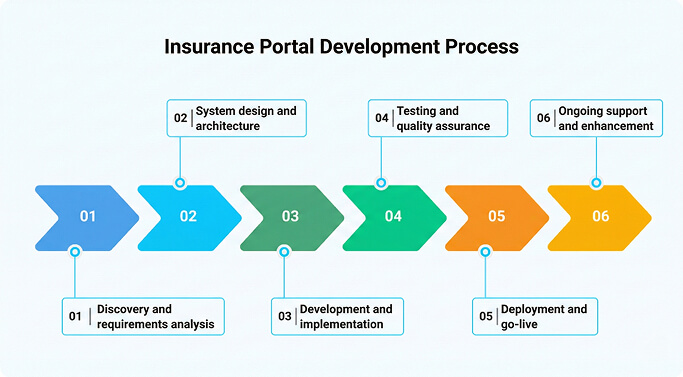
Building an effective insurance portal follows a structured approach that balances thorough planning with iterative delivery. Each phase builds upon the previous one to ensure successful outcomes.
Phase 1: Discovery and requirements analysis
Timeline: 4-8 weeks
Discovery lays the groundwork for everything that follows. This phase documents current workflows, identifies pain points, and establishes success criteria for the portal project.
Key activities
- Stakeholder interviews: Discussions with policyholders, agents, claims staff, and executives reveal different perspectives on needs and priorities.
- Workflow documentation: Mapping existing processes exposes inefficiencies and integration requirements. Visual process diagrams clarify handoffs and decision points.
- Technical assessment: Evaluation of current core systems identifies integration requirements and the scope of data migration. Infrastructure capabilities inform deployment options.
- Compliance analysis: Insurance regulations shape security architecture and feature design. State-specific requirements and data privacy laws require early consideration.
- Prioritization workshops: Stakeholders rank features by business value and implementation complexity. This prioritization guides development sequencing.
Discovery produces comprehensive requirements documentation, technical architecture recommendations, and a prioritized feature roadmap. Rushing this phase leads to costly corrections later in development.
Phase 2: System design and architecture
Timeline: 3-6 weeks
Design transforms requirements into technical specifications. This phase defines system structure, user interfaces, and integration approaches.
Key activities
- Architecture design: Technical architects define database structure, application layers, and infrastructure requirements. Security and scalability considerations shape foundational decisions.
- User experience design: UX designers create wireframes and prototypes visualizing portal behavior. User testing validates designs before development begins.
- Integration planning: Detailed specifications define connections with core insurance systems, payment processors, and third-party services.
- Security design: Authentication mechanisms, encryption standards, and access control models address regulatory requirements.
Design deliverables include technical specifications, interface mockups, and integration documentation. Stakeholder approval prevents costly changes during development.
Phase 3: Development and implementation
Timeline: 12-40 weeks, depending on scope
Development transforms designs into functional software. Agile methodologies deliver capabilities incrementally, enabling early feedback and course correction.
Key activities
- Sprint-based development: Two-week sprints deliver testable functionality at regular intervals. Product owners review progress and adjust priorities as needed.
- Continuous integration: Automated testing validates code quality with every change. Issues surface immediately rather than accumulating for later discovery.
- Environment management: Development, testing, and staging environments mirror production configuration. Environment consistency prevents deployment problems.
- Documentation creation: Technical documentation, user guides, and training materials are developed alongside the portal software.
Development follows the prioritized roadmap while maintaining flexibility for scope adjustments. Regular demonstrations keep stakeholders informed and engaged throughout the process.
Phase 4: Testing and quality assurance
Timeline: 4-8 weeks (overlapping with development)
Comprehensive testing ensures the portal meets requirements while maintaining performance and security standards.
Key activities
- Functional testing: Test cases verify every feature works as specified. Edge cases and error conditions receive explicit attention.
- Integration testing: End-to-end workflows validate behavior across connected systems. Data flows correctly between the portal and core insurance platforms.
- Performance testing: Load testing confirms portal capacity under expected and peak usage patterns. Performance bottlenecks receive attention before launch.
- Security testing: Penetration testing and vulnerability scanning identify security weaknesses. Compliance audits verify regulatory adherence.
- User acceptance testing: Real users validate portal behavior in realistic scenarios. Feedback drives final refinements before launch.
Testing should never be compressed to meet deadlines. Undiscovered defects create expensive post-launch remediation and damage user confidence.
Phase 5: Deployment and go-live
Timeline: 2-4 weeks
Deployment transitions the portal from development to production use. Careful planning minimizes disruption while ensuring smooth adoption.
Key activities
- Data migration: Transferring user accounts and historical information from legacy systems to the new portal. Validation confirms accuracy and completeness.
- Training delivery: Role-based training prepares staff for new workflows. Hands-on practice builds confidence before go-live.
- Cutover planning: Detailed runbooks define every step of the production transition. Rollback procedures provide a safety net in case issues arise.
- Go-live support: Hypercare teams provide intensive support during the initial operational period. Quick issue resolution maintains user confidence.
Phased rollouts reduce risk for large implementations. Starting with a specific user group validates processes before broader deployment.
Phase 6: Ongoing support and enhancement
Timeline: Continuous
Post-launch support ensures portal stability while enabling continuous improvement. Insurance portals require ongoing attention to maintain value.
Key activities
- Bug fixes and patches: Issues discovered in production receive prompt resolution. Severity-based prioritization ensures critical problems get immediate attention.
- Performance monitoring: System health metrics identify capacity needs and performance degradation. Proactive intervention prevents user-facing issues.
- Enhancement development: New feature requests are added to the development backlog for prioritization. The portal evolves as business needs change.
- Compliance updates: Regulatory changes require system modifications. Planned maintenance keeps compliance current.
Budget for ongoing support from project start. Portals without maintenance degrade over time and eventually require expensive overhauls.
Let Our Experts Handle the Complex Portal Development Process
With 15+ years of experience, Space-O Technologies develops compliant, user-centric insurance portals that streamline operations, enhance the customer experience, and ensure regulatory compliance.
Insurance Portal Development Cost Breakdown
Understanding cost components helps organizations budget accurately and make informed decisions. Insurance portal development costs vary based on complexity, features, and development approach.
Cost by implementation scope
| Scope Level | Development Cost Range | Timeline | Features Included |
|---|---|---|---|
| Basic Portal | $60,000 – $120,000 | 3-5 months | User accounts, policy viewing, basic claims, and payments |
| Standard Portal | $120,000 – $280,000 | 5-8 months | Basic features + agent portal, document management, reporting |
| Advanced Portal | $280,000 – $550,000 | 8-14 months | Standard features + AI claims routing, mobile apps, advanced analytics |
| Enterprise Portal | $550,000 – $1,200,000+ | 12-18 months | Advanced features + multi-carrier support, custom integrations, white-label options |
Cost breakdown by development phase
| Phase | Budget Allocation | Activities |
|---|---|---|
| Discovery and Requirements | 8-12% | Stakeholder interviews, workflow documentation, and technical assessment |
| Design and Architecture | 10-15% | UI/UX design, technical architecture, integration planning |
| Development | 45-55% | Core feature development, integration implementation, testing |
| Quality Assurance | 15-20% | Functional testing, security testing, performance optimization |
| Deployment and Training | 8-12% | Data migration, user training, and go-live support |
| Project Management | 10-15% | Coordination, communication, risk management |
Factors that increase development costs
Several variables push costs toward higher ranges:
- Integration complexity: Each core system integration adds $15,000-$60,000, depending on API availability. Legacy systems without modern APIs require custom middleware development.
- Compliance requirements: State insurance regulations add 15-25% to baseline costs. Multi-state operations multiply compliance complexity and testing requirements.
- Custom underwriting rules: Complex product configurations with custom rating engines significantly expand development scope and testing needs.
- Mobile applications: Native iOS and Android apps double or triple the user interface development effort compared to web-only solutions.
- Multi-carrier support: Managing General Agents requiring connections to multiple carriers face additional integration and data normalization work.
Ongoing cost considerations
Initial development represents only part of the total ownership cost. Plan for ongoing expenses:
- Annual maintenance: 15-20% of the initial development cost covers bug fixes, security patches, and minor enhancements.
- Infrastructure: Cloud hosting costs range from $800 to $6,000 monthly, depending on user volume and data storage requirements.
- Compliance maintenance: Annual security audits, penetration testing, and regulatory updates require $15,000-$40,000 annually.
- Feature enhancements: Budget $60,000-$180,000 annually for new functionality to maintain competitive position.
Know the Real Cost of Building a Secure Insurance Portal
We analyze platform complexity, data protection requirements, system integrations, and compliance factors to provide a clear, tailored estimate for insurance portal development.
Common Challenges in Insurance Portal Development
Even well-planned projects encounter obstacles. Anticipating these challenges enables proactive mitigation rather than reactive crisis management.
Challenge 1: Legacy system integration complexity
Core insurance systems often run on outdated technology, lacking modern APIs. Connecting new portals to these legacy platforms creates technical challenges and project delays.
How to overcome this challenge
- Conduct a thorough technical assessment of all integration targets during discovery.
- Budget additional time for legacy system reverse engineering and custom adapter development.
- Build data transformation layers to handle format inconsistencies between systems.
- Consider middleware platforms that specialize in insurance system integration.
- Document integration specifications comprehensively for future maintenance.
Challenge 2: Regulatory compliance across jurisdictions
Insurance regulations vary by state and line of business. Portal features must accommodate different requirements without creating maintenance nightmares.
How to overcome this challenge
- Engage compliance expertise from project initiation to identify requirements early.
- Build configurable rules engines that adapt to jurisdiction-specific regulations.
- Implement automated compliance testing in development pipelines.
- Plan for ongoing regulatory monitoring and update processes.
- Document compliance measures for regulatory examinations.
Challenge 3: User adoption resistance
Insurance professionals comfortable with existing processes may resist new portal systems. Poor adoption undermines return on investment.
How to overcome this challenge
- Involve end users throughout development to build ownership and gather feedback.
- Design interfaces that minimize learning curves and match existing mental models.
- Provide comprehensive training tailored to different roles and skill levels.
- Identify and support champions who advocate for the new portal.
- Address concerns quickly to prevent negative sentiment from spreading.
Challenge 4: Data migration from legacy systems
Moving policyholder data, claims history, and documents from old systems creates unexpected challenges. Data quality issues and format inconsistencies complicate migration.
How to overcome this challenge
- Assess data quality early to identify cleanup requirements before migration.
- Develop data transformation rules with business stakeholder input.
- Plan multiple migration test cycles before production cutover.
- Establish data validation checkpoints throughout migration.
- Maintain rollback capabilities until migration verification completes.
Challenge 5: Security and fraud prevention
Insurance portals handle sensitive personal and financial information. Cyber threats and fraud attempts require robust security measures.
How to overcome this challenge
- Implement a defense-in-depth security architecture with multiple layers of protection.
- Deploy fraud-detection algorithms to identify suspicious activity patterns.
- Conduct regular penetration testing and vulnerability assessments.
- Train users on security awareness and phishing recognition.
- Monitor portal activity for anomalies indicating potential breaches.
Challenge 6: Performance under peak loads
Insurance portals experience usage spikes during renewal periods and after catastrophic events. Systems that perform well may struggle under surge conditions.
How to overcome this challenge
- Conduct performance testing simulating peak load scenarios.
- Build horizontal scaling capabilities into the portal architecture.
- Implement content delivery networks for static assets and documents.
- Plan capacity expansion before anticipated high-traffic periods.
- Monitor performance continuously to detect degradation early.
Best Practices for Successful Insurance Portal Development
Successful insurance portal development depends on disciplined planning, user-centric design, and long-term technical foresight. Organizations that follow proven best practices significantly reduce project risk, control costs, and achieve higher user adoption. The following guidelines reflect lessons learned from real-world insurance portal implementations.
1. Start with comprehensive discovery
Begin with a detailed discovery phase to understand existing workflows and business goals. Engage stakeholders across policy, claims, and leadership teams to uncover real operational needs. Document findings clearly to prevent scope gaps and costly rework later.
2. Prioritize user experience design
User adoption defines insurance portal success, making intuitive design essential. Create workflows that reduce steps for common tasks and align with user expectations. Validate designs with real users and refine them based on actionable feedback.
3. Build security into the foundation
Security and compliance must shape portal architecture from the start. Early involvement of security experts ensures regulatory requirements are addressed correctly. Continuous testing helps identify vulnerabilities before they become costly risks.
4. Plan integrations carefully
Integrations often introduce hidden complexity and timeline risks. Identify all system dependencies early and assess API reliability and documentation quality. Build monitoring and error-handling to reduce user impact during integration failures.
5. Implement iterative delivery
Iterative development enables faster feedback and reduces long-term risk. Short sprints allow teams to adjust priorities based on stakeholder input. Deliver core workflows first to create early business value.
6. Invest in thorough testing
Comprehensive testing protects user trust and system stability. Automated tests help catch regressions consistently throughout development. Include performance and security testing to ensure scalability and resilience.
7. Plan for ongoing evolution
Insurance portals require continuous improvement after launch. Design flexible architectures that support future changes efficiently. Allocate long-term resources to avoid stagnation and costly redevelopment.
Build Secure Insurance Portals With Space-O Technologies — 15+ Years of Portal Development Experience
Insurance portal development transforms how carriers, agencies, and policyholders interact digitally. Custom solutions eliminate the compromises that packaged software requires while delivering experiences precisely matched to your operational needs.
Success requires more than technical capability alone. Understanding insurance-specific requirements, compliance obligations, and user adoption challenges determines whether projects deliver lasting value.
Space-O Technologies brings 15+ years of expertise in custom software development to insurance portal projects. Our web team professionals have delivered 300+ software solutions across the insurance, healthcare, and financial services industries. We hold ISO 27001:2022 certification for information security and ISO 9001:2022 for quality management. Our compliance expertise ensures insurance portal projects meet regulatory requirements from initial design through ongoing operations. Explore our portfolio to see how we’ve developed robust portals that support secure communication, workflow automation, and business growth.
Fyule Video Lab: Online Learning Platform
A digital education platform that encourages active learning through video-based courses, creative assignments, and student participation programs. Built with Flutter, PHP, Laravel, and MySQL.
Learn More
Parts Express: eCommerce Marketplace
A transaction-focused marketplace that helps waste management companies source and sell equipment through a centralized online platform. Developed using Laravel, PHP 8.1, MySQL, and AWS.
Learn More
RaeCRM: NDIS Fund Management Software
A dedicated NDIS administration platform built to streamline financial workflows, participant funding, and service-related transactions. Powered by Laravel, MySQL, and Amazon S3.
Learn More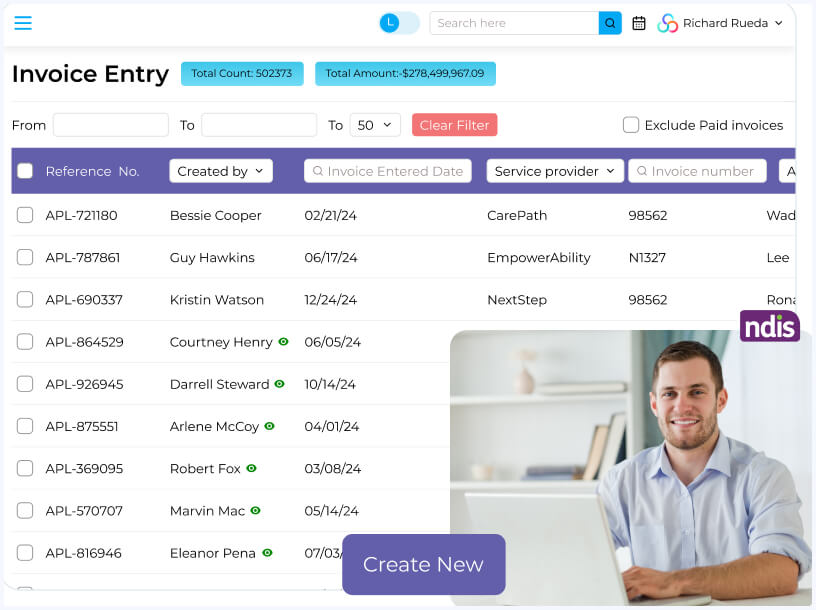
Contact our consultants to discuss your insurance portal requirements. We provide detailed assessments, realistic cost estimates, and development roadmaps tailored to your specific situation.
FAQs on Insurance Portal Development
1. How much does it cost to develop an insurance portal?
Insurance portal development costs range from $60,000 for basic systems to $1,200,000+ for enterprise platforms. Basic portals with policy viewing and claims submission cost $60,000-$120,000. Standard systems with agent portals and reporting cost $120,000-$280,000. Advanced portals with AI features and mobile apps cost $280,000 to $550,000. Enterprise systems with multi-carrier support and custom integrations exceed $550,000.
2. How long does it take to develop an insurance portal?
Development timelines range from 3-5 months for basic portals to 12-18 months for enterprise implementations. Basic portal projects with core self-service features typically take 3-5 months to complete. Standard implementations with agent portals and integrations take 5-8 months. Advanced projects with AI capabilities require 8-14 months. Enterprise deployments across multiple business units take 12-18 months, including phased rollouts.
3. What features are essential in an insurance portal?
Essential insurance portal features include secure user authentication, policy management dashboards, claims submission and tracking, premium payment processing, and document management. Additional important capabilities include agent portals with commission tracking, reporting, and analytics, communication tools, and mobile responsiveness. Specific feature requirements depend on whether the portal serves policyholders, agents, or internal staff.
4. Should I build a custom insurance portal or buy packaged software?
Custom development suits organizations with unique workflows that packaged solutions cannot accommodate. Understanding the distinction between a web app and a website helps clarify which solution you need. Consider custom development for carriers seeking competitive differentiation, organizations requiring deep integration with legacy core systems, and businesses with complex multi-state compliance requirements. Packaged solutions work better for smaller agencies with standard processes, limited budgets, and immediate implementation needs.
5. How do you ensure the security and compliance of the insurance portal?
Security for insurance portals requires architectural decisions from the start of the project. Key measures include end-to-end encryption for data at rest and in transit, multi-factor authentication, role-based access controls, and comprehensive audit logging. Compliance requirements vary by state and line of business. Development teams need insurance regulatory expertise to implement proper controls for policy transactions, claims handling, and data privacy.
6. Can an insurance portal integrate with existing core systems?
Yes, modern insurance portals integrate with core policy administration, claims management, and billing systems. Integration typically uses APIs, web services, or specialized insurance data standards. Integration complexity depends on the specific core system. Modern platforms with documented APIs integrate more easily than legacy mainframe systems, which require custom adapter development.



 All our projects are secured by NDA




 4.8
4.8