
 By
By 
Contents
Digital-first consumers expect fast, intuitive, and always available online experiences. Whether they are browsing products, managing subscriptions, tracking orders, or accessing personalized services, users want a seamless interface that works across devices.
For businesses, meeting these expectations requires more than a standard website or mobile app. A well-designed B2C portal becomes the foundation for consistent and scalable consumer engagement.
B2C portal development focuses on building customer-facing platforms that handle high user volumes, real-time interactions, and personalized experiences. These portals serve as a single point of access for consumers to interact with a brand, manage their accounts, and complete transactions independently.
In this blog, we cover everything you need to know to build a successful consumer portal. Drawing from our 15+ years of experience as a leading web portal development company, we have shared insights to help you understand the benefits, key features, development process, cost considerations, and best practices for building B2C portals. Let’s get started.
What is a B2C Portal?
B2C portal development is the process of designing and building a consumer-facing digital platform that allows businesses to interact directly with end users at scale. A business-to-customer portal serves as a centralized interface where consumers can register, manage profiles, access services, make transactions, and engage with a brand through a seamless digital experience.
Unlike internal or B2B portals, B2C portals are built for high user volumes, frequent interactions, and diverse device usage. Custom B2C portal development focuses on delivering fast performance, intuitive navigation, and personalized experiences while ensuring security and data privacy. The portal is designed around user behavior and engagement patterns rather than internal workflows.
A well-developed B2C portal enables businesses to offer self-service capabilities such as account management, order tracking, subscriptions, content access, and support requests. It reduces operational overhead by automating routine interactions and creates consistent touchpoints that strengthen customer relationships. For consumers, it provides convenience, transparency, and anytime access to services.
What Develop a B2C Portal For Your Business?
Building a custom B2C portal delivers advantages that template solutions cannot match. Organizations gain complete control over user experience while addressing specific operational challenges unique to their business model.
1. Direct consumer relationships without intermediaries
A custom B2C portal eliminates dependence on third-party marketplaces and retailers. Your business owns the entire customer relationship from first click to final purchase. This direct connection enables deeper customer insights and higher profit margins.
Marketplace fees typically range from 15% to 40% of each sale. Custom web portal solutions eliminate these recurring costs. Your business retains full revenue while controlling pricing and promotional strategies.
2. Personalized experiences that drive conversions
Custom development enables personalization far beyond what template solutions offer. Your portal can analyze browsing behavior, purchase history, and preferences to deliver tailored recommendations. Personalized experiences significantly increase engagement and sales.
Generic platforms limit personalization to basic features. Custom portals implement sophisticated algorithms that learn from each interaction. Consumers receive relevant suggestions that feel helpful rather than intrusive.
3. Complete brand control and differentiation
Template platforms force businesses into similar visual layouts and user flows. Custom B2C portal development creates unique brand experiences that differentiate your business. Every touchpoint reflects your brand identity and values.
Competitors using the same template cannot replicate your custom features. Proprietary functionality becomes a sustainable competitive advantage. Your portal stands out in crowded markets where sameness prevails.
4. Scalable architecture for growth
Off-the-shelf solutions often struggle during traffic spikes or rapid growth phases. Custom development builds scalability into the foundation. Your platform handles increased demand without performance degradation.
Seasonal businesses benefit particularly from custom scalability. Black Friday traffic surges or seasonal peaks no longer threaten site stability. Infrastructure scales automatically based on actual demand patterns.
5. Seamless integration with business systems
Consumer-facing operations require coordination across multiple backend systems. Inventory management, order fulfillment, customer service, and accounting all need real-time data synchronization. Custom portals integrate these systems into unified workflows.
Template solutions offer limited integration options. Custom development connects systems via APIs or custom middleware. Data flows automatically between platforms without manual intervention or duplicate entry.
6. Enhanced mobile experience for modern consumers
Mobile commerce dominates consumer shopping behavior today. Custom development creates mobile experiences tailored to your audience. Touch-friendly interfaces, fast loading, and native app features improve mobile conversions.
Responsive templates often deliver compromised mobile experiences. Custom portals optimize every element for mobile users. The result is higher engagement and lower bounce rates on mobile devices.
7. Ownership and long-term cost efficiency
Subscription fees for template platforms compound over time. Custom development represents an upfront investment that eliminates recurring licensing costs. Organizations with significant transaction volumes achieve cost savings within a few years.
Complete ownership means no vendor lock-in or forced upgrades. Your business controls the development roadmap and feature priorities. Technology decisions serve your needs, not vendor revenue goals.
Looking to Build a Custom B2C Portal?
Space-O Technologies builds consumer portals aligned with your audience behavior and engagement goals.

What Are the Must-Have Features for Successful B2C Portal Development?
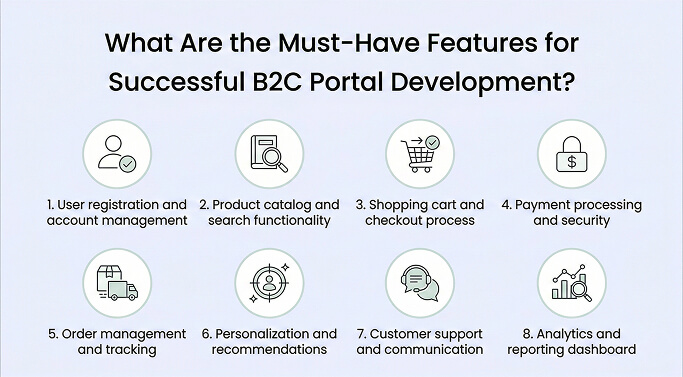
Successful B2C portals combine essential functionality with features tailored to specific business models. Understanding these components helps prioritize development investments and create platforms that users love. For a comprehensive overview of portal building, refer to our web portal development guide.
1. User registration and account management
The account system forms the foundation of personalized experiences. This module handles user registration, authentication, profile management, and preference settings. Secure, frictionless account features encourage user adoption.
- Social login options through Google, Facebook, Apple, and other providers.
- Email and phone verification for account security.
- Password recovery with secure reset workflows.
- Profile customization with saved addresses and payment methods.
- Communication preference management for marketing consent.
- Account activity history and security alerts.
Effective registration removes barriers to entry. Users create accounts quickly and manage them independently. Self-service capabilities reduce support burden while improving satisfaction.
2. Product catalog and search functionality
Consumers need to find products quickly and easily. Robust catalog management displays offerings attractively, while powerful search helps users locate specific items. These features directly impact conversion rates.
- Hierarchical category organization with filters and facets.
- Advanced search with autocomplete and spelling correction.
- Product comparison tools for informed decisions.
- High-quality image galleries with zoom capabilities.
- Detailed product descriptions with specifications.
- Stock availability and delivery estimates.
- Customer reviews and ratings display.
Search performance matters enormously in e-commerce. Users who cannot find products leave for competitors. Intelligent search returns relevant results even with imprecise queries.
3. Shopping cart and checkout process
Cart and checkout directly determine conversion success. Complicated processes lead to abandonment, while streamlined flows complete sales. Every click in the purchase path requires careful optimization.
- Persistent cart that saves items across sessions and devices.
- Guest checkout options without forced registration.
- Multiple payment methods are supported, including cards, wallets, and financing.
- Real-time shipping calculations with delivery options.
- Promo code and discount application.
- Order summary with clear pricing breakdown.
- Address validation and autofill features.
Cart abandonment rates average around 70% across e-commerce. Optimized checkout reduces this significantly. Saved payment methods and one-click purchasing further streamline repeat purchases.
4. Payment processing and security
Secure payment handling builds consumer trust and enables transactions. Payment modules must support a variety of payment methods while maintaining strict security standards. Compliance with PCI-DSS requirements is mandatory.
- Credit and debit card processing through secure gateways.
- Digital wallet integration for Apple Pay, Google Pay, and PayPal.
- Buy-now-pay-later options through financing partners.
- Subscription billing for recurring charges.
- Refund and partial refund processing.
- Fraud detection and prevention measures.
- PCI-DSS compliant data handling.
Payment flexibility increases conversion rates. Consumers expect their preferred payment method. Missing options cause abandonment at the final purchase step.
5. Order management and tracking
Post-purchase experience significantly impacts customer satisfaction and repeat purchases. Order management keeps consumers informed while enabling self-service for common requests. Transparency builds trust throughout the fulfillment process.
- Real-time order status updates with notifications.
- Shipment tracking integration with carrier APIs.
- Order history with reorder functionality.
- Self-service order modification before shipping.
- Return and exchange request submission.
- Invoice and receipt access.
- Delivery scheduling preferences.
Proactive communication reduces “where is my order” inquiries. Consumers appreciate visibility into fulfillment progress. Tracking integration automatically provides real-time location updates.
6. Personalization and recommendations
Personalization transforms generic shopping into tailored experiences. Recommendation engines analyze behavior to suggest relevant products. These features increase average order values and customer engagement.
- Browsing history-based product suggestions.
- Purchase pattern analysis for cross-selling.
- Recently viewed item tracking.
- Personalized homepage content.
- Dynamic email recommendations.
- Wishlist and save-for-later functionality.
- Personalized search results ranking.
Effective personalization feels helpful rather than intrusive. Consumers appreciate relevant suggestions that save them time browsing. Machine learning improves recommendations continuously based on interaction data.
7. Customer support and communication
Support accessibility to impact customer satisfaction and retention. Self-service options handle common questions while direct channels address complex issues. Multi-channel support meets consumers where they prefer to communicate.
- Searchable FAQ and help center content.
- Live chat with agent availability indicators.
- Chatbot integration for instant responses.
- Support ticket submission and tracking.
- Email communication with response tracking.
- Callback request scheduling.
- Community forums for peer support.
Support costs decrease when self-service handles routine inquiries. Knowledge bases answer common questions without agent involvement. Escalation paths ensure complex issues reach human support efficiently.
8. Analytics and reporting dashboard
Data-driven decisions require comprehensive analytics. Dashboards display key performance metrics while detailed reports enable deeper analysis. Business intelligence capabilities turn data into actionable insights.
- Real-time sales and traffic monitoring.
- Conversion funnel visualization.
- Customer behavior analytics.
- Product performance reporting.
- Marketing campaign attribution.
- Customer lifetime value calculations.
- Inventory and demand forecasting.
Analytics reveal optimization opportunities invisible otherwise. A/B testing capabilities enable continuous improvement. Data integration connects portal metrics with broader business intelligence.
Get Expert Guidance on Picking the Right B2C Portal Features
With 15+ years of experience and 300+ software products delivered, Space-O Technologies helps businesses build reliable and scalable B2C portals that drive growth.
What Are the Key Stages in the B2C Portal Development Lifecycle?
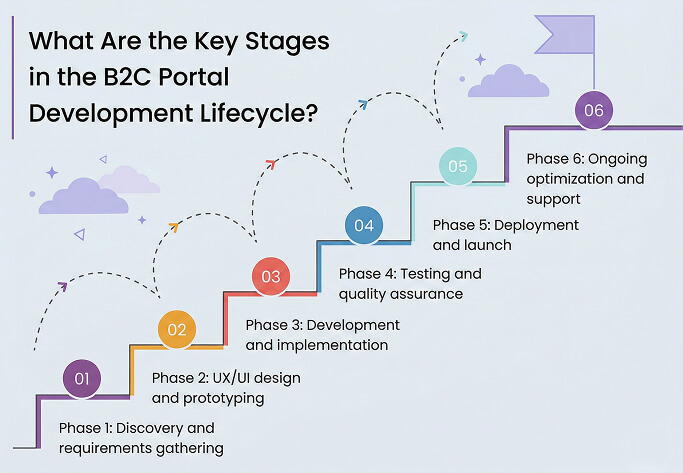
Building an effective B2C portal follows a structured process that balances thorough planning with iterative delivery. Understanding each phase helps set realistic expectations and ensures successful outcomes.
Phase 1: Discovery and requirements gathering
Timeline: 3-6 weeks
Discovery establishes the foundation for everything that follows. This phase documents business goals, user needs, and technical requirements. Thorough discovery prevents expensive mid-project changes.
Key activities
- Stakeholder interviews: Conversations with business leaders, marketing teams, and customer service reveal diverse perspectives. Each stakeholder contributes unique insights about requirements.
- User research: Understanding target consumers through surveys, interviews, and analytics shapes feature priorities. Personas and journey maps guide design decisions.
- Competitive analysis: Reviewing competitor platforms identifies market standards and differentiation opportunities. Understanding user expectations comes from existing market offerings.
- Technical assessment: Evaluating existing systems determines integration requirements and the scope of data migration. Infrastructure capabilities influence architecture decisions.
- Feature prioritization: Stakeholders rank features by business impact and user value. This prioritization drives development sequencing.
Discovery delivers comprehensive requirements documentation and a prioritized feature roadmap. Investing time here prevents costly rework during development phases.
Phase 2: UX/UI design and prototyping
Timeline: 4-8 weeks
Design translates requirements into visual interfaces and interaction patterns. This phase creates the user experience that determines portal success.
Key activities
- Information architecture: Organizing content and features into logical structures enables intuitive navigation. Site maps and user flows document the planned organization.
- Wireframe creation: Low-fidelity layouts establish page structure and content hierarchy. Wireframes enable early feedback before investing in visual design.
- Visual design: Brand-aligned interfaces bring wireframes to life with colors, typography, and imagery. Design systems ensure consistency across all pages.
- Prototype development: Interactive prototypes simulate actual user experience. Stakeholders and test users validate designs before development begins.
- Usability testing: Real users interact with prototypes to identify confusion points. Testing feedback drives design refinements.
Design deliverables include complete interface specifications and interactive prototypes. Stakeholder approval prevents costly mid-development design changes.
Phase 3: Development and implementation
Timeline: 12-30 weeks, depending on scope
Development transforms designs into working software. Agile methodologies deliver functionality incrementally, enabling early feedback and course correction. If you want a step-by-step breakdown, read our guide on how to create a web application.
Key activities
- Frontend development: Building user interfaces with modern frameworks creates responsive, fast-loading pages. Component-based architecture enables efficient development.
- Backend development: Server-side logic handles business rules, data processing, and system integrations. Secure APIs power frontend interactions.
- Database design: Optimized data structures support efficient queries and scalability. Schema design considers future growth requirements.
- Integration development: Connecting payment gateways, shipping carriers, and business systems enables end-to-end workflows.
- Sprint delivery: Two-week sprints deliver testable functionality regularly. Product owners review progress and adjust priorities as needed.
Development follows the prioritized roadmap while maintaining flexibility for scope adjustments. Regular demonstrations keep stakeholders informed and engaged.
Phase 4: Testing and quality assurance
Timeline: 4-8 weeks (overlapping with development)
Comprehensive testing ensures the portal meets requirements and performs reliably in real-world conditions.
Key activities
- Functional testing: Test cases verify every feature works as specified. Edge cases and error conditions receive explicit attention.
- Performance testing: Load testing confirms system capacity under expected and peak usage. Bottlenecks receive optimization before launch.
- Security testing: Penetration testing and vulnerability scanning identify weaknesses. Payment handling receives particular security focus.
- Compatibility testing: Verification across browsers, devices, and screen sizes ensures consistent experiences. Mobile testing covers major platforms.
- User acceptance testing: Real users validate the system in realistic scenarios. Feedback drives final refinements.
Testing should never be compressed to meet deadlines. Undiscovered defects cause post-launch issues and erode customer trust.
Phase 5: Deployment and launch
Timeline: 2-4 weeks
Deployment transitions the portal from development to production. Careful planning minimizes disruption while ensuring a smooth launch.
Key activities
- Data migration: Transferring existing customer data and product catalogs to the new platform. Validation confirms accuracy and completeness.
- Infrastructure setup: Configuring production servers, CDN, and security certificates. Performance optimization ensures fast page loads.
- Staff training: Preparing teams to manage the portal and handle customer inquiries. Documentation supports ongoing operations.
- Soft launch: A limited release to a subset of users identifies issues before the full launch. Real usage reveals problems testing missed.
- Full launch: Marketing-coordinated public release with monitoring for issues. Support teams are ready to answer customer questions.
Phased rollouts reduce risk for large implementations. Starting with a limited audience validates everything before broad exposure.
Phase 6: Ongoing optimization and support
Timeline: Continuous
Post-launch work ensures continued performance and enables continuous improvement. B2C portals require ongoing attention to maintain a competitive position.
Key activities
- Performance monitoring: System health metrics identify issues before they impact users. Proactive intervention prevents problems.
- Bug fixes: Issues discovered in production receive prompt resolution. Priority-based handling ensures critical problems get immediate attention.
- Feature enhancements: New functionality requests are added to the backlog for prioritization. The platform evolves as business needs change.
- A/B testing: Continuous experimentation optimizes conversion rates and user experience. Data drives improvement decisions.
- Security updates: Regular patching and security assessments protect against evolving threats.
Budget for ongoing development from project inception. Platforms that don’t continuously improve fall behind competitors.
How Much Does B2C Portal Development Cost?
Understanding cost components helps organizations budget accurately and make informed decisions. B2C portal development costs vary based on complexity, features, and development approach. For additional insights into budgeting, explore our comprehensive guide to web app development costs.
Cost by implementation scope
| Scope Level | Features Included | Development Cost Range | Timeline |
|---|---|---|---|
| Basic Portal | User accounts, product catalog, cart, checkout, basic admin | $40,000 – $80,000 | 3-4 months |
| Standard Portal | Basic features + payment integration, order management, analytics | $80,000 – $180,000 | 4-7 months |
| Advanced Portal | Standard features + personalization, loyalty programs, mobile apps | $180,000 – $400,000 | 7-12 months |
| Enterprise Portal | Advanced features + multi-region, advanced analytics, custom integrations | $400,000 – $800,000+ | 10-16 months |
Cost breakdown by development phase
| Phase | Budget Allocation | Activities |
|---|---|---|
| Discovery and Requirements | 8-12% | Stakeholder interviews, user research, and competitive analysis |
| UX/UI Design | 12-18% | Wireframing, visual design, prototyping, usability testing |
| Development | 45-55% | Frontend, backend, database, integrations, testing |
| Quality Assurance | 12-18% | Functional testing, performance, security, compatibility |
| Deployment and Launch | 6-10% | Data migration, infrastructure, training, and go-live support |
| Project Management | 8-12% | Coordination, communication, risk management |
Factors that increase development costs
Several variables push costs toward higher ranges:
- Custom integrations: Each external system integration adds $8,000 to $40,000, depending on API complexity. Legacy systems without modern APIs require custom middleware development.
- Personalization engines: AI-powered recommendation systems add 20-30% to baseline costs. Machine learning requires additional development expertise and infrastructure.
- Mobile applications: Native iOS and Android apps double the user interface development effort compared to web-only solutions. Cross-platform frameworks reduce but don’t eliminate this cost.
- Multi-currency and multi-language: International operations require additional development for currency conversion, tax calculations, and content translation.
- High-availability architecture: Mission-critical portals that require 99.99% uptime require redundant infrastructure and automated failover systems.
Hybrid models combining onshore project management with offshore development optimize both quality and cost. This approach delivers 40-50% savings while maintaining communication effectiveness.
Ongoing cost considerations
Initial development represents only part of the total ownership cost. Plan for ongoing expenses:
- Annual maintenance: 15-20% of the initial development cost covers bug fixes, security patches, and minor enhancements.
- Infrastructure: Cloud hosting costs range from $500 to $8,000 monthly, depending on traffic volume and storage requirements.
- Payment processing: Transaction fees typically range from 2.5% to 3.5% plus per-transaction charges.
- Feature enhancements: Budget $40,000 to $120,000 annually for new functionality to maintain competitive position.
Get an Accurate B2C Portal Development Estimate
Share your requirements with our technical team for a detailed cost breakdown tailored to your specific needs. We analyze complexity, integration requirements, and scalability needs to provide realistic budget expectations.
Common Challenges in B2C Portal Development and How to Overcome
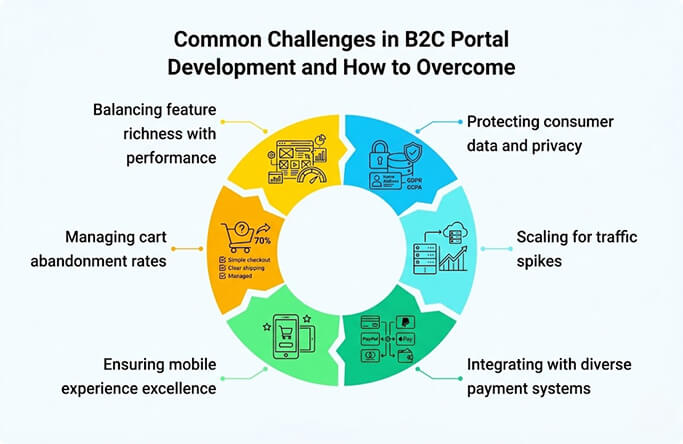
While developing a B2C platform, you’re likely to face multiple roadblocks and challenges. Here are the most common B2C portal development challenges and how to overcome them:
Challenge 1: Balancing feature richness with performance
Consumers expect fast-loading pages and smooth interactions. Adding features often increases page weight and complexity. Finding the right balance requires careful architectural decisions.
How to overcome this challenge
- Implement lazy loading for images and non-critical content.
- Use content delivery networks to serve assets from locations near users.
- Optimize database queries and implement caching strategies.
- Monitor real user performance metrics continuously.
- Prioritize features by user value and performance impact.
Challenge 2: Managing cart abandonment rates
Cart abandonment remains a persistent challenge in e-commerce. Consumers add items but leave before completing purchases. Reducing abandonment directly impacts revenue.
How to overcome this challenge
- Simplify checkout to reduce the number of steps and fields.
- Offer guest checkout without mandatory registration.
- Display shipping costs early to avoid checkout surprises.
- Implement abandoned cart email sequences.
- Provide multiple payment options, including digital wallets.
Challenge 3: Ensuring mobile experience excellence
Mobile traffic often exceeds desktop traffic for consumer platforms. Suboptimal mobile experiences lose sales and damage brand perception. Mobile-first thinking must guide development decisions.
How to overcome this challenge
- Design mobile interfaces first, then adapt for larger screens.
- Test on actual devices, not just emulators.
- Optimize touch targets for finger-friendly interaction.
- Minimize form fields and enable autofill features.
- Monitor mobile-specific metrics separately from desktop.
Challenge 4: Integrating with diverse payment systems
Consumers expect their preferred payment methods. Each payment integration brings unique technical requirements and compliance obligations. Managing multiple payment providers adds complexity.
How to overcome this challenge
- Partner with payment aggregators that support multiple methods.
- Implement payment abstraction layers for consistent handling.
- Plan for regional payment preferences in target markets.
- Test payment flows thoroughly, including error scenarios.
- Monitor transaction success rates by payment method.
Challenge 5: Scaling for traffic spikes
Promotional events and seasonal peaks create traffic surges. Systems that cannot scale disappoint customers and lose sales. Infrastructure flexibility is essential for consumer businesses. Learn proven strategies in our guide on how to scale a web application.
How to overcome this challenge
- Design stateless architectures that scale horizontally.
- Use cloud auto-scaling to match capacity with demand.
- Load test with realistic traffic patterns before peak periods.
- Implement queue-based processing for background tasks.
- Plan capacity increases ahead of known peak events.
Challenge 6: Protecting consumer data and privacy
Data breaches destroy consumer trust and create legal liability. Privacy regulations impose strict requirements on data handling. Security must be foundational, not an afterthought.
How to overcome this challenge
- Encrypt sensitive data at rest and in transit.
- Implement role-based access controls to limit data exposure.
- Conduct regular security assessments and penetration testing.
- Comply with GDPR, CCPA, and other applicable regulations.
- Maintain incident response plans for potential breaches.
Addressing these challenges early helps ensure a resilient and high-performing B2C portal. With the right architecture, mobile-first design, scalable infrastructure, and strong security practices, businesses can deliver seamless consumer experiences while supporting sustainable growth.
Best Practices for B2C Portal Development Success
Following proven practices dramatically increases project success rates. These guidelines represent accumulated wisdom from successful implementations across industries.
1. Prioritize user experience
User experience determines B2C portal success. Design decisions should always focus on consumer satisfaction. Test with real users, observe behavior, and track experience metrics like task completion and satisfaction to guide continuous improvement.
2. Design mobile-first experiences
Mobile-first design ensures optimal experiences for the primary user base. Create touch-friendly interfaces, simplify forms, and test on real devices under varied network conditions to uncover performance and usability issues early.
3. Optimize the purchase journey
Every unnecessary step reduces conversions. Simplify discovery, checkout, and post-purchase flows. Features like guest checkout, saved payments, and proactive order updates significantly improve conversion rates and customer retention.
4. Build personalization early
Plan personalization from the beginning to avoid technical debt. Start with basic recommendations and expand as data grows, while maintaining transparent data practices that respect privacy and build consumer trust.
5. Invest in search functionality
Search-driven users show strong purchase intent. High-quality search, autocomplete, filtering, and analytics help users find products faster, reveal demand patterns, and directly improve conversions.
6. Plan for international expansion
Prepare your portal for global growth early. Support multiple currencies, regional tax rules, localization needs, and preferred payment methods to avoid costly architectural changes later.
7. Implement analytics from launch
Comprehensive analytics enable data-driven decisions. Track key KPIs such as conversion rate and customer lifetime value, and integrate portal data with business intelligence to provide a complete performance view.
Applying these best practices helps build a scalable, user-centric B2C portal that drives conversions and long-term growth. With thoughtful planning, data-driven optimization, and a mobile-first approach, businesses can deliver seamless consumer experiences and stay competitive.
Build a Custom B2C Portal Platform Designed for Scalability with Space-O Technologies
A B2C portal plays a critical role in shaping how consumers interact with your brand. Performance, usability, and reliability directly influence user satisfaction, engagement, and retention. When designed with scalability and security in mind, a B2C portal becomes a long-term digital asset that supports business growth and evolving consumer expectations.
Space-O Technologies is an experienced B2C portal development company with over 15 years of expertise in building custom consumer-facing platforms. Having served more than 1200 clients and delivered 300+ software solutions, our team understands how to design B2C portals that handle high traffic, dynamic content, and personalized user journeys.
From discovery and UX design to development, system integration, and ongoing optimization, Space-O Technologies delivers B2C portals built for performance and scale. With Space-O Technologies as your development partner, you gain a future-ready B2C portal built for performance, scalability, and sustained growth. Our expertise ensures your platform can evolve confidently alongside your business and consumer expectations.
Browse our portfolio to discover web portal solutions we’ve built for organizations seeking greater efficiency, accessibility, and scalability.
Fyule Video Lab: Online Learning Platform
An online education solution that helps teachers deliver interactive lessons while keeping students engaged through projects and learning activities. Built with Flutter, PHP, Laravel, and MySQL.
Learn More
Parts Express: eCommerce Marketplace
A digital marketplace created for the waste management sector, making equipment sourcing and sales more efficient through a unified platform. Powered by Laravel, PHP 8.1, MySQL, and AWS.
Learn More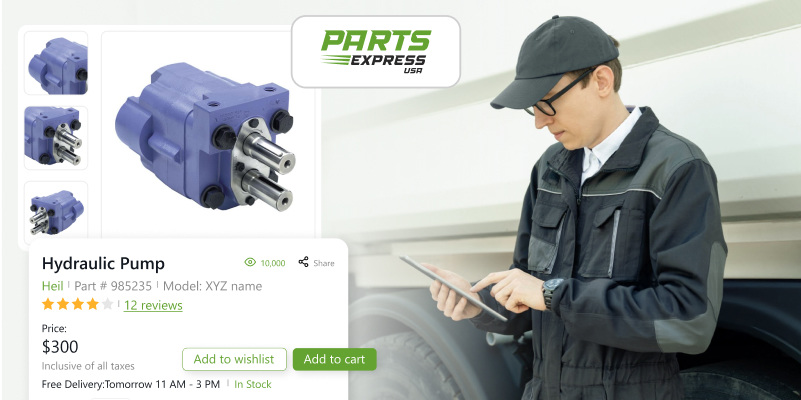
RaeCRM: NDIS Fund Management Software
A web-based platform that simplifies NDIS financial administration, helping users manage budgets, invoices, and funding records. Built with Laravel, MySQL, and Amazon S3.
Learn More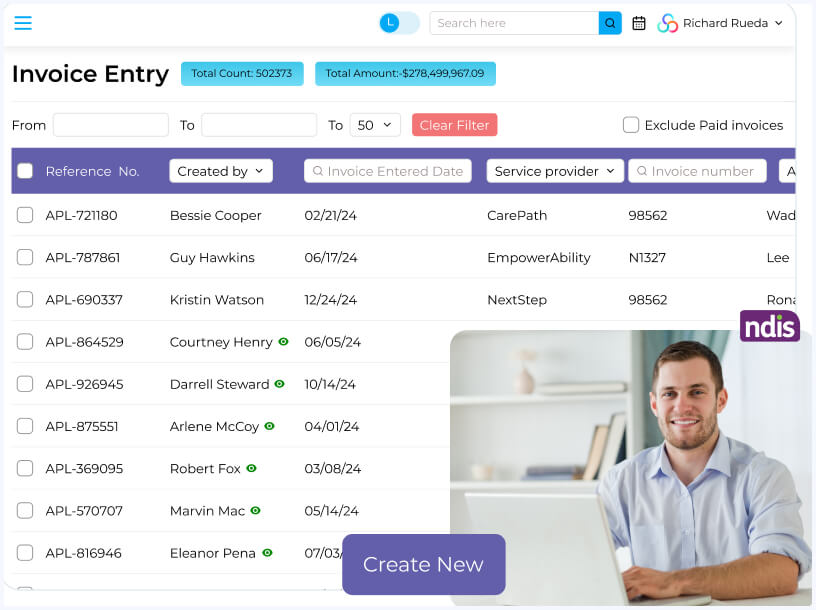
Whether you are launching a new consumer platform or modernizing an existing one, our experienced developers help you build a secure, engaging, and future-ready B2C portal. Connect with us today for a free expert consultation and hire our developers to build an effective, customer-centric B2C portal for your business.
FAQs on B2C Portal Development
1. How much does B2C portal development cost?
B2C portal development costs range from $40,000 for basic platforms to $800,000 or more for enterprise solutions. Basic portals with core e-commerce features cost $40,000 to $80,000. Standard platforms with payment integration and analytics cost $80,000 to $180,000. Advanced portals with personalization and mobile apps cost $180,000 to $400,000. Enterprise implementations with multi-region support exceed $400,000. Costs depend on features, integrations, and scalability requirements.
2. How long does B2C portal development take?
Development timelines vary from 3 months for basic implementations to 16 months for enterprise platforms. Basic portals with essential features take 3-4 months. Standard implementations with integrations take 4-7 months. Advanced platforms with personalization take 7-12 months. Enterprise portals with complex requirements take 10-16 months or longer. Timeline depends on feature scope, integration complexity, and testing requirements.
3. What features are essential in a B2C portal?
Essential B2C portal features include user registration and account management, product catalog with search functionality, shopping cart and checkout process, secure payment processing, and order management with tracking. Additional important features include personalization and recommendations, customer support channels, and analytics dashboards. The specific feature set depends on the business model and the target consumer’s needs.
4. How do you ensure the security of the B2C portal?
B2C portal security requires multiple layers of protection. Key measures include SSL/TLS encryption for data transmission, PCI-DSS compliance for payment handling, secure authentication with multi-factor options, and regular security assessments. Additional protections include fraud detection systems, data encryption at rest, access controls limiting data exposure, and compliance with privacy regulations. Security architecture must be foundational, not added later.
5. Can a B2C portal integrate with existing business systems?
Yes, custom B2C portals integrate with virtually any business system through APIs or custom middleware. Common integrations include ERP systems for inventory and order management, CRM platforms for customer data, accounting software for financial transactions, and shipping carriers for fulfillment. Integration complexity depends on the target system capabilities. Modern systems with documented APIs integrate more easily than legacy platforms.
6. What ongoing support does a B2C portal require?
B2C portals require continuous maintenance, including bug fixes, security patches, performance optimization, and feature enhancements. Budget 15-20% ofthe initial development cost annually for maintenance. Additional ongoing costs include cloud hosting, payment processing fees, and security assessments. Platforms without adequate support lose performance and security over time. Continuous improvement maintains a competitive position in dynamic markets.



 All our projects are secured by NDA




 4.8
4.8