
 By
By 
Table of Contents
- Why Invest In Custom Food Delivery App Development In 2025
- Benefits of Investing in Custom Food Delivery Application Development
- Food Delivery App Models: Choose Your Path
- Features Every Food Delivery App Needs
- Advanced Features of Food Delivery App
- Food Delivery App Development Process
- Cost of Food Delivery App Development
- Food Delivery App Monetization Models
- Best Practices for Successful Food Delivery App Development
- Common Challenges in Food Delivery App Development
- FAQs
If you’re planning to build a food delivery app like Uber Eats, DoorDash, or Zomato, chances are you’re looking for more than just an idea. You want to understand what it takes to develop one successfully.
- How do you design the app’s workflow?
- Which features should you include for customers, restaurants, and drivers?
- How to monetize from a food delivery app?
- And most importantly, how much does it cost to build a food delivery app in 2025?
With food delivery becoming a core part of everyday life, businesses of all sizes, from local restaurants to new-age startups, are investing in custom-built delivery solutions. Such platforms help reach customers directly, reduce third-party commissions, and strengthen brand loyalty.
This guide simplifies the entire process of food delivery app development. Drawing from our experience as a leading food delivery app development company, we’ve added key insights and best practices to help you avoid common pitfalls and build a product that truly stands out in a competitive market.
Explore the market trends, food delivery app models, key features, cost breakdown, and development roadmap you need to create a market-ready app. Let’s get started.
Why Invest In Custom Food Delivery App Development In 2025
Understanding the financial advantages and strategic benefits of owning your delivery platform helps you make confident investment decisions for long-term success. The food delivery application development industry continues its remarkable growth trajectory.
-
According to Business of Apps:
- The global food delivery market is expected to reach $213 billion by 2030.
- China leads as the largest market at $40.2 billion in 2024.
- The United States follows as the second-largest market, where DoorDash commands 68% market share.
For restaurant owners, the financial burden of third-party platforms creates a compelling case for custom solutions.
Beyond immediate cost savings, custom food delivery app development addresses the fundamental problem: when platforms take 15-30% of every order, restaurants work harder only to see profits disappear. Building your own platform transforms these ongoing commission expenses into one-time development investments that pay for themselves through eliminated fees.
To understand the benefits of building a food delivery app, let’s take a deeper look at some of its most compelling benefits.
- CNBC reports that Uber Eats and DoorDash charge 15-30% commission per order.
- CloudKitchens notes that restaurants with 10-15% profit margins see these commissions eliminate most delivery earnings.
Beyond immediate cost savings, custom food delivery app development addresses the fundamental problem: when platforms take 15-30% of every order, restaurants work harder only to see profits disappear. Building your own platform transforms these ongoing commission expenses into one-time development investments that pay for themselves through eliminated fees.
To understand the benefits of building a food delivery app, let’s take a deeper look at some of its most compelling benefits.
6 Compelling Benefits of Investing in Custom Food Delivery Application Development
For startups and restaurant owners, a custom-built food delivery app offers far more than convenience. It becomes the foundation for scalable growth, customer retention, and operational control. Here are the benefits of developing a food delivery app:
-
Reduces commission fees and maximizes profit margins:
Eliminating 15-30% commission fees on every order directly improves your bottom line. Custom platforms let you keep the full revenue from delivery orders, making each sale significantly more profitable without changing your menu prices or operations.
-
Provides customer data and builds direct customer relationships:
Third-party platforms own your customer data, preventing you from building direct marketing relationships. Custom food ordering app development gives you complete access to customer preferences, ordering patterns, and contact information for targeted promotions and loyalty programs.
-
Builds brand loyalty without platform restrictions:
Your custom app showcases your unique brand identity without competing against dozens of other restaurants on aggregator platforms. You control the entire customer experience, from interface design to promotional strategies, creating stronger brand recognition and customer retention.
-
Helps scale the platform without limitations:
Third-party platforms impose restrictions on menu customization, pricing flexibility, and promotional freedom. Custom online food delivery apps grow with your business, whether you’re expanding to multiple locations, adding catering services, or entering new markets.
-
Streamlines operations and reduces order errors:
Direct integration with your existing POS systems, inventory management, and kitchen workflows eliminates coordination issues common with third-party platforms. Real-time synchronization reduces order errors, improves kitchen efficiency, and enhances overall customer satisfaction.
-
Captures growing direct-to-consumer demand:
The shift toward direct-to-consumer delivery presents first-mover advantages for restaurants investing in custom platforms. As customers increasingly seek convenient ways to order from their favorite restaurants, having your own food delivery app solution positions you ahead of competitors relying solely on aggregators.
For businesses looking to partner with a mobile app development company, these strategic advantages justify the initial investment. Direct customer relationships, eliminated commissions, operational efficiency, and long-term scalability create a compelling business case for custom platform development.
You now have a compelling business case for owning your platform. Let’s dive into the specifics of how you can structure that business. The next critical step is defining the right food delivery app development model that fits your entrepreneurial vision and target market.
Want to Create Food Delivery App?
Tell us a little bit about your app idea. We will send you a free quote.

Food Delivery App Models: Choose Your Path
Each model serves distinct business objectives, target audiences, and operational structures. Your choice determines not just the development cost and timeline, but also your revenue potential, scalability options, and competitive positioning in the market.
1. Single restaurant ordering app (Direct-to-consumer model)
Best For: Established restaurants, regional chains, specialty cuisine restaurants with loyal followings
This model works best for established restaurant chains or individual restaurants with strong brand recognition looking to build direct customer relationships. Think of how Domino’s, McDonald’s, and Chipotle operate their own ordering apps independently of third-party platforms. For a detailed walkthrough on how to make a restaurant app, refer to our step-by-step guide.
-
Key Features: Menu management, order placement, payment processing, order tracking, loyalty programs, promotional offers, customer reviews, and direct communication with the restaurant.
Pros and cons
| Pros | Cons |
|---|---|
| Complete brand control and customer experience | Requires an existing customer base for adoption |
| Higher profit margins with no commission fees | The marketing burden falls entirely on you |
| Direct customer data ownership | Limited discovery for new customers |
| Easier to implement and maintain |
Development Cost: $25,000 – $45,000
Timeline: 3-4 months
2. Multi-vendor marketplace (Aggregator model)
Best For: Entrepreneurs targeting underserved markets, regional delivery platforms, niche cuisine aggregators
The aggregator model is what made Uber Eats, DoorDash, and Grubhub household names. You create a platform that connects multiple restaurants with customers, handling the entire ordering and delivery process while taking a commission from each transaction.
-
Key Features: Restaurant discovery, advanced search and filters, multiple restaurant ordering, order management, delivery fleet management, commission tracking, restaurant analytics, customer support system, and dispute resolution.
Pros and cons
| Pros | Cons |
|---|---|
| High revenue potential from commissions | Complex development and maintenance |
| Attracts customers with variety and choice | High operational costs for fleet management |
| Network effects drive growth | Restaurant acquisition and retention challenges |
| Multiple revenue streams available | Intense competition from established players |
Development Cost: $60,000 – $100,000
Timeline: 5-7 months
3. Integrated/Full-cycle model
Best For: Established restaurant chains, food service companies, businesses planning full operational control
This model combines restaurant operations, delivery logistics, and customer ordering into one seamless system. Companies like Domino’s use this approach, managing everything from kitchen operations to final delivery through integrated technology.
-
Key Features: End-to-end order management, kitchen display systems, inventory management, delivery fleet optimization, real-time tracking, automated dispatch, performance analytics, and supply chain integration.
Pros and cons
| Pros | Cons |
|---|---|
| Complete operational control | Highest development complexity |
| Optimized efficiency across all touchpoints | Requires significant operational expertise |
| Better quality control and customer experience | Substantial initial investment |
| Higher profit margins through vertical integration | Longer time to market |
Development Cost: $80,000 – $150,000
Timeline: 6-8 months
4. Cloud kitchen/Virtual kitchen model
Cloud kitchens operate without physical dining spaces, focusing entirely on delivery orders. This model requires specialized online food delivery app development that optimizes kitchen operations, handles multiple brands from one location, and manages high-volume delivery logistics.
-
Key Features: Multi-brand management, order aggregation from multiple platforms, kitchen workflow optimization, delivery partner integration, inventory tracking, menu engineering tools, and performance analytics per brand.
Pros and cons
| Pros | Cons |
|---|---|
| Lower operational costs than traditional restaurants | Completely dependent on delivery channels |
| Can operate multiple brands from one kitchen | No dine-in revenue stream |
| Easy to test new concepts and menu items | High competition in popular areas |
| Faster expansion to new markets | Customer loyalty is harder to build |
Development Cost: $40,000 – $70,000
Timeline: 4-5 months
Best For: Food entrepreneurs, restaurant chains expanding delivery presence, businesses testing new concepts
5. Subscription-based meal delivery model
Best For: Meal kit companies, health-focused food services, corporate meal programs
Companies like HelloFresh and Blue Apron pioneered this model, where customers pay recurring subscriptions for regular meal kits or prepared meal deliveries. This requires unique food ordering mobile app development features focused on subscription management and recurring logistics.
-
Key Features: Subscription plan management, meal customization, dietary preference tracking, recurring payment processing, delivery scheduling, recipe and cooking instructions, ingredient sourcing information, and cancellation management.
Pros and cons
| Pros | Cons |
|---|---|
| Predictable recurring revenue | High customer acquisition costs |
| Higher customer lifetime value | Subscription fatigue and churn |
| Better inventory planning | Complex logistics and fulfillment |
| Strong customer retention | Requires excellent customer service |
Development Cost: $45,000 – $75,000
Timeline: 4-6 months
With your chosen business model defined, the focus shifts to technology. It’s time to build your features list. We’ll break down the key features your food delivery app needs to satisfy customers, restaurants, and drivers across your entire platform.
Essential Features Every Food Delivery App Needs
When you create a food ordering app, you’re actually building three interconnected applications: one for customers, one for restaurants or vendors, and one for delivery drivers. Each must work seamlessly with the others while serving distinct user needs.
Here’s a detailed food delivery app features list covering all three sides of your platform, plus the admin panel that ties everything together.
1. Customer app features
The customer app is the front-end interface where users browse restaurants, place orders, make payments, and track deliveries in real time. It’s designed to offer a seamless and intuitive experience that keeps customers coming back.
- User Registration: Quick signup via email, phone, or social media with secure authentication
- Restaurant Discovery: Advanced search, filters by cuisine type, rating, price range, and delivery time
- Menu Browsing: Detailed menu with images, descriptions, prices, customization options, and dietary info
- Smart Ordering: Add items to cart, customize orders, save favorites, and reorder previous meals
- Multiple Payments: Credit/debit cards, digital wallets, cash on delivery, and saved payment methods
- Real-Time Tracking: Live GPS tracking of order preparation and delivery driver location
- Order History: Complete past order records with easy reordering and receipt access
- Ratings & Reviews: Rate restaurants and drivers, leave detailed reviews, view community ratings
- Promotions: Apply discount codes, loyalty points, referral rewards, and special offers
- Push Notifications: Order confirmations, preparation updates, delivery status, and promotional alerts
2. Restaurant/Vendor app features
The restaurant app enables restaurant owners or partners to manage their digital storefront. It is useful for updating the menu, processing incoming orders, tracking deliveries, and monitoring sales performance. It acts as their complete operations dashboard.
- Order Management: Receive, accept, and manage incoming orders with estimated preparation times
- Menu Management: Update menu items, prices, availability, photos, and descriptions in real-time
- Inventory Tracking: Monitor stock levels, set low-stock alerts, and mark items as unavailable
- Order Analytics: Track sales performance, popular items, peak hours, and customer preferences
- Earnings Dashboard: View daily, weekly, and monthly revenue with detailed breakdowns
- Customer Communication: Send order status updates and respond to special requests
- Payout Management: Track commissions, pending settlements, and payment history
- Performance Metrics: Monitor ratings, delivery times, cancellation rates, and customer feedback
- Operating Hours: Set business hours, mark holidays, and enable/disable ordering temporarily
- Promotional Tools: Create restaurant-specific deals, discounts, and featured listings
3. Delivery driver app features
The delivery app is built for drivers or delivery personnel to manage assigned orders efficiently. It includes tools for navigation, communication, delivery tracking, and earnings management, ensuring fast and reliable order fulfillment.
- Order Notifications: Instant alerts for new delivery requests with order details and earnings
- Accept/Reject Orders: Review pickup and delivery locations before accepting assignments
- Route Optimization: GPS navigation with real-time traffic updates and optimal route suggestions
- Order Details: Access customer address, phone number, special instructions, and order contents
- Delivery Confirmation: Mark pickups and deliveries complete with photo proof and signatures
- Earnings Tracker: View trip earnings, tips, bonuses, and daily/weekly totals
- Availability Toggle: Go online/offline easily to control when you receive delivery requests
- Customer Communication: In-app calling and messaging without sharing personal numbers
- Navigation Integration: One-tap access to Google Maps or Waze for delivery routing
- Support Access: Quick contact with support for order issues, accidents, or assistance needs
4. Admin panel features
The admin panel is the centralized control system for managing the entire food delivery ecosystem. It allows the platform owner to oversee users, restaurants, drivers, payments, and analytics, ensuring smooth coordination across all app modules.
- Dashboard Overview: Real-time metrics on orders, revenue, active users, and deliveries
- User Management: Manage customer accounts, restaurant profiles, and driver accounts
- Order Monitoring: Track all ongoing orders, resolve disputes, and handle cancellations
- Commission Management: Set commission rates, track restaurant earnings, and process payouts
- Analytics & Reports: Generate detailed reports on sales, user behavior, and platform performance
- Content Management: Update app content, promotional banners, and featured restaurant listings
- Payment Management: Monitor all transactions, refunds, and payment gateway performance
- Support System: Manage customer queries, restaurant issues, and driver support tickets
- Promotional Campaigns: Create platform-wide offers, referral programs, and marketing campaigns
- System Settings: Configure app parameters, delivery zones, tax rates, and operational rules
Successful delivery app development prioritizes these core features during initial launch, then adds advanced capabilities based on user feedback and market demands. For businesses planning online food delivery app development, this comprehensive feature set creates the foundation for a platform that satisfies customers, restaurants, and drivers equally.
You have the core functionality covered. To truly stand out in a competitive market, you need innovation. Let’s explore the advanced features that can make your app stand apart and drive higher user engagement and retention.
Want to Build a Feature-Rich Food Delivery App?
From intuitive user flows to real-time tracking and secure payments, we develop apps that users love and businesses trust.
Must-Have Advanced Features for a Winning Food Delivery App
Once you’ve covered the essentials, advanced features differentiate your custom food delivery app from basic solutions. These innovations improve user experience, optimize operations, and create unique value propositions that help you stand out in a crowded market.
1. AI-powered Recommendations and Personalization
Machine learning algorithms analyze customer order history, browsing patterns, and preferences to suggest relevant restaurants and dishes. This increases average order value and improves customer satisfaction through personalized experiences. The system learns from each interaction, becoming more accurate over time at predicting what customers want.
2. IoT Integration for Quality Monitoring
Smart sensors in delivery bags monitor temperature and humidity during transit, ensuring food quality standards are maintained. This is particularly valuable for cold chain items, hot meals, and sensitive cuisine. Restaurants and customers receive alerts if conditions fall outside acceptable ranges, reducing complaints and improving trust.
3. Voice Ordering Integration
Integration with Alexa, Google Assistant, or Siri allows customers to place orders through voice commands. This hands-free convenience is especially valuable for frequent customers who already know what they want. Voice ordering reduces friction in the ordering process and can increase order frequency by making it effortless to reorder favorites.
4. Dynamic Pricing and Surge Management
Automated pricing algorithms adjust delivery fees and restaurant offerings based on demand, weather, traffic conditions, and driver availability. This maximizes driver earnings during peak periods while optimizing order flow during slow times. Transparent surge notifications help manage customer expectations during high-demand situations.
5. Multi-language and Multi-currency Support
For businesses operating across regions or countries, supporting multiple languages and currencies is essential. This includes right-to-left language support for Arabic and Hebrew, local payment method integration, and region-specific content. True localization goes beyond translation to adapt the entire experience for different cultures and markets.
With your core and advanced feature sets defined, you now have a comprehensive blueprint for your platform. Transforming this blueprint into a fully functional, profitable food delivery app requires a disciplined, multi-stage development process to manage complexity and ensure quality.
The Complete Food Delivery App Development Process: From Idea to Launch
Understanding how to create a food delivery app requires following a proven step-by-step development process. Whether you’re building in-house or working with a development partner, this structured approach ensures quality, efficiency, and successful market entry.
Step 1: Discovery, Market Research, and Requirements (2–3 Weeks)
Whether you build in-house or hire dedicated developers, start with comprehensive market research to understand your target audience, analyze competitors, and identify market gaps. Define your unique value proposition; what makes your service different and why customers should choose you. .
Document every feature you need, from menu browsing and cart functionality to real-time tracking and payment processing. Create a detailed project scope document with technical specifications, user journeys for all three user types, and a realistic timeline with budget estimates.
Step 2: UI/UX Design (2–3 Weeks)
Begin with wireframes that map out the structure and flow of every screen in your customer, restaurant, and driver apps. Turn these wireframes into interactive prototypes that let you test the user experience before investing in development.
Design the visual interface that reflects your brand through colors, typography, and imagery while keeping navigation intuitive and accessible. Prepare a comprehensive style guide to ensure design consistency throughout development and future updates.
Step 3: Development (12–16 Weeks)
Build all three apps — customer, restaurant, and driver — simultaneously using agile development sprints for faster progress and regular checkpoints. Develop responsive frontend interfaces that match your approved designs while creating robust backend systems with APIs, databases, and server infrastructure.
Integrate essential third-party services like payment gateways (Stripe, PayPal), GPS tracking, push notifications, and SMS alerts. Create an admin dashboard that gives you complete control over platform operations, from order monitoring to performance analytics.
Step 4: Quality Assurance and Testing (2–3 Weeks)
Test every feature thoroughly to ensure it works as intended across different scenarios and user behaviors. Conduct performance testing to verify your app can handle peak order volumes without crashes or slowdowns. Run security audits on payment processing, user authentication, and data storage to protect sensitive information.
Test the app on various devices, operating systems, and network speeds — from high-speed WiFi to slow 3G connections — and involve real users in usability testing to catch any confusing elements before launch.
Step 5: Deployment and Launch (1 Week)
Set up your production servers with proper configuration for security, performance, and the ability to scale as your business grows. Submit your apps to Apple App Store and Google Play Store with all required materials, descriptions, screenshots, keywords, and compliance documentation.
Install analytics tools, crash reporting systems, and performance monitors to track how users interact with your app. Consider a soft launch in a limited geographic area or to a small user group to identify any final issues before your full market rollout.
Step 6: Post-launch Support and Maintenance (Ongoing)
Monitor your app’s performance continuously to catch and fix bugs quickly as real users begin placing orders at scale. Release regular updates to maintain compatibility with new iOS and Android versions and add security patches to protect user data.
Analyze user behavior data to understand which features work well and where customers face friction in the ordering process. Plan feature enhancements based on user feedback and business growth, scaling your infrastructure to support more restaurants, drivers, and orders as you expand into new markets.
The process is clear, but the budget is the next hurdle. Let’s address the crucial question: how much does it cost to create a food ordering app?
How Much Does Food Delivery App Development Cost?
One of the most common questions entrepreneurs ask is: “How much does on-demand food delivery app development actually cost?” The answer depends on your chosen model, feature complexity, design requirements, and development team location.
Building a food delivery app involves multiple components working together: customer, restaurant, and driver apps, plus backend infrastructure. Here’s what you can expect to invest based on your requirements.
Food Delivery App Development Cost Breakdown
| App Type | Features | Timeline | Cost Range (USD) |
|---|---|---|---|
| Basic MVP | User registration, restaurant browsing, menu viewing, cart, basic payment, order tracking, simple UI | 3–4 months | $25,000–$45,000 |
| Standard | All basic features plus multiple payment options, real-time GPS tracking, ratings & reviews, push notifications, order history, search filters | 5–6 months | $60,000–$100,000 |
| Advanced | All standard features plus AI recommendations, personalization, IoT integration, advanced analytics, multi-language support, loyalty programs, in-app chat | 6–8 months | $100,000–$150,000+ |
Four Factors That Influence Your Development Budget
Your food delivery app’s budget isn’t just defined by the number of features. It depends on strategic choices like platform type, integrations, and the expertise of your development partner. Here are the key factors that can influence food delivery app development costs:
1. Platform Choice (Native vs. Cross-platform)
Native development for iOS and Android delivers the best performance but costs 40–60% more. Cross-platform frameworks like React Native allow you to build a food delivery app for both platforms with a single codebase.
2. Design Complexity
Template-based design costs significantly less than custom design systems. However, superior design typically results in better engagement and retention.
3. Third-party Integrations
Essential integrations like payment gateways and maps are necessary. Advanced features like AI recommendations or IoT require specialized expertise.
4. Team Location and Expertise
Food Delivery App development cost vary based on region and local developer rates. North American developers charge $100–$200 per hour. European teams charge $50–$150 per hour. Asian teams charge $25–$80 per hour.
Ongoing costs to consider
- Cloud hosting: $300–$1,000 monthly for scalable server infrastructure
- Maintenance & updates: $1,500–$3,000 monthly to maintain compatibility and security
- Payment gateway fees: 2.9% + $0.30 per transaction for processing orders
- Marketing & user acquisition: $2,000–$10,000+ monthly depending on growth strategy
Moving further, let’s explore the strategies for earning revenue through your food delivery app and turn it into a profitable venture.
Get an Exact Cost Estimate for Your Food Delivery App
Tell us about your idea and features, and we’ll give you a transparent, no-obligation quote based on your project needs.
Food Delivery App Monetization Models: Proven Strategies That Work
Building a successful food delivery platform requires understanding how to monetize effectively. Here are seven proven strategies to generate sustainable revenue from your platform.
1. Commission-based model (10–30%)
The most common revenue model charges restaurants a percentage of each order value. Commission rates typically range from 10% for high-volume chain restaurants to 30% for independent restaurants seeking customer access. This model scales naturally with platform growth and aligns incentives between your platform and restaurant partners.
2. Delivery fees ($2–$8 per order)
Customers pay a delivery fee based on distance, order value, weather conditions, or demand. Dynamic delivery fees adjust in real-time, increasing during peak hours or bad weather to ensure driver availability. Many platforms offer free delivery on orders above a certain threshold to increase average order values.
3. Subscription memberships ($9.99–$14.99/month)
Premium memberships provide unlimited free delivery, exclusive discounts, priority support, and early access to promotions. This creates predictable recurring revenue while encouraging frequent orders. Subscription members typically order 2–3 times more frequently than non-subscribers, significantly increasing lifetime value.
4. Restaurant listing and promotion fees
Restaurants pay for premium placement in search results, featured listings on the homepage, or boosted visibility during peak hours. Additional revenue comes from professional menu photography, marketing campaigns, and promotional support services that help restaurants increase their order volume.
5. In-app advertising
Sponsored restaurant placements, banner ads, and promoted dishes create additional revenue without directly impacting transaction costs. Strategic ad placement maintains user experience while generating substantial income from restaurants competing for customer attention.
6.Surge pricing (15–25% increase)
During periods of high demand or low driver availability, surge pricing temporarily increases delivery fees. This demand-based pricing encourages more drivers to go online during busy periods while managing customer expectations about delivery times. Clear communication about surge periods prevents customer frustration.
7. White-label licensing
For established platforms, licensing your technology to restaurants or smaller delivery services creates passive income. White-label solutions enable restaurants to launch their own branded delivery apps, powered by your infrastructure, with you earning monthly licensing fees plus a percentage of transactions.
With your monetization strategy in place, the focus must return to execution. To ensure your app runs flawlessly and keeps users coming back, let’s review a few best practices for building a successful food delivery app.
Best Practices for Successful Food Delivery App Development
These six principles guide our approach to food ordering mobile app development and ensure your platform delivers exceptional value to all users.
-
Prioritize seamless user experience
Your app should allow customers to place orders in 3–4 clicks maximum. Optimize the checkout flow to reduce friction, enable guest checkout for first-time users, and save payment methods securely for faster repeat orders.
Load times under 3 seconds are critical, as each additional second of delay decreases conversion by 7%. Implement smart defaults based on user preferences and order history.
-
Optimize for performance
Fast, responsive apps retain users while slow ones get abandoned. Implement caching strategies to reduce server requests, use Content Delivery Networks (CDNs) for faster image loading, and compress assets without sacrificing quality.
Lazy loading ensures only visible content loads initially, speeding up perceived performance. Regular performance audits identify and eliminate bottlenecks.
-
Ensure security and compliance
Food delivery apps handle sensitive payment and personal data, making security paramount. Implement PCI-DSS compliance for payment processing, encrypt all data in transit and at rest, and use secure authentication methods.
Comply with GDPR, CCPA, and local data protection regulations. Regular security audits and penetration testing identify vulnerabilities before they become problems.
-
Build for scalability
Your infrastructure must handle growth without performance degradation. Use microservices architecture instead of monolithic systems, implement load balancing across multiple servers, and design databases for horizontal scaling.
Cloud-based infrastructure with auto-scaling capabilities adjusts resources based on real-time demand, ensuring consistent performance during peak hours.
-
Focus on retention
Acquiring customers is expensive, making retention crucial for profitability. Implement personalization based on order history and preferences, create loyalty programs that reward frequent orders, and use push notifications strategically without annoying users.
Proactive customer support that resolves issues quickly builds long-term loyalty and positive word-of-mouth.
-
Test extensively
Thorough testing prevents costly post-launch problems. Conduct beta testing with real users in your target market, perform load testing to verify your infrastructure handles peak traffic, and implement A/B testing for critical features and user flows.
Test on various devices, operating systems, and network conditions to ensure consistent experiences for all users.
These six practices guide our approach to food ordering mobile app development and ensure your platform delivers exceptional value to all users. Apart from these practices, leveraging the right technologies to develop a food delivery app also plays a key role in achieving that success.
Even with the best planning, building a huge app can have bumps in the road. Let’s look at the common challenges in online food ordering app development and exactly how to fix them so you can be ready for anything.
Build the Next Uber Eats or DoorDash with Space-O Technologies
Get a custom-built food delivery app tailored to your business goals, from concept to launch.
Common Challenges in Food Delivery App Development (And How to Solve Them)
Even with careful planning, food delivery app development service projects face predictable challenges. Understanding these obstacles and their solutions helps you navigate development smoothly and avoid costly mistakes. Let’s take a quick look at them:
1. Inaccurate real-time tracking
Problem: GPS location updates lag or show incorrect driver positions, frustrating customers who can’t accurately estimate arrival times. Poor tracking increases support inquiries and reduces trust in your platform.
Solution:
- Set location update intervals to every 10–15 seconds during active delivery.
- Use geofencing for automatic status updates.
- Combine GPS with cellular tower triangulation for higher accuracy.
- Adjust update frequency based on driver speed to save battery.
2. App crashes during peak hours
Problem: When order volume spikes during lunch or dinner rushes, inadequate server capacity causes slowdowns or complete app crashes, resulting in lost orders and angry customers.
Solution:
- Implement auto-scaling infrastructure to add server resources on demand.
- Use load balancing for request distribution.
- Add caching for frequently accessed data.
- Conduct regular load testing to identify and fix bottlenecks.
- Maintain a 30–40% buffer above peak server loads.
3. Payment failures and fraud
Problem: Payment processing errors frustrate customers ready to order, while fraudulent transactions and chargebacks eat into your revenue and increase operational costs.
Solution:
- Integrate multiple payment gateways for redundancy.
- Use machine learning for fraud detection.
- Enable 3D Secure authentication for high-value payments.
- Maintain PCI compliance for data security.
- Show clear error messages and alternative payment options.
4. Driver availability and logistics
Problem: Insufficient drivers during peak demand leads to long wait times and canceled orders, while too many drivers during slow periods reduce their earnings and increase churn.
Solution:
- Implement dynamic surge pricing to attract drivers.
- Leverage predictive analytics for demand forecasts.
- Create shift scheduling to help drivers plan.
- Offer bonuses for service in underserved areas.
- Partner with third-party delivery services for backup.
5. Restaurant onboarding difficulties
Problem: Complex onboarding processes discourage restaurants from joining your platform. Manual menu entry is time-consuming and error-prone, delaying time-to-market for new restaurant partners.
Solution:
- Provide simple, step-by-step onboarding guides.
- Offer menu upload templates and bulk import tools.
- Deliver onboarding support with dedicated specialists.
- Use menu scraping tools for automation.
- Provide pre-configured tablet devices for instant setup.
6. Maintaining food quality during delivery
Problem: Food arrives cold, soggy, or compromised in quality, leading to negative reviews and high refund rates that damage your platform’s reputation.
Solution:
- Set realistic delivery times based on prep and travel.
- Implement temperature monitoring bags for premium service.
- Recommend insulated packaging and provide guidelines.
- Educate partners on packaging best practices.
- Enable delivery-condition-specific ratings for transparency.
Partner With Expert Food Delivery App Developers
Building a successful food delivery platform requires more than just technical expertise. You need a development partner who understands the complexities of multi-sided marketplaces, real-time logistics, payment processing, and user experience optimization. Look no further and partner with Space-O Technologies.
With 15+ years of expertise in food delivery mobile app development, we combine technical excellence with a deep understanding of food delivery operations. Since 2010, we’ve delivered multiple food delivery solutions to clients worldwide, maintaining a 97% client retention rate.
Our team of 140+ experienced developers specializes in creating custom food delivery apps that solve real business problems. Check out our portfolio featuring some of the most successful food delivery app development solutions we’ve delivered to our clients.
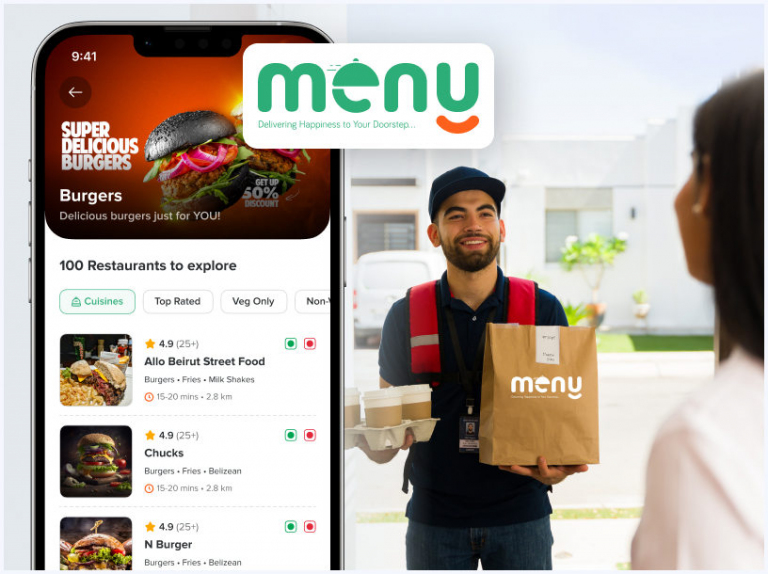
Menus: Food Delivery App for Restaurant Chains
Space-O created Menus as an all-in-one food delivery platform designed for a Kuwait-based restaurant owner operating multiple brands with 2-3 locations each. This digital solution consolidated manual workflows across various restaurant chains and their branches, creating a centralized management system for streamlined operations.
Delishry: On-Demand Food Delivery App
Designed for a North Eastern Arizona restaurant owner, Delishry automates the entire food delivery workflow to minimize costs and maximize revenue. We built this iOS and Android platform with live order tracking, Stripe payment integration, and app masking technology that keeps driver and customer phone numbers private throughout the delivery process.
Bevy: On-Demand Alcohol Delivery App
Operating exclusively during London’s late-night hours (5 pm to 5 am), Bevy connects customers with nearby wine shops for rapid delivery service. Space-O Technologies created this platform to dispatch motorcycle butlers who deliver alcohol, snacks, and tobacco within 30 minutes. The app features GPS tracking and charges a flat £5 delivery fee.
We help restaurants reduce commission costs, entrepreneurs launch successful platforms, and established businesses expand their digital presence. Get in touch with our experts today for a free consultation and get started with your food delivery app development project.
Frequently Asked Questions About Food Delivery App Development
1. How long does it take to develop a food delivery app?
The development timeline depends on complexity and features. A basic single-restaurant ordering app takes 3-4 months, while a full-featured multi-vendor marketplace requires 5-7 months.
The integrated full-cycle model with kitchen management systems needs 6-8 months. These timelines include discovery, design, development, testing, and launch phases. Working with an experienced food delivery app development company helps ensure realistic schedules and on-time delivery.
2. What does it cost to build a food delivery app like Uber Eats?
A comprehensive multi-vendor marketplace similar to Uber Eats typically costs $60,000-$100,000 for the initial version. This includes customer, restaurant, and driver apps, plus an admin panel.
Advanced features like AI recommendations, IoT integration, and sophisticated analytics can push costs to $100,000-$150,000. Ongoing operational costs add $5,000-$15,000 monthly for hosting, maintenance, and support.
3. Should I choose native or cross-platform development?
Cross-platform development using React Native or Flutter is ideal for most projects. You’ll save 40-50% compared to native development while reaching both iOS and Android users simultaneously.
Native development offers slightly better performance and access to the latest platform features, but these advantages rarely justify the additional cost for food delivery apps. Start cross-platform and rebuild specific performance-critical components natively only if needed.
4. Do I need separate apps for customers, restaurants, and drivers?
Yes, each user type needs a dedicated app optimized for their specific workflows. Customers need easy browsing and ordering, restaurants require efficient order management, and drivers need quick acceptance and navigation tools.
Combining these into one app creates confusing interfaces that frustrate all users. The investment in three separate apps pays off through better user satisfaction and operational efficiency.
5. How do food delivery apps make money?
Successful platforms use multiple revenue streams. Restaurant commissions (10-30% per order) provide the primary revenue source. Delivery fees ($2-$8 per order) cover logistics costs while generating profit.
Subscription memberships ($9.99-$14.99 monthly) create predictable recurring revenue. Additional income comes from restaurant listing fees, in-app advertising, surge pricing during peak demand, and white-label licensing of your technology.
5. How do food delivery apps make money?
Successful platforms use multiple revenue streams. Restaurant commissions (10-30% per order) provide the primary revenue source. Delivery fees ($2-$8 per order) cover logistics costs while generating profit.
Subscription memberships ($9.99-$14.99 monthly) create predictable recurring revenue. Additional income comes from restaurant listing fees, in-app advertising, surge pricing during peak demand, and white-label licensing of your technology.
6. Can I start with an MVP and add features later?
Absolutely, and we recommend this approach. Launch with core features like restaurant browsing, ordering, payment, and basic tracking. This gets you to market 40-50% faster at significantly lower cost.
Once you’re generating revenue and gathering user feedback, add advanced features that users actually want rather than guessing during initial development. This iterative approach reduces risk and improves overall product-market fit.
7. How long does it take to achieve ROI from a food delivery app?
Most food delivery platforms reach profitability within 12-18 months of launch with proper execution. Initial months focus on building a user and restaurant base, often requiring aggressive customer acquisition spending.
Once you achieve critical mass in your target market (typically 50+ restaurants and 5,000+ active users), network effects accelerate growth. Your path to profitability depends on commission structure, operational efficiency, and customer lifetime value versus acquisition cost.



 All our projects are secured by NDA




 4.8
4.8