
 By
By 
Contents
- An average website redesign cost can range from $2,000 to $80,000 in the USA.
- The pricing range differs depending on who is redesigning the website—an agency, freelance designers, or in-house teams.
- The cost of redesigning differs depending on the project’s scope, including factors like website size, technical integrations, and features & functionalities to be added.
Key Takeaways:
A website that looked modern three years ago can cost your business leads, credibility, and search visibility today. User expectations, design standards, and Google’s ranking criteria evolve faster than most businesses update their digital presence. The result is a growing gap between what visitors expect and what an outdated site delivers.
Understanding the website redesign cost before starting the project prevents budget surprises and helps you prioritize what matters most. The investment varies widely based on project scope. A basic template refresh can cost as little as $2,000, while a complex enterprise redesign with custom integrations and advanced UX exceeds $80,000. For businesses considering a visual-first approach, choosing to hire UI/UX designers with proven portfolio experience is often the most impactful starting point.
Several factors drive the final cost, from the number of pages and design complexity to third-party integrations and CMS platform choice. Evaluating proposals from multiple agencies is essential before committing. Our curated list of top web development companies can help you benchmark pricing, expertise, and deliverables across vetted partners.
This guide breaks down every cost element, from quick overview tables and platform comparisons to hidden expenses and strategies for reducing the total investment.
When Should You Redesign Your Website?
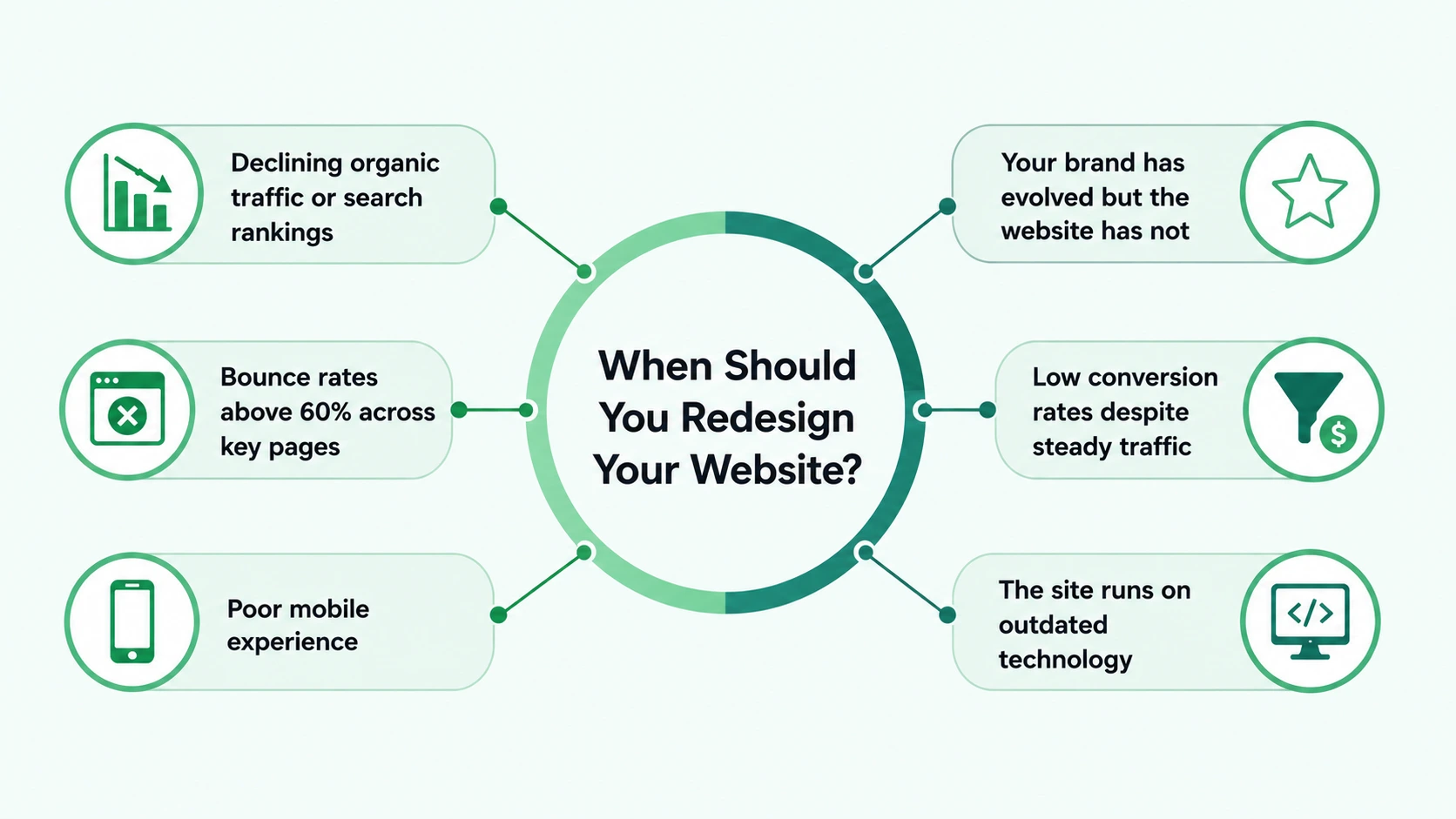
Before calculating how much does it cost to redo a website, the first question is whether you actually need one. Not every outdated page requires a full redesign. Some issues can be resolved through targeted updates. However, these six signs indicate a complete redesign is the right investment.
- Declining organic traffic or search rankings: Google prioritizes fast, mobile-friendly, and technically clean websites. An outdated structure, slow load times, or poor Core Web Vitals scores push your site down in search results over time.
- Bounce rates above 60% across key pages: Visitors leaving within seconds signals a disconnect between what they expect and what your site delivers. Outdated layouts, confusing navigation, or slow performance are common culprits.
- Your brand has evolved but the website has not: If your logo, messaging, target audience, or service offerings have changed since the last design, the site no longer represents your business accurately.
- Poor mobile experience: Over 60% of web traffic comes from mobile devices. A site that is not fully responsive loses more than half its potential audience.
- Low conversion rates despite steady traffic: Traffic without conversions means the site attracts visitors but fails to guide them toward action. Weak CTAs, unclear value propositions, or friction-heavy forms are typical causes.
- The site runs on outdated technology: Legacy CMS platforms, deprecated plugins, or unsupported frameworks create security vulnerabilities and limit your ability to add modern features.
If three or more of these apply, a redesign will deliver more value than incremental fixes. Whether you call it a redesign or website modernization, understanding the cost upfront ensures the investment aligns with the business impact you expect.
Is the Cost to Redesign a Website Worth the Investment?
Yes. A well-executed redesign pays for itself through conversion rate optimization (CRO), better search visibility, and reduced operational friction. The cost of keeping an underperforming website often exceeds the investment required to fix it.
- Lost revenue from poor conversion rates: Even a 1% improvement in conversion rate on a site with 50,000 monthly visitors translates to 500 additional leads or sales per month. An outdated design that leaks conversions costs far more than a redesign over 12 months.
- SEO penalties from outdated structure: Websites that fail Core Web Vitals benchmarks, lack mobile responsiveness, or use outdated URL structures lose ranking positions to competitors who have modernized. Rebuilding with clean architecture recovers that lost visibility.
- Brand credibility damage: Research consistently shows that users judge a company’s credibility based on website design within seconds. A dated site signals a dated business, driving potential customers to competitors with a stronger digital presence.
- Compounding maintenance costs: Patching an aging site with workarounds, plugin conflicts, and compatibility fixes drains developer hours without solving the root problem. A redesign resets the technical foundation and reduces ongoing maintenance overhead.
Framing the cost to redesign a website as an investment with measurable returns rather than an expense helps justify the budget to stakeholders and align the project with revenue goals.
A Quick Overview of Website Redesign Cost Breakdown
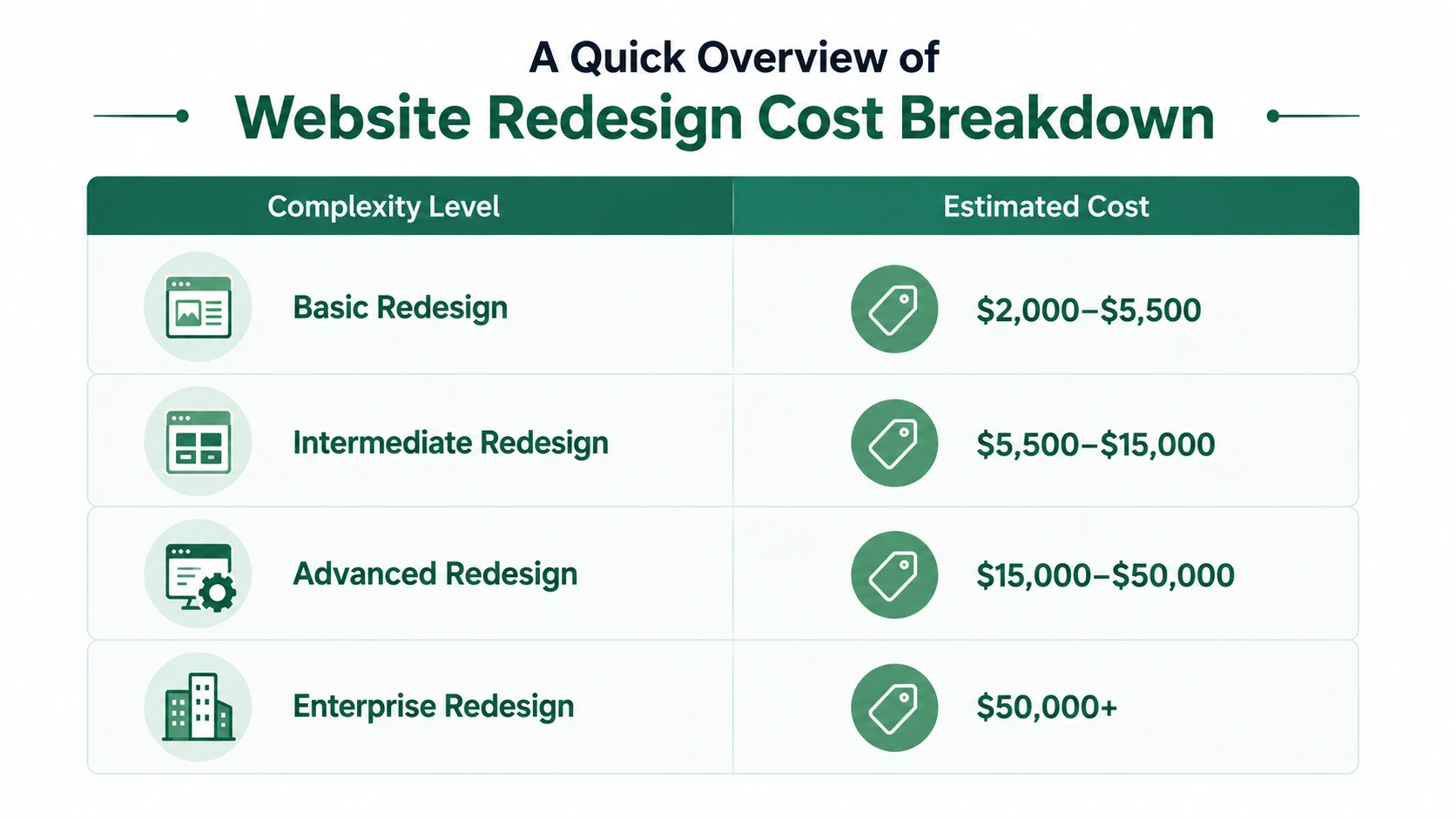
Redesigning a website with a simple UI typically costs between $2,000 and $80,000. However, the exact estimates vary depending on the complexity of the project and the specific redesign services required.
For instance, if redesigning is limited to visual refreshes, it might cost less. On the other hand, adding custom features, integrating third-party tools, and UI/UX redesign can drive up website redesign pricing significantly.
Here’s a table giving you an overview of website redesign costs based on the complexity of the website and design.
| Complexity Level | Description | Estimated Cost |
|---|---|---|
| Basic Redesign |
|
$2,000–$5,500 |
| Intermediate Redesign |
|
$5,500–$15,000 |
| Advanced Redesign |
|
$15,000–$50,000 |
| Enterprise Redesign |
|
$50,000+ |
Need a Cost Estimate for Redesigning Your Website?
Get a personalized cost estimate tailored to your business needs. Our experts at Space-O Technologies provide transparent, budget-friendly pricing for your website redesign project.

These cost ranges provide a starting point, but the deliverables included at each level vary significantly. Understanding what you actually receive at each price point helps you evaluate proposals on value rather than bottom-line cost alone.
What Can You Expect at Each Website Redesign Price Point?
Cost tables show ranges but rarely explain what you actually receive at each tier. Here is what deliverables typically look like across four common website redesign price levels.
- $2,000 to $5,000: Template-based redesign with visual updates to colors, fonts, images, and layout. Includes mobile responsiveness, basic contact forms, and CMS setup (WordPress or Squarespace). Usually 5 to 10 pages. No custom functionality or third-party integrations.
- $5,000 to $15,000: Semi-custom design with 10 to 30 pages. Includes brand-aligned layouts, improved UX flow, blog setup, lead capture forms, basic SEO optimization, and integration with email marketing tools. Some custom components like testimonial sliders or FAQ accordions.
- $15,000 to $50,000: Fully custom design and development. Includes comprehensive UX research, wireframing, 5 to 10 unique page templates, responsive development, CMS training, SEO migration planning, analytics setup, and integration with 2 to 4 third-party systems (CRM, marketing automation, payment gateways). Content migration for up to 100 pages.
- $50,000+: Enterprise-grade redesign. Includes discovery and strategy phase (3 to 4 weeks), information architecture, 10+ unique templates, accessibility compliance (WCAG 2.1 AA), advanced integrations (ERP, CRM, custom APIs), performance optimization, security hardening, and 60 to 90 days post-launch support. Often includes professional copywriting and brand photography coordination.
Understanding what each website redesign price point includes helps you evaluate proposals on deliverables rather than bottom-line cost alone.
DIY vs. Semi-Custom vs. Custom: Which Redesign Approach Fits Your Budget?
The website redesign budget varies dramatically based on the approach you choose. A template-based refresh costs a fraction of a fully custom build, but the tradeoffs in customization, performance, and scalability are significant.
| Approach | Cost Range | Timeline | Best For | Limitations |
|---|---|---|---|---|
| DIY Template | $300 to $2,000 | 1 to 2 weeks | Solopreneurs, personal brands, side projects | Limited customization, generic design, platform dependency |
| Semi-Custom | $2,000 to $10,000 | 2 to 6 weeks | Small businesses wanting a polished site without full custom investment | Restricted to template structure, limited integrations |
| Fully Custom | $15,000 to $80,000+ | 2 to 6 months | Growing businesses, e-commerce, lead generation, enterprise sites | Higher upfront cost, longer timeline |
DIY templates work when the site serves as a basic digital presence with no complex functionality. Platforms like Showit, Squarespace, and Wix offer drag-and-drop editors with pre-built layouts.
Semi-custom redesigns take a purchased template and hire a designer to tailor it for your brand. This middle-ground option delivers a polished look without the cost of building from scratch.
Fully custom redesigns give complete control over design, architecture, functionality, and performance. Every page, component, and interaction is built to match your specific business requirements.
For businesses evaluating how much does it cost to rebuild a website, the deciding factors are project complexity, number of integrations, expected traffic volume, and long-term scalability needs.
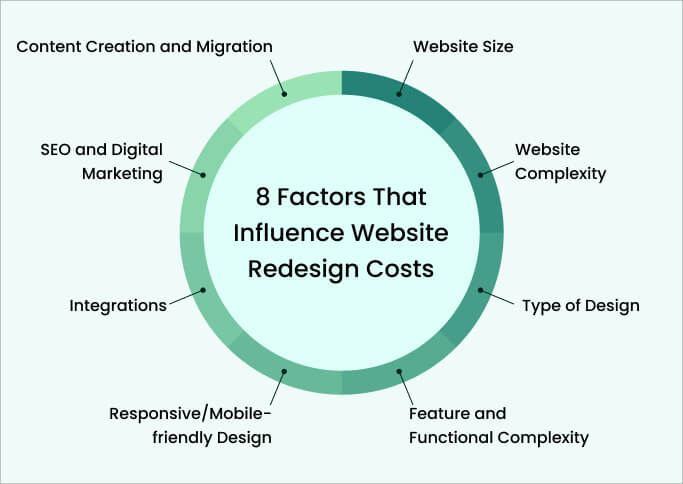
What Are the Factors Influencing Website Redesign Costs?
Website redesign costs vary based on factors such as website size, design complexity, custom functionality, content migration, SEO requirements, and third-party integrations. Below are 8 critical factors influencing the average cost of a website redesign project:
-
Website size
The website’s size refers to the number of pages, content volume, and database size. Below is how website size impacts the redesigning costs:
- Number of pages: The higher the number of pages a website has, the more time and effort is invested in the redesign process. For instance, the cost of redesigning 10 pages of a website will differ from the cost of redesigning 100 pages.
- Content volume: Updating extensive volumes of content, including text, images, or videos, often involves remodeling, migrating, and reorganizing during the redesign process, which can significantly increase costs.
- Database size: If a website relies on large data sets, for example, an eCommerce site with thousands of products, then redesigning involves migrating or restructuring the database, which results in driving up the cost of redesign.
In short, larger websites require more time, effort, and resources, driving up the redesigning cost. Conversely, the smaller the website, the less you need to spend on redecoration and remodeling.
-
Website complexity
Project complexity is likely to influence the price of website redesigning. Website complexity refers to technical difficulties involved in redesigning the website. It covers up complexities like:
- Functionalities include interactive components, a content management system, API development and integrations, and multilingual support.
- Features, for example, user accounts, payment gateways, and custom tools.
- In the case of legacy content or outdated technologies, the website requires restructuring pages, upgrades, or replacements to ensure compatibility with current SEO standards.
If a complicated website redesign with a large number of pages requires custom functionality, it requires more resources and is time-consuming. Customization also depends upon the level of uniqueness you’re seeking. Overall, functionality plays a vital role in redesigning a website.
-
Type of design
Design is defined as a visual representation of your business website, showcasing and representing your brand to visitors. Whether you’re aiming for a basic site that includes static pages or a feature-picked site, the design you choose will significantly impact both the cost and development time invested.
In such cases, maintaining a well-designed website upholds your brand identity and creates a lasting impression. Here are some of the common design styles and their cost implications for a website redesign:
Type of Design Key Aspects Cost Implications Basic Minimalist, clean, and functional. Most cost-effective; ideal for businesses with limited budgets. Modern Bold typography, vibrant colors, clean layouts, and responsive design. Moderate cost; requires more time and expertise than a basic design. High-end Sophisticated, sleek, and polished with custom visuals and micro-interactions. Higher cost; involves advanced features and additional design/development effort. World-class Innovative, cutting-edge, and immersive with 3D animations, AI-driven features, etc. Highest cost; demands cutting-edge technology, extensive development, and specialized expertise. Creating an impactful website starts with choosing experienced web developers for hire who can combine intuitive design, seamless functionality, and technical expertise to deliver exceptional user experiences. This is why working with an experienced web design agency like Space-O Technologies can help you deliver high-quality design and make your website stand out.
-
Feature and functional complexity
Functionality and features refer to additional tools, systems, or integrations that will improve your website’s performance and user experience. The cost of implementing these website functionalities varies depending on your business type and requirements.
For example, eCommerce businesses rely heavily on advanced features like product pages, shopping carts, secure payment gateways, advanced search and filtering, and functionalities like inventory management systems, shopping cart and checkout processes, and order tracking and notifications to manage day-to-day operations. Meanwhile, other companies redesign their websites to drive sales and improve lead generation.
Adding complex features or integrations can significantly increase development costs. However, these enhancements and features are important for delivering a seamless user experience, improving customer retention, and increasing revenue growth.
-
Responsive/mobile-friendly design
According to a recent Statista report, nearly 60% of the website traffic comes from smartphones. Therefore, responsive design is no longer an option—it is critical. A responsive design or a mobile-friendly site supports compatibility across multiple devices, including tablets, desktops, and mobile phones, offering a persistent and seamless user experience.
When planning to design a responsive website, it’s crucial to consider both aesthetics and functionality. Whether modifying the pre-existing page or building a separate mobile site, the goal is to adapt to different screen sizes and resolutions, ensuring enhanced usability to all the users is important.
Designing and developing a responsive website design may involve higher upfront costs, but the benefits outweigh the investment. A mobile-friendly design that supports all devices helps you reach a wider target audience. It improves user experience, leading to higher traffic, better engagement, and increased conversions.
-
Integrations
Integrations are significant price contributors to the cost of website redesign. They include the integration of third-party tools, APIs, and plugins to streamline the overall functionality of the website. Some of the common examples include payment gateways, CRM, and marketing automation platforms.
The pricing packages of integration vary depending upon the complexity of integration and the types of tools you want to include. As the integration of tools and services drives the overall redesign budget, it is important to select the right tools to align your integrational strategies with your business and objectives. This will ensure your website is operating efficiently and correctly.
While Integrations add to the redesign cost, they certainly provide undeniable value to business operations and user expectations. For instance, CRM tools or marketing automation tools help track the data and deliver the content, leading to fostering engagement and ultimately driving higher ROI.
-
SEO friendly website
Designing an SEO-friendly website is one of the critical factors impacting the cost of redesign. Implementing SEO best practices involves optimizing the page speed, structuring URLs, and ensuring mobile responsiveness to lay a foundation for long-term success. Certainly, an SEO-friendly website redesign attracts more digital visibility and organic traffic, mitigating the need for paid marketing efforts.
Implementing SEO best practices adds to the overall redesign costs. SEO focuses on aspects like content optimization, UI enhancement, and accessibility. This adds up to the overall resource requirements for redesigning—significantly raising redesign costs.
-
Content creation and migration
Content plays a vital role in any website. During a site’s redesign, content creation and migration include updating the pre-existing content, creating new content, or migrating the existing content to a new website.
Content creation includes everything from blog posts to landing pages, product descriptions, videos, and other media elements. The cost of content creation depends upon the extensive research, scope, and complexity of your website project.
For small websites, creating and updating the content pages may be straightforward. However, it’s not the same for large websites, as they may require an overhaul of the content strategy, which can be a key contributor to the overall cost of website redesign.
Creating content or migrating the existing content can increase redesign costs, but it is a key investment. High-quality content drives up user engagement, SEO, and brand presence. On the other hand, content migration ensures that the valuable content of the business is retained and updated, offering a more engaging experience for users.
Beyond these core factors, the CMS platform you choose adds another layer of cost variation that applies across every redesign project.
WordPress vs. Shopify vs. Webflow: How Platform Choice Affects Website Redesign Cost
The CMS platform you choose significantly impacts the website redesign price, both upfront and in ongoing maintenance.
| Platform | Redesign Cost Range | Best For | Ongoing Cost |
|---|---|---|---|
| WordPress | $3,000 to $80,000+ | Content-heavy sites, blogs, custom functionality | $500 to $3,000/year (hosting, plugins, security) |
| Shopify | $5,000 to $50,000+ | E-commerce with built-in payment and inventory | $348 to $2,300/year (subscription + apps) |
| Webflow | $3,000 to $40,000+ | Design-led sites with visual CMS editing | $168 to $588/year (hosting included) |
| Custom Build (React, Next.js) | $20,000 to $150,000+ | High-performance, complex integrations, full control | $2,000 to $10,000+/year (hosting, DevOps) |
WordPress offers maximum flexibility through 60,000+ plugins but requires ongoing security updates, plugin compatibility management, and dedicated hosting.
Shopify simplifies e-commerce with built-in checkout, inventory, and payment processing. Customization beyond the theme layer requires Liquid templating or headless architecture, which increases development cost.
Webflow provides a visual builder with clean code output and built-in hosting. It works well for marketing sites but has limited functionality for complex web applications or large-scale e-commerce.
Custom frameworks like React or Next.js deliver maximum performance and control but require a dedicated development team for both the build and ongoing maintenance.
Switching platforms during a redesign adds 20 to 40% to the project cost due to content migration, URL restructuring, and integration reconfiguration. Evaluate whether your current platform still serves your needs before committing to a migration.
Why Does E-Commerce Website Redesign Cost More?
E-commerce redesigns carry higher costs because they involve transaction processing, product data management, inventory logic, and security requirements that standard business websites do not need.
| E-Commerce Tier | Cost Range | Scope |
|---|---|---|
| Basic Store (10-50 products) | $5,000 to $15,000 | Template-based, standard checkout, basic product catalog |
| Mid-Size Store (50-500 products) | $15,000 to $50,000 | Custom filtering, customer accounts, payment gateway integration, inventory sync |
| Enterprise Store (500+ products) | $50,000 to $150,000+ | Headless commerce, multi-warehouse inventory, advanced personalization, ERP integration |
Product catalogs require structured data, filterable navigation, and real-time inventory updates. Payment gateway integration demands PCI DSS compliance and encrypted transaction processing. Customer account management adds user authentication, order history, and wish list functionality.
Platform choice also impacts the cost of a website redesign significantly. Shopify-based stores require less custom development but limit design flexibility. WooCommerce offers more control but needs ongoing plugin management. Headless commerce architectures using frameworks like Next.js with Shopify or Medusa provide maximum performance but require dedicated frontend development.
Businesses planning an e-commerce redesign should budget 30 to 50% more than a standard business website of equivalent page count. Regardless of whether you choose an agency, freelancer, or in-house team, these costs consistently apply.
Web Redesign Cost: In-House vs Agency vs Freelancer
When redesigning a website, you can follow either of these three approaches: hiring an in-house design team, outsourcing web design and development to a web design agency like Space-O Technologies, or hiring freelance web designers.
Each approach impacts web redesign costs differently and comes with its pros and cons. Let’s understand each of these approaches and their pros and cons in detail.
Cost of redesigning a website through a web design agency
Hiring a top web development company like Space-O Technologies guarantees access to top-tier professional expertise, ensuring your project is undertaken with precision. Certainly, understanding the cost breakdown is essential to allocate your budget effectively and achieve the desired outcomes.
| Agency Type/Project Scale | Details | Cost Range |
|---|---|---|
| Scope of the Project |
|
|
| Design and Development |
|
|
When hiring an agency, there are several pros and cons to consider. Here are some of the pros and cons which help you to make an informed decision.
Pros and cons of hiring a web design agency
| Pros | Cons |
|---|---|
|
|
Cost of redesigning a website through freelance UI/UX designers
Hiring a freelancer for redesign projects can be cost-effective, but getting a comprehensive understanding of each aspect that adds to the total cost helps you better plan your budget.
| Category | Details | Cost Range |
|---|---|---|
| Scope of the Project |
|
|
| Design and Development |
|
|
When considering hiring a freelancer for a website redesign, it’s important to consider the pros and cons.
Pros and cons of hiring a freelancer web designer
| Pros | Cons |
|---|---|
|
|
Cost of hiring in-house resources for a website redesign
Opting for in-house resources can significantly impact the website redesign pricing. Here’s a cost breakdown and the total estimated investment you need to make for six months in case of a successful website redesign:
| Expense | Cost Range |
|---|---|
| Resources: Web designer, UI/UX experts, project manager, and technical personnel | $120,000–$250,000 (depends on the number of team members and their expertise) |
| Tools & Software: Design software (e.g., Adobe XD, Figma), Project Management Tools (e.g., Asana, Jira) | $1,500–$5,000 |
Now that you know the cost of hiring in-house web designers, let’s look at the pros and cons of redesigning your website with in-house resources.
Pros and cons of hiring in-house designers
| Pros | Cons |
|---|---|
|
|
Why Do Website Redesign Projects Exceed Budget?
Most redesign budget overruns stem from avoidable planning gaps, not unpredictable technical problems. These are the hidden costs that catch businesses off guard.
- Content rewriting and migration: Content rarely transfers cleanly into a new design. Pages need rewriting, images need resizing, and metadata needs restructuring. Professional copywriting costs $100 to $300 per page, and migration for 50+ pages can add $5,000 to $15,000 to the project.
- Premium images, video, and creative assets: Custom brand photography ranges from $1,500 to $5,000. Video production costs $3,000 to $15,000 per video. Stock photography subscriptions add $500 to $2,000 annually. These costs are frequently excluded from initial proposals.
- Post-launch maintenance and support: Ongoing maintenance typically costs 15 to 20% of the original build cost annually. This covers security patches, CMS updates, performance monitoring, and minor content changes.
- Paid plugins, SaaS tools, and licensing: Premium WordPress plugins, analytics platforms, marketing automation tools, and CDN services add $500 to $5,000 per year in recurring costs that agencies rarely include in the initial quote.
- CMS training for internal teams: Training staff to manage the new CMS, update content, and handle basic troubleshooting adds 10 to 20 hours of billable time.
- Scope changes during development: Adding features, pages, or integrations after the project scope is finalized triggers change orders. Each mid-project addition costs 20 to 40% more than if included in the original scope.
Asking for a detailed breakdown of how much does it cost to revamp a website, including these hidden line items, prevents budget surprises after signing the contract.
What Can Reduce Website Redesign Cost?
Strategic planning and clear scope management can lower the average cost of website redesign by 30 to 50% without compromising quality.
- Define scope before contacting agencies: Document page count, must-have features, integration requirements, and content readiness before requesting proposals. Vague briefs lead to inflated estimates that account for worst-case assumptions.
- Prepare content before development begins: Agencies charge $100 to $300 per page for copywriting. Providing finalized copy, approved images, and organized brand assets before the design phase eliminates one of the largest hidden cost drivers.
- Limit unique page templates: Each custom template costs $3,000 to $8,000 in design and development. Reusing 3 to 5 core templates across similar page types reduces design hours significantly.
- Phase the project instead of launching everything at once: Launch with core pages and essential functionality first. Add secondary features, advanced integrations, and content expansions in Phase 2 after validating the initial design with real users.
- Use stock photography for non-critical pages: Custom brand photography adds $1,500 to $5,000. Reserve it for the homepage and key landing pages. Use high-quality stock images for supporting pages.
- Appoint a single decision-maker: Conflicting feedback from multiple stakeholders extends revision cycles and inflates project management costs. One person with final authority on design approvals keeps the timeline and budget on track.
These strategies help small businesses manage how much does it cost to update a website without sacrificing the quality of the final product.
How Do I Budget for a Website Redesign?
Setting a realistic website redesign budget requires accounting for more than just design and development fees. A complete budget covers six cost categories.
- Design and development (60-70% of total budget): This is the core investment covering discovery, wireframing, UI design, frontend/backend development, CMS configuration, and QA testing. Allocate the majority of your budget here.
- Content creation (10-15%): Professional copywriting ($100 to $300 per page), custom photography ($1,500 to $5,000), and video production ($3,000 to $15,000 per video) are frequently underestimated. Preparing content in-house before the project starts reduces this cost significantly.
- Third-party tools and licensing (5-10%): Premium plugins, SaaS integrations, analytics platforms, and CDN services carry annual fees ranging from $500 to $5,000.
- SEO migration and optimization (5-10%): Redirect mapping, metadata migration, schema markup, and post-launch ranking recovery monitoring protect the organic traffic you have already built.
- Post-launch maintenance (15-20% of build cost annually): Security patches, CMS updates, performance monitoring, and minor content changes require ongoing support after launch.
- Contingency buffer (10-15%): Scope changes, unexpected technical issues, and additional revision rounds are common. A 10 to 15% buffer prevents mid-project budget shortfalls.
Establishing clear website governance policies for content updates, design approvals, and performance reviews after launch ensures the redesigned site maintains its quality over time. For a $50,000 redesign, a realistic total first-year budget looks closer to $65,000 to $70,000 when content, tools, maintenance, and contingency are included. Planning for the average cost for website redesign at this level of detail prevents the surprise overruns that derail most projects.
How Is Website Redesign Cost Calculated?
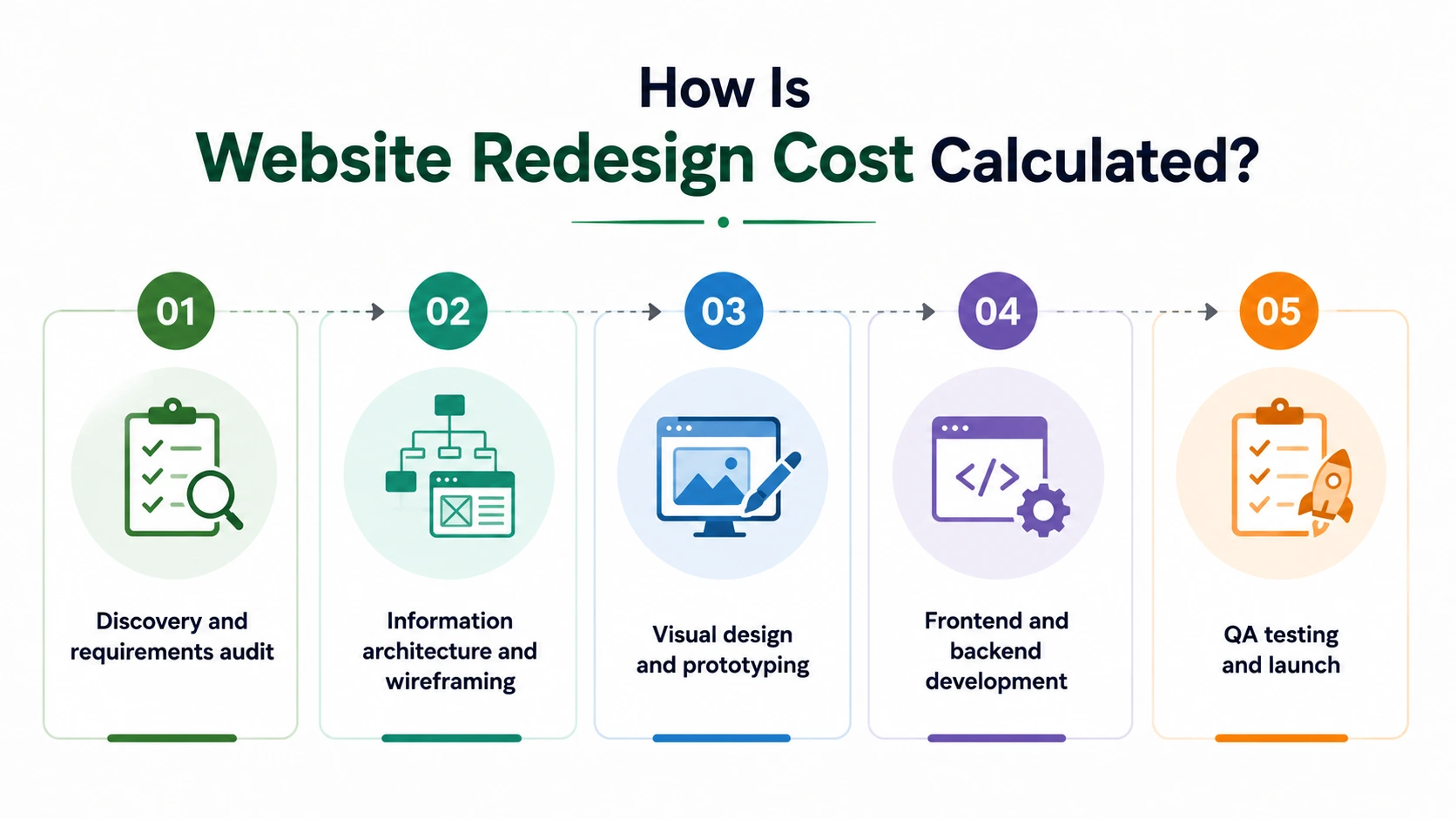
Understanding how agencies calculate website redesign pricing helps you evaluate proposals and negotiate from an informed position. Most firms follow a structured process.
-
Discovery and requirements audit
The agency reviews your current site’s analytics, content inventory, technical stack, and business goals. This phase defines what needs to change and why. Discovery typically accounts for 10 to 15% of the total cost of website redesign.
-
Information architecture and wireframing
Sitemaps, user flows, and wireframes define the structure before any visual design begins. The number of unique page templates (3 to 12+) directly impacts cost, with each template requiring separate design and development.
-
Visual design and prototyping
Designers create high-fidelity mockups for each template, often building a reusable design system for consistency across pages. Revision rounds (typically 2 to 3 included) and design complexity determine the hours spent. Custom illustrations, animations, or interactive elements add to this phase.
-
Frontend and backend development
Developers build the approved designs into a functional website, configure the CMS, and implement integrations. Development accounts for 40 to 50% of the total how much does it cost to redesign a website budget.
-
QA testing and launch
Cross-browser testing, mobile responsiveness checks, performance optimization, and SEO migration verification happen before deployment. Post-launch support (30 to 90 days) is included in most professional proposals.
Each phase produces deliverables with defined hours. Agencies multiply hours by their hourly rate ($50 to $250 depending on location and expertise) to arrive at the project total.
How Does the Website Redesign Process Work?
Understanding the step-by-step website redesign process helps you plan timelines, assign internal resources, and set realistic expectations before the project begins.
-
Website audit and performance review
The process starts by analyzing what is working and what is not on the current site. This includes reviewing analytics data (traffic sources, bounce rates, conversion rates), conducting a technical SEO audit, performing a content audit, evaluating Core Web Vitals scores, and identifying content gaps. The audit produces a clear picture of what needs to change and what can be retained.
-
Strategy and goal definition
Based on the audit findings, the team defines redesign goals: improve lead generation, enhance customer experience (CX), reduce bounce rates, increase time on site, or support a brand refresh. Target audience personas, competitor benchmarks, and business KPIs are documented in a strategy brief that guides every downstream decision.
-
Information architecture and sitemap
The team restructures the site’s navigation, page hierarchy, and content flow. Existing pages are mapped, consolidated, or retired based on performance data. New pages are added where gaps exist. The finalized sitemap serves as the blueprint for design.
-
UX wireframing and UI design
Wireframes define each page’s layout, content blocks, and user journey mapping without visual styling. Once approved, UI designers apply brand colors, typography, imagery, and interactive elements to create high-fidelity mockups. Prototypes allow stakeholders to test the experience before development begins.
-
Frontend and backend development
Developers build the approved designs into a functional website. This phase includes CMS configuration, responsive coding, third-party integrations, form setup, and performance optimization. Agile sprints deliver working sections every 2 to 4 weeks for stakeholder review.
-
Content migration and SEO preservation
Existing content is migrated, reformatted, and optimized for the new design structure. URL redirects (301s) are mapped to preserve search rankings. Metadata, schema markup, and internal linking are configured before launch.
-
QA testing and launch
The QA team tests across browsers, devices, screen sizes, and user roles. Performance benchmarks, accessibility compliance, and security checks are verified. Once approved, the site is deployed to a live server with DNS configuration, SSL activation, and monitoring setup.
-
Post-launch monitoring and iteration
After launch, the team monitors analytics and heatmaps, user behavior, and site performance for 30 to 90 days. Bug fixes, content adjustments, and conversion optimization tweaks are applied based on real usage data. This phase ensures the redesign delivers the expected business impact.
The entire how much does it cost to redesign a website question becomes easier to answer once you understand how each phase contributes to the timeline and budget.
Redesign Your Website in Budget With Space-O Technologies
Redesigning a website comes with considerable financial investment. Depending on the scope of your website’s redesign and chosen design partner, the costs can be skyrocketing high.
If you are looking for budget-friendly website redesign services, get in touch with Space-O Technologies. At Space-O Technologies, we specialize in redesigning your website while staying within the budget. Whether you’re a start-up or an established enterprise pursuing digital transformation, we offer tailored design services focused on your business needs..
Here’s what makes Space-O Technologies a reliable partner for redesigning your website:
- 14+ years of proven experience in website design and development.
- 140+ in-house designers, developers, project managers, and QA experts.
- Record of working with 1200+ clients from across the globe.
- Accredited with ISO 9001, showcasing commitment to quality.
Want to know more about us and how we can help you redesign your website? Contact us today and schedule a free consultation with our experts.
Curious About Your Website Redesign Costs?
Get an accurate cost estimate based on your requirements. Let’s discuss how we can revamp your website for better performance.
FAQs about Website Redesign Cost
How much does it cost to redesign a website?
Website redesign costs range from $2,000 to $80,000+ in the USA, depending on project scope, complexity, and the team you hire. Basic redesigns with template updates and minimal custom features cost $2,000 to $5,500. Intermediate redesigns with 10 to 50 pages and advanced UI/UX work cost $5,500 to $15,000. Complex redesigns with custom integrations, e-commerce, or API development cost $15,000 to $50,000. Enterprise-grade redesigns with CRM/ERP integrations, extensive testing, and compliance requirements exceed $50,000.
What factors affect website redesign cost?
Eight primary factors determine the cost: website size, design complexity, feature requirements, responsive design, third-party integrations, SEO optimization, content migration, and CMS platform choice. Each additional page adds design and development hours. Custom functionality like payment gateways, user portals, or multi-language support increases costs significantly. Platform migrations (WordPress to Webflow, for example) add 20 to 40% due to content restructuring and URL redirects.
Is it cheaper to redesign or rebuild a website?
Redesigning is typically 30 to 50% cheaper than rebuilding from scratch. A redesign updates the visual design, UX, and frontend while retaining the existing backend infrastructure, database, and content. A full rebuild replaces everything, including the CMS, server architecture, and codebase. Choose a redesign when the current platform still meets technical requirements. Choose a rebuild when the existing technology is outdated, unsupported, or cannot scale to meet future business needs.
How long does a website redesign take?
A website redesign takes 4 weeks to 6+ months depending on project size and complexity. Small websites with 5 to 10 pages and minimal custom features take 4 to 6 weeks. Medium websites with 10 to 50 pages, advanced UX, and integrations require 6 to 12 weeks. Large or enterprise websites with 50+ pages, custom development, compliance requirements, and content migration take 3 to 6+ months. Timeline extends further if content creation, brand photography, or CMS migration is included in the scope.
Is a website redesign worth the investment?
Yes. A well-executed redesign delivers measurable returns through higher conversion rates, improved search rankings, and reduced maintenance costs. Even a 1% conversion rate improvement on a site with 50,000 monthly visitors generates 500 additional leads per month. Outdated websites lose ranking positions to competitors with modern, mobile-optimized architecture. Ongoing patching of an aging site often costs more over 12 to 24 months than a one-time redesign investment that resets the technical foundation.
Can a website redesign improve SEO and conversions?
Yes. A redesign directly impacts both SEO and conversions when technical performance, content structure, and user experience are prioritized. Faster page load times and passing Core Web Vitals benchmarks improve search rankings. Clean URL structures and proper 301 redirects preserve existing SEO authority during migration. Improved navigation, clearer CTAs, and mobile-responsive layouts reduce bounce rates and increase the percentage of visitors who complete desired actions.
What is included in website redesign services?
Professional website redesign services typically include discovery and strategy, UI/UX design, frontend and backend development, content migration, SEO optimization, QA testing, and post-launch support. Discovery covers site audits, competitor research, and goal definition. Design includes wireframing, prototyping, and high-fidelity mockups. Development covers responsive coding, CMS configuration, and third-party integrations. Post-launch support includes 30 to 90 days of bug fixes, performance monitoring, and content adjustments.
How much does it cost to hire a website redesign company?
Hiring a professional website redesign company costs $2,000 to $50,000+ depending on agency size, location, and project scope. Small agencies and studios charge $100 to $150/hour, offering personalized service for straightforward projects. Mid-sized agencies charge $150 to $225/hour with deeper expertise across design, development, and strategy. Enterprise-focused agencies charge $225 to $350+/hour for large-scale projects with dedicated teams. Freelancers offer lower rates ($25 to $75/hour) but may lack the full-team capabilities needed for complex redesigns.
What are the 7 C’s of a website?
The 7 C’s of a website are Context (design and layout), Content (information provided), Community (user interaction), Customization (personalization), Communication (engagement channels), Connection (links and integrations), and Commerce (online transactions). Together, these elements create an effective and user-friendly website experience.



 All our projects are secured by NDA




 4.8
4.8