
 By
By 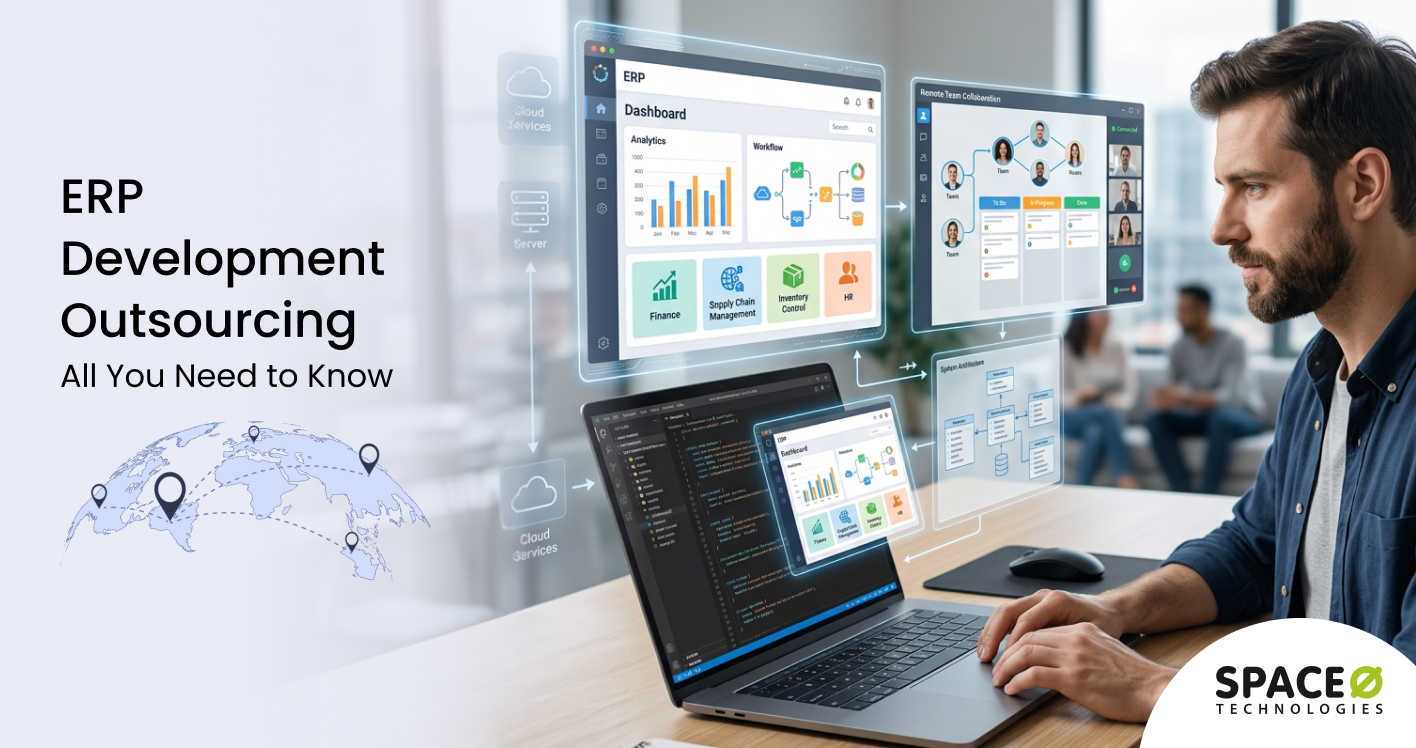
Contents
Enterprise Resource Planning (ERP) systems have become essential for businesses looking to streamline operations, centralize data, and improve decision-making across departments. As organizations continue to invest in digital transformation, the demand for ERP solutions is growing rapidly.
According to Fortune Business Insights, the global ERP market is projected to grow from $92.6 billion in 2025 to $229.8 billion by 2032, at a CAGR of 13.8%. This rapid growth is encouraging many businesses to adopt ERP platforms that can scale with their operational needs.
However, building a robust ERP system requires specialized technical expertise, significant development resources, and ongoing maintenance. For many organizations, maintaining an in-house development team for such a complex project can be costly and time-consuming.
This is why many companies are choosing ERP development outsourcing as a strategic approach to build and implement ERP solutions more efficiently. By outsourcing ERP development to an experienced ERP development agency, businesses can access skilled developers, accelerate project timelines, and reduce development costs while maintaining high-quality standards.
In this guide, we’ll explore what ERP development outsourcing is, its key benefits, outsourcing models, and best practices to help you successfully outsource your ERP project.
What Is ERP Development Outsourcing?
ERP development outsourcing is the practice of hiring an external development partner to design, build, implement, and maintain your enterprise resource planning system. Instead of assembling an in-house team of ERP architects, developers, and QA engineers, you delegate the entire development lifecycle, or specific phases of it, to a third-party company.
This is not the same as buying off-the-shelf software. When you outsource ERP development, you get a solution built specifically for your business processes, industry requirements, and growth plans. The outsourcing partner handles the technical execution while you focus on defining business needs and strategic direction.
The scope can be as broad or narrow as you need. Outsourcing can cover requirements gathering, system architecture, module development, third-party integrations, testing, deployment, and ongoing support. Some companies outsource the entire project end-to-end, while others outsource specific components like modules or integration layers.
Now that the concept is clear, let us look at why so many companies are choosing this route.
Why More and More Businesses are Outsourcing ERP Development
The decision to outsource ERP development is driven by real market pressures and operational realities that most growing businesses face today.
1. The talent gap is widening
Finding experienced ERP developers who understand both the technical architecture and business logic is extremely difficult. The demand for certified ERP specialists in platforms like SAP, Oracle, Microsoft Dynamics, and Odoo far outstrips supply. Hiring a full in-house ERP team takes months of recruitment, followed by extensive onboarding and ramp-up time before productive work even begins.
2. The cost of building in-house is steep
Beyond developer salaries, you need project managers, business analysts, QA engineers, infrastructure, and licenses. The ERP software development cost for an in-house build adds up quickly and can exceed initial estimates significantly. Outsourcing lets you convert this fixed cost into a variable, project-based expense that is easier to manage and predict.
3. Speed matters more than ever
Experienced outsourcing partners follow proven methodologies, have pre-built frameworks, and understand common ERP pitfalls. This means they deliver results significantly faster than an in-house team starting from scratch. Companies that try to build internally often face extended timelines due to resource constraints and competing priorities.
4. Digital transformation is no longer optional
Businesses across industries are actively pursuing ERP implementations to stay competitive. Those who delay risk falling behind competitors who have already modernized their operations. Outsourcing accelerates the path from planning to production without requiring you to build capabilities from the ground up.
5. In-house teams get pulled in multiple directions
Your IT team likely manages existing infrastructure, supports daily operations, and handles other technology projects. Adding a complex ERP build to their plate creates bottlenecks. Outsourcing frees your internal team to focus on core business priorities while experts handle the ERP development.
The reasons to outsource are clear. But what specific advantages does this approach deliver? Let us break down the benefits.
Benefits of Outsourcing ERP Development
Outsourcing ERP development delivers measurable advantages that go beyond just saving money. Here are the key benefits businesses gain when they partner with an external ERP development team.
1. Cost savings and budget predictability
Outsourcing eliminates the need for full-time ERP hires, office infrastructure, and ongoing training costs. You pay for the expertise you need, when you need it. This converts large capital expenditure into predictable, project-based operational costs.
2. Access to specialized ERP expertise
Outsourcing partners bring dedicated teams with deep experience in custom ERP software development, specific platforms, and industry verticals. You gain immediate access to architects, developers, and QA specialists who have delivered dozens of similar ERP projects.
3. Faster time to market
Experienced outsourcing teams follow proven development methodologies, have pre-built components, and understand common ERP pitfalls. This means your ERP system moves from concept to deployment significantly faster than an in-house build.
4. Focus on core business operations
Delegating ERP development to an external partner frees your leadership and internal teams to concentrate on revenue-generating activities, customer relationships, and strategic initiatives rather than managing a complex software project.
5. Scalable and flexible resources
Outsourcing allows you to scale your development team up or down based on project phases. Need more developers during the build phase and fewer during maintenance? Outsourcing partners adjust team size to match your requirements.
6. Reduced implementation risk
Established outsourcing partners have delivered multiple ERP projects and understand the risks involved. They bring proven risk mitigation strategies, structured project management, and quality assurance processes that reduce the chances of costly failures.
7. Access to the latest technologies and best practices
Outsourcing partners stay current with emerging technologies, frameworks, and ERP trends. From cloud-native architectures to AI-powered analytics, you benefit from the latest innovations without investing in continuous training for an internal team.
With these benefits in mind, the next question is which outsourcing model fits your project best. Let us explore the options.
Thinking About Outsourcing Your ERP Development?
Our ERP consultants evaluate your business requirements, recommend the right outsourcing model, and provide a detailed development roadmap within 48 hours.

ERP Development Outsourcing Models You Should Know
Not all outsourcing arrangements work the same way. The right model depends on your project scope, budget, timeline, and how much control you want to maintain. Here is a breakdown of the most common ERP development outsourcing models.
1. Dedicated team model
A dedicated team model assigns a full development team exclusively to your ERP project. This team works as an extension of your in-house staff, following your processes and reporting structure. It works best for long-term ERP projects that require continuous development, customization, and iteration over several months or years.
- Large-scale, ongoing ERP projects with evolving requirements
- Companies needing full control over the development process
- Projects where close collaboration and deep domain understanding are essential
2. Project-based outsourcing
In this model, you define the project scope, requirements, and deliverables upfront. The outsourcing partner delivers the completed ERP system within an agreed timeline and budget. This is ideal for companies with well-defined requirements and a fixed scope.
- Well-defined ERP projects with clear specifications and milestones
- Companies with limited technical oversight capacity
- Fixed-budget projects where cost predictability is a top priority
3. Staff augmentation
Staff augmentation lets you add ERP developers from an outsourcing partner to work alongside your existing team. If you need to hire ERP developers for specific skills like SAP ABAP, Odoo development services, or Oracle integration, this model fills the gap quickly without long-term hiring commitments.
- Supplementing existing teams with specific technical skills
- Short-term resource needs during peak development phases
- Companies with strong internal project management and leadership
4. Build-operate-transfer (BOT)
The BOT model starts with the outsourcing partner building and operating your ERP system. After a defined period, they transfer full ownership, knowledge, and operations to your in-house team. This is a strategic option for companies that eventually want in-house capabilities.
- Companies planning to build internal ERP teams over time
- Organizations that need immediate expertise with a long-term in-house goal
- Complex projects requiring structured knowledge transfer at completion
5. Managed services model
With managed services, the outsourcing partner takes full responsibility for your ERP system’s ongoing maintenance, updates, support, and optimization. You focus on using the system while they ensure it runs smoothly and evolves with your needs.
- Post-implementation support, maintenance, and continuous improvement
- Companies without internal IT support teams to manage ERP systems
- Organizations want predictable monthly costs for ERP management
The following table compares these models across key decision factors to help you evaluate which approach aligns with your project needs.
| Model | Control Level | Cost Structure | Best Timeline | Ideal Project Size |
|---|---|---|---|---|
| Dedicated Team | High | Monthly retainer | 6+ months | Large, evolving |
| Project-Based | Medium | Fixed price | 3–12 months | Well-defined scope |
| Staff Augmentation | High | Hourly/monthly per developer | 1–6 months | Skill-specific gaps |
| BOT | Medium to High | Phased investment | 12–24 months | Strategic, long-term |
| Managed Services | Low | Monthly subscription | Ongoing | Post-deployment |
Each model has its strengths, and some companies combine two models across different project phases. The choice depends on your internal capabilities and how much ownership you want to retain.
Now that you understand the models, the critical question becomes: how do you find the right partner? Let us walk through the selection process.
How to Choose the Right ERP Outsourcing Partner
Selecting the right outsourcing partner is the single most important decision in your ERP development outsourcing journey. A poor choice leads to missed deadlines, budget overruns, and a system that does not fit your business. Here is what to evaluate.
1. Evaluate industry experience and ERP portfolio
Look for a partner with a proven track record in ERP projects similar to yours. Review their case studies, client list, and the industries they have served. An outsourcing partner experienced in your vertical will understand your workflows, compliance requirements, and common pain points without a steep learning curve. Prioritize ERP development companies with demonstrated results in your specific domain.
2. Assess technical expertise and technology stack
Your partner should have deep expertise in the technologies your ERP will be built on. Whether it is Python, Java, .NET, or platforms like Odoo and ERPNext, verify their team’s certifications and project history. Ask about the best framework for ERP development they recommend for your use case and why they favor that approach.
3. Check communication protocols and project management
Communication breakdowns are the top reason outsourced projects fail. Evaluate how the partner handles project communication. Do they use tools like Jira, Slack, or Microsoft Teams? What is their reporting frequency? Do they assign a dedicated project manager? Clear communication protocols are non-negotiable when outsourcing ERP development.
4. Verify security standards and compliance certifications
ERP systems handle sensitive business data, from financial records to customer information. Your outsourcing partner must demonstrate strong security practices. Look for ISO 27001 certification, SOC 2 compliance, NDA willingness, and clear data handling policies. This is especially critical for industries like healthcare and insurance with strict regulatory requirements.
5. Review client testimonials and case studies
Past performance is the best predictor of future results. Speak to the partner’s previous clients directly. Check reviews on platforms like Clutch, GoodFirms, and G2. Look for consistently positive feedback on delivery quality, communication, timeline adherence, and post-launch support.
6. Understand pricing models and contract terms
Get complete clarity on how the partner charges. Is it fixed-price, time-and-materials, or retainer-based? What is included in the scope, and what costs extra? Watch for hidden fees around change requests, additional testing cycles, or post-deployment support.
If your project requires strategic guidance before development begins, consider engaging ERP consulting services separately to define requirements, evaluate vendors, and create a detailed roadmap. This upfront investment often saves significant time and money down the line.
With the right partner selected, the next step is execution. Let us walk through the exact process to outsource ERP development step by step.
Looking for a Trusted ERP Development Outsourcing Partner?
With 15+ years of enterprise experience and 140+ skilled developers, Space-O Technologies builds scalable ERP systems tailored to your specific industry and workflow needs.
Step-by-Step Process to Outsource ERP Development Successfully
Following a structured process dramatically increases your chances of a successful ERP outsourcing engagement. Here are the eight steps to get it right.
Step 1: Define business requirements and ERP scope
Start by documenting exactly what your ERP system needs to accomplish. Map out your business processes, identify pain points, and list the modules you need. Clear requirements prevent scope creep and give potential partners accurate information to estimate the project.
Action items
- Conduct workshops with key stakeholders from each department
- Prioritize features as must-have, nice-to-have, and future enhancements
- Document integration requirements with existing systems and third-party tools
- Define compliance and security requirements specific to your industry
Step 2: Research and shortlist potential outsourcing partners
Identify 5 to 10 potential ERP outsourcing partners through industry directories, referrals, and platforms like Clutch and GoodFirms. Look for companies with relevant ERP experience, an appropriate team size, and positive client reviews.
Action items
- Filter by industry experience, technology expertise, and company size
- Review portfolios for ERP-specific projects similar to yours in scope
- Check ratings, reviews, and client testimonials on third-party platforms
- Shortlist 3 to 5 partners for detailed evaluation and proposal requests
Step 3: Evaluate vendors and select the right partner
Run a detailed evaluation of your shortlisted partners. Share your requirements document and request proposals. Assess each partner on technical capability, communication quality, cultural fit, pricing, and references.
Action items
- Send a detailed RFP (Request for Proposal) to shortlisted vendors
- Conduct technical interviews with proposed team leads and architects
- Request references from past ERP clients and speak to them directly
- Compare proposals across cost, timeline, methodology, and team structure
Step 4: Plan the project scope, timeline, and milestones
Once you select a partner, collaborate on a detailed project plan. Define the development methodology (typically agile), sprint structure, milestone checkpoints, and acceptance criteria for each phase.
Action items
- Create a detailed project roadmap with milestones and deliverables
- Agree on sprint duration, demo frequency, and reporting cadence
- Define roles and responsibilities on both sides with clear accountability
- Establish escalation procedures for blockers, disputes, and critical decisions
Step 5: Execute development using agile sprints
Development begins with the outsourcing team working through defined sprints. Each sprint delivers a working increment of the ERP system. Regular demos and feedback loops ensure the product aligns with your expectations.
Action items
- Participate actively in sprint planning and review sessions
- Provide timely feedback on demos and deliverables after each sprint
- Track progress through shared project management tools like Jira or Asana
- Address change requests through the formal change process agreed upon earlier
Step 6: Conduct rigorous testing and QA
Testing should happen throughout development, not just at the end. Your outsourcing partner should conduct unit testing, integration testing, performance testing, and security testing. Your team handles user acceptance testing (UAT).
Action items
- Review test plans and ensure coverage across all modules and workflows
- Participate in UAT with real business scenarios, data, and edge cases
- Document and prioritize bugs for resolution before the go-live date
- Conduct load testing to verify performance under expected usage volumes
Step 7: Deploy, train, and go live
Deployment is where ERP implementation services become critical. Plan the cutover carefully to minimize business disruption. Train all end users thoroughly and have support resources ready for the initial weeks after go-live.
Action items
- Plan deployment during low-activity periods to reduce business impact
- Conduct end-user training sessions tailored to each department and role
- Prepare a rollback plan in case of critical issues during go-live
- Run parallel systems briefly if a full cutover feels too risky for operations
Step 8: Ensure post-launch support and maintenance
The work does not end at launch. ERP systems need ongoing monitoring, bug fixes, performance optimization, and feature enhancements. Agree on a post-launch support plan with your outsourcing partner before the project begins.
Action items
- Define SLAs for bug resolution, uptime guarantees, and response times
- Schedule regular maintenance windows for updates, patches, and optimization
- Plan periodic performance reviews and system health assessments
- Document a roadmap for future feature enhancements and scaling needs
Even with a solid process in place, outsourcing comes with challenges. Knowing them upfront helps you plan around them.
Not Sure Whether to Build In-House or Outsource Your ERP Development Project?
Our ERP consultants analyze your business needs, team capacity, and budget to recommend the right development approach for maximum ROI.
Common ERP Outsourcing Challenges and How to Overcome Them
ERP development outsourcing delivers significant advantages, but it is not without risks. Many outsourcing failures trace back to poor planning and weak management rather than the outsourcing model itself. Here are the most common challenges and practical ways to overcome them.
1. Communication and language barriers
Miscommunication between your team and the outsourcing partner can lead to misunderstood requirements, rework, and frustration. When teams operate across different countries, language nuances and cultural differences add another layer of complexity.
Solution
- Establish daily or weekly standup calls with clear agendas
- Use project management tools like Jira or Asana for transparent task tracking
- Assign a dedicated project manager on both sides as the single point of contact
- Document all requirements and decisions in writing to eliminate ambiguity
- Use screen recordings and visual references to reduce misinterpretation
2. Data security and IP protection concerns
Sharing sensitive business data and proprietary processes with an external team raises legitimate security concerns. ERP systems often handle financial data, customer records, and operational intelligence that must stay protected.
Solution
- Sign comprehensive NDAs and IP assignment agreements before starting
- Verify the partner’s security certifications (ISO 27001, SOC 2)
- Implement role-based access controls for all project resources and environments
- Use secure development environments and encrypted communication channels
- Conduct regular security audits throughout the project lifecycle
3. Quality assurance and testing gaps
When development happens externally, maintaining consistent quality standards can be challenging. Without proper oversight, bugs, performance issues, and feature gaps can slip through to production.
Solution
- Define acceptance criteria and quality benchmarks upfront in the contract
- Implement automated testing alongside manual QA processes from sprint one
- Conduct regular code reviews and sprint demos with your internal stakeholders
- Include UAT (user acceptance testing) phases in the project plan
- Set clear SLAs for bug resolution, response times, and severity classifications
4. Knowledge transfer and documentation issues
A major risk with outsourcing is that critical system knowledge stays with the external partner. If the relationship ends, you may struggle to maintain or extend the ERP system independently.
Solution
- Require comprehensive technical documentation as a mandatory deliverable
- Insist on code comments and architecture documentation throughout development
- Plan structured knowledge transfer sessions before project handoff
- Ensure your internal team participates in key development milestones and reviews
- Use the BOT model if long-term in-house ownership is your ultimate goal
5. Timezone differences and coordination
Working across different time zones can slow decision-making and create delays. A question asked at the end of your business day might not get answered until the next morning, stalling progress.
Solution
- Choose partners with at least 4 to 6 hours of overlapping work time
- Schedule critical meetings during overlap windows for real-time collaboration
- Use asynchronous communication tools effectively for non-urgent items
- Establish clear response time expectations for urgent issues and blockers
- Consider nearshore software development services if timezone alignment is a critical priority
5. Hidden costs and scope creep
What starts as a well-defined project can quickly expand as new requirements emerge. Without proper controls, these additions inflate costs and extend timelines significantly.
Solution
- Define the project scope in granular detail before signing the contract
- Use a formal change request process for any scope additions or modifications
- Set a budget contingency of 15% to 20% for unexpected requirements
- Review progress against the budget at every sprint milestone
- Choose fixed-price models for well-defined scopes to cap your cost exposure
Seamless ERP integration services also play a critical role here. If your ERP needs to connect with existing CRM, accounting, or supply chain systems, ensure integration scope is clearly defined from the start to avoid mid-project surprises.
With both the process and challenges covered, many businesses still wonder how outsourcing compares directly to in-house development. Let us break down the comparison.
In-House vs Outsourced ERP Development: A Detailed Comparison
Deciding between in-house and outsourced ERP development is one of the most consequential choices you will make. Both approaches have merit, and the right choice depends on your company’s resources, timeline, and long-term strategy.
The following table provides a side-by-side comparison across the factors that matter most to businesses evaluating their options.
| Factor | In‑House Development | Outsourced Development |
|---|---|---|
| Cost | High (salaries, benefits, infrastructure, training) | Lower (project-based or retainer pricing) |
| Time to Start | 3–6 months (hiring and onboarding) | 2–4 weeks (team ready to start) |
| ERP Expertise | Limited to existing team skills | Deep, specialized ERP knowledge |
| Scalability | Difficult to scale quickly | Easy to scale up or down per phase |
| Control | Full control over team and process | Shared control with clear agreements |
| Risk | Higher (single team, no external benchmarks) | Lower (proven methodologies, diverse experience) |
| Long-Term IP | Full ownership from day one | Ownership defined by contract terms |
| Maintenance | Internal team handles everything | Can include ongoing managed services |
This comparison highlights the trade-offs between the two approaches. The right choice depends on your specific situation and priorities.
In-house makes sense when:
- ERP is a core competitive differentiator, and you need full-time, permanent control
- You already have a strong internal development team with ERP experience
- Your organization has the budget for long-term team investment and retention
- Data sensitivity requires all development to stay within your organization
Outsourcing is the better choice when:
- You need specialized ERP expertise that your current team does not have
- Speed to deployment is a priority, and you cannot afford months of hiring
- Budget constraints make a full in-house team impractical for the project
- You want to reduce risk by leveraging a partner’s proven track record
- Your ERP requires ERP customization services for specific industry workflows
Many companies choose a hybrid approach. They maintain a small internal team for strategic oversight and day-to-day management while leveraging software development outsourcing for the heavy development, integration, and customization work.
This brings us to an important question: which industries benefit the most from ERP development outsourcing? Let us take a look.
Key Industries That Benefit from ERP Development Outsourcing
ERP development outsourcing is not limited to any single vertical. However, certain industries benefit disproportionately due to the complexity of their operations and regulatory requirements.
1. Manufacturing
Manufacturing companies manage complex production planning, inventory tracking, quality control, and supply chain operations. Manufacturing ERP software development requires deep domain knowledge of shop floor processes, bill of materials management, and production scheduling that outsourcing partners with vertical expertise can deliver effectively.
2. Healthcare
Healthcare organizations need ERP systems that integrate with EHR platforms, manage patient billing, track medical inventory, and maintain strict HIPAA compliance. Healthcare ERP software development demands both technical skill and regulatory understanding that specialized partners provide.
3. Retail and eCommerce
Multi-channel retailers need real-time inventory synchronization, POS integration, customer loyalty management, and demand forecasting. Retail ERP software development outsourcing helps retailers deploy these capabilities faster than building from scratch with an internal team.
4. Construction
Construction firms require project-based cost tracking, subcontractor management, equipment scheduling, and compliance monitoring across multiple job sites. Construction ERP software development addresses these unique needs that generic ERP systems simply cannot handle out of the box.
5. Insurance
Insurance companies need policy lifecycle management, claims processing automation, underwriting workflows, and regulatory compliance features. Insurance ERP software development outsourcing connects these companies with teams experienced in building compliant, data-secure systems for the financial services sector.
6. Real estate
Property management companies and developers need multi-property portfolio tracking, lease management, tenant CRM, and maintenance scheduling. Real estate ERP software development outsourcing delivers these specialized modules without the overhead of building in-house vertical expertise from the ground up.
Regardless of your industry, the key is finding an outsourcing partner who understands your domain’s specific workflows, compliance needs, and integration requirements.
Now, let us address the most common questions businesses have about ERP development outsourcing.
Space-O Technologies — Leading ERP Development Outsourcing Partner with 15+ Years of Experience
Outsourcing ERP development is not just a cost-saving move. It is a strategic decision that determines how fast you digitize operations, how well your system scales, and how effectively you compete in your industry. This guide gave you the complete playbook, from choosing the right model and partner to navigating challenges and executing the process.
Space-O Technologies has spent over 15 years helping businesses turn complex ERP requirements into production-ready systems. We work with companies across manufacturing, healthcare, retail, and construction to deliver ERP solutions that are built around their actual workflows, not generic templates.
Our team of 140+ developers brings hands-on experience in custom ERP architecture, seamless third-party integrations, and full-cycle deployment. Every project follows a structured methodology with transparent communication, milestone-based delivery, and dedicated project management from start to finish.
If you are ready to move forward with ERP development outsourcing, reach out for a free consultation. We will assess your requirements, recommend the right approach, and map out a clear development plan tailored to your business.
Frequently Asked Questions on Outsourcing ERP Development
How much does it cost to outsource ERP development?
The cost of outsourcing ERP development varies based on project complexity, number of modules, integration requirements, and the outsourcing partner’s location. Small to mid-size ERP projects typically range from $40,000 to $150,000, while enterprise-grade solutions can exceed $250,000 to $400,000+. Factors like customization depth, data migration scope, and ongoing support agreements also influence the total investment.
How long does outsourced ERP development take?
A standard ERP outsourcing project takes 4 to 12 months, depending on scope and complexity. Simple ERP systems with limited modules can be delivered in 3 to 5 months, while large-scale enterprise implementations with extensive customization and integrations may take 12 to 18 months. Agile development methodologies help accelerate delivery through iterative sprints and continuous feedback.
What are the risks of outsourcing ERP development?
The primary risks include communication gaps, quality inconsistencies, data security vulnerabilities, knowledge transfer challenges, and scope creep leading to budget overruns. These risks can be mitigated through clear contracts, defined communication protocols, security certifications, comprehensive documentation requirements, and formal change management processes.
How do I ensure data security when outsourcing ERP?
Start by signing comprehensive NDAs and IP protection agreements. Verify your partner holds security certifications like ISO 27001 and SOC 2. Implement role-based access controls, use encrypted communication channels, conduct regular security audits, and ensure compliance with industry-specific regulations like HIPAA or GDPR, depending on your sector.
What is the best outsourcing model for ERP development?
The best model depends on your project. Dedicated teams work well for long-term, evolving projects. Project-based outsourcing suits well-defined scopes with fixed budgets. Staff augmentation is ideal for filling specific skill gaps. The BOT model works for companies that want to eventually bring ERP management in-house after initial development.
Can I outsource only part of my ERP project?
Yes. Many companies outsource specific components like module development, system integration, data migration, or post-deployment support while handling other phases internally. This hybrid approach gives you control over strategic decisions while leveraging external expertise for specialized technical work that your team may not cover.
How do I manage an outsourced ERP development team?
Effective management starts with assigning a dedicated internal project owner who serves as the primary contact point. Use project management tools for transparent task tracking, schedule regular check-ins and sprint reviews, define clear escalation paths, and ensure both teams share access to the same documentation and communication platforms.
How do I transition from an outsourced ERP team to in-house management?
Start with a structured knowledge transfer plan that includes detailed documentation, architecture walkthroughs, and hands-on training for your internal team. The BOT (build-operate-transfer) outsourcing model is designed specifically for this scenario. Plan a gradual transition over 2 to 4 months where both teams work in parallel before the external team fully exits.



 All our projects are secured by NDA




 4.8
4.8