
 By
By 
Contents
Developing an electronic health record system requires deep healthcare expertise, regulatory knowledge, and strong technical capabilities. For many healthcare providers and healthtech startups, building an in-house development team can be time-consuming and expensive. As a result, outsourcing EHR development has become a strategic choice for organizations looking to reduce costs, accelerate delivery, and access specialized talent.
However, outsourcing healthcare software development is not a simple vendor handoff. EHR systems involve complex integrations, strict HIPAA compliance requirements, interoperability standards such as HL7 and FHIR, and long-term scalability planning. Choosing the right outsourcing model and EHR development partner who offers comprehensive EHR software development services is critical to ensure security, performance, and regulatory compliance.
In this blog, we will explore how to outsource EHR development successfully. We will cover the key benefits, outsourcing models, step-by-step process, common challenges, risk mitigation strategies, and cost considerations to help you make an informed decision.
What Does It Mean to Outsource EHR Development?
Outsourcing EHR development involves partnering with external companies to build or enhance electronic health record systems. These partnerships transfer some or all development responsibilities to specialized service providers. Organizations retain control over product direction while leveraging external technical expertise.
EHR development outsourcing companies offer various engagement models to match different needs. Full project outsourcing hands over complete development responsibility to the external partner. Staff augmentation adds external developers to existing internal teams. Dedicated team models provide exclusive resources working solely on your projects.
Offshore EHR software development has become increasingly popular among healthcare organizations. Teams in regions like Eastern Europe, South Asia, and Latin America offer competitive rates. Many offshore providers have built deep domain expertise in healthcare over the years of specialization. Time zone differences can enable round-the-clock development progress.
The outsourcing relationship requires clear communication and defined processes. Healthcare organizations maintain product ownership and strategic direction throughout the engagement. Development partners handle the technical implementation in accordance with agreed specifications. Successful partnerships balance autonomy with appropriate oversight and collaboration.
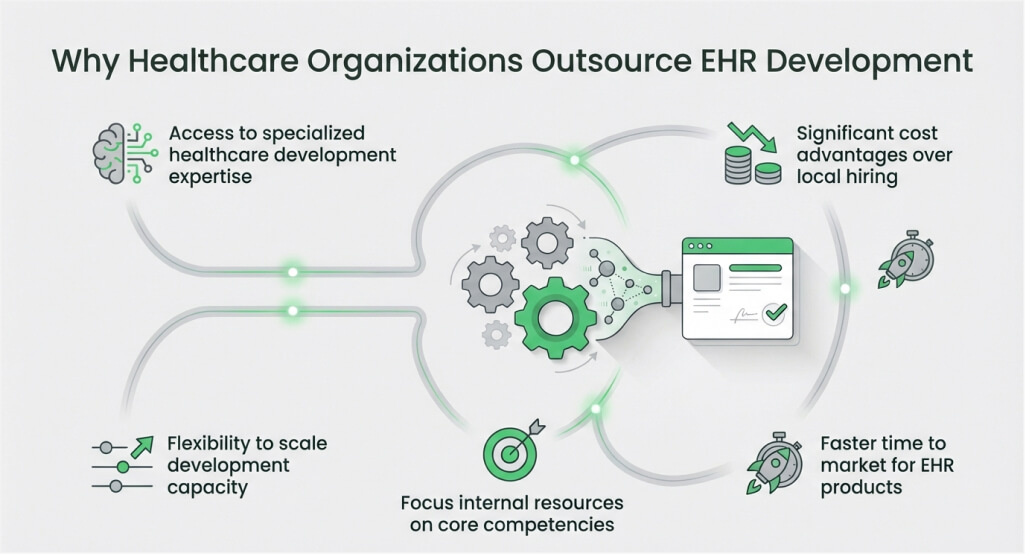
Why Healthcare Organizations Outsource EHR Development: 5 Key Benefits
Multiple factors drive healthcare organizations toward external development partnerships. Understanding these helps determine whether outsourcing is a good fit for your situation. Let us explore the primary reasons companies prefer to hire EHR developers from offshore locations.
1. Access to specialized healthcare development expertise
EHR development requires knowledge that extends beyond general software engineering. Developers need a deep understanding of clinical workflows and healthcare data standards. Expertise in HL7, FHIR, and other interoperability protocols remains essential. Finding developers with this specialized background proves challenging locally.
Established outsourcing partners have assembled teams with proven healthcare experience to build an EHR software solution efficiently. Their developers have worked on multiple EHR projects across various specialties. This accumulated knowledge translates into faster development and fewer costly mistakes. You gain expertise that would take years to build internally.
Healthcare software development also requires knowledge of compliance. HIPAA regulations govern how protected health information must be handled. Offshore EHR development teams familiar with these requirements reduce compliance risks. Their experience prevents security gaps that could lead to violations.
2. Significant cost advantages over local hiring
Development costs vary dramatically based on geographic location. North American EHR developers command hourly rates between $150 and $250. Eastern European teams typically charge $50 to $100 per hour. South Asian developers charge rates between $25 and $60 per hour.
These differences translate into substantial savings over the life of a project. A $500,000 project at North American rates might cost $150,000 to $250,000 offshore. Organizations can reinvest savings into additional features or faster timelines. Budget constraints become less limiting when development costs decrease significantly.
Cost benefits extend beyond hourly rate comparisons alone. Outsourcing eliminates recruitment expenses, benefits costs, and overhead associated with employees. You avoid the costs of office space, equipment, and management infrastructure. The total financial advantage often exceeds initial rate difference calculations.
3. Faster time to market for EHR products
Internal hiring cycles frequently delay project starts by months. Finding qualified EHR developers takes considerable time in competitive markets. Training new hires on your systems and processes further extends timelines. These delays cost opportunities and competitive positioning.
Outsourcing partners can typically begin work within weeks of engagement. Their teams come ready with healthcare development experience and established processes. Ramp-up time decreases significantly compared to building internal capabilities. Products reach the market faster when development starts sooner.
Larger outsourcing providers can also assign more developers than you could hire locally. Parallel workstreams accelerate the completion of complex features. More hands on deck means faster progress toward launch milestones. Speed advantages compound when you need to scale quickly.
4. Flexibility to scale development capacity
Healthcare software projects rarely maintain constant resource needs throughout their lifecycle. Initial development phases may require large teams for intensive building periods. Maintenance phases need fewer developers focused on enhancements and support. Internal teams struggle to keep up with this variable demand pattern.
Outsourcing provides flexibility to adjust team size as needs change. Adding developers during intensive phases happens without lengthy hiring processes. Reducing team size between major releases avoids carrying unnecessary costs. This elasticity optimizes development spending across project phases.
Dedicated team models offer stability while maintaining flexibility. Your core team remains consistent throughout the engagement. Additional specialists join for specific phases requiring their expertise. This hybrid approach balances continuity with adaptability.
5. Focus internal resources on core competencies
Healthcare organizations excel at delivering patient care and managing clinical operations. Software development may not represent their primary organizational strength, particularly when it comes to EHR development for dental health providers. Focusing on building development capabilities dilutes focus on core missions.
Outsourcing allows internal staff to concentrate on strategic priorities. Clinical leaders focus on workflow optimization rather than technical implementation. Business stakeholders guide product direction without managing developers directly. Technical oversight remains necessary but requires fewer internal resources.
This division of labor leverages each party’s strengths most effectively. Your organization provides healthcare domain expertise and strategic direction. Development partners contribute technical skills and implementation experience. The combination produces better outcomes than either could achieve on its own.
Looking to Scale Your EHR Development Capacity?
Work with experienced healthcare developers who understand compliance requirements and clinical workflows. Build software that meets your specifications while staying within budget.

Benefits of Outsourcing EHR Development
Organizations that outsource EHR development gain advantages beyond simple cost reduction. These benefits compound over time, delivering significant strategic value. Understanding them helps build stronger business cases for outsourcing decisions.
1. Reduced development costs without sacrificing quality
Cost savings are the most immediate benefit of offshore EHR development. Geographic rate differences enable substantial reductions in development spending. However, lower costs need not mean lower quality work.
Reputable outsourcing partners maintain rigorous quality standards regardless of their location. Many have achieved industry certifications demonstrating their development practices. Code review processes, automated testing, and quality assurance procedures ensure deliverable standards. You receive professional work at rates below local market prices.
Long-term cost benefits extend beyond initial development phases. Outsourcing eliminates ongoing employment costs, such as benefits and paid time off. You avoid technology investment in development tools and infrastructure. Total cost of ownership decreases across the entire product lifecycle.
2. Access to a global talent pool
Local talent markets constrain hiring options for specialized roles. Healthcare developers with EHR experience remain particularly scarce. Geographic limitations restrict access to qualified candidates.
Outsourcing removes these geographic constraints entirely. Your talent pool expands to include developers worldwide. Countries with strong technical education systems produce skilled professionals seeking opportunities. This expanded access increases your chances of finding ideal team members.
Diverse teams also bring varied perspectives to development challenges. Developers from different backgrounds approach problems through different lenses. This diversity often produces more creative and robust solutions. Global teams combine various strengths into unified development efforts.
3. Accelerated development timelines
Speed matters in competitive healthcare technology markets. Being first to market with innovative features provides significant advantages. Delays allow competitors to capture opportunities you might have owned.
Outsourcing accelerates timelines by eliminating recruitment delays. Development begins weeks after engagement rather than months after posting job listings. Teams arrive ready to contribute productively from day one. Projects progress immediately rather than waiting for capacity to build.
Time zone distribution can further accelerate development progress. Teams in different regions provide extended daily coverage. Morning handoffs enable continuous progress on critical tasks. This follows the sun mode, which maximizes productive development hours.
4. Risk mitigation through shared responsibility
Software development projects carry inherent risks of delays and cost overruns. Internal teams bear these risks entirely within the organization. Budget variances and timeline slips impact only your company.
Fixed price outsourcing engagements transfer some risk to development partners. Vendors commit to delivering within the defined scope and within agreed budgets. Cost overruns become their responsibility, not yours. This risk sharing protects your organization from unexpected expenses.
Reputable partners also bring risk management expertise to engagements. Their experience across multiple projects reveals common pitfall patterns. Proactive mitigation prevents problems before they impact your project. You benefit from lessons learned across their entire client portfolio.
5. Enhanced focus on strategic initiatives
Development management consumes significant leadership attention and energy. Technical decisions, personnel issues, and day-to-day oversight demand ongoing focus. This attention diverts leaders from higher-value strategic activities.
Outsourcing reduces internal management burden substantially. Partners handle developer supervision, performance management, and technical mentorship. Your team provides direction and reviews deliverables, but does not manage individuals. Leadership time redirects toward business priorities and growth initiatives.
Strategic focus improvements often produce benefits exceeding direct cost savings. Better market positioning results from leaders concentrating on competitive strategy. Product direction improves when stakeholders focus on user needs rather than technical details. The organization becomes more effective at its primary mission.
6. Continuous improvement through external perspectives
Internal teams sometimes develop blind spots regarding their own code and processes. Familiar approaches become default choices without critical examination. Innovation stagnates when the same people keep working on problems.
External developers bring fresh perspectives to existing systems. They question assumptions that internal teams accept without challenge. Alternative approaches surface when outsiders examine established patterns. This external viewpoint often reveals opportunities for improvement.
Partners working across multiple clients also transfer best practices. Techniques that worked well on other projects benefit your implementation. Industry trends reach your team through developers with broader exposure. Continuous learning happens naturally through these external connections.
Ready to Experience the Benefits of EHR Development Outsourcing?
Our healthcare development teams have delivered compliant, scalable EHR solutions for organizations worldwide.
Key Factors to Consider When Outsourcing EHR Development
Successful outsourcing requires careful evaluation of potential partners and engagement structures. Multiple factors influence whether partnerships deliver expected value. Consider these elements when planning your outsourcing strategy.
1. Healthcare domain expertise and experience
General software development skills alone prove insufficient for EHR projects. Partners need demonstrated experience building healthcare applications. Look for providers with portfolios showing relevant prior work.
Evaluate the depth of healthcare knowledge during vendor assessments. Ask about specific EHR features they have implemented previously. Inquire about their understanding of clinical workflows and terminology. Assess familiarity with healthcare data standards like HL7 and FHIR.
Experience with healthcare compliance requirements matters significantly. HIPAA knowledge should be evident throughout their development practices. Security measures must align with healthcare industry expectations. Partners unfamiliar with these requirements create compliance risks.
2. Data security and HIPAA compliance capabilities
EHR systems handle sensitive protected health information requiring rigorous protection. Security failures can result in regulatory penalties and reputational damage. Partners must demonstrate robust security practices before engagement.
Evaluate security certifications and compliance attestations during selection. SOC 2 Type II certification indicates mature security practices. HITRUST certification demonstrates healthcare-specific security capabilities. These certifications provide independent validation of security claims.
Review specific security measures implemented in their development environment. Data encryption, access controls, and audit logging should be standard practices. Secure development lifecycle processes prevent vulnerabilities from reaching production. Security awareness training for all team members reduces human error risks.
3. Communication practices and cultural alignment
Effective collaboration requires clear communication despite geographic separation. Language proficiency affects daily interactions and the quality of documentation. Cultural differences can affect work styles and expectations.
Assess English proficiency during initial conversations with potential partners. Written and verbal communication should be clear and professional. Misunderstandings due to language barriers lead to costly rework and delays. Strong communication skills prevent many common outsourcing challenges.
Cultural alignment influences working relationship effectiveness. Work ethic, meeting punctuality, and feedback reception vary across cultures. Discussing expectations explicitly prevents misalignment issues. Partners who share your values collaborate more naturally.
4. Time zone compatibility and overlap
Geographic distribution affects real-time collaboration possibilities. Some organizations prefer substantial overlap in working hours for daily interaction. Others accept asynchronous communication with limited synchronous meetings.
Define your overlap requirements before evaluating vendors. Critical decision points may require real-time discussion capabilities. Routine status updates can happen asynchronously without problems. Match vendor locations to your actual collaboration needs.
Consider time zone differences as potential advantages rather than obstacles. Eastern European teams overlap well with North American business hours. Asian teams provide coverage during Western overnight periods. Strategic time zone selection enables extended development coverage.
5. Technical capabilities and technology stack alignment
Partners must work effectively with your existing technology choices. EHR projects typically involve specific programming languages and frameworks. Database platforms, cloud providers, and integration tools vary across organizations.
Verify vendor expertise with your technology stack during evaluation. Request evidence of experience with relevant languages and platforms. Assess familiarity with healthcare-specific technologies and standards. Mismatched technical capabilities create friction and quality issues.
Evaluate development practices and tooling sophistication as well. Modern approaches like continuous integration and automated testing indicate maturity. Code quality standards and review practices affect the reliability of deliverables. Partners using outdated methods may struggle to meet quality expectations.
6. Scalability and resource availability
The project needs change over time as development progresses. Partners must accommodate growth when projects expand successfully. Resource availability during critical phases prevents bottlenecks.
Inquire about total team size and typical utilization rates. Smaller vendors may struggle to allocate additional resources quickly. Larger organizations maintain bench capacity to scale up requirements. Understand their ability to add team members when needed.
Assess flexibility in engagement models as well. Projects may shift between dedicated teams and staff augmentation approaches. Partners offering multiple models adapt better to changing needs. Rigid engagement structures limit responsiveness to evolving requirements.
EHR Development Outsourcing Engagement Models
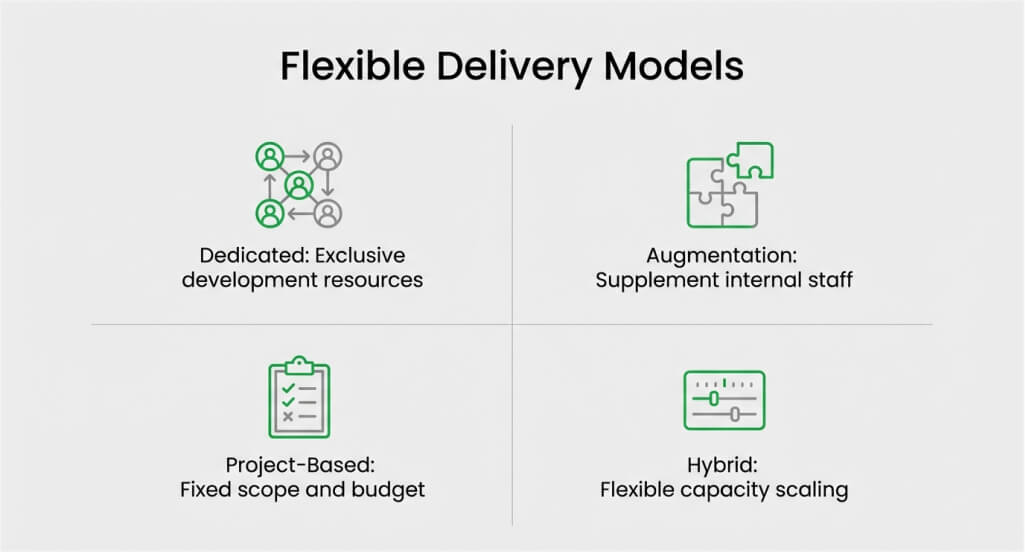
Different engagement structures suit different project situations and organizational needs. Understanding available models helps select appropriate partnership approaches. Each model offers distinct advantages for specific scenarios.
Dedicated team model
Dedicated team arrangements provide exclusive development resources for your projects. Team members work solely on your initiatives without competing priorities. You maintain consistent personnel throughout the engagement duration.
How it works:
This model assigns specific developers, testers, and other roles exclusively to your organization. The team operates as an extension of your internal staff. You direct their work priorities and manage their day-to-day activities. The outsourcing partner handles employment, facilities, and administrative matters.
Best suited for:
- Long-term development programs require ongoing capacity.
- Organizations wanting consistent team composition over extended periods.
- Projects require deep knowledge that accumulates over time.
- Situations where intellectual property protection demands controlled access.
Advantages:
- Team members develop a deep understanding of your systems and domain.
- Consistent relationships improve communication and collaboration.
- Full control over priorities and resource allocation.
- Knowledge retention within a stable team reduces ramp-up needs.
Staff augmentation model
Staff augmentation adds external developers to supplement existing internal teams. Augmented staff work alongside your employees on shared projects. This model fills specific skill gaps without building permanent capabilities.
How it works:
Individual contractors or small groups join your internal team structures to support EHR integration initiatives. They report to your managers and follow your processes. Integration into existing workflows happens quickly with proper onboarding. The outsourcing partner manages employment while you direct daily work.
Best suited for:
- Organizations with existing development teams need additional capacity.
- Projects requiring skills not currently available on the staff.
- Temporary needs during peak development periods.
- Situations where cultural integration with internal teams matters.
Advantages:
- Seamless integration with existing team structures and processes.
- Direct control over individual contributor activities.
- Flexibility to adjust capacity as project needs change.
- Retained knowledge transfers to internal team members.
Project-based outsourcing model
Project-based engagements transfer complete delivery responsibility to external partners. The vendor owns the execution of development from requirements through deployment. Fixed scope and pricing provide budget predictability.
How it works:
You define project requirements and success criteria upfront. The outsourcing partner proposes an approach, timeline, and fixed pricing. Upon agreement, they execute development according to specifications. Deliverables will be transferred to you upon completion and acceptance.
Best suited for:
- Well-defined projects with clear requirements and scope.
- Organizations without internal development management capabilities.
- Discrete initiatives are separate from ongoing product development.
- Situations requiring budget certainty and risk transfer.
Advantages:
- Predictable costs are established before development begins.
- Reduced management burden with partner handling execution.
- Risk transfer for delivery timeline and quality outcomes.
- Clear accountability for meeting defined specifications.
Hybrid engagement model
Hybrid approaches combine elements from multiple engagement models. Core teams remain dedicated while specialists join for specific phases. Project-based work supplements ongoing dedicated capacity.
How it works:
Organizations establish dedicated teams to support continuous development. Staff augmentation fills temporary gaps during intensive periods. Specific modules or components use project-based arrangements. The mix adapts to match evolving requirements over time.
Best suited for:
- Complex programs with varying resource needs across phases.
- Organizations want flexibility without sacrificing relationship continuity.
- Situations require both ongoing capacity and specialized expertise.
- Long-term partnerships spanning multiple project types.
Advantages:
- Balances stability with flexibility across engagement duration.
- Optimizes costs by matching resource models to need patterns.
- Enables specialization for specific capabilities beyond the core team.
- Adapts to changing requirements without renegotiating entire relationships.
Need Help Choosing the Right Engagement Model?
Our consultants analyze your requirements to recommend the optimal outsourcing approach for your EHR development goals.
How to Select the Right EHR Development Outsourcing Partner
Partner selection significantly impacts outsourcing success rates. Thorough evaluation prevents costly mistakes and failed relationships. Follow this structured approach to identify suitable partners.
Step 1: Define your requirements clearly
Successful vendor selection requires a clear understanding of your own needs. Ambiguous requirements lead to mismatched partner selection. Invest time documenting expectations before beginning vendor outreach.
Specify technical requirements, including technologies, platforms, and integrations. Document compliance requirements and security expectations explicitly. Describe the expected engagement model and team composition needs. Establish budget parameters and timeline constraints.
Clear requirements enable accurate vendor proposals and meaningful comparisons. Vague specifications produce proposals that are difficult to evaluate. Providing details upfront saves time during evaluation phases.
Step 2: Research potential vendors thoroughly
Initial research narrows the field to candidates worth detailed evaluation. Multiple sources provide information about potential partners. Cast a wide net before focusing on specific candidates.
Review vendor websites for healthcare development experience and case studies. Check client testimonials and third-party review platforms. Request referrals from industry contacts and professional networks. Examine portfolios for relevant examples of EHR development.
Create a shortlist of candidates who meet the basic qualification criteria. Eliminate vendors lacking required healthcare experience or certifications. Focus detailed evaluation on the remaining promising candidates.
Step 3: Evaluate technical capabilities rigorously
A technical assessment determines whether vendors can meet your requirements. Multiple evaluation methods provide a comprehensive capability. Do not rely solely on vendor claims about their skills.
Request detailed proposals addressing your specific requirements. Review proposed architectures, technology choices, and development approaches. Assess understanding of healthcare standards and compliance requirements. Look for thoughtful approaches rather than generic responses.
Consider technical interviews or coding assessments for key personnel. Evaluate problem-solving approaches and communication during technical discussions. Request code samples from relevant prior projects when possible.
Step 4: Assess healthcare domain knowledge
Healthcare expertise distinguishes capable EHR partners from general software developers. Domain knowledge impacts design decisions and implementation quality. Evaluate healthcare understanding through multiple assessment methods.
Ask detailed questions about clinical workflows and healthcare data models. Discuss interoperability standards like HL7, FHIR, and CCD. Inquire about experience with healthcare compliance requirements. Assess familiarity with terminology and concepts relevant to your specialty.
Prior EHR project experience indicates accumulated domain knowledge. Review case studies for depth of healthcare involvement. Request references from healthcare clients for detailed feedback.
Step 5: Verify security and compliance practices
Security failures pose serious risks that require careful evaluation. Independent verification provides more confidence than vendor assertions. Multiple evaluation methods build a comprehensive understanding of security.
Request security certifications and audit reports from potential partners. Review SOC 2 reports, HITRUST certifications, or equivalent attestations. Examine security policies and procedures documentation. Assess employee training and background check practices.
Discuss specific security measures relevant to your requirements. Encryption approaches, access controls, and monitoring capabilities matter. Incident response plans and breach notification procedures warrant review. Security must be demonstrably embedded in their development practices.
Step 6: Evaluate communication and collaboration
The effectiveness of a working relationship depends heavily on communication skills. Assess these factors through direct interaction during evaluation. Observation reveals more than vendor claims about communication skills.
Conduct video calls with proposed team members to assess language proficiency. Evaluate responsiveness during the evaluation process itself. Notice professionalism, preparation, and attention to detail in interactions. These behaviors predict future collaboration experiences.
Discuss communication protocols and tools they recommend. Regular meeting cadences, status reporting formats, and escalation paths matter. Ensure alignment between your expectations and their standard practices.
Step 7: Check references from healthcare clients
Reference checks provide crucial insights beyond sales presentations. Prior clients reveal actual working experiences with potential partners. Healthcare-specific references carry more relevance than general software references.
Request multiple reference contacts from healthcare industry clients. Prepare specific questions about collaboration experiences and challenges. Ask about quality, reliability, communication, and responsiveness. Inquire whether references would engage the vendor again.
Follow up on any concerns raised during reference conversations. Patterns across multiple references indicate systemic strengths or weaknesses. Weight healthcare client feedback heavily in your final evaluation.
Step 8: Negotiate clear contracts and SLAs
Strong contracts protect both parties and establish clear expectations. Ambiguous agreements create disputes and disappointment later. Invest in thorough contract development before beginning work.
Define deliverables, timelines, and acceptance criteria explicitly. Establish payment terms tied to milestone completion. Include intellectual property assignment provisions protecting your ownership. Address confidentiality and data protection requirements comprehensively.
Service level agreements specify performance expectations and remedies. Response time requirements for different issue severities warrant definition. Penalties for missed commitments provide accountability mechanisms. Clear SLAs prevent misunderstandings about expected service levels.
Common Challenges in Outsourcing EHR Development
Even well-planned outsourcing engagements encounter obstacles. To overcome these challenges, organizations often hire EHR development team with specialized expertise in proactive mitigation strategies. Understanding common problems helps avoid or minimize their impact.
Challenge 1: Communication gaps and misunderstandings
Geographic separation and cultural differences create communication challenges. Requirements may be interpreted differently from what was intended. Misaligned expectations lead to deliverables that fall short.
How to overcome this challenge:
- Establish regular video meetings rather than relying solely on written communication.
- Create detailed written specifications supplementing verbal discussions.
- Use visual aids like wireframes, diagrams, and prototypes to clarify intent.
- Implement structured review processes to catch misunderstandings early.
- Build relationships through occasional in-person meetings when practical.
Challenge 2: Quality concerns with deliverables
Quality problems arise when expectations and delivery diverge. Code quality, testing thoroughness, and attention to detail vary across providers. Receiving substandard work wastes time and damages project outcomes.
How to overcome this challenge:
- Explicitly define quality standards and acceptance criteria in contracts.
- Implement code review processes involving your technical staff.
- Require automated testing with defined coverage thresholds.
- Conduct regular quality audits throughout development phases.
- Address quality issues immediately rather than allowing patterns to continue.
Challenge 3: Data security and compliance risks
Handling protected health information offshore introduces security considerations. Different countries have varying data protection laws and enforcement. Security incidents can trigger regulatory penalties and reputational harm.
How to overcome this challenge:
- Verify partner security certifications and compliance attestations.
- Implement contractual requirements for specific security measures.
- Conduct security assessments before and during engagements.
- Use technical controls limiting data access to authorized individuals.
- Establish incident response protocols and notification requirements.
Challenge 4: Knowledge transfer difficulties
Transitioning work to or from outsourcing partners challenges knowledge continuity. Institutional knowledge may be lost when engagements end. Poor documentation complicates the understanding of delivered systems.
How to overcome this challenge:
- Require comprehensive documentation as standard deliverables.
- Include knowledge transfer periods in project plans.
- Maintain internal expertise sufficient to oversee outsourced work.
- Document decisions, rationale, and architectural choices systematically.
- Plan transition periods before engagement conclusions.
Challenge 5: Hidden costs exceeding initial estimates
Projects often cost more than the initial proposals indicated. Scope changes, unclear requirements, and unforeseen challenges drive overruns. Fixed-price projects may involve change-order expenses for modifications.
How to overcome this challenge:
- Define requirements thoroughly before requesting proposals.
- Include contingency budgets for anticipated scope evolution.
- Establish clear change management processes and pricing.
- Review invoices carefully against contractual terms.
- Maintain ongoing visibility into cost accumulation throughout projects.
Challenge 6: Vendor lock-in and dependency
Organizations sometimes become overly dependent on specific outsourcing partners. Transitioning to alternatives becomes difficult when knowledge is concentrated externally. Vendors may exploit this dependency in contract negotiations.
How to overcome this challenge:
- Maintain internal capabilities sufficient to oversee and evaluate work.
- Require documentation enabling transition to other providers.
- Avoid proprietary frameworks or vendor-controlled tools.
- Consider multi-vendor strategies for risk distribution.
- Plan exit strategies before engagements begin.
Navigate EHR Development Outsourcing with Confidence
Partner with experienced healthcare developers who understand both the opportunities and challenges of outsourced EHR development.
[Get Started Today]
Navigate EHR Development Outsourcing with Confidence
Partner with experienced healthcare developers who understand both the opportunities and challenges of outsourced EHR development.
Best Practices for Successful EHR Development Outsourcing
Following proven practices significantly improves outsourcing outcomes. These guidelines reflect accumulated wisdom from successful partnerships. Apply them consistently to maximize value from your outsourcing relationships.
1. Invest in thorough requirements definition
Clear requirements form the foundation for successful outsourced development. Ambiguous specifications create misunderstandings and misaligned deliverables. Front-end investment in requirements prevents expensive downstream corrections.
Document functional requirements with sufficient detail for development. Include user stories, acceptance criteria, and edge case handling expectations. Provide visual references, such as wireframes and mockups, when helpful. Explain the business context to help developers understand the underlying intent.
Review requirements documents with outsourcing partners before development begins. Clarify questions and resolve ambiguities before coding starts. Mutual understanding prevents costly rework from divergent interpretations.
2. Establish strong project governance structures
Effective governance ensures projects stay on track and issues surface quickly. Defined roles, responsibilities, and escalation paths prevent confusion. Regular cadences maintain visibility and alignment throughout engagements.
Designate specific individuals responsible for key partnership functions. Product ownership, technical oversight, and relationship management need clear owners. Both organizations should understand who makes which decisions.
Implement regular meeting rhythms appropriate to project intensity. Daily standups work well during active development phases. Weekly status reviews provide management visibility into progress. Monthly steering meetings address strategic issues and relationship health.
3. Maintain appropriate internal oversight capabilities
Outsourcing execution does not mean abandoning technical involvement entirely. Internal expertise remains essential for evaluating deliverables and guiding direction. Complete abdication of technical oversight creates quality and dependency risks.
Retain technical staff capable of reviewing code and architecture decisions. Their involvement catches problems early and ensures quality standards. Technical engagement also builds internal understanding of delivered systems.
Balance oversight with trust to avoid micromanaging partners. Define review checkpoints without controlling every development decision. Partners need autonomy to execute effectively within agreed parameters.
4. Prioritize communication quality and frequency
Communication quality correlates strongly with outsourcing success. Regular interaction prevents small issues from becoming large problems. Investment in communication infrastructure pays dividends throughout engagements.
Use video conferencing for meetings requiring nuanced discussion. Visual cues improve understanding beyond audio or text alone. Face-to-face interaction builds relationships despite geographic separation.
Establish multiple communication channels for different purposes. Instant messaging handles quick questions and informal coordination. Emails documents and decisions, and provides asynchronous updates. Project management tools systematically track tasks and deliverables.
5. Build relationships beyond transactional interactions
Strong relationships improve collaboration quality and longevity. Viewing partners as long-term allies rather than interchangeable vendors produces better outcomes. Relationship investment yields returns through improved commitment and understanding.
Learn about partner team members as individuals beyond their roles. Understanding their professional goals and challenges builds mutual respect. Celebrating successes together strengthens partnership bonds.
Visit partner locations when practical to deepen relationships. In-person time accelerates relationship building significantly. Understanding their working environment improves empathy and collaboration.
6. Implement continuous quality monitoring
Quality problems compound when left unaddressed over time. Early detection prevents small issues from becoming systemic problems. Systematic monitoring reveals quality trends requiring intervention.
Conduct regular code reviews involving internal technical resources. Review coverage should match the risk levels of different system components. Critical functionality warrants more intensive review attention.
Consistently track quality metrics throughout the engagement. Defect rates, rework frequency, and test coverage provide objective measures. Trend analysis reveals patterns of improvement or deterioration.
7. Plan for knowledge continuity from the start
Engagement conclusions arrive sooner than anticipated in many projects. Knowledge trapped with external teams creates risk and dependency. Proactive knowledge management enables smooth transitions when needed.
Require documentation as standard deliverables rather than afterthoughts. Architecture decisions, design rationale, and implementation details need to be recorded. Documentation should enable someone unfamiliar with the code to understand it.
Include knowledge transfer activities throughout the engagement. Internal staff should gain understanding progressively rather than all at once. Regular sessions prevent knowledge accumulation solely with external teams.
Cost Considerations for Outsourcing EHR Development
Understanding cost structures helps organizations budget accurately and evaluate proposals effectively. Multiple factors influence the total investment required. Consider these elements when planning your outsourcing budget.
Hourly rate comparisons by region
Development rates vary significantly based on geographic location. Understanding these differences enables informed sourcing decisions.
| Region | Hourly Rate Range |
|---|---|
| Region | Hourly Rate Range |
| North America | $150 – $250/hour |
| Western Europe | $100 – $180/hour |
| Eastern Europe | $50 – $100/hour |
| South Asia | $25 – $60/hour |
| Latin America | $40 – $80/hour |
Factors affecting total project costs
Beyond hourly rates, multiple variables influence overall project investment.
- Project complexity: More complex EHR features require additional development time. Clinical decision support, interoperability, and analytics substantially expand the scope. Simpler systems cost less than sophisticated, comprehensive platforms.
- Compliance requirements: HIPAA compliance adds development overhead throughout the project. Security testing, documentation, and audit preparation consume additional effort. Organizations with strict compliance needs should budget accordingly.
- Integration scope: Each external system integration adds significant effort. Legacy systems without modern APIs require custom connectivity development. Plan an additional budget for each required integration point.
- Team composition: Senior developers command higher rates but deliver faster with fewer defects. Junior developers cost less but may require more oversight and produce more rework. Optimal team composition balances cost and capability.
Hidden costs to anticipate
Budget for expenses beyond direct development charges.
- Communication and coordination: Meeting time, travel expenses, and collaboration tools add overhead. Plan for coordination costs scaling with project complexity and team distribution.
- Knowledge transfer: Transitioning work into or out of outsourcing engagements requires investment. Documentation development, training sessions, and overlap periods consume resources.
- Quality assurance: Testing, code reviews, and defect correction add costs beyond initial development. Quality activities typically consume 15% to 25% of total project budgets.
- Change management: Requirements evolving during development trigger change orders. Budget contingency of 15% to 20% for anticipated scope adjustments.
Partner with Space-O Technologies for Your EHR Development Needs
Space-O Technologies is a healthcare software development company that enables healthcare organizations to build secure, scalable, and high-performance electronic health record solutions without the complexity of long hiring cycles. With 15+ years of healthcare software development experience, our teams understand clinical workflows, regulatory compliance, and interoperability standards that are critical to successful EHR systems.
We offer flexible engagement models to match diverse organizational needs. Dedicated teams support long-term development initiatives, staff augmentation strengthens existing technical teams, and project-based models deliver a clearly defined scope, predictable budgets, and timelines.
Security and compliance are embedded across our development lifecycle. HIPAA-driven processes guide design, development, deployment, and maintenance, while rigorous quality assurance ensures every solution meets enterprise-grade quality standards and operational requirements.
Connect with our healthcare technology consultants to discuss your EHR development needs. We provide strategic assessments, transparent cost structures, and customized engagement models to help transform your EHR vision into a robust, future-ready healthcare technology platform.
Frequently Asked Questions on Outsourcing EHR Development
1. What does it mean to outsource EHR development?
Outsourcing EHR development means partnering with external companies to build or enhance electronic health record systems. Organizations retain product ownership while external teams handle technical implementation. Engagement models include dedicated teams, staff augmentation, and project-based arrangements. Partners provide specialized healthcare development expertise without the overhead of permanent employment.
2. Why do healthcare organizations outsource EHR development?
Healthcare organizations outsource to access specialized talent unavailable locally at competitive costs. Outsourcing accelerates timelines by eliminating lengthy hiring cycles. It provides flexibility to scale teams based on changing project needs. Organizations also outsource to free up internal resources for core healthcare delivery competencies.
3. How much does outsourcing EHR development cost?
Costs vary based on location, project complexity, and engagement model. Hourly rates range from $25 to $250 depending on geographic region. North American developers charge $150 to $250 per hour, while South Asian teams charge $25 to $60 per hour. Total project costs depend on scope, features, compliance requirements, and integration needs.
4. What should I look for in an EHR development outsourcing partner?
Evaluate healthcare domain expertise, security certifications, and relevant prior experience. Assess communication capabilities and cultural alignment with your organization. Verify compliance practices, including HIPAA knowledge and security measures. Check references from healthcare industry clients for authentic feedback.
5. What are the risks of outsourcing EHR development?
Primary risks include communication challenges, quality issues, and data security concerns. Hidden costs may exceed initial estimates without careful contract definition. Knowledge dependency on external teams creates transition risks. Vendor lock-in can develop when work focuses on a single provider.
6. How do I ensure data security when outsourcing EHR development?
Verify partner security certifications, such as SOC 2 or HITRUST, before engagement. Implement contractual requirements for specific security measures and practices. Use technical controls limiting access to sensitive data. Conduct security assessments throughout the engagement duration. Establish incident response protocols and notification requirements in the contract.
7. What engagement models are available for EHR development outsourcing?
Common models include dedicated teams, staff augmentation, and project-based outsourcing. Dedicated teams provide exclusive resources working solely on your projects. Staff augmentation adds individual developers to your existing teams. Project-based engagements deliver a defined scope, fixed pricing, and timelines.
8. How do I manage communication with offshore EHR development teams?
Establish regular video meetings for synchronous interaction and relationship building. Use multiple communication channels suited to different purposes. Define response time expectations and escalation paths clearly. Ensure adequate working-hour overlap for real-time collaboration.
9. What compliance considerations apply to outsourced EHR development?
HIPAA requirements govern the handling of protected health information throughout the development process. Business associate agreements must be in place with partners accessing PHI. Security controls must meet healthcare industry standards and regulatory requirements. Partners should demonstrate knowledge of compliance requirements and appropriate certifications.



 All our projects are secured by NDA




 4.8
4.8