
 By
By 
Contents
Want to validate your web project idea without burning through your budget? MVP web development is the smartest way to do it. Instead of investing months and thousands of dollars into a full-scale website, a minimum viable product (MVP) website lets you launch a functional version with only the essential features your users need. This approach gives you real user feedback early so you can refine your product, reduce risk, and make data-driven decisions before committing to full-scale development.
The concept is simple but powerful. You build an MVP website with core functionalities, put it in front of real users, and learn what works and what does not. According to IntelMarketResearch, the global Minimum Viable Product (MVP) development market was valued at USD 288 million in 2024. It is expected to increase to USD 541 million by 2031. This growth reflects a compound annual growth rate (CAGR) of 9.5% over the forecast period.
This growing adoption is not surprising. According to a GoodFirms report, 74.1% of businesses are planning to launch an MVP in the future. MVP web development directly addresses this problem by letting you test assumptions with minimal investment and validate demand before scaling.
In this guide, we cover everything you need to know about MVP website development, from what an MVP website is and how to build one, to the right tech stack, cost breakdown, feature prioritization frameworks, and common mistakes to avoid. Whether you are a startup founder or an enterprise looking to test a new digital product, this guide will help you build an MVP website that delivers results.
What is MVP in Web Development?
An MVP website is the simplest functional version of a website that includes only the core features needed to solve a specific user problem. Unlike a fully developed website with extensive functionality, an MVP in web development focuses on delivering the minimum set of features required to test a business idea with real users.
The primary objective of building a minimum viable product website is threefold: validate your business concept, gather actionable user feedback, and test actual market demand, all without committing significant time or financial resources. The insights collected from early users act as a strategic roadmap, guiding future development priorities and ensuring the final product aligns with what your target audience actually needs.
Think of an MVP web app as the foundation of a building. It needs to be structurally sound and functional, but it does not need the interior decoration, landscaping, or luxury finishes yet. To build it right from the start, many businesses choose to hire MVP software developers who can deliver a solid core product. Additional enhancements come later, guided by real user feedback, making this iterative approach key to successful digital products.
Successful examples of MVP in web development
Here are successful examples of MVP websites that validated their business ideas and turned out to be major platforms:
Fyule Video Lab
Fyule Video Lab is an EdTech platform for art-integrated video learning. Founded by IIM alumni, it launched as an MVP in 2021. Space-O built it using Flutter, Laravel, and MySQL. The MVP focused on video modules, project submissions, and contests.
The platform now serves over 100,000 students across 150+ schools. Its library includes 1,500+ academic projects today. The validated MVP helped founders raise $1.4 million in funding. Backers included senior leaders from Google, Deloitte, and Tata 1mg.
FIYA
FIYA is a cross-platform fitness app built for the UAE market. Space-O developed it using Laravel, Kotlin, and Swift. The MVP focused on workout programs, HD video, and tracking. It also included bilingual support for English and Arabic.
Launching with a focused MVP validated demand in the Middle East. Real user data guided all future feature expansion decisions. The team planned AI recommendations based on actual usage patterns. This MVP-first approach saved significant development cost and time.
Airbnb
Back in 2007, Airbnb started with an MVP website rather than opting for a traditional way of creating a full-fledged website. They created a simple MVP website addressing one issue with a few features. The validation of the idea led them to build a billion-dollar app – Airbnb.
X (Formerly known as Twitter)
Twitter started as an internal messaging platform for employees at Odeo. They first introduced their MVP website to the public at SXSW, and it quickly took off. Their MVP website focused on basic features like posting and reading updates. The simplicity of their concept was well-received by the users. Today, Twitter (now X) is one of the active social media platforms globally.
With a clear understanding of what a Minimum Viable Product (MVP) is, it’s important to consider its pros and cons. Evaluating these factors will help you make informed decisions that align with your business goals as you start developing your MVP.
What are the Advantages and Disadvantages of MVP Web Development?
Minimum Viable Product (MVP) in web development has its advantages and disadvantages. Having a better understanding of both aspects helps businesses to make informed decisions.
Advantages of MVP Web Development
Here are the key benefits of MVP web development that become a game changes for both startups and established business setups.
Cost-effective
An MVP website consists of just the essential features, which reduces the MVP development costs. Furthermore, it mitigates the risk involved in launching a fully developed website without market testing and research.
Quick user feedback
With an MVP website, you get real-time feedback from your early customers. This feedback provides you with a detailed insight into user behavior. After getting quick feedback, you can make necessary adjustments before scaling up.
Less risk
MVP websites provide an opportunity to test the product in the real market environment before making a substantial investment. The risk and costs involved in making changes at this phase of development are quite low. So businesses can pivot early without major financial losses.
Time-saving
MVP website focuses only on essential features, which quickens its development process. This allows businesses to avoid unnecessary delays, stay ahead of competitors, and improve based on insights.
Faster time-to-market
An MVP is designed to enter the market as soon as possible. It ditches the lengthy development route that goes on for months or years. With this, businesses can gain early customers, build brand recognition, and attract potential investors.
Builds customer base
An MVP acts as an initial step for early customer acquisition. It provides users with functional products that meet their basic requirements. With MVP, businesses can engage with their audiences and create a community of loyal early customers.
Disadvantages of MVP Web Development
While MVP web development offers several benefits, it also comes with a few challenges and limitations that businesses should consider before implementation.
Limited features
An MVP lacks a handful of features included in a fully-developed website. Due to this, the users might perceive that the MVP is incomplete and not feel satisfied. This can be potentially harmful to your brand’s reputation.
Resistance from investors or stakeholders
Individuals or businesses accustomed to traditional web development methodologies might resist MVP development. It can be quite challenging to convince an investor or stakeholder to accept a “work-in-progress” product.
Short term focus
MVP’s focus on the user’s immediate needs is beneficial, but it might result in overlooking long-term strategic goals. This avoidance could result in missed opportunities for growth and innovation.
Ready to Build a High-Impact MVP Website?
Get your MVP web development done right. Our experts will help you launch a fast, scalable, and market-ready MVP website that drives real results.

After knowing the pros and cons of MVP web development, it’s clear that this approach offers both advantages and challenges. Now, let’s have a look at the essential steps to create an effective MVP website.
What are the Essential Steps to Create an MVP Website?
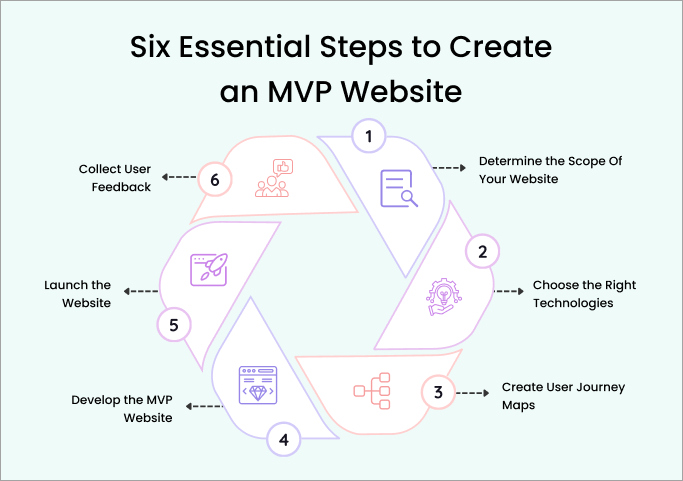
MVP website creation comprises several steps to ensure idea validation is performed at minimum costs and development time. Here are the 6 essential steps to create a successful MVP website:
Step 1: Determine the scope of your website
Initiate the process by clearly stating the issues you wish to solve with your MVP.
Questions to consider
- What specific problem are you addressing for your users?
- What essential functionalities do users need to solve this problem?
- How can you deliver these features effectively within a limited scope?
Your MVP website can be a simple landing page or a functional prototype as per your pre-decided goals. For example, Dropbox’s MVP used an explainer video to validate demand, while Airbnb’s early version tested bookings with a small market. Make sure that the website showcases your brand and provides an enhanced user experience.
Step 2: Choose the right technologies
Choose the most suitable tech stack for building your MVP website.
Questions to consider
- What programming languages and web frameworks are best suited for your project?
- Are there any existing tools or platforms that can expedite development?
- How will you ensure scalability and flexibility for future updates?
With the right technology, you will be able to implement essential features quickly without any hassle.
Step 3: Create user journey maps
Map out the user journey from start to finish.
Questions to consider
- What are the key touchpoints users will encounter on your site?
- How do users navigate through these touchpoints?
- What emotions or challenges might users experience at each stage of their journey?
Understanding the user journey enables you to design a seamless navigation experience and ensures that essential features align with user expectations.
Step 4: Develop the MVP website
With the scope defined and technologies chosen, it’s time to build your MVP.
Questions to consider
- Which core functionalities should be prioritized during development?
- How can you maintain a clean and user-friendly design while implementing these features?
- Are there opportunities for iterative development based on early feedback?
Focus on implementing the core functionalities identified in earlier steps while maintaining a clean and user-friendly design.
Step 5: Launch the website
Once development is complete, launch your MVP website to the public.
Questions to consider
- Is your website engaging and easy to use?
- Have you tested all essential functionalities before launch?
- How will you communicate the value of your MVP to potential users?
Remember that an MVP is not synonymous with low quality; it should still meet user needs effectively.
Step 6: Collect user feedback
After launching, actively collect user feedback through surveys, analytics tools, and direct interactions.
Questions to consider
- What specific feedback are you looking for from users?
- How will you analyze this feedback to identify areas for improvement?
- What metrics will indicate whether your MVP is meeting its goals?
With valuable user feedback, you will get a clear understanding of the way users interact with your website. Additionally, you will be able to find areas where improvements are needed for a fully-developed website.
Pro Tip:
Partnering with an experienced MVP development company like Space-O Technologies helps build MVP websites effectively and within budget. It also saves the hassle of self-developing a website.
Now that we’ve covered the essential steps to creating an MVP website let’s explore the must-have qualities that will ensure your MVP effectively meets user needs and drives success.
How to Prioritize Features for Your MVP Website
One of the most common reasons MVP projects fail is feature creep, the tendency to keep adding features until the product is no longer minimal or viable within the original timeline and budget. A structured approach to feature prioritization prevents this and keeps your MVP focused on what truly matters.
The MoSCoW method is one of the most effective frameworks for deciding which features belong in your MVP and which should wait. It categorizes every potential feature into four groups:
| Category | Description | Example (eCommerce MVP) |
|---|---|---|
| Must-Have | Features essential for the MVP to function. Without these, the product has no value. | Product listing, shopping cart, basic checkout, and user registration |
| Should-Have | Important features that add significant value but are not critical for launch. | Product search with filters, order tracking, and email notifications |
| Could-Have | Desirable features that improve UX but can wait for future iterations. | Wishlist, product reviews, social sharing, and loyalty program |
| Will Not Have | Features intentionally excluded from the MVP to maintain focus and speed. | AI-powered recommendations, multi-vendor marketplace, and AR try-on |
Start by listing every feature your team and stakeholders envision for the final product. Then, collaborate with your development team to categorize each feature using MoSCoW. Your MVP should include only the Must-Have features, with Should-Have features planned for the first post-launch iteration. This keeps development lean and ensures you launch with a focused product that addresses the core user problem.
Recommended Tech Stack for MVP Web Development
Choosing the right technology stack for your MVP website depends on several factors: the complexity of your product, your team’s expertise, the speed of development required, and how you plan to scale after launch. Below are the most effective tech stack combinations for different types of MVP websites.
For content-driven MVP websites
If your MVP is primarily a content-based website such as a blog, directory, marketplace listing, or informational platform, a lightweight stack works best. WordPress with a custom theme or Webflow for no-code development can deliver professional results in 2 to 4 weeks. These platforms provide built-in SEO capabilities, responsive design, and plugin ecosystems that cover most common functionality needs.
For interactive MVP web applications
When your MVP requires dynamic user interactions, real-time data updates, or complex business logic, a modern JavaScript-based stack is the most efficient choice. A React.js or Next.js frontend paired with a Node.js and Express backend provides fast development cycles, excellent scalability, and a large developer ecosystem. For the database layer, MongoDB is ideal for MVPs that need flexible data structures, while PostgreSQL suits MVPs requiring strong relational data integrity.
For enterprise-grade MVP websites
If your MVP needs structured backend operations like role-based access control, complex API integrations, payment processing, or multi-tenant architecture, a PHP-based stack with Laravel on the backend offers rapid development with built-in security features. Pair this with a Vue.js or React frontend for a responsive user interface. Laravel’s Eloquent ORM, built-in authentication, and queue management make it particularly effective for MVPs that need to handle transactional workflows.
| MVP Type | Frontend | Backend | Database |
|---|---|---|---|
| Content-driven | WordPress / Webflow | PHP (built-in) / Webflow hosting | MySQL / built-in CMS |
| Interactive web app | React.js / Next.js | Node.js + Express | MongoDB / PostgreSQL |
| Enterprise-grade | Vue.js / React | Laravel (PHP) | PostgreSQL / MySQL |
| Rapid prototype/landing page | Webflow / Bubble / Framer | No-code backend / Firebase | Airtable / Firebase |
Regardless of which stack you choose, ensure it supports the scalability path you envision for the full product. An MVP built on a technology that cannot scale will require a complete rewrite later, which defeats the purpose of the iterative approach.
What are the Must-Have Qualities for Your MVP Website?
While developing an MVP website, you must pay attention to essential features that offer a seamless user experience. Here are the 5 essential elements that define a successful MVP website:
Quality content
Your MVP website must have content that is clear, relevant, and also trustworthy. Collaborate with content creators and markets to ensure your content is aligned with your brand’s voice. It will act as an effective way to effortlessly communicate your message to users.
User-friendly design
Design is one of the most important aspects of any website. Make sure your MVP website is mobile-friendly and works on different devices. A responsive website offers a positive experience to users regardless of screen size, which is essential for retaining visitors and encouraging engagement.
Lead generation mechanism
Lead generation integration is important for attracting users and validating market demand. Add contact forms and surveys enabling users to showcase their interest in your services. With a considerable lead collection, you can build a robust database that helps you in future marketing efforts.
Analytics integration
Integrate tools like Google Analytics into your MVP website to track your potential user behavior. Getting these valuable insights will help you understand the way users interact with your website. This information helps in making informed decisions regarding improvements needed in the full-fledged website.
User authentication
Implement a basic user authentication system, in case your MVP requires user accounts or personalized experiences. To build a loyal customer base, you must offer data security to your users while they are creating accounts on your website.
After having a clear understanding of the must-have qualities for your MVP website, it’s crucial to implement key practices that enhance its effectiveness.
6 Key Practices to Follow for Effective MVP Web Development
To build a functional Minimum Viable Product (MVP) website, you need to opt for a strategic and user-driven approach. This approach will help you validate ideas, lessen the risk involved, and optimize resources.
By following these 6 key practices, businesses can ensure that their MVP is functional, scalable, and aligned with market needs.
Define business goals
Businesses must start by defining their prime objectives and success metrics. The lack of a well-defined purpose leads the MVP to become unfocused, resulting in wasted resources. Foremost, you must identify the core issue the website will solve and ensure that the proposed solution is in alignment with market demands.
Prioritize essential features
An MVP must comprise the most important functionalities that offer immediate value to the users. Rather than developing a complex product, you must focus on launching a lean and functional version, allowing users to test its core features.
If you are confused as to which feature to prioritize, you can use the MoSCoW method (Must-have, Should-have, Could-have, Won’t-have). Additionally, you can analyze your competitor’s strategy to know user’s preferences.
Build a proof of concept (PoC)
Before diving into full-scale development, you should opt for a Proof of Concept (PoC) that can validate whether the idea is feasible. A POC is a small-scale business model showcasing whether the product’s fundamental concept works. With this POC, you can identify the technical challenges and technology stacks and improve the product before full development.
Pick agile development methods
Pick agile methodology to iterate quickly, get feedback, and continue improving the product. Contrasting to traditional development models that take months or a year to launch, agile’s prime focus is on short development cycles. These short development cycles help businesses to develop the functional parts of the MVP quickly.
By using Agile methods like Scrum or Kanban, MVP teams can work in short, manageable sprints, release incremental updates, and refine the product based on real-world usage rather than assumptions.
Implement user-friendly designs
MVP offers limited features, but despite that, it should be easy to use and navigate, offering an intuitive user experience (UX). A poorly designed MVP can discourage users even before getting a chance to test the product’s functionality. To avoid such a situation, ensure mobile responsiveness to accommodate different devices.
Use data collection tools
MVP’s main purpose is to gather user feedback and make data-driven improvements. Using the right analytics tools helps track the way users interact with the website, the most used features, and the challenges faced. By collecting and analyzing user data, businesses can improve their MVP based on real user behavior rather than assumptions, ensuring a more successful full-scale product.
Looking to Build a Cost-Effective MVP Website?
Space-O Technologies offers affordable, high-quality MVP web development services for quick market entry and data-driven optimizations.
One of the best ways to incorporate these best practices is to outsource your MVP web project. You can choose from the leading MVP development companies offering tailored MVP web development services.
While following these six key practices can significantly enhance your MVP web development, it’s equally important to be aware of common pitfalls.
5 Pitfalls to Avoid in Your MVP Web Development Journey
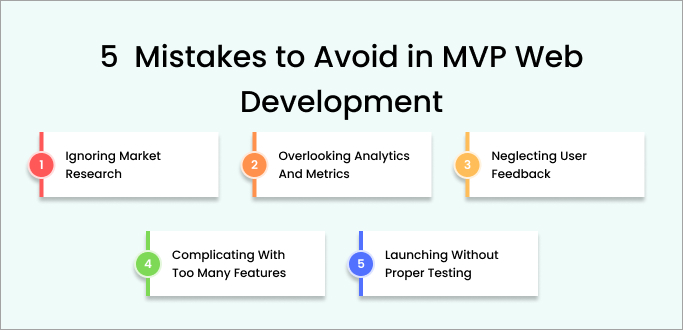
Developing an MVP website comes with its own challenges and pitfalls. Below are 5 typical mistakes to avoid as you start your MVP web development journey.
Ignoring market research
Skipping detailed market research could result in developing a product that doesn’t meet the requirements of your potential users. To avoid such situations, you must conduct thorough research to understand your target audience and their preferences. Always invest your valuable time and resources after getting important insights otherwise, you might have to face losses.
Overlooking analytics and metrics
Avoiding analytics tools leads to missing out on important insights regarding how future users will interact with your MVP. Further, if you don’t track the key performance indicators (KPIs), you will fail to make any decision regarding future developments. Consider setting up robust analytics to track users’ behavior and make changes in strategies based on the acquired information.
Neglecting user feedback
Ignoring user feedback could lead you to create a product that doesn’t meet your actual user’s needs. To create a market-fit product, you must incorporate user insights and enhance the overall user experience. Establishing channels for ongoing feedback throughout the MVP development process is extremely important.
Complicating with too many features
Adding too many unnecessary features will make your MVP website complex and slow down the development process. Always keep your MVP website simple, focusing on a specific user issue with minimal features. By including only key features, you can create a decent product that can be enhanced later.
Launching without proper testing
Launching an MVP website without proper testing results in significant issues. A website with bugs might frustrate users and affect user adoption. Additionally, fixing issues after launch might be more expensive. So, perform thorough testing to ensure that MVP’s basic functionality resonates with users. This will be the foundation for future improvements and success.
Also Read: Complete Web Application Testing Checklist
After identifying the common pitfalls in your MVP web development journey, it’s essential to clarify and understand the difference between an MVP website and a prototype. Understanding these differences will help you choose the right approach for your project.
How Much Does it Cost to Build an MVP Website?
The cost of building an MVP website varies significantly based on complexity, technology choices, and development approach. Here is a general breakdown to help you budget effectively:
| MVP Complexity | Estimated Cost Range | Typical Timeline |
|---|---|---|
| Simple (landing page, basic forms, CMS) | $3,000 – $15,000 | 2 – 4 weeks |
| Medium (user accounts, database, API integrations) | $15,000 – $50,000 | 6 – 12 weeks |
| Complex (real-time features, payment processing, dashboards) | $50,000 – $100,000+ | 3 – 6 months |
Several factors influence where your MVP falls in this range. The number of core features, the design complexity, third-party integrations (such as payment gateways, CRM systems, or analytics tools), the technology stack chosen, and the development team’s location all play a role.
Hiring an MVP development company like Space-O Technologies offers a significant cost advantage without compromising quality, often reducing total costs by 40% to 60% compared to US or Western Europe-based teams.
How to Define Success Criteria and KPIs for Your MVP Website
Launching an MVP website without clearly defined success criteria is like driving without a destination. You might move fast, but you will not know if you are heading in the right direction. Before your MVP goes live, establish the specific metrics that will determine whether your product idea is validated and worth scaling.
User acquisition metrics
Track how many new users visit your MVP, where they come from (organic search, social media, paid ads, referrals), and what percentage complete your primary conversion action (sign-up, download, purchase). A healthy MVP should show consistent growth in new user acquisition week over week, even if the absolute numbers are small at first.
Engagement metrics
Monitor how users interact with your MVP once they arrive. Key indicators include average session duration, pages per session, feature adoption rate (what percentage of users actually use your core feature), and return visit rate. High engagement signals that your core value proposition resonates with users.
Retention metrics
Acquisition without retention is meaningless. Track what percentage of users return to your MVP within 7 days, 14 days, and 30 days. For subscription-based MVPs, monitor churn rate. If users try your MVP once and never return, it indicates a problem with your core value delivery, not just your marketing.
Revenue or conversion metrics
If your MVP includes a monetization component, track conversion rate from visitor to paying customer, average revenue per user, and customer acquisition cost. Even if your MVP is free, tracking how many users complete your target action (such as filling out a contact form or requesting a demo) provides quantifiable validation data.
Qualitative feedback
Numbers alone do not tell the full story. Implement mechanisms to collect qualitative feedback through in-app surveys, user interviews, customer support interactions, and Net Promoter Score (NPS) surveys. This qualitative data explains the “why” behind your quantitative metrics and often reveals opportunities that analytics alone cannot surface.
Set specific, time-bound targets for each KPI before launch. For example: achieve 500 sign-ups within the first 30 days, maintain a 15% week-over-week growth rate, or reach a 40% day-7 retention rate. These benchmarks give you clear decision points for whether to invest further, pivot, or discontinue the project.
Difference Between an MVP Website and a Prototype
Many founders confuse an MVP website with a prototype. A prototype tests design and usability, not business viability. An MVP website is a functional product with real users. Understanding this difference prevents costly mistakes in your development journey.
Choosing the wrong approach can waste months of effort and budget. A prototype validates the look and feel before development begins. An MVP validates whether customers will actually pay for your solution. For a deeper breakdown, read our guide on MVP vs prototype vs PoC.
| Factor | MVP Website | Prototype |
|---|---|---|
| Purpose | Validates market demand and business model | Validates design concept and user experience |
| Functionality | Fully functional with core working features | Simulated interactions with no real backend |
| Target audience | Real end users and early adopters | Internal team, stakeholders, and investors |
| Timeline | 8–16 weeks of development | 1–3 weeks of design work |
| Budget | $3,000–$50,000+ depending on complexity | $500–$5,000 for clickable mockups |
| Revenue potential | Can generate real revenue from day one | No revenue generation capability |
| Goal | Prove people will pay for the solution | Prove the concept looks and feels right |
Build Cost-Effective MVP Websites With Space-O Technologies
Choosing MVP web development for your business is a strategic approach to launching your product with lesser risk. While developing your MVP website, always give importance to the core functionality, get user feedback, and make changes in your strategy based on the insights.
We at Space O Technologies specialize in MVP development for startups and mid-sized enterprises. With an experience of 14+ years, we have helped 115+ startups grow and 35+ startups secure Series A funding.
Space-O Technologies is your trusted technology partner for MVP development across industries. From healthcare and logistics to fintech MVP development, we help businesses at every stage translate ideas into market-ready products. Contact us today for a free consultation.
Frequently Asked Questions on MVP Web Development
What is the cost of building an MVP web project?
If you want to develop a basic MVP website with 15-20 pages through a development team of 2 to 5 members, then it would range from USD 10,000 to USD 50,000. However, the cost of building an MVP website depends on various factors like features, complexities involved, technology stack, and team location. You can reach out to our team at Space-O Technologies and get a customized quotation for your project.
Can we reduce the development cost of an MVP website?
Yes, it is possible to reduce the MVP website development cost by prioritizing important features, using open-source frameworks, and outsourcing to cost-effective teams. You can also opt for agile development and iterative testing to prevent unnecessary expenses and rather focus on validated user needs.
How much time does it take to develop an MVP website?
Generally, it takes around 3 to 6 months to develop an MVP website. However, the exact timeline depends on the features required and the project’s complexity. Always ensure to device your project scope to get the exact timeline for your MVP website development project.
What industries benefit the most from MVP web development?
Any industry that prospers on rapid testing and user feedback will benefit the most from MVP web development. To name a few would be tech startups, eCommerce, SaaS, fintech, healthcare, and education sector. With MVP, these industries can validate their ideas, lessen the risk involved, and improve their products before creating a full-fledged website.
What are the best tools and frameworks for MVP web development?
The best tools and frameworks for MVP web development comprise React, Angular, and Vue.js for the front end. Backend development consists of Ruby on Rails. Last but not least, Firebase, AWS, and Heroku for cloud hosting. If you wish to have quick MVP launches, you can opt for no-code tools like Webflow and Bubble.
Is an MVP website different from a full-fledged website?
Yes, MVP websites are different from full-fledged websites in terms of functionalities. The MVP websites focus only on the essential functionalities to validate their ideas and get user feedback. On the other hand, a full-fledged website consists of all the features, scalability, and refined UX/UI.



 All our projects are secured by NDA




 4.8
4.8