
 By
By 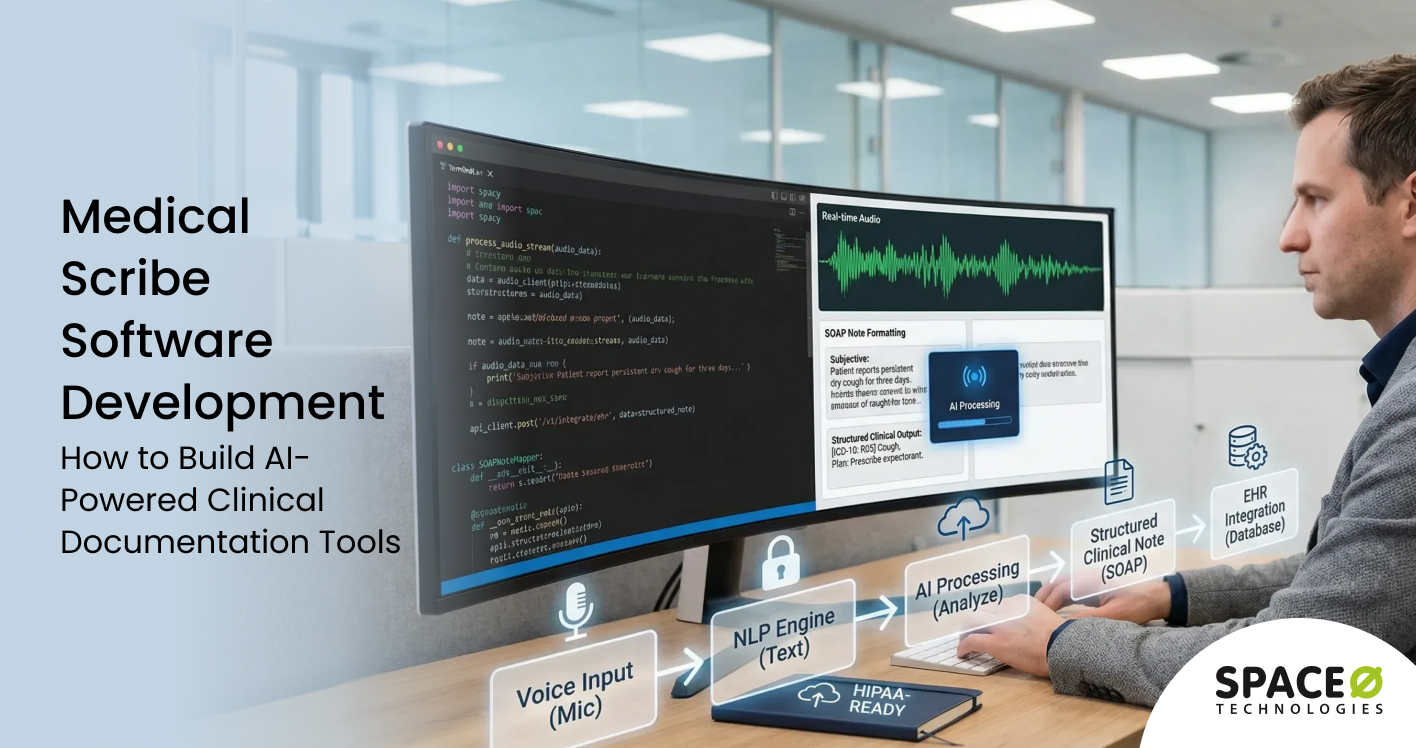
Contents
Physicians spend nearly half their workday on clinical documentation and paperwork. This growing burden fuels burnout, limits face time with patients, and raises operational costs. Most healthcare facilities still rely on manual methods that drain valuable clinical resources. The demand for smarter, automated documentation solutions has never been stronger across the industry.
Medical scribe software development addresses this challenge through AI-driven automation and intelligence. According to Grand View Research, the global AI in healthcare market was valued at $36.67 billion in 2025 and is projected to reach USD 505.59 billion by 2033. This rapid expansion signals the industry’s accelerating shift toward intelligent clinical tools.
Traditional medical scribes assist doctors by recording patient encounters in real time. Software-based alternatives replicate this function using artificial intelligence and natural language processing. These platforms capture clinical conversations and generate structured notes automatically.
To ensure the output aligns with clinical documentation standards and fits existing workflows, many providers build these tools with an EHR development company that can support seamless integration, data mapping, and compliance requirements. The right solution saves hours of charting time while boosting record accuracy across care settings.
This guide covers everything about building medical scribe software from the ground up. You will discover essential features, core technologies, and the complete development process. We also explore compliance requirements, cost factors, and proven best practices for success. Whether you manage a hospital or lead a healthtech startup, this resource helps you plan confidently.
What Is Medical Scribe Software?
Medical scribe software is an AI-powered tool that automates clinical documentation during patient encounters. It captures spoken conversations between doctors and patients in real time accurately. The platform then converts these interactions into structured medical notes and records. This technology removes the need for manual note-taking during clinical appointments entirely.
These tools rely on speech recognition, natural language processing, and machine learning algorithms. They identify medical terminology, extract clinical details, and organize information into proper formats. Generated notes follow standard documentation structures like SOAP and HPI templates automatically. Advanced systems also suggest diagnosis codes and populate relevant EHR fields without manual input.
Medical scribe platforms connect directly with electronic health record systems for seamless workflow. Clinicians review and approve generated notes before they enter the patient’s chart officially. This process preserves physician oversight while dramatically cutting documentation effort overall. The result is faster charting, fewer errors, and more time for direct patient care.
Why Healthcare Providers Need Medical Scribe Software
Clinical documentation consumes a massive portion of every provider’s workday across specialties. Facilities that adopt scribe technology see measurable gains in efficiency and staff satisfaction. These advantages span clinical, financial, and operational dimensions of care delivery. Below are the most significant reasons providers invest in this technology today.
1. Reduced physician burnout and fatigue
Doctors currently spend up to two hours on paperwork for every hour of patient care. This administrative load ranks as a leading cause of burnout across the medical profession. Scribe software handles documentation tasks that previously consumed entire evenings and weekends. Clinicians reclaim valuable time and energy for clinical work and personal wellness.
2. Increased patient face time
Manual documentation forces providers to focus on screens instead of their patients constantly. AI scribe tools capture encounter details without requiring direct physician input during visits. Doctors maintain eye contact, listen actively, and engage more meaningfully with each person. This improved interaction strengthens the care relationship and boosts satisfaction scores.
3. Improved documentation accuracy
Human scribes and manual entries introduce transcription errors into medical records regularly. AI-powered tools apply consistent formatting and terminology standards to every note created. They catch missing information, flag inconsistencies, and suggest proper coding automatically for review. Higher accuracy reduces claim denials, compliance risks, and potential safety concerns overall.
4. Faster clinical workflows
Automated documentation accelerates the entire patient encounter cycle from start to finish. Providers close charts within minutes instead of hours after each appointment ends. Follow-up orders, referrals, and prescriptions process faster with complete records available immediately. Clinics handle more patients daily without sacrificing care quality or thoroughness.
5. Lower operational costs
Hiring human medical scribes costs healthcare facilities between $36,000 and $45,000 annually per person. Software solutions deliver equivalent functionality at a fraction of that recurring expense. Organizations reduce staffing overhead while maintaining consistent documentation quality across departments. The return on investment typically materializes within the first year of deployment.
Want to Build Medical Scribe Software That Delivers Results?
Access experienced healthcare software developers who understand AI, NLP, and clinical workflows. Build accurate, compliant documentation tools for your organization today.

Core Features of Medical Scribe Software
Building effective scribe software requires a well-defined set of features and capabilities. Each component serves a specific purpose within the clinical documentation workflow. Selecting the right features ensures the tool meets provider needs without unnecessary complexity. The table below outlines essential and advanced capabilities for medical scribe platforms.
| Feature Category | Key Features | Purpose |
|---|---|---|
| Speech Recognition | Real-time audio capture, speaker diarization, noise filtering | Converts spoken conversations into accurate text transcripts |
| NLP Engine | Medical entity extraction, context analysis, and intent recognition | Identifies clinical details and structures them into organized data |
| Note Generation | SOAP notes, HPI templates, customizable formats | Produces complete clinical notes following standard structures |
| EHR Integration | FHIR APIs, HL7 support, bidirectional data sync | Sends generated notes directly into health record platforms |
| Clinical Coding | ICD-10 suggestions, CPT code mapping, auto-coding | Recommends accurate diagnosis and procedure codes automatically |
| Security and Compliance | AES-256 encryption, RBAC, audit trails, BAA support | Protects patient data and ensures HIPAA regulatory compliance |
| Review and Editing | Physician review interface, inline editing, approval workflows | Allows clinicians to verify and modify notes before submission |
| Analytics Dashboard | Documentation metrics, provider productivity, usage reports | Tracks platform performance and highlights improvement areas |
These features form the foundation for building a scribe platform that clinicians trust daily. Prioritize core capabilities first and add advanced features based on user feedback over time.
Key Technologies Behind Medical Scribe Software Development
Developing robust scribe software requires expertise across several advanced technology domains. Each layer of the technology stack contributes to overall accuracy and platform performance. Understanding these components helps stakeholders evaluate development partners and technical solutions effectively.
1. Automatic speech recognition (ASR)
ASR technology converts spoken language into written text in real time during encounters. Medical-grade ASR models train on thousands of hours of clinical conversations specifically. These specialized models understand drug names, anatomical references, and complex medical terminology. Popular frameworks include Google Cloud Speech, AWS Transcribe Medical, and OpenAI Whisper.
2. Natural language processing and understanding
NLP algorithms analyze transcribed text to extract meaningful clinical entities and relationships precisely. Named entity recognition identifies medications, symptoms, procedures, and diagnostic findings within conversations. Relationship extraction connects these entities to build coherent clinical narratives automatically. NLU adds deeper contextual comprehension that improves note quality across diverse specialties.
3. Large language models (LLMs)
LLMs power advanced text generation and summarization capabilities within modern scribe platforms. These models produce fluent, contextually appropriate clinical documentation from processed conversation inputs. Fine-tuning on medical datasets improves output accuracy for healthcare-specific language patterns significantly. Responsible deployment requires careful validation against clinical documentation standards and safety guidelines.
4. Cloud infrastructure and scalable architecture
Cloud platforms provide the computing power needed for real-time speech processing and AI inference. Services like AWS, Azure, and Google Cloud offer HIPAA-eligible hosting for healthcare applications. Microservices architecture enables the independent scaling of ASR, NLP, and integration components easily. Container orchestration ensures consistent performance during peak-volume usage periods across facilities.
5. FHIR and healthcare data exchange standards
FHIR APIs enable standardized data exchange between scribe platforms and EHR systems reliably. According to Fortune Business Insights, the global medical transcription software market is projected to grow from $2.92 billion in 2025 to $11.84 billion by 2034 at a CAGR of 17.10%. These figures reflect the accelerating demand for AI-powered clinical documentation tools worldwide. Adopting FHIR ensures your platform connects with major EHR vendors without compatibility barriers.
Selecting the right technology combination depends on your target specialties and scale requirements. Teams should evaluate each component based on accuracy, compliance, and integration needs carefully. A strong technology foundation ensures your scribe platform delivers dependable results across environments.
Step-by-Step Medical Scribe Software Development Process
A structured development process ensures your platform meets clinical and compliance requirements completely. Following these steps reduces risk and prevents costly rework during later project stages. Each phase builds critical foundations for the next stage of development. Skipping any step often leads to quality issues that compromise the final product.
Step 1: Define requirements and clinical workflows
Begin by documenting the specific documentation workflows your software must support daily. Interview physicians, nurses, and administrative staff to understand their pain points thoroughly. Identify target specialties, note formats, and EHR platforms for connectivity needs. Clear requirements prevent scope creep and guide every subsequent development decision accurately.
Step 2: Design the system architecture
Create a technical blueprint that supports real-time processing, scalability, and security needs. Define how ASR, NLP, and note generation components interact within the platform design. Plan the integration layer for connecting with health record systems using FHIR standards. Document all infrastructure decisions, including cloud providers, databases, and deployment strategies.
Step 3: Build the speech recognition pipeline
Develop or integrate an ASR engine capable of handling medical vocabulary with high precision. Train or fine-tune models using clinical audio datasets specific to your target specialties. Implement speaker diarization to distinguish between doctor and patient voices reliably. Test recognition accuracy across different accents, speaking speeds, and ambient noise levels.
Step 4: Develop the NLP and note generation engine
Build algorithms that extract clinical entities from transcribed conversation text with precision. Design note templates that follow formats like SOAP, HPI, and progress note structures. Implement context analysis that understands medical relationships and clinical reasoning patterns. Validate generated notes against physician expectations through iterative feedback and testing cycles.
You can also partner with an experienced healthcare software development agency like Space-O Technologies to take care of the technical aspects of medical scribe system development. We bring 15+ years of healthcare software development expertise to help you build impactful medical software solutions.
Step 5: Implement EHR integration and clinical coding
Build FHIR-based APIs that connect your platform with major health record systems bidirectionally. Develop clinical coding modules that suggest ICD-10 and CPT codes from generated documentation. Test data exchange accuracy and ensure notes populate the correct fields within the target platforms. Verify integration reliability under realistic clinical workload conditions before proceeding further.
Step 6: Apply security controls and ensure HIPAA compliance
Encrypt all data in transit and at rest using AES-256 encryption standards consistently throughout. Implement role-based access controls that restrict data visibility to authorized users exclusively. Build comprehensive audit trails that log every data access and modification event automatically. Conduct third-party security assessments to validate compliance before any clinical deployment begins.
Step 7: Test, validate, and deploy
Execute thorough testing that covers accuracy, performance, security, and usability criteria comprehensively. Conduct clinical validation with real physicians to measure documentation quality and workflow impact. Deploy to a pilot group first to gather feedback and resolve issues before broader rollout. Establish monitoring systems that track accuracy, uptime, and user satisfaction post-launch continuously.
A disciplined process produces reliable software that clinical teams trust for daily documentation. Invest properly in each phase to build a platform that delivers lasting clinical value.
Need Help Building Your Medical Scribe Software?
Work with Space-O Technologies to design a clear development roadmap tailored to your clinical requirements. Discuss your project with our experts and move forward with confidence today.
Common Challenges in Medical Scribe Software Development and How to Overcome Them
Building medical scribe software presents unique technical and regulatory hurdles for development teams. Anticipating these obstacles enables proactive planning rather than reactive problem-solving afterward. Below are the most frequent issues and proven strategies for addressing them successfully.
Challenge 1: Achieving high speech recognition accuracy
Clinical environments contain background noise, overlapping speakers, and varied accents that reduce precision. Medical terminology adds another complexity layer that generic speech models handle poorly overall. Low recognition rates undermine clinician trust and increase manual editing time significantly.
How to overcome this challenge
- Train ASR models on specialty-specific clinical audio datasets for improved vocabulary coverage.
- Implement noise cancellation and audio preprocessing to handle challenging recording environments.
- Use speaker diarization algorithms to separate physician and patient speech streams accurately.
- Continuously retrain models using corrected transcripts to boost performance over time.
Challenge 2: Ensuring HIPAA compliance and data security
Medical scribe software processes highly sensitive protected health information during every encounter. Any security gap can result in breaches that trigger severe financial and legal penalties. Healthcare data breach costs average millions of dollars per incident across the industry today.
How to overcome this challenge
- Encrypt all patient data using AES-256 standards both in transit and at rest consistently.
- Implement strict role-based access controls across every layer of the application architecture.
- Conduct regular penetration testing and vulnerability assessments on all system components.
- Sign Business Associate Agreements with every third-party vendor handling patient information.
Challenge 3: Integrating with diverse EHR platforms
Healthcare facilities use different health record systems with varying API capabilities and standards. Some platforms offer robust FHIR APIs while others rely on older proprietary interfaces exclusively. Supporting multiple vendors requires significant development and testing effort across environments.
How to overcome this challenge
- Build integration layers using FHIR as the primary standard for maximum platform compatibility.
- Develop adapter modules for popular systems like Epic, Cerner, and Athenahealth, specifically.
- Use middleware solutions to bridge connectivity gaps with legacy health record platforms effectively.
- Test integrations thoroughly against each target platform in sandbox environments before deployment.
Challenge 4: Gaining physician adoption and trust
Clinicians often resist new documentation tools that change their established routines significantly. Poor accuracy or cumbersome interfaces drive providers back to manual methods very quickly. Trust builds slowly but erodes rapidly with any negative documentation experience.
How to overcome this challenge
- Involve physicians in the design and testing process from the earliest development stages.
- Deliver accuracy rates above 95% before launching the tool to clinical users officially.
- Provide intuitive review interfaces that make editing and approving notes completely effortless.
- Offer dedicated training and support during the initial rollout period at every facility.
These obstacles are manageable with proper planning and experienced development resources available. Teams that address them proactively build platforms that clinical staff trust and adopt willingly. Investing in early solutions prevents costly redesigns and adoption failures after product launch.
How Much Does Medical Scribe Software Development Cost?
Medical scribe software costs vary based on feature complexity, AI capabilities, and compliance requirements. Simple ambient listening tools cost far less than full-featured, multi-specialty platforms overall. Understanding these cost drivers helps organizations budget accurately for their development projects.
Cost factors that influence your investment
- AI model complexity: Advanced NLP and LLM capabilities require more development and training resources.
- Speech recognition needs: Custom ASR models trained on medical data cost more than generic alternatives.
- Specialty count: Each additional specialty demands unique training data and note template development.
- EHR integration scope: Connecting with multiple health record platforms increases development and testing expenses.
- Compliance needs: HIPAA security controls, audit trails, and encryption add to the total project budget.
- Cloud infrastructure: Real-time processing demands significant computing resources and ongoing hosting fees.
- Ongoing AI training: Continuous model improvement requires dedicated data science resources and compute costs.
Typical medical scribe software development cost ranges
| Project Scope | Estimated Cost | Timeline Range |
|---|---|---|
| MVP with basic ASR and note generation | $80,000 to $150,000 | 12 to 20 weeks |
| Mid-range platform with NLP and EHR integration | $150,000 to $350,000 | 20 to 36 weeks |
| Enterprise platform with multi-specialty AI and coding | $350,000 to $750,000+ | 36 to 60 weeks |
| Custom LLM fine-tuning and specialty model training | $100,000 to $300,000 | 12 to 24 weeks |
Facilities that invest in robust AI foundations achieve stronger long-term returns on spending. Cutting corners on accuracy or compliance creates hidden costs through dissatisfaction and regulatory fines. A phased development approach helps manage budgets while delivering incremental value at each stage.
Want a Transparent Cost Estimate for Medical Scribe Development?
Share your medical scribe software requirements with Space-O Technologies for a transparent, no-obligation development quote.
Best Practices for Medical Scribe Software Development
Following proven strategies increases your chances of building a successful scribe platform significantly. These guidelines reflect lessons from real healthcare software implementations across multiple facilities. Apply them from the start to avoid common pitfalls and deliver a tool clinicians use. Each recommendation addresses a specific risk that can derail projects without proper attention.
1. Prioritize clinical accuracy above everything
Documentation accuracy determines whether physicians trust and adopt your software for daily use. Invest heavily in training data quality, model validation, and physician feedback loops consistently. Set accuracy benchmarks for each specialty and measure performance against them continuously. No feature matters if generated notes contain errors that clinicians must constantly correct.
2. Design for the physician workflow first
Build the user experience around how doctors actually conduct patient encounters every day. Minimize clicks, screens, and interactions required to review and approve generated notes. Integrate naturally into existing routines instead of forcing clinicians to adopt new processes. Observe real clinical sessions to understand documentation timing and workflow patterns deeply.
3. Build compliance into the architecture from day one
HIPAA requirements affect every component, from data storage to API communications, fundamentally. Retrofitting security controls after development costs significantly more than building them initially. Design encryption, access controls, and audit capabilities as core architectural elements throughout. Engage compliance experts during the design phase to prevent expensive remediation efforts later.
4. Start with a focused specialty and expand gradually
Attempting to support every medical specialty simultaneously dilutes quality across the entire platform. Launch with one or two high-volume specialties where the documentation burden is greatest currently. Perfect your models and workflows for those areas before expanding to additional fields. This focused approach delivers faster results and builds credibility for broader organizational adoption.
5. Invest in continuous model improvement
AI models degrade over time without regular retraining on fresh clinical data and corrections. Build automated pipelines that incorporate physician edits back into training datasets continuously. Monitor accuracy metrics across specialties and flag performance drops for investigation promptly. Continuous improvement separates reliable platforms from tools that clinicians quickly abandon altogether.
These practices help teams build medical scribe software that delivers genuine clinical value consistently. Skipping any guideline increases the risk of creating a tool that providers reject outright. A disciplined, clinician-centered approach ensures your investment produces lasting, meaningful results.
Partner with Certified Healthcare Software Experts You Can Trust
Work with our technology team to deliver on-time, on-budget medical scribe platforms backed by experience and proven methodologies. Get comprehensive support from planning through post-launch optimization.
Partner with Space-O Technologies for Medical Scribe Software Development
Medical scribe software development is a strategic investment that transforms clinical documentation. The right platform reduces physician burnout, improves note accuracy, and accelerates care delivery. AI-powered scribe tools represent the future of clinical documentation across all specialties. Success demands deep healthcare expertise, advanced AI capabilities, and unwavering commitment to compliance.
Space-O Technologies specializes in custom healthcare software development for providers and healthtech companies. Our experienced teams bring deep expertise in AI, NLP, speech recognition, and EHR connectivity. We help hospitals, clinics, and startups build HIPAA-compliant medical scribe platforms from concept to launch. From initial requirements through ongoing optimization, we deliver solutions that clinicians trust daily.
Our healthcare technology experts collaborate closely with your clinical teams to understand workflows. We design scalable architectures, train specialty-specific AI models, and build seamless EHR connections. This methodology reduces development risks and accelerates your path to clinical deployment confidently.
If you are planning to develop custom medical scribe software, consult our healthcare technology experts today. Let Space-O Technologies help you build a secure, intelligent, and future-ready medical scribe solution tailored to your organization’s needs.
FAQs About Medical Scribe Software Development
1. What is medical scribe software?
Medical scribe software is an AI-powered tool that automates clinical documentation during visits. It uses speech recognition and natural language processing to generate structured medical notes. Physicians review and approve the output before it enters the patient record officially. This technology cuts documentation burden and gives providers more time for patient care.
2. How long does it take to develop medical scribe software?
Timelines depend on feature complexity, AI capabilities, and the number of supported specialties. A basic MVP typically requires 12 to 20 weeks of focused development effort. Full-featured enterprise platforms with advanced AI may need 36 to 60 weeks total. Thorough planning and phased delivery help manage timelines and deliver value incrementally.
3. How much does medical scribe software development cost?
Costs range from $80,000 for basic platforms to $750,000 or more for enterprise solutions. Major cost drivers include AI model complexity, EHR integrations, and compliance requirements overall. Facilities that follow phased approaches manage their budgets more effectively throughout the project. Partnering with experienced teams helps control spending while maintaining quality standards consistently.
4. How accurate is AI-powered medical scribe software compared to human scribes?
Modern AI medical scribe platforms achieve transcription accuracy rates between 95% and 98% when properly trained on specialty-specific medical terminology. However, every AI-generated note still requires physician review before final submission. The accuracy improves over time as the system learns from corrections and adapts to individual provider speech patterns, clinical vocabulary, and documentation preferences. Human scribes offer contextual understanding that AI is still developing, which is why most platforms include a clinician review and editing interface as a core feature.
5. Which EHR systems can medical scribe software integrate with?
Custom medical scribe software can integrate with virtually any EHR platform that supports standard healthcare interoperability protocols. Modern systems use FHIR APIs for platforms like Epic, Cerner, and Athenahealth, while legacy systems connect through HL7 interfaces. The integration enables bidirectional data sync, meaning the scribe software can pull patient context from the EHR before an encounter and push completed notes back into the correct patient record after physician review.
6. Is medical scribe software HIPAA compliant?
HIPAA compliance is not automatic and must be built into the platform architecture from the initial development phase. A properly developed medical scribe platform includes AES-256 encryption for data at rest and in transit, role-based access controls, comprehensive audit trails, secure authentication mechanisms, and business associate agreement support. For organizations operating in Canada, the platform must also meet PIPEDA and provincial health information act requirements, including data residency provisions that keep patient information within Canadian borders.



 All our projects are secured by NDA




 4.8
4.8