
 By
By 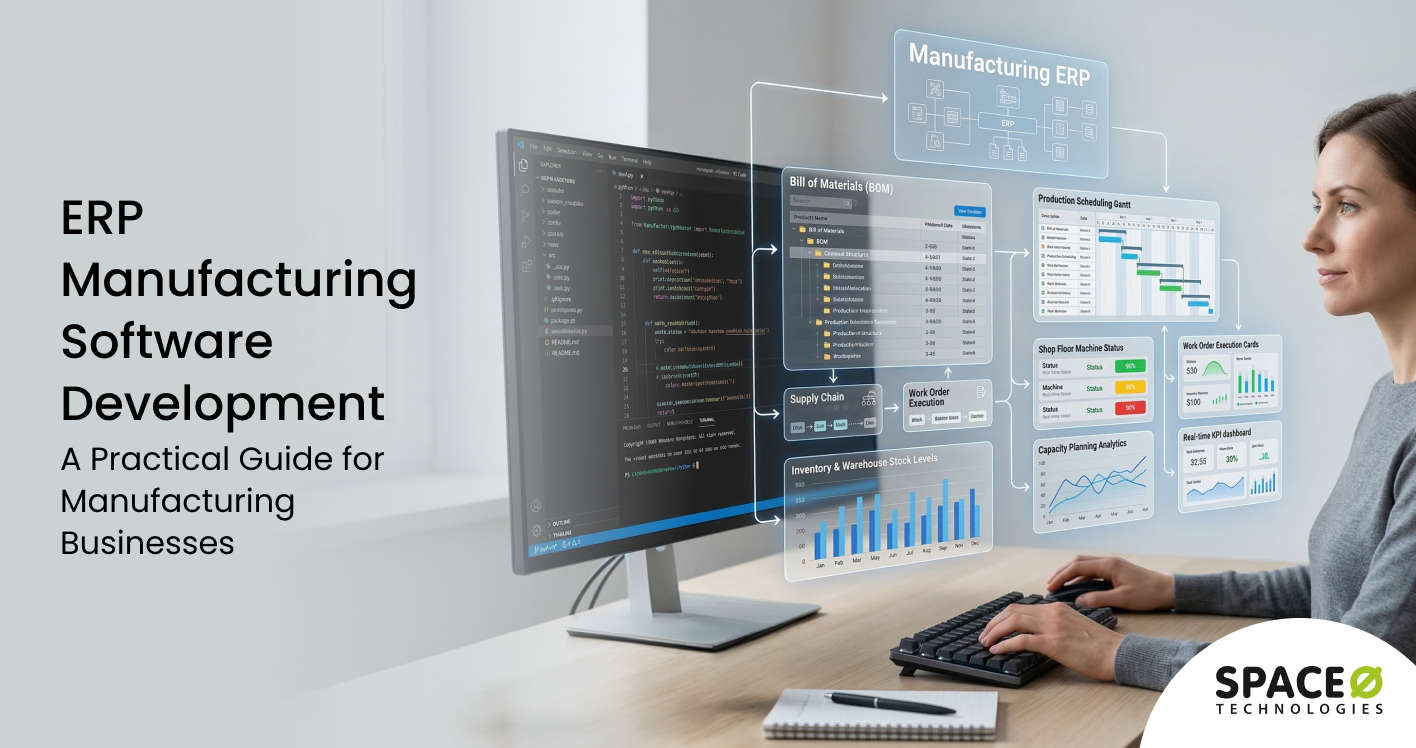
Contents
Manufacturing is one of the most operationally demanding industries, and staying competitive requires more than just efficient production lines. It demands connected systems, real-time data, and streamlined workflows across every department.
Yet many manufacturers still operate with disconnected legacy systems, manual data entry, and limited real-time visibility across production lines. These inefficiencies lead to costly delays, inventory inaccuracies, missed delivery deadlines, and shrinking profit margins. According to Statista, the global ERP software market is projected to reach $58.63 billion in revenue by 2026, growing at a CAGR of 3.50% through 2030.
Manufacturing is a key driver of this growth, as more manufacturers invest in ERP to eliminate these exact operational gaps. A well-planned ERP manufacturing software development strategy addresses each of these pain points by connecting every department, workflow, and data source into one unified platform.
This guide covers everything you need to know. With our experience as a leading ERP software development agency, we have shared information on the business benefits, essential features, development process, cost considerations, and implementation challenges for building a manufacturing ERP software.
What Is Manufacturing ERP Software?
Manufacturing ERP software is an Enterprise Resource Planning (ERP) system designed specifically for manufacturing operations. Unlike generic ERP platforms that serve multiple industries, a manufacturing ERP focuses on production-specific workflows such as shop floor control, material requirements planning, quality management, and production scheduling.
A manufacturing ERP system connects core business functions into a single platform. This includes production planning, inventory management, procurement, supply chain operations, financial accounting, and human resources. The result is a centralized system where data flows between departments in real time.
What makes manufacturing ERP development unique is the depth of industry-specific functionality it requires. A retail ERP might prioritize point-of-sale integration and customer loyalty programs. A manufacturing ERP, however, needs to handle bill of materials (BOM) management, work order execution, production sequencing, and capacity planning.
How manufacturing ERP works in practice
Consider a discrete manufacturer producing automotive parts. Their ERP system needs to track raw materials from receiving through work-in-progress to finished goods. It must schedule production runs based on customer demand, monitor machine performance on the shop floor, flag quality defects in real time, and calculate accurate job costs for each production order.
This level of integration eliminates data silos that plague many manufacturers still relying on spreadsheets or disconnected software. When the inventory module communicates directly with production planning and procurement, the entire operation becomes more responsive and efficient.
Building on this foundation, let’s explore why investing in ERP software is critical for modern manufacturing businesses.
Key Benefits of ERP Manufacturing Software Development
ERP manufacturing software development delivers measurable advantages across every department in a manufacturing organization. Here are the key benefits.
1. Real-time production visibility
Manufacturing ERP software provides live dashboards showing production status, machine utilization, and order progress. Managers make faster, data-driven decisions instead of relying on manual reports.
2. Reduced operational costs
By automating manual processes and eliminating redundant data entry, manufacturers reduce labor costs and minimize errors. Streamlined workflows lower overhead across procurement, production, and distribution.
3. Improved inventory accuracy
Real-time inventory tracking across raw materials, work-in-progress, and finished goods prevents overstocking and stockouts. Accurate inventory data reduces carrying costs and improves cash flow management.
4. Better production scheduling
Advanced scheduling tools optimize production sequences based on machine availability, material supply, and customer deadlines. This increases throughput while reducing lead times and idle machine hours.
5. Enhanced quality control
Built-in quality management modules track defects, manage inspections, and enforce quality standards at every production stage. Statistical process control and traceability features support continuous improvement initiatives.
6. Stronger supply chain coordination
Manufacturing ERP connects procurement, vendor management, and logistics into a single workflow. Automated purchase orders, delivery tracking, and supplier performance monitoring strengthen the entire supply chain.
7. Accurate cost tracking
Job costing and process costing modules provide precise calculations for labor, materials, and overhead. Manufacturers gain clear visibility into product profitability and cost variances.
8. Faster compliance reporting
Automated audit trails, lot tracking, and regulatory documentation features simplify compliance with industry standards such as ISO, Six Sigma, and industry-specific regulations.
9. Scalable architecture
Custom ERP systems built with modular architecture scale as the business grows. New production lines, warehouses, or business units can be added without replacing the entire system. Selecting the best framework for ERP development ensures your system can handle this growth from the foundation up.
10. Data-driven forecasting
Historical production data combined with demand forecasting algorithms helps manufacturers predict material needs, plan capacity, and align inventory with projected demand more accurately.
These benefits become tangible when the ERP system includes the right set of features. Let’s look at the core features that a manufacturing ERP should include.
Build a Custom Manufacturing ERP System That Drives Real Production Efficiency
Space-O Technologies has delivered 300+ software solutions for businesses worldwide. Get a free consultation and detailed project estimate for your manufacturing ERP.

Key Features of Manufacturing ERP Software
A well-built manufacturing ERP system includes modules that address every aspect of production operations. The specific features depend on the manufacturing type and business requirements, but the following are essential for most implementations.
1. Production planning and scheduling
Production planning is the backbone of any manufacturing ERP. This module handles master production scheduling, capacity planning, material requirements planning (MRP), and work order management. It ensures the right materials, machines, and labor are available to meet production targets.
Key capabilities include production sequencing, route optimization, demand forecasting, and shop floor scheduling. These tools help manufacturers balance workloads, reduce bottlenecks, and maintain on-time delivery rates.
2. Inventory and warehouse management
This module tracks inventory across multiple locations, managing raw materials, work-in-progress, and finished goods in real time. Features include lot tracking, serial tracking, FIFO management, automatic reorder points, and barcode or RFID integration.
Effective inventory management prevents production delays caused by material shortages while minimizing the carrying costs of excess stock.
3. Shop floor control
Shop floor control modules provide real-time visibility into work order execution, production status, machine performance, and labor tracking. Production teams can monitor job progress, track scrap and rework, record downtime, and measure Overall Equipment Effectiveness (OEE).
4. Quality management
Quality modules support inspection workflows, defect tracking, statistical process control, and calibration management. These features help manufacturers maintain compliance with ISO standards and industry-specific regulations while driving continuous improvement through Six Sigma and lean manufacturing practices.
5. Supply chain and procurement
Procurement modules automate purchase order creation, vendor management, supplier evaluation, and delivery tracking. When integrated with inventory and production planning, procurement responds automatically to material requirements, reducing lead times and preventing supply disruptions.
6. Financial management and cost accounting
Financial modules handle general ledger, accounts payable, accounts receivable, and reporting. Manufacturing-specific features include job costing, standard costing, actual costing, overhead allocation, and cost variance analysis. These provide accurate product profitability insights.
7. Maintenance management
Preventive and predictive maintenance modules schedule equipment servicing, track spare parts inventory, and monitor equipment health. Proactive maintenance reduces unplanned downtime and extends asset lifespan.
Understanding these features is essential, but knowing how they apply in practice brings even more clarity. Let’s explore common use cases.
Major Use Cases of Manufacturing ERP Software
Manufacturing ERP software serves different production models, each with unique requirements. Here are the most common use cases where a custom ERP system delivers the greatest value.
1. Discrete manufacturing
Discrete manufacturers produce distinct items such as machinery, electronics, or furniture. Their ERP needs focus on bill of materials management, work order tracking, assembly routing, and component traceability. Each finished product can be traced back to specific materials and production steps.
2. Process manufacturing
Process manufacturers produce goods through chemical, biological, or physical processes. Industries like food processing, pharmaceuticals, and chemicals require batch management, recipe or formula management, yield tracking, and regulatory compliance. Process manufacturing ERP also handles unit conversions and shelf-life tracking.
3. Mixed-mode manufacturing
Some manufacturers combine discrete and process methods. For example, a company might mix chemical compounds (process) and then assemble them into packaged products (discrete). A flexible ERP system supports both modes within a single platform.
4. Make-to-order (MTO) manufacturing
MTO manufacturers produce goods only after receiving customer orders. Their ERP system must handle order-specific BOM configurations, custom pricing, extended lead time management, and dynamic scheduling. Strong integration between customer order portals and production workflows is essential for this model.
5. Make-to-stock (MTS) manufacturing
MTS manufacturers produce goods based on demand forecasts and store them as finished inventory. Demand forecasting, inventory optimization, and warehouse management features are critical. The ERP system must balance production output with projected sales to minimize overstock and stockouts.
6. Engineer-to-order (ETO) manufacturing
ETO manufacturers design and build custom products for each order. Their ERP must support project-based costing, engineering change management, document control, and extended design-to-delivery workflows. This is common in construction equipment, specialized machinery, and industrial systems.
Each use case requires a tailored approach to custom ERP software development. With these applications in mind, let’s walk through the step-by-step development process.
Manufacturing ERP Software Development Process: A Step-by-Step Breakdown
Building a manufacturing ERP system follows a structured development process. Each phase requires careful planning and execution to deliver a system that meets production requirements. Here is a proven software development process adapted for manufacturing ERP.
Step 1: Discovery and requirements analysis
This phase involves understanding the manufacturer’s current workflows, pain points, and business objectives through stakeholder engagement. The development team conducts structured interviews with operations managers, floor supervisors, finance leaders, and IT directors to document functional requirements, integration needs, and compliance obligations.
Action items
- Map existing production workflows and identify inefficiencies across all departments
- Document integration requirements with existing accounting, CRM, and supply chain systems
- Define user roles, permissions, and department-specific access levels for the ERP
- Establish compliance and regulatory requirements specific to the manufacturing vertical
Step 2: System architecture and technology selection
Based on the documented requirements, solution architects design the system architecture covering module structure, data flow, and deployment strategy. This includes selecting the technology stack, defining the database design, planning API architecture for integrations, and establishing scalability patterns to support future business growth.
Action items
- Choose between cloud-native, on-premise, or hybrid deployment models based on operational needs
- Select backend frameworks, frontend technologies, and database systems for performance and scalability
- Design API architecture for third-party integrations, IoT device connectivity, and data exchange
- Plan horizontal and vertical scaling to accommodate additional production sites and growing data volumes
Step 3: UI/UX design
UX/UI designers create role-specific interfaces tailored to manufacturing environments where usability directly impacts adoption rates. Shop floor terminals require simplified, touch-friendly dashboards for quick data entry, while management interfaces need comprehensive analytics views with drill-down capabilities for production analysis.
Action items
- Design role-specific dashboards for operators, supervisors, warehouse staff, and executives
- Create mobile-responsive interfaces for warehouse teams and shop floor personnel on the go
- Build intuitive navigation structures that reduce training time and accelerate user onboarding
- Develop wireframes and interactive prototypes for stakeholder review and approval before development
Step 4: Module development
Development follows Agile sprints, with each sprint delivering functional module increments for stakeholder testing and feedback. Core modules like production planning, inventory management, and quality control are prioritized to deliver early business value while more specialized features are built in subsequent development phases.
Action items
- Develop production planning and scheduling modules first to deliver immediate operational improvements
- Build inventory, procurement, and financial management modules in parallel, where dependencies allow
- Implement shop floor control with real-time data collection, job tracking, and OEE measurement features
- Code quality management and compliance features with automated inspection workflows and audit trails
Step 5: Integration and data migration
This phase connects the new ERP with existing business systems and migrates historical data from legacy platforms. Integration and migration are among the most technically challenging aspects of ERP development, requiring careful data mapping, validation procedures, and parallel testing to ensure data integrity and system reliability.
Action items
- Integrate with existing accounting, HR, and CRM platforms using standardized REST APIs and middleware
- Connect IoT devices, sensors, and shop floor equipment for real-time production data collection
- Migrate historical data from legacy systems with automated validation scripts and integrity checks
- Test all integration points for data accuracy, synchronization timing, and failover handling reliability
Partnering with an ERP implementation services provider often becomes crucial during this phase. A structured implementation approach reduces the risk of data loss, downtime, and workflow disruptions that can halt production.
Step 6: Testing and quality assurance
Comprehensive testing validates that every module, workflow, and integration point performs correctly under real-world manufacturing conditions. The testing phase covers functional accuracy, system performance under peak transaction loads, security vulnerabilities, and end-user acceptance to confirm the ERP system is production-ready.
Action items
- Run functional tests for every module, workflow, user role, and permission configuration
- Perform load testing that simulates two to three times normal transaction volumes during peak periods
- Conduct security audits to protect sensitive production data, financial records, and proprietary processes
- Execute user acceptance testing (UAT) with actual manufacturing staff in a realistic staging environment
Step 7: Deployment and training
The ERP system moves from staging to production with a carefully planned rollout strategy that minimizes disruption to ongoing operations. A phased deployment approach, starting with core production modules before adding supporting functions, reduces risk and gives each team time to adapt.
Action items
- Deploy using a phased approach, starting with core production planning and inventory modules first
- Train department-specific teams on their modules with hands-on sessions and real production scenarios
- Provide user documentation, video tutorials, and quick-reference guides for every role and workflow
- Establish a dedicated support channel for immediate post-launch issue resolution and troubleshooting
Step 8: Ongoing support and optimization
Post-deployment, the ERP requires ongoing monitoring, maintenance, and iterative improvement to remain aligned with evolving business needs. Regular performance reviews, user feedback sessions, and technology updates ensure the system continues delivering value and adapts to changing manufacturing requirements.
Action items
- Monitor system performance metrics and resolve issues through a dedicated support team and SLA
- Release periodic updates for new features, security patches, performance optimizations, and bug fixes
- Gather user feedback through structured reviews to identify areas for improvement and usability gains
- Plan a long-term product roadmap for adding AI analytics, advanced automation, and predictive features
This development process demands significant expertise and resources. For many manufacturers, ERP development outsourcing offers access to experienced development teams without the cost and complexity of building an in-house team.
With the process clear, let’s address the common challenges manufacturers face during ERP development and how to overcome them.
Need Expert Guidance for Your Manufacturing ERP Development Project?
Our team of 140+ developers specializes in building enterprise-grade ERP solutions. Schedule a free consultation to discuss your specific manufacturing ERP requirements today.
Challenges in Manufacturing ERP Development and How to Overcome Them
Manufacturing ERP development projects face specific challenges that can impact timelines, budgets, and adoption rates. Many ERP implementations fail to meet their original objectives due to poor planning, scope creep, and inadequate change management. Understanding these challenges early helps you plan accordingly.
1. Complex customization requirements
Manufacturing processes vary significantly between industries and even between companies in the same sector. Off-the-shelf modules rarely fit without extensive customization, and over-customization increases development time and cost.
Solution
- Define core requirements versus nice-to-have features during the discovery phase
- Use a modular architecture that allows custom components without affecting core system modules
- Prioritize features by business impact and implement them in manageable development phases
- Work with an ERP customization services provider experienced in manufacturing workflows
2. Data migration from legacy systems
Migrating data from multiple disconnected legacy systems is one of the most technically demanding aspects of ERP implementation. Inconsistent data formats, duplicate records, and incomplete historical data create significant risks.
Solution
- Conduct a thorough data audit across all source systems before migration begins
- Clean and standardize data formats, remove duplicates, and fill gaps in historical records
- Run the legacy system and new ERP in parallel during the transition period to validate accuracy
- Build automated validation scripts to catch data errors and inconsistencies before go-live
3. Resistance to change among staff
Floor workers and supervisors accustomed to existing processes often resist new systems. Without proper change management, even well-built ERP systems fail to achieve the adoption rates needed for ROI.
Solution
- Involve key users from each department in the requirements gathering and design phases early
- Provide role-specific training sessions rather than generic, one-size-fits-all system overviews
- Designate department champions who can support their teams and answer questions during transition
- Communicate the benefits clearly to every team, focusing on how the system simplifies daily tasks
4. Budget constraints and cost overruns
Mid-market manufacturers with limited budgets struggle to balance ERP investment with ongoing production needs. Scope creep and unplanned customizations are the primary drivers of cost overruns in ERP projects.
Solution
- Establish a fixed project scope with a detailed, signed-off requirements document before development
- Implement in phases, starting with the highest-impact modules that deliver the quickest returns
- Allocate a 15%–20% contingency budget for unexpected requirements that surface during development
- Track costs against milestones continuously and address overruns as soon as they are identified
5. Performance bottlenecks during peak production
ERP systems must handle peak transaction volumes without degradation. Production scheduling, inventory updates, and reporting queries running simultaneously can strain system resources and slow operations.
Solution
- Conduct load testing that simulates two to three times normal transaction volumes before deployment
- Optimize database queries, indexing strategies, and caching for high-frequency manufacturing operations
- Design the system architecture for horizontal scaling so it handles growth without performance loss
- Monitor system performance continuously post-launch and address bottlenecks proactively with tuning
6. Integration complexity
Manufacturing ERP must integrate with CRM systems, IoT sensors, accounting platforms, supplier portals, and e-commerce systems. Each integration point introduces potential failure and synchronization challenges. Partnering with an ERP integration agency can help manage this complexity across all connected systems.
Solution
- Map all integration requirements and data flow dependencies during the discovery phase thoroughly
- Use standardized REST APIs and middleware platforms for reliable third-party connections and data sync
- Build error handling, retry mechanisms, and logging for all integration points to ensure reliability
- Test integrations under real-world conditions with production-level data volumes before going live
Understanding these challenges and their solutions helps set realistic expectations. The next consideration for most manufacturers is cost. Let’s break down what ERP manufacturing software development typically involves financially.
How Much Does Manufacturing ERP Software Development Cost?
The cost of ERP manufacturing software development varies based on project scope, complexity, and the development approach you choose. Here is a breakdown of typical cost ranges for different project sizes.
Cost by complexity
The following table provides estimated cost ranges based on project complexity and module scope.
| Project Complexity | Modules Included | Development Timeline | Estimated Cost Range |
|---|---|---|---|
| Basic ERP | Inventory, production planning, basic reporting | 4–6 months | $50,000–$100,000 |
| Mid-Range ERP | Core modules + quality, maintenance, supply chain | 6–10 months | $100,000–$250,000 |
| Enterprise ERP | Full-suite with AI, IoT, multi-site, advanced analytics | 10–18 months | $250,000–$500,000+ |
Basic ERP is suited for small manufacturers or single-facility operations that need foundational modules to replace spreadsheets and disconnected tools. It covers core production planning, inventory tracking, and standard financial reporting without advanced automation or integrations.
Mid-Range ERP serves growing manufacturers that require deeper operational control. This tier adds quality management, preventive maintenance scheduling, and supply chain coordination alongside the core modules. It supports multi-department workflows and basic third-party integrations.
Enterprise ERP is designed for large-scale or multi-site manufacturers with complex production environments. This tier includes AI-driven analytics, IoT connectivity for real-time machine monitoring, advanced forecasting, and full integration across all business functions. It supports global operations with multi-currency, multi-language, and cross-site production planning capabilities.
These ranges depend on several key factors that every manufacturer should evaluate during the planning stage.
Factors affecting development cost
- Number of modules: Each additional module, such as quality management, maintenance, or advanced analytics, adds to development time and cost. Core modules like production planning and inventory form the foundation, while specialized modules increase the total investment based on complexity.
- Integration requirements: Connecting the ERP with existing systems, IoT devices, and third-party platforms requires additional development effort. Complex integrations with legacy systems or proprietary hardware cost more than standard API connections.
- Customization depth: Highly customized workflows, industry-specific calculations, and unique reporting requirements increase development hours. Balancing customization with standard functionality helps manage costs effectively.
- Deployment model: Cloud-based ERP systems typically have lower upfront costs but include recurring hosting fees. On-premise deployments require higher initial investment in infrastructure but offer long-term cost predictability and full data control.
- Team location and engagement model: Development rates vary by region. Onshore teams in the US or Europe charge $100–$200+ per hour, while offshore teams in South Asia or Eastern Europe range from $25–$75 per hour. The engagement model (fixed-price, time-and-materials, or dedicated team) also impacts total project costs.
For a detailed breakdown of factors affecting your specific project, check this ERP software development cost guide to understand the costs better. Manufacturers looking to optimize costs without compromising quality often hire dedicated developers through flexible engagement models that scale with project needs.
With cost in mind, the next decision many manufacturers face is whether to build a custom solution or use an off-the-shelf platform. Let’s compare both approaches.
Get a Free Manufacturing ERP Development Cost Breakdown
Share your manufacturing ERP software requirements with our team and get a tailored, no-obligation cost breakdown.
Custom vs. Off-the-Shelf Manufacturing ERP Solutions
Choosing between custom and off-the-shelf ERP solutions is a critical decision that affects long-term operations, costs, and flexibility. Each approach has clear advantages and limitations that manufacturers should evaluate against their specific needs.
The following table compares both approaches across key decision criteria for manufacturing businesses.
| Criteria | Custom ERP | Off-the-Shelf ERP |
|---|---|---|
| Initial Cost | Higher ($50,000–$500,000+) | Lower ($10,000–$50,000/year licensing) |
| Customization | Fully tailored to your workflows | Limited to vendor’s configuration options |
| Scalability | Scales with your exact growth path | Depends on vendor’s roadmap and tier pricing |
| Implementation Time | 4–18 months | 2–6 months |
| Ongoing Costs | Maintenance and hosting | License renewals, per-user fees, add-ons |
| Ownership | Full ownership of code and data | Vendor controls the platform |
| Integration Flexibility | Built for your specific tech stack | Limited to vendor-supported integrations |
| Competitive Advantage | Unique features aligned to your operations | Same features available to competitors |
When to choose custom ERP development
Custom ERP is the right choice when your manufacturing processes are highly specialized and off-the-shelf solutions cannot accommodate your workflows without excessive workarounds. Manufacturers with unique production methods, complex multi-site operations, or strict compliance requirements benefit most from custom development.
Custom development also makes sense when you need full control over your technology stack, data ownership, and long-term scalability. Working with an enterprise software development partner gives you a system built to your exact specifications.
Manufacturers who want to scale their development capacity can hire ERP developers through flexible engagement models that match their project timeline and budget.
When to consider off-the-shelf ERP
Off-the-shelf solutions like SAP, Oracle NetSuite, or Odoo work well for manufacturers with standard production workflows and limited customization needs. They offer faster deployment, lower initial costs, and vendor-managed updates.
However, as operations grow and requirements become more specialized, many manufacturers outgrow off-the-shelf platforms. License costs escalate with user count and module additions, and vendor lock-in limits flexibility over time.
The decision often comes down to long-term ROI. While custom ERP requires a higher upfront investment, it eliminates recurring license fees and provides a system that fits your operations precisely.
Looking beyond today’s requirements, manufacturing ERP is evolving. Let’s explore the trends shaping the future of this space.
Top Trends in Manufacturing ERP Software Development
The manufacturing ERP landscape is changing as new technologies reshape what these systems can do. Here are the trends driving ERP manufacturing software development in 2025 and beyond.
1. AI-powered manufacturing intelligence
AI adoption in manufacturing ERP is accelerating rapidly. In manufacturing, AI enables predictive demand forecasting, automated quality inspection, intelligent production scheduling, and anomaly detection on the shop floor. Manufacturers implementing AI-enabled ERP consistently report improvements in forecasting accuracy, waste reduction, and resource optimization.
2. Cloud-native ERP architecture
Cloud-native ERP is becoming the preferred deployment model for new implementations. Cloud deployment offers lower upfront costs, automatic updates, remote accessibility, and easier scalability. Manufacturers with distributed operations benefit from a cloud-native architecture that supports multi-site management without on-premise infrastructure at every location.
3. IoT and smart factory integration
IoT sensors on production equipment feed real-time data directly into the ERP system. This enables automated machine monitoring, predictive maintenance triggers, environmental condition tracking, and real-time OEE measurement. The convergence of IoT and ERP creates the foundation for smart factory operations.
4. Composable ERP architecture
Composable ERP is replacing monolithic systems. This approach uses modular, interchangeable components that can be assembled and reconfigured as business needs change. Manufacturers gain the flexibility to add or replace specific modules without disrupting the entire system.
5. Predictive analytics and digital twins
Advanced analytics modules use historical production data to predict equipment failures, forecast material needs, and optimize production schedules. Digital twin technology creates virtual replicas of manufacturing processes, allowing manufacturers to simulate changes before implementing them on the shop floor.
6. Low-code and no-code customization
ERP platforms increasingly offer low-code tools that allow manufacturers to configure workflows, create reports, and build custom dashboards without extensive programming. This reduces dependency on development teams for routine changes and gives operations teams more control over their system.
These trends are shaping how manufacturers plan and build their ERP systems. Staying ahead of these developments ensures your ERP investment remains competitive for years to come.
Build Your Manufacturing ERP with Space-O Technologies
ERP manufacturing software development transforms production operations through unified data management, automated workflows, and real-time visibility across departments. This guide covered essential features, development steps, cost factors, and emerging trends to help you plan your manufacturing ERP project with confidence.
Space-O Technologies is a trusted enterprise software development company with 14+ years of experience delivering 300+ custom software solutions for global businesses. We serve 1,200+ clients worldwide with reliable, high-quality software built on proven Agile development practices and transparent methodology.
Our team of 140+ in-house developers brings deep expertise in ERP system architecture, module development, integration engineering, and production workflow automation for manufacturers. We follow a structured development process that ensures your manufacturing ERP meets performance, scalability, and compliance requirements.
Ready to discuss your manufacturing ERP project? Contact us for a free consultation where our team will analyze your requirements, recommend the right approach, and provide a detailed project estimate today. Let’s build an ERP system that drives real results.
Frequently Asked Questions on Manufacturing ERP System Development
How long does it take to develop a manufacturing ERP system?
Development timelines range from 4 to 18 months, depending on project complexity. A basic ERP with core modules like production planning and inventory takes 4–6 months. A full-suite enterprise ERP with AI, IoT integration, and multi-site support can take 10–18 months. The average ERP project timeline in 2025 decreased to 9 months due to high SaaS adoption.
Should I build a custom manufacturing ERP or buy an off-the-shelf solution?
Choose a custom ERP if your manufacturing processes require specialized workflows, deep integrations with existing systems, or full data ownership and control. Off-the-shelf solutions work for standard operations with limited customization needs. Consider long-term costs carefully, as off-the-shelf license fees accumulate over time while custom ERP offers predictable maintenance costs.
What modules are essential for a manufacturing ERP system?
Core modules include production planning and scheduling, inventory management, shop floor control, quality management, procurement, financial management, and reporting. Additional modules like maintenance management, supply chain optimization, and advanced analytics add further value based on your specific manufacturing model and operational requirements.
How does AI improve manufacturing ERP systems?
AI enhances manufacturing ERP through predictive demand forecasting, automated quality inspection, intelligent production scheduling, and anomaly detection. In 2025, 83% of ERP projects include AI capabilities. AI-enabled ERP helps manufacturers reduce waste, improve forecasting accuracy by up to 20%, and optimize resource allocation across production operations.
Can a manufacturing ERP integrate with IoT sensors and shop floor equipment?
Yes, modern manufacturing ERP systems integrate with IoT sensors and shop floor equipment through APIs and middleware platforms. This enables real-time machine monitoring, automated production tracking, predictive maintenance alerts, and OEE measurement. IoT integration transforms manufacturing ERP from a data management tool into an active production intelligence and control system.



 All our projects are secured by NDA




 4.8
4.8