
 By
By 
Wondering how to build software from scratch for your business? You’re exploring one of the most strategic decisions that can give you a competitive edge in today’s digital economy. Building software from scratch means developing a custom application tailored to your unique business requirements, starting with a clean slate rather than adapting pre-built solutions.
According to Precedence Research, the global custom software development market is valued at USD 53.02 billion in 2025. It is expected to reach USD 334.49 billion by 2034, reflecting the surging demand for tailored digital solutions.
When you build custom software for business operations, you gain complete control over functionality, design, user experience, and scalability, advantages that off-the-shelf products simply cannot provide. Companies like Netflix, Amazon, and Spotify chose to build custom software that addresses their specific operational challenges, gaining a competitive advantage in the process.
Based on our experience as a leading custom software development company, we have created this guide explaining how to develop a custom software solution. Whether you are exploring custom software development for small businesses or enterprise-level platforms, learn how to define requirements, design architecture, select the right technology stack, manage development teams, and deploy your solution successfully while gaining a realistic understanding of the costs and timelines for your project.
Table of Contents
- What is Custom Software Development?
- When Should You Build Custom Software Instead of Buying?
- Key Benefits of Building Custom Software From Scratch
- Step-by-Step Guide to Create Custom Software
- Common Mistakes to Avoid When You Build Custom Software
- How Much Does It Cost to Build Software from Scratch?
- How to Choose the Right Custom Software Development Partner
- 5 Best Custom Software Development Methodologies
- Why Choose Space-O Technologies to Build Custom Software Solutions?
- FAQs
- Want to Build Your Own Custom Software Solution?
What is Custom Software Development?
Custom software development means the designing of software applications to address the challenges faced by users within an enterprise business. Custom software development services address the users’ needs better than off-the-shelf software or readymade software.
For example, Microsoft Office or Adobe Photoshop, which are specifically designed to address the challenges of the diverse needs of software users. With these off-the-shelf tools, you cannot customize software features or update the functionalities according to your needs.
On the other hand, understanding how to create custom software starts with a detailed plan. The solution is built by a software development team or in-house software developers. The custom software development process includes:
- Designing
- Developing
- Deploying
- Maintaining Software
A custom software solution is developed keeping the company’s management, branding, implementation needs, and business processes in mind. Look at McDonald’s, it uses POV technology to serve millions of customers with their customized orders.
Before you finalize the software development plan, let’s discuss the scenarios of building software instead of buying.
When Should You Build Custom Software Instead of Buying?
Not every business needs custom software. Off-the-shelf tools work well when your requirements are standard, and your workflows align with what the market already offers. However, there are clear signs that indicate it is time to build custom software tailored to your operations.
When your workflows don’t fit the tools you use
Teams often adjust their daily processes to fit the limitations of generic software. This leads to workarounds, extra manual steps, and wasted time. If your employees spend more time navigating the tool than completing actual tasks, it is a strong signal. Custom software eliminates these friction points by mapping directly to how your business operates. You get features that support your exact process instead of forcing your team to adapt.
When your tools cannot connect or scale
Many businesses rely on multiple disconnected tools that fail to share data properly. Manual data transfers between systems increase errors and slow decision-making. As your business grows, these disconnected tools struggle to handle increased users, transactions, or data volume. When you build custom software, you create a unified system where every module communicates seamlessly. This removes data silos and gives your team a single source of truth.
When security and compliance requirements increase
Off-the-shelf software offers standard security that may not meet your industry-specific compliance needs. Businesses handling sensitive customer data, financial records, or healthcare information need stronger access controls, encryption protocols, and audit trails. Custom software gives you full control over security architecture. You can implement role-based access, data encryption, and compliance features tailored to regulations like HIPAA, GDPR, or PCI DSS without depending on a third-party vendor’s update schedule.
When licensing costs exceed the value you receive
Subscription fees for commercial software add up quickly, especially as your team scales. You often pay for features you never use while missing the ones you actually need. Over a 3 to 5 year period, cumulative licensing costs can exceed the investment required to create custom software. With a custom solution, you own the product outright and avoid recurring fees that grow with every new user or module.
Custom software becomes a strategic advantage when off-the-shelf solutions no longer support your growth, workflows, or long-term vision. Once you understand when building custom software makes sense, it’s important to evaluate the tangible benefits that come with developing a solution tailored specifically to your business needs.
Key Benefits of Building Custom Software From Scratch
Investing in custom software delivers long-term advantages that off-the-shelf solutions simply cannot match. Here are the core benefits that make custom development a strategic business decision.
1. Complete ownership with no recurring license fees
When you build custom software, you own the entire codebase. There are no monthly subscription costs that increase as your team grows. You control the update timeline, feature additions, and system modifications without waiting for a vendor. This ownership turns your software into a long-term business asset rather than an ongoing expense.
2. Higher operational efficiency and productivity
Custom software is designed around your actual workflows, not generic processes. Your team completes tasks faster because the system supports their natural work patterns. Automated processes replace repetitive manual work, reducing human error and freeing employees to focus on higher-value activities. Businesses that create custom software often see measurable productivity gains within the first few months of deployment.
3. Stronger security and regulatory compliance
With custom software, you define the security architecture from the ground up. You control user access levels, data encryption methods, and audit logging based on your specific compliance requirements. Unlike shared platforms, where a single vulnerability can expose thousands of businesses, your custom system has a unique codebase that is significantly harder to breach.
4. Seamless integration with existing systems
Custom software connects with your current tools, databases, and third-party APIs without the compatibility issues common with off-the-shelf products. Whether you need to integrate with your CRM, ERP, payment gateway, or legacy systems, the development team builds these connections directly into the architecture. This eliminates data silos and creates a unified technology ecosystem.
Now that you understand the core benefits of building custom software from scratch, the next step is to see how the development process actually unfolds. A clear, structured approach ensures your investment translates into a scalable, high-performing solution aligned with your business goals.
Step-by-Step Guide to Create Custom Software
Whether you are an entrepreneur or looking for custom software for small business operations, follow these 5 points and get a clear answer to how to develop custom software. So, let’s dive deeper and understand each step in a very simple manner.
Identify Your Business Challenges
How to develop software? When you plan to build custom software, the first step is to identify core business challenges. We all know that every business has its own unique work process and business needs. One specific software can never fulfill the requirements of each business.
Therefore, you need a custom or tailor-made solution to solve your entire business-related challenges, such as:
- Managing a large number of employees
- Increasing work efficiency
- Boosting business revenue
So, when you start to develop custom software for startups or small businesses, identify your business challenges first that you are concerned about the most. Discuss your challenges and requirements thoroughly with your management team, business leaders, and employees.
After this discovery phase about your challenges, it is time for you to analyze the requirements that can help you minimize the difficulties.
Analyze Your Requirements
Once you have a list of all your challenges, focus on the features and functionalities that you want to integrate into the software solution. The ability to customize software according to your workflow ensures you only add features that streamline your business process in the long run.
So, analyze what you actually need and what can be helpful for you to streamline the business. Let’s take an example to understand this step in a better way. Suppose you run an on-demand business and are facing challenges to manage customers’ data or probably looking to generate new leads.
In fact, according to a study, it is found that without CRM, 79% of marketing leads never convert into sales. We are sure that you wouldn’t let this happen to your business. And just like you, no other entrepreneur would be ready to lose their marketing leads.
Therefore, we have also shared some of the advanced and common features that you can consider for your custom software application. Here are the key features:
- Customer relationship management (CRM)
- Accounting and financing
- Task scheduler system
- Security
- Integration with existing systems
- Migration from off-the-shelf software to new software
- Work automation
Once you decide on all the features and functionalities, the next step to create custom software is designing the architecture.
Assemble Your Development Team
When you build custom software from scratch, it requires assembling a skilled team with diverse expertise across multiple disciplines. Your team composition directly impacts development quality, timeline, and ultimate project success.
Essential Team Roles
A complete software development team includes:
- Project Manager: Oversees timelines, resources, and stakeholder communication
- Business Analyst: Translates business requirements into technical specifications
- Software Architect: Designs system structure and technology decisions
- Frontend Developers: Build user-facing interfaces and experiences
- Backend Developers: Create server-side logic, databases, and APIs
- UX/UI Designers: Design intuitive, visually appealing interfaces
- QA Engineers: Ensure quality through comprehensive testing
- DevOps Engineers: Handle deployment, infrastructure, and automation
Team Sourcing Options
Approach Best For Advantages Considerations In-House Team Long-term projects with ongoing development needs Full control, direct communication, deep product knowledge Higher costs, longer hiring process, limited skill diversity Outsourcing Time-sensitive projects or specialized expertise needs Access to experienced teams, faster start, and cost-effective Requires clear communication, time zone differences, and less direct control Hybrid Model Complex projects need both control and specialized skills Flexibility, balanced costs, and a combination of in-house oversight with external expertise Requires coordination between teams, clear role definitions Consider your project complexity, available budget, required timeline, and whether you need ongoing development or a one-time build when deciding on your team structure. Many successful projects use hybrid approaches, maintaining in-house product owners and project managers while outsourcing specialized development work.
Design Software Architecture
Once your development team is in place, the first technical step is designing your software architecture. Whether you plan to develop new software product capabilities or scale an existing platform, this is one of the critical process steps that determines how your application’s components interact, scale, and evolve. Proper architecture design prevents expensive rewrites and technical debt down the line.
Key Architecture Components
System Modules: Your architects break your software into logical, independent components: user authentication, data processing, business logic, and integrations. Each module should have clear responsibilities and well-defined interfaces.
Architecture Patterns: Your team will choose the right approach for your needs:
- Monolithic Architecture: Best for smaller applications with straightforward workflows and faster initial development
- Microservices Architecture: Ideal for complex, large-scale systems requiring independent scaling and team autonomy
- Serverless Architecture: Perfect for applications with variable usage patterns and cost optimization needs
When developing software, your architect addresses database structure and relationships, data flow and security measures, API design for integrations, scalability planning for user growth, and cloud infrastructure decisions. Planning these elements during the architecture phase ensures your system handles current requirements while accommodating future expansion without major overhauls.
Create UX/UI Design and Prototypes
With your architecture planned, your design team transforms technical specifications into intuitive, visually appealing interfaces that users actually want to use. This phase is crucial when you make your own software because user experience (UX) and user interface (UI) design directly impact adoption rates and user satisfaction.
The Design Process
UX Research: Your UX designers conduct stakeholder interviews, analyze user needs, study competitor solutions, and create detailed user personas representing your target audience.
Wireframing: Designers develop low-fidelity sketches showing screen layouts, navigation patterns, and content hierarchy without visual styling. Wireframes enable quick validation and iteration.
UI Design: Your UI designers transform approved wireframes into high-fidelity mockups featuring your brand colors, typography, custom icons, and polished visual elements.
Interactive Prototyping: The team builds clickable prototypes that simulate actual software functionality, allowing stakeholders to test workflows before development begins.
Good design reduces training time, minimizes user errors, and increases productivity. Understanding how to make your own software successful means investing in design early, identifying usability issues during the design phase costs significantly less than fixing problems after development.
Select Development Tools and Technology Stack
Your development team now selects the technology stack; the combination of programming languages, frameworks, databases, and development tools that will power your software. Choosing the best frameworks for software development at this stage directly impacts how fast you build, how well your software scales, and how easy it is to maintain long-term. This decision fundamentally affects your software’s performance, scalability, maintenance costs, and long-term viability when you build your own software.
Core Technology Components
Frontend Technologies: Your team chooses between React, Angular, or Vue.js for web applications, or React Native/Flutter for cross-platform mobile development.
Backend Technologies: Developers select from Node.js (JavaScript), Python (Django/FastAPI), Java (Spring Boot), or .NET based on your requirements.
Databases: The team opts for PostgreSQL or MySQL for relational data, MongoDB for flexible document storage, or Redis for high-speed caching.
Development Tools: Essential tools include Visual Studio Code or IntelliJ IDEA (IDEs), Git and GitHub (version control), Jira or Trello (project management), Selenium or Jest (testing), Jenkins or GitHub Actions (CI/CD automation).
When you’re figuring out how to create a software application that meets your business needs, technology selection becomes crucial. Your team must consider existing expertise, security and compliance requirements, scalability needs, development speed priorities, and long-term maintenance implications.
The right technology stack balances innovation with reliability. When you develop new software product features over time, this foundation ensures your software remains supportable and can evolve as your business grows.
Software Development and Testing
Now you have decided on the bespoke software development company as per your preference, you can start the software development process by signing an NDA non-disclosure agreement. To keep your proprietary information and idea safe, signing an NDA is essential.
Also, know that this step is the longest one where you will need to invest your time to build custom software solution. Being an owner of the business, you will need to ensure that everything is in line and that the custom software development for enterprise processes is going smoothly.
For this, you can regularly contact the project managers or get in touch with the dedicated development team. Also, know that when all the components such as system requirements, the architecture, and the wireframe are in line, the plan execution would be a lot easier and faster.
Once your customized software application is ready, the software development team will carry out the testing phase. This phase will also involve various types of functional and non-functional testing. This is either achieved manually or automatically.
Functional Testing Non-functional Testing - Unit testing
- Component testing
- Smoke testing
- Sanity testing
- Regression testing
- Integration testing
- API testing
- UI testing
- Availability testing
- Performance testing
- Compatibility testing
- Localization testing
- Volume testing
- Scalability testing
- Usability testing
- Reliability testing
Apart from this list, it is essential to test the software for:
- The core application functions
- Text input
- Installation on localized machines
- Security of the software
In case any bug or error is detected, it will be fixed and re-tested. The whole testing process will continue until the quality of your software matches the original requirements. The software development team will ensure that everything is smooth and the customized application software is offering you the same results that were expected.
After successful testing, your software will be ready to get launched.
Software Deployment and Maintenance
This time, you and your users will start getting familiar with the new custom software. You all will start using the system and exploring its features. Therefore, you need to note that the development company will support the software application post-release as well.
You can choose to install the software in your existing system. Later, under the guidance of the development company, end-users will be trained for using the software. Gradually, your team will learn to operate the software, and the integration of software with existing systems can be implemented.
In case your software needs maintenance or up-gradation, you can contact the development company. However, you need to talk to the software development company beforehand about whether they will offer the maintenance services or not. This will streamline the whole software development process and avoid you paying maintenance costs.
Now that you understand the complete development process, the next critical question is budget planning. Whether you’re pursuing custom software development for a small business or enterprise-level solutions, understanding cost structures helps you make informed investment decisions.
Want to Validate Your Custom Software Idea?
Want to discuss this with our technical experts? Want to get a free consultation?

Common Mistakes to Avoid When You Build Custom Software
Even well-funded projects fail when teams overlook critical planning and execution steps. Understanding these common mistakes helps you avoid costly setbacks and deliver a successful product.
Skipping the discovery phase
The discovery phase is where your team defines business objectives, gathers functional and non-functional requirements, and creates a software requirements specification (SRS). Skipping this step forces developers to make assumptions that lead to feature creep and scope creep later. A structured discovery phase typically takes 2 to 4 weeks and produces a clear project roadmap, feasibility analysis, and stakeholder alignment. This small upfront investment prevents expensive rework during development.
Setting unrealistic deadlines
Rushing the development timeline forces teams to cut corners on architecture, testing, and documentation. This creates technical debt that compounds over time and leads to unstable software that requires constant fixes after launch. Instead of setting arbitrary deadlines, work with your development partner to establish realistic milestones based on the actual technical scope. A well-planned timeline with iterative sprints delivers working features consistently without sacrificing quality.
Underestimating quality assurance
Testing is not a one-time activity at the end of development. Effective QA runs in parallel with every sprint and includes unit testing, integration testing, regression testing, and user acceptance testing (UAT). When teams treat QA as an afterthought, bugs slip into production and damage user trust. A dedicated QA process with automated and manual testing catches issues early when they are cheaper and easier to fix.
Ignoring post-launch maintenance and iteration
Software is never truly “finished.” After deployment, your system needs ongoing monitoring, bug fixes, security patches, and feature updates. Many businesses focus entirely on the launch and fail to budget for continuous maintenance. Without a CI/CD pipeline for smooth updates and a dedicated support plan, even well-built software degrades over time. Discuss maintenance terms with your development partner before the project begins to ensure long-term system stability.
Avoiding common development mistakes can save significant time, budget, and operational setbacks. Once you understand what not to do, the next logical step is evaluating the actual cost involved in building software from scratch and planning your investment realistically.
How Much Does It Cost to Build Software from Scratch?
One of the first questions businesses ask when considering custom development is about budget. The cost to build custom software varies widely depending on your project’s scope, but understanding the investment breakdown helps you plan effectively and avoid surprises.
Building a software application from the ground up typically ranges from $20,000 for simple MVPs to $500,000+ for complex enterprise systems. Let’s break down what influences these costs and what you should expect at each level.
Cost Breakdown by Project Complexity
The complexity of your project is the primary cost driver. Simple applications with basic features cost significantly less than enterprise platforms with advanced capabilities:
| Project Type | Cost Range | Timeline | Key Features |
|---|---|---|---|
| Simple MVP | $20,000–$50,000 | 2–4 months | Basic features, 1–2 user roles, simple integrations |
| Medium Complexity | $50,000–$150,000 | 4–8 months | Multiple roles, third-party integrations, analytics |
| Complex Software | $150,000–$300,000 | 8–12 months | Real-time features, advanced security, mobile + web |
| Enterprise-Level | $300,000–$500,000+ | 12–18+ months | AI/ML, compliance requirements, multi-tenant architecture |
What Drives Your Development Costs?
Beyond complexity, several specific factors significantly impact your final budget. Understanding how to build your own software cost-effectively means knowing where money goes:
| Factor | Impact on Cost | Example |
|---|---|---|
| Feature Complexity | +15–30% per advanced feature | Real-time chat, AI integration, video calling |
| User Roles | +20% per additional role | Admin, user, manager, support staff |
| Platform Coverage | +40–60% for multi-platform | iOS + Android vs. web only |
| Design Customization | $5K–$80K range | Template-based vs. custom animations |
| Compliance Requirements | +25–35% | HIPAA, GDPR, PCI DSS, SOC 2 |
| Third-Party Integrations | 40–200 hours each | Payment gateways, ERP/CRM systems |
Each additional user role, platform, or integration compounds costs. A marketplace with buyer, seller, and admin roles costs more than a single-user application.
Smart Budget Optimization Tips
While costs can add up quickly, these strategic approaches help you build quality software without overspending:
- Start with MVP: When you create custom software, launch with core features first, reducing initial costs by 30-50%. Add enhancements after validating with real users.
- Prioritize features: Focus on the 20% of features delivering 80% of business value first.
- Plan integrations early: Budget adequately upfront to avoid cost overruns from underestimated integration complexity.
Understanding these factors helps you plan realistic budgets. Custom software development for small businesses and enterprises alike requires smart planning to deliver business value without breaking the bank.
How to Choose the Right Custom Software Development Partner
The development partner you choose directly impacts the quality, timeline, and long-term success of your project. A wrong choice leads to missed deadlines, budget overruns, and software that fails to meet your business needs. Here is what to evaluate before making your decision.
Evaluate technical expertise and industry experience
Review the company’s portfolio and case studies to confirm they have built software similar to what you need. Look for experience in your specific industry, whether it is healthcare, fintech, logistics, or e-commerce. A partner with domain knowledge understands your compliance requirements, user expectations, and operational challenges without needing extensive onboarding. Ask for references from past clients and verify the outcomes they delivered.
Assess the communication and project management approach
Transparent communication prevents most project failures. Ask how the team manages progress updates, sprint reviews, and stakeholder feedback. Look for partners who use established project management tools like Jira or Trello and communication platforms like Slack or Microsoft Teams. Regular sprint demos and documented progress reports ensure you always know where your investment is going and can course-correct early if needed.
Confirm post-launch support and maintenance terms
Software requires ongoing updates, bug fixes, and security patches after deployment. Before signing a contract, clarify whether the development partner offers post-launch maintenance services and what those terms include. A reliable partner provides dedicated support for monitoring system performance, releasing updates through a CI/CD pipeline, and adapting the software as your business evolves. Without a clear maintenance agreement, you risk launching software that degrades over time.
Prepare your project before the first meeting
Come prepared with clear business goals, a prioritized list of must-have versus nice-to-have features, a realistic budget range, and identified key stakeholders who will participate in the discovery and feedback phases. This preparation accelerates the scoping process and helps your development partner deliver accurate estimates. The more clarity you bring to the first conversation, the smoother the entire development journey becomes.
Choosing the right development partner is only part of the equation—how they execute your project matters just as much. Understanding the most effective software development methodologies helps ensure your project is delivered efficiently, transparently, and aligned with your business goals.
5 Best Custom Software Development Methodologies
What is custom software development methodology?
The methodology is a sequence that is used in a custom software development project. In other words, it is a kind of framework where plan, design, and control the development process. Development methodologies include standard processes like:
- Design
- Development
- Implementation
Choosing the right methodology is always essential when you build custom software from the ground up. While there are several standard processes like design, development, and implementation, it is important to understand the differences between software development vs app development methodologies.
The style of development and the system you choose has an impact on the success of the project. However, it largely depends on the team size, organization, and product goals. A properly defined methodology offers you with:
- Better estimates
- Delivering stable systems
- Keeping the customer informed
- Creating a clear understanding of the task ahead
- Identifying pitfalls earlier
- Allowing for ample time to make adjustments
The primary and competitive advantage of choosing the right methodology is to have a smooth and effective software development process. However, each methodology comes with a unique set of features, advantages, and disadvantages.
We have discussed 5 essential methodologies below.
- Waterfall Methodology
- Agile Methodology
- Spiral Model Methodology
- Scrum Development Methodology
- Big Bang Methodology
After reading and knowing about custom software development, you will easily be able to choose the perfect methodology for your project.
Waterfall Methodology
The waterfall model is known as a linear sequential life cycle model, and it is also considered a software development life cycle approach. The waterfall model is one of the oldest and most popular methodologies that you can use for your project.
As its name defines, the waterfall method follows a sequential flow and doesn’t overlap the custom software development progress. We have also explained the same through the following image.
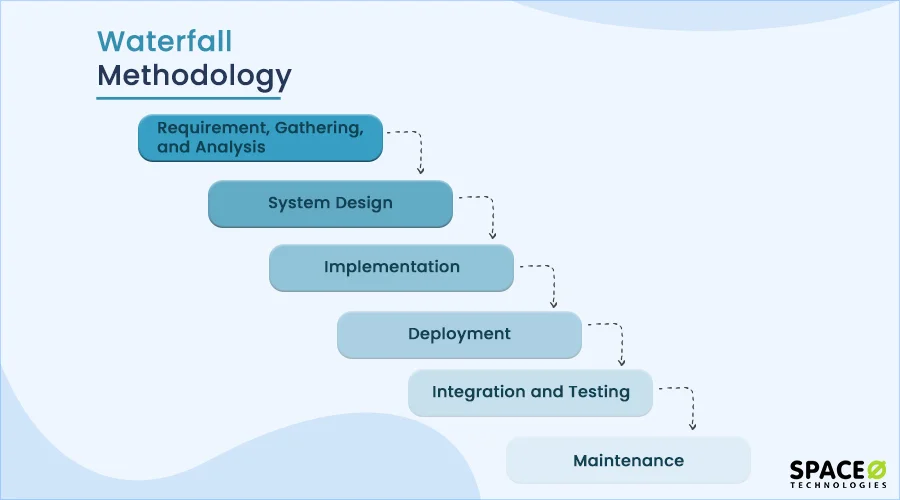
The sequential flow ensures that it is easy to follow and has a functional flow. You can save money and time because everything is well-planned and structured. The waterfall methodology works flawlessly like a waterfall and has a defined set of phases, such as:
- Requirement specification
- Software designing
- Integration to existing software or creating a new process
- QA/Testing
- Deployment
- Maintenance
Departments like defense, military, and aircraft follow the waterfall model because of the strict standards and natural flow. The waterfall model is compatible with their acquisition process and makes it easy to follow the process required by the government.
Conditions When Waterfall Methodology is Suitable
- The requirements are known, clear, and fixed
- No confusion with the end goals
- The project is short
- The risk is minimum or zero
Advantages and Disadvantages of Waterfall Methodology
| Pros | Cons |
|---|---|
|
|
Agile Methodology
Agile is an advanced version of the waterfall as it is developed in response to the challenges of the waterfall. Agile is more flexible as compared to waterfall. It starts with the simple design of projects, where you can assign each module a completion target.
After the successful completion of each module, you can evaluate the work process and give your feedback. Later, all the bugs are fixed and code quality is monitored.
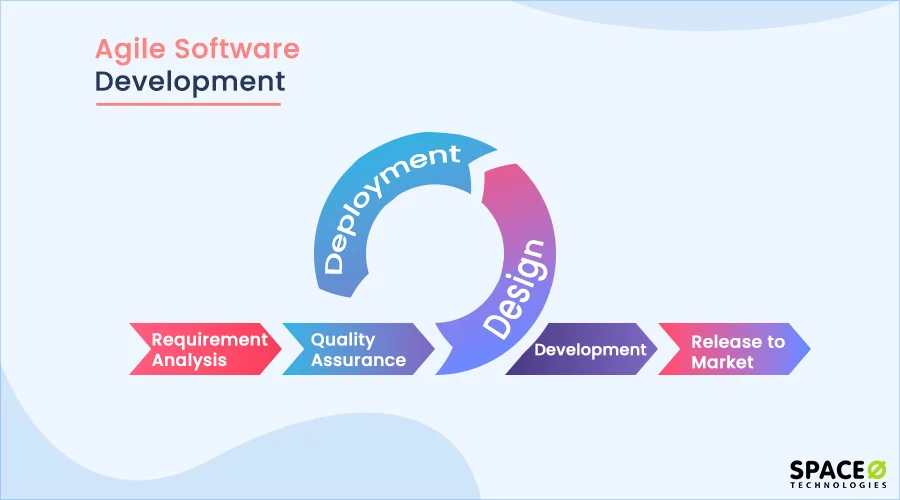
The best part of using agile is that software developers are allowed to make continuous changes according to their project requirements. This way, the developer can always look back to the previous phase and rectify the error.
The agile method offers a bifurcation system that uses a successive iterative approach. This means, all the phases can be bifurcated into smaller parts, such as testing, validation, integration, and deployment.
Many well-known organizations are currently using an agile method for their custom software to deliver results in a fast, experimental, and iterative manner, such as Apple, IBM, Microsoft, and Procter & Gamble.
Conditions When Agile Methodology is Suitable
- Want regular changes in your software
- Have limited planning to get started with the project
- Want to produce more features in a shorter period of time
Advantages and Disadvantages of Agile Methodology
| Pros | Cons |
|---|---|
|
|
Spiral Model Methodology
Just as the name suggests, the spiral model starts with the smaller section of the software development and moves towards the larger sections. To carry out the systemic flow, many app development companies use the spiral model methodology.
The prime reason for using the spiral model is that it identifies and eliminates risks at an initial stage itself. Everything is systemized in this model, so it becomes really easy to streamline the development process.
Conditions When Spiral Model Methodology is Suitable
- Want to build large, expensive, and complicated projects
- To reduce and manage the risk of the project
- When the budget is limited, and risk evaluation is important
- Flexibility to change the flow of the process whenever required
Advantages and Disadvantages of Spiral Model Methodology
| Pros | Cons |
|---|---|
|
|
Scrum Development Methodology
Scrum methodology divides your project into different smaller groups, and each phase is carried out with a unique strategy. To custom build software faster and to see rapid transformations, scrum is highly recommended as it allows a series of iterations in a single go.
Scrum has three sequential phases:
- Planning
- Meeting
- Conclusion
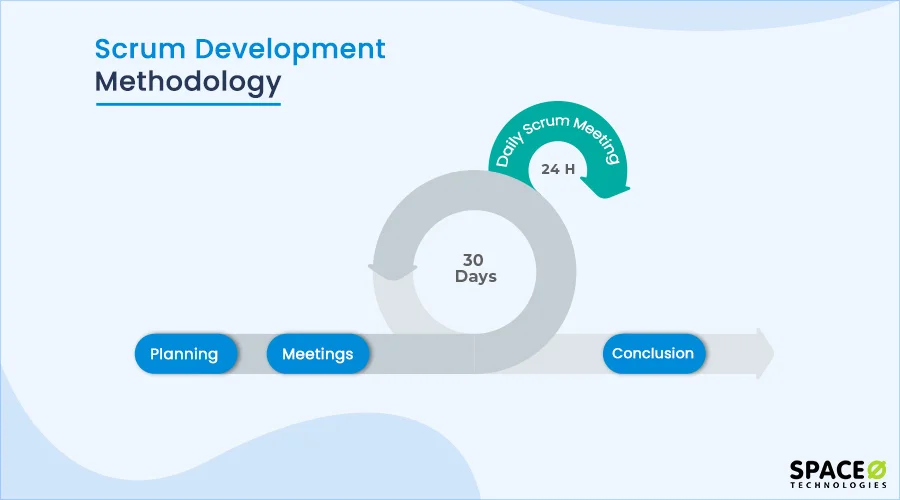
With scrum, you start the project with short planning, and then a detailed analysis of the project is carried out. Later, the development process is implemented. For scrum, you need a team of cross-functional engineers, who have experience in analyzing requirements, designing, coding, testing, and installation.
According to the 12th Annual State of Agile report, 70% of enterprise businesses use the scrum method. This includes industries like financial services, product development, construction, and consulting firms.
Conditions When Scrum Development Methodology is Suitable
- Project requirements are well-understood at the beginning
- Requirements frequently change according to your needs
- To achieve quick turnaround (2 – 4 week) for high-priority
Advantages and Disadvantages of Scrum Development Methodology
| Pros | Cons |
|---|---|
|
|
Big Bang Methodology
The big bang methodology is the best method for entrepreneurs who aren’t aware of the requirements and do not have a proper vision for the outcomes. Therefore, it is best recommended for small and simple projects. It is not complicated or has rigid formal protocols.
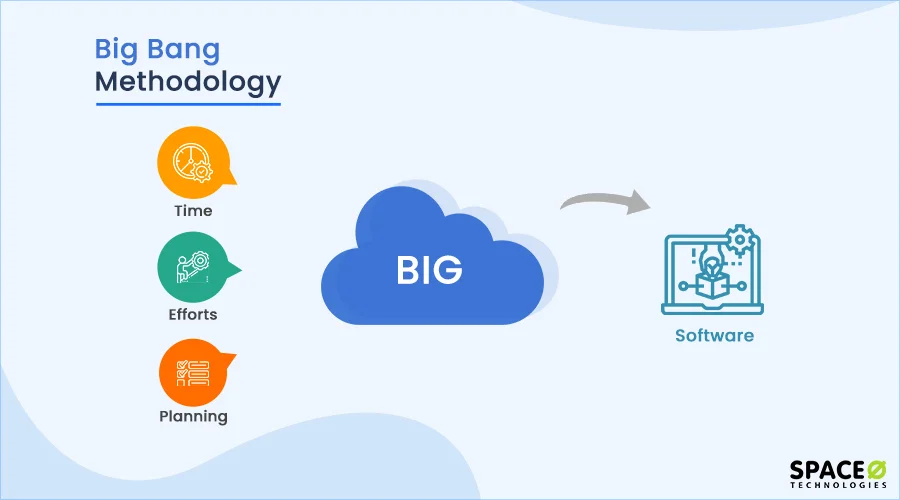
It will not require pre-hand planning for your project. You can manage it easily as the resources required are very minimal. However, it can be a risky model if you are planning to use it for complex or big projects.
Conditions When Big Bang Methodology is Suitable
- Ideal for small projects with one or two developers
- Requirements are not clear, and there is no deadline
- When you don’t have any planning to go ahead with the process
- If you are changing your requirements too quickly
Advantages and Disadvantages of Big Bang Methodology
| Pros | Cons |
|---|---|
|
|
After discussing the important methodologies, we will check for the reasons why a custom solution is essential for your business.
Want to Estimate the Cost of Your Custom Software?
Get an instant project cost estimate with our easy-to-use calculator. Discover how much it’ll take to build a tailored software solution for your business.
Why Choose Space-O Technologies to Build Custom Software Solutions?
Space-O Technologies brings over 15 years of experience in delivering custom software solutions across industries like healthcare, logistics, fintech, and e-commerce. Our team of 100+ developers, designers, and QA engineers has completed 4,500+ projects for startups, mid-sized businesses, and enterprises worldwide. Every solution we build starts with a deep understanding of your business goals, user expectations, and technical requirements, so the final product fits your operations, not the other way around.
What sets us apart is how we work with you throughout the process. You get a dedicated project manager, real-time progress tracking, and regular sprint demos so you always know where your project stands. We follow agile development practices that keep timelines predictable and give you flexibility to refine features as you go.
Beyond launch, we provide ongoing support and maintenance to keep your software secure and aligned with your evolving needs. If you are working with outdated systems, our application modernization services can help you upgrade legacy software without disrupting your workflows. Book a free consultation today to discuss your project and get a detailed development roadmap tailored to your goals.
Frequently Asked Questions About Building Custom Software
What is the first step to building custom software for my business?
The first step is identifying the core problem your software needs to solve. Document workflow challenges, inefficiencies, and feature gaps with input from stakeholders and end-users. This discovery process helps define clear goals and a prioritized feature list that guides the entire development process.
How do I choose between building custom software and buying off-the-shelf tools?
Choose off-the-shelf software when it meets around 80% of your requirements and you need a quick deployment. Choose custom software when you need unique features, full control over data and security, or when long-term licensing costs outweigh development investment.
What is the discovery phase in custom software development?
The discovery phase is a 2 to 4 week planning stage where business goals, requirements, and technical feasibility are analyzed. The outcome is a detailed software requirements specification (SRS) covering scope, timeline, technology, and cost estimates.
What are the biggest risks of building software from scratch?
Common risks include scope creep, technical debt, budget overruns, and unstable launches due to poor testing. These can be minimized with clear requirements, agile development practices, and continuous quality assurance throughout the project.
Can I build custom software on a limited budget?
Yes. Start with an MVP that focuses only on core features needed to solve your primary business problem. This approach reduces upfront investment and allows you to expand based on real user feedback over time.
How do I prepare before approaching a software development company?
Prepare clear business goals, a prioritized feature list, a realistic budget range, and identify key stakeholders for collaboration. This preparation ensures accurate estimates and smoother communication from the beginning.
What is the difference between agile and waterfall methodology?
Waterfall follows a sequential process where each phase is completed before moving to the next, making it suitable for fixed-scope projects. Agile delivers software in short iterations with continuous feedback, allowing flexibility and faster adaptation to changes.
What happens after my custom software is launched?
After launch, your software requires ongoing maintenance, updates, and performance optimization. Planning post-launch support in advance ensures your system remains secure, stable, and aligned with evolving business needs.



 All our projects are secured by NDA




 4.8
4.8