
 By
Contents
- A dedicated AI team pairs ML, data, and MLOps engineers who work only on your project.
- Hire in six steps: scope, data check, model choice, vetting, paid pilot, contract.
- Verify production experience with seven acceptance criteria before you sign anything.
- Space-O Technologies matches vetted AI engineers within 48 to 72 hours.
Key Takeaways
A dedicated AI development team is a vetted group working only on your project. It pairs machine learning (ML) engineers, data engineers, and MLOps specialists. Most companies source one through an AI development agency or a talent network.
Hire well with a clear use case, a fitting model, and proof of production work. Skipped steps usually return later as rework and wasted budget. This guide covers roles, steps, engagement models, costs, and a production-readiness checklist.
Space-O Technologies has built AI-powered custom software since 2010. Our AI development services cover chatbots, agents, machine learning, and computer vision. You can also hire AI developers individually or as a full team.
Core Roles in a Dedicated AI Team
Every dedicated AI team is built around ML, data, and MLOps engineers, plus generative AI specialists for chatbots and copilots.
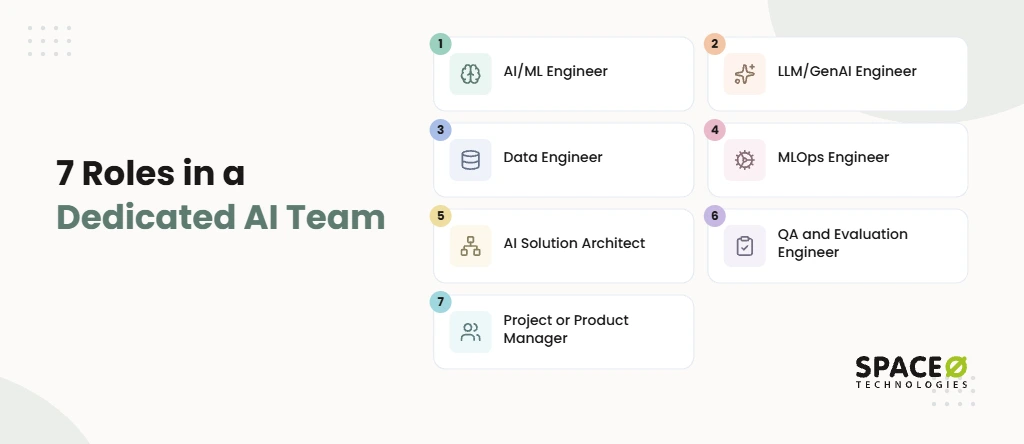
One AI developer rarely covers models, data, and deployment alone. An AI software development team splits that work across clear roles:
- AI/ML Engineer: Trains, fine-tunes, and deploys models that predict, classify, or generate outputs (PyTorch, TensorFlow). Start with machine learning consulting if your use case is unclear.
- LLM/GenAI Engineer: Builds large language model (LLM) features and retrieval-augmented generation (RAG) pipelines for generative AI development projects. Typical tools include LangChain and vector databases such as Pinecone or Qdrant.
- Data Engineer: Designs the data pipelines that collect, clean, and version your training and retrieval data. These are extract, transform, load (ETL) workflows.
- MLOps Engineer: Runs machine learning operations: continuous integration and delivery (CI/CD), model monitoring, and drift detection (AWS, Azure, GCP).
- AI Solution Architect: Designs the end-to-end system, including model choice, RAG versus fine-tuning, integrations, and security controls.
- QA and Model Evaluation Engineer: Runs quality assurance (QA) against evaluation sets for accuracy, hallucinations, and bias before every release.
- Project or Product Manager: Owns scope, sprint priorities, and daily updates, so your stakeholders see progress and risks early.
Key Steps to Hire a Dedicated AI Development Team
Hire in six steps: scope the use case, check your data, pick an engagement model, vet, pilot, then contract.
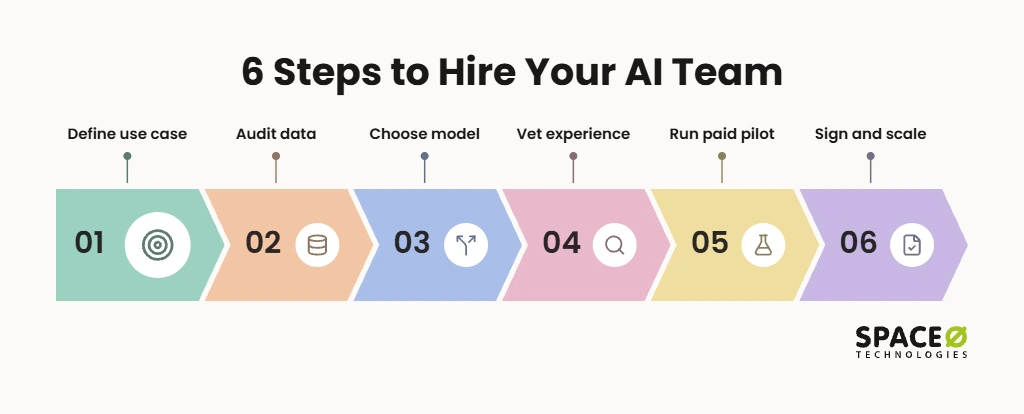
Skipped steps tend to come back later as rework, so run them in order.
- Define the use case. Name the outcome first: an LLM chatbot, an AI agent, a predictive ML model, or computer vision.
- Audit data readiness. Confirm what data you have, where it lives, who can access it, and how clean it is.
- Choose an engagement model. Match the model to how fixed your scope is and who will direct daily work.
- Vet production experience. Ask for models the team has shipped, and set a practical RAG or data task.
- Run a paid pilot. Test a 1-4 person squad for 2-4 weeks before you commit to a full team.
- Sign contracts, then scale. Sign the non-disclosure agreement (NDA), intellectual property (IP) assignment, and statement of work (SOW) before adding engineers.
Production deployment experience matters more than notebook prototypes. A notebook does not prove that a model can survive real traffic and real data.
Engagement Models: Dedicated Team, Staff Augmentation, or Project-Based?
Choose a dedicated team, staff augmentation, or a project-based model based on scope clarity and who directs the work.
The wrong model wastes budget. You either pay for idle capacity or lose control of priorities. Space-O Technologies offers four engagement models. Time and material and fixed cost are both project-based. In-house hiring and freelancers are the common alternatives.
| Model | Best for | Who directs day-to-day | Team size | Commitment | IP ownership | Reporting |
|---|---|---|---|---|---|---|
| Dedicated Team | Long-term AI product builds with an evolving roadmap | You set priorities; our project manager runs delivery | Cross-functional pod sized to scope | Monthly, ongoing | Full code and IP ownership | Dedicated PM + daily updates |
| Staff Augmentation | Filling a specific AI skill gap, such as MLOps or RAG | Your engineering lead | One or more engineers | Flexible, per engineer | Full code and IP ownership | Dedicated PM + daily updates |
| Time and Material | Scope that will change as you learn from users | Shared, reprioritized each sprint | Varies with workload | Billed for actual effort | Full code and IP ownership | Dedicated PM + daily updates |
| Fixed Cost | A clearly scoped MVP or pilot | Space-O Technologies, against an agreed scope | Sized to the fixed scope | Fixed scope, timeline, and budget | Full code and IP ownership | Dedicated PM + daily updates |
| In-house hire | Permanent AI capability you manage directly | Your team | Built one hire at a time | Salaries and benefits; slow to recruit | Owned by you | Internal |
| Freelancers | Short prototypes | You | Individuals | Per task or contract | Set by each contract | Self-reported |
Estimated Costs to Hire a Dedicated AI Development Team
Region and seniority drive cost most, so compare monthly benchmarks before you compare vendor quotes.
Your budget depends on team size, seniority, region, and engagement length. Our AI development cost guide covers full project budgets. The market benchmarks below show the monthly cost of one full-time engineer, calculated at 160 hours.
- North America: about $12,800-$40,000+ per engineer per month.
- Offshore (India, Latin America, Eastern Europe): about $3,200-$12,800 per engineer per month.
- US freelance, junior: about $15,200-$22,720 per month.
- US freelance, mid-level: about $19,040-$29,600 per month.
- US freelance, senior: about $24,800-$37,600+ per month.
Space-O Technologies bills dedicated developers monthly. Full-time is 160 hours a month, and part-time is 80 hours. The minimum commitment is one month. A proof of concept costs $15,000 to $40,000 over 4 to 8 weeks.
Get A Free Estimate For Your AI Team
Tell us your AI use case, budget, and target launch date. We will return a free, expert-reviewed estimate for a team sized to your scope and timeline.

How Quickly Can a Dedicated AI Team Start?
Start time depends on whether a provider already employs vetted engineers or must recruit them.
Every week without a team delays your roadmap. McKinsey’s State of AI survey reports that most organizations already use AI in at least one business function. Ask any provider for these three figures:
- Time from brief to matched profiles: Space-O Technologies matches developers within 48 to 72 hours.
- Time from signed contract to kickoff: Matched developers are onboarded within days.
- Minimum commitment: One month, billed monthly at 160 hours full-time or 80 hours part-time.
Where to Find a Dedicated AI Team
Most companies hire through an AI development agency or a talent network, not by recruiting each engineer.
Recruiting role by role requires in-house ML expertise just to screen candidates. Our guide to AI development company vs freelancer compares the routes. The two main sourcing routes split that burden differently:
- AI development agency: Provides a managed, cross-functional team, with vetting, project management, and replacements handled for you.
- Talent network: Matches pre-vetted individual engineers. Your team manages their priorities, sprints, and code reviews.
Before you shortlist any provider, ask three questions:
- Which AI systems has the team shipped to production, and for which business outcomes?
- Which AI and cloud partner credentials can it show?
- Which security certifications cover the systems that will touch your data?
Why Space-O Technologies for a Dedicated AI Team
Space-O Technologies fits teams taking AI from pilot to production, with software, mobile, web, and AI under one partner.
Startups, SMEs, and enterprises hire us for AI work. We begin with your business goal and choose the most cost-effective technology for it.
- 140+ in-house developers: Your AI engineers work beside our mobile and web teams. You can also hire dedicated developers for backend work.
- 1,200+ clients since 2010: We serve startups, SMEs, and enterprises worldwide.
- 4.8 Clutch rating: Clients rate us 4.8 on Clutch for quality, schedule, cost, and willingness to refer.
- Partner credentials: We are an OpenAI Select Partner and an AWS Partner, with Claude Certified Architects on staff.
- Security and compliance: All work is NDA-protected.
- Responsible AI by default: We do not train on client data. We also mask personally identifiable information (PII), test for hallucinations and bias, and require human review for high-stakes decisions.
Team Composition by AI Use Case
Your use case decides which roles you need first and which can join later.
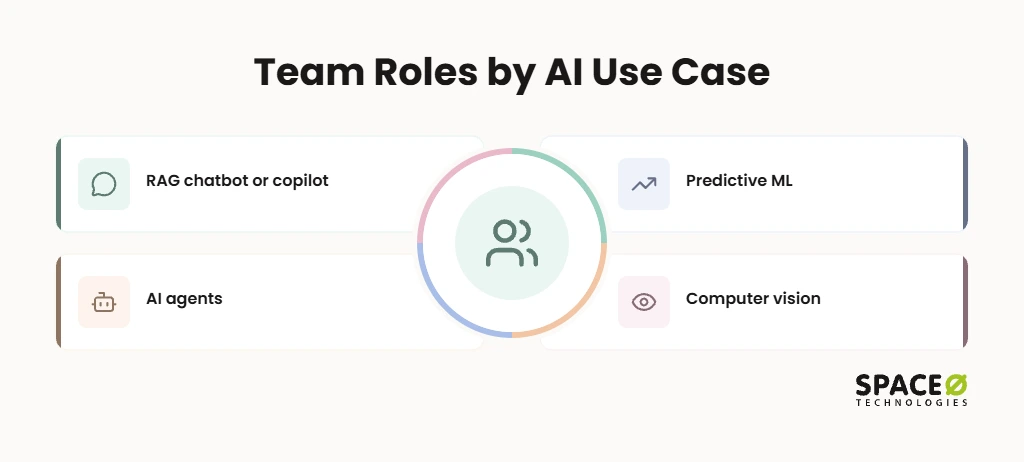
Paying for roles you do not yet need slows a project as much as missing a key skill. Start with these combinations:
- RAG chatbot or copilot: LLM/GenAI engineer, data engineer for document pipelines, and QA engineer for answer accuracy.
- AI agents: AI solution architect, LLM/GenAI engineer, MLOps engineer, and QA engineer to test agent actions.
- Predictive ML: AI/ML engineer, data engineer for historical data, and MLOps engineer for retraining and drift alerts.
- Computer vision: AI/ML engineer, data engineer for labeled image data, and MLOps engineer for deployment and monitoring.
Most teams also add a project or product manager from day one to keep scope and priorities clear.
Production-Readiness Checklist for Your AI Team
Demand seven acceptance criteria from any vendor before you treat its production experience as proven. Each item states what to ask for, then the control Space-O Technologies publishes.
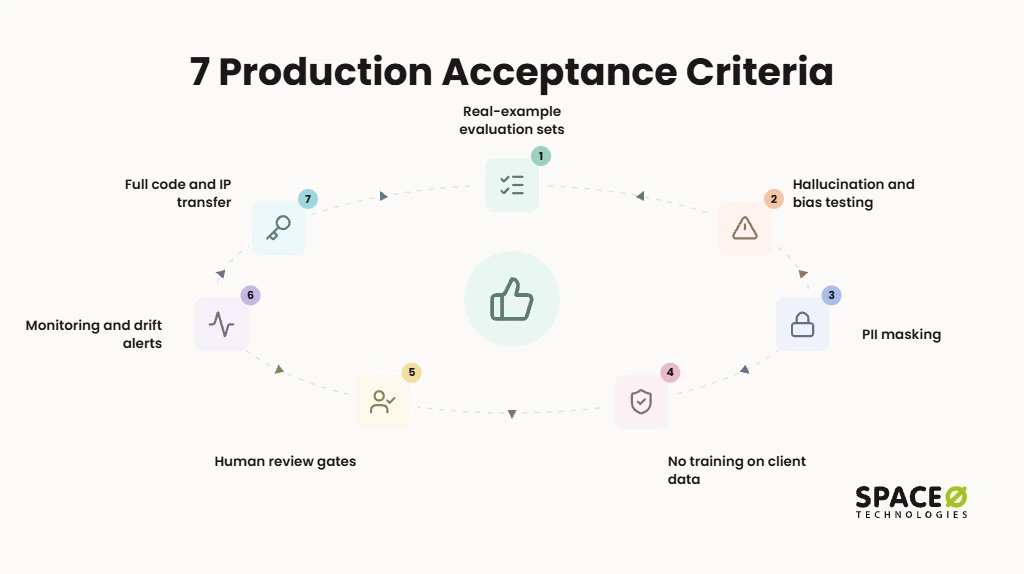
- Evaluation sets built from real examples. Demand a test set drawn from your own data before release. Space-O Technologies runs an evaluation suite on every production model. It covers accuracy, hallucination rate, bias, latency, and cost.
- Hallucination and bias testing before release. Demand a written release gate, not an informal review. Outputs that fail validation are rejected before users see them. New releases are red-teamed before launch.
- PII masking. Demand to know which fields are masked and at which pipeline stage. Space-O Technologies masks PII and sensitive fields before they reach any third-party model.
- No training on client data. Demand this in writing. Space-O Technologies’ model provider contracts prohibit training on client inputs and outputs.
- Human review gates for high-stakes decisions. Demand to see which outputs need human approval and what triggers review. Low-confidence outputs route to a qualified person for review.
- Model monitoring and drift alerts. Demand named metrics and alert thresholds. Space-O Technologies monitors models continuously and re-evaluates them after every meaningful provider upgrade.
- Full code and IP transfer. Demand a handover list that goes beyond source code. All source code, data, and IP transfer to you at project completion. Nothing is retained after handover.
Frequently Asked Questions
Who should hire a dedicated AI team instead of a single AI developer?
Hire a team when your AI work spans models, data, and deployment. One AI developer rarely covers all three areas. A dedicated team splits the work across ML engineers, data engineers, and MLOps engineers. Generative AI specialists join when the product is a chatbot or copilot.
What is the difference between staff augmentation and a dedicated AI development team?
Staff augmentation fills a specific skill gap, while a dedicated team is a cross-functional pod sized to your scope. Augmented engineers cover gaps such as MLOps or RAG. Your engineering lead directs their daily work. In a dedicated team, the vendor’s project manager runs delivery while you set priorities. Staff augmentation is flexible per engineer, while a dedicated team is a monthly, ongoing arrangement.
Can I hire LLM or generative AI developers specifically?
Yes, you can hire LLM and generative AI engineers on their own or inside a team. An LLM/GenAI engineer builds large language model features and retrieval-augmented generation (RAG) pipelines. They typically use LangChain and vector databases such as Pinecone or Qdrant. For chatbots and copilots, add a data engineer for document pipelines. Add a QA engineer to check answer accuracy.
What technologies do dedicated AI engineers typically work with?
Dedicated AI engineers typically work with PyTorch, TensorFlow, LangChain, vector databases, and the major cloud platforms. Model work is typically done in PyTorch or TensorFlow. LLM applications use LangChain with vector databases such as Pinecone or Qdrant. Deployment and operations run on AWS, Azure, or GCP, with CI/CD, monitoring, and drift detection handled by MLOps engineers. Confirm that a vendor’s stack matches yours before you sign.
How much does it cost to hire a dedicated AI development team?
Cost depends on team size, seniority, and region, so compare monthly benchmarks per engineer. Offshore engineers run about $3,200 to $12,800 per month. North American engineers run about $12,800 to $40,000+ per month. Space-O Technologies bills monthly, and a proof of concept costs $15,000 to $40,000 over 4 to 8 weeks.
How fast can a dedicated AI development team start?
Space-O Technologies matches developers within 48 to 72 hours, and onboarding takes days. Start time depends on whether a provider already employs vetted engineers. The minimum commitment is one month, billed at 160 hours full-time or 80 hours part-time.



 All our projects are secured by NDA




 4.8


